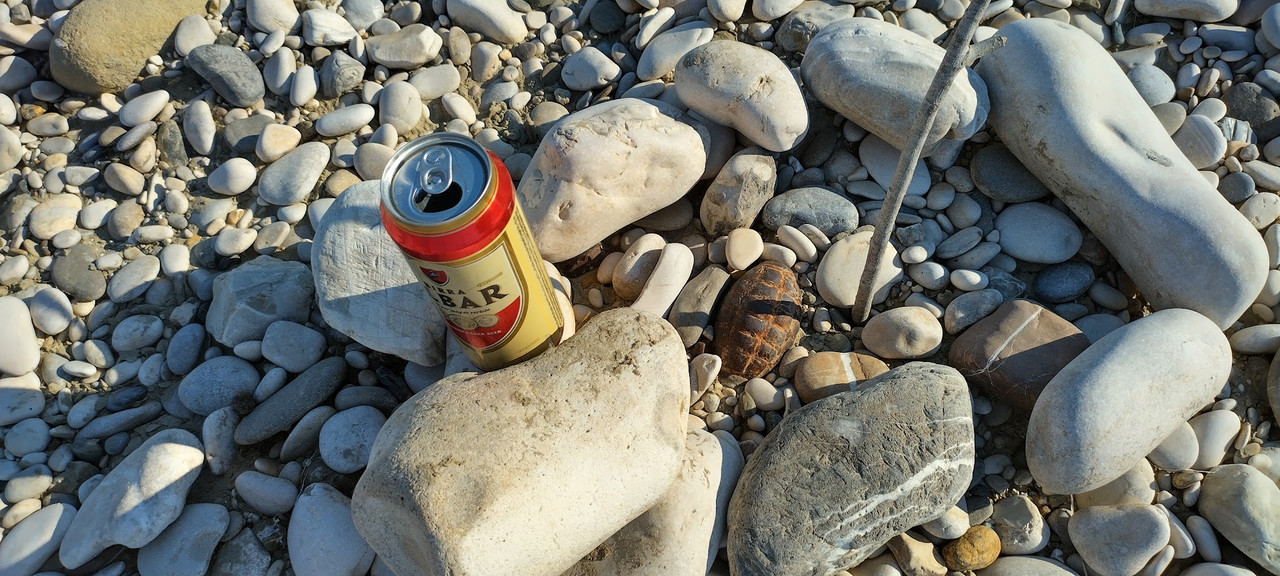
What is interesting is that both Indonesia and Thailand have strong and similar anti blast fishing laws since early 00s that charge 5+ years of prison time.
However, Thailand has been much more successful with taming blast fishing which is practically gone now and the story here is very insightful.
Some of it is due to Thailand's geography and high demand for marine tourism but the biggest push here was EU and US regulation that gave Thailand opportunity to shape up. In 2015 (same year when Thai anti blast laws were codified more strictly) US TIP (trafficking in persons) report down-graded Thailand to tier 3 mostly due to fishing slave workers while at the same time EU's IUU (illegal, unreported and unregulated fishing) issued a yellow card. All of which lead to the biggest fishery reform in Thai history which mostly eliminated blast fishing.
Since then Thailand is back to tier 2 of TIP and got lost the yellow card from EU's IUU. Indonesia never got tier 3 of TIP despite many arguing it should have and never got a card from IUU. Stories like this turn me into a globalization believer - I know it's not perfect but the system is kinda working?
[1] https://www.google.com/maps/place/Livingseas+Coral+Restorati...
I know you mentioned Indonesia never got the yellow card it should have and that certainly creates less incentives for them to straighten their act. But I am trying to understand if the government is still largely to blame or not?
all blast fishing is a failure of governance so I'd say yes but the fishing cultures here in SEA are so different from anywhere else in the world so it's very hard to govern without strong central body. Lots of cultural, religious, poverty and spiritual stuff mixed into all of that which really complicates things.
IMO Thailand has a much stronger centralized government and just better geography to make enforcement easier. It's mostly mainland with coastlines while Indonesia is mostly islands which are notoriously difficult to govern. So to answer your question, it's probably just that incentives in Thailand go much further due to all of these variables.
In Fiji, for example, no fisherman could get dynamite if they wanted it. The only way to get that is if you run a (very heavily regulated) mine, or a quarry, and you'd have to account for every blast.
Situation you describe is not unique for former colonies all around the world, how breakup of former empires was generally handled is the peak of colonial incompetence and worse, and most of Africa and Middle east are a huge mess due to that.
Its one thing when one draws a nice square around Wyoming for example, another when such straight line makes you suddenly part of country led by your rival tribe, with different religion, priorities and often outright hate towards you (and usually long history of violent conflicts to build upon).
This isn't a former colony. West Papua is colonised still, by the country of Indonesia.
It's not a separatist movement, but an independence struggle. Of course there are attacks from both sides. You aren't suggesting that West Papuans should lie down and be ethnically cleansed without fighting back are you?
And the Javanese of Indonesia aren't just a different tribe, they've a completely different race from completely different lands.
What's the difference?
> And the Javanese of Indonesia aren't just a different tribe, they've a completely different race from completely different lands.
Why would that matter? Would it be okay if they were the same race? How do you define race?
An independence struggle is where a people are trying to remove an occupying force, their colonizer.
Very similar, but not quite.
> Why would that matter? Would it be okay if they were the same race? How do you define race?
It matters when the colonizers are racial supremacists who look down on your culture, traditions, and way of life. And as a result of their POV, they confiscate your lands (because they don't accept your unwritten land ownership "titles"), wipe out your men, and replace you with their own people.
> How do you define race?
Head over to reddit where your trolling will be welcomed.
Race is a term with a rather vague meaning, if I remember genetics correctly both groups here belongs to the East Asian branch of Humanity although to distant branch, which made me question what the different races are here, understanding you definition of race would have been helpful to understand why you used it instead of ethnic groups.
No trolling here, your weird definition of an independence struggle was definitely a good reason to ask you to define your terms.
It was both, but yes, more a separatist movement. It was British colonisers separating from their government, not a colonised people overthrowing their colonisers.
Javanese: https://en.wikipedia.org/wiki/List_of_Javanese_people#/media...
Papuans (NSFW): https://en.wikipedia.org/wiki/Indigenous_people_of_New_Guine...
The east of the island became independent (from Australia) in 1975 and is now Papua New Guinea. Meanwhile, the western half was handed over to Indonesian control following the end of Dutch rule, a status formalized through the controversial, UN-backed 1969 "Act of Free Choice" in which a tiny, handpicked group of local leaders voted under military duress to integrate with Indonesia.
Indonesia has been conducting a decades-long genocide of the people of West Papua. It gets little press because it's an ethnic cleansing slow-burn. Slaughter the Papuan people, replace them with Javanese, then bulldoze their forests to grow palm oil.
For more, read the abstract (or the entire paper) here: https://researchers.westernsydney.edu.au/en/publications/for...
There's a timeline of the history of the "conflict" here: https://www.papuapartners.org/west-papua
https://www.abc.net.au/news/2020-12-01/west-papuan-separatis...
Is it not rather down to identity? If the victims had paler skin and a different religion, we'd never stop hearing about it. But unfortunately for Papuans their complexion is too dark for international media to care and the perperators are with "You-Know-Who".
> Otherwise how would people have cheap fish?
https://i.kym-cdn.com/photos/images/original/001/259/257/342...
https://knowyourmeme.com/memes/we-should-improve-society-som...
tempeh can be crazy toxic if spoilt. there is coconut tempeh which is officially banned due to potential for toxic contamination, but which is still super popular -- and routinely kills a couple of people every year.
Bongkrek acid [2] is odorless, tasteless and is not destroyed by cooking. Food can show no signs of spoilage and contain a lethal dose, though fermented products that were contaminated during production might show differences in color, texture and smell if the Burkholderi out-competed the normal fermentation process.
[0]: https://en.wikipedia.org/wiki/Burkholderia_gladioli
[1]: https://youtu.be/yXnSYfv6bCA?si=7DTW4J0ahMoWUuLd
[2]: https://en.wikipedia.org/wiki/Bongkrek_acid
[3]: https://en.wikipedia.org/wiki/Tempeh#Tempe_bongkr%C3%A8k
I was curious if this was an inherently dangerous dish or if locally a lack of effective regulation of industry was to blame. It sounds like it really is unsafe to at least some extent.
That doesn't sound right.
However, I will now refer to explosives exclusively in units of Bald Eagles when referring to their mass, and "star spangles" when referring to their energy output.
UK should not hold us back with their shenanigans.
If you're trying to communicate 'this much rainforest disappeared' or 'look how large this landmass-sized Antarctic iceberg is' to a wide audience a well-known area is a reasonable way to do it. In Britain basically everyone knows roughly what the size of Wales is relative to the other countries of the UK, even if they don't know its exact size.
I don't play football, nor soccer nor rugby nor baseball or similar sports, just like you most probably don't climb on rock. I am not pushing my metric of '2 spans of typical rope length for alpine tightrope 2-people setup ' or similar obscure metric, do I.
advanced question for the college types: how many if you supersize it?
Fishers, I would guess, are aware of fish wanting to be near reefs.
Man kind - If we can, we will.
The best way to stop bomb fishing is to give locals a reason to preserve the habitat, like what you see in places like Tulamben.
I wouldn't be surprised if social media was spreading this technique as successful way to fish.
There was a diving incident maybe 10 years ago where a group of Chinese divers were killed by bomb fishermen in Indonesia.
There are videos of Jacques Cousteau using dynamite to clear reefs of fish.
Visit Bali and you can find square km's of rubble that used to be reef off the shore of pretty much every beach.
>how to
Dynamite goes into the water, fish goes belly up, 90% of the catch is lost. It's not rocket science.
the coral is a tragedy of the commons things; it's a sweet deal for lazy fisherman.
Fishermen were doing this in Indonesia decades ago. Pretty well known technique.
It’s leading us to do insane things damaging our own health and the environment, nevermind how much suffering it’s causing the actual sentient beings we’re using.
To incentivize them to stop you have to give them better options. In this case, teach a man to not fish with explosives and you’ll feed him for the rest of his life.
Why make excuses for greedy jackasses? Their ancestors didn't invent this 5,000 years ago and it's the "oNlY wAy they can survive." They fished without bombs once. Some guy realized this depraved method works, so now lazy people choose to do it so they can get money faster than the people fishing legitimately can. That's why it's illegal.
In a world where all wealth accumulates at the top and leaves the bottom in precarious conditions, perversions like these are inevitable and could be resolved by treating human needs as priorities and make sure everyone has their needs met, which with todays productivity we could easily accomplish if we all worked together instead of against each other.
I know that seismic survey acquisition should be easily identifiable because those shots occur at precise intervals during the survey and continue all day long with no breaks unless there is an equipment failure or other reason to shut down. A 10 second interval would be one common example.
The damages from activities like this are terrible. Using explosives as a seismic sources was banned in the late 1970's I think due to harms done to marine mammals and organisms and the environment in general. Since then, airguns firing compressed air have been the dominant marine seismic source. Depending on the bandwidth of the bubble created and the volume of the airgun array they can also be extremely destructive to marine mammals like whales and porpoises so crews employ biologists as whale watchers in those areas where activity can be expected so that the effects on whales can be minimized.
It is still a serious issue in offshore exploration though.
Bomb fishing is something I would expect to hear about from some redneck coon-ass from Lousyana. I guess that people everywhere figured out how to stun fish to improve catch quantities and some use that as the primary method now. Maybe if deeper waters weren't fished out they could just go further offshore. Once you have foreign fleets dragging up everything in their paths then the only fish left are around the reefs.
As far as I know these are not usually larger boats with captains and workers, more single famlilies who own small craft.
Second, the article debunks exactly this point with this paragraph:
> While understudied, the incentives for the use of dangerous dynamite fishing are often falsely attributed solely to poverty and desperation. The cost barrier to buying boats, bombs, and detonators means it’s more likely a practice for middle-income fishers, according to experts.I hate the idea but this article makes me optimistic that other proactive measures that are not mentioned might be restoring a lot more than this.
Read critically.
Expect more elephants to be slaughtered as a result of Elon Musks teardown of USAID.
The difference between the first world and the rest of the world is that the first world has more sympathy for the non-existing, abstract humans from the distant future.
https://en.wikipedia.org/wiki/Overfishing#Examples_and_evide... has several examples of prior ‘art’, and I don’t think that list is complete. Herring almost became extinct in the Atlantic in the 1970s, for example.
And that’s only fishing. Other examples include the passenger pigeon, the American bison, and the dodo.
Why so quick to make excuses for selfish and mind-bendingly stupid people? Why are you assigning guilt on the “rich west” for a local practice that is for local consumption? Not every indigenous practice is good. Some are the reason those communities can’t escape poverty. It’s not colonialism or oppression, their problem is stupidity.
> It’s not colonialism or oppression, their problem is stupidity.
bingo
The article addresses that objection.
The people want better for themselves, similar to people here. Since this is speaking about people in Sulawesi, they don't really have any money or work there. It's largely jungle, mining, farms.
I'll just give an example with some of the people i spend time with whenever I'm in Indonesia.
Eko lives in his village. He largely has no real job or work. He catches fish sometimes. Different ways. Sometimes with rod. Sometimes he shimmies an air tank with an air pipe underwater and spears them. He might get bends and die of the pains of it. I told him he shouldn't fish like that, but he still does it.
You see, Eko does crazy things because wants his two kids to live better than him. He wants them to live more like those folks in Jakarta, with air conditioning and sanitary toilets. Eko thinks his life isn't great, but he makes do with it. He largely does not have a vehicle besides a weak scooter, he brings his kids together with. His hut is poor, and he built it himself with concrete and bamboo. No electrical. He defecates into a hole toilet he learned to build from his friend. Sometimes he defecates into the river.
Eko's father died recently. The father likely died of poor treatment. The hospital is about 2 hours away in the main city. The hospital is poorly run. Its red lights make you feel ill; there is barely any materials or equipment.
Sometimes he thinks he needs to bomb something to get more fish. It doesn't ever get him enough money because he needs a lot more than he does get from it. Even if his wife works on her tobacco farm, there is very little at the end of the month. Maybe his kids will die too in that same hospital. Some of my friend's kids died in similar fashion last year. Maybe an earthquake will happen again, and all the stuff that they've been doing will just be burnt away.
Poverty. It's uh, quite bleak.
I’m sure if you told an indigenous tribe you were planning to do this they’d agree that it’s stupid, yet here we are.
The gaming industry and cellphones alone have pacified a species whose footprint is ever shrinking. Literal monks with hypnotic glowing stones, this whole industry is a miracle and has given nature a breather it would not have had without it.
soon humanity will be the only footprint that matters.
https://en.wikipedia.org/wiki/Henderson_Island_(Pitcairn_Isl...
This is our turn; eg, similarly dinosaurs preying on proto-mammals and our abuses of avians.
> While understudied, the incentives for the use of dangerous dynamite fishing are often falsely attributed solely to poverty and desperation. The cost barrier to buying boats, bombs, and detonators means it’s more likely a practice for middle-income fishers, according to experts.
“A combination of factors drives blast fishing, including ineffective enforcement and management,” said Hampton-Smith, highlighting how indiscriminate the explosions are, killing all manner of species, regardless of age, size, or intent.
Destroying habitats and the future of fellow fishermen for short-term gain is just selfishness and greed.
Desperation is no excuse.
I’d argue this practice hurts poor fisherman more than helps as coral reefs are important nurseries for fish and reliable sources as well. Blowing them up will rob communities of shallow fishing grounds and future fish
Paternalistic racism might as well be a central tenet of certain political movements — whose entire ideology is that certain humans are not fully equal as thinking moral agents in the world.
The new “scientific racism”.
Developed countries are rich after centuries of extracting natural resources, to the point that Europe is nearly deforested, American rivers in the rust belt used to catch on fire from chemical pollution, and we destroyed a pacific atoll with over 20 nuclear bombs.
A little rich for us to suddenly care about the coral so much that we can lecture developing countries about it. In this case, it doesn’t seem these are the acts of desperate people, but the arrogance of someone who will probably never face hardship beyond “ramen profitability” saying desperation is no excuse is astounding.
I am calling out exactly that sentiment, because it removes the intelligence, agency, and morality from the people you’re discussing by reducing them to animals. You call them lessers and stop holding them to the same standard — and that so many did so here, despite poverty being unrelated, is precisely the evidence their motivation for doing so was racial stereotypes and not facts.
You see the same with, eg, excusing gangland violence as “poverty”, despite areas with much higher poverty (including foreign nations) not experiencing the same anti-social behavior.
There's always someone out there who is going to make the argument.
[0] https://law.wm.edu/academics/intellectuallife/researchcenter...
>Centuries of Dutch control produced an ethnic and economic caste system familiar to many colonized peoples. Compared to some imperial powers, Dutch policy was less focused on “Dutchifying” the indigenous population, with most attention paid to resource extraction and maritime strategic advantage.
[1] https://archive.org/details/ahmad-nashih-luthfi-muhammad-fau...
>The short cut to development that the New Order took was highly depending on foreign loans. Consequently, development models were very much shaped by the foreign institutions that became the source of finance for Indonesia. At the end of the 1980s for instance, the World Bank forced for the project for the construction of Kedung Ombo Dam [...] The construction of the Dam had caused thousands of people and tens of villages to be evicted and involuntarily resettled. The Dam became the symbol of prestige for the New Order. When the New Order regime collapsed, the dam was abandoned and gradually left to dry.
They’re just getting off on being racist to the “savages who don’t know better”.
you'd have to imagine that higher earners would easily be able to navigate out to deeper waters with better boats whereas lower income would stay in shallower waters which is noted as largely where this is happening
From the article:
> While understudied, the incentives for the use of dangerous dynamite fishing are often falsely attributed solely to poverty and desperation.
> The cost barrier to buying boats, bombs, and detonators means it’s more likely a practice for middle-income fishers, according to experts.
None of those things cost a lot of money and the return on investment for just affording a single bomb pays for itself almost immediately.
The article agrees, assuming "here" is global north tech workers.
There's basically one solution to bomb fishing: make it economically nonviable. You could ban it an punish the people doing it, which is often the immediate action taken and seems like the path being set up here...
but really any money spent on enforcement may be better spent on setting the bomb fishers up with the tools to make a living doing something else — ironically "teach a man to fish"