Nowadays, many people can't find anyone or any place unless their phone helps them. And postmen never stop to chat. Such a letter would not pass through the technology process, and probably not through the human network.
Unfortunately the page does not have a base rate--the total number of mail pieces that were not prepared for automated processing. Total first class mail, which includes a lot of bills prepared for automation was 25.7 billion [1]. If 10% of that are non-automated, then .8 / 2.57 = .31 or a third of mail not prepared for automation is handled by "employees look at the image and type in address information"
0. https://facts.usps.com/remote-encoding-center-rec-decipherin...
1. https://about.usps.com/what/financials/10k-reports/fy2025.pd...
Quantitatively, I don't know the stats, but qualitatively I can confirm it felt like a lot.
I'm not against them being a global organization, that's wonderful. I was just surprised. I expected a parisian office and european accents.
The financial structure of the EU is nowhere close to enabling these capital devouring endeavors based on lofty future bets. Operating at a loss for years and years is simply unacceptable in European markets and the EU is not authoritarian enough to randomly divert capital based on political orders like China because the EU doesn't try to be a superpower controlling a hemisphere.
Can you share which are those industries with lose money?
>EU is not authoritarian enough to randomly divert capital based on political orders like China
Except it seems it was authoritarian enough to manage to divert taxpayer funds for refugees, covid, Ukraine, etc in an instant when the shit hit the fan. But somehow for risky but domestic vital industries, that's not possible.
I guess because there's not a well developed kickback industry yet in place for the latter as it is for the former, so politicians handing out the cash to their friends can't grift so easily, yet.
Mistral has a successful business model and is actually making money. Not sure opening and anthropic are doing that yet.
(I did work for one which had an office in Vancouver, instead; same tz.)
¹ The one locally famous for being sued by Amazon for non compete back when non compete were a thing: https://www.geekwire.com/2020/amazon-sues-former-aws-marketi...
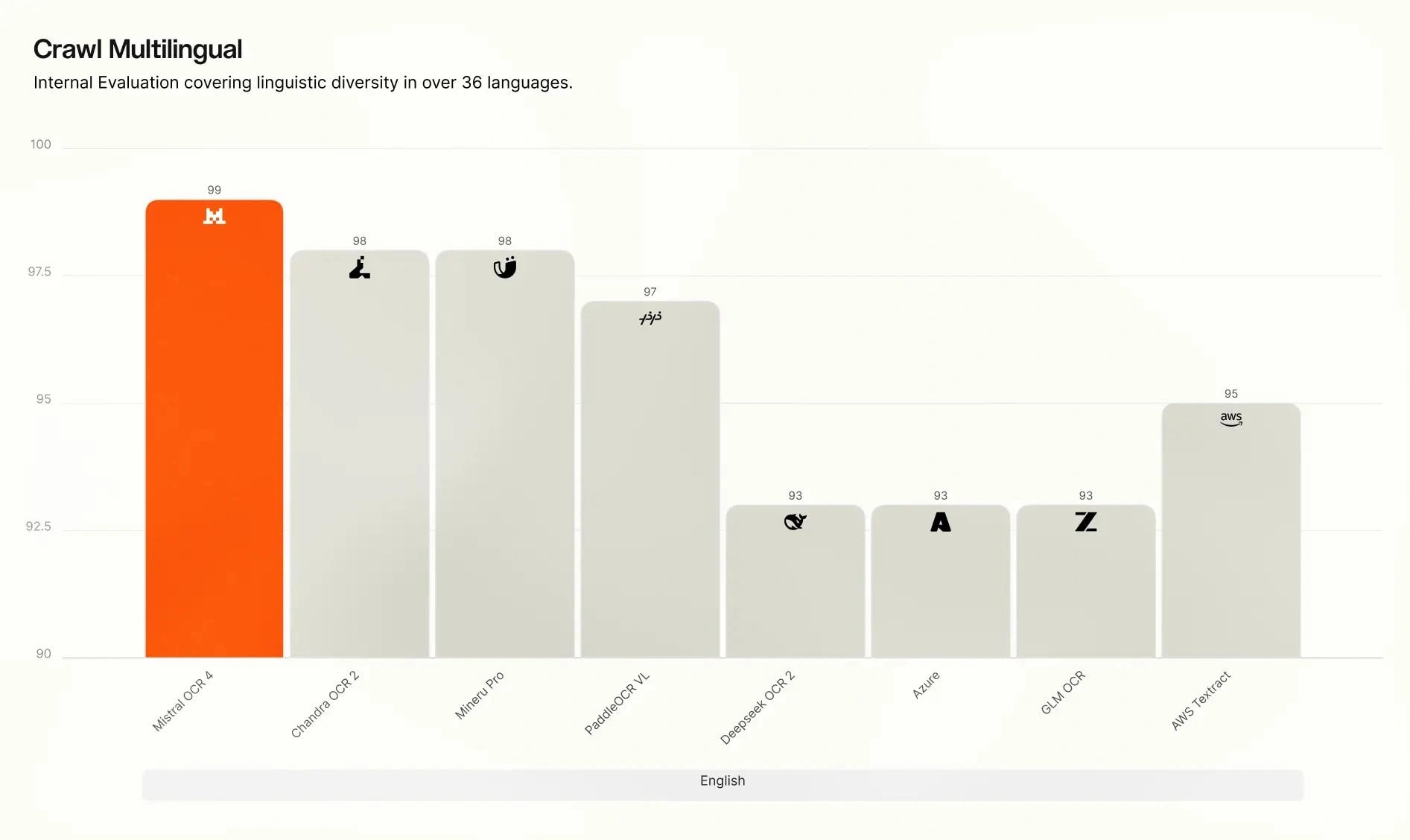
https://mistral.ai/_astro/cm-engish_ZhlvoT.webp?dpl=6a3a94bd...
Even in this one, they just report that OlmOCRBench and OmniDocBench have "known limitations" and that's why they report flagship numbers from their internal benchmark.
https://getomni.ai/blog/benchmarking-open-source-models-for-...
I've been quite curious but hesitant about Indian offerings, particularly because they seem to be priced a little higher than what I would think they should be (I could be wrong and simply be misrembering though).
Can't wait for the "oh so innovative" manager who will suggest during the next meeting "Ok... but what if WE used it for high-stakes financial decisions on non-document inputs like a photo from my phone?"
I guarantee you somebody on HN is going to comment about this "idea" next week.
Mistral is just a bit more forward about this. I guess because they don't need/want to "wow" an audience with generalist user-facing tools (chat) that seem to be experts in everything (but in reality quite often will be a lot of such specialist models chained together).
Here, what you want, is really just a few python scripts away. Voxtral to turn your spoken prompt into text, piped into mistral large 3 with extra system prompts that creates a prompt for ocr and paths to files. It could do this in a loop to actually find those files. which you throw at ocr3, is pased back to misteal large 3 to interpret and turn into decisions.
This is common. It's rather uncommon, really, to build something like this using only one model for everything.
Should have probably tried a more OCR specific model
Was this... not basically a solved problem like 30 years ago? I'm pretty sure the shareware OCR tool that came with a black and white scanner I had at one point would do better than 20% wrong.
But with Gemini the API the model does do the OCR resulting in much better accuracy.
Opus 4.8 scanned hundreds of PDFs for me recently with the worst handwriting imaginable. 100% successful, other than one record where even I could not figure out what was written.
That's not really productive lol, I'm glad it worked for you but these models are non-deterministic and 'YMMV' very much applies everywhere. I had it parse receipts (in fairness, in variable lightning), all taken from iPhone cameras in the past year. And yeah, not a great job, about 20% failed to get the date correct. (Not outrageously wrong, e.g 05/20/2026 becomes 05/23/2026.
YMMV, glad it worked for you.
Haven't compared it with any other high tech OCR estups, but it's way better than the jank that comes as standard with my scanner.
I'm personally using the small Qwen 3.5 models. If you have an OCR problem, Mistral OCR 4 is probably great. Open weights models that you can run on a laptop may also work great.
Even if you are able to read someone's scratches, having a model to do the bulk lifting saves your eyes a lot of squinting. One thing that makes Transkribus useful for research vs a chat interface is that it can line up its interpretation alongside the original image so you can examine its work directly.
They won't have the capacity to be fed an image of handwritten text and say "Ahh, this is a note written by Winston Churchill!". You could very easily use these models and your agent framework of choice, like Hermes, the Segment Anything models, and other foss tooling to build a dedicated, specialist handwriting recognition system. Or facial recognition, or fingerprint recognition, etc - these sorts of things can be done very procedurally, without a lot of interpretive AI.
https://www.ssllabs.com/ssltest/analyze.html?d=mistral.ai&la...
Looks good so far, A+ on ipv4 as well as ipv6
Edit: I also asked Gemini 3.1 Pro to analyze the certificate and it looks good
It looks like you have shared an `about:certificate` URL containing a chain of three Base64-encoded X.509 TLS/SSL certificates. This specific chain is used to secure connections to *mistral.ai*.
Here is the decoded breakdown of the certificate chain you provided:
## Certificate Chain Overview
This is a standard three-tier certificate chain issued by Google Trust Services for the Mistral AI domain.
---
### 1. Leaf Certificate (End-Entity)
This is the specific certificate issued to the website to verify its identity and encrypt traffic.
* *Subject (Common Name):* `mistral.ai` * *Subject Alternative Names (SANs):* `mistral.ai`, `workers.mistral.ai` * *Issuer:* WE1 (Google Trust Services) * *Valid From:* June 13, 2026 * *Valid To:* September 11, 2026 * *Key Type:* Elliptic Curve (ECDSA)
### 2. Intermediate Certificate
This certificate acts as a bridge between the website's certificate and the trusted Root CA.
* *Subject:* WE1 (Google Trust Services) * *Issuer:* GTS Root R4 (Google Trust Services LLC) * *Valid From:* December 13, 2023 * *Valid To:* February 20, 2029 * *Key Type:* Elliptic Curve (ECDSA)
### 3. Root Certificate
This is the foundational trust anchor pre-installed in browsers and operating systems.
* *Subject:* GTS Root R4 (Google Trust Services LLC) * *Issuer:* GTS Root R4 (Self-signed) * *Valid From:* June 22, 2016 * *Valid To:* June 22, 2036 * *Key Type:* Elliptic Curve (ECDSA)
Been using Claude in parallele, it's better not not that much, just 10x (or 100x ?) more expensive.