Co-worker 1: Interesting. I wonder if that voids the warranty. It's Apple you know.
Co-worker 2: May Jobs have mercy on their soul...
Co-worker 3: Not a bad idea. But not sure if that would cause problems with structural integrity of the laptop, like if you drop it or something.
Co-worker 4: The only downside I see is that you can no longer say "Hey, that's a sharp-looking laptop!"
See https://www.reddit.com/r/macbook/s/hbyVh5SJhw for another poor soul with the same caustic skin
It's easy for me to feel the mains frequency while gently rubbing the top surface of the MacBook while it's plugged in. Really feels unsafe, but neither me nor the computer have suffered any serious injuries yet.
I haven't been a regular Mac user, but I've had maybe 3 work MacBooks since 2010 and I recall having this issue with all of them.
Why haven't they fixed it?
Seriously though, that does not sound safe at all.
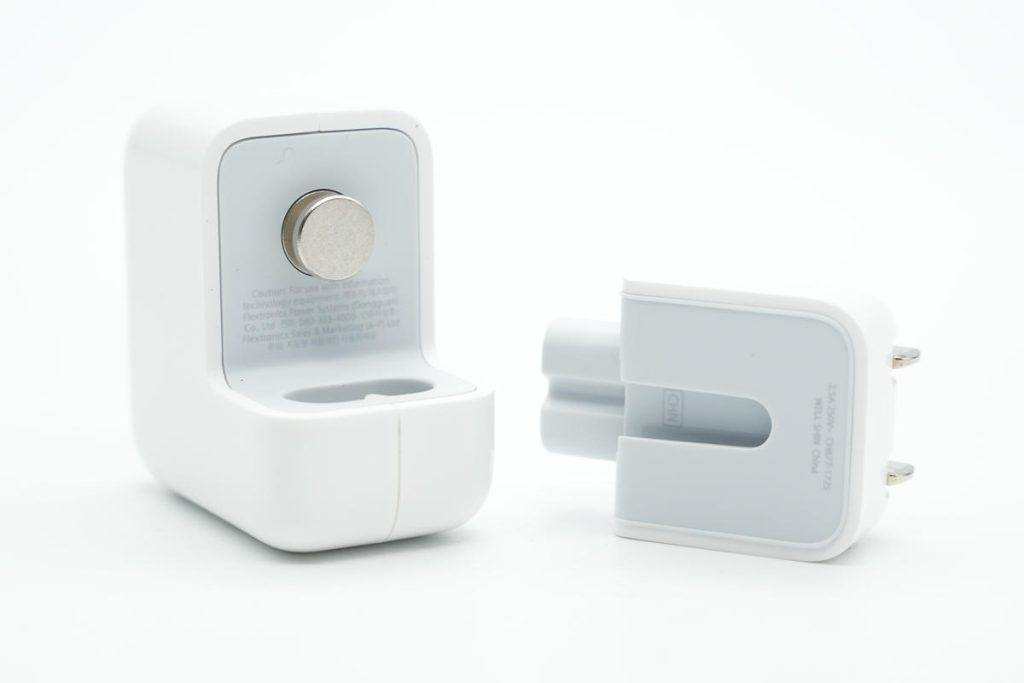
if you take the plug part from the brick you'll note that there's only two pins but the button-like thing is a ground
as noted in a sibling, the power adapter extension cable does plumb the ground through (https://www.apple.com/shop/product/mw2n3ll/a/power-adapter-e...)
> acidic sweat. once you got through the anodization the raw aluminum wears faster....
If one files off the sharp edges, won’t the sweat eat through everything faster, as that protective layer was filed off.
Some heat is normal, but the sparking seems concerning.
The flame war on whether the original chassis design sucks or rocks is not that interesting.
Maybe the next phase of Apple could return to flowing shapes and save our wrists.
I also really like this article and am 100% supportive of people messing around and modifying their stuff.
Chopping the fenders on a Porsche 911 to install a widebody kit does not have the same weight as rolling the seams on an Jeep Cherokee.
Author's another post on "The Seasons are Wrong" [0] is excellent too and I fully support both approaches.
I would propose boundaries that align partly with how I perceive the weather, and partly with how we plan our year (by months): Summer starts June 1st, Fall starts September 1st, Winter starts December 1st, and Spring starts March 1st.
There's no need to change the dates. They're already arbitrary based on the position of the sun and the earth and people have the experience to take them with the grain of salt necessary to the region they live in. People who live near the equator probably don't have much care for the notion of the winter at all. Folks who live far up north know that spring actually comes in much later than march 21st. People who climb glaciated mountains in the canadian rockies know they won't get summer conditions until late june.
My understanding is that tropical regions tend to divide the year into "wet season" and "dry season".
probably same for other post-soviet countries too?
But we lost a lot of nice symmetries that way, which is unfortunate
You do realize there's also a southern hemisphere on planet Earth?
In India our summer holidays start at the end of March and finish in the start of June. That’s usually our hottest months too. And a lot of our regional “New Year” calendar’s and related festivals are on April 14th and can probably be considered the start of summer.
In Australia it's just split up by months, with each season being 3 months long:
March 1 - Autumn starts June 1 - Winter starts Sept 1 - Spring starts Dec 1 - Summer starts
Of cause, those in far northern Australia, only really have Dry and Wet seasons. I have no idea when those are.
Adelaide’s climate anecdotally feels to be more humid in recent years (historically bone dry Mediterranean climate) and the seasons feel like they’ve shifted a few weeks forward.
The Kaurna (Australian Aboriginal people of Adelaide, pronounced Gar-nuh) apparently mapped seasons a little differently, with a longer summer that resonates with my experience:
https://www.bom.gov.au/resources/indigenous-weather-knowledg...
The Noongar people of Western Australia have a 6 season model that also maps pretty well to my experience in South Australia.
https://australiassouthwest.com/six-seasons-of-the-south-wes...
But most countries other than the USA use meteorological definitions of the seasons starting on the 1st of December, March, June, and September.
That said being an English speaking country and absorbing a lot of media from other English speaking countries, there’s been a slow drift towards the American system making its way in, so younger generations are more likely to use American seasons and older people more likely to use traditional seasons, though you’ll find people of all age groups using either. Certainly they taught the traditional seasons in school when I was a kid, I wonder which they teach now.
(Of course, you could make yet another system based on the weather where summer is approximately two weeks in July, winter is a thing that happens every few years and the rest is a sequence of mild weather with occasional wind and scattered showers)
In Finland the traditional division is that winter is Dec-Feb, spring is Mar-May, summer is Jun-Aug, and autumn is Sep-Nov. Historically it has made perfect sense, weather and climate wise – particularly from the point of view of agriculture, which is of course the reason people used to think about seasons in the first place!
February in particular is 100% winter in Finland with no signs of spring besides the days starting to get very noticeably longer by then. It's often the coldest month of the year and when schools usually have a week-long winter break. Similarly, August is very definitely a summer month except in the far north where spring comes late and autumn early. The academic year in schools and universities typically starts at the end of August, so that's a clear and important dividing line in many people's lifes. In Southern Finland, December is these days rather autumny more often than not, and there's often no lasting snow until January (if even then). June is a crapshoot, it can be nice and warm or surprisingly cold.
I guess Jan-Feb are definitely winter, Apr-May definitely spring, Jul-Aug definitely summer, and Oct-Nov definitely autumn. The rest are kind of transitional and their weather unpredictable. Of course, the climate change isn't helping things, either.
https://youtu.be/y8HEZ-x4-_w?t=402
Getting the shade right could be tricky though.
I've got no idea why, but the sharp feeling is amazing.
When apple releases a 12" retina Macbook M-series, I'll be the first in line, I don't think there's a better laptop for size and aesthetic.
These objects are becoming more like clothing and less like unyielding industrial machines. It's to the point that I'd be genuinely disgusted to handle any used laptop regardless of how "clean" it is.
[1] https://x.com/andrewculver/status/1297575768520716288/photo/...
But the obvious way to handle that problem is to put it in a case. For example: https://www.itslaut.com/products/crystal-x-case-for-macbook-...
I wasn't thrilled with a product design that required a case to protect the rest of the world from the product, but it obviously makes more sense than trying to file the MacBook yourself.
And yes, why are they so sharp?
I seem to recall my wife having the plastic MacBook that came out circa 2006 and the edges on that thing were legitimately painful.
I always marvel at how sharp the points are on the notch of the lid on my current MacBook. Very very pointy.
they intentionally ship them sharp so you can file them down to your desired fillet
the design is very human
They are quite stabby and I hate them.
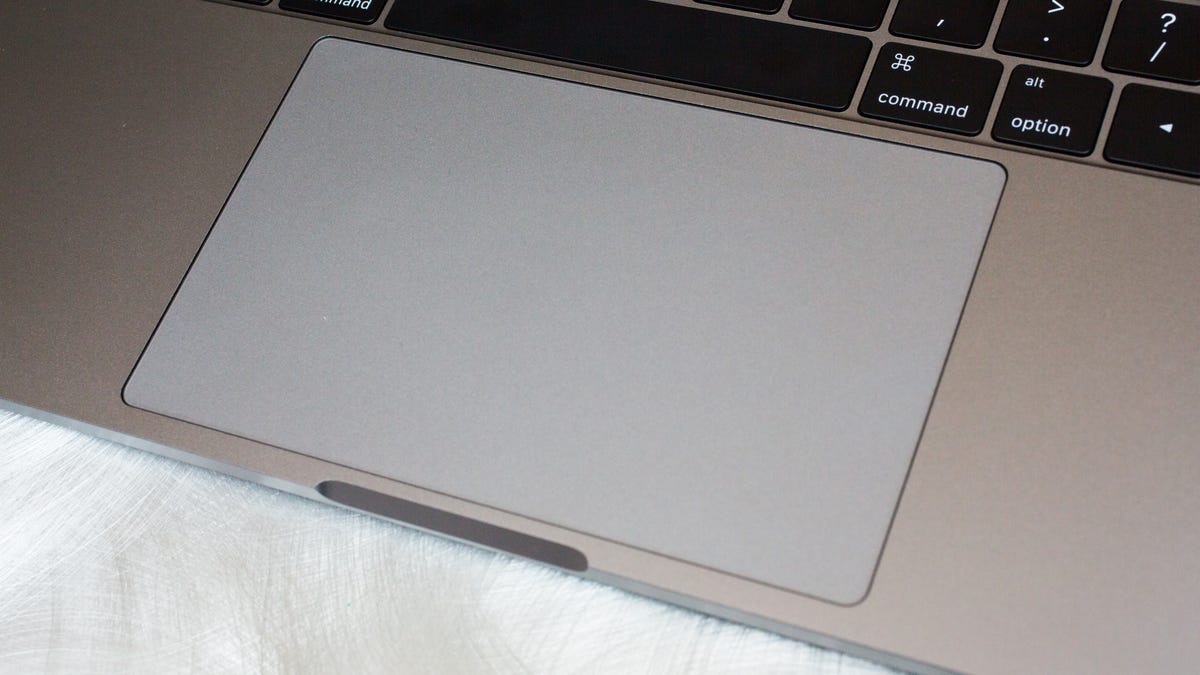
https://www.cnet.com/a/img/resize/aca51a7051edc493b19cfd93da...
Unibody Intels before that were really really sharp.
I have intrusive thoughts of trying to cut my finger over it, but so far the attempts were unsuccesful.
Alternatively, because they care about aesthetics more than utility and comfort.
«During the first Jobsian era at Apple, I used to joke that Steve Jobs cared deeply about Apple customers from the moment they first considered purchasing an Apple computer right up until the time their check cleared the bank.» (Bruce Tognazzini)
They still sell computers, which count below 10% of the revenue, and are also partly fashion accessories.
get a single-cut fine file, maybe with a little more weight than the one in the video. single cut file has diagonal slots and allows firm and continuous contact with the piece. most files are double cut, have two sets of slots and look like bumpy diamonds. they remove more material but tend to bounce.
use long even strokes with firm pressure, only during the fore stroke. watch out for roll-off, where you unconsciously change the angle or pressure of the file as you're at the end of the stroke.
you can make a pretty even-looking chamfer that way.
- Sharp edges eat into my forearms.
- Glossy screen makes it hard to see when it's light out.
- The keys have a real hard stop when you press on them which tires out my hands.
- An arrogant desire to obsolete ports.
I don't understand the appeal of the machine, it feels like style over function everywhere.
Now the only annoying things are the MacOS window manager (uBar attempts to fix this, but is flaky) and the weird keyboard mappings for things like "start of line", "end of line", "previous word", etc. Karabiner fixes those if you're willing to invest 3 hours in setting it up.
I filed my work dell laptop too. Very different feel, but it is nice not living in feel of your own stuff.
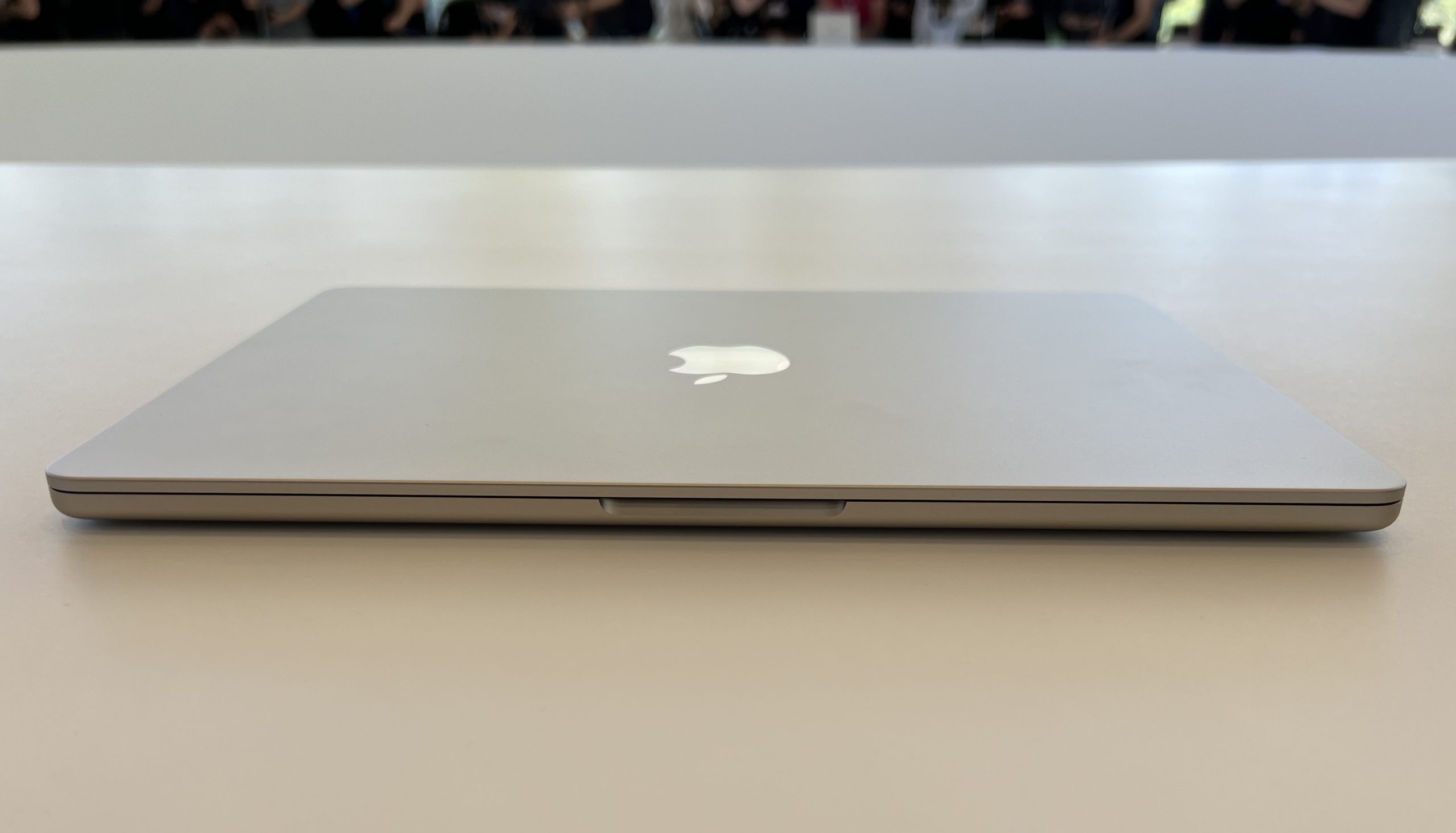
So the seam looks neat when the macbook is closed, eg. https://cdn.arstechnica.net/wp-content/uploads/2022/06/MacBo...
Though you're right that machines whose exteriors are customized and unusual are less likely to get stolen.
Since I mentioned Tahoe, it bears repeating, my spotlight is still broken.
[0] https://ljpuk.net/2025/05/23/how-does-the-space-black-macboo...
Totally fine to do whatever you want to your personal belongings though.
I'm betting they don't notice if I file down the corners. Hell they probably wouldn't notice if I just cut the corners off with a fret saw. But God forbid I try to install an ad blocker or use Firefox.
Bold move to do this on your work Macbook. I'd be too worried of getting chased down with a bill when returning the laptop eventually.
It's a laptop computer.
This is a particularly hilarious customization both for its combined utility and shock value and also for doing it on a work computer.
Are your wrists supposed to be coming into contact with that? I suspect many of us have bad posture and do rest our wrists like that, but if your concern is wrist comfort, you probably want to consider that you're going out of your way to enable harmful posture.
also, where is the new version of Visual Basic, Ballmer? Your sweaty chants can only distract me for so long…. Wait….. ITS BEEN TWENTY YEARS!?!?
found the Windows 8 enthusiast! haha, I kid. (I myself use a tiling window manager , i3, with completely square windows without any gaps or rounding)
The square corners are part of a 2 pixel wide border (one black, one white) because who needs to waste space on handling things we aren't manipulating? But the title bar is high-contrast, because you'll go looking for it when you want to switch windows.
The round corners go with a fairly thick border in a customizable color, usually something very bright in the yellow, orange or cyan ranges. When you sit down, you should immediately know what is active.
If I could run the Windows 2000 UI on a modern OS I would but any recent clone/theme/etc feels too uncanny valley.
(Yes, please tell me about some buggy half-compatible tiling window manager for my Mac.)
They don't have to be any particular shape or size. The property of being virtual overrides everything else when free of these self-imposed constraints.
Even if you lose the GUI and go back to text, the ideal terminal is a plane of infinite columns of arbitrary cell size that dynamically fills your field of view.
I'd further argue that the only reason VR/AR isn't more widely adopted is the lack of orthographic vs perspective modality per application (and uncomfortable headsets). In VR/AR, you don't want a window manager or even windows at all. What you want is a field manager (as in FOV "fields" of varying opacity that can be composited by the user). Shape and size is just an arbitrary region blended in with the environment.
For the sake of ergonomics, you'd more often prefer to project an interface onto a surface if you had the choice. When you don't, you probably want the projection to be orthographic, but for the edges to be fuzzy if not invisible. You'd generally want to be able to layer these interfaces as well instead of having opaque rectangles always in your way.
This makes perfect sense considering that most LCD displays, and practically all computer displays, don't have rounded corners. This trend of rounding displays and GUI elements is purely an aesthetic choice. I also find this obnoxious since the only thing it does is rob me of a few pixels which are often useful.
But considering Apple users have accepted living without a large block of pixels dead center at the top of the screen, which they've been sold as a "feature", the rounded corners are likely even less of an issue.
I'm not sure that an infinite plane of pixels makes sense even in XR. I want to see a clear edge of where digital content begins and ends, and a rectangle is the simplest and most optimal shape for that. So I would rather have physical display-like floating rectangles, than floating text in arbitrary locations, or rounded off corners for the sake of aesthetics. I'm not opposed to a very slight rounding off of edges on certain elements, but the trend Apple is pushing is supremely ridiculous.
I'm saying that there is room for your arbitrary preference for opaque rectangles if we all abandon the notion of a "screen". We are well past the point where we can do this economically. It only persists because of consumer acceptance. Traditional screens are less efficient in every tangible way. They are less power efficient for their apparent brightness and require more material to construct.
Even the notion of clear boundaries and pixel size is an illusion. Traditional screens only make the pixels so big because they require sufficient brightness and power to see them at that distance, not because we cannot manufacture smaller pixels for cheaper. We could have much better results for everyone and the only remaining cost/problem is finding a way to comfortably wear the display.
I suppose I would prefer it nice and rounded and soft on my wrist - but I don't feel like it's quite as extreme as this thread would have you believe lol
It’s quite an annoying flaw, and i’ve only had this problem with the machines since the M1 redesign
I appreciate the customization, but would probably make an effort to make it not look like (another) accident.
> This was on my work computer. I expect to similarly modify future work computers, and I would be happy to help you modify yours if you need a little encouragement.
I don’t understand the actual decision but I appreciate the gusto with which it was made.
If you’re not planning on doing that then it’s not really a factor for you.
He honestly seems like a terrible designer, which seems corroborated by him doing nothing of remote interest outside of Apple and barely inside it. The items that are regarded as design epochs, like the iPod, we're not his.
All the same, hell yeah.
The channel’s Swiss host is famous for removing sharp edges from metal things.
Since the edge has been filed away, the rubber seal on the screen would no longer presses against the edge of the body protecting the screen.
Do you have a brand you'd recommend?
Not sure if the Apple Silicon devices have the same issue - but it was consistent through at least 3 different generations.
I was worried about scratches because I abuse the shit out of anything I wear, and sure enough, there are scratches in the titanium bezel, but they look good in a way that scratches on my (non-pro) steel Apple Watch did not.
There’s a sharp corner there is unnecessary.
Very minor "you can just do things" collides with the "infallible object" presence that Apple wants for its products - almost feels "wrong", but it's a nice norm to break.
(and I'm not a "Cult of Mac" guy)
Unless you fly/train travel alot I guess.
Bet this person never heard about FAFO
Meanwhile a very important object called "Orion CM-003 Integrity" of the Artemis II mission is about to splash-down on Earth in 35 mins.