I think the table at the end of the article is more so.
- Worldwide sales -10% YoY
- China sales -26% YoY
And when you cross compare Porsche saying they sold more EV powertrains than their gas equivalents against China's new found foothold as the market leader in consumer electric cars (BYD, NIO, Xiaomi, etc...)
Then I think you see an early indication not just of electric car dominance, but of the (very potential) rise of China as the premier automotive super power.
It’s done man. Americans are stuck in ICE engines because they’ve been told they’re “car enthusiasts” while the Chinese have been developing EV technology for years. Meanwhile, European makers are stuck not knowing what to do, make Americans happy or compete with the Chinese. The result: nothing has been done properly. And let’s be real, “car enthusiasts” are going to disappear in one or two generations. Practicality beats enthusiasm for 95% of car use.
Switch to an EV and it's even simpler, you can get away with a motor, battery, BMS and inverter and you can get just about any soapbox to move.
ECU embedding makes the whole system more complexe. That is not necessary absolutely a bad thing, but the trade-off is different. And there is on top of that a different topic which is how electronics are used to enforce obsolescence and make harder to maintain the vehicle without special equipment of the specific firm. This can also be enforced with more analogical stuffs of course, but electronic devices are more likely to be used this way.
My father has used a traditional (European) car (which had no electronics except the rectifier diode bridge for the alternator) for 35 years (1973-2008), during which the car has been used every day for commuting to his job (an almost 2-hour round trip in a city with very crowded traffic) and during vacations it was used mainly on difficult mountain roads. He stopped using the car when he was too old, not because the car became unusable.
The car has been repaired from time to time, but almost all the repairs were done by my father himself, alone and in a short time (he had the service manuals for that car, but he was not any kind of mechanic by profession, he was a physicist). In the very few cases when the car was taken to a repair shop, that was for replacing some rusted parts of the car body, and once for machining the cylinder block, after several hundred thousand miles.
And this was not some unusually good car, many others were like this, if their owners took good care of them.
I doubt that a Tesla would live that long, in similar conditions, though it would have the advantage that the owner would not have to be skilled in using his hands in order to avoid to waste time and money for minor repairs, like with that "analog" car.
Define "modern". My 1988 Porsche 911 Carrera is now 38 years old (and I own it since 1999, it used to be my daily back in the day). It's considered one of the most reliable car ever built. Mine is sure still running strong and, well, we have to wait until year 2064 (I'll be long gone I guess) to see if any modern car proves as reliable.
Also: there are still Porsche 356 from the 1950s on the road. They do rust a lot (body had no treatment against rust back then) but many are still in working condition. Mechanic and bodyshops know how to keep these on the road. If after 38 years my 911 Carrera is still on the road, I'm sure the knowledge is out there to keep it on the road for another 38 years.
Do we know if all these Chinese cars sold today, say in the EU, shall still be usable in 38 years? What about the batteries? Shall there be compatible ones? Batteries that fail every x years and needs replacement is already quite a stretch from a "reliability" point of view compared to a 38 years cars whose engine has never been opened.
Thing is: my 911 is mostly analog except for the electronic fuel injection. A good old Bosch part.
Funnily enough that part is a typical part that fails. That and all the little sensors (but thankfully there aren't too many). But they're easy fix.
I think there's that sweet spot where cars were still simple enough and yet had already electronic fuel injection: that made for some extremely reliable cars.
Note that I don't use it as a daily car anymore: I now drive maybe only about 1000 miles / 1500 km a year with my old Porsche. But I totally could use it everyday: the reason I don't is not reliability, it's that an old Porsche from the 80s is a real gas guzzler (not as much as an american V8 from the 80s but still a gas guzzler). One of my favorite thing is the relatively short drive to go pick my kid at school then go groceries shopping. Every time I use I'm thinking "it's crazy to think it could be my daily".
And when my regular car has to go to the garage/maintenance, the good old trusty 1988 Porsche 911 Carrera gets to be a daily for a while.
38 years old.
My modern car has sensors for everything. It's very convenient to know what is the problem, but there are still problems. In seven years it's been something like seven times to the garage (in addition to maintenance / tires) for a variety of problems. Under warranty but still.
Something tells me, and not only me, that longevity and ease of repair of these electrical gadgets are nowhere near old ICE car we all know very well. Is it direct experience with same type of cars across several decades? Nope, but experience with electronics in general, powered by similar batteries in general and its not looking good. More electronics = more failure surface.
Lots of cars in 1988 still had 5 digit odometers because most of them weren't expected to ever need a 6th. Nowadays with some companies you can get almost that far and still be under warranty.
They're reliable, but when they have a problem, they're too hard to fix.
Last time I got my Toyota Hybrid fixed, the recommended first step for the fault code was to "replace the ECU". Expensive. Fault was elsewhere but I had to suck up that cost. I've just scrapped that car for a different fault, because although the new fault was easily fixable, the parts and labour were very expensive (and wouldn't make the car more reliable).
This is likely due to experience, regardless, it's the reality.
I came across a post about a diesel tractor with no electrical parts and imagined the value of a post-apocalyptical car that could withstand EMPs and run on virtually any fuel type. Limited market obviously, make it configurable like a diesel Slate truck and baby you've got a stew going!
When your EV breaks down, you won't even bother to get it towed, because the only ones who can repair it are the (very expensive) showroom of the car manufacturer you bought it from, or their authorized (and very expensive) service center (and those will be very few of them in a city, and forget about getting such EV Service centers in the suburbs or rural areas). And you have to accept whatever cost quote and dependencies (additional upgrades to "fix" the "issue") he specifies. Good luck trying to figure it out or getting a second opinion, unless you have an EV industry expert as a friend or family member.
The EVs are white elephants. They look good while they last. But once they start breaking down, you will be paying through your nose just to keep it ticking along.
Whereas that 30-years old ICE car of your grandpa? That rustbucket can be repaired (eventually to full functionality and best looks) in your home garage by you and family/friends if you have the knowhow (or want to learn it), and can afford the time and spare parts cost (which are affordable for middle class, except if it is a vintage car or sports/luxury car).
EVs will be the deathknell for the hobbyist market and small-scale auto shops.
And don't even get me started on how easily and dangerously EVs can be hacked/hijacked by hackers.
I do agree though that modern ICE vehicles are becoming more and more complex, with electronic subsystems replacing manual subsystems, so non-dealer mechanics may struggle with such complex work and may even reject the work saying it's out of their ambit. This situation is getting aggravated as car manufacturers are pushing for hybrids, which have the partial advantages & disadvantages of both ICE & EV worlds.
But for any EV (including the Nissan Leaf), repairs & advanced diagnostics on the electric-drive components (which is basically the main component of the EV), health checks on the battery (other main component), or repairs involving high-voltage systems, are typically out of the competency and ambit of a non-dealer mechanic, unless the mechanic shop is a dealer-certified EV-trained service center.
However, the routine mechanical work — things like brakes, suspension (e.g., sway bar links, shocks), tires, wheel alignment, cabin filters, etc. — can generally be done safely and correctly by a good independent mechanic, whether it be for an ICE vehicle or an EV.
And then there's all the people putting Tesla drive-trains in classic cars. They couldn't do that if they weren't able to work on the electric drive.
That's true, but it is has more to do with parasitic capitalism than EV technology, and could (and hopefully will)be solved with regulation. My understanding is that there is already significant regulation around ICE car parts which is the main reason why the situation there is better.
EV is basically a battery-powered motor on wheels.
The smartphone in your hands is a battery-powered communication device with a touchscreen.
If your smartphone doesn't work, can you take it to any phone repair shop and get it repaired for anything other than a battery replacement or screen replacement (or if the service center guy is technically competent, then maybe replacing the charging port if it is busted).
EU, India and few countries have enacted the Right to Repair law.
But if your smartphone is broken, your options to get it repaired are minimal, because its manufacturers have gone to extreme lengths to ensure that such devices are not easy to open (let alone repair).
Now extrapolate that Smartphone Repair problem 10x-100x, and you have the EV Repair problem.
EVs are DESIGNED and MANUFACTURED to be extremely difficult to repair even by excellent technicians and software experts.
EVs are the Razor Blade Theory in moving attractive action. (Razor Blade Theory is basically a selling cheat but perfectly legal one; they sell you a razor blade with special handle/holder cheaply, but you have to keep buying razor blades from same brand (e.g., Gilette) & model that only work with that specific type of handle/holder. Over a period of time, the manufacturer will keep increasing the cost of the razor blades, because they know they have locked in the customers who have become accustomed to that type of handle/holder, blade quality & comfort, design, etc.)
You can buy an EV for an expensive upfront cost (it is sold as a premium (> ICE car) segment; just like smartphone brands have a premium price-tier segment), but running and repair costs is where the customers will be fleeced.. hard.
And please note that running cost (wear & tear) of an EV will not be covered by car insurance, so if your EV breaks down on the road, and you get it towed for repair, then the showroom/service-center (who usually have a tie-up and nexus with car insurance vendors) and insurance vendor will simply say the repairs won't be covered under extended warranty or insurance as it is normal "wear and tear".
And you'll have to swallow all those lies at face value, because you cannot even go elsewhere for a second opinion (because an EV of one brand, cannot be repaired at service center or showroom of another; if you go to another service center of same brand, they will cite you the same lies because that's their revenue model (Razor Blade Theory)).
EVs are a losing proposition for humanity, because unfortunately, even the supposedly green (not affecting climate change) EVs have toxic waste (typically the chemical batteries and plastics) that are never safely disposed off in climate-friendly ways.
ICE vehicles have some of these same problems, but their biggest advantages are their long mileage (per full tank of fuel), easier operation (not driving, I mean it is easy to top/fill up the fuel), easy maintenance (affordable repair options), and all-round viability that can even last a century with the right care.
However, you can bet that EVs are being designed for planned obsolescence, and that's a shame since humanity indeed needs some viable alternative to fossil-fuel-guzzling climate-polluting ICE vehicles.
> EVs are DESIGNED and MANUFACTURED to be extremely difficult to repair even by excellent technicians and software experts.
Correct. So we should pass regulation that makes this illegal (or otherwise prohibitively expensive for manufacturers due to legal responsilities which would be difficult to fulfil with such a design). We know that repairable EVs are entirely possible.
The same applies to smartphones and whole bunch of other hardware from washing machine to tractors, and is the basis of the "right to repair" movement.
Furthermore, once EVs become mainstream across the world, it will be China controlling the world [since batteries and chips & ICs (integrated circuits) need Lithium, Rare Earth Metals, etc., but China has the monopoly on them (especially on Rare Earths processing)].
That's why China is doing its best to dominate EV market (as hinted in the above linked article), because it knows no nation can dethrone it for the basic essentials of any EV.
It would be a bad idea for the world to be beholden to a single country for anything. Oh wait, the world is already beholden to China for most of the manufacturing. LOL.
We are doomed.
I don't think that follows. Nobody has even attempted to solve these problems for mobile phones. And the main reason for that is that it's a pretty new problem. Appliances 40 or 50 years ago were much simpler and typically quite repairable. It's only the recently that a focus on manufacturing efficiency and profitability have led to these kind of problems.
The former requires a special printer while the latter requires tons of machines for precision engineering and the industrial equivalent of smitheries and blacksmiths!
Damned if I have any idea what anything is or what to do on a new one. I had a moderate chance of diagnosing and fixing my old Triunph.
To put a different spin, a friend's father was a very successful auto mechanic. What he loved about it was the mental challenge of diagnostics. The stranger the problem, the better for him.
A few years back he sold his shop. There were two reasons:
1) He made f** you money, and retired decades earlier than he'd expected. 2) For many years he'd felt like the daily intellectual challenge was gone.
His repeated refrain was that modern self-diagnostic systems were good enough that it took away most of the day-to-day intellectual challenge.
But there are an ever increasing number of assemblies with a "non starter to anyone other than the OEM" up front manufacturing set up cost. And when the OEM drops support......
I'd also dump my ol reliable ICE car that's now probably worth less than a fancy electric bicycle, if someone just gave me an EV for free ;)
But since I'm poor and can't afford EV prices with decent range, nor can I afford a home with a parking place with charger, then ICE it is. European here btw, not american.
The ”americans can’t afford EVs” argument falls totally apart when the average(!) sale price is over $50k and you can get a perfectly good Leaf for $25k
And boomers and gen-X are used to owning ICEs, so there you go.
Millennials and Zoomers would be more open to EV adoption but they have a lot less disposable income to buy new cars.
The main issues for me are small load capacity and whether or not there is a shower at the destination.
https://news.google.com/search?q=cyclist+run+over&hl=en-US&g...
I feel naked on the rare occasion I don’t have it.
Don't worry, there are people scheming up ways to change that. And it's (mostly) not even the auto lobby.
Getting to work and running local errands?
Not everyone's work commute can be done by bicycle. I can't cycle 40+ km each way on the highway.
And not everyone who buys a car to get to work buys a pickup truck. Sensible cars exist. Ignoramus.
One for commuting long distances versus one for commuting short distance. ignoramus
Life is short enough, I don’t need to waste it providing power to travel to work and back when I can save 1.5 hours per work day driving. (And more if I go to lunch.)
I don't know your particular circumstances, but unless you have tried riding a bike to work you probably don't have a good sense of how long it would take you.
That’s going to depend where you live. Commuting by bike is half to one third the time it takes to drive for my commute. One work location is 8km away, the other is 15km.
Yes, it's disingenuous to insinuate through that comparison as if bicycles are replacements for cars, or that all car trips can be replaced by bike trips. Both are good for different kinds of trips. Hence why cars still have a place, even in bike dominated Netherlands, and why your comment was in bad faith and why Ic alled you out for it.
>Plenty of people live without a car.
Plenty of people also live without a home, that doesn't mean it's a good situation to be in.
More likely they stay popular because America has extremely cheap petrol/gas and poor electric car charging infrastructure.
Even a Dacia Spring with its 900kg is slightly more expensive overall to run (in my circumstances. I could charge at home, but don't have solar panels atm), and a lot more expensive up front to buy (used).
It has over 304k km already, and it runs perfectly well with some occasional maintenance and some mechanical sympathy, but I was considering alternatives in case something were to happen. Conclusion? Just buy another one. Suzuki Celerio is the only one in the same ballpark, but it's about 2k EUR more expensive. And I love my Daihatsu.
We ran a Leaf for years like that, and it would charge overnight just fine.
We do have a charger now and it’s quicker, but it’s a luxury we didn’t need.
Imagine how many people are reading this and thinking to themselves "government has to do something to drive up those numbers so it's no longer financially sensible for you to drive that car"
And the insurance is cheap because of years of no incidents, and the fact that I'm over 30. But indeed, I wouldn't disagree if the government made electric cars cheaper from a tax perspective. They just reduced the tax discount to 25%, and it will be gone completely in a few years.
If they raise taxes significantly for me, I'll just sell the car and find a closer job. 20km one way to Amsterdam with an ebike, that's 2 hours per day. I don't have that much time to give away at this point in life.
People aren't being asked to dump their current reliable vehicles.
What we want is for people to think about EVs when it's time to replace them.
Depends on where the people live. In France, that's just about what they're asked. If their car is "too old" (reliability doesn't matter, only age), they may no longer drive in Paris and some other major cities on weekdays from 6 AM to 8 PM or something like that.
https://www.france.fr/en/article/crit-air-anti-pollution-veh...
But the point I was responding to was "people aren't being forced to dump their old, reliable cars". Which they absolutely are. Whether that's a good or a bad thing is a different matter. I think it's good for health, but I also understand it can be difficult for people who struggle to make ends meet.
I think most people would agree that no tariffs would be good, but China is more protectionist than any other major economy, including recent changes in US policy.
In contrast, in the West (at least until a few years ago), we have been fed the discourse that free market without protectionism is the best model, and protectionist countries are sabotaging themselves. And I don't know how it was in the US, but in the EU this caused hardship to many people. Entire countries pretty much sacrificed whole industries to the free market gods, because it was more efficient to bring the merchandise from elsewhere. Opponents who were defending their livelihood were framed as reactionaries that were opposing +X% GDP gains or didn't want "free competition" (often against products with unbeatable prices due to being made in countries with totally different rules and labor standards).
Now it seems that the system that supposedly was so bad gives an unfair advantage, so if others apply it the only defense is to apply it as well... but the free market apologists won't shut up anyway, in spite of the obvious cognitive dissonance.
there are many people in America who don't believe in protectionism, but we lost this time.
The point however is that the United States is supposed to operate under a different model than China. The reason to bring up the ways we act the same is then to find clarity in the contradiction.
This is essentially the same tension that runs through much of modern American discourse. It's never welfare if the beneficiary is a rich CEO at a corporation, only if it's a family in poverty. It's not like Chinese cars can't employ American workers just as Japanese and other foreign automakers do.
To my mind then, I think it's less about reciprocity and more about corporate welfare. Putting aside ICE automakers, there is also a very obvious individual who turned conspicuously political as of late who owes a great deal of his fortune to the expectation that his electric car company will one day rule the world. It would be quite embarrassing for even him if demand for his vehicles suddenly got demolished on his own turf. I would think he and others would be willing to spend a small fortune to keep the political needle tipped in their favor on this issue, the average consumer be damned.
At some level there is nothing wrong with such naked self interest. I just prefer we be honest about it, as only then can we really analyze it.
Does it mean we shouldn't have borders and a military because China has them?
Same applies to tariffs.
Not true. China let Tesla set up shop in the backyard of their domestic EV industry, WITHOUT the mandatory by law 51% Chinese ownership, precisely so Tesla would light a fire under the asses of domestic players, forcing them to compete better with what was at the time, the pinnacle EV brand.
China is no longer beating us with protectionism but with innovation and manufacturing. People better wake up.
More like having Tesla to bootstrap the upstream suppliers so local brands can leverage them.
If anything the shame is not that the Chinese pulled this off successfully, but that Detroit is still barely trying to compete in streamlining their bloated supply chains in light of EV competition; none of the US automakers are sharing upstream suppliers on batteries and all are scrambling in different directions on even some of the basics.
Protectionism that works to bolster inovation.
TSMC didn't become the world's supreme chipmaker by a laissez-faire aproach from Taiwan.
Same applies to Samsung. And oh-so-many Japanese tech ventures.
And all of them were a product of American geopolitics and tech collaboration.
Let's not pretend high tech was ever not a result of government-assisted efforts, subsidies, tarrifs, export controls, and geopolitical games.
>Same applies to Samsung. And oh-so-many Japanese tech ventures.
You're missing a lot of context with these analogies. TSMC and Samsung started off in the 1950-1980s as cheap manufacturers of low margin electronic commodities the west was actively trying to get rid of in the name of protecting the environment(semi industry is poisonous) and increasing shareholder value via cheap(cough, slave, cough) labour, while giving western consumers who had options of better paid jobs access to cheaper imported stuff. It was a win-win-win situation, kind-of.
But fast forward to today, now that TSMC and Samsung have become masters of cutting edge high margin manufacturing, and the west finds itself exposed to lack of said cutting edge manufacturing at home, they're starting to twist their arms to get the know-how and infrastructure that they missed out on back on-shore. Had the west know the table would turn like this they probably would have acted differently.
Same with cars. German OEMs like Mercedes that were the pinnacle of auto tech especially when it came to tings like safety and self driving/crash avoidance, but got greedy and were more than happy to outsource electronics and ECU development and manufacturing to the lowest bidder in the name of shareholder value, but over time they lost vertical integration and access to inhouse critical high end technologies that made them valuable over the competition. Now China used that outsourced electronics industry to develop its own electronic auto tech and its vertical integration supply chain to beat the Germans.
The highest margin item in an ICE car was always the engine at which the Germans were the best at, and China could not catch up. Fast forward to today, in an EV, the highest margin items are the battery, self driving stack and supporting AI silicon, almost none of which come from Europe, meaning German OEMs are losing out on innovations and profits big time, becoming only system integrators of US and Chinese sourced parts on top of which they slap a badge hoping the consumers will value it more than Chinese badges because "heritage and tradition". They are super fucked.
In this round of history repeating, 2020s US car maker management was also actively anti-collaboration and anti-expert within it's own domain. You can see commentary by Sandy Munro on US companies ignoring design and production efficiency details - outsourcing too much of their own supply chain, and being resistant to integration improvements. And similar occurrences of Chinese auto companies hiring US auto production experts who were being ignored by the US auto industry, then going on to to improve fit, finish and quality, while building organizations unafraid of vertical integration.
That's a guess at the White House's thinking. They've been using every form of coercion in international relations, including economic (tariffs), military, and diplomatic. That's a factual basis for divining their reasoning.
Their words are not a factual basis - they can say anything and clearly will. Everyone who does those things provides justifications - Putin was helping oppressed Russians in Ukraine and stopping fascism, for example. Taking them at face value is not a serious analysis.
https://news.ycombinator.com/item?id=46648778
It's limited but I feel like Canada aligning themselves at all with China over the US is an interesting development.
This is classic multipolar politics, trade the two behemoths against each other so they don't roll over one day and just squish you. By alienating Canada and Europe we've handed China a great gift.
Wonder what's going on behind the scenes.
The real question is what do those countries do when they have other options.
I believe this led to some legislation in 2023 to prevent or reduce foreign home buyers?
https://vancouversun.com/business/local-business/chinese-inv...
It'd be difficult to compete with companies receiving large gov assistance without gov assistance and I find taxing them slightly safer than making it rain on specific people/companies.
But with the ridiculous tax incentives here in Australia (at least while they last), my new car turned out to be an EV. Specifically the Hyundai Ioniq 5 N. And let me tell you, while the logical part of my brain knows that the gear shifts and the exhaust notes and everything about it is “fake”, when I’m driving it around a track or a challenging B road, every part of my body is fooled into thinking it’s real. And reluctant as I might be to admit it, it might just be the most fun car I’ve ever had
Is it perfect? No. I wish it was 10cm lower to the ground. I wish it was at least 600kg lighter. But it has completely disabused me of the notion that electric cars can’t be fun.
I'm slightly surprised there aren't more cheap electric "hot hatches", but I think that market is dead even in ICE cars - young people don't have much free cash, aren't interested, and the insurers won't let them either.
While not exactly cheap, you can get the MG for under 30k eur if you shop around for some discounts and the volvo at around 35-40k. considering a 300hp golf R is over 50k eur they're pretty great options for some cheap fun. Cheap as in total cost of ownership, not just purchase price.
Also, the SC01 people just announced that they plan to bring it to Europe [1] so that's gonna be a great option.
[1] https://insideevs.com/news/784884/sc01-electric-coupe-roadst...
At the moment US automakers are stuck in a "cross-over is the new hatchback" position because Americans got into a tragedy of the commons that has trended towards larger vehicles at the expense of everyone's safety (and energy efficiency and weight to passenger efficiency and general vehicle coolness).
There are multiple other factors for the relatively low adoption of EVs compared to China.
Then there's the utility / practical / recreational crowd who goes for SUVs and pickup trucks.
Those whose primary aim is utility are already in (non-EU) foreign markets or used. Those are invisible to new-car US/EU sales.
It's a classic Innovators Dilemma dynamic (Clayton Christensen), where chasing higher-end market niches torpedoes development of disruptive tech within the same firm.
The types of buyers who chose their form factor or source of motive power for their vehicle based on image or virtue points are a rounding error.
I will never buy a gas car again. I plan to keep my Boxster until I can buy an EV version.
Remember, if you need a widget that you don't otherwise care about knowing someone who does care about them recommends something is a very important factor in your decision. The realistic difference between a car/suv of similar size between GM, Toyota, or VW (random choice of brands but covering the 3 geographical regions) is minimal: the non-enthusiast will be happy in any of them.
There's simply nothing comparable currently produced by an American marque, though there were the Chevy Spark (Korean-built) and Ford Fiesta (Spain), both have been discontinued.
Only like 1-2% of new cars are manual transmission here. A lot of the enthusiast market complains that everything is an automatic these days, even high end sports cars.
Manuals are really good in bumper-to-bumper traffic: often the second gear has an incredible range from slow crawling to 40 km/h. You keep the clutch completely engaged and just work the gas pedal. (The odd time when things look like they are coming to a complete stop, you hit the clutch to keep the engine from stalling. But if the traffic moves again while you are still rolling, then you just re-engage in second gear.
You can do a similar thing in automatics with their 1 or 2 gears, but it doesn't work quite as nicely as that second gear in a typical manual.
Manual transmissions are tougher against heavy loads (than torque converter automatics). If you have to tow a heavily loaded trailer, manual is better. The clutch is fully engaged and so very little energy is lost in the transmissions. Automatic transmissions can heat up under load and can overheat.
A lot of this is not relevant when we are talking electric vehicles, of course.
But in an ICE car, there are good reasons to prefer a manual transmission, even if you're not a sporty driving enthusiast.
On YouTube there are videos of machines doing precise jobs well, which people call "satisfying to watch". Those are relevant to the discussion, I feel.
I would 100% get a vehicle without a manual for my next car if it’s an improvement over a manual. I’ve driven a handful of Priuses. I would definitely own one. I would definitely own an EV.
I have no desire to own an ICE-only vehicle with a CVT, automated manual, or conventional automatic. They add complexity and opaque failure modes. Last year I lost reverse in our plow truck (an automatic). Totally undiagnosable for me, nevermind fixable. Had a new used transmission put it, and it started bogging and lurching from a stop and up hills. Can’t work around it, can’t fix it. Sold the truck for $300 to someone who’s going to part it out (the engine wasn’t great either) and moved the plow onto a new used truck.
We’re not all stuck in the past. Some of us do understand the system well enough to be picky about believing something is an improvement.
Another example: CFL lightbulbs flat-out sucked. Avoided them as best as I could. Bought CREE LED bulbs at $20 apiece as soon as they came out at Home Depot.
They are also on their way out, together with the internal combustion engine. It's possible to work them into electric cars, but they don't make much sense there.
The deal breaker for me isn't the lack of a manual transmission, but all the screens and software updates, and barriers to repair.
Can we not have an electric econobox that focuses on utter simplicity?
Cars are a way people mark their social status - whether they will admit it or not. A big, luxurious SUV with a small mountain of space, the latest tech, etc is not an 'appliance'. It's a luxury people are choosing to buy.
The difference is in priorities. Americans wanted a very different kind of car than China is/was making.
If competitively priced EVs hit the market, consumers would buy them in much bigger numbers. Manufacturers want to use EVs as a way to redefine themselves and make more money and seemingly the industry is colluding to keep them premium with a shorter shelf life.
The above isn't quite true - there are some "daily" ICEs yet because EVs aren't in all niches and I don't replace things instantly even if they were. The idea is the future that is coming closer and closer to reality.
Gee, I wonder why.
For example in my neighborhood most cars are parallel parked, people are living in centuries old houses converted into high density condos, there are no garages.
So what is more practical, charging your car overnight without an electric plug or going to the gas station for a few minutes?
100x charging your car overnight with a plug. I don't think people who don't own an EV realize how great that is. Imagine if your petrol car magically got refilled with fuel every single night - add up all of those "few minutes" spent at a petrol station over your lifetime, and realize how much time you're getting back.
>> people are living in centuries old houses converted into high density condos, there are no garages
And yeah, that's a problem everywhere, not just in Portugal. Here in the UK a lot of people wouldn't have anywhere to charge at home.
(The unique US problem that the easiest charging is Level 1 is a complication here, too, because it especially can't recharge modern battery sizes overnight. But overnight Level 1 charging is still a game changer versus no overnight gas refueling. The "what's the point of charging when it can't do 100% overnight?" crowd can be quite vocal, despite gas cars having no easy way to refuel overnight.)
There's some nicer differences like leaving the air-conditioning on constantly because there's no pollution and it's also practically free. It's nice to have a giant battery instead of requiring an engine to constantly recharge it to run the electronics.
Unless the downside doesn't matter to you, then obviously it doesn't. Our e-Up was more expensive than a regular petrol Up, but it was absolutely worth paying the extra for the convenience of being able to charge it at home - it's like having your own personal petrol station in your own driveway.
For someone else, that might have been an inconvenience and the car would have to be much cheaper to offset the hassle - for us it was worth the premium. So it's not so clear cut as you present it.
Somewhere between 2010 and 2020, most automakers went crazy with their designs and it went all downhill from there.
Not sure if you have realized this, but we have a pretty decent numbers of horse enthusiasts now.
It can be invented sooner of course, technology prediction never really works.
Additional tipping points will come when cities start banning combustion engines on emissions grounds. Then gas stations start closing. After a while you get the reverse condition to EV range anxiety: having to drive further and further out of your way to fill up. Maybe you get a script-flipping service, an EV comes to the few remaining unconverted combustion vehicles with a small bowser of fuel.
Gas logistics is fascinating with how many possible places exist for disruption (in the negative sense more than the tech sense) to cause domino chains.
Things have the possibility to get "very interesting" in a unique shutdown spiral. I don't know how soon we'll see it, or if we'll see it, but if it happens I don't think it is "far" in the future, even as the 1970s starts to feel too far out of cultural memory to use as an allegory.
Hybrid adoption in the US is soaring. It's doubled in just a few years. They're hugely popular in the US precisely because they're NOT a compromise.
From the perspective of a BEV with a modern range, hybrids have terrible all-electric range (if they even have true electric range) and worse maintenance schedules/cost of ownership. That's the compromise: less weight for good batteries for pure electric range and higher cost of ownership for high weight moving parts that you don't need in trips below electric range.
Sorry, but this is simply incorrect. The Toyota Prius has the most reliable powertrain on the American market in most studies. This is the decades old Toyota hybrid planetary gearset engine and eCVT. It has less moving wear parts than an ICE engine, a generous warranty, absorbs brake wear, etc. It's pretty umambigious at this point, so I'm not sure where you're sourcing your facts from (vibes?).
Given this fact wasn't understood, there isn't much more content to engage with. Modern hybrids are popular because they're very good and side-step all of the myriad problems with electric vehicles.
https://www.consumerreports.org/cars/car-reliability-owner-s...
Cars don't need triple energy density, 600mi range and 15min charge is plenty. There is cost factor, but batteries have gotten cheap that isn't an issue. People talk about lithium shortage but it hasn't shown up.
Agreed.
So, it would be a matter of how fast the solid state batteries you speak of make their ways into actual cars. Right now, there aren't any.
And battery tech has always over promised and under delivered.
Electric motors are far more efficient at producing mechanical energy than a engine+transmission combo is. But at the same time, batteries suck.
Canadians already took the lead and are now taking steps to let Chinese EV manufacturers into the Canadian markets with less tax/tariff.
Meanwhile Europe is still struggling a lot with coming to terms with new world order. They've been sucking up to the USA too long since the WW2. German economy is largely dependant on car manufacturing and China is threatening this. But something is going to have to give now.
I remember the (UK) Top Gear episode, which I'd guess must be at least 15 years old now, where they were talking about Chinese car brands, like Roewe, and they were ripping on them for being a bit crap in various ways (performance, not that fun to drive, etc.), but they also highlighted that what's important to Chinese car buyers is equipment level and having the latest tech[0] so, even though the cars at the time weren't the best, they were packed with gadgets and creature comfort.
Add 15 years of rapid progress onto that and it's not surprising that China is dominating in the EV space, because it aligns so well with what Chinese buyers might be looking for in a vehicle.
[0] And having seen what traffic jams in Chinese cities can look like it entirely makes sense to optimise for comfort and engagement whilst sitting still or in stop go traffic, than for driving experience when you're never really going to experience the handling anyway.
actually I think there are two strange things going on.
Tesla has completely dominated acceleration vs ice cars. The model S can dor 0-60 in (admittedly fudged) 1.99 seconds. The model 3 performance has 500 or 600 horsepower.
This has created lots of EV enthusiasts.
BUT - they have also been screwing things up.
By taking away displays like the dashboard in model 3, or controls like drive select, turn signals and putting everything on the touchscreen... there's a really terrible UI. Who can be an enthusiast without being part of the car control equation?
but for the majority of people, yeah, I don't think they really care either way. if we had the infrastructure and EVs were sold at the prices that people are seeing for the Chinese EVs, I think they'd switch away from ICE fairly easily.
This is awesome to me https://youtu.be/0c9prOTdp_M?si=r0q3vqohdVNw7HpF&t=181
Maybe 4ish? Most kids alive but not yet driving are likely to own only hybrid ma or electrics.
Seems like a relatively short term problem overall.
I've test driven one, fun little car, decent provision of some non-touchscreen controls.
Ironically I think Tesla really opened up the EV market at all in the West by starting as a luxury option and working downwards. People don't want to feel they're taking a "hair shirt" option. "EVs are for rich people" has probably sold more cars than "EVs are for poor people" messaging would have.
The VW ID4 is winning the middle of the range family SUV market: https://electrek.co/2025/02/28/volkswagen-id-4-best-selling-...
It's not to my taste that bonnet lines have got higher, SUV style, but it appears to be what the public wants to buy.
The US can’t compete in electric vehicles solely due to lack of control over the complete supply chain.
Whenever I read or hear definitive statements like that I heavily bet on the other side.
They DID fear them and took action to gimp their industry. Read the Plaza Accord and the aftermath to the Japanese economy.
(I śaw recently that the USA market is about 16M cars.. this would have been low figure years ago. But they are barely selling 'basic commuter cars'.)
A lot of Americans spend far more on their vehicle than they need to and so I would classify them as enthusiasts even if they couldn't tell you how many cylinders their engine has.
https://www.caranddriver.com/news/g64457986/bestselling-cars...
About two years ago I rented an electric car for a few days. I felt like I wasted a ton of time finding a charging station, jumping through phone app hoops to get the charging process started, and then waiting for the car to charge. I've stayed away from electric rentals since, even though they're often cheaper.
Also, when you own a car you charge it at home and work, so you don't really wait for the car to charge very often.
And the next time you rent a car, it will be a bit simpler as you have done it once before. And even quicker/simpler the time after that etc.
If you usually make trips that are over the battery life, that's a different thing though. But most people don't have that problem.
Meanwhile I passed half a dozen gas stations. No app/account needed at any of them, just tap/swipe my credit card and fill.
Most people don't have the charging problem often, but when you make a mistake you sometimes will need it. The system doesn't work. There needs to be chargers all over, and they need to be quick/easy. I don't want to download an app for a charger I will likely never visit again in my life.
That being said, I don't think I would want to rent a car that didn't have a place to charge it or a very easy-to-use fast charger nearby.
I think we are still a couple of years away from other manufacturers catching up to Tesla and making road trips for most people useful.
The very idea you effectively need a mobile phone to charge your car is mind boggling. The mess of proprietary charging networks and registrations is needless complexity that puts people off hiring (and ownership) of EVs.
Also, many chargers support tapping a credit card on them to charge.
(Proprietary networks are a mess, and ordinary debit/credit card payments for EV charging are far from universal)
Haven’t quite made it in our house, we went once or twice last year to charge on a long trip. Didn’t go in.
Here is a different narrative: https://www.reddit.com/r/technology/comments/1qh5kdg/us_pres...
Who told them?
Huh? This comment sounds extremely America-centric to me. Porsche sells more cars into Europe than North America, despite taking a bigger there (-13-16% vs 0%)!
In general I don't think Porsche is representative of the car market as a whole, given their cars are all premium sports cars to at least some degree.
If you want more representative numbers look at more mass-market manufacturers. Notably, the Volkswagen group has a huge 20%+ market share in the EU, while it is below 5% in the USA. Renault is another example of a strong EU-centric brand and manufacturer with over 10% market share, even over 25% at home in France. Ford is a good example of the opposite, having 13% market share in the USA and only 2-3% here. Stellantis is strong in both markets, but has significant differentiation, even having different brands in both markets.
Unions sabotaged automation efforts and limited hours worked. Quarterly financial pressures kept research investments to a minimum. Nations refused to scale up nuclear, and cost of electricity kept rising. The one well-run EV company (Tesla) decided to destroy its brand value overnight. Toyota went on a pig-headed hydrogen tangent and Honda still hasn't tried to make an EV. Korea has done surprisingly well. But, they're the exception that proves the rule.
China's rise as a manufacturing superpower was inevitable. But its rise as an automotive superpower involved major capitulation by the primary competition.
It's completely rational for unions, and the workers, to prevent automation. The short term results of automation are only negative for workers, and positive for every other part of the market (customers, suppliers, capitalists). The results might be positive in the long run, but why should only one group suffer.
Perhaps, the capital-owning class could make the deal positive for the workers by giving the workers ownership of a substantial portion of the firm. Then whats good for the firm would become good for workers, and the union would not oppose automation so much.
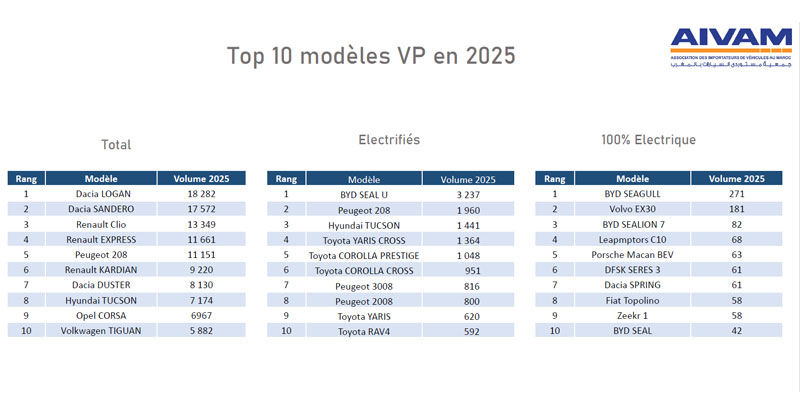
It's done. They're already the premier automotive superpower now. It might not seem like it in Europe and USA, but anywhere else in the world they are dominating. I live in Morocco and I am not exaggerating when I say that every week I see a new Chinese brand on the road. Not just cars of the same brand, completely new brands. Dacia and a lot of PSA cars are built in Morocco, so naturally they always had a strong positioning here, but now I'm seeing more BYDs than DACIA's most popular car, the Duster. It's anecdotal but it's quite telling considering the foothold French brands have always had here.
Here's a chart showing the sheer dominance of Chinese brands on the EV market in Morocco. 6 out of 10 models are Chinese.
https://www.wandaloo.com/files/2026/01/aivam-bilan-marche-au...
And I think the difference is going to be apparent 15-20 years from now when new parts are needed for these models.
With the big boys like Ford, Toyota etc I can trust that they manufactured (and still manufacture) parts with warehouses full of them and I can always find the part I need to repair a vehicle.
I very much doubt that we will see the same thing with Chinese auto companies, even premier ones like BYD.
Perhaps unstated, but this is going to be like trying to find parts for my Nokia 3210 (current age: 27). EVs are still in the "rapid improvement" phase, and by the time the battery warranty expires (5-7 years) the cars available on the current market will be significantly better in all respects.
On the other hand, they just have far fewer "parts" in the first place. Early indication is very good for lifetimes of the non-battery parts.
I expect the median EV of today to have a shorter life than a corresponding ICE, but the EV of 10 years time to have a much longer one. Which is going to make all the stupid issues around infotainment and subscription issues more acute.
The average age of all cars on UK roads has just hit 10 years: https://www.racfoundation.org/media-centre/average-car-in-th... ; EVs skew young because they're new.
I'd be more concerned about the underlying skateboard of the car; all the mechanical bits & bobs that are still required for an electric car i.e. the "car" part. I feel like new Chinese manufacturers' skateboard will be hugely inconsistent over time, whereas you find that consistency with established manufacturers - for example many EVs started out built on top of a manufacturer's existing platform.
(The other direction: the costs of battery replacements haven't gone down because the demand mostly doesn't exist. The "range degradation" of EV batteries at 20 years isn't noticeable to the owners at 20 years.)
And they often outsell European cars price-to-price, even through tariffs. It's crazy.
The whole topic of tariffs on their cars is also very complicated that European automakers aren't in favour of, because large parts of their sales come from outside Europe.
Most of the European EVs are basically just electric city cars, unable to drive long ranges due to small batteries and limited fast charging. And most of them after 100,000km will need a new battery. Doesn't really fit in with Toyota's 'long term reliability' stance.
I can't blame Toyota for waiting for the technology to mature before they go all in on EVs. Plus they do have the bz4x / RX which are full EVs you can buy today.
Australian cities must be enormous for this statement to make any semblance of sense.
The top 10 most sold European EVs in Europe in 2025 were the Skoda Elroq, VW ID.7, VW ID.3, Skoda Enyaq, BMW iX1, Audi Q4 e-tron, VW ID.4, VW ID.Buzz, Audi Q6 e-tron and Volvo EX30. All but the iX1, the ID.Buzz and the EX30 you can get with >300 miles range. All but the iX1, the Q4 and the EX30 you can get with >150 kW DC charging.
Whether any of these is a city car depends on your definition; to me a city car is something like a Toyota Aygo. The current version, the Toyota Aygo X, has an overall length of 3700 mm. The shortest car in the top 10 list from earlier is the Volvo EX30 at ~4200 mm. I think being 0.5 m longer than an Aygo disqualifies even the Volvo from being a city car.
Source for sales numbers: https://eu-evs.com/bestSellers/ALL/Brands/Year/2025
And they could still be right. The future could be 100-mi-EV PHEVs with ever-smaller engines and they'd be the best at it. But I think BYD will prove that wrong outside the USA.
That is, the people who design engines and run the engines division have sufficient heft within the organization that they can prevent a good car being made that doesn't have an engine in it.
It's sort of worked out for them as they have a big niche in the taxi market, and other high milage users who've not taken the EV plunge yet. If you want the most efficient vehicle that still uses petrol, buy a Toyota.
I thought we were there already tbh. Chinese cars have gone from laughably bad to quality parity in less than a decade. Like even 2 years ago, I was still hearing "the paint the paint" as the last remaining issue. But I dont hear that anymore.
Otherwise the software is pretty good, with the occasional midflight reboot.Its definitely no worse than the honda I ran previously.
Their interiors on midrange+ vehicles seems leagues ahead of European automakers.
A 100k+ euros Mercedes Benz E class doesn't even get you real leather from a decade (by the way I prefer MB tex, but what are you paying for exactly?).
It's literally quieter than a bicycle, except for a whirring when the car powers up. We've come across people and animals standing in the middle of the road because they didn't realize the car was right behind them.
Soundproofing is good too. It comes with karaoke built in and it's more sound proof than many karaoke rooms.
Suspension is much better than my previous car but I'll reserve judgement until it's also 5 years old.
Seats are comfortable enough to sleep in - some people are even using it as an alternative to a hotel, because you can keep the air-conditioning on all night and the seats go all the way down to a horizontal position. There's a window up top so you can watch the stars at night too.
Also the seats have air-conditioning in case your back is hot too.
BYD's seem (super subjective) to make less road noise outside of the vehicle. I still get snuck up on by them in car parks, but I have tuned in to the Tesla hum and can hear them a while off.
That makes it easier for brands who sell cheaper models imho. It is all about status, and right now having an EV and a fricking 17" TV on the dashboard trumps everything else.
They're up roughly 10% over last year and will likely hit 35% of global production. The big shift over the last decade (beyond their growing market share) is that their overall quality has caught up to (and in many cases surpassed) the traditional incumbents.
Barring a global war, I think they're unstoppable at this point.
Toyota did become the dominant producer, but American and European car makers (and now Koreans and Chinese) are still around. I wouldn't bet on total domination from China anytime soon.
Basically Japan never had the numbers to "take over the world" while China has them even if natality is way down.
If China had the same clout relative to population as Japan, Germany, Korea, or the US it would dwarf everyone else, and that's why the US are in a panic about China.
This is dangerous, geo-politically, should China ever go to war with the West in any capacity.
In WW2, America's car factories gave it a decisive advantage, as part of the war machine.
Ford’s Willow Run plant produced one B-24 bomber every ~63 minutes at peak output. General Motors built tanks, aircraft engines, trucks. Chrysler: tanks and artillery.
The West de-industrialised, as a result of our globalist policy (thanks to the WTO, WEF and other supranational organisations). We have decimated our own military industrial production capability.
Meanwhile China has taken exactly the opposite approach.
I don't think the deindustrialization narrative is quite as bad as the doomers would have it, although it's notable that both sides in the Ukraine war depend on Chinese drone electronics.
(we've also forgotten the nuclear war narrative of the 80s: it's irrelevant if you can build a bomber in 63 minutes if it only takes the ballistic missiles 43 minutes from launch to arrival, at which point the war or at least industrial society is over)
I’m sure they can handily win the lower end of the market though. And yes I’m aware many western manufacturers are shit tier quality.
Having a totally local, integrated supply chain pays dividends in a lot of ways, as does leading in production volume. Tim Cook also gave that interview where he was just talking about the incredibly deep bench of industrial talent that you just can’t find outside China at this point - that labor cost wasn’t why they produced there.
- Japanese consumer goods were perceived as junk until the tipping point was reached, and then they were perceived as high-quality, easily equalling or surpassing Western goods. That took ~30 years (1950 to 1980, say). Older readers will recall the controversy over Akio Morita's (Morita-san being the founder of Sony) statements in the book "The Japan that can Say No" (edit: see [0]), which seems strangely prescient in the sense that it ignited a lot of (US) debate around dependence on foreign semiconductors.
- Then there was Taiwan, again, a 30 year cycle from about 1970 to 2000. Taiwan used to be known for cheap textiles, consumer dross, and suchlike. Not now...
My point is that the way to get better at products is to make them and make them and make them, and eventually an export-led country reaches a tipping point where the consumers flip over, and their perception changes.
Regardless of where they are perception wise, the long term lesson is clear - local manufacturers may ride the "quality" bandwagon for a while, but ultimately it's a losing strategy.
ICE cars, and manufacturers who don't gave an EV strategy are already inside their Kodak moment. It's fairly obvious that at some point "all" cars will be EV, just like "all" cameras are digital. Those who remain ICE only will fade into obscurity.
Unfortunately the politicians in the US right now are driving a narrative away from EVs (and Tesla has become semi-toxic). Which in turn affects local manufacturers planning near term sales. By the time the mood swings it may be hard to catch up.
Or maybe not. Maybe they come late to the party simply skipping a bunch of iterations, going straight to great, cheap, reliable. Time will tell I guess.
My last few cars have been Hyundai's. Unfortunately my driving habits don't allow full EV driving, but I did go with one of their (non-plugin) hybrids.
And almost all of my family has moved to Hyundai over time. The pure US car companies have been dumping out total crap for the longest time, it's an easy sale for almost anything else.
Even though China can compete at the top of many markets, they still also compete at the bottom, which taints their reputation.
China is clearly supporting Russia in Ukraine. China is clearly making plans to invade Tiawas (that alone makes them just as bad as the US, even if it hasn't happened yet).
Your empire is decaying and it's going to keep lashing out up until it's completely gone.
China conducted one several-week war against Vietnam and annexed Tibet, both over 50 years ago. Other than the longstanding dispute with Taiwan, who are they threatening? Some quibbles over a few Himalayan mountains with India?
Two wars.
According to Chinese claims, the number of soldiers killed was 32 on the Chinese side and 65 on the Indian side in Nathu La incident; and 36 Indian soldiers and an 'unknown' number of Chinese were killed in the Cho La incident.[8] "
War might be overstating it a bit, "incident" might be more appropriate, but we can round up in the spirit of comity.
So adding it all up, the Chinese had 1-2 small foreign wars per decade in the 50s-70s, zero since 1979. It still doesn't justify the phrasing "threatening all their neighbors" in 2025, aside from Taiwan specifically.
In the case of the line of control with India, it's reached the point where they're having ritualized fistfights at high altitude for pride, that's just comical. It's not threatening.
I've got one from 2011 that I'm still driving myself, and aside from one minor thing, I've not had a single problem with it, despite putting it through its paces.
European companies are trying even harder to outsource to China.
In the past months I’ve seen an increase and it feels like almost everything is made in China, from books to Christmas trinkets to clothes and kitchen utensils, it’s a pain the ass to find locally produced goods.
This has a lot to do with the energy crisis triggered by decoupling from Russia, which was never properly put into context and evaluated from an economical perspective.
Simply put China is an unrecognized superpower at this point with the investments they've already made. The amount of infrastructure they've built in a decade dwarfs what the West has done in decades.
When Americans discover again how crappy their cars are compared to what's available elsewhere, like we did with Japan, there will be a reckoning once more. And again American cars will become the laughing stock they really are.
In the meantime, this incredibly short sighted protectionism will end just like the last round did. Further hollowing out our industrial base and permanently giving away large parts of a massive market.
And I'm sure all of the people involved in this insanity will want a bailout too.
No, that's not what happened. Japanese manufacturers made cars in the US, to match US tastes. Japanese cars as sold in Japan, were not models Americans would buy.
>In the meantime, this incredibly short sighted protectionism will end just like >the last round did.
It'll end with...Chinese cars made in US factories w/ American workers? Chinese V8 pickup trucks failing to win market share against the US competition?
Honda started selling cars in the US in 1970, with their quirky, tiny, Japan-made N600.
The Civic didn't happen until 1973, and it was also a Japanese-built car. Bigger than the N600 but still very small by American standards, it was the right car at the right time for the oil crisis the US was beginning to face. They sold a lot of Civics to Americans, despite the strong anti-Japanese sentiment around that time.
It wasn't until 1982 that Honda started building cars in the States, with the introduction of the Honda plant in Marysville, Ohio that began building Accords.
But even then: They still didn't build all of the USDM Accords in Marysville; many were still built in Japan and imported. It took additional years for the transition to fully occur.
---
That's 12 years from the time that they started selling cars in the US, to the time when they began to build their US-market cars in the US.
(If 12 years sounds like a short period of time, remember: We've only had the Tesla Model 3 for about 9 years now.)
The Japanese made cars for the US that were different than local cars, but they were also different from what the US was making.
If you read Calvin and Hobbes you can learn that Taiwan used to be known for making... shirts.
For my primary tools I'll have hundreds of hours of use I still buy the more expensive brands, but on tools I'll use much less commonly I'll pick up a Chinese unit in a heartbeat for 1/10th the price.
Maybe Jeep? Very popular, dogwater quality. They take nearly half of the Consumer Reports “top 10 worst cars on the road” almost every year.
It’s a theory for sure, but I don’t think that’s a common strategy for modern capitalism.
That notwithstanding, Xiaomi cars are nicer than Teslas. They're called "the Apple of China" for a reason.
In some cases:
Target - in 2022 we enhanced our starting pay again, offering a range of $15 to $24 per hour
UAW wages at the big three automakers start at $18 and top out in the $30's. Meanwhile, UAW jobs at suppliers can start as low as $14/hr. You're probably not going to get 20-30 hours of overtime a week at Target, though.
Only 150,000 of the 380,000 UAW members are employed by the big three.
You also have union skilled trades jobs (electricians, millwrights, etc) that make more than production workers but Target pays their electricians etc more than the retail workers as well.
Sometimes it’s the carrot and sometimes it’s the stick but the policies remain the same.
I’m not anti-EV but the electric Macan and Cayenne look awful. They are under equipped technologically relative to their Chinese peers (heck basically anything).
Porsche sort of sold its soul for this tech-forward design but it doesn’t deliver any meaningful benefits, these cars don’t even have level 2+ highway cruise control. In the meantime I get a bunch of crap screens and lose all the glorious physical buttons and I don’t even have a fun engine rumble to make up for it?
So, the cars are ugly and uncool (I grant a matter of taste), aren’t selling in their target market (China) won’t sell meaningfully in their backup market (US) and they’re behind GM, Tesla and BYD in all regards on quality of life stuff.
Not a recipe for endurance.
Design is obviously a totally personal matter of taste, but as they have made many iconic shapes, apparently they're in the broad opinion not too bad at it.
The main difference is driving. I have driven many cars in my life, from very cheap to very expensive. For me personally, Porsche is in my opinion comparable to using a Mac - they're one of the few who "get it right":
- The entire workmanship is fantastic—nothing wobbles and nothing rattles. - Everything looks very harmonic, from interior to usability. Every button is where it has to be. Even the built-in entertainment system is highly usable (which in my opinion others like Mercedes never got right). - And, most importantly, despite being ICE or EV, the whole driving experience is just lightyears away from many competitors. Whether it's a 911 or a 718, they are just a joy to drive. Even a Cayenne just doesn't feel like a bulky SUV. There seems to be a lot of engineering going into all of that, weight distribution, chassis tuning, etc.
Apart from that - again, having owned many cars in my life - they're the most service-unintense cars ever. They just - work. You change the oil, sometimes the tires and that's it. I never had a single bigger problem with them.
Is there a lot of stuff which they didn't get? Agreed. Would it be nice to have better self-driving options? Without a doubt, but that's just a question of time.
But at least you have to give them that they, in strong contrast to many other German car manufacturers, didn't miss the trend and started to produce sexy EVs (hello Taycan) from very early on.
As long as I can, I will stay a loyal customer to them. If you have never driven a Porsche, get a test drive. I can only highly recommend it.
PS: And double points if you can do it on the German Autobahn. Try driving 240+ km/h with any other large-volume-production car, you'll be sweaty. With a Porsche, it just feels joyful.
This is just very much not true, Audi, Mercedes,Toyota, BMW breeze through it, hell my friends audi S4 from 2004 regularly shoots 240+ over the autobahn, and we never break a sweat.
- BMW is indeed very nice, I agree. I also once had a 6 series convertible which was - apart from the very low consumption (Diesel) - really nice to drive. Their cars are indeed a good alternative at a lower price point. - Audi is the utmost catastrophe. Apart from the abysmal navigation system, the car simply doesn't feel safe at higher speeds (had an A6, your mileage may vary with tuned S models). I didn't want to drive faster than 180km/h - Same goes for Mercedes (drove C, E and S Classes). The entertainment system is straight from the 90ies and the steering gets super wobbly at higher speeds. - Toyota - are you kidding me? Very reliable, good value, but nowhere near the driving capabilities of a BMW or Porsche.
Of course they are all nice cars and should do the job, especially in countries with speed limits - until 120 km/h that all doesn't matter. I'm just saying, if you really want (and can) go fast, most of those cars don't deliver in my opinion.
This is an entertainingly German-centric answer.
That refers back to my original answer when the poster said Porsche are "in trouble" because they are "technologically underequipped" and "don't deliver meaningful benefits". There is a lot of stuff China and other carmakers haven't caught up to. Will they in the future? Maybe.
To take that German-centric thing out: Try going on a mountain road and have fun in the corners. I am sure, if you have multiple cars to do the same thing, the Porsche will rank pretty high.
In any case, of course, this is all a pretty niche market for people who love driving sports cars. In 99%, a Toyota can deliver exactly the same value for the base use case (going from A to B) for way less money.
Now I kinda wish my Prius had a 3.5mm aux-in jack but I get by with an FM transmitter.
1. Backup camera with lines that move as you turn the wheel
2. Camera setup that lets you see how close you are to curbs, other cars, etc. from a plethora of unexpected angles (you can get a top-down view of your car! Pretty cool.)
3. Automatic parking when parallel parking
4. “Reverse actions” feature, where you press a button after very carefully getting into a spot, and the car replays it in reverse to get you out of said spot
5. Lots of remote features tied to an app. The ability to look through cameras, auto-record videos when people get close, lock and unlock and view status of the car. Remote tracking via GPS in case it’s stolen.
6. Turn on your turn signal, your dash changes to a live video feed of that side of the car
7. Chairs with heating and cooling, massaging, and auto-inertia-damping features
8. Bluetooth and Apple CarPlay plus Android auto
9. Road-scanning cameras which adjust suspension live based on upcoming road conditions
10. Crash preparation features like Benz’s Pink Noise or auto-recording a minute of video to assist with crash investigations
There are probably may I’m forgetting.
This is akin to spyware, since inevitably it is a cloud service using an onboard cellular modem.
I would personally rather have none of 1-10. What I do want in a high-end vehicle is things that are there for my benefit (heated steering wheel, heated/ventilated seats, spacious cupholders, etc.) not the manufacturer's.
Some of these have been around for almost a decade. Not specific to EVs. I drive an ancient car (2003), but I've rented cars that have the rest.
and, this is not a joke, truly: the seat gave me a massage.
There are hundreds of millions of drivers with new ones entering and old ones exiting the roads all the time.
If you want to practically improve safety you have to make the vehicles safer, you can't just hope pointing fingers at bad drivers is gonna do anything.
So many parents ran over their own child that backup cameras are now mandatory in the US.
Yes, in principle one could take whatever other measures necessary to prevent such accidents. In reality, backup cameras save lives. Just like seatbelts, anti-lock brakes, crash safety standards, and other safety features that "Real Manly Drivers" protested against back in the day.
So yes everyone is right, yes a lots of people are just bad at taking basic safety measures but backup cameras are still a necessity because this will not change, it is even worse with people doomscrolling their smartphone while driving.
How does that help other people walking down a sidewalk?
I'm in the market for buying a new car, either EV or hybrid. Currently have a Audi, been looking at various BYD models, particularly the new Touring one.
One important feature, that I didn't know I needed before I tried it, was in-seat AC, where the air from the AC hits the back and bottom, instead of just your arms and face. Living in a warm country, and spending most of the time in the car during the summer, this feature is something I really want now.
Heading to Audi and asking what the cheapest model available with that feature? Around 70K EUR. Doing the same but going to BYD: 35K EUR. And that's just considering that single feature, the same happens for almost everything. Want a HUD in the windshield? Audi adds 5K to the price, with BYD it's in the middle variants and up.
Basically, you get the same amount of "features" for half the price, and it's hard to just say "Well, I'm a fan of Audi so that's worth the markup". Still, there are many decisions that go into purchasing a car, not just the features, but I think that explains why you see that argument come up, because they do offer more features for cheaper than at least what the European car makers do.
They're going to need to cover the losses they're compensating for with the ridiculous upgrade prices somehow or they're going to lose even more customers. The import tariffs raised to protect the European market from affordable Chinese cars aren't going to work forever.
The equivalent BYD comes with all of that included for free in the cheapest SKU. The biggest differentiator is that the heated seats are only available in BYD's most luxury version of the car, but the most luxury option is still 22% cheaper than the Skoda with equivalent options. BYD does charge more for a lick of paint, to be fair, so if you're looking for a specific colour you may pay a little more.
Perhaps BMW and Mercedes are worse at this, but the 150 euro plastic tray with cup holder says everything that needs to be said.
Lincoln started doing this about 20 years ago. You can buy Chevrolet pickup trucks with this feature. Of course my Polestar 2 (Swedish but made in China) has ventilation.
Now some might do true AC, while many just do ventilation, but either way it adds a lot of comfort if you're in a very warm cabin (or, say, have a huge panoramic sunroof.)
To add insult to injury - a good portion of it is tariff (which in itself is just countering CN government subsidy)
I'd be careful buying Chinese EV's purely due to sanction/markup depreciation, on top of already hard EV depreciation.
1. They do not have robust self-driving capability. At this level of expense I expect hands-free major highway driving.
2. They’ve removed a lot of physical buttons that improve quality of life, the level of technology in the cabin is simply overwhelming.
3. They’ve done a great job with the driving experience of the EVs but they have poor range relative to the competition.
It very much is! (no offense) And EV vs ICE doesn't make a difference, the manufacturers put the same ADAS systems regardless of the powertrain.
BMW has had radar cruise control + lane keeping since 2016 I think? In 2019 they added full hands-free operation in highway traffic (up to 40 mph) as well as auto lane change when you tap the turn signal. In 2023 they have full hands free up to 85 mph on highways, plus auto lane change w/ navigation integration and auto-overtaking (car promps you to check the mirror, then changes lane completely touchless).
A frickin' 2020 Honda Civic has the same ADAS functionality as your '22 Porsche, even on the base trim ($21k). Porsche is way, way behind. And that's before you even get to all of the non-ADAS drivers assistance systems for parking, reversing, etc., which again the other Germans trash Porsche on.
IMO the car has a lot of bells and whistles that many drivers (probably!) don't really care about. But I guess car fans like this kind of stuff. The active noise cancelling feature might be nice, but wouldn't be surprised if we see regulation on that matter at some point. You kind of need to be alert of your surroundings, etc.
Where I live, luxury cars are just status now. I don't think that's enough to keep gen Z and gen A interested.
As an EV it is excellent. But Porsche is known for engaging driver's cars, and without the visceral sounds and vibrations of an engine it is bland and boring. The flaws in a gas engine's power curve give it character. Letting the driver manage that power curve is fun. A perfectly linear sub-3s 0-60 with fake electric sport sound played through the speakers does nothing for me.
I'd have probably bought it at $75K, but at $125K it needs to be more special. Especially considering the rate at which they depreciate. Its not a surprise to me that their EVs aren't selling as well as hoped. The Taycan sure is pretty though.
Prosche specifically is facing huge losses, and with this strategy is doomed to die. There are already rumors of potential bancrupcy.
EVs grew 20% globally in 2025, with developing markets surging 40%+. When EVs under $100,000 can hit sub-2.5-second 0–60 mph (0–100 km/h), all this fake "benefit" talk about exhaust notes and luxury engine refinement sounds exactly like people cheering for Vertu golden buttons at the dawn of the iPhone era.
EVs are growing incredibly fast—despite the West's biggest EV supplier deciding to commit marketing harakiri by alienating half its customer base.
New battery tech has made EVs affordable, and that's why adoption will keep accelerating in China, the EU, and the rest of the world. There'll be some irrelevant fluctuations in the US, but those will eventually even out regardless—because the rest of the world and technological progress will move on with or without them.
we are on the edge of go-to-market of billions of dollars of investments into battery development. It will deliver both much cheaper where needed and more capable batteries on the market. Guess what it will do with legacy cars.
The market for EV sports cars is soft. The Rimac Nevera R broke 24 performance world records and yet nobody wants to buy it [1]. Even the CEO of Rimac has said people want an engine sound. Meanwhile Ferrari can launch an even more expensive gas car and it sells out before its officially announced [2].
I'm pro-EV and my partner owns one. They are practical appliances that are perfect for the 90% of people who just want to get from A to B. But the stats show that it's not just my personal preferences. The average sports car buyer wants an engine and exhaust.
0. https://newsroom.porsche.com/en/2026/company/porsche-deliver...
1. https://www.carscoops.com/2024/05/slow-selling-nevera-is-a-s...
2. https://www.reuters.com/business/autos-transportation/ferrar...
If there's no electric 718/911 version to hype them up, there’s not going to be any demand. There's also the issue that they're known for their small sporty cars, yet they're trying to sell 5m-long sedans and 'soccer mom' SUVs and failing at it.
The Taycan is pretty close to being an electric 911. There's a 718 EV coming out soon but Porsche realized there was not enough demand so now they're retrofitting a gas engine into the design.
The lack of demand for the 718 EV boils down to EVs being heavy, and therefore less chuckable than the gas one, and the lack of soul & engagement in cars without an engine. Solid state batteries will eventually solve the first problem. I'm not sure how we can solve the second one. Perhaps kids of today will grow up caring less about mechanical sounds.
Personally I experienced this the strongest in my friend's restored mk3 Ford Escort. I recall it as a feeling of not actually being inside a car due to the wind and engine noise.
Meanwhile the BMW 5 Series I rented a while ago didn't provide any of those feelings. Granted, it was a diesel automatic, but when I floored it, it just went and the engine noise was barely noticeable - at least compared to my poorly noise insulated daily Toyota.
The best thing about that car was that I could take my family on a 400km trip, the last 100km of which were mountain roads and not even break a sweat.
Unless you live in a really remote and desertic place, there are just too much people on the road nowadays.
Who says it's supposed to boring? It's supposed to be safe and you're supposed to drive with the consideration of others, but I don't think it's supposed to be either fun or boring, that's up to you.
I'm having a blast rolling down the highway in the middle of the night blasting music and singing, am I not allowed to do this because driving is supposed to not be fun?
I am saying this as a pistonhead in remission.
But what people usually mean by 'fun' driving is mostly just antisocial behaviour - too fast, loud brrm-brrm noises etc
Most people can safely wring out their cars in 1st and 2nd on a highway on-ramp, or from a traffic light on an empty 55 mph country road. I own a fun weekend car that I take out at dawn on a Saturday to carve up a mountain pass - which is fun even at the speed limit. In a lightweight sports car with excellent brakes, I am safer than all the trucks I see on these roads.
I used to have a GT3...it was a dream car of mine and I finally got it. The sad reality was that in order to have fun with it on public roads I was either going to kill myself/someone else, or go to jail. The only way to really experience that car in a responsible way was to go to the track. Which I just flat out didn't have the time to do with young kids.
Things were very different 20-30 years ago. Roads were less crowded and people were much more respectful on the road. Now, especially where I live, it's a free for all Mad Max cosplay.
Luxury sport cars are sold on 2 basis, a status symbol, and being driver's car. If you don't have the second and it's just another EV why bother ?
I am modtly getting my racing dose/fun from simulators these days but go-karts are cheap and fun in comparison of a road homologated luxury sportscar.
(Of course, if a lot of other people share my extremist views, that's pretty bad for Porsche the company. They likely can't survive just producing 911's. Oh well, I'm not here for corporate charity anyway.)
But the 911 range has a lot of bandwidth and there are models that go from minimalist driver’s car (911 T) to Touring/GT (most 911s) to race car for the street (GT2/GT3). But you definitely pay to step outside the GT box.
The way forward for Porsche would be to rip the band aid off and focus on just EVs. Leave the ICE market to hedge funds. Those are good at milking dying businesses that shrink year on year. They need to do some EV only models that are heavily optimized at being good at just that. Leave the SUV crossover BS. to all the traditional brands and make a proper sports car that goes fast and far. A little autobahn monster. That would restore their reputation for delivering unapologetically high performance cars that are slightly dangerous and exciting.
ICE is dead. That's grand daddy's car at this point. That's not something somebody born this century is going to lust after and put on their wall (in poster form). And Porsche needs something that young people would want if they had the money. Their current lineup is a bit too conservative and boring. Sensible cars if they'd be half the price. But they are just too expensive and unremarkable to sell well. You can do better for the same money.
I can't exactly remember the situation but I'm pretty sure there was a car company that did something like this in recent history, restarting a production run on a classic model and selling it out.
It's like bragging about having a Hermes bag vs a Temu brand bag. Yeah it's all irrational, but if the world was a rational place we'd not have a man-child threatening wars and invasion because he didn't get the peace prize he wanted...
(NYTimes - Why Porsche Is No Longer a ‘Premium’ Sports Car in China)[https://www.nytimes.com/2025/02/17/business/porsche-china-ge...]
Electric motors are essentially maintenance free over the life of a BEV, same for the batteries. The maintenance is for brake pads/rotors, but regen braking also avoids that.
There is the passenger heat pumps for heat/cooling, and the lighting, but LED lighting also requires minimal maintenance.
That cuts out a large chunk of the automotive industry in general.
US/EU/JP manufacturers are having to handle a major market disruption, independent of whether or not CN is leaping over them.
They require maintenance, although less than an ICE, but drive train repairs are not as uncommon as you might think. Manufacturers are always going to pinch pennies.
> That cuts out a large chunk of the automotive industry in general.
Hardly. You've removed the engine, fuel and exhaust system. You still need literally everything else. Windows and motors, doors and locks, wheels and hubs, seats and accessories, gauge clusters and radios, environmental controls, differentials and oil changes, the list goes on and on.
You deliver them the same way, you sell them the same way, you license them into the system the same way.
> US/EU/JP manufacturers are having to handle a major market disruption
That was called COVID. They all handled it badly save Toyota. The oil companies have far more to worry about.
Post COVID was getting back to what was before, this is the equivalent of the introduction of Ford mass production techniques on the previous industry of coach building.
ICE engine parts are a major ongoing expense but also profit centre for dealers and an entire industry on their own.
So there's entire supply chains that will be disrupted.
How many engine plants are going to be needed going forward?
Australia went through this wrench back in 2014 when our local car industry collapsed after the government withdrew a measly amount in annual subsidies.
Fortunately it was a 3 year process that played out that allowed adjustments.
That had a major knock on effect of the loss of roughly 50K manufacturing jobs and industries had to pivot.
The US/EU/JP manufacturers are having trouble pivoting, the US because its car industry is entirely about trucks/SUVs, EU because its premium for manufacturing is rapidly eroding, and JP because they seem to be having trouble actually manufacturing EVs.
CN and KR is where the leaders are now.
Suspension and tyres might actually need more frequent maintenance because of the extra weight of an EV.
But how often does suspension require actual maintenance?
It’s an alignment problem, trivial fix.
The suspension is a rust issue, I believe EVs are still made of metal.
Given in the last 3 years I’ve only spent money on tyres, replacement wing mirror, and now suspension on this car, and you assert an EV needs more spending on tyres and suspension, it seems that an equivalent EV would be higher maintenence costs.
I’m sure things are different at the high end of the market where you’re spending £10k on a nearly new car, but at my end where it’s under £2k it doesn’t make sense.
You had me until "same for the batteries." The batteries do pretty well, but they are quite the gamble.
The audience of Porsche SUVs (cayenne, macan) care about signaling wealth via the badge. But they mostly want an everyday car for their commute, groceries / kid pickup.
No wonder the EVs options sell better. They have the badge, and are better at everyday tasks.
The 911 will stay gas powered (maybe e fuel at some point if mining of oil stops), because the target audience cares equally for signaling as well as the driving experience.
Yes they are very functional compared to a 911. No they don’t drive like a 911.
Do they drive better than an Audi A7, Mercedes GT, BMW 8 series? That is debatable.
FTR I don't care about this myself, I'm happy with my EV. But the importance of this aspect is easily missed by people not part of the target demographic.
https://www.drive.com.au/news/electrified-vehicles-have-offi...
Hybrids aren't running around doing 30 miles a day with a 300 mile battery like most EVs. Talk about inefficient!
Since the short trips can all be done very efficiently on battery (recovering all the braking, too), I guess the weight isn't much of an issue for commuting if you can have the rest -half of the total driven miles- on EV with a full battery vehicle.
I wish I could find numbers on eCO2/miles for the short vs long trips.
The future of BEVs (and the most practical today) is also charging at home, and available chargers can grow slowly with BEVs used for road trips. Tesla is pretty close to there already. So, chargers don’t need to ubiquitous, just a bit more available on less common road trip routes.
They screwed public transit and entire nations just for profits. I love my Subbie and I'll keep that until it breaks apart and replace it with an EV. Maybe today there's many downsides to an EV, but I hope it evens up and maybe becomes even better to get one.
Looking at Doug Demuro reviews it has one the worst weekend score and one the best daily score. Amazing.
>“Many of the problems with EVs and plug-in hybrids are because they are newer designs compared to gas technology, so some kinks still continue to be worked out,” says Jake Fisher, senior director of auto testing at Consumer Reports. “By comparison, hybrids have been around for nearly three decades, and the technology is tried and true.”
https://www.consumerreports.org/cars/car-reliability-owner-s...
[1] https://www.carscoops.com/2025/10/toyota-accuses-rivals-of-s...
> In 2025, 34.4 per cent of Porsche cars delivered worldwide were electrified (+7.4 percentage points), with 22.2 per cent being fully electric and 12.1 per cent being plug-in hybrids.
My hunch is there are some laws or regs somewhere that kept hybrids from really taking off (or rather, they were taking off.. then suddenly were suppressed). Which is why I don't interpret headlines like these to mean "consumers have crossed the tipping point" - in many cases it is incentive-driven, not pure consumer demand.
The EU is committed to the full EV route and that is not changing. But it's not taking hold in the US, and over the next few years the big thing we will see being sold is actually EREVs, which are BEVs with a gas generator attached to charge the battery (yes, really).
Source: in the industry
Being able to shed the ICE bits from the car's powertrain eliminates multiple entire classes of maintenance burden. With hybrid and EREV you get the problems of both types of powerplant and drivetrain, and even though ICE has evolved to be fairly reliable, it's still a very complicated assembly and basic wear-and-tear still is still a challenge.
There will probably be parts of the country where hybrid or EREV make sense for some period of time due to the distances involved and the incredible energy density of gasoline, but a lot of the driving that happens day to day can already be handled with pure EVs as long as you have a 120V plug accessible to your car.
I don't know but is this a uniquely US (and/or a few other such countries) thing, because of the high volume of daily driving?
Here in India we send our (ICE) car in for a service somthing like once or twice a year? And that too is mostly because "the engine sounds a bit off", not "the car isn't starting".
Less maintenance sure is nice, but I don't think it's consciously a "problem" for many.
All the other maintenance I do would be the same with an electric vehicle (suspension fixes, flat tires / new tires, brake pads / brake fluid, etc).
ICE car maintenance isn’t a problem for me either. That alone isn’t going to make me buy a new $40k EV with no physical buttons because it’s one giant unusable touch screen that is a safety hazard to me and anyone else around me.
(Looking at you Polestar - your entire interior UX is garbage.)
Hybrids are a better option for me since I don’t have a charger at my house nor do I want one, but they’re also very expensive.
I had one car where the timing belt broke unexpectedly and because it was an 'interference' engine, that led to damage to the engine head and a piston rod (and could easily have been bad enough to have been irreparable had the timing been a bit different).
Second car, had a loud noise from the engine that resolved on its own while driving up a hill. That car model later has a recall for the engine catching fire. Did I just get lucky? Who knows.
My first car (a minivan), the rear exhaust plate fastener broke while driving and make a noise that could be heard from a mile away... right as I was driving past a bunch of cops on heightened DUI enforcement night. Now I wasn't drinking but I still didn't appreciate my car not only breaking ostentatiously, but buying me a ticket in the process.
A fourth car, also a minivan, had an issue with its automatic transmission where it would struggle to upshift going from first to second gear sometimes. At least once every couple weeks, sometimes more frequent. It was never resolved by the manufacturer or any mechanic we could take it to before we sold it.
Now I did make sure to mention that ICE has evolved a high degree of reliability for a reason, but the fact is that even when the odds of things going bad is low, when there are a multitude of different independent ways for things to go bad (as there are with an ICE engine and drivetrain), the birthday paradox makes it inevitable that something will eventually be an issue.
And even though I had an issue like that with every ICE car I have ever owned, even those I didn't have to take to the mechanic for an issue outside of routine maintenance twice a year. They were more reliable than that, but that wasn't enough to keep them from falling prey to various issues.
Also if everyone in your neighbourhood turning on a space heater strains the grid you have bigger problems.
Utilities have plenty of ways to solve that. We already have electric water heaters on demand controlled circuits and electricity billing that incentivises off-peak use.
And as for range? 400km is plenty for all but one trip a year, if that's an issue for your use perhaps EVs are not for you.
Not to mention parking garages for daytime parking at work.
Not to mention mall parking lots.
The garage is an obvious starting point, because your car spends a lot of time there, but there are lots of opportunities elsewhere.
Once upon a time 44 million households didn't have electricity. Things change.
So now you’ve added another thing I have to worry about - finding charging somewhere along my 10 minute errand route?
EVs are a bad solution to a problem I don’t have. Hybrids are much better.
For the small amount of driving I do, driving my commuter ICE car with a tiny, 35-mpg 4 cylinder engine is fine… why are the EV cultists so convinced their way is the only way and the rest of us are living in prehistoric times?
Plus, your EV is heavier than my ICE, so your tires shed rubber particulate more quickly than my tires due to the weight, which is also an environmental pollutant (that is toxic enough to kill wildlife, btw)
Your car lives somewhere when you're not doing errands. Expect a charging point there as demand for that grows.
Not to mention charging points at the mall, shops, restaurants and so on.
Clearly it will be a long time before EV replaces ICE completely. There was lots of horse infrastructure which changed when cars appeared.
But the pendulum is swinging and each motion there opens up new opportunities.
Also each motion has an impact on existing infrastructure. Expect gas stations to be less common, ditto for mechanics and so on.
>non-exhaust emissions on an ICE vehicle are roughly 1/3 brake dust, 1/3 tire dust and 1/3 road dust. EV's have almost no impact on road dust, 83% lest brake dust and 20% more tire dust.
https://electrek.co/2025/05/27/another-way-electric-cars-cle...
My point exactly. Your new EV has more tire dust (and probably more brake dust) than my old, smaller ICE.
> But who is saying we have to "stop" oil and gas?
People who are concerned about climate change? Should we not be?
The people in this thread have lost their minds in a cult of EV.
I don’t know why EV has to be the answer to every question. There are plenty of economical hybrid options.
It's a lot more comfortable though. It's been a great addition to the home to get an EVSE, even a small single-phase one.
Good point, most people without garages should continue buying hybrid or ICE, because EVs aren't for them yet.
That way I wouldn't need to stress over finding a charging place so often.
Welcome to Texas.
And with Texas a 200 mile+ driving day is just more common than people from smaller places experience.
Probably not 7 days a week, but a couple days a week, sure.
And of course not everyone. Maybe 10%?
Not that it matters. What do I care about the needs of some Texans? (I mean that non perjorativly). I mean just because ranchers still need horses doesn't mean the rest of us have to use them.
The world will go EV, even much of the US will go EV, regardless of what some folks need.
There are a lot of people driving more than 200 miles a day for work though. Many of them are in cars because their unique skills are why they need to be there (as opposed to delivery drivers who are bringing cargo).
There are also people who drive a long distance once a week. I know of a rural hospital that pays a lot of doctors to drive in on Thursday so locals don't have to go to the city. (they keep an ER, but the rest of the hospital is empty other than a few nurses the rest of the week)
In an average year I'll have 40+ days where I drive that much. Not for work, just for doing random things.
>a policy failure and we should care about it.
We should, but we won't because Oil/Gas/ICE cars spend an epic fuckload telling you that anything not related driving more is communism.
Eventually this compounds and gas stations start closing.
That accelerates the switch to EVs because gas becomes hard to find. Which accelerates gas station closures, and so on.
The point at which it becomes impractical to drive a gas-fuelled car is approaching. It will hit different countries at different times, but it's there. 10 years, 30 years, whatever, but it's coming.
Long before that point, a hybrid is just an EV that has to carry around a chunk of useless engine that is hard to fuel.
  Elbil: 31,78 prosent
  Diesel: 31,76 prosent
  Bensin: 23,90 prosent
  Hybrid (not plug-in): 5,38 prosent
Plug-in hybrid: 7,18 prosent Electric: 31.78 percent
Diesel: 31.76 percent
Petrol: 23.90 percent
Hybrid (not plug-in): 5.38 percent
Plug-in hybrid: 7.18 percentIn US, gas stations barely make any profit on gas, its all from the convenience store, beer, water, lottery tickets, trinkets, souvenirs, etc. Costco, HEB, Walmart, etc also have gas and can run it as a loss leader for customers to compete with Amazon. As the number of gas consumers go down, gas stations everywhere will start shutting down, except the Costco/HEB/Walmart, because gas stations can't compete with those prices.
The U.S. saw over 210,000 stations in the early 1990s, dropping to around 145,000 by 2022, and potentially as low as 115,000 by 2020, according to various data points. Some estimates suggest a potential 50% reduction in traditional stations by 2050 in some regions: https://boosterusa.com/from-the-experts/the-inevitable-death...
Gas stations are also trying to figure out how charging fits in. While people are expected to charge at home, there will still me some demand for on the road charging. This is a place that hasn't worked out yet (I personally expect people will go for a nicer meal and sit down for an hour charge - but this might be my bias)
As for what would happen with gas station when EV's dominate, what already seems to be in progress here (not due to EV's, but other factors in the market) is that the "traditional" gas station serving stale coffee, snacks, and windshield wiper fluid are on the way out, replaced by either unmanned cold stations with just the pumps, or then by major roads large full-featured mini shopping malls with groceries, half-decent restaurant (sometimes several), and other shops. I think in a future EV world the cold stations would disappear but the higher end service centers would do fine.
You hardly ever need a rapid refuel in your garage though. That's where your car spends most of its hours.
And most of the world has 220/240v mains supply: https://en.wikipedia.org/wiki/Mains_electricity_by_country. Regular wall outlets can charge a car fast enough outside North America.
Car prices have increased well above the rate of inflation over the last decade and even used cars are more expensive than ever. Average new car price is $50k, mostly because EVs are so expensive https://www.caranddriver.com/news/a69047202/average-new-car-...
This is a fair concern, but also, looking at the rise of average car prices is like looking at the rise of average iPhone prices. That is to say, cars (and iPhones) are providing increasingly premium offerings that didn’t exist decades ago. If you look at the entry levels of both these things, you find that the bottom-line price broadly keeps pace with inflation. And for cars, that’s with the addition of now-standard safety and convenience features. When you match cars feature-for-feature (an unrealistic comparison, as there aren’t really bare-bones cars on offer anymore), you’d see that cars are increasing in price much more slowly than inflation, and in other words, are effectively cheaper. Ultimately, whether car prices are rising or falling depends a lot on how you calculate things.
I’ll also add that EV pricing doesn’t have to mean insane car costs. The US market has the Chevy Bolt and Nissan Leaf each selling for about $30k new and can be readily bought for half that with used inventory.
You're right. There isn't a single legacy auto manufacturer in the US (Ford, GM, Stellantis) that can profitably sell an EV. Yet they make them anyway, and sell them for huge losses ($billions per year) because they have to meet mandates.
Elsewhere in the world EV prices are steadily coming down. They're not as low as ICE yet, and maybe never will be, but a nice entry level ICE car here is circa $15k, and a nice EV entry level is circa 25k.
Factor in fuel and maintenance costs and the real price is getting very close....
Full EVs: Less moving parts = less maintenance required = less issues to worry about (think no oil changes, no timing belt changes, no spark plug replacements, no belt/filter changes, no exhaust system checks, etc).
Also zero emissions = better air quality around you.
Bonus: it's like waking up with a full take of gas every morning
I've owned my full EV for almost 10 years now and had 0 maintenance done whatsoever (apart from tire rotation and window wiper fluid replacement). I would never go back to an ICE vehicle.
The above is a tiny part of the costs of an ICE. Sure you have to do it, but either it isn't common, or it is cheap. ICEs have gotten very reliable over the decades.
Meanwhile most of the parts of a car a common between an ICE and EV. You have tires either way, which need to be rotated (do you?) Shocks/struts, rust, tie rods, AC compressors, just to pick a few random ones.
Weight, space and reliability.
Dragging that generator (and fuel) around costs weight and space, reducing range. Exhaust, fuel tank, radiator- all the support systems the ICE motor needs. Which leaves less space for batteries, which reduces range.
Plus, the maintenance burden is still there. All those ICE parts still need all the maintainence etc that full ICE needs. One of the joys of EV is that maintainence is sooo much simpler.
So yes, hybrid is much more efficient than gas only, but a poor cousin of full EV.
By contrast full EV has range limitations. And yes distances in Europe are much shorter than the US. No that's less of an issue there. But even there we're seeing range go up, and charging come down.
Today, a PHEV is the best of all world’s, but full parity for BEVs (in the US) is almost here. Reliable trip charging (NACS, SuperCharger network) and available destination charging will be enough pretty soon.
In terms of ev weight overall, it's typically close to ice weight. (Obviously a lot of differences between vehicle class and range).
An ev has motor, batteries, plus controllers. Ice has engine, gearbox, fuel tank, radiator [1], exhaust.
[1] Evs also have a radiator, but its a much smaller system running at lower Temps, with less water.
I'm converting an old vehicle now to EV and the overall weight difference is not significant.
All ICE cars should have been hybrid from 5-10 years ago but it is a stepping stone we should already be stepping off.
This is just the most visible source for a bunch of people who have made their conclusion unencumbered by the data.
The emissions from powering and heating your house are several times what your car emissions are.
So go solve that one and leave my Corolla alone.
You do realize that net zero homes are buildable? Even in surprisingly challenging climates.
There are so many ways to make better use of the energy we have available than to waste a bunch of it to pollute the air.
I hope you have never run a technology project this way by starting with a goal that simply can't be accomplished; you would have set it up to fail, demoralized your team, and chased the wrong priorities.
The goal is net zero, meaning, emissions added = emissions removed. There must be an allowance for some emissions. Industrial human life cannot continue without some amount of greenhouse emissions.
For that goal, I am way better off driving less than buying a new EV - it releases greenhouse gases to produce the plastic in your Tesla and the battery in your Nissan Leaf.
I walk to the supermarket. I work from home. I don't eat red meat. I'm careful with my home electricity consumption. For the third time in this thread: my old 4 cylinder Corolla is not the thing standing between us and existential doom. Focus on more important things.
I don't understand the myopic focus on car emissions: is it because Elon talks about it? Is it because it's the most easily seen for you?
Your Corolla is worse than a BEV because it puts way more GHG in the atmosphere, making net zero harder. Your opinion that the Corolla emits less GHG than a BEV is not borne out by the data. Most of the pollution of your car is from using it, not building it. EVs flip that and only are only slightly worse to produce. And we have to replace pretty much every road vehicle with a zero emission one, and sooner is better.
Buying the new EV, selling your old car, and helping push ICE vehicles off the roads is better than not replacing it in any reasonable environmental accounting.
Also, 15% is... a very significant percentage. You have to do lots of efficiency improvements across every part of the world to make net zero happen. Not to mention that slice of the pie would grow to 30-40% if electricity goes zero-carbon.
And we simply have the technology to zero it out. But, like you, most people want to invent a reason the green technology is actually bad.
Does this mean that a non-plug-in hybrid would be in the "pure combustion-engined" bucket, or that they don't make those?
It’s probably just an incredibly small number of sales?
Some electric sports cars, and I'm not sure but Porsche may be one of them, have a loud deep bassy faux-sports engine sound emitting from the speaker. "VROOOOM VROOOOOM VROOOM!" - on an electric car.
Does anyone else find this *extremely* weird?
It's like a petrol car having a speaker playing the coconuts (as it's replaced the horse).
And this is absolutely… bad. I mean requiring is good, but almost all of the execution of it is awfully bad.
It can be personal - but Hz of that sounds just makes me boil inside. That's how badly I'm receiving it. Almost no other sounds I hear on daily basis makes me uncomfortable.
And another issue - when somebody is parking the sound goes on, off, on, off, and that all the time until person is happy how car is parked. Couldn't it just make that sound all the time? Would be easier to get used to it. Same way it works with PC fans - there is no benefit to keep it as lowest as possible at all times, the trick is to keep it spinning fast enough to avoid as many changes of speed as possible - keeping the noise constant and easier to live with.
But the law requires a artificial sound only for low speeds. Electric cars are indeed silent and it can be dangerous not expecting one approaching, when one is used to loud explosion engines. But I would prefer to just have no noise and people adopting.
I think I’d prefer it sound like an ICE car vs the weird electric noises. I don’t notice when most cars drive by my house, unless they are obnoxiously loud. But someone on my street got an electric SUV about 6 months ago and I can hear it every single time; it drives me crazy.
I was hoping electric cars would cut down on noise pollution, but no such luck. I understand the sounds is there for blind people, but the sound some of these companies have picked cuts right through the walls of my house like few other things do. I’m wondering what it will sound like when we have a whole city full of them.
The end is in sight for German cars as Chinese made electric cars take over.
I have had several German cars. Never again ! Sticking to Japanese and probably Chinese cars in the future.
German cars were decent once. Now they are notorious for poor long term reliability.
JD Power and Consumer Reports both rate BMW above average.
BTW, my impression of BMW maintenance from prior decades is expensive and not great reliability. I care about it less now with EVs because there is so much less regular maintenance. No oil changes, no brake pad changes, etc.
Soon, battery weight and performance will be the main differentiator of vehicles.
Steering, braking, balance, suspension, Infotainment, UI and controls, and internal materials will all still vary widely for brands and manufacturers.
> Soon, battery weight and performance will be the main differentiator of vehicles.
People don't buy Corolla for performance. And even low-end EVs are "enough" thanks to the power coming on from the very lowest RPM. Aside from range all the characteristics are not performance based. It must be big enough, have expected comforts and look nice.
The specs that we compare when EV shopping are mostly just how well the battery works (range, charge time, peak output, lifespan, power to weight, cold weather performance).
This from someone who owned three or four BMWs.
If you're transitioning from a barebones 330i then yeah the Tesla is probably better. But it's not even close when you compare to the top end German vehicles.
But I also much prefer my EV BMW to my previous Teslas. Nicer to drive, nicer features (better sound, HUD, sunroof), hardware controls, door handles that you can open with either hand, better in weather (no rain in the trunk).
My family complains the i4 has a smaller cabin, but the driver's seat feels just fine to me. :D
Not that it really matters, my car is 27 years old this year and I won't be getting another one but that has to do with wanting a car that is doing what I want it to do rather than what it wants to do.
The same goes for Chinese built cloud connected hardware, especially if it is grid connected, contains heater elements or batteries. Inverters, solar panels, vehicles, 3D printers, the list is endless and all of these are either potential fire starters or ways to destabilize the grid. Used maliciously the potential for misery is pretty large. All this crap that wants to connect to the cloud from a country where your average citizen has very limited access to the internet should give you pause: if the Chinese government thinks these connections are A-ok then they must see some advantage, especially if all the services are supposedly free of charge.
If Taiwan is invaded how do you think things will go if some number of Taiwanese people are defending the island mixed in with the local populace? Will the PLA call in an airstrike on an apartment with a sniper, or do you think they’ll go the hearts and minds route?
Part of the problem with your statement here, in my view, is you’re suggesting that the United States or Israel’s “way of war” is. It the default, or that in comparison to how other countries treat civilians may actually be more humane. I don’t think there’s a large sample size, or any particularly strong evidence to suggest how China will treat civilians.
And if you take into account how China has treated its own people, it’s not much better or worse than the United States. Maybe worst, actually, since Americans do have a legal right to protest.
In "The Great Leap Forward" they killed tens of millions of their own. Granted, that was a long time ago, but while the current leaders may be wiser little suggests they aren't as ruthless.
They were pretty happy to attack their own civilians, I see no reason to think why that would be different abroad.
> Don't project america and israel's way of war onto others.
I'm not projecting, merely being cautious. Besides, I have no illusion about either America or Israel doing something similar, especially not with their current upper cadre but this subthread is about China).
> I would imagine part of their strategy is to win hearts ad minds.
I would imagine it isn't. See also: partnering with Putin in the war with Ukraine.
> America just kills and kills and kills and wonders why we arent loved.
Yes, but they're not alone in that.
Yes.
> [...] I see no reason to think why that would be different abroad.
Well, you can look at the history of the PRC so far.
> I would imagine it isn't. See also: partnering with Putin in the war with Ukraine.
It's not all that much of a partnership. They are mostly squeezing Russia dry with cheap oil, and press territorial concessions out of the Tsar in the East, when he's busy in the West.
It does not have to be on purpose quality wise either: I had 2 spicy pillows in my life (and I have a lot of gadgets, including fully Chinese ones); a Samsung flagship phone and a macbook air. Both just unannounced got very hot and broke open: no fire but still... So I would say it is possible for a state actor to remotely hack, take over and ignite your Samsung and Macbook as apparently it can already almost happen without hackers.
What to do about it? Without just fully open sourcing hardware and software, I do not know. I mean that would not help a lot if no one reads it and finds the issues/vulnerabilities, but at least we stand a chance, vs now. Unplugging from internet is not really a thing, although, when it comes to cars and airplanes i would rather see it mandatory non connected.
I think "every device" is just fearmongering. No software Apple/Huawei push could immediately make a phone or laptop combust. Electric cars, 3D printers, etc... I'm not so sure.
But even if that is not possible, de-activation would he possible; finding a 0 day as nation state and using it to disable all iPhones currently connected in the US?
[1] https://zh.wikipedia.org/zh-cn/%E6%B1%9F%E6%BE%A4%E6%B0%91%E...
[2] https://www.flightglobal.com/chinese-vip-jet-was-bugged/4121...
chips with backdoors which would allow exactly something like that (or many other things) have been found more then once in recent years AFIK
through a fancy personal car stopping working is the least relevant target. Network backbone, smart phones, and other core infrastructure is a much more relevant target. And even for cars all the non-personal vehicles (e.g. ambulance, trucks, police ...) are much more relevant targets.
Hyundai used to be synonymous with "garbage".
The only other universally-bad major component is JATCO CVT transmissions. I think his record was an Infiniti QX60 that had 95k km and a blown transmission. Most small vehicle/sedan CVTs he did were in the 160-190k km range, with some lasting as long as 250k km. And of course they were not repairable, since even if parts were available, the entire thing grenades leaving basically nothing left to rebuild.
Point being, “one engine issue due to a manufacturing flaw” is drastically underselling the issue, at best. It is an incorrectly-engineered engine that fails prematurely when built within specification, except when the tolerance stackup lines up in your favour and you perform much more frequent maintenance than prescribed. Oh and the affected engines were manufactured over about 15 years (and there’s signs that their current GDI 4-cylinders are still affected).
It may it be as well designed and that is responsible for some failures when combined with poor maintenance. I think the manufacturing issues bumped it to a percentage that is noticeable.
However. It can't be a significant amount because it would collapse the dealer network
1.3 Billion-Dollar settlement.
Seems significant.
https://safetyresearch.net/hyundai-kias-billion-dollar-engin...
I noticed when GMT800 trucks were blowing DRLs constantly and lo and behold there's a TSB for that. So I don't think I'm imagining things.
For what it's worth, this puts Hyundai around "industry average", above Acura, Audi, BMW, Subaru, Mazda, Nissan.
Below Chevrolet, Honda, Porsche, Toyota.
https://en.wikipedia.org/wiki/BYD_Brazil_working_conditions_...
https://www.amnesty.org/en/latest/news/2024/10/human-rights-...
https://en.wikipedia.org/wiki/Instrumental_and_intrinsic_val...
I agree with you, but luxury car manufactures largely sell leases. So they are designing their cars for that market.
Japan doesn't produce many strong competing EVs at the moment.
Why are you sticking with Japanese cars? why not American? But yes definitely Chinese EVs in the future when they come to America/Europe.
It is most obvious with things like subscription services for basic function, like acceleration or the seat heaters you already paid for, but it has been present in a more insidious way for far longer, like intentionally breaking good design so that small cheap and easy to mass manufacture parts break at predictable schedules. These are then quoted to you at $900+ for a part that will cost you 60 through china, for what is a plastic mould, some magnets and a wire. The cheap replacements work just fine and last just as long.
So, over time, we've become so fed-up with it, and it is a problem present from bmw, vw, audi and beyond, that we just started going with Toyota/Hyundai or Chinese EV's etc, and no one has a gripe since. Repairs when required are cheap and easy, often easily done at home, cars drive almost if not just as well, mileage is comparable, joy of driving is comparable, overall there is simply no value left in German cars beyond the status symbol, something we care little for.
The software is garbage, the car is too fancy (electric folding seats) but poorly implemented so it’s just frustrating. Total nanny car, can’t turn off backup beeping alerts. Rear row of seats randomly go to full hot on the climate system.
New battery is $700. Can only use a BMW battery installed by a BMW technician with computer access (they are coded and only a tech with the keys can pair the new battery to your car).
Should have just bought a damned minivan, but the wife likes it and doesn’t want to get rid of it.
The enthusiasts car company is no more.
But parts for the older ones are getting harder to come by. The Classic Center isn't what it once was. You used to be able to get almost any part for any car but many things are NLA for cars that are only 20-30 years old.
Some of the recent models have plastic timing chain guides and have turned the engine around so that the timing chains are in the back. The only innocent explanation is that the car is only meant to last 10 years at most, so saving the money on plastic instead of metal and screwing whoever owns the car when the timing chains need to be redone (or ruining the engine when the chain fails) is out of scope for their quality team.
There were many older models of BMW that had an electric water pump. If that sounds silly, well, it is. And it failed frequently and was again, very difficult to replace.
I just don't have any respect for German automotive engineering. Reliability is job #1. And the company's themselves, well, "collusive" is a pretty good term. I saw an estimate that German auto industry collusion resulted in about $10k of additional cost per vehicle to U.S. buyers. The cases have somehow been kept quiet, but they've at least been caught holding back innovations until the other automakers have a competitive response, and gaslighting regulators into allowing higher emissions from diesels in the name of reducing the size and filling frequency of the AdBlue tank. I've also heard that there's another layer of this in the parts suppliers. Explains how a wiper motor or wiper body module is somehow hundreds of dollars.
On the face of it, it's not actually a bad idea. The electric pump can run at an optimal speed regardless of engine rpm. This means the pump can be downsized, because otherwise if it's driven directly from the engine it'd have to be sized for the worst case scenario of low rpm and high load.
Same reason why many vehicles nowadays have electric radiator fans rather than driven directly from the crankshaft like in the "good ol' days". (Of course with transverse mounted engines a crankshaft driven fan doesn't really work either, so that's another big reason to go for an electric fan.)
Now, of course this concept can be badly implemented, just like any other part of the design.
Electric water pumps are a great idea though, instead of having an aux belt with tensioners and pulleys, you have on single part that can be unmounted and swapped out. Can run after the engine shuts off too to help cool it down.
They are a great idea if they are reliable, or cheap and easy to replace. The BMW unit was neither.
The timing chain thing also came with plastic parts. Mount the timing chain at the back if it's needed for other goals, but don't cheap out on a bit of metal. It really seems like planned obsolescence.
Made me realize quality is a process that requires investment and commitment, and not some magic quality imbued upon the product by the locale in which it's made.
Hybrid porsches are called "tax evasion hybrids" atleast in finland
However, pure EVs are taxed at very low rates in comparison, so if you own a company or have the ability to do a "salary sacrifice" for a car with your employer, it becomes very tax advantageous to get an EV. Your company can also pay for your insurance, EV charge installation, public charging costs (even for private mileage) and so forth, so it's very common to see small business owners in EVs compared to private buyers. Porsches also tend to have particularly low monthly payments compared to their value since I guess they hold their value well and can be traded back in at the end of the financing period. I don't have one, though, as a Porsche is just crying out to be keyed or mocked where I live compared to a more modest car.
It all depends on service network and value for money. And now charging network and range. People who find a way to give you value for money will probably nail it.
These days, I think it is just far better to do without a car. I like being very local, and if I really need to go somewhere outside my city (SF) I'll just not lol.
I'll take a flight to visit my parents or my closest friends. Everyone else, we can just meet online.
I have no friends in SF, so I'm just sorta dissolved into the neighborhood. When I did have a car, I'd go on long drives but looking back that was just a waste of time. Maybe I'll drive again when I've "made it" but until then, gimme some Brooks lol.
I can't overstate how catastrophically stupid this is. Paying what they consider smaller competitors real cash to build core software, instead of developing that capability in-house or acquiring a few startups with decent engineering talent.
This isn't just a bad decision. It reveals a completely dysfunctional decision-making process and a total absence of technical ambition.
People who say but "Porche/Mercedes/etc.." has this design. Luxury segment is not coming from nowhere. This is the same reason british luxury cars are gone essentially. It will take some time, but EU built cars will be in a constant decline.
What's even more fun, they don't want to protect their own market the same way chinese did.
VW has a JV with Rivian. I'd consider that to be similar to what you suggest.
It's usually the former and their infotainment stuff is usually nothing to get excited about. When they buy startups they get bogged down and burn off the talent quickly.
Maybe the solution is not having the same small set of car companies trying to pull off the survival balancing act as we did a century ago, maybe that's why China is progressing quicker.
It's the governemt priorities, local gov in China is building EV companies, AI companies. EU governemnt, US local gov is building shelters, or people who kick out people from a shelter on a voters mood swing.
A friend from the EU visited recently. He said, "At least the Netherlands is doing much better than 10 years ago...we have lights, roads." That one sentence captures the entire mindset gap.
The bitter irony: Philips literally built ASML and TSMC, then sold both. Now those companies dominate global semiconductor supply chains while Philips sells... healthcare equipment at a loss.
And ASML is about to lose it's dominance too.
But yeah...lights on the streets. Built with Chinese LEDs. Powered by Chinese solar panels. Bought using budget deficits. In debt.
And the deficit keeps growing. Some EU countries faster, some slower. But the trend is unmistakable.
I studied math at the University of Eindhoven which, at the time, basically meant you would work at Philips or one of its companies. I did not and in hindsight I don't think I could've handled the downfall of that company up close.
I did not mean that; i meant NL thought all privatised would be better looking at the US so they did (mostly). So they took the US as blueprint rather than repeat their steps.
In return, they raised rents and health care premiums are still rising. And they are the last generation with massive egos (early boomer and before).
Car manufacturers have for a very long time acted mostly as integrators and outsourced a vast amount of components, from braking systems to windows, lights, gearboxes alternators starters and other engine parts, electronic harnesses, suspension systems, seats, buttons and others. Lots of conglomerates nowadays even use common frames and engines ("platforms") across brands, developing engines is so expensive that they're sometimes shared across brands that aren't even part of the same groups. Infotainment and electronics are practically never built in-house, but instead purchased from Bosch, Samsung and the likes.
This makes sense, this isn't their specialty, the core market of vehicle buyers buy it for the car, not the infotainment system. Especially when talking about German cars, what they specialize into is the actual power train and quality of assembly. Not the radio.
it's not new. companies assemble tech, not build it.
That’s the top seller. So… you end up with more electric than gas — because you don’t sell it.
always have been a fan of Porsche.
hope they find the way forward
1. A lot of hybrids 2. "Reasons for the decrease in both regions include supply gaps for the combustion-engined 718 and Macan models due to EU cybersecurity regulations."
What is the second about?
Porche possibly could sell more by putting the price up
They put their marque behind EV and Hybrid. It worked. Their brand sold well. This is in contradistinction to vendors who won't think about this market niche in positives, but are being dragged into it.
When I see a Porsche SUV, to me that isn't a Porsche. It looks like any other SUV on the road with Porsche badge on it. It akin to someone putting a Apple Sticker over Dell Logo on their laptop.
The same happens when you see a Bentley or Rolls Royce SUV.
> They put their marque behind EV and Hybrid. It worked. Their brand sold well.
They are losing money. Sales are down and they are planning to move back to ICE and are postponing or cancelling EV projects.
https://finance.yahoo.com/news/porsche-loses-1-1-billion-220...
EV sales increased around 20% last year.
[1] https://www.reuters.com/sustainability/climate-energy/global...
They're taking some kind of Nvidia strategy where they just charge more money for the new generation rather than making the new generation just objectively better than the previous for the same cost. The new GTS basically is a replacement for the old 911 Turbo - and at the same cost...
I was considering putting in an order for the new generation until the prices were announced. $300k is purely in exotic territory and if I am going down the exotic path, I'll gladly get something far more ridiculous. (Which is now the plan - just waiting for a carb legal one to appear on the market)
Well, the new T-hybrid thing is really cool. But I'm not someone who spends $100k+ on a car.
"Due to market conditions, the new SUV series above the Cayenne, which was previously planned to be fully electric, will initially be offered exclusively as combustion engine and plug-in hybrid at market launch. In addition, current models such as the Panamera and the Cayenne will be available with combustion engines and plug-in hybrids well into the 2030s."
https://newsroom.porsche.com/en/2025/company/porsche-realign...
also they put a dinky 2KWh battery in some 911s
They could have copied Teslas playbook and create a cool, fun, overpowered electric 911 or Targa or pull an old, fun concept and make it electric.
Instead, they have a boring SVU and the panamera, one of the probably ugliest car they have.
No one buys a Porsche because they want a sensible car for their family or they need something with large storage. They want midlife-crisis cars that go fast and look sleak.
They are now giving up on their entire electric strategy.
I don't get it. They could have ridden the wave of electric fun vehicles, instead they are giving in. Either because they can't do it or because they had no real interest to begin with.
I know two porsche-owners personally. One sometimes uses his porsche (non SUV, but the small fast one) to go on family vacations (with the kids cramped at the too small back seats, which seems funny to me). The other has an SUV and lives in the country with bad roads; They sometimes use their porsche to commute to work and for everyday-stuff like shopping.
That blows my mind.
I guess its the same mindset as people who buy a mercedes "jeep" (don't know the product id) or range rover and live the middle of the city.
but now they've lost their luster since china makes cars better than most luxury brands and china has a moat in EVs
so what's left is either the US or emerging markets
More like China makes cheaper cars which is enough for most people.
China was a huge market for Audi in the past as luxury status symbol. However, now Chinese buyers are so enamored with new tech-heavy Chinese luxury cars that Audi had to go make a whole sub-brand specific to the Chinese market just to stay in the game[1].
[1] https://www.audi-mediacenter.com/en/press-releases/double-de...
Zeekr 001 is prettier outside but inside still is terrible. https://www.datocms-assets.com/143770/1728613060-rectangle-4...
There are much better ways to insult this garbage product. :)
Why not start off looking at the cheapest EV or PHEV that you can find without high mileage that’ll fit your daily driving habits, then give it a test drive? Consider how much monthly expenses will cost (might save ~90% on fuel) and then consider if you like the driving characteristics more.
Any brand recommendations? I'm really not one for 'smart' features, though I know they're kind of intrinsic to electric vehicles.
Maybe also check out Ioniq 5, EV6, Equinox, etc.
FWIW, my wife drives a Mach-E and I drive a Fisker Ocean. The Mach-E is very comfortable but tends to be a bit higher in price than some other options. The Fisker Ocean is.. (from what you’ve said) probably not for you.