This "basked of goods" approach to understanding price inflation seems outdated to me. 114 items! It seems to me like there must be organizations out there with tons and tons of price and consumer spending data for thousands and thousands of items, right? It should be possible to get much more comprehensive measurement of price changes over time vs and approach taken like this one (or the CPI, for that matter).
There needs to be an index that reflects what people really need and the closest I’ve found is the ALICE index: https://www.unitedforalice.org/essentials-index
My household does care if basic games and toys are cheaper or more expensive; we have kids and want to get some amount of stuff for them. If the price changes we will get more or less of those things since our budget for them is limited. I probably won't fall into abject poverty if some non essential things go up in price, but I also will be buying less which has both personal and broader economic impacts.
The game of Clue, and other games/toys, are in basket of goods because on average Americans spend some portion of their income per surveys:
* https://www.bls.gov/respondents/cpi/
The CPI published (and in headlines) isn't about your personal spending, but the spending on average spread over millions of people/households. The CPI is a model of reality, and so pointing to a particular instantiation of consumer will not match exactly:
Alice pulls medians from other surveys (so it uses what I assume to be CPI food and CPI housing data, though they may also use other things), and then includes childcare and healthcare costs with some (imo) pretty painful assumptions, and then tacks on a random 10% "misc" category. It does a good job of creating a very high estimate of costs. As one example, I looked at the housing cost for an suburb I'm familiar with, and it lists the housing cost for a single individual as nearly $1800, you can pretty easily find 1BR apartments for 1-1.2K in that area, and utilities aren't going to run $600/mo, and you can pretty easily go cheaper.
And then again after doing that it tacks on a "misc" 10% budget item. I wouldn't call it a good estimate of "what people really need" and also it consumes the basket of goods, it doesn't compare to it.
There's value in the index you described as well, but IMO it doesn't make sense to use it as the basis for the overall economy.
1/3 of the households make less than $50k. Mean survival budget is $35k-40k. After taxes, if a third of the population can barely meet a survival budget, an index like this needs to be part of the overall economy.
And the point of the ALICE index is exactly to address what you are pointing out. When wages, social security etc. were increasing proportionally to the essential goods, it made sense to have the CPI include other goods and services, allowing policy makers to use it as a basis for policy directions. However, when essentials become expensive faster than non essentials, it creates a problem for policy makers. It explains the “vibeflation” where policy makers were pushing back hard on economic struggles that most people are feeling by pointing to CPI numbers that show a 2-3% inflation, meanwhile people are struggling and dipping into savings to make things work.
We need to have both.
Not even counting the number of households who are at credit card and other debt limits at close to 30% interest. Trump has given some lip service to trying to get this down to 10%, but it'll really take congress to make anything happen that has a chance of sticking.
A lot of people are very underwater.
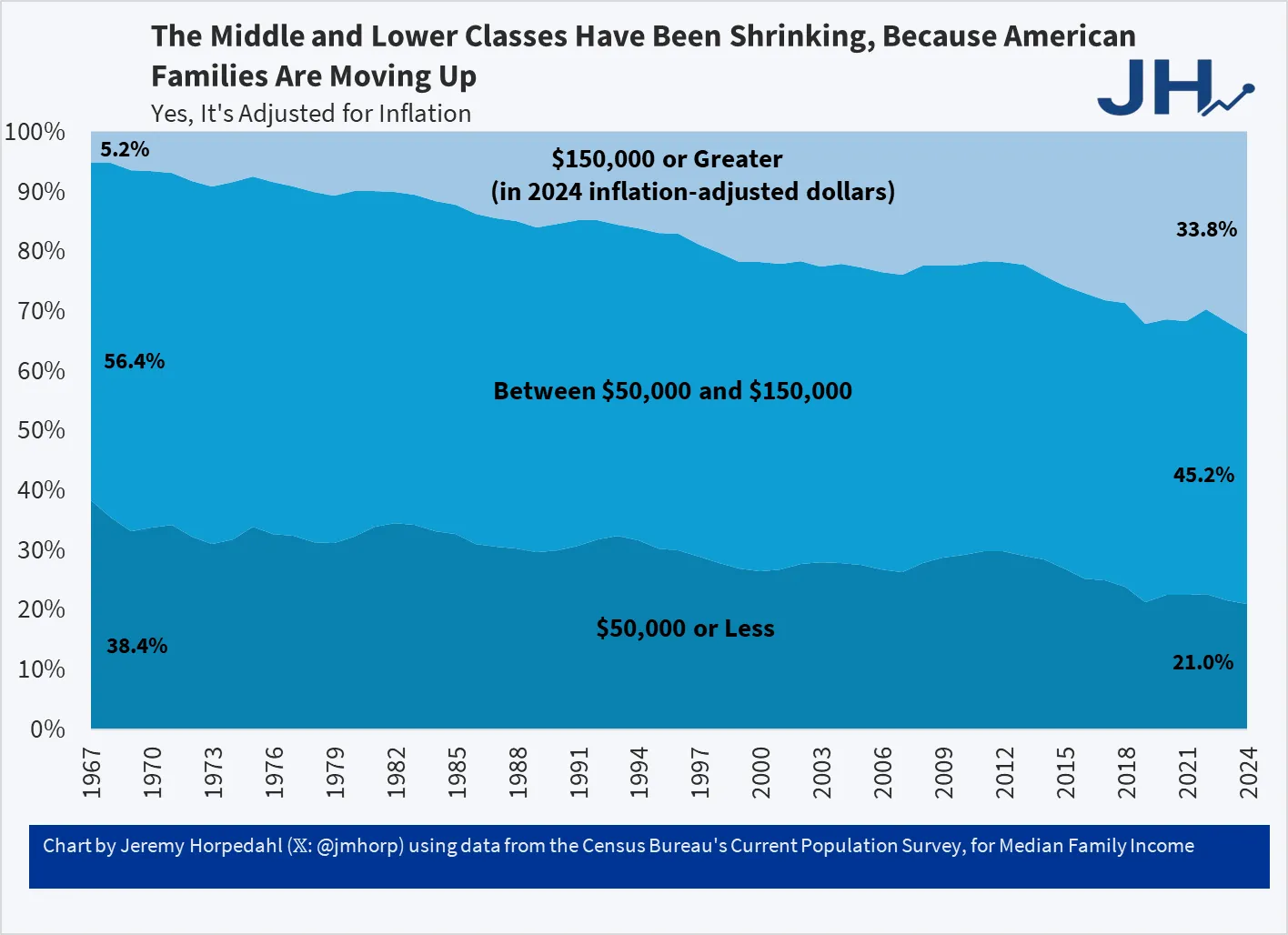
It means increasingly focusing on the spending of the rich, because the population is increasingly richer. Proportion of families making more that 150k (in 2024 dollars) has gone from 5% in 1967 to 33% in 2024, while both middle class (50k-150k) and poor (<50k) have decreased. [1]
[1] https://substackcdn.com/image/fetch/$s_!dtoi!,f_auto,q_auto:...
No single metric tells the whole story, and by taking them in isolation it’s quite easy to lose the forest for the trees.
[1] https://www.wsj.com/economy/consumers/us-economy-strength-ri...
The ideal number of toys is non-zero, but my experience suggests that it is pretty low.
I would hesitate to include the retail prices for these kinds of goods to a CPI type metric because the price are incredibly flexible.
How many toys do you have?
Mostly sarcastic, but I don't think it's a hot take to realize that the curtain has shifted substantially over the decades in terms of how to raise a child.
2. This specific exercise is designed to be relatable to individuals (in general, and specifically ones such as the people interviewed in the article who claimed that their grocery bill went up about 50% in a year, which is implausible to put it politely) so that they can understand the actual level of inflation rather than the one they imagined in their head.
Not to mention, in general it might be a counter-intuitive index... If the spend per person on TP on average goes down, is that an uptake in bidets, lowered tp costs, or economic affects and people choosing cheaper options?
That said, I still think it could be a "fun" index to track over time.
It's fascinating to see such work. By the grace of NPR, apparently the "transient inflation" narrative is officially inoperative, and plebian concerns about the price of eggs are now worthy!
Will wonders never cease?
Good to track this yearly since some standard metrics are useless versus the shrinkflation, reduction in quality ingredients, and other manipulation we’ll learn about sooner or later.
Many ice creams are now dairy desserts due to not having enough ingredients to make the cut. Same with milk chocolates and now declared chocolate candy due to not using enough real cocoa.
This is generlly taken into account. From StatCan, who publishes Canada's CPI numbers:
> 7.10 Quantity adjustment entails accounting for changes in the quantity (e.g. package size, number of tissue ply, etc.) of observed POs. This is another implicit method of quality adjustment because it is assumed that the quality per standardized unit is the same over time.
> 7.11 Quantity adjustment is the default treatment for nearly all of the POs in the food major aggregate as well as some of the products in the household operations, and personal care supplies and equipment aggregates.
* https://www150.statcan.gc.ca/n1/pub/62-553-x/2023001/chap-7-...
To account for possible changes in package sizes, we focused on the price per unit, whether it was an ounce of salsa or a square foot of aluminum foil.
I don't really know how you can account for quality either. User surveys? Ingredient sourcing? But then again I think this kind of reporting is just a general barometer. Some other comments are pointing to data sources that might do more of this.
> The amount of liquid had shrunk to 92 ounces from 100 ounces before the pandemic, and the price had risen by a dollar. After that, the cost stayed the same, but the contents shrank to 84 ounces in 2024 and then to 80 ounces in December.
> The label continuously promised enough detergent for 64 loads of laundry.
> ...Tide specifically got the "most significant upgrade to its liquid formula in over 20 years," according to the company, with a "boosted" level of active cleaning ingredients and updated dosage instructions.
> "The result is superior cleaning performance in a smaller dose," a Procter & Gamble representative said.
Do you take them at their word for that? I'm specifically wondering whether the 84 ounce, 64-load bottle with a cap that measures out 1.3125 ounces per load contains the exact same liquid as the 80 ounce, 64-load bottle with a cap that measures out 1.25 ounces per load. I prefer powder detergent with a prewash dose, I know my clothes get clean, but I don't know that anyone outside a lab would be able to inspect clothes post-wash and notice the difference in cleanliness caused by the removal of 0.0625 ounces of detergent.
They have three ways to protect or boost profits: Raise prices, decrease quantities, or decrease quality. NPR and the
There's been plenty of volume gaming as costs and prices have risen.
My last trip, they were all now 10oz bags too. As far as I can tell the bag size itself did not change, only the weighted contents. Read those labels people.
When I got home I noticed it was 12oz instead of the (historical) norm 16oz.
to
"MEGA ROLLS, MEGA VALUE: Pack contains 6 Mega Rolls (208 Sheets Per Roll) of Charmin Ultra Soft Toilet Paper"
Everyone saw that coming when they changed roll sizes and reframed it, right?
12 Mega Plus rolls = 54 Regular rolls
30 Double Plus rolls = 68 Regular rolls
12 Super Mega rolls = 72 Regular rolls
18 Mega rolls = 72 Regular rolls usually, but sometimes are sold as "Bonus Mega = 82 Regular rolls"
* https://en.wikipedia.org/wiki/MIT_Billion_Prices_project
Generally peer-reviewed papers have shown the official CPI numbers are fairly accurate.
I've been nursing a minor Coke Zero addiction for years but usually get the store brand which is close enough at half the cost. For whatever reason Coke Zero itself dropped in price by about 30% recently but that's apparently not nationwide.
It really kind of blows my mind how much of that people drink. I'll get a 2 liter bottle that will last days and then I read about people going through entire cases of Mountain Dew Insane Flavor Combo Super Bacinator Blast in a day and it's like my god that's like 4000 kcals of corn syrup.
One confounding factor here is that oftentimes the price is only reasonable in bulk. I don't know about walmart, but around me the best deal typically is "buy 2 get 3 free". I rarely buy/drink soda, but on the occasions I buy at all I'll be getting many cases at a time.
I've had great results making my own mineral water clones though, so maybe I'll try making LabCoatz's coca cola clone syrup and see how it works with sucrolose or allulose.
5 years ago I think they were about 30c.
https://finance.yahoo.com/news/pepsico-cut-prices-eliminate-...
(The link is for PepsiCo but we all know that they all raised their prices together and will lower their prices together.)
Supply and demand.
I don't have deep food industry knowledge, IIRC there are some rules around SKUs needing to rotate in response to certain changes, but these are completely opaque to customers. People should know they're eating snickers 12.2.2, and while a sub-1% change to one ingredient's amount might be a patch bump, a 10% total weight reduction should absolutely trigger a major version bump. SKU and nutrition labels should be tied to a public changelog, and inaccuracies in that changelog should proportionally imperil manufacturer solvency.
From my perspective (ie, in the USA) it can still be hella cheap if you're willing to cook food yourself from scratch. Rice, Beans, Lentils, and frozen veggies can give you the baseline of very nutritious meals (but boring af) for like $2 a day.
you can eat (all dry/unprepared weight) 100g white rice, 100g black beans, 100g black lentils, 225g frozen mixed veggies for about $1 if you buy in small bulk (like 2-5lbs at a time)
A store, for example, might ... charge slightly more for several items in order to sell something else at a break-even price or even below cost.
Swai is perhaps the worst possible fish to buy (low nutritional value, bad for environment, contains toxins) so (a) it's unfortunate they picked this fish and (b) it's good it's more expensive since perhaps people will buy less of it.
A recent job loss forced me to look harder at my own financials, and I was surprised just how much things like groceries accounts for in overall spending. I'm making a habit this year of, at the end of each day, recording what I spent and on what - so I can get better data.
I appreciate what NPR did here. Taking into account price per ounce/square foot/etc is essential so I'm glad they did.
It's useful to see these kinds of changes, can help make decisions. If company X is shrinking product Y, maybe it's time to look for an off-brand instead? That's what I'll be doing for a lot of things.
I think, at least in the last year-or-so, big brands also became worried about getting flamed by the president for raising prices.
The really empty states lack the water.
I track my spend each year and my personal actual inflation rate has averaged about 4.5% over past 5 years. And I'm pretty low income, my spending is all core stuff.
I think we’ve crossed a line where we can no longer assume basic alignment with “our” leadership.
Except that a president, in normal times, COULD make an impact on inflation, both directly and indirectly.
What is surprising, is that after a completely failed presidency that saw a marked decrease in middle class prosperity, people thought that Donald Trump, of all people, could bring inflation down.
They want democratic socialism.
Meanwhile, the right wing has been telling them that public libraries and public schools and everything good except profit -- is communism.
Yes, though the definition of "reasonable" is a real sticking point
> and tighter regulation of markets
This is less clear to me, but I would agree people want less fraud and deception in markets
> with elimination of profit-taking middlemen
I don't think many people think about this at all, and it's another very nebulous term
> They want democratic socialism.
No, democratic socialists want democratic socialism. Most Americans do not.
> Meanwhile, the right wing has been telling them that public libraries and public schools and everything good except profit -- is communism.
I disagree with basically everything the current incarnation of the Republican party is doing or stands for, and silly statements like this aren't helpful.
People don't "essentially want communism" by advocating for socialist policy. Serious economists will tell you that it is impossible to transition America's free market into a planned economy. We're capitalist through thick and thin.
Yet there is a sizeable number of us who consider seriously promises to "lower prices of X" like it's a thing that can be done by decree. It's disappointing is all.
The disappointment comes from faith in capitalism lowering prices naturally through competition. The 30% isn't competing against shit.
Exactly, people didn't used to even imagine there was any way to change nor think free-enterprise should be compromised for any special interests, the outcome had always been negative when lobbyists got their way too often with either party.
Remember why Ronald Reagan and the bulk of the American people from both parties absolutely hated Communism so much?
It wan't mainly the economic differences from a free-market system; that barely made it onto the radar and was largely academic.
It was the dictatorship aspect that was so disgusting and anti-American as can be.
Dismal economic considerations under Communist governments were well-recognized as a logical result of dictatorship, that had been obvious for centuries.
Otherwise there wouldn't have been as much ambition for subjects to withdraw from dictator/monarchy regimes and settle in America to begin with.
yes: because nationalizing industries represented a grave threat to western capitalists' bottom lines.
> It was the dictatorship aspect that was so disgusting and anti-American as can be
remember Pinochet? guess not.
They're also useful when I need to use a harsh chemical that I don't want lingering on a household cloth my young kids might use on their bodies.
I've had the same roll for around a year, but it's almost exhausted. I think they're fine.
They're also very useful in a lab setting, but that's another matter.
We stopped using toilet paper during covid, got a bidet, and bought a couple hundred shop towels to dry our butts. Now we only buy toilet paper for guests, which happens maybe once a year after throwing several parties.
Then we also bought shop towels for the kitchen to replace paper towels. I love the shop towels so much.
The butt-towels are white, and we wash them with bleach, there's been zero problems doing this over the last ~6 years. If there happens to be a bit of excess poop on a towel (typically there is none at all), we just throw it out, we have hundreds. The kitchen towels are blue, so we don't mix them up with the butt-towels.
We have laundry baskets for each kind of shop towel. A small one in the bathrooms, a larger one in the kitchen for the kitchen towels. We have to wash the butt-towels maybe once a month, and about the same for the kitchen towels. It's a simple chore that takes practically none of our time, less than it would to go out and buy paper. No, the butt-towels do not smell at all, they dry quickly and there's never been any problem whatsoever.
It's so much better than spending multiple $100s of dollars a year on paper that literally gets flushed down the toilet or goes into the trash.
A few of our friends took notice and started doing this too.
Honestly, I don't know why we ever wiped our butts with toilet paper for so many years, it's just so... shitty. It's just not a good experience. When we travel we miss our bidet and shop towels so much, to the point that I've ordered a cheap bidet if I'm staying in an Airbnb for a week or more, and install it there, and leave it behind. $30 well spent.
The numbers show reduced prices for milk and butter (e.g. cream), and sugar remaining constant.
Thus: ice cream is being priced too high.
But maybe there are other factors? What about energy? One would assume that ice cream has a higher energy requirement than other "treat" style products? Are there specific tariff impacts on ice cream manufacturing equipment?
That's the implication of your comment.
Healthy economies "should" have a reward for specialization where both supplier and purchaser win. There is no reward anymore for economic specialization in the context of ice cream; its cheaper to make your own, now. This is a troubling long term implication for any *-as-a-service
There's a second even worse economic implication in that ice cream has long been affordable to 100% of US households... Now due to permanent long term economic decline its seen as acceptable losses for some not to afford it anymore. Again, troubling long term implications.
2. I strongly suspect the couple in the article could afford ice cream if they brought less beef, less name brand items, or were just more savvy shoppers.
3. I don't know how you determined that it's cheaper to make your own ice cream, but I would say that's generally inaccurate based on personal experience and a basic assessment of input costs and a reasonable value on your time.
4. If you really feel like ice cream is overpriced, you have identified an opportunity!
Or - Walmart is a big enough supplier that they have stable contracts with manufacturers, and are able to purchase their ingredients for the same cost as always, while Turkey Hill et al is competing over what's left. (Like Apple, buying up TSMC runs.)
Or, from the buyer's perspective, it is priced appropriately if the total amount buyers would spend on it would go down if the price is lowered or raised.
There isn't a correct intrinsic price that an object should be sold at that can be calculated based on the ingredients and labor. That idea is one of the fundamental flaws of Marxism. Price is a compromise between the buyers and sellers, based on the values of each.
It it completely insane? No. But draw a set of supply and demand curves that supports it, and then try to come up with a narrative that explains them. In the static, same time, all other things being equal case, it is hard to do.
It's 100% purely supply side pricing, propped up by government spending and credit (which is largely backstopped by the government as well).
I listened to a podcast recently that some 'homeowners' have not made a mortgage payment in years, have no ability to pay, but here are essentially unlimited 'no doc' mortgage modifications available since the Corona time period.
How? Somebody is holding the bag here on the mortgage - a bank, probably. And they are fine with not receiving payments? Or is somebody else making payments on the homeowner's behalf?
So, the government is making everyone whole.
Lenders incur legal fees, court costs, property taxes, insurance, maintenance, HOA dues, servicing advances, and loss of interest during the process. Industry estimates often put foreclosure costs in the tens of thousands of dollars per loan, excluding the loss from selling the property below the outstanding balance.
“Writing off the mortgage” is not the realistic alternative. Lenders generally compare foreclosure against loan modification, repayment plans, short sales, or deeds-in-lieu, because charge-offs are accounting outcomes after losses are realized, not an operational substitute for foreclosure.
You don't usually skate by on years of non-payments, so I'd sticker the original claim with [citation needed]
sounds like a very similar thing.
Here's another one on perpetual forbearances: https://www.wsj.com/opinion/covid-housing-relief-forever-rec...
This would seem to indicate that Covid forbearances are extending into 2026: https://www.hud.gov/sites/dfiles/SFH/documents/SFH_FHA_INFO_...
I think they're looking at adding a means test, but I'm unsure.