Condescending attitude aside, if I wanted to hear what Fable says about this, I'd ask Fable myself. I want to hear what YOU have to say about this.
> How this was made. I wrote this with the help of Claude Fable 5.2, Anthropic’s AI model. ...... The model economy is joint work with Johan Båge.
Why are you misrepresenting his words?
See https://web.archive.org/web/20261111200720/https://wilsonium...
It clearly says:
> How this was made. I wrote this with Claude Fable 5.2, Anthropic’s AI model.
This manifests as policy that harms most Americans while benefiting the rich/elite. Americans idolize the rich/celebrity while also claiming to be victimized by them. Its so weird.
"When I'm rich I want these privileges."
Americans also overwhelmingly misrepresent themselves as better as they are in regards to a variety of social stances. Animal rights, trans rights, race in general, the environment, homelessness, China/foreigners, etc. Americans say they support causes but their actions are the opposite, because "in my circumstance" excuses. There is always an excuse.
My saying this will really piss off a lot of Americans who misrepresent themselves. Thats why we hate having conversations about it, it means we have to be honest and that really upsets a lot of Americans. A lot of Americans also will take a "Okay sure but I'm a victim" stance. Call em out and see how quickly an american claims businesses, politicians, or something else is the bigger issue. No accountability for the outcome of our actions. It's just a bunch of dishonesty
1. Boyce, Brown & Moore (2010), “Money and Happiness: Rank of Income, Not Income, Affects Life Satisfaction”
If we all agreed to work less (and have less), it would actually work. But as soon as competition enters the game (some people work more and have more)...
Ah, damn, that's the catch with everything isn't. As alway, the only winning move appears to be not to play, and to even get to state where you can drop out, you need to play well for at least a while.
If anything, it’s many of the basics that have become more expensive. Housing and education are far more expensive today then 100 years ago (as a share of average salary). And some essentials like health care, while more effective today, definitely absorbs a much higher share of people’s wallets (and the nation’s GDP).
That may be broadly true, but it's descriptive, not prescriptive.
There are many relatively poor people (with physical needs met, but not always) who are far happier than most of the top 1%. The secret is character -- things like contentment, thankfulness, and showing faithful love to family and people in general.
The "golden billion" people almost all live in luxury, by the standards of an early industrial society like the early 19th century Europe which Marx described, and daily use a ton of amenities which even the mightiest king could not afford 1000 years ago. But we take it for granted.
I could have taken my savings and downshifted to a comfortable life in a third-world country. But instead I've put them in my wife's business, and keep working, while living in one of the most expensive cities in the Solar system. This is because I want a better education for my children, and success for the business. (The city is also enjoyable when I have the time.)
Then, some amenities are still expensive. Think about medical care, especially larger-scale like cardiac surgery. Well, think about the cost of a Claude subscription if you live otherwise happily for $25 / day in an inexpensive third-world countryside.
We work so much because there's still utility in it, in many cases. We have plenty, but not plenty enough.
That’s not ambition, that’s desire. Ambition is wanting to do more.
The research strongly suggests that the most important factor in giving a child a better education is the degree of parental involvement. Do you think working and focus on business success gives you more attention capacity to be involved with your child's education than the downshifted option would have?
So, the good news is that even if you want to give your best in that area, you only have to endure for five years, give or take. Something tells me you won't be packing your bags after that, though. It may not be your intention, but the combination of words gives the impression you're actually more interested in the appearance of giving your child a good education than giving a good education.
I knew WHAT I wanted to learn, just not how to learn it, how to nurture and guide myself. it was a big deal and it still is
I realized it wasn’t making me happy. Sitting inside everyday is not how I want to spend my life. Now I live in a mountain town of 10,000. There is no traffic. We ride everywhere in town. I work 10-20 hours a week on writing and books, depending on the season. I snowboard 100 days a season. We took our 6 month old on a trip for a year (wife got 18 months maternity leave) she works 3 days a week.
I cut our firewood so we have no heating bill, have no phone, no tv. We really enjoy the simple life. We have plenty of time to host dinner gatherings, hang out with our daughter, hike, camp etc.
We did a 10 day wilderness canoe trip with friends this summer, it was unreal.
We realized More money will not make us happier. We don’t want more money. More time doing the things we love with family and friends will. The choice is there.
I love the city, the friend group, being into some communities that do not exist in small towns.
If you'd put the outdoorsy small town lifestyle on me, I'd kill myself.
I'm really happy for you it worked out, but what you suggest is not an overall solution. (And just imagine how your town would look like, if we all moved out of the cities ... we'd create new cities).
The fact that cities are big is cause by people wanting to live there, not elsewhere.
Obviously it’s horses for courses.
That being said, would you take an extra paid week of leave if offered? What about two or three? Would you be happier? What if you had 20 weeks of paid leave? Would you be happier?
I think the very vast majority of people would work less if they could.
We have plenty of room for this in many, many, many, many countries.
They are the reason I choose to work less - to spend time with them doing the things we love.
This is a significant claim. What do you base this on? Are there any studies or references?
"Research shows that average U.S. income growth is strongly related to rising house prices but is essentially unrelated to changes in the supply of housing units across metropolitan areas."
San Fran is a clear example, tech money is driving the price for scarce homes up substantially. Go peruse Zillow and see the insanity
This book is most famous for being misquoted by nitwits trying to argue that globalization is always good for everyone, but if you had asked David Ricardo he would have said his most important result was that of Rent (later specified as differential rent or Ricardian rent), the idea that economic productivity tends to get squeezed onto land prices. A modern update would argue that this applies to assets more generally. Assets go up by squeezing productivity out of the main economy. Whether you think this is brilliant or terrible depends largely on whether you own lots of assets.
That's not what your data shows. It just shows that people don't want to be near the bottom of the pile, because it indicates they're being mistreated (which they are).
People don't want to "do better then their neighbors," they just don't want to be left behind by society.
Framing it the way you do makes it seem like everyone desires brutal social darwinism. It's not true. People just want to be treated fairly and live in a relatively egalitarian world.
I'm not dismissing what you are saying, but do you have evidence for what "people want"? In my experience, when somebody claims to know what people want then it tends to be a mix of "I want", "the people I know want", "I hope people want", "people should want", and a few others, rarely with any evidence.
https://www.researchgate.net/publication/315944588_Why_peopl...
Hey, hopefully some of you techbros can 'disrupt' the status quo.
Post 2008 it has been about 6-8
This creates crank where even billionaires will whip their workers to death over competition with their neighbors.
Just to touch on one important problem for which one must account:
Productivity over time is how much stuff you get out vs what you put in, from one time period to the next. Inflation is what the stuff costs over time.
But what do you do with stuff you used to make that you don't make now?
And the opposite: what do you do with stuff you make now that you didn't used to make?
If you look only at the the things that are almost exactly the same from one period to another, usually you find that the intuitions hold: food used to take 10% of our hours, now it takes .6%, etc. etc.
If you dig into the details of CPI and PPI, you'll quickly say, "waiiiiiit a second, can you really just do that?"
For example: they'll say that your tv or car now is "more stuff" because of "features." But if you had to make the old car now, you might be able to make way more of them for the same inputs.
We're not allowed to do that. Environmental regulations, crash safety, the operating environment has changed dramatically.
Look at the Chinese cars we aren't allowed to buy here. But even more, look at "quotas" for Japanese cars from much earlier - these had the result that the Japanese and the Americans upped the features and price of the vehicles since how many they could sell was limited. Now, the basic situation continues with multiple means of maintaining.
And oh, look at how zoning keeps people from building small houses, etc. etc.
And there are many factors with environmental regulations sometimes being involved but a whole of the situation being tacit collusion to sell only "big" things.
on average, in the US, food consumes 13% of annual household expenses [0]
in our household it's higher than that, because in order to buy primarily healthy food, it costs a lot more than the average shopper spends, and it's more expensive than it used to be
if you had to make an old car now, it would cost you way more unless you do intend to make and sell way more of them. you could make more of them now then you made then for the same inputs, but you couldnt make more of the old cars now than we make of the new cars now for those inputs. This is much more relevant to farming. they dont own the seeds because they can get much more product out of buying the new seeds than using 'old style' seeds.
but overall i like the point you bring up, and inflation and productivity are fundamentally hard to compare. we know that borrowing from the future increases the cost of money in hte future which yields inflation. but the money is the benchmark for things so its like trying to measure the expansion of the universe with rulers that are expanding with the universe
I bring up massdrop because it has helped me realize that for an individual it is best to keep an eye on what is actually being produced right now that may not have the same kind of demand in the future. A lack of demand does not necessarily mean the product isnt good, as it could mean everyone already bought what they needed and you missed the boat.
The past was able to think a lot less about it in this way because there was always large population growth happening creating demand for any good product because new people need their own copy. With that leveling off its going to pay a lot more to stay in the loop with timing buys with others, even though its not really coordinated.
> But if you had to make the old car now, you might be able to make way more of them for the same inputs
All these arguments miss that inflation is a proxy for the improvement of quality of living over time.
You don't make a 1998 Camry in 2026 because the 2026 Camry is a much better car for the end user than the 1998 Camry.
The 1998 Camry is easier to maintain and lasts a long time but if the end user doesn't keep a car longer than 7 years and they have to pay a mechanic to change their oil, they dont care about "easier to maintain and lasts a long time". They care about AirPlay, Remote Start, Parking Assist and ass warmers. No 1998 Camry has any of that.
You could chop wood for heat, grow your own vegetables and meat, living off a few hundred dollars a month if you wanted but most people won't do that because it's not very entertaining and a lot of hard manual labor.
Things cost more over time because people demand more over time. More things cost more, so people demand more money to get paid.
they don't. If they did, the retail car market would be flooded with cars that are made specifically for Hertz, Enterprise and the like that are built to hit a specific low price.
People want a good deal but they don't want to drive a cheap car everyday. They are fine with it when they have to rent a car because then their focus is on the daily rate, perhaps because they are focused on having fun on a vacation or thinking of a business opportunity etc.
A typical tech job requires far more than 40 hour work weeks.
We need to react to it with the same intentionality that we did a century ago when we won the 40 hour work week, which still hasn't been entirely eroded despite half a century of chipping away.
What do you mean won? The 40 hour work week was instituted during the Great Depression (hence why you see 1938 in the link) to try and get more people back into the labour force. The idea was that, like, if those working 60 hour weeks were forced into working 40 hours then 20 hours would open up for someone else, giving them some spending money to open up the economy again.
The 40 hour work week was originally conceived of by labor, which may be what you're thinking of, but it wasn't put in place for them. That was for businesses so that they could have more customers.
This is a labor power story, not a war profits story.
These arguments were omnipresent at the time but they suddenly faded away when Hitler got his ass kicked. I wonder why?
What we do know is that the 40 hour workweek went by the wayside during the war. The US, for example, mandated a minimum wartime workweek of 48 hours in 1943. It would be quite reasonable to conclude that Hitler would have won if labor didn't take the loss. Presumably that is what you are expressing?
I guess what you're struggling to get out is that those sayings were true and thus became adopted as common knowledge? It is the case that people stop talking about things that are already commonly accepted. If it weren't that way we'd be sitting around talking about 1+1=2 all day, every day. It still remains unclear what you think that adds to the discussion, though.
You need to read up on your history.
The 40 hour work week came in 1938. This is even echoed in the original link, as mentioned earlier.
But it remains that 6 days per week was the norm prior to 1938, so 48 hours would be typical. We're talking about 40 hour weeks being typical. Stay on topic, my man. The 40 hour work week was not won, unless you think the Great Depression was caused by a labor uprising?
In specific bubbles like Silicon Valley startup culture or FAANG this is true.
Greater than 40 hour weeks has been the expectation at several non-FAANG, non-Silicon Valley, non-startup companies where I've worked.
But I don't think people in those jobs realize how uncommon it is. The jobs in the middle of the curve, even tech jobs, are not all that demanding. They also don't pay the high salaries that we correlate with demanding tech jobs, but that goes with the territory.
It's a weird feeling if you've only known hustle-and-grind companies and then you stumble into a more traditional company where nobody is in a rush to get anything done and few people even work for more than 2-4 hours that they're in the office. These jobs are everywhere, though.
You explained the symptom but not the root cause, which I did in my heavily downvoted comment.
Every student is conditioned from K to work hard like a robot. Those who refuse to work hard fail out of the school system.
Work for a ramen noodle startup? Sure. Work for a typical profitable company (Atlassian/Xero, whatever) - and I just don't see it.
Especially with the leverage of good LLMs operated well - if anything I find I have less time pressures than more, and I over deliver as compared to almost every one of my peers.
Let me fix that for you.
The simple answer is that we will continue to work this hard as long as some members of society [hoard wealth beyond the wildest imagination of those in the bottom 99%.]
So much wealth they quite literally don't know what to do with it, and for a cherry on top they're not even happy. The richest man on the planet is a depressed Twitter troll.
Until the general public rightfully takes back the money they've worked generations to generate that _mostly_ flows into the pockets of these (t|b)illionaires, we will continue to see a more stressed and less happy society for all.
The problem is the fact that any couple, of any combination of sex or gender, now cannot afford a decent life without 2 full time salaries (or more, in many cases). That's a bad result of natural market forces that should definitely be addressed.
When HN comments talk about tech jobs they often mean specific, high-compensation or highly competitive companies.
When competent programmers or engineers have a difficult problem to solve, they will think about it all the time, regardless whether they are "working" long hours in the office or they are doing any other activities, at home or on the street.
It is quite frequent to have the best ideas when you are not in the office "working". For things like programming or designing, the time required to type on a keyboard the solution is never a bottleneck.
At least for myself, the majority of the technical solutions to the problems on which I have worked have come to my mind at home, in the morning, immediately when waking up, and the "work" done in the office has always been mostly in typing whatever solution I already had in mind when arriving at the office.
Anyone who believes that a programmer or engineer who "works" e.g. a 50-hour week is more productive than one who "works" a 40-hour week is naive, to not use a more insulting word.
This is true regardless how competitive the company is believed to be. How many hours one stays in the office in the front of a computer, while being watched by a manager who believes that this is how you "work", has an extremely poor correlation with the amount of useful work that is actually completed.
To keep perspective, that is illegal in many countries. Not everyone has it so bad. You can make it better.
The most powerful members of our society (not the hardest working ones) are the ones who set the tone for the rest of us. We only need to continue working this hard as long as we accept their dominion over our society.
That's a choice we make as a society every day, and it's probably a result of the simplistic form of thinking you offer in your comment.
Dig deeper.
"I think the problem we've had is, people decided they didn't want to work so much anymore. (...)
We need to see pain in the economy. We need to remind people that they work for the employer, not the other way around. (...)
So it's a dynamic that has to change. We've got to kill that attitude, and it's go to come through hurting the economy, and that's what the whole world, the governments around the world are trying to increase unemployment, to get that to some sort of normality."
-Tim Gurney
". . . the justification for the existence of the investing class is the service it renders the working class, measured in terms of wages and desired goods. The contrary is not true. The working class does not exist to serve the investing class. The working class has the right to insure itself through organizations composed of its members or through government, thereby eliminating the investing class." - Levy
Jerome Levy was a committed ideological capitalist.
From that perspective the idea that workers need to be reminded to suffer is like saying insurance companies need to stop paying so many claims to remind us of the risk of house fires....
To be clear, I do not support the disparity of wealth, I’m literally just trying to make sure I understand people…
It depends how you separate your personal wealth and the business's
It's a pretty clear separation between those who spend 30+ hrs per week working and those that spend the majority of their waking time "networking" (attending conferences, playing golf, traveling, whatever) with the occasional board meeting or office hours type meeting as the only part of that which looks like a regular job.
Clues specially being
1) you hope to RETIRE
Ie be able to not work
2) you HOPE to retire
Ie it’s not certain
The system is rigged. I pay less in tax than someone earning a quarter of my income through their labour. It isn’t fair. It wasn’t fair when I worked, and it isn’t fair now - and that’s why I absolutely incinerated my 20s on the pyre of 60 hour weeks, year-round, as I realised that working for a living is a fucking trap, and only by living like a hermit, working like a slave, and getting really damn lucky can you climb out of the crab bucket.
It only gets more unfair the richer you get. I only need to increase my worth by about another 30%, and then I pay no taxes at all.
I do compensate through altruism and charity, but equally, I could choose not to - and again, it is not fair that I have that luxury.
I think the problem, trying to be as objective about it without taking sides, is that you make more money the more money you already have. This leads to runaway wealth inequality, which leads to civil unrest and eventually violence.*
If we at least didn't have all this systemic rigging in favor of the investor class, the wealth inequality would at least be less severe and maybe low enough for a stable equilibrium.
I'm not an economist but I would guess that you need the return on capital to be closer to the return on labor, and when they're about equal you have a stable distribution of wealth.
1. Upper ranges more closely match a pateto distribution. For.the purposes of this argument, I don't think that is too relevant, but willing to change my mind.
Well, besides from it is deemed as what the bankers call it "risk free rate", but I have already started to challenge this assumption 6 years ago
The US, where unbridled capitalism, at any cost, in all fields of endeavor, is the goal - from healthcare to education to private prisons.
"But that's illegal!" Yes. It doesn't matter because wage theft is the largest class of theft in the US. If nobody stops you, is it actually illegal?
History shows most innovations would have happened anyway without big dependence on individuals, which is overrated most of the time.
Humanity really doesn’t need billionaires
It's the ability to not work a day in one's life because of inherited investment.
For example, I don't consider Jim Simons to be in the investor class.
Nothing prevents any of us from similarly figuring out how to make a money via investment.
But Simon's descendants are in the investor class.
They are not the ones who invested to make those productivity gains possible.
In fact those descendants may not even understand what "productivity gains" mean.
Also I am going to be in the alleyway with a bag of glue if you’re keen. But I am not going to make any more money as I called in sick to work.
Some are filling hours with more work however it seems like many are not increasing work volume, just quietly reducing the amount of labor.
Of course "some folks say they work a lot more than they actually do" is also nothing new to AI anyways.
I have.
But hey, it's not your employer's job to just hand out money. Demand it. Or, if you truly are a 10x dev, just go solo and work 4 hours a week.
And there is an argument for companies to pay both a wealth and a turnover tax, appropriately scaled. This might be able to stimulate more diversity of small/medium companies, and thus negating the monoculture like markets that currently seem to arise on a per sector basis, also allowing wider ranging ideas to flourish.
The tax system in western countries generally does not seem to have kept pace with the change in what work/productivity now is, and so gives incentives to the established rather than the emerging.
A number of eastern economies seem to have worked out better regimes encouraging overall diversity of enterprise - it is a tricky balance as you don't want to remove the incentive to try, but the concentration of wealth we see is not healthy in such individualistic societies as the west has.
We're very good at absorbing productivity improvements. Hell that's the whole goal of software – make things faster then eat the edge by making them faster for everyone.
The author still writes with a savior complex. The basic observation, that productivity goes up but the rich get richer, is not novel to their work. Their explanations and conclusions about this issue are also not new either - they just rehash 250-year-old classical economics.
The actually (apparently) novel part - a macro wage model described in 'Pinning the Wage to Scarcity and Technology' - is not discussed in detail. We don't know its relative merits or if its predictions are historically accurate.
Almost 13 years of data on this. The only time my productivity tanks is when I grind 40-50 hours a week for months on end.
I don’t care about the political or social aspects of this everyone can and should be able to work doing what they want, but there has to be some impact on workers leverage when we go from women being ~30% of the workforce (1970) to >50% (2026). Immigrant labor has also exploded over that time.
Again I don’t give a shit about who works, just noting that huge increases in workers must have some impact?
If 2 people both need something to survive, then collectively the group needs to produce 2 of those things. But if 1 of them demands 1000 of that thing, then collectively they need to produce 1001 of that thing to satisfy the demand.
The _problem_ is that the demand for the extra 999 is given equal weight and competes for production resources vs the 2 that are actually needed instead of explicitly prioritizing the 2 and then letting the 999 come from a secondary market of post-needs-fulfillment labor. Right now if the group produces only the needed 2, then most of the time the person who only wants the 1 that they need won't get anything at all, and in many cases that means they starve and die.
When the consequence of collectively producing less than the total sum demanded by the wealthy is that some people will then starve and die, that hangs like an inverse sword of damocles over the heads of the poor and middle class, always threatening those who can't just buy their way out into laboring more than would be otherwise needed.
The very obvious to me solution is to structurally prioritize meeting everyone's common needs for food/water, shelter, and medical care first before then satisfying the desires of the rich who want more. That way rich people can still get all their private jets and fancy cars, but they'll need to pay more to convince people that the loss of their leisure time is worthwhile instead of everyone in the underclass living under constant threat for survival.
Personally I think the constant political drumbeat to have more jobs instead of literally anyone trying to maximize collective leisure time is the greatest tragedy of modern capitalism. It's always jobs jobs jobs instead of needs and rest.
https://en.wikipedia.org/wiki/Baumol_effect
We had a run from 1980 to 2020 or so where the price of most things stayed stable except for housing, healthcare, education and childcare. It’s only the last year that people are complaining about the price of electronics.
The whole video could of been said in one sentence!
Microsoft going faster is funny, on a number of levels - The whole company seems to be run as if it's still the 1990's :D getting anything done or changed takes years.
> There is a machine called Productivity, and on this machine there is a knob and a button. The knob increases productivity, and the button is labeled "reset."
Whenever we increase productivity, someone comes along and presses the reset button. The current level of productivity becomes the norm. In fact, if you don't produce as much you are unproductive.
That extra time we gained is not for you to rest, but it's to find ways to produce more.
[0]: https://idiallo.com/blog/where-did-the-productivity-gains-go
I work and do something very specific, a lot of people around me do not need what I do.
I need water, food, energy, I don't know anyone personally who is providing this for me.
Then we have A LOT of people in our society (no critisism here) who get food, housing energy etc. without satisfying anyone.
What i want to say: 1. in a highly automated society there is a real disconnect between you getting something and you doing something for it.
money =\= purchasing power. if they print enough (and spend it themselves first into the economy), then the purchasing power is being siphoned away towards the source of the new money.
see the cantillon effect.
Also has to do with demand for savings. The US has a bunch of mostly accidental policies that juice that demand.
We aren't competing with workers from 1973, we're competing with other workers leveraging the same accelerated efficiency.
It's hard to see this if you're a typical HN reader because we're all a pretty motivated lot who tend to enjoy what we do, and what we do is fairly concrete. But survey the typical office and you will be blown away by how little effort people are putting in. And of the "work" that is getting done a lot of it is never used, or the sort of thing whose quality can't be easily evaluated so it trends towards the min viable product.
I used to work at a company where a significant fraction of the workforce just spent all day producing "decks" (PowerPoints). They hardly sent emails or wrote documents - even things you'd expect to be a Word file were decks - and on the few occasions I gently enquired about how long they'd been working on their current "project" (a deck) I'd always regret it, because the answer would be something like several weeks. Total output from those weeks: a dozen badly made slides that said very little, and which could have been an email.
And that was in fintech! Go look at the public sector, academia or NGOs and be amazed at the endless armies of people who can spend an entire year on making a single PDF that your average hyped-up Valley engineer would produce in a week.
These people are all technically working a 40 hour week but in reality a lot of their time is spent on YouTube, napping, walking the dog, taking care of kids, listening to podcasts, researching their next vacation etc. Their managers don't hold their feet to the fire because they're doing the same things, and the company produces enough profits that nobody is really motivated to do layoffs (or they're tax funded and won't get fired even if they do no work at all).
But let's say I decide that I'd be happy with my life at 50% of my current pay, and I want to do 50% less work in exchange. 20 hours per week instead of 40. If you're in the kind of job that makes enough for this to work, you probably can't do it. 20 hours per week is for crappy jobs in retail and food service. It's very unlikely that you'll find a tech job willing to employ you part time at any pay level.
So even if I, personally, am sufficiently productive and sufficiently compensated that I could afford to work a lot less than people did 50 years ago, I can't do it. At least, I can't do it on a rolling basis. The closest I can come is to retire early. Or maybe take some years off in the middle of my career, but that's extremely risky. I definitely can't cut my hours and pay in half over a week, or month, or even year.
a) people don't just work to make X dollars per year. They work to have a similar or higher standard of living than their peers (the famous "keeping up with the Joneses"). Sure there are dirt cheap housing in the middle of the country, but everyone wants to live in NYC. This is not about getting to a fixed point, it's a competition. So no matter how much more productive we get, we'll work as much as we reasonably can, which for most people is 40-60 hours/week
b) the issue with doing redistribution with taxes, is that the government doesn't just give the money back to the people. They waste it by proclaiming they can put it to good use, via custom benefits, non profits, etc. This is (usually) a huge waste of resources. So taking in an additional 30% of GDP as taxes won't make everyone 30% richest; it'll go in the pockets of the well connected or those willing to commit fraud and grift. And the politicians in governmetn have strong incentive to continue doing it this way because they get support and votes in return (e.g. through media corruption or special interest groups that vote as a bloc)
c) we have taken some of the productivity back - we have life saving drugs, clean water, cheap energy, all the entertainment in the world in our fingertips - things that 100 years back were reserved for royals and kings. But because of point (a) of course, nobody's happy having "just" that
d) even if the macines become super productive, it doesn't mean the price of everything is going to zero. There's still only so many apartments to rent or own in manhattan, and the price of human service will skyrocket (as it has done over the past few decades - compare the price of a TV to the minimum hourly wage for example). So it's a misconception that the value of money will go to zero, as Elon recently said
Some people are working hard. The growing demographic is the retired, the trust-funded and those NEET-ing around on various forms of subsistence income. Another few years we'll be back to post-war levels ~%58 of participation, where two-parent homes prevailed, and one stayed home.
https://fred.stlouisfed.org/series/CIVPART
Peaked in 2000 at 67.3%. It's now around 61.8%. That's over an 8% decrease. Hadn't realized it was that significant.
I recommend everybody spend some time poking around FRED occasionally. It's a good reality check.
[0]: https://en.wikipedia.org/wiki/In_Praise_of_Idleness_and_Othe...
You also went on about "why a job that somebody is willing to do is assumed to be a job worth doing". This should have been something learned by workers early in their careers. Not sure what is happening in your hypothesis, or even what your hypothesis is in the study regarding the worker's responsibility within this system. You may want to put some bounds on that, or if unbound, be frank about that at the outset.
There were two paragraphs about consumerism that are hanging there unloved starting from "Two things happen..." and ending with "...every drop." but the worst part of those two paragraphs is that you attempt to drive them into a ridiculous conclusion: "Everything we measure about work is a record of what people did when they could not refuse." This is seems to embarrassingly stated as a polemical against human effort, which is ludicrous. Believe it or not, there are many many many many people who are energized each and every day by their careers, and get excited to have the opportunity to contribute to humanity's arrangements whether it is flipping burgers or curing cancer.
Where the paper went after this is really mindbending because it asks the reader to take a leap of faith that unseen models are replicating an entire economic system faithfully, and that hypotheticals can be believed and that the outcomes proposed can thereafter be believed. There is really not enough background or basis to make this leap and it is my assessment that economists will absolutely barbecue you if you try to make a pass. Asking readers to draw from their own anecdotal ["Do the people you know have more free time than their parents had at the same age?] is interesting but not going to move the needle in a meaningful way.
all the formulaic stuff that follows probably comes form the models and well maybe it is hopeful and maybe you could get a piece of land somewhere outside a small town in Oregon and try it all out on a government grant or something.
sorry if this seems harsh. I really want to give constructive feedback but its hard to see anything here that might gain traction.
The fact that we can do in 16 hours what we used to in 40 doesn't suddenly mean that people are only willing to work 16 hours.
it's strange that all these articles about how much we're working don't even peek into the history of how our current structure was formed
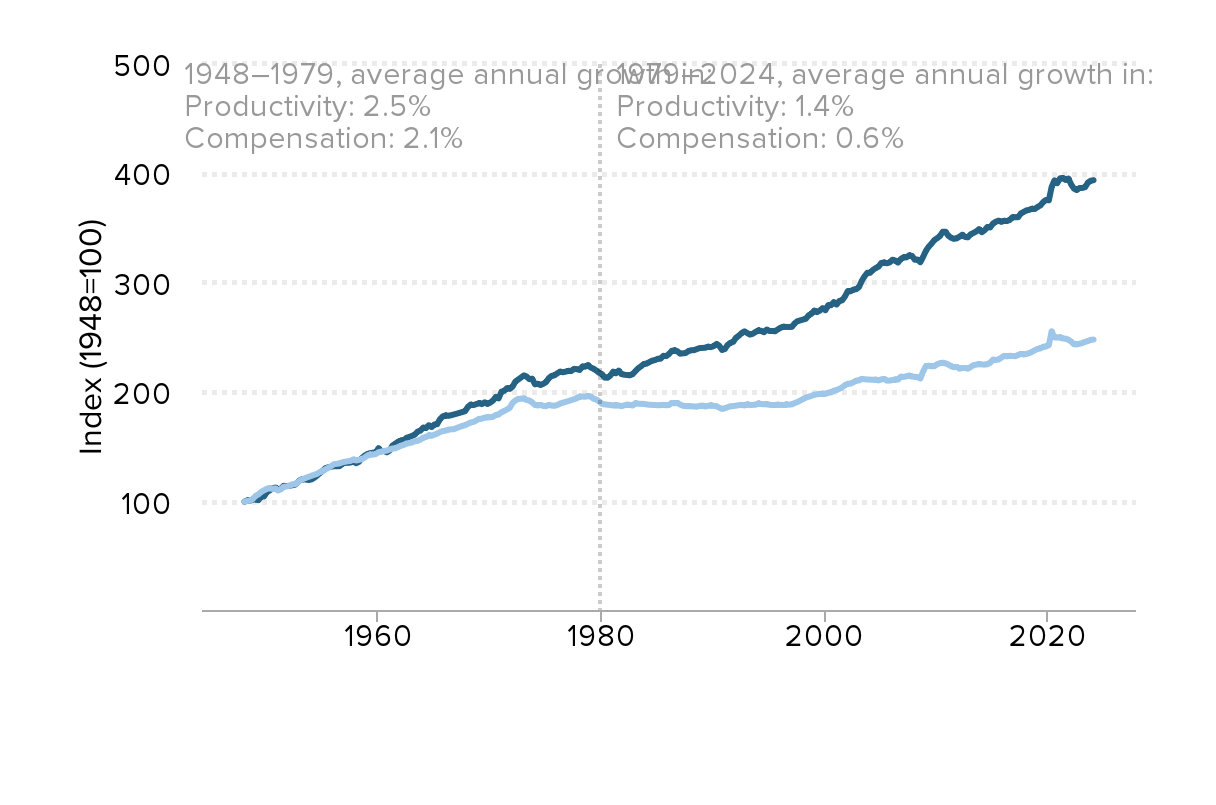
the current productivity gains have mostly been captured by the richest, and everyone else is competing against each other for the scraps... if you choose to work less, you are out-competed and lose your status (guess what kind of groups can help avoid this!)
The additional compensation is a statistical artifact that accounts for air conditioning, iPhones, reliable cars that last 20 years, the Internet, etc.
My god, they might even become actively engaged in politics. The horror!
We still work hard and will continue to do so because we are conditioned for the first 21 years of our lives to work hard at school.
21 years is a third of your productive life, a time when you body still works reliably, can repair itself rapidly, you have very little responsibilities and thus can take more risk and explore the frontiers of possibility.
The math teacher tells you to write out twenty tables of addition, so you do it.
The chemistry teacher tells you to balance out fifty chemical equations, so you do it.
The English teacher tells you to write out 500 word essays to explain why Sherlock was not a villain but just misunderstood, so you do it.
If you question why, you fail.
If you question is there's a better way to demonstrate the understanding, you fail.
If you refuse to do these assignments and start a lemonade stand, you fail.
Thankfully working hard is getting disrupted. An LLM doesn't sleep, take breaks, fall asleep after three 6 hour shifts or take sick leave. Nothing works as hard as an LLM and even basic LLMs that can run on commodity GPUs with 6GB of VRAM can write out twenty tables of addition, balance out fifty chemical equations and argue both for and against why Sherlock was a villain.
People will argue that balancing out fifty chemical equations and writing out twenty tables of addition is necessary to gain the foundation necessary to do more abstract tasks.
That to be an effective writer, you need to read two works of Shakespeare and critique in a manner that appeals to your teacher or the AI that grades your writing assignments. People who never got to do this are idiots and their writing is just garbage, unfit for human consumption.
That to be an effective Front End developer you need to code in x86 assembly.
That you need to understand quantum physics before you can design your first semiconductor circuit. I would like to save those debates for another day.
But people actually don't give a s*it if you work hard or not!
They only care if you're giving them value for either their time or money.
Those who don't realize this will keep working hard for those who will put them to work. Those teachers will keep joining unions and complaining they don't get paid enough while they will reject the truth, the reality of why them working so hard isn't translating into a situation they like.
and all they have to say is? land value tax and tax on spending??? LVT is fine but let's be honest is going to do fuck all, spending tax is literally a tax on the poor. how dumb (if not malicious) can you be? if a revolution is too unpalatable for you, at least say wealth tax. it's just two simple words, in that order, it's not that hard
It has over time negated the gains that workers had made (through much campaigning, protests, strikes, and the threat of social upheaval during the Great Depression) to earn a greater share of the output (through higher wages, work week limits, etc.)
But if machines produce more, couldn't the state provide free services rather than cash? In kind provision could be less dependent on wages than taxation is.
Then couldn't we divide the monetary system further — not as banknotes, but by subdividing it? Would the administrative system be too difficult after all?
In other words, if the problem is that only the "wage" earned for participating in production grants the right to consume, then shouldn't tickets to the means of production also be distributed?
Still, no matter how I think about it, in the end it comes down to the problem of distribution. The OP also gives capital ownership as an example, but...
If automation can enable substantial production without human labor, then what on earth is the reason we should keep demanding that humans do wage labor for survival? I find myself thinking about this a lot these days.
Someone who did not participate in production can consume the product because they own capital. Then what is the basis on which that right arises?
In fact, economic logic, when you think about it, seems to be mostly a kind of circular reasoning. It says "capital's share equals its marginal contribution," but that market itself is ultimately something created by power.
Sometimes I have thoughts like this. In fact, the core of capitalism is the ownership of the means of production, and such ownership will keep accumulating ever-widening disparities. If automation keeps advancing, humans will eventually become unnecessary — and then how will the market be maintained? We cannot give everyone a claim on automated production. In the end, a ruling class and a ruled class will inevitably exist, and the question becomes how the ruling class can rule entirely with the consent of the ruled. Lately, it seems this principle no longer works in capitalism.
Welcome to the Marxism 101, the basic idea when observing increasing automation while expanding the ideas of Adam Smith, and some of the more solid parts of the thought (there are both very good bangers and "let's not talk about this" in it)
A ruler will always prefer to rule over 100 wretches, than be an equal with 100 peers. And people all over the world have been bred to submit by relentless head stomping by family, school and media.
But the current order will end without violence and be forgotten as foolishness, just like the spell of the feared Soviet terror regime ended as if people woke up from a dream. Just like the strangle grip of popes, priests and monks ended and is now the source of ridicule. Our children's children will look with nothing but disgust at how the current population worship "governments", "authorities" and so on - all of these illusions made up of some of the least admirable people alive.
https://wtfhappenedin1971.com/
Someone from the shadow wizard money gang will have to chime in and explain how this is all actually a good thing ;)
We could just get rid of any inefficency.
Capitalism is driving our current economy, it doesn't has to.
There is no real reason why we couldn't decide tomorrow that every car is electric and depending on some factor you can just request a car.
Planet earth has resources x, the only question is for what we use it and how we distribute it.
But no if i want to be self sufficient (100%) i can't do this.
If i want to exit capitalism and build up a country not defined by it, i can't either.
If i kill bad leaders, i will be thrown in prison.
We're still working this hard because we, as a group, want to. It is as simple as that.
Next!