https://gml.noaa.gov/ccgg/trends/global.html
The Iran blip is clearly seen, but it's just that - a blip. Levels continue to steadily rise.
From 2022 -> 2025 the CO2 mole fraction (ppm) rose 10pts. from ~416 to ~426.
It seems we'll have the ppm rise 10pts. in 6 years, which is 40% faster than 40 years ago, which seems like an insane increase to me; almost like things are getting MUCH worse not better.
edit: I looked up the answer to my question. NOAA reported 25 ppm increase 2015 to 2025, from 400 parts per million (ppm) to over 425 ppm. (A 25% increase from 1980s)
NOAA has nice charts of ppm growth rate by year and decade https://gml.noaa.gov/ccgg/trends/gr.html
Its also entirely possible things go back to "normal", like happened after the ME oil shocks of the 70s.
It's entirely consistent with precise and good faith emissions measurements for CO2 to be still increasing.
[1] Modulo the seasonal variation, absorption in the ocean, emission from other sources like permafrost thawing, yada yada.
"With emissions from land-use change (such as deforestation) projected to increase slightly this year, total CO2 emissions are projected to be 43.3 billion tonnes in 2026 – up from 42.8 billion tonnes last year."
Total annual CO2 emissions are projected to increase by ~half a billion tonnes as a result of land use changes.
https://www.reuters.com/sustainability/climate-energy/chinas...
There is no excuse for every government in the world to not be covering every bit of rooftop or scrap land with solar. China is losing money on panels at the moment they have such production capacity. Its free money for anyone country who wants to do it.
Because of this issue, starting next year I will be paying my power company money for surplus solar energy that I give back. Unfortunately, batteries are expensive and impractical to install in our houses.
So now, it's not that popular to buy solar panels unless you can also immediately finance the batteries.
This wouldn't be for everyone but there are other options to chemical batteries depending on whats easy for you to do.
I'd like a hot water tank like that, but I don't really have the attic space to place it near my boiler. I have a gas powered CV unit, so I already have on demand hot water. Ideally I'd replace it for a hybrid boiler that would work of electricity until demand exceeds electric capability. But it's still well within its lifespan.
And they get away with it because people are so willing to believe ridiculous lies like this. Their newspapers have told them "this is a problem" nearly daily for years. Any problem can immediately be blamed on renewables with no need to wait for expert input. A triumph of propaganda.
Not necessarily that brand specifically but something similar?
Yes, I mentioned that in my comment. They are quite an investment, and they're impractical to place in many houses. So it's not always an option. I personally have the space. But there's some ongoing projects that make it impossible for me to currently install them.
A lot of houses here are terraced, so actual room for a powerwall is very limited. You usually only have a few meters of front and back exterior walls, with big windows. And any apartment owner is going to have to fight with the HoA to install something.
Not saying it's impossible for all houses. But I was replying to the "why don't we cover all buildings with solar" sentiment.
I honestly have no clue how I can configure my inverter, there is zero option to configure on my end. So I'd probably have to get the installer here to set that up. The panels were already on my house.
Thank Mark Rutte and his short sightedness.
Kept pushing for renewables and more electrical dependency. And then oops, sorry, the infrastructure can't handle it.
But they are quite big, so you need good place to put them. That doesn't work too well for people in apartment buildings or a lot of terraced houses.
Unluckily, your noble and exceptional on a global but even on a national scale efforts are not pulling that CO2 chart down.
It's not so advantageous for new installs because the point of awkwardness in the UK has switched to storage. It's currently possible for some battery owners to make money from arbitrage because the grid hasn't bought enough batteries and north/south links yet.
No? Unless you consider an HOA the government. Why would the make this hard? I now quite a few that will subsidize it. Fill in some paperwork, submit it along with the invoice and wait a few weeks/months for some free money back.
Concentrated interests can defeat popular movements. It fits the facts very neatly.
Watching the last decade of American politics has led me to absolutely despise the culture of learned helplessness and attitude of "everything is someone else's fault."
You're absolutely right about the first part. Radical change is much more straightforward. At the individual level there are absolutely things that can be done that are pretty easy Consuming less and recycling more is a huge one. But if the attitude is, "we can't or won't do it individually. We need someone to make us behave," then that's a losing culture. The last American election reassured me that indeed, even if the elite class wants something, no amount of money will override the will of the people. The people just don't want this badly enough.
Well, we need to be organized around a plan, such as electrifying power generation and transport. Since government already heavily manages those things, it's not a matter of individual behavior, apart from the behavior of voting, and generally expressing approval of policies.
I do think you should stop with the guilt-tripping of individuals, and I do think that they're powerless - without organization - and that attacking consumers is wrong-headed. To complain about consuming says that the problem is that we have industry and nice things, but that's incorrect. It's a hard sell, firstly because people like nice things and think they're entitled to them, and secondly because they're right about that. The problem is that we have emissions, not that we have consumer goods.
It is logical to vote and advocate for policies that require everyone to consume less while not individually doing so. Similar to wanting changes in taxing policy while still only paying the minimum required tax.
Because they realized they're minority compared to boomers so they can't outvote them anyway, so then what's the point of going to vote just to see yourself lose.
That's the issue with democracy. The bigger group wins.
This is every culture. We address it structurally or not at all.
> The last American election reassured me that indeed, even if the elite class wants something, no amount of money will override the will of the people.
:|
[1] As of the wishful thinking that huge capacity solar panels bring joy, one aspect of the several directly related is this: https://www.nature.com/articles/s41560-026-02144-0. An other one of the further ones: https://www.cleanenergywire.org/news/german-government-appro.... So big dreams and delegating responsibility are not enough for the people.
That's much less than the Iran war is costing us.
If we continue to do nothing effective, the economy will be paralyzed by 100%.
Of course, that's one of the dumbest ways to get to carbon neutral. Solar and wind + batteries cost less than internal combustion engines, yet they're somehow "too expensive" and would cripple the economy.
For a huge number of people it ruined their lives. Which is why it’s sensitive to this day. Like the financial bailouts there was a sense that some people benefited while others got ruined.
Bad example to invoke for “beneficial change.” If that’s the answer then it can’t be done in a democracy.
* Total reorganization of society was carried out in a matter of weeks.
* Oil is worth negative dollars if society isn't forced to consume.
* Generous payments were made to those who couldn't work, with no one humming and hawing about how it'll be paid for.
If the governments of the world were serious about climate change they would focus on it with that same iron will...
The United States was a couple feet from an actual coup dude.
Would that not have been different? I certainly haven't heard of a suspected coup by disgruntled democrats and/or minorities.
I suspect the coup you allude to would have amounted to a coup of the people in power to stay in power. Not a popular, armed uprising. So I don't see how it's relevant to the point you are trying to make.
The point is that the radical change that was "so easy" during COVID was 1) forced by an emergency, and 2) triggered a stream of emergencies that we're still dealing with today across the entire world.
If GP meant "radical change is easy so long as you can accept a stream of emergencies with uncertain outcomes for an indefinite amount of time into the future," then sure... radical change is easy!
The pandemic was easy for me to live through because I'm just like that; and it was easy for the disease to evolve in a wet market*…
… but that whole "flatten the curve" thing was because it came within a hair's breadth of overwhelming national healthcare systems and this was obviously a risk to be mitigated before the event.
* this happened in wet markets many times, not just COVID; and this will happen again if steps aren't taken to mitigate that, no matter what you may think about lab leaks which do also happen sometimes because humans are fallible and do make mistakes on occasion.
In any event, over here in the UK there's a real wind-power push (with the surrounding water being so shallow that off-shore wind-farms are very possible), but even in these extended latitudes, solar power is viable and the government currently make them VAT-free for installs, with no planning requirements because they fall under 'permitted development'. Renewable energy was at ~56% Q2 2026.
The UK government set up 'Great British Energy' with £8.3B of funding for coinvestment with private firms in various clean energy generation. I think the UK is definitely doing its part.
How does this square with the oft-repeated line that the Second Amendment is useless when the government has tanks, bombs, and aircraft carriers? January 6th was a bunch of unarmed boomers. If you really think the government was >this< close to being overthrown by them, then you might as well pack it up. The US wouldn't stand a chance if a couple thousand armed Russian or Chinese nationals decided to show up to the Capitol.
At that point it would require the top generals to stage a coup of their own. Which they probably would have. But I'm glad we didn't find out.
The military is extremely strong and would easily show off foreign invaders. But the Constitution didn't foresee an elected but corrupt executive overthrowing the government. That is a blind spot they reasonably didn't anticipate.
is it intentional hyperbole and you mean something else, or are you making exactly this kind of claim?
because there are many many caveats to add here (even if we go with plan that specifically governments should be doing it)
For start: land with legitimate environmental protection, land where connecting power would be ruinously expensive, area likely to be destroyed by floods and landslides or scheduled to be overbuilt and so on...
https://www.google.com/maps/place/Pakistan/@30.1940381,71.49...
You can look at random cities in somewhere like Pakistan and see their rooves are covered in solar from a boom that has occurred in only the past 2-3 years. In comparison I live in a far wealthier country and people hesitate.
It says the report "finds that clean energy growth is not yet fast enough for a durable decline in global fossil CO2 emissions" and quotes the report's lead as “A decline in fossil CO2 emissions is encouraging, but a reduction driven partly by geopolitical shocks is not a sustainable climate solution.”
The most optimistic note was “If further acceleration of clean technology deployment can be supported through time, a sustained peak and decline in global CO2 emissions could be a few years away.”
Unfortunately the opposite might happen in the next years. It seems this year China is starting to export less solar panels: https://www.bloomberg.com/news/articles/2026-07-18/china-sol... . Despite the low prices, some countries are investing less in solar panels and wind turbines for many different reasons. Other technologies might come but are slower to develop.
Sure, we can always move faster but hydro and wind limit how much solar we actually need. Batteries have cycle limits so even if wind is unreliable producing power at 2AM just to increase battery lifetimes makes sense.
According to the IEA, we currently have only about 1.5TW/year of manufacturing capacity: https://www.solarplaza.com/resource/13581/article-global-sol...
Hydropower is already scaled nearly to its limits, and wind energy is useful and important, but is dropping in cost much more slowly than solar, and it's tapping a much smaller resource.
This confuses primary energy with work. 1 TWh of solar can displace multiple TWh of primary energy. This depends on details, of course; in some cases it makes sense to directly convert solar output resistively to heat even if that takes a second law loss.
So, at the current production rate, we can produce solar cells that deliver 20TW/year in about 15 years. Eventually, we’ll have to replace lots of them, but given that the rapid growth of installed panels makes the majority of panels new, I think we can mostly ignore that in this calculation.
Oh, but it is. The two most recent major conflicts resulted in fossil fuel related infrastructure to be destroyed - particularly Qatar had a huge chunk of its natural gas infrastructure irrecoverably damaged.
It's going to take close to two years to rebuild it, but that can only really start after the hostilities cease.
On a different front datacentre buildout created a huge backlog for natural gas turbines, making them for the first time everunattractive for peak shaving compared to batteries.
I predict we'll spend 10x what it would cost to de-carbonize the US economy over there just to protect historical CO2 emission growth curves.
I think we shouldn't mix (1) negative events in the world which impact CO2 emissions (covid, Ukraine war, Iran war etc.), (2) with "normal" events such as population decline in polluting countries, (3) with an actual coordinated and effective action against global warming.
(1) and (2) can have a large impact on CO2 emissions. (3) is more difficult to notice.
Although it's not popular to say so, the entire system is acting here and it can't readily be decoupled. Even when it comes to flying - the rich wouldn't do so much flying if there weren't poor people working for nothing in resorts and gig work in tourism.
That's not to say I think poor people are to blame. But it does mean that increasing the number of poor and their resulting desperation gives the rich something to feed off of.
(The American poor are solidly upper middle class by global standards)
All that builds a momentum that actually makes me somewhat optimistic that we have at least reached peak emissions.
I realize anything other than doom wallowing is verboten on the Internet but it is a massive achievement, especially since global economic growth continues which means we are actually switching (renewables, nuclear, EVs) and decoupling (less energy per $ gdp).
Now for the other side of the curve!
I don't see a plausible scenario in which there's a reduction in demand for artificial intelligence in the near future.
As a general rule old tech is far more power hungry (per unit of work) than new tech. Sure my old Atari computer used very few watts compared to my modern 50 core server (I'm not sure what GPU), but the modern server can do a lot more per watt.
> developing less new stuff, and just slowed down the economy for a simpler life.
To each their own - I would find that world boring. I enjoy camping for a weekend, but I'm very glad to get back to modern civilization and there are plenty more luxuries that I want in development.
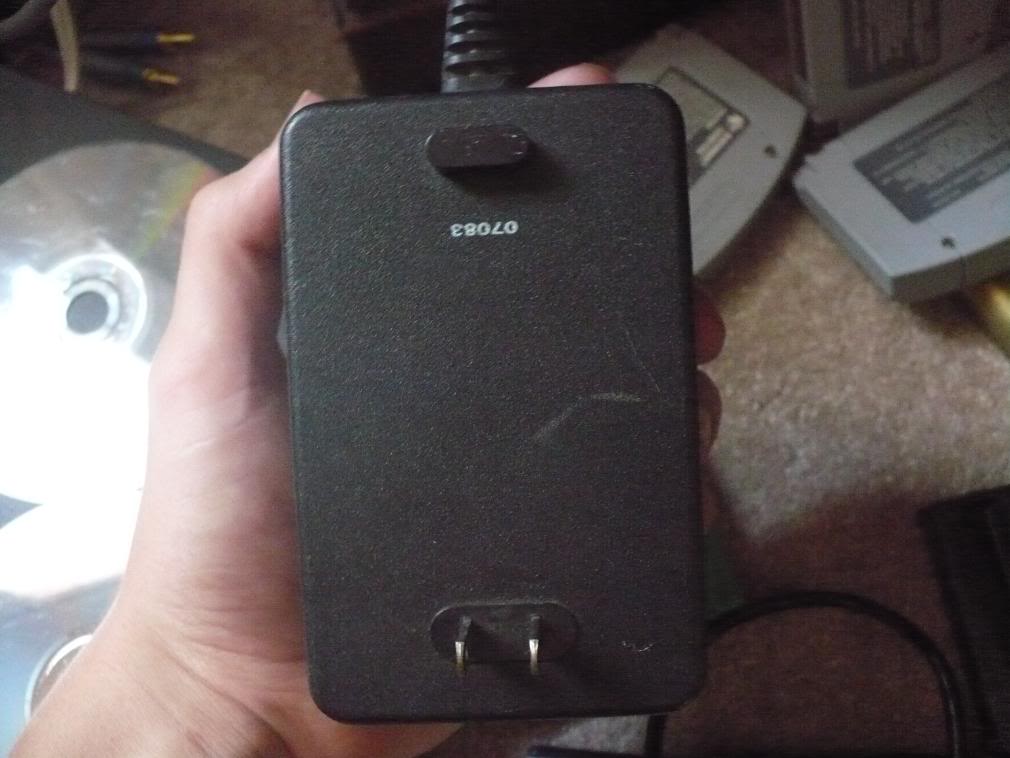
[1] https://p.kagi.com/proxy/jaJn771.jpg?c=LeUEJczBkA3eiHIb6Q3EK... It doesn't quite come across in the picture but this adapter is gigantic.
I'd guess the Colecovion has a linear power supply which is known to be very large for the power delivered, and very inefficient. A quick search says the power supply was 28.5 watts. I'm typing this on a laptop with a 15 watt power supply (pinebook pro - about as low power as you can get in a laptop); connected to a USB hub with a 20 watt power supply!. My work laptop has a 240 watt power supply. I'm not sure what laptop you have, but I'd guess it can draw more power than a Colecovision if you worked it - but also that if all you were doing was running 10 Colecovion emulators it would draw less power.
We also should mention that our laptops have a screen built in and counted as part of the power consumption. The Colecovion expected to be connected to a power hungry CRT television.
My point entirely is that people shouldn't have everything that they want if the creation of that thing is unsustainable.
Same with burning tankers in Iran...
Burning a refinery likely reduces emissions, because the fuel this refinery produced would be burned anyway, and the destroyed refinery will cease producing fossil fuels. So it wouldn't be a surprise if all the refineries destroyed this year in Russia and in the Middle East contributed to a reduction in CO2 emissions.
Pushing up prices on new plastic does make recycling more economic but most of those products still get burned. If you're lucky on average they make it round the loop once, maybe your mountain dew bottle makes a plastic trash bag and then we burn the bag.
Incineration is probably better than nothing, even though it releases CO2.