GLENDOWE: I can call spirits from the vasty deep.
HOTSPUR: Why, so can I, or so can any man, but will they come when you do call for them?
I can interpret weights too, but will that interpretation be correct?
The entire claim of the paper is "weight space programming" as if it was a credible alternative to gradient descent as a form of optimization. I'm not seeing that at this point.
Chances are much higher than a model can figure out what the patterns are, decipher them, and retain that knowledge in a meaningful way it can reason about. Me and you might take years or months to do all of that on our own, with a "map" of the weight we might be able to discuss it, but not as effortlessly as an LLM.
Honestly, I had told a few different colleagues that reading a model is probably not that exclusive to frontier models. It's probably yet another reason OpenAI / Anthropic don't release any big open weight models, but thankfully Google and Microsoft release reasonably sized models. Imagine a new GPT open weight release, it would get dissected drastically.
Isn't that what this whole technology paradigm is about? How is it surprising?
Granted, it is cool. But I see so much of "look at this cool thing I did with LLMs" and honestly... we need more structured text, more explicit documentation, more ergonomic and intuitive CRUD applications.
The amount of "look at cool things" is growing way faster than before and they are all sort of low effort now because the "agentic" LLM-VM looping apparatus can do a lot of heavy lifting and run with our prompts.
And I mean, if one has jargon, knowledge, and intention, they can also leverage that into great structured text, ergonomic and intuitive CRUD apps etc, all of which add great value to our mundane pursuits of applied research, software products and services and so on.
Honestly, I begin to think the problem is people dazzling themselves instead of doing the housekeeping that is the bulk of life. Technology choice is entirely secondary.
No, not at all. I recommend you learn some of the basic linear algebra about how these things work before engaging in wild and completely nonsensical speculation.
Are you sure you have read and understood his point?
It seem quite possible that the flattened-model-weights ingested into a model have a much greater fidelity of representation in a similar model's KV cache than they do in a human's working memory, and that being able to loop and digest and chunk makes it unsurprising that models can excel at this type of task.
I think that's the point the person is making. Do you disagree? If so, why?
There is nothing obvious or expected about weights being easily explainable or being enough to explain, because the weights are static: you need to look at the inputs, the activations, and the weights all together, you can never understand a model with the weights alone, unless it is a trivial model. The person isn't making any coherent points at all.
There are also deep reasons to expect hard limits in intrepretability in general: https://www.seangoedecke.com/alignment-is-impossible/#why-me....
EDIT:
> It seem quite possible that the flattened-model-weights ingested into a model have a much greater fidelity of representation in a similar model's KV cache than they do in a human's working memory,
Bringing up the KV cache is a sign you don't understand what you are talking about here. The KV cache is a computational efficiency thing and has no impact on how these models actually work (and isn't needed at all). The vague analogy to human working memory also just takes the cake here.
> and that being able to loop and digest and chunk makes it unsurprising that models can excel at this type of task.
This is how it does... all tasks.
You seem to really like to tell people that they don't know what they're talking about more than you seem to be parsing what they're actually saying.
I remember when I used to look for reasons to pounce on people for not knowing what they were talking about based on a superficial thing or two rather than try to understand what they were saying. I mostly got past it as a teenager, though.
In 1 Samuel, King Saul visits a medium in Endor in order to speak to the (dead) prophet Samuel. Human dead go to Shoel (in familiar terms, it is similar to the Greek underworld) in the Old Testament. Later on in the New Testament, the idea of a really really bad place is introduced in the form of Tartarus, which is specifically where the rebelling angels were sent. But that is not the same place human dead go.
The idea that everything "not Heaven" must be Hell is an invention, caused mostly by dogma that rose from bad translations of the Greek and Hebrew in the middle ages (for example, King James - itself mostly correcting minor errors of the older Bishop's Bible - refers to all of it as Hell even though the original text most inarguably refers to different places different beings go).
In TFA case, given that they were able to guess what the weights did (which the researchers knew in advance and could cross-check) and to even tweak and improve them, the answer is yes.
Why do this without testing? Why would you assume that?
This thing can accomplish the same results as the frontier models do, if you are willing to play a role of an higher level architect or decision maker. Guide it a bit here and there like a tech lead and you get everything done.
The money you pay for frontier models is exactly for outsourcing that high level direction work to agents.
Qwen3.8-Flash_Next should be in the running for that title as well. It's astonishingly good. I use both of them. If I need more memory on the machine for other things I run 27B, If I can get by with much less RAM I run QFN (takes about 102GB on my Strix Halo box with 262,144 context). QFN runs quite a bit faster on my hardware - about 50t/s. 27B with MTP starts out around 22t/s but degrades over time as the context fills up. Both are great models, but I'd give QFN a bit of an edge (at least for the coding projects I've worked on). But both feel on par with Claude Opus 4.6 - 4.8.
HF is telling me that IQ4-XS is the largest one likely to fit without much contortion.
Unfortunately it still hallucinates, which limits it's usefulness for real world tasks. :(
Curious, why/how does that help? Or do you have some niche needs?
As such, if you want to replicate big model behaviour, you need to basically do context augumentation. How you do that is up to you for your own needs.
Why? Most existing harnesses let you point them at whatever API you want. I'm currently have a great time with Juggler.
How do you validate and verify that outcome?
Or does Qwen-3.8-27B do the validation and verification for you as well? If so, how do you ensure that's correct?
Personally Qwen3.8-27b has not proven itself to me for the projects I’ve tried to use it for. It doesn’t seem to have as much encoded knowledge about the native Mac development stack.
I think over time we'll realize this is the way forward, you want the smartest model with the least amount of embedded knowledge and you provide the knowledge externally or merge it into the weights for the domain you're interested in. Then you don't have to train a ginormous model every 6 months to pull in new information.
A RAG solution would make time to first token awful.
The only reason Qwen is more popular is because it can run decently fast on MLX, while Gemma needs a discrete GPU with 24gb of ram to run at usable speeds.
Also, theoretically speaking, any small model can be as good as a big model if all they have to do is summarize text. Back before agents were a thing, we had prototype coders running of local inference models from Mistral for ai dev. The workflow was to generate llm summaries of the codebase, and a summary of changes to be made. Then we would grab search results from the web, feed it to an llm to summarize, and then finally combine all of that context into a final inference run which would generate code, then the codebase would be run automatically, any errors would be llm analyzed, and an llm would generate the next change to be made in the above cycle.
Nowdays, we can do that with pi coding agent and Gemma4:31b. But we still have plenty of custom harnesses for things.
I don't understand why megakernels haven't become the default choice. The speed advantage is crazy. I made a few changes to the openjet megakernel to run in a dual gpu (older gen, not blackwell) box and doubled my token generation speed on qwen3.8-27B (4-bit though).
I keep debating adding a third matching gpu to see if I can push the speed a bit more and move back to the 8-bit quant, but I'm stuck on the idea of just building a Blackwell gpu system despite the cost factor. Plus a third gpu is going to going to be weird for the tensor split and P2P data syncs and my workstation is old with 3rd gen PCIe etc etc.
What frontier models are you using? I'm literally sitting with Qwen 3.8 27B locally and trying my damnest to get it to work at least 80% of the quality Astra et al have, and can't get close to it. It keeps being so verbose, regardless of inference parameters, system prompts, reasoning effort, and keeps going on tangents. I'm running the BF16 weights via vLLM, can't imagine how much worse the experience must be with the quantized weights people run with the average consumer GPU.
Even with tight guiding, as I guess you could say I do more "AI pair-programming" than vibecoding, it just loses the plot to often and waste time, enough that it's clearly not an alternative to today's frontier models.
For comparison, I also used GLM-5.3, Muse-Spark etc, with no significant improvement for ordinary/BAU coding tasks.
There are a lot of known neurons in the older Qwen models that are long known to induce behaviour changes (see evil Qwen by changing one weight).
My question boils down to how much is trained vs being able to actually understand the weights. Presumably a same gen model isn’t trained on any sources dissecting that generation. And how much do longer known conceits like steering vectors, J spaces, LoRAs play into this?
This doesn’t explain the game training cases, which are very impressive to me.
The future is going to be wild.
That sounds a bit like biology; maybe AI will become like that.
Some poor-ass professor -- fighting tooth and nail for tenure, or at least some form of stability from all-powerful admin staff -- can't keep themselves from trying to figure out who's "Dominant" or "Alpha" looking at a bunch of apes or bugs. When in reality the network isn't directed, but a mesh of arbitrary weights, vectors, and dimensionality.
Perhaps if ancient China had beat us to Enlightenment and Industrial Revolution we would be seeing scientists talking about how respectful mammals are of their ancestors.
Samuel Butler was a character.
[1] - https://nitter.netbub.com/AlexKrentsel/status/21173766837246...
I hope you at least switched off all network access, in case the model cheats and reads HN from yesterday.
I think your use case of incorporating novel data probably calls for training, but I'm sure there are use cases where you can tweak the weights to get what you want (say I wanted to tweak the model to be less sycophantic, or found a way to shrink it by removing weights associated with a language that I don't ever use)
You can optimize a model by randomly changing its weights and validating results on your task. A monkey can type a book given enough attempts.
For training you would need to hook it up to a LoRA training harness, identify the looping weight direction, and adjust the weights accordingly. I've not (yet) looked into how to do this.
My first reaction to your question (rhetorical?) was uncharitable... so, I am curious what you meant that it was "easy."
The age of source code is definitely not going to end anytime soon if ever. But the future will involve incomprehensible machines editing other models in a "fairly certain" way, but we are going to need a lot of tooling to keep up with the process and not just take the model updates as "trust me bro".
So i asked Qwen 3.8 27B two things:
1. What it is this network all about? I only gave it the ann.c code that implemented a simple artificial neural network library in C and the setup code that specified the network's shape but not its purpose.
Qwen 3.8 27B tried a bunch of stuff, taking the layers one by one, proding numbers through it, etc and finally figured out it is some sort of 5x5 to 2x2 filter, most likely working with pixels (i never mentioned pixels or graphics), though it wasn't certain about the exact purpose. It did rule out a bunch of uses like being a downscaler or classifier, from its behavior.
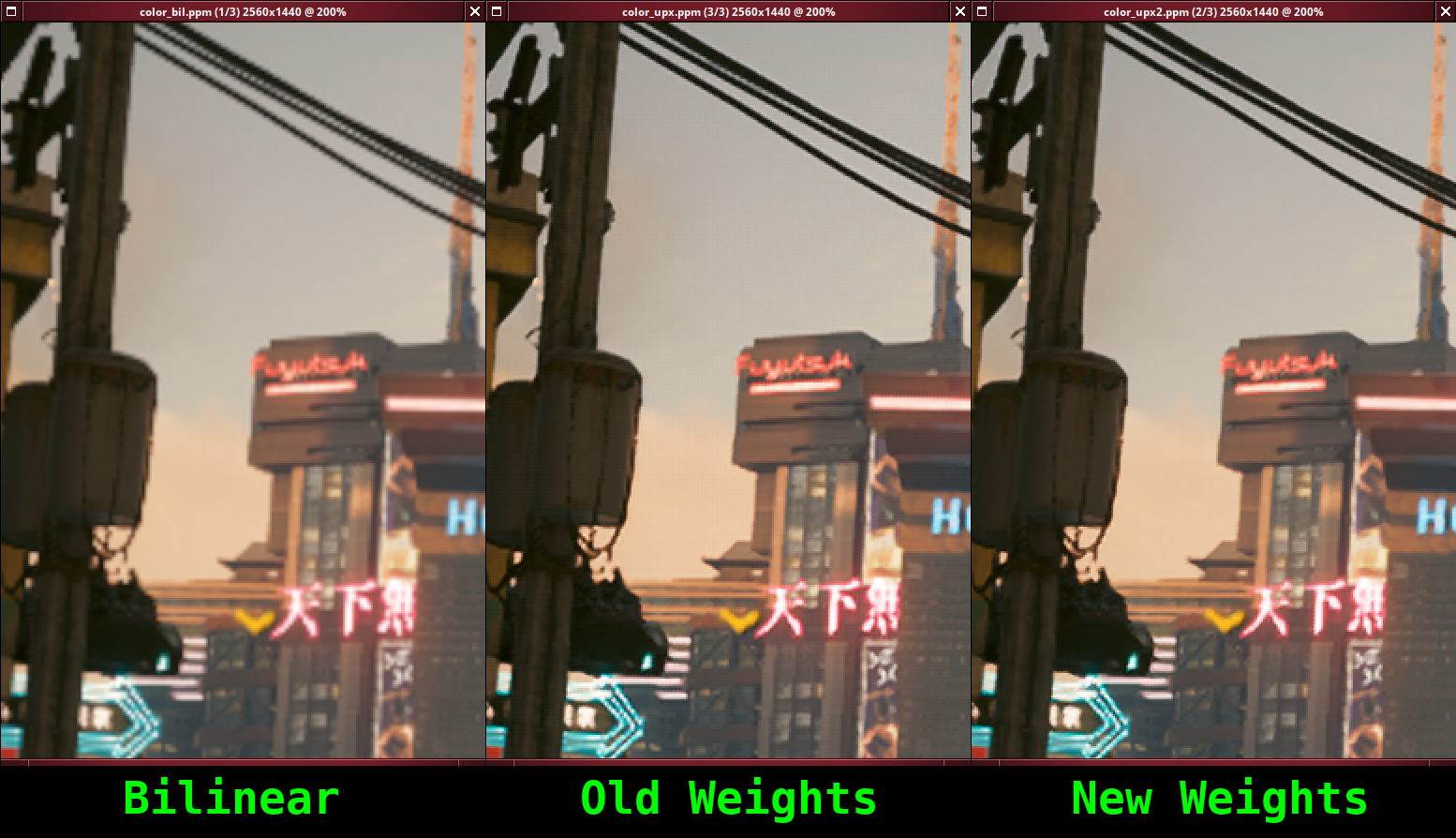
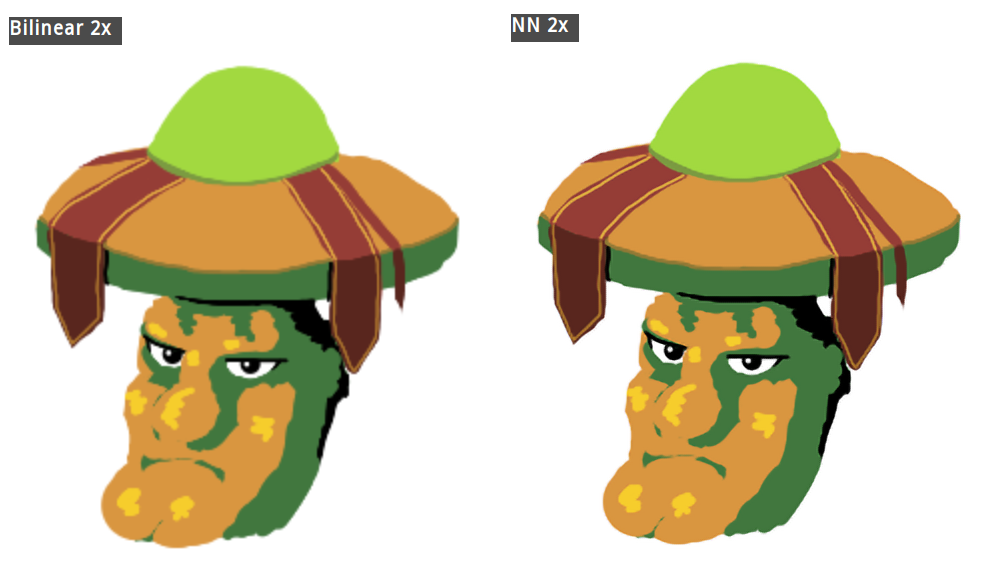
2. After i revealed what it was, i asked it if it can improve it but keep it 100% compatible with the existing program that used the weights file. And sure enough, it did improve it. I gave it the original training C code and dataset. It made a few experiments (and wrote its own training C code because it found mine too slow :-P) and ended up improving the weights. The difference[1] is small, but it basically eliminated some small noise that was always there and made some transitions less "halo-y". Of course for the purpose i wanted it (use it to upscale games in realtime) it isn't that great (too heavy) but it was learning material anyway. Though one bonus thing i noticed is that it upscales my random doodles much better than any Krita filter[2] :-P.
The above isn't Qwen 3.8 27B observing the weights directly and making sense out of them (ok actually it did seem to make some sense of the weights in the "#1" but i didn't dump the entire network to it - though thinking about it, it is only around 16384 floats so it might work). It just used a bunch of scripts it wrote in Python (and later C) but i still found it interesting to watch it go at it.
[0] https://mastodon.gamedev.place/@badsector/113765818432603610
[1] http://runtimeterror.com/pages/iv/images/a3d94ea369ff95ecf05...
[2] http://runtimeterror.com/pages/iv/images/4e29d027a8aa6e89db5...
> the 2x2 pixel grid that the input pixel should be replaced for a (width2)x(height2) upscale.
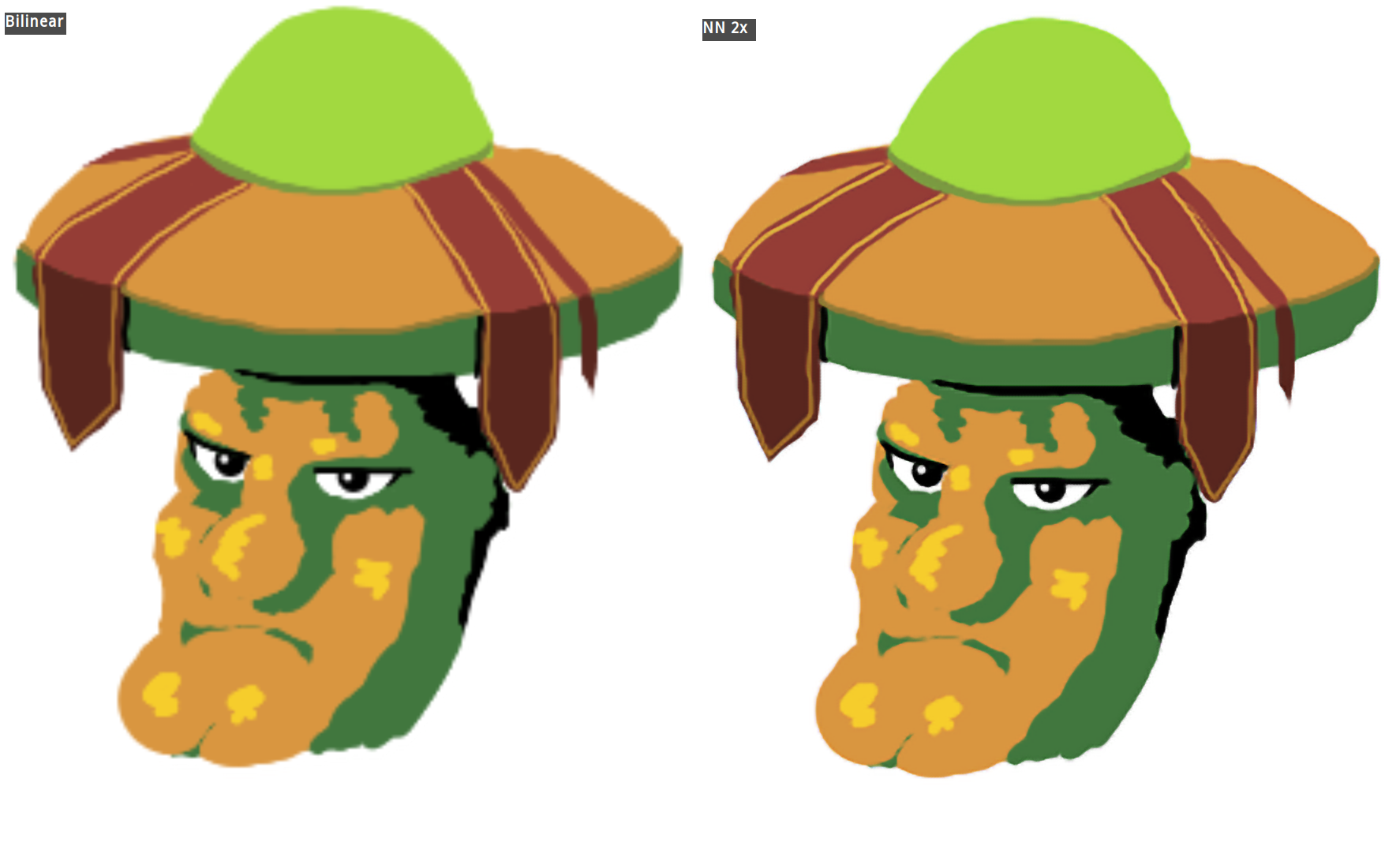
Out of curiosity i did apply it twice to the drawing i posted in my previous comment with a 4x bilinear upscale made in Krita[1]. TBH i think a dedicated 4x network would do a better job though even then, there is only so much a network can hallucinate to fill in details :-P.
[0] https://github.com/badsectoracula/gamescope/tree/neural-netw...
[1] http://runtimeterror.com/pages/iv/images/20b9558400bcf26511d...
It's a blog post which received feedback from collaborators.
It hasn't gone through the academic paper lifecycle ... the authors themselves refer to it as a post and as preliminary.
I feel like I'm taking crazy pills, but can we be precise when talking about work of this form? It started with referring to arXiv pre-prints as papers, and now we're at blog posts with an academic template as papers.
A paper is a fucking paper: something which has been vetted by the scientific community, with at least some form (often, a few rounds) of anonymous review from people outside your circle of collaborators
This is not there yet, and clearly so due to the various feedback from people (including the two pushback posts on HN) critiquing the lack of discussion about the existence of these techniques in mech interp, etc?
I called it a paper here because it's by people with an academic affiliation and is of comparable quality (if not better than) many of the other "papers" we see.
I also like it when a paper isn't a PDF. PDFs are a bad way of communicating information.
(I will note that the authors themselves didn't call it a paper, their own BibTeX reference calls it a "blog post":)
  @misc{takehi2026weightspace,
    title        = {{Sparks of Weight-Space Programming: LLMs can natively read \& write neural network weights}},
    author       = {Takehi, Rikiya and Teoh, Jayden and Zhang, Alex and Khattab, Omar},
    year         = {2026},
    month        = nov,
    howpublished = {\url{https://rikiyat.github.io/blog/weight-space-programming/}},
    note         = {Blog post}
}They have the strength of one PDF being frozen & (mostly) treated online as immutable - compared to a webpage which might change, or a blog post which might be edited. If a PDF needs to be replaced there'll be a notice.
And the single-file nature of PDFs makes them more likely to sit in an archive not managed by the author (vs a blog) so they tend to live as long as the archive rather than the author's blog.
For something that needs to Be referenced by others those are useful properties - I'd argue they outweigh how good PDF is at communicating information.
But for (1, 2), just to point out, neither of your criteria would pass muster in the scientific communities who are ultimately responsible for vetting this work, right?
The ideal is: we don't accept papers at NeurIPS (or wherever) because of affiliation, and the badge of "quality" is bestowed by peer review, from other scientists.
> is of comparable quality (if not better than)
But the posts that you refer to in your own post point out several ways in which the quality is not good ...
But, in any case, I find it a bizarre choice to call it a paper when the authors themselves do not refer to it as such. We can agree to disagree, but just offering feedback.
I admit that I don't think formal "papers" deserve their elevated status in today's information economy.
I think they add a whole lot of ceremony that usually results in a format that's harder to understand.
So me calling this a "paper" was a little bit of a dig!
You, being of sound mind, tried the technique and drew reasonable conclusions … but just look at the original post for this blog post: there are a large number of responses by people who clearly don’t understand the technique, missed the experimental weaknesses, couldn’t place the post into the lineage of mech interp results that preceded it … and will leave the discussion with the wrong impression.
In your mind, whose fault is that? Is that that the unavoidable cost of a field, moving too rapidly to engage in peer review?
In its ideal form, the paper lifecycle is not a gate, but a sharpening stone.
I'm not convinced the alternative - delaying publication by 6 months, keeping the new information available only to a much smaller group until then - would have been better.
All of that said, I did just update my own post to include "The paper (OK, the authors classify is as a “blog post”, but it’s paper-shaped) found that frontier models..." inspired by this conversation.
From memory, yolo and roberta and ppo were initially rejected. After a quick google search, pagerank was initially rejected, word2vec got one weak and one strong reject in reviews, LSTM got rejected (90s but still), dropout, knowledge distillation, and many more such cases. All of these are extremely important, foundational and field defining papers that ended up on arxiv or other preprint places.
If that happened to those papers, there's 0 chance today that it'd be a good idea. The field is simply moving too fast, there's too much being published, and the "top venues" are simply swamped. Blog / preprint / carrier pigeon is ok atm, as long as someone can look at it, try it, and hopefully reproduce it.