His blog, Diary of an x264 developer, was a great read too for anyone wanting to get a vantage point on how crazy that codebase was.
[1]https://github.com/mstorsjo/x264/blob/master/doc/threads.txt
(edit: was Gaikai that was acquired by Sony in 2012 and is the basis for PlayStation Now)
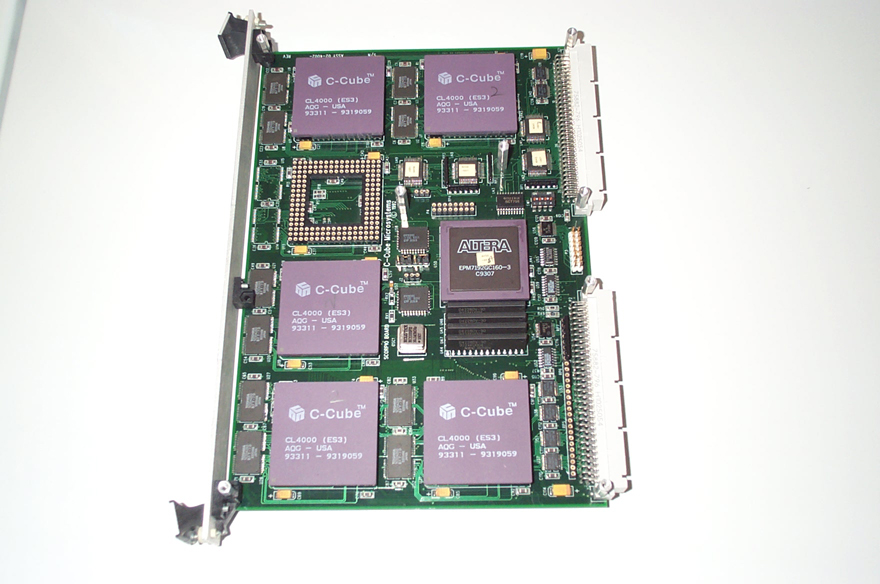
Here's a picture of the VME bus development board. It was a two board sandwich to support 10 chips in parallel (only one board pictured).
https://www.w6rz.net/scorpio.jpg
The first real-time HDTV encoders for terrestrial digital television (ATSC) were built by Harris using an IBM encoder chip. It took 6 chips to encode 1920x1080. The IBM chips didn't have an auxiliary bus, so you could see motion vectors limited to chip image boundaries (in this case, 6 tiles arranged like so).
  -------------------------
  |       |       |       |
  |   1   |   2   |   3   |
  |       |       |       |
  -------------------------
  |       |       |       |
  |   4   |   5   |   6   |
  |       |       |       |
-------------------------"x264vfw" is one tool which supports this format, even inside of an AVI file. So older software that uses Video For Windows can create those files.
Is it similar to lossless audio were there's not a ton of optimization you can do?
They are still using directories of tiff, though.
I’m not sure if lossless h.264 is I only or not, but if it uses inter-frame compression then it’s difficult to randomly access arbitrary frames. For any arbitrary frame you’d have to find the nearest key frame, then interpolate from there based on the inter-frame compression metadata.
the days where the OS matters for video playback are long gone
https://engineering.fb.com/2026/06/22/video-engineering/adop...
And soon AV2
It looks like they normally sell for around $200: https://www.ebay.com/sch/i.html?_nkw=NUC11TNKi3&LH_Sold=1
Would be interesting to see if we could segment third-party from TV-embedded (see quote), but the metrics from the article seem to reflect actual consumer usage, as most consumers just use what comes in the TV they buy nowadays.
> This reflects a consolidated approach and eliminates yet another device in the home, and it’s catching on, as just 34% consider streaming media players as their primary viewing device. Meanwhile, 56% said the same for smart TVs.
https://www.cepro.com/news/roku-amazon-lead-streaming-media-...
https://developer.roku.com/dev/docs/media
So if you are saying Roku has 43% of the market, I would consider that as support for my point that AV1 is not that widely supported.
That's still a sliver of the market, but the more royalty-free* codecs we use, the better.
0: https://developer.amazon.com/docs/device-specs/device-specif...
*: https://arstechnica.com/gadgets/2026/03/av1s-open-royalty-fr...
This is so wrong..
> From Jellyfin blog: https://jellywatch.app/blog/jellyfin-nvidia-shield-tv-setup-...
>> The NVIDIA Shield TV (Pro and Tube) is widely considered the best Android TV streaming device for self-hosted media servers in 2026. While the Apple TV 4K wins on UI polish and the Onn 4K Pro wins on price, the Shield wins on something most other devices can't match: lossless audio bitstream passthrough. TrueHD, TrueHD Atmos, DTS-HD MA, DTS:X - the Shield passes them all to your AV receiver untouched.
>> Combined with hardware decode for H.264, H.265, VP9, and AV1, plus an 8-year-old Tegra X1+ chip that still gets driver updates, the Shield is a genuine "set it and forget it" Jellyfin client.
Nvidia shield is a device that simply works and passes the audio untouched to my sound receiver and I enjoy it __everyday__.
EDIT: <trying to fix formatting>
Maybe a device from 2019 is a bad data point
I'm posting from a machine without AV1 acceleration. I disabled AV1 in Firefox's about:config and Youtube falls back to VP9.
Mainstream support doesn't have to be forced.
A lot less than half of devices are broken when playing YouTube, I assure you.
If they stopped forcing it, it would still be the best choice most of the time. It doesn't "have to be" forced to be a major choice. The forcing changes the exact percentage but not the overall picture.
Otherwise we will have this:
Edit: And you can also look at the video codec landscape as having two major standards that put out new versions sometimes. The MPEG/h.26x series and the VPx/AVx series. It's not quite that simple but it's close.
…maybe THIS one will be The Final Codec… doodoodoo dooo
And then we'll get AI-designed hardware codecs for them.
4.nov.2016 https://news.ycombinator.com/item?id=12871403 219 comments
17.mar.2022 https://news.ycombinator.com/item?id=30710574 219 comments
24.may.2019 https://news.ycombinator.com/item?id=19997813 180 comments
14.jun.2024 https://news.ycombinator.com/item?id=40681306 205 comments
Hutter prize (I think mentioned in a 3b1b video somewhere else in this thread) is a great example. Given this was written before advent of LLM, I would love to see someone throw openAI/Anthropic levels of compute at a similar problem to see what the swarm can produce.
35'000$ for a prompt and some training is a nice chunk of cash.
Next steps are replacing the encoders and all the other human-biased compression parts by just raw data and training, probably another 20-30% is up for grabs.
PNG: 1039993 bytes - baseline
optimized*: 541539
WebP: 398974 - lossless mode, of course.
JPEG XL: 310778 - lossless, quick, and easy.
*after monumental compute effort; still probably some room for improvement but the effort is ridiculous.
For lossy, neither is in a good place, since lossy AVIF beats both lossy JXL and lossy WEBP. Lossless AVIF is a joke and barely competes with PNG.
And AVIF compression ratio beats JXL only conditionally. E.g. my photo library had AVIF at 29% and JXL at 25% the input size at the same perceptual quality (SSIM2=83). Sometimes it's on par. Sometimes AVIF wins. JXL wins almost always. Not to mention you can losslessly, reversibly transcode lossy JPG files to JXL, getting significant size reduction for free.
There's also a case for AVIF in some use cases (for this image it performs poorly). But if I had to choose one, I'd choose JXL.
[1] https://meta.wikimedia.org/wiki/Have_the_patents_for_H.264_M...
That's just image compression though. Very few space-grade cameras support video compression. In a lot of cases it works well even though you think you're after a series of still images.
Like, it's baffling to me how much we can compress high-quality video nowadays. HEVC and AV1 and VP9 are all also very cool and they still sort of break my brain. I understand how they work but it doesn't feel like it should compress as well as it does.
The context heavily implies that quantization is "discarding information" generally (e.g. clipping, masking). The wikipedia article he links in the footnote disagrees, and so do I:
> quantization is the process of mapping input values from a large set (often a continuous set) to output values in a (countable) smaller set, often with a finite number of elements.
Quantization is a function over values, or the image itself. Clipping and masking, by contrast, are functions over the space/frequency dimensions, i.e. the pixel indices ("preimage"). A rule like "apply a circular mask" or "drop the first quadrant" does not depend on the values!
The most extreme example of quantization is a threshold filter. Regardless of location, output "1" if the pixel is brighter than X, or "0" otherwise. This depends only on the value, not on the location. He also misses the opportunity to point out that chroma subsampling is another application of quantization, this time to chroma values (drop the low-order bits).
Codecs like H.264 and JPEG use spatially-varying quantization rules to effectively discard more information at high frequencies, so his explanation of H.264 is spot on, but a non-expert encountering quantization for the first time would probably come away with the wrong idea. For an article explicitly targeted to non-experts that goes out of its way to introduce the term, it's a pretty important oversight.
Should I use H.264 or H.265?
I was surprised that Twitter only lets you upload H.264 still, in 2026.
Even then, it was a crapshoot whether or not the video would look like a pixel collage, and I'd need to delete the Tweet, tweak the video a bit, and try again.
E.g. I remember having lots of issues sharing smaller video files encoded with H.265 via both WhatsApp and Messenger. iMessage doesn't support H.265 (or at least it didn't work for me at the time).
How are you generating video?
How are you playing it back?
AV1 is the future/present: Fully open standard, better than h265. Only downside is hardware support: You need hardware made in the last few years.
Mostly the trick is they're comparing lossy to lossless compression which doesn't even make any sense.
They're not actually confused here. It's a writing style, where you pose an interesting problem/scenario, then explain it.
When good expositors choose motivating questions, say like 3 blue 1 brown, they don’t usually make apples to oranges comparisons. The best examples motivate while making sense before and after you learn.
> This concept of throwing away bits you don't need to save space is called lossy compression. H.264 is a lossy codec - it throws away less important bits and only keeps the important bits.
> PNG is a lossless codec. It means that nothing is thrown away. Bit for bit, the original source image can be recovered from a PNG encoded image.