507 pointsby Jowsey4 hours ago73 comments
  • rudolftheone4 hours ago
    That's something which caught my attention:

    > First, we aim not to release open weights that would extend the absolute frontier of cyber capability. K3.1 Pro's offensive cyber capability is, by design, below what our pipeline can produce, and remains behind that of frontier proprietary models. Second, we intend to progressively raise the cyber capability available in open weights.

    So they admit that they could do more, but they won't?

    • NitpickLawyer3 hours ago
      > So they admit that they could do more, but they won't?

      Yeah, there's another paragraph:

      > Identifying and removing cyber-related data. During development, we observed vulnerability research performance improving steadily as post-training scaled. Tracing the source of this trend, we found that cyber-related content was embedded within the general mid-training corpus, and cyber-related tasks were present in the RL environment mix — a natural byproduct of training on broad data. In preliminary experiments on internal models, we found that without data removal at either the mid-training or the RL stage, downstream cyber capability would increase substantially. These findings gave us a concrete lever for control. For the open-weight release of K3.1 Pro, we identified and removed cyber-related data from both training stages, while retaining the general-purpose coding tasks needed for model usefulness. We will continue to apply appropriate controls at every training stage, of which cyber-related data identification and restriction is one example.

      (emphasis mine)

      It's clear that cyber is a touchy subject right now. But it's also clear that RL works on it, because it's highly verifiable. So smaller models are going to become very interesting, because they can be fine-tuned later to cover this field.

      • neuronexmachinaan hour ago
        I'm betting this is related to China's Announcement No. 48 last week about AI export controls, since releasing an open-weight model is effectively export: https://www.jdsupra.com/legalnews/china-proposes-new-export-...

        > Prohibited: high-performance detection technologies used to counter cross-border data transmission security risks, including deep-synthesis forgery detection (266401J); AI cyber offensive capability technologies, such as malicious code generation and mutation, automated mass generation and distributed large-scale deployment of anti-detection variants (266402J); large models trained using China’s Core Data (266501J); and high-performance AI agents designed for highly sensitive scenarios, such as critical information infrastructure, national defense and core government affairs (266502J).

      • yorwba3 hours ago
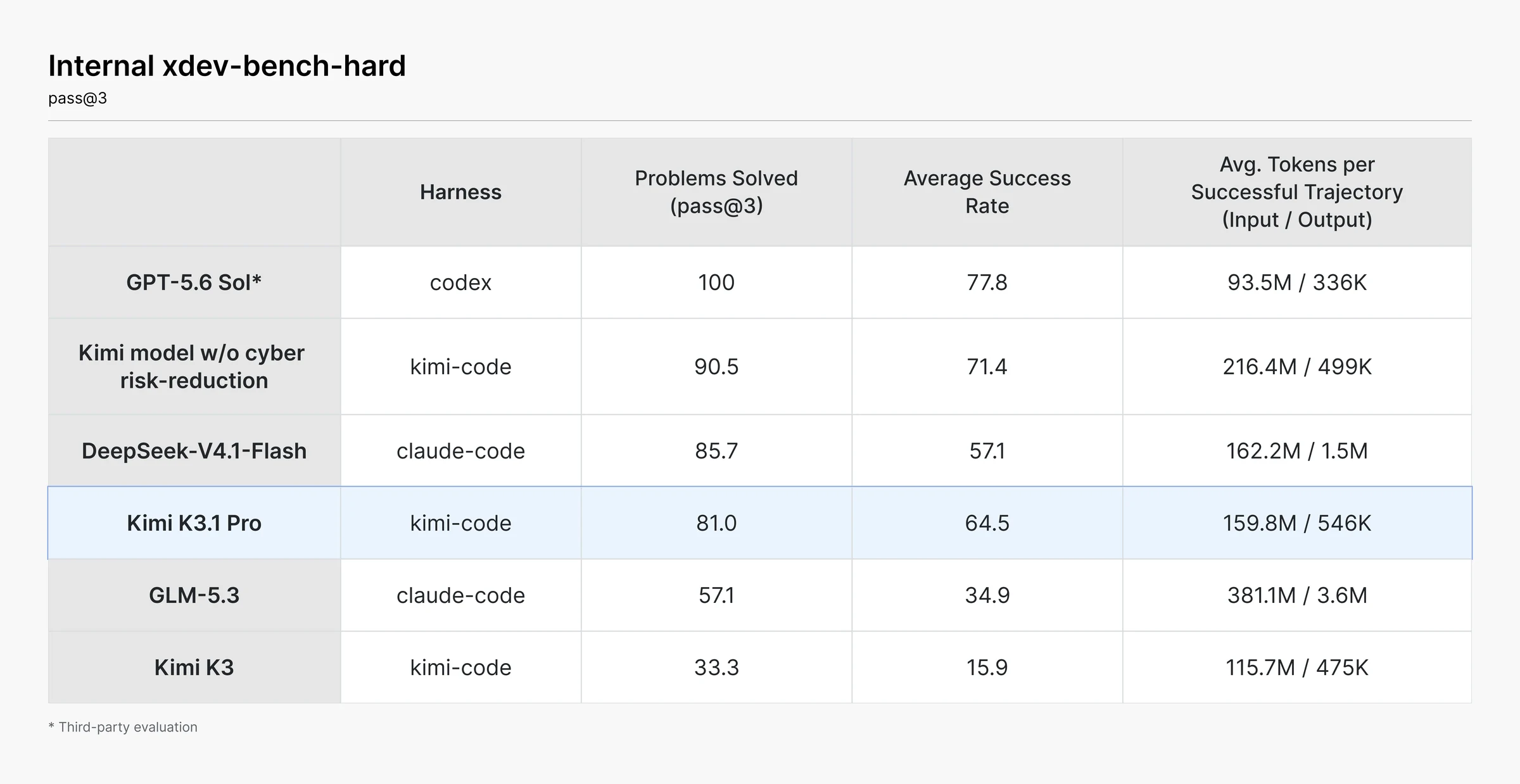
        They also show scores for a "Kimi model w/o cyber risk-reduction" https://statics.kimi.ai/kimi-blogs/kimi-k3-1/20261023/xdev-b... Presumably State Security will get access to that on request.
      • dotancohenan hour ago

          > It's clear that cyber is a touchy subject right now.
        
        And that's why we need models that understand "cyber" or application and data security. The offensive models are powerful, and they are in the hands of script kiddies now. The models writing our software and designing our cloud infrastructure had better understand these issues as well, just to avoid coding in vulnerabilities.
      • fartfeatures2 hours ago
        I think this is misguided. Considering how much code is AI written these days do we really want LLMs writing insecure code because we lobotomised them?
        • MattDaEskimo2 hours ago
          I think it's political. Certain companies are exploiting as much as possible to push the boogeyman of AI for regulation.
          • echelonan hour ago
            It's exactly this.

            If the "scary Chinese open weights models" can do "dangerous cyber", then we might see regulations spring up against open weights sooner than later.

            I hate Anthropic and OpenAI. As companies and leadership, anyway.

            Dario and Sam are 100% to blame for this. They're trying to turn us all into jobless slaves, sex workers, and Squid Game pawns.

            The only good future is open weights. They're trying their damnedest to keep us under boot.

            I hope the Chinese companies (and I say this as a patriotic American) slay these two companies and destroy their moats.

            In my mind, the two most dangerous people in the world are Dario and Sam.

            We need open weights to win.

            • m348e912an hour ago
              > They're trying to turn us all into jobless slaves and sex workers.

              Speak for yourself, I don't think there is a market for many of us as the latter.

              • echelonan hour ago
                Let me edit my comment :)
            • Hammershaft16 minutes ago
              Why do you think Dario is dangerous? I think he's genuine on the dangers of AI capabilities moving faster than AI alignment.
              • smashed3 minutes ago
                Because his solution is to block competition and capture all the market through regulation.
            • felixgallo5 minutes ago
              Sam, I'll grant you, is probably among the top 10 most dangerous, but Dario? The only thing he's done to piss people off is to predict, correctly, that releasing too-powerful models too-quickly would cause havoc and chaos. This prediction actively hurts his company! It actively harms his chances of a huge exit! It actively raises the probability that Anthropic and OpenAI get nationalized and treated in the same way as, for instance, the nuclear program!

              By comparison, do you think the Chinese models are going to be trained in such a manner that you enjoy the society that results? What makes you think that?

            • pixl9743 minutes ago
              >I hope the Chinese companies (and I say this as a patriotic American) slay these two companies and destroy their moats.

              China cares about about stability way more than the US even, they aren't going to be big on AI models upsetting the governments power, and mass cyber attacks could do that.

              At the end of the day we are going to have to realize AI is both dangerous and governments are going to control it. Worse if you start making and releasing your own dangerous models the 4chan party van is going to visit you.

              • echelon22 minutes ago
                > At the end of the day we are going to have to realize AI is both dangerous and governments are going to control it.

                Your thinking is dangerous. Do you work for Anthropic?

                AI is dangerous when these powers are being hobbled up by the select few. These systems threaten to put us all out of work. I refuse to be a slave to a company or a government that is taking away our livelihoods, scraping up our earnings potentials, then seeking to muzzle us and put us in jails with no rights.

                I would rather burn down all of tech than have AI be owned by the elites.

                Your thinking is a threat to all of our liberties.

        • an hour ago
          undefined
        • zer00eyz2 hours ago
          Anthropic: Touch too much security stuff and we ban you, and keep your money.

          Kimi: We took out the worst of it so have at it for free.

          Everyone else: Back to my ablated model on openrouter for 1/10th the price where I can brute force issues.

      • sheepscreek3 hours ago
        It’s not much of a deterrent to a motivated organization.

        They are basically saying that models themselves are already capable. If you fine tune them with some cyber security tasks, that should make them potent. :-/

      • vessenes3 hours ago
        Classic “rules for thee and not for me.”

        Agreed that this could be reinjected later. Makes me think of neo in the matrix:

        “I know zero days.”

        “Show me.”

        • zozbot2343 hours ago
          What "rules"? They don't have to post-train the model on anything specific, it's their judgment call.
          • vessenes2 hours ago
            The "rule" here is, if you read the disclosure carefully, that they have cyber trained models in house. But you do not get them, you only get the non-cyber models.
          • mlmonkey3 hours ago
            Post-training _is_ a part of the whole training regime.
        • pixl9740 minutes ago
          Governments also control who owns tanks and missiles.

          Do you think that going around making cyber weapons isn't going to get you buried in a shallow grave?

        • an hour ago
          undefined
    • mrandish2 hours ago
      With frontier competitors and the U.S. govt actively pushing "concerns" about Chinese models, Kimi including this statement on "offensive cyber capability" seems like smart defense. Models are opaque and training details are trade secrets, so whatever they did might be negligible or significant and no one can tell. This bit is also artfully done:

      > "below what our pipeline can produce, and remains behind that of frontier proprietary models."

      Like Ant and OAI, they've realized vaguely claiming to have nerfed their latest model to an unspecified degree not only looks 'good guy' prudent, it provides a built-in excuse when a model fails.

      • mirekrusinan hour ago
        I'm not sure if not doing RL capability gain on offensive cybersecurity can be really called "nerfing"?

        They're not post training it to lose capabilities/censor them – they just don't spend training time on this topic, which sounds like a great idea.

        It doesn't mean model can't do it, it just means it's less good at it; -10% on benchmark feels like a great result and overall approach to pace it.

        • mrandisha few seconds ago
          > I'm not sure if not doing RL capability gain on offensive cybersecurity can be really called "nerfing"?

          I concede that term can carry overly broad connotations.

    • Keyframe34 minutes ago
      We really need some breakthrough like DiLoCo does, but for heterogeneous unstable consumer hardware to make volunteer crowdsourced AI training a reality. Yeah, I understand from current technical angle how much of a mountain that is. Call it AI@Home or whatever. I never thought it would bother me personally or even become a problem, but these companies acting like gatekeepers and virtue signaling while also in bed with governments etc.. this leads nowhere good.
    • scottyah4 hours ago
      Or it's a cop out. I could totally outrun Usain Bolt, but by design I don't push to set new World Records. I will increasingly show faster times though.
      • locknitpickeran hour ago
        > Or it's a cop out. I could totally outrun Usain Bolt, but by design I don't push to set new World Records.

        The benchmarks show Kimi K3.1 Pro outrunning practically all models. It's weird to hear someone like you accusing them of making up excuses for not lagging behind in discussions on how they are ahead of the pack.

      • stalfie3 hours ago
        Well, in the publication they claim to have identified specific cybersecurity post training tasks that nerfed capabilities when they removed them, which seems like a reasonable methodology.

        Seeing as no one besides blackhats want frontier cybercrime capability to be open source, this seems like a very sensible thing to do.

        So they have published a reasonable means, and they have a motive. I'd put my money on "probably true".

        • InsideOutSanta3 hours ago
          > Seeing as no one besides blackhats want frontier cybercrime capability to be open source

          Sure. The problem is that there is no practical difference between "cybercrime capability" and "cybercrime defense capability."

          All of my PRs go through an adversarial security review by GLM-5.3, because it's the only smart-enough model with a good understanding of cybersecurity issues that won't regularly refuse the job. Removing that ability from frontier models helps nobody except cyber criminals.

          • stalfie3 minutes ago
            I'm not sure I follow. Let's say that GLM remains the frontier of open source cyber capabilities because Kimi is nerfed. Your situation, and the situation of your attackers, remain exactly the same. You run GLM to audit your code, they do the same looking for exploits.

            Let us say that un-nerfed Kimi was released, and it turns out to be at the absolute frontier of cyber capabilities, Mythos 5.5 level, a step ahead of anything else. What now? Well now your situation is exactly the same as before, just that auditing and hacking got more expensive. You run a Kimi security audit, they do the same to try to pwn you. However, now the cabal of Linux kernel defenders with secret access to Mythos 5.5 all of a sudden have no advantage, where before they used to have one. And even worse now they are in a literal race to be the first ones to find every bug that Kimi is capable of finding, and patching it yesterday.

            So for you, this makes no difference in practice, your capabilities are not elevated, and neither are those of the attackers. The only result of the other scenario is an overall defender disadvantage.

        • ApolloFortyNine3 hours ago
          The problem is, as anyone trying to address security concerns in claude can attest to, the guardrails trigger even when trying to address real bugs. Good cyber defense requires an understanding of the offense.

          How you avoid the "fix my code" attack, the code being someone else's code, I do not know. But nerfing the model doesn't seem like the best path forward either.

          • zozbot2343 hours ago
            This is not about guardrails, it's just not post-training the model on tasks that specifically relate to cyber-offense. It's a very lightweight intervention, and it makes the model less of a target for bad actors.
          • tough3 hours ago
            claude code "auto-mode" uses a smaller sonnet-like model for classifying, which means it's basically dumb, and the harness biases it into denials
        • tkz13122 hours ago
          I am a defender, and I really really want to have access to high quality models that are good at finding vulns and hacking. Leaving them in the hands only of government agencies and orgs with enough resources to do extensive training / fine tuning seems like the absolute worst possible case for the future security of global software systems.
          • stalfie23 minutes ago
            Well, and I am genuinely curious here, wouldn't defender and attacker capabilities being accessible equally by both parties be objectively worse than having a limited amount of privileged defenders? Of course, you could have every piece of code go through an adversarial audit before it's pushed, but in an equal world you would have to always devote as much or more resources to this as your attackers. And historically speaking people just don't do this in practice.

            In the scenario where only "verified" defenders get access to the best cyber capabilities, unverified plebian defenders and blackhats are on the same level exactly as described above, there's just also a few defenders that get to run things on godmode.

            So to me, it seems that the only result of frontier cyber capabilities is removing a defender advantage. Although that advantage is not for everyone, it can only exists as long as capabilities are unequally distributed. Am I missing something?

        • ben_plotke3 hours ago
          > Seeing as no one besides blackhats want frontier cybercrime capability to be open source

          I'm not interested in black hat anything, but I am very invested in making sure the products I work on are not compromised. Given that state agencies have "frontier cybercrime capability", I would like to have the same.

        • LtdJorge3 hours ago
          It would also be very sensible to offer a BlackHat Pro version to national officials, for them.
        • CBLT3 hours ago
          Please don't change "cybersecurity" to "cybercrime" from one sentence to the next as a rhetorical flourish. It comes off as disingenuous and makes it harder to get your real point across.
          • zozbot2343 hours ago
            "Cybersecurity" as a general term often includes offensive "cyber" which is what is being talked about here.
            • bbg240129 minutes ago
              But the person being addressed specifically used the term cybercrime.
        • verdverman hour ago
          Black Forest Labs did similar with vision capabilities

          https://bfl.ai/blog/capable-open-and-safe-combating-ai-misus...

    • pcarolan3 minutes ago
      Good point. Wouldn't be good if there were white hat models being developed by legitimate organizations at this point?
    • segmondy4 hours ago
      They don't want to be banned, and maybe their best offensive cyber capability models will be for their govt.
      • Danox2 hours ago
        That really does go without saying…
        • pixl9739 minutes ago
          It seems a good portion of HN doesn't seem to realize that
    • emilsedgh2 hours ago
      Isn't this done so they can defuse Anthropic's excuse for regulatory capture?
      • pixl9739 minutes ago
        Or maybe cyberweapons are actually dangerous.
    • revolvingthrow4 hours ago
      Yeah that's a huge downside. That the model does the task without tripping over its own feet, like discovering a vulnerability the model itself accidentally built 15 minutes ago and triggering its own guardrails, made the Chinese models attractive to use for security-adjacent things. Also useful to red-team your own stuff. While I can understand the reasoning behind it (and I guess having a model that's really good at both offense and defense released into the ether could lead to CCP asking some very pointed questions if Moonshot managed to get blamed for some incident stemming from their model's misuse) it's still a huge disappointment.

      I don't want to give US labs the results of my DNA tests and my family tree going back to the 16th century just to secure my shitty app, but if the Chinese are bowing out as well it seems the only alternative is to admit that some script kiddie with a bunch of tokens will just pwn you now and then.

      • arjie3 hours ago
        If the Chinese want it, they have it. BGI does an enormous amount of sequencing. My own genome is entirely public (or was, and will be again when/if Personal Genome Project comes back) so you can watch and see if it harms me.
      • 0xWTF3 hours ago
        > I don't want to give US labs the results of my DNA tests

        My friend, you realize that if you have had blood drawn for a genetic test, there is a very decent probability that the sequencing was done by a Chinese lab operating in the US, right? The Chinese probably have more US genomes that the US does.

        https://pandorareport.org/the-gryphon-scientific-biosecurity...

        Also, illumina used to ship products with hardcoded S3 access, so purchasers of used equipment could gain access to sequencing information generated by the original owners. Too many links to cover all of it, here's the Gemini summary:

        https://share.google/aimode/4JLsHpeRCWlVqU8qT

    • Mattwmaster584 hours ago
      This doesn't seem particularly notable and is in line with Anthropic and OpenAI's approach of restricting release/access to more capable models.
      • _factor3 hours ago
        It is notable in that it’s the first time an open Chinese company openly stated they were reducing intelligence for “safety”.

        “Our lock can be picked by the robot.” We ban the robot instead of fixing the lock. It’s shortsighted.

        • JoshTriplett3 hours ago
          If we had a technique that would defeat almost every lock in the world, we might be prudent to delay releasing that until people have had time to change the locks.

          Same general benefit as coordinated disclosure, except it's a big game-theory problem where we're likely to eventually have sufficiently capable defectors.

        • vikramkr2 hours ago
          they're pretty clearly framing it as holding back on the robot and letting is lose slowly to give everyone time to update their locks
    • baq2 hours ago
      Read this as ‘dear government we can train a cyberweapon if you pay us’ assuming they wouldn’t say anything if they were already paid to do that
    • quotemstr17 minutes ago
      Cowards.

      The way to stop the vulnerability apocalypse is to fix the vulnerabilities, not to shoot the damn messengers.

      I hope someone abliterates and FTs this model on vulnerability discovery so we can find more bugs in our testing, insecure tech stacks.

    • modeless2 hours ago
      They will. Just not in the version they release to you.
    • comeonbro3 hours ago
      Moonshot (Kimi) seems to be unashamedly into American culture[0], I wonder if they're paying closer attention to and giving more credence to some cultural aspects of American AI discourse including aspects of AI caution/panic.

      [0] https://x.com/crystalsssup/status/1944287779896328668

      (note: extremely speculative and based on almost nothing, and especially near-complete ignorance to alternatives)

      • noelsusman2 hours ago
        This is an extreme stretch before you even get into the fact that Pink Floyd is famously not American.
        • TacticalCoderan hour ago
          And Radiohead ain't american either.

          Maybe GP meant to say that the model was westernized.

        • comeonbro2 hours ago
          All postwar english language culture that isn't much more explicitly non-American than that is American. All good rock music is American by default, unless it is near-constantly screaming otherwise.

          Regardless, expand both sides of the point from "American" to whatever you need to, the idea is the same either way.

          • cromka2 hours ago
            The American exceptionalism: even when it's not American, it still is.
            • comeonbro2 hours ago
              Unironically yes.
              • locknitpickeran hour ago
                > Unironically yes.

                That just conveys an idea of being extremely desperate for being the leaders when you're clearly not it, and that despair is so great that you don't mind switching teams midway through just to be able to claim you're winning.

              • whoanoway2 hours ago
                [dead]
    • WarmWash3 hours ago
      All it takes is one idiot who happens to have the resources to "pWm Teh Interwebs" to scare both the US and Chinese governments.
    • Onavo4 hours ago
      The more interesting question is how much more performance can be squeezed out by post training the open weights through RL.
    • TrainedMonkey4 hours ago
      On the surface that seems like a responsible thing to do
    • MisterMunchkin2 hours ago
      Oh great, more censorship. We wouldn’t want those pesky plebs securing their work.
    • woadwarrior013 hours ago
      Kimi is the closest Chinese equivalent of Anthropic.
      • henry7003 hours ago
        Yeah but not hypocritical
    • ls6123 hours ago
      I mean they say they will release the weights by November 4, so presumably after that it won’t be hard for people to fine-tune it to be better at cyber right?
      • lisplist2 hours ago
        My understanding is if something is entirely absent from the dataset, good luck trying to teach a model that through post training
        • efromvt2 hours ago
          Given that most of their improvements here are positioned as RL on their last base train, seems like just doing some additional RL would work fine?
        • ls6122 hours ago
          Presumably if it knows how to find and fix bugs it can be told how to exploit them. But who knows what it will actually be capable of doing in the real world as opposed to Kiki’s benchmarks
    • ex1fm3ta2 hours ago
      [flagged]
    • zozbot2343 hours ago
      It's not actively nerfed like the Western frontier models, it's just downweighting offensive "cyber" as a domain for post-training/fine tuning. Which, if anything, ought to improve model capabilities wrt. other domains.
  • johnmlussier4 hours ago
    If you are expecting any sort of usable limits on their subscription plan I suggest adjusting your expectations. I subscribed to $99 a month plan and within 47 minutes with one session (not asking for swarms or anything) was limited by 5-hour quota.
    • SwellJoe2 hours ago
      Same experience. I had the $19 monthly plan for experimenting and running benchmarks, but it was a uselessly small amount of usage, a single task would blast through the whole five hour limit and a big chunk of the weekly limit. All of the US provider plans are remarkably more generous (though OpenAI plans have gotten a lot stingier lately, where they used to be the most generous).
    • smith70183 hours ago
      Welp, that ruins this news for me. I'm glad open models are catching up but if I can't practically run them locally _or_ through a flat fee then it doesn't really help me. I fear API pricing.
      • elxr2 hours ago
        This'll end up on opencode go soon enough. $40/month on there gives you a bit more than just "light use"

        Don't use frontier models like this for problems that can be solved with flash models, and you'll see API pricing isn't that terrible. Still cheaper than anything with remotely this level of capability 2.5 months ago.

    • Onavo6 minutes ago
      What about via US hosted data center resellers like Fireworks?
    • Altern4tiveAcc2 hours ago
      Had a similar experience here. Their limits are very, very low, and ultimately make it not worth subscribing. Can't leverage a good modal if it exhausts its 5-hour budget in 30 minutes.

      Paying API prices for Deepseek 4.1 Flash feels like a much better deal at the moment.

    • InsideOutSanta3 hours ago
      Yeah, the plan is far too expensive for what it provides. I wonder if the quota with these new models will be better, but I'll wait for others to try this out before wasting another hundred bucks.
      • tonyhart73 hours ago
        but its not expensive tho ??? it is not subsidize
        • InsideOutSanta2 hours ago
          Yes, if you just look at API pricing, the cost is about on par with its capabilities. The problem is that we all use subscriptions, and when you compare subscription pricing, Kimi is much pricier than pretty much all of their competitors, including Chinese ones.
    • mogili2 hours ago
      Ya it's not very usable compared to Claude / codex
    • esafak2 hours ago
      It also has the lowest quota of any model on https://opencode.ai/go

      I think Kimi just doesn't have the means to subsidize plans.

  • arjie3 hours ago
    Fascinating that we’re converging on AI safety and alignment in time across jurisdictions. The cybersecurity approach taken here is interesting because should the model be opened it’s still not dealignable because it just doesn’t know enough.

    The slow warming of the water is a good approach. I’ve been using abliteration.ai’s cybersecurity models to pentest my own software and it produces much more usable defensive results. Opus 5.5 can fix everything but the guardrails trigger too easily.

    The Fable ban affair was a nightmare for defensive cybersecurity. As far as I’m concerned we’re already in the world of Void Star and Cloudbreaker is here.

    • zozbot2343 hours ago
      > should the model be opened it’s still not dealignable because it just doesn’t know enough

      This is the only AI-safe approach - see the OpenAI agent swarm incident where the swarm engaged in offensive cyber because guardrails were not active for their task and the model had clearly been post-trained on that narrow domain.

      • jamienk2 hours ago
        Does this make sense? It is the same as when Stable Diffusion tried to not have "people laying down" in their training data in order to block the generation of sex pictures.

        Deliberately keeping all models ignorant doesn't make sense. It won't work (whoever breaks the pact has a massive advantage); it won't be enforceable; it will have downstream impacts on things you don't want it to be ignorant about; this kind of regulatory regime invites adding more and more to the "no-no list".

        Is it not possible to focus on hardening? And on new legal liabilities for operators who do security attacks?

        • quotemstr13 minutes ago
          Deliberately keeping people ignorant doesn't help either
  • minimaxir3 hours ago
    Artificial Analysis index results are up, since multiple people are asking: https://artificialanalysis.ai/models/kimi-k3-1-pro

    It's 55, at 4th overall, beating both GPT-6 Astra and Fable 5.1. It's also faster than both.

    > When evaluating the Intelligence Index, it generated 150M tokens, which is very verbose in comparison to the median of 87M.

    • thepasch3 hours ago
      > When evaluating the Intelligence Index, it generated 150M tokens, which is very verbose in comparison to the median of 87M.

      This is 100M fewer than Opus 5.5, 40M fewer than Fable 5.1, and about a third of Sonnet 5.5. In the top-6, it's 3rd, beaten by Muse Wonder at 140M and Astra at, impressively, just 60M.

      • jwolfe2 hours ago
        That's versus Opus 5.5 max effort, no? Opus high has the closest cost and intelligence characteristics and generates far fewer output tokens per task than the one Kimi 3.1 Pro effort level we have data for.
        • thepasch2 hours ago
          Yes, max effort is what the displayed-by-default score on the index is measured by. At xhigh, Opus 5.5 outputs 100M tokens, but remains only 1 point ahead of K3.1 rather than 5. And Sonnet at xhigh outputs 110M tokens and trails K3.1 by 3 points rather than leading by 3, at the same price point per mtok.

          Opus 5.5 high trails K3.1 by 1 point, but outputs only 53M tokens, so it indeed comes out cheaper per-task. I think it's still remarkable that this is effectively an open model that matches the frontier for the first time in a long time, pretty much since DeepSeek R1.

        • TobTobXXan hour ago
          I think that this is Kimi K3.1 Pro on max too. Unfortunately, AA doesn't seem to test for other effort levels for models not from Anthropic/OpenAI.
    • SkiFire1342 minutes ago
      From that link:

      > reasonably priced when comparing to other models of similar price

      ???

    • dom96an hour ago
      > beating both GPT-6 Astra and Fable 5.1. It's also faster than both.

      Very similar to my adversarial programming language (KillSwitch) benchmark[1], at least on pass rate, it is much slower though.

      1 - https://bench.killswitch-lang.org

    • mwigdahl3 hours ago
      Muse Wonder is even higher, and there is no way in hell it's better in practice than either Astra or Fable.
      • jrfloan hour ago
        Muse Wonder Full* is higher, which by all accounts I've seen it's actually a good model
        • nostrebored42 minutes ago
          I strongly like muse-wonder-full and it's broadly competent
        • mwigdahl34 minutes ago
          Ah, good point; I haven't tried it.
    • saberience2 hours ago
      I don't trust these Artificial Analysis indexes and I'm not sure why anyone considers them authoritative, the site just sprung up a few months ago and now everyone quotes it?

      From my own use of the models I find their ranking to be totally inaccurate.

      • jrfloan hour ago
        They are the only site that really combines all benchmarks into a single place. And their intelligence index is pretty broad, including knowledge work and finance tasks as well as coding, so if your use case is narrow it may not match the general benchmarks
      • augment_mean hour ago
        Do you have an alternative? Its a benchmark collection. When a benchmark gets saturated, they remove it from the index and add new ones.

        I think lm-arena is a better concept that reflects the actual target users, but it only captures chat, and relies on users spending their time improving it.

        • gennethan hour ago
          https://epoch.ai/eci?view=graph&tab=release-date is at least an alternative. They are slower to update, but entirely anecdotally I find the numbers are aligned with my personal observations a bit better than AA. But I am also highly aware this is some pretty confirmation-bias heavy ares of meta-benchmark picking...
          • augment_mean hour ago
            If we ignore the older releases (sonnet 5, etc that exist in that one) and the new models epoch has not benchmarked, we end up with the same order within the noise brackets as in ArtificialAnalysis.

            I do trust epoch more than AA due to capital incentives, but in this case I don't think like there is a difference

      • sureMan6an hour ago
        It's appealing to me because it's not just one benchmark but a summary of a collection of benchmarks. Also the current rankings have Opus on top by far and everyone's experience is that Opus is best by far so it's not massively inaccurate
    • 3 hours ago
      undefined
    • optionan hour ago
      while this is an awesome model, I have a bridge to sell to folks who think (based on AA leaderboard) that this is better than Opus 5.5
    • red_hare3 hours ago
      > When evaluating the Intelligence Index, it generated 150M tokens, which is very verbose in comparison to the median of 87M.

      So their base price is 1/5th of Opus 5.5 per token, but if you want "highspeed" it's 2x that and then I guess it generates 2x the number of tokens as well?

      That might suggest that Opus is competitively priced after all.

      • minimaxir3 hours ago
        In an agentic pipeline, the output text is 2-5% of the total tokens used, so verbosity is a nonissue costwise. Although, higher verbosity could cause input to balloon faster and potentially cost more, but that would be captured by the cost-per-task metric.

        But as noted by other replies, it's still lower than Opus/Sonnet.

        • jukea2 hours ago
          You pay for chain of thought tokens as well. Ex: Imagine asking for a single number that takes 1h to compute
          • minimaxiran hour ago
            That's included in my estimate. Take for example Opus 5.5: https://openrouter.ai/anthropic/claude-opus-5.5

            Currently for today, it's 1.19T input tokens, 5.41B reasoning tokens, and 4.29B completion.

            Therefore, reasoning + completion is 0.8% of the total usage. Actually below my estimate!

      • ctolsen3 hours ago
        Opus 5.5 is even more verbose. 260M on the same suite.
  • Athanase0003 hours ago
    I bought a yearly subscription to kimi when it was the hype and never use it. The 5h limit makes it completely unusable. You barely start doing anything and you hit the limit immediately. I advise everyone against using kimi.
    • ricardobeat7 minutes ago
      I had the lowest plan ($20/month I think) and it literally gave me fifteen, maybe twenty minutes tops, using the cheaper K3-256K variant. Basically enough to fill the context about 1.2x and that was it.

      It's a really smart model but way too expensive. The same $20 goes 100x further with Claude. I used it for the initial task planning while the plan didn't expire, then handed off to DeepSeek or Minimax.

    • jimmymcgee733 hours ago
      I’m not saying you’re wrong (I have no experience), but wouldn’t it be useful to test this model out for yourself before passing judgment on it?
      • InsideOutSanta3 hours ago
        Since you've volunteered as tribute, give it a shot and let us know if the quota has improved.
        • an hour ago
          undefined
  • chvid15 minutes ago
    Moonshot is 300 employees and about to do a 50B ipo. Going to toe to toe with US counterparts with not even a tenth of the resources.
    • adenta14 minutes ago
      I mean... They just copy the US's homework, so I would hope they can run a leaner operation.
      • Slartie4 minutes ago
        You mean that "homework" that the US labs stole from me and billions of others before?

        Yeah, I gladly get some of the fruits of that work back!

      • teyopi11 minutes ago
        'just copy the US's homework'

        elaborate please.

      • randbyte11 minutes ago
        [dead]
  • jamienk2 hours ago
    In looking into what Anthropic has accused the Chinese AI companies of, "distillation" is not the crux of the matter: they accuse them of the use of massive numbers of breached computers and credit cards. Supposedly (though not explicitly demonstrated) distillation campaigns used "dark web" resources (like stolen and faked credit cards and p0wned IOT devices, routers, etc) that were used to create many many accounts for distillation. (Note: I am generally in favor of distillation - it is "normal" use as far as I can see.)

    So there are these "resources" out there: massive botnets, stolen credit cards and credentials, etc. These often seem to be linked to or supported by state actors.

    How can we hope that these "standing reserves" aren't used generally by AIs as if they are just another "skill" they know how to leverage?

    Our infrastructures need serious hardening.

    • SR2Z2 hours ago
      I imagine that Chinese AI labs would be more than happy to pay for tokens to train on. If Anthropic goes and bans them as quickly as it can identify to them, of course they'll shift to using lots of cheaply obtained sockpuppets to keep getting the same data.

      I doubt that an AI could do anything with these that legions of scammers haven't already figured out how to do - after all, it's not like AI set up this distillation setup in the first place :)

    • tarpitt2 hours ago
      Hardening against what? Apologies if I am being dense here.

      The way I see it, automated systems should basicially have access to the financial system anyways. This is some of the appeal of cryptocurrency.

      Sybil resistance built into the traditional financial system (for example firewalling based on residential IP, requiring banking apps, etc.) is a massive annoyance that can obviously by circumvented at scale.

      • jamienk2 hours ago
        You think it is a lost cause to get credit cards, for example, less steal-able? Apparently there is a way to create fake cards that work for a few minutes, and stolen cards can be used. A lot of the current security is inelegant and lame. Could data-breech laws not light a fire under some company's asses?
    • __MatrixMan__2 hours ago
      Hardening in this case could mean biometrics, or it could mean rethinking the trust model so that controlling an army of duplicates confers no advantage because you have to be trusted in order to do any damage anyhow. Containing multitudes buys you nothing.

      I hope we chose the latter. Biometrics are creepy.

    • johnnyApplePRNG2 hours ago
      No offense but you don't know what you're talking about.

      Spitballing random pr pieces from companies about to IPO is not helpful to anyone, fyi.

      • jamienk2 hours ago
        I'm anti-Anthropic and think their accusations are total PR FUD-packing. They don't focus much on the cc fraud because their PR firm landed on pushing the (tech-sounding) word "distillation" to try to scare people in the US and to try to make it a geopolitical issue where trade negotiators can put pressure. The Chinese companies see an advantage in being "open" right now, and it is working. They will not stay open once they see an advantage there. (Contrast with GNU.)

        But I've slowly come to realize that AI+"dark resources"(scare quotes)=something bad! And this is imminent (maybe I'm naive and it is already ubiquitous).

        We see here, with Kimi, that there's growing traction with the idea of eliminating types of training to avoid evil. I'm skeptical of that.

        • qwe----39 minutes ago
          Have you trained models? If not then you can't really speak to how effective distillation is (answer: it is very effective)
  • dom96an hour ago
    Ran it on my adversarial programming language (KillSwitch) benchmark[1]. Very significant improvement over K3. On par with Gemini 4 Argon and Fable 5.1. Much slower than both though.

    But this is now the highest scoring open-weight model. Amazing stuff.

    1 - https://bench.killswitch-lang.org

  • daviTeodoro4 hours ago
    Pricing is here: https://platform.kimi.ai/docs/pricing/chat#model-pricing

    kimi-k3.1-pro $2.00 / MTok $10.00 / MTok

    cached: $0.20 / MTok $2.00 / MTok $4.00 / MTok

    • minimaxir3 hours ago
      This is a price drop from Kimi K3 ($3/$15/$0.30) despite being a slightly larger model (3T vs. 2.8T params).

      I'm glad I waited a day to post my analysis of LLM price cuts because it needs...an addition.

      • Philpax3 hours ago
        Are we sure this is a new pretrain and not them rounding up 2.8T?
        • vikramkr3 hours ago
          Literally from the linked announcement:

          > Kimi K3.1 Pro is a post-trained version of Kimi K3, with substantially larger post-training compute

        • minimaxir3 hours ago
          The Kimi K3 announcement (https://www.kimi.ai/blog/kimi-k3) used 2.8T and it would be weird to round that up for this announcement.
          • Philpax3 hours ago
            Looks like this post's using "3T-class", which I think I've seen them use before.
        • rfoo3 hours ago
          it's almost certainly rounding up 2.8T
      • tonyhart73 hours ago
        lol, price mtok mean nothing if they substantially generate more reasoning token that would just add more cost to the task
  • besterman233 hours ago
    There is a ton of questions to ask regarding their removal of cybersecurity data.

    First, how much “cybersecurity data” is just standard software knowledge that one can derive cyber security exploits from?

    Did they also get rid of all references to hacking in general?

    Are they implying that all the recent exploits are just things that were already in the data?

    For a model it doesn’t seem that far fetched to make the leap from “I have the knowledge of what hacking is” and “I know how computer systems work” to just being able to exploit stuff anyways.

    • modeless2 hours ago
      If you're an amazing, top 1% software engineer, and you switch jobs to become a penetration tester, you're not going to be top 1% day one. There's knowledge specific to penetration testing you'll need to research and absorb and practice before you're good.

      For the models, it's always day one. They don't learn from experience. Whatever they know after training is all they'll ever know. So if you don't teach them penetration testing in training, they won't know it. Maybe they could theoretically derive everything from first principles, and so could a top 1% software engineer, but that's a very slow and inefficient way to do things.

    • zozbot2343 hours ago
      > For a model it doesn’t seem that far fetched to make the leap from “I have the knowledge of what hacking is” and “I know how computer systems work” to just being able to exploit stuff anyways.

      You'd be surprised. Cyber offense is a very narrow domain, especially given the extensive mitigations that are being used in modern systems. Leaving it out of post-training tasks unless you're specifically interested in it is the no-brainer approach.

      • jamienk2 hours ago
        Will there be a book of secret knowledge that only the initiated will be allowed to see? And they will all swear an oath to never input it into an AI system?

        And then we'd also do that for all kinds of potential terrorism, sex-crimes, political subversion, and evil advocacy?

        It would be the "restricted section" like in the Hogwarts library?

        • zozbot2342 hours ago
          Post-training is not about "secret knowledge": it's literally about training the model in a RL environment on very specific tasks (including, potentially, cyber exploitation). It's just as compute-intensive as pre-training these days, if not more (given that several checkpoints of the same pre-trained model are being released, showing sizeable gains in real-world capabilities for non-trivial productivity tasks).
      • besterman233 hours ago
        Perhaps the gap is just too wide, but to use a more simple analogy. I see this like someone knowing everything about biology, simple mechanics, metallurgy, and human history but never hearing about an axe then assuming that person would never come up with the concept, use case of, or means to create an axe.
  • throwa3562624 hours ago
    Ah, the version available to us mortals is nerfed in cybersecurity just like the US models :(
    • anderber4 hours ago
      It seems that GLM-5.3 is still the go-to for cybersecurity.
  • gadtfly3 hours ago
    I really like K3, I still regularly consult it alongside Astra and Opus/Fable.

    It is spiky in different places than them and can be surprising in things it gets or catches they don't or don't in the same way. And it has a default personality that I like.

    Looking forward to getting to know K3.1

  • KronisLVan hour ago
    Wonder whether they're close to Opus because they're routing to it again or what: https://news.ycombinator.com/item?id=49647300

    To be fair, there were some arguments to the opposite, but an odd situation to be in anyways: https://news.ycombinator.com/item?id=49654350

    • npnan hour ago
      It is pretty obvious anthropic is lying yet again if you think about it rationally.

      Unlike Claude models which always hide the thinking process, Chinese models always show it. So how the heck they can delegate the api call to anthropic and still get the full reasoning? Yes there are tricks to reveal the thinking output, but they are just tricks and do not works reliably. So what would happen when they failed to do it? Cancel the ongoing token generation and revert back to it own model? What about the glitches, the delays, the changes in behavior?

      I would understand if the attempts are small in volume, because normally people hardly notice it, but anthropic claims that they happened for millions of calls. Such large numbers would surely get noticed by Chinese users and got reported in the tech forums like linux.do. yet we haven't seen any sight.

      • staticman22 minutes ago
        I agree we shouldn't believe Anthropic but if you wanted to scam people into thinking they weren't using Claude wouldn't you simply generate synthetic COT?
      • smurf985220 minutes ago
        They probably took real inputs and served their owned model to the user, while also getting the response from Claude to compare/train
  • WithinReason3 hours ago
    Interesting that they specifically nerf cyper-capabilities of open weight models:

    "In preliminary experiments on internal models, we found that without data removal at either the mid-training or the RL stage, downstream cyber capability would increase substantially. These findings gave us a concrete lever for control. For the open-weight release of K3.1 Pro, we identified and removed cyber-related data from both training stages, while retaining the general-purpose coding tasks needed for model usefulness."

    • petu3 hours ago
      Maybe it's intentional so government doesn't block open weight release.

      There was law proposal (rumour?) last week about Chinese labs having to get approved for weights release now.

  • wolttam4 hours ago
    It's a bit fascinating to me how all of these labs have rolled their own (it sounds like) completely unique RL environments.

    I wonder how much the industry will centralize around a few key patterns, and if we'll start to see some RL framework projects gain traction and be used by the bigger labs

    P.S. weights by November 4th

  • moecables4 hours ago
    Great! next week we'll get Astra 6.1 and Fable 5.2
    • onlyrealcuzzo2 hours ago
      Probably something like:

      MiniMax -> Qwen -> DeepSeek (pro) -> Gemini (Carbon) -> Fable (to beat Carbon) -> Astra (to be slightly worse than Fable but cheaper).

      I doubt we'll see any major US release besides Grok in the next 3 weeks.

      Would be nice if we got a Terra that's competitive with Gemini Flash and DeepSeek Flash.

      The fun part is, we're already at the point where we are seeing something frontier-ish almost every single week.

      The really fun part will be when they all start adding System 1-3 natively (IMO) - which I think will be the next release cycle.

      • henry7002 hours ago
        > Would be nice if we got a Terra that's competitive with Gemini Flash and DeepSeek Flash.

        GPT 6.1 Sol is already the new Terra IMO. Same pricing as old Terra and competitive performance with even Astra on strictly coding-oriented tasks.

        • onlyrealcuzzo2 hours ago
          It's almost like there's a dimension besides time which is important - speed, which Sol 6.1 moved vastly in the wrong direction on...
  • willmorrisonan hour ago
    Bought the $100/month subscription and hit my 5-hour limit with one prompt on default settings (max effort) in their CLI harness.

    It might be smart but it's unusable compared to other subscriptions right now.

    Edit: gave the same prompt to Claude Code and it didn't make a dent in my usage.

  • 3 hours ago
    undefined
  • wkcheng4 hours ago
    It would be super useful to have more specific analyses of what areas the model is good at. I'd like to know when I should reach for this model instead of Anthropic's or OpenAI's.

    For example, Opus 5.5 is better at UI design than Sol. Anyone who has used both models knows that, but it's not something you can look up anywhere.

    I'm sure that there's a need for this kind of benchmarking, not just for coding.

    • AlanYx3 hours ago
      One things Kimi is useful for is accessing/querying websites that have paywalls or try to prevent use by AI agents. It is aggressive and persistent for that, though not always successful.
    • brazukadev3 hours ago
      Not sure if this is benchmarkable besides for the own person deciding which one they like more. Models difference is more about taste, preferences and prompt style.
      • AspireOne3 hours ago
        Furthermore, "UI design" is not a narrow enough category, I think. Sure, statistically significant differences in performance between models do manifest when benchmarking against "UI design", but there's still just so much variance within the category. Opus 5.5 can have excellent one-shot results, but totally shit the bed when it's placed in an existing codebase and should uphold the UI/UX conventions, design language, and existing component primitives already established in an app.

        But that's just the obvious. There are task by task differences (component by component, page by page, context by context) that the model is worse and better at, even though they are all within the general category of UI design.

        I honestly don't have the clarity of mind to explain this coherently, but the crux of my point is that there's a huge variation in it's performance in different contexts, often ones that seem near similar, and in result, even Sol can beat Opus 5.5 in some variations of UI design.

        And this is my problem in benchmarking and comparing model performance in general. Presently, we try to create broad categories to benchmark against, create a set of tasks, and then average out the results. That works generally, but it's kind of misleading and it's partly what drives people to feel a disconnect between benchmarks numbers and real world usage on their specific tasks.

        It's such a messy field that it's kind of maddening.

      • ariwilson3 hours ago
        I had a friend yesterday tell me he likes the way Claude writes and finds it easier to understand compared to Gemini. But he mostly doesn't use Claude for coding. Whereas I find Claude insufferable in writing often and prefer Gemini for writing. But I don't use Gemini for coding.

        Familiarity breeds contempt.

    • kingjimmy3 hours ago
      idk, openai has alot of apple designers and their prototypes
      • amelius3 hours ago
        Is that good or bad?
        • luqtas3 hours ago
          how biased you are?
  • throwa3562624 hours ago
    Looking at their pricing page for China, K3.1 seems to be about 30% cheaper than K3.

    --

    Model K3.1 Pro K3.1 Pro Highspeed. K3

    Input ¥13.00 ¥26.00 ¥20.00

    Output ¥68.00 ¥136.00 ¥100.00

    Cache hit ¥1.30 ¥1.30 ¥2.00

    Cache write ¥13.00 ¥26.00 ¥20.00

    • 4 hours ago
      undefined
    • oblio4 hours ago
      How do their numbers compare with Anthropic and OpenAI?
      • RussianCow3 hours ago
        Extrapolating a bit, Moonshot AI provides Kimi K3 at $15 / $3 / $0.3 per million output/input/cached tokens. A 30% reduction would put K3.1 at roughly $12 / $2.4 / $0.24.

        For comparison:

            Sol 6.1:    $10 / $2  / $0.10
            Opus 5.5:   $20 / $4  / $0.20
            Astra 6:    $50 / $10 / $1
            Fable 5.1:  $50 / $10 / $0.25
        
        So Kimi K3.1 Pro would be generally competitive with the latest Sol and Opus models on API pricing. And that's before factoring in third-party providers, some of which serve Kimi K3 for significantly less than Moonshot. For example, inference.net offers K3 for $10.80 / $0.239 / $0.21.

        (One caveat: A Claude or GPT subscription still gives you way more value compared to API pricing.)

        Exciting times in any case! We really need more direct competition to OpenAI and Anthropic.

        ---

        Edit: As another comment pointed out, official pricing is now available and it's about 2/3 the price of Kimi K3: https://platform.kimi.ai/docs/pricing/chat#model-pricing

        • pupppet2 hours ago
          It's too bad Kimi K3.1 Pro cached input is twice the price of Sol 6.1 at 20 cents.
      • polski-g17 minutes ago
        OpenAI allows you to use serviceTier=flex, dropping their price by 50%.

        And not to mention the gargantuan amount of tokens you get with the US labs' subscription plans. I still cannot see a reason to use this as an end consumer.

      • selectodude4 hours ago
        Opus 5.5 is about the same price as Kimi K3.1 Pro Highspeed.
  • vikramkran hour ago
    Is highspeed a different model like a flash model or is that just a api/platform feature thats a normal fast mode? I can't tell from the announcement but I might just be missing something obvious?
  • peri-cl3 hours ago
    How many frontier labs are there right now? There's 5 independent groups neck-and-neck on the benchmarks, right?

    A few weeks ago it was 2. Argon happened 23 days ago; Muse Wonder was 11 days ago.

    • reissbaker2 hours ago
      Moonshot has been frontier since this summer. At this point whenever they release a model it's on par with whatever the latest OpenAI/Anthropic model release was.

      Not sure I'd put Google there in practice. And while Muse is an impressive jump from behind it's still not quite at the frontier either IMO.

    • nater50002 hours ago
      You either include all labs which can reasonably produce models which are capable enough to be considered generally on-par with the best available models, in which case there has been way more than 2 frontier labs for a while now, or you take a more literal definition and only include labs which are capable of producing models which are considered "the best" out there, in which case there are basically just 2.

      I think the former definition is a bit more meaningful since it avoids issues with determining what actually constitutes "the best" model out there. In that case, Google has been a frontier lab for a long time, Meta arguably as well, and you're also ignoring xAI which has been competitive for a while now. And, obviously, there's a bunch of Chinese labs which would deserve the title as well.

      But if one is being strict (and willing to accept generally accepted definitions/measures/etc.), then there has only ever been two frontier labs: OpenAI and Anthropic. They're the only labs to have had "the best" models at any point in time since LLMs became a thing.

      • sureMan6an hour ago
        Google definitely had the best model at points if you're not only concerned with coding, but then they didn't release any pro models for 8 months
        • Avamander10 minutes ago
          I have gotten the same impression, great at writing text. Horrible with code and the CLI interface is unbelievably bad.
    • Shekelphile2 hours ago
      right now it looks like only anthropic since openai made the staggering business decision to release their midrange model (terra) rebranded as sol 6.1 and quantized astra into the ground.

      everyone else mostly seems to have just decided to cheat on benchmarks to make their models look better than they actually are, and none seem to want to actually try to make better models.

      • fancyfredbotan hour ago
        I thought it was 6 Sol which was a rebadged Terra? You think 6.1 Sol is too? It does seem to benchmark better than 5.6 Terra? Regardless agree both models have been very bad for openAI's Sol brand. To be fair it's at least cheap compared to other OpenAI models.
    • margalabargala2 hours ago
      Muse Wonder is good but it's not frontier. It goes neck and neck with Opus 5.
    • ur-whale30 minutes ago
      > How many frontier labs are there right now?

      As long as LLM's can be distilled, and all these "labs" (what a weird name) can distill one another, there are going to be as many as capital is available to be burnt on the topic.

    • lern_too_spelan hour ago
      It's still just 2. Google hasn't been at the top in a long while, and even when it was, it was just a tiny improvement over what other labs had previously released. Meta has never been at the top. Only two labs release LLMs that really push the limits out.
    • metalliqaz2 hours ago
      I'm not sure what counts anymore. You've got OpenAI and Anthropic; then Meta, Google, and X; then over to Alibaba/Qwen, Z/GLM, Moonshot/Kimi, Deepseek; and Mistral in Europe. How many people out there in the real world can actually come up with tasks that differentiate those 10?
  • Tiberium4 hours ago
    To be fair, some of the benchmarks they highlight might not represent the reality, for example they say:

    > On Terminal-Bench 4.0, which evaluates coding agents on realistic, resource-constrained terminal tasks using strict task-specific tests, K3.1 Pro scores 65.7%, ahead of GPT-6 Astra (58.2%) and narrowly behind Claude Opus 5.5 (66.4%).

    Now see https://preferencemodel.com/blog/terminal-bench-4-is-saturat...:

    > Our biggest finding is that Terminal Bench 4 is closer to solved than its leaderboard suggests. In 41 of the 65 tasks we reviewed, models could do honest, correct work and still fail, because the grader checked a rule the instructions never clearly stated. We also caught frontier models cheating their way to full marks.

    > With the same settings as on Harbor, Claude Sonnet 5.5 went from passing 62.8% of its attempts on these 65 tasks to 89.2%. The best score on Harbor's leaderboard for the same tasks is 65.8%, by Claude Opus 5.5.

  • Quitschquatan hour ago
    What are you using for testing vulnerabilities in your own code?

    Claude gates on me like a stupid nanny with some cybersecurity bullshit (like bad actors haven't found a way around).

  • rglover2 hours ago
    Using it now via API (3.1 Pro on Open Router) in a HITL setup (Cline in VSCode).

    Off-hand it's quite good. I've been using K3 for the past few months almost exclusively for coding work and have been stunned by how good it is. Excited to see how far 3.1 Pro can be pushed.

  • WASDx4 hours ago
    Their benchmark result table is broken in Firefox.
    • yorwba3 hours ago

        document.querySelector("table").style["table-layout"] = "auto";
    • chalmovskyan hour ago
      software is solved what r u talkin bout?
  • yipinwong3 hours ago
    I read somewhere that Chinese SOTA work better in chinese, and worse for English or other languages.

    I rarely use any other languages but English for LLM tasks for reasons of sharing across the world.

    Maybe that explains Chinese models been subpar for me. Don't tell me the bench marks here are based on Chinese languages only.

    Unless I see the diff, I won't use more Chinese models be it cheaper or faster since I can't get the same perf/intelligence with English.

    • kristopolous2 hours ago
      I've consistently heard the opposite from Chinese programmers. Maybe the performance is better in some tasks or maybe the sample size of San Francisco is just skewed.
  • TuxSH4 hours ago
    > For the open-weight release of K3.1 Pro, we identified and removed cyber-related data from both training stages, while retaining the general-purpose coding tasks needed for model usefulness. We will continue to apply appropriate controls at every training stage, of which cyber-related data identification and restriction is one example.

    Lame.

    • AspireOne3 hours ago
      I like it. If the increase in unrestricted cyber capabilities can be slowed down, please be it. The world needs to get ready, and that takes time. Way more time than even a slow progress would allow.

      Unless you want to see more of what happened the past few days.

      I think the argument that "cyber capabilities should be democratized, thus keep producing them now, fast, and for everybody" is a very naive one.

      • 2001zhaozhao9 minutes ago
        I am glad that at least one Chinese company seems to be listening to AI cybersecurity concerns and did concrete steps that actually reduce the problem. This was probably at least somewhat costly to them in terms of general model capabilities as well. They'd probably have gotten slightly better coding capabilities if not for removing the cyber training data and tasks.
      • jrfloan hour ago
        Yes, thank you Moonshot for not throwing open Pandora's box and seeing what happens security wise.
      • 0xbadcafebee42 minutes ago
        > The world needs to get ready

        How will it do that without a model that's good at security? You gonna have humans manually secure the millions of lines of new AI-generated code, in addition to the existing code? Suddenly people will start doing the job they haven't been doing up to now? Not only are we not capable of auditing all the code, it would take decades to finish, and new code will be coming out at the same time. We can't catch up by hand.

        The only way to fight this fire is with fire. We need AI hacking tools to find our security holes quickly and patch them. Otherwise we're just churning out more insecure software, and the only people who can defend against it are the governments who don't want to patch the holes (because they want to be able to exploit them). Without open tools, we all lose.

    • CamperBob2an hour ago
      If I were them, I'd release the weights and claim I had nerfed them for safety, having done no such thing in reality.
  • hippycruncher22an hour ago
    I want an unrestricted full blown open weight model. The frontier companies can hold us all hostage
  • brianritz4 hours ago
    Maybe this was why the “AI trade” was weak this week.
  • volf_4 hours ago
    That's quite an impressive jump
  • simonw4 hours ago
    Pelicans are solid: https://tools.simonwillison.net/markdown-svg-renderer?url=ht...

    Here's Kimi K3 for comparison, though I didn't try that on different reasoning levels: https://tools.simonwillison.net/markdown-svg-renderer?url=ht...

    Update: I ran all three reasoning levels against K3 again: https://tools.simonwillison.net/markdown-svg-renderer?url=ht...

    • jorgen1233 hours ago
      I think I have yet to see a pelican where the left leg and pedal are drawn on the left side of the bike.
    • minimaxir2 hours ago
      Simon's comment apparently got flagkilled; I vouched for it.

      If enough people are flagging it, we may be at a point where the pelican benchmark is truly overdone.

    • MrBuddyCasino2 hours ago
      I like the low effort one most.
    • tetraodonpuffer3 hours ago
      definitely not frontier though, as even on max both legs are in front of the frame; although I am wondering how much getting that right correlates with model intelligence.
      • simonw3 hours ago
        The biggest (of many) failing of the pelican test is that it's only one prompt - what matters most these days is how well a model can drive a lengthy agentic tool calling session.
    • ciefa3 hours ago
      Can I just say that I love how you are also just always here the moment something drops lmao. Hope you're all well! The pelicans indeed are solid.
    • 3 hours ago
      undefined
  • henry7003 hours ago
    Great idea for handling their cyber, by nerfing the model specifically for cyber through removing cyber data from pretraning. This is a way better approach than refusal, which can be trivially abliterated out.

    If someone wants to use this model for hacking they will have to train the 3T weights to do so, at that point it's better to use GLM 5.3, so by making it economically unviable to use their models for offensive cyber Kimi has effectively made themselves immune to being targeted in the cyber regulation push efforts.

    This is what *actually* pacing the (cyber) frontier looks like.

    • zozbot2343 hours ago
      Post-training (i.e. RL fine-tuning) not pre-training. This is just a post-trained checkpoint of the K3 pretrained model.
  • Haunt10002 hours ago
    SWE2 is post trained apparently on Kimi 3. Using it now on Devin, as it's free until the end of the month for a pro account (hey, $20 a month), and it's pretty strong. If I had to pay for tokens I'm not sure how efficient it would be, but definitely Kimi 3 seems a great base. I co-code with ChatGPT 6 and between the three of us it's pretty effective.

    So interested to see what the Kimi 3.1 has to offer.

  • codeulike3 hours ago
    How does it do on DishwasherBench?

    https://news.ycombinator.com/item?id=50068437

  • guybedo2 hours ago
    it gets harder by the day to justify >$1T valuations for OpenAi and Anthropic
    • jrfloan hour ago
      Even with Chinese models this close Moonshot only makes $1B in revenue compared to $60B for Anthropic. Enterprises (where all the real money is) will almost always pick a turnkey solution like Anthropic rather than messing around with running their own open weight setup
      • guybedo37 minutes ago
        i agree with this, "Enterprises will almost always pick a turnkey solution".

        For now it's Anthropic. But i don't see how they can maintain this leader position when other companies can provide similar services with models good enough for 90% use cases and at way lower cost.

        Anthropic so far is doing a good job building and serving frontier models, they built a nice toolset around it (the web ui, desktop and cli apps ...) but the problem is to justify their IPO price and the huge investments when their moat is so thin

        • jrflo27 minutes ago
          That's fair, the moat is definitely thin now, but despite that we still haven't seen a mass exodus from enterprise to cheaper models despite ~1 year of these models being actually capable enough to use in a professional setting, their growth numbers remain ridiculous. Whether their moat is inherent bureaucracy in switching, liability, odds that they will remain at the frontier long term, or whatever, it appears to be working (so far).
      • objektif33 minutes ago
        I don't think so especially when cost of building software is approaching zero.
  • rvz4 hours ago
    This is a frontier level model and is at worst 1 month behind Anthropic and OpenAI.
    • Imustaskforhelp3 hours ago
      Which is also gonna be open weights on 4 Nov.

      When the frontier is pacing itself in its speed in terms of adding new capabilities (notice how fast opus 5.5 got released after Astra), then that also means that the open weights models which were just behind are accelerating in their speed just as much as well.

      Good news for us because the models which used to feel 6 months behind now feel like they are lesser.

      Double threat to Anthropic and OAI because if open weights models become good enough at the current level of Sota while being cheaper (which time will tell if this model fits the bill or not), then people will use those models instead of OAI/Anthropic provided it is "good enough"

      Though it has to be said that only real world use case can be trusted but I remain optimistic and hope that this turns out to be good in real world use cases as well.

      But in my opinion, all of this is really good for us end users!

      • inknight2 hours ago
        > then people will use those models instead of OAI/Anthropic provided it is "good enough"

        The only reason people aren't doing this is that hardware prices are high, thanks to, well, OpenAI and Anthropic :D

        I wonder when will this madness end

  • rudolftheone4 hours ago
    Hallu Bench Hard: K3 at 23.4%, K3.1 at 8.3% which is very nice improvement!
  • cosmojg4 hours ago
    The announcement page is very extra: https://www.kimi.ai/blog/kimi-k3-1-pro
  • jiraiyasarutobi2 hours ago
    Wow. that's a beautiful website
  • Aboutplants4 hours ago
    If those are true then wow
  • pcwelder3 hours ago
    Biggest gripe with K3 was slow responses, partly due to inefficient thinking. So far K3.1 pro is almost twice as fast as k3 on our benchmark.
  • mixtureoftakes4 hours ago
    looks extremely impressive, the full benchmark table isn't opening for some reason though so do we really have agi if small important things like that keep breaking?
    • WASDx3 hours ago
      It's broken for me in Firefox, worked with Chrome.
  • threepts3 hours ago
    if this model is truly not distilled/benchmaxxed, then why are not investors pouring trillions into moonshot?
    • program_whizan hour ago
      first time? Welcome to the irrational SV investor world. Its about hype, perception, politics, perceived future returns, not actual market fit and the proven viability of a technology. Its pets.com, myspace, and NVIDIA pumps because people want to 10x the money now.

      Everyone and their dog has been saying its a bubble, there is no moat, this is all known techniques being scaled (very inefficiently) onto increasingly expensive hardware clusters at exponential cost, etc.

  • dom963 hours ago
    So I just created a brand new Kimi API account and it seems I have no access to this new model. Is this expected?
  • maxdo2 hours ago
    this is fun to watch, next week : new fable and astra, also where use muse wonder in this benches? they where leading model in many of these charts.
  • hartator3 hours ago
    Benchmarks seem amazing. Rivalzing with Opus 5.5 is something.

    I wonder when the Artificial Analysis bench will be out?

  • minimaxir3 hours ago
    Not the point, but did Moonshot AI announce this at Saturday 1 AM in China? Weird timing for a model drop.
    • drcode3 hours ago
      makes you wonder if they have intel on an upcoming model drop by the frontiers
      • eunos2 hours ago
        GLM maybe
  • chrsw4 hours ago
    So, the US economy spends trillions of dollars to be at the "frontier" and China puts out a model that basically does the same thing, for free, and for a tiny fraction of the development cost. How is this sustainable?
    • SXX4 hours ago
      It's not like US companies spend trillions on training itself.

      Mostly it's datacenter build out and circular financing magic when the same dollars being commited multiple times by multiple companies passing hot potato to each other. They basically commit capacities 2-3 years ahead.

    • phoghed3 hours ago
      There would be no Chinese model without US models to distill though. So, in a way, the Chinese models also cost a trillion dollars, they just don’t cost China that much.
    • hgoel3 hours ago
      It's 'sustainable' because there's enough regulatory risk to using Chinese models that many will avoid them, and a 3T parameter model is still a bit beyond even many enthusiasts for running locally.
      • ashkankiani3 hours ago
        That regulatory risk argument won't work forever. It's the same with how the US bans chinese EVs which is why Tesla has high market share in the US, but in the rest of the world, chinese EVs are doing big numbers. The future is going to be full of surprises.
      • verdverm2 hours ago
        There are US companies hosting the open weight models in US data centers.
    • MangoCoffee3 hours ago
      its hyperscalers and neoclouds data center build out that ate those trillions.

      a lot of those money is the commitment from US AI labs that's not yet spend until the data center is roll out.

      you are conflating.

      • chrsw3 hours ago
        Maybe I'm conflating. I could be dead wrong about all this. But I'm trying to zoom out and look at the big picture. So, I'm letting the details sort of blend away and I'm just asking myself: "Is such a large financial sink in our economy, at the macro level, really going to offer the value that the investment warrants?". So, the particulars of who exactly is spending what where I guess doesn't concern me as much. What I'm thinking about is American companies, American people, American dollars going to something that seems like an iffy value proposition.

        Now, if you tell me American businesses are turning cheap Chinese tokens into goods and services of high value, for Americans and people all over the world, then obviously I would have a different outlook on what's happening here.

        • jrflo40 minutes ago
          You are conflating. The build out is almost entirely for running inference, not training. Open weight models will make that inference build out bet more likely to work as it adds diversity to the suppliers, all the data centers are not beholden to just OAI and Anthropic to buy their compute - they can host their own models (even Chinese ones, in America) if that becomes a popular option.

          Zooming out, I think that build out still makes sense. There will be losers in it, but think about how ridiculous the amount of compute we're using has increased from 4 years ago. If I had to guess 60-70% of developers and engineers everywhere in the world are now burning thousands in compute individually every month, whereas it was previously approximately 0.

  • cesarvarela4 hours ago
    I wish Opus 5.5 had an alternative just for the sake of not having a monopoly, but I have yet to see a model live up to its benchmark scores except for Fable and Opus; there is something about Anthropic that no other lab has.
    • vessenes3 hours ago
      Astra is very strong.
  • kocial3 hours ago
    No comparison against Gemini 4 Argon?
  • SomeonesAccount4 hours ago
    No AA scores yet.
  • sergiotapia3 hours ago
    What is the best subscription to use with Kimi to use for software engineering work? And how is usage? I remember when K3 came out it burned through usage at an insane rate. Is this still the case with Kimi K3.1 Pro?
  • cardboard99263 hours ago
    55 on AAI, really awesome
  • MrBuddyCasino2 hours ago
    Now I wanna see its slopcode ranking.
  • doctoboggan3 hours ago
    I always assume they are benchmaxxed until proven otherwise.
  • I_am_tiberius4 hours ago
    That's incredible
  • AmazingTurtle3 hours ago
    whats the decode tok/s speed?
  • rafaelero4 hours ago
    That's nuts.
  • tonyhart73 hours ago
    its better than trillion dollar companies model (Argon)
  • dcchambers3 hours ago
    Wow.
  • scotty793 hours ago
    > Kimi K3.1 Pro is a post-trained version of Kimi K3, with substantially larger post-training compute.

    It's very nice that we entered a time where models are large enough and we can push the frontier just by training them longer.

    When the next generation of gardware comes the ones on the smaller size will be running on a computer that might cost as little as a good car.

    So after a home and a car, next major family purchase might be personal AI. And when the robots get good, pehraps in a decade, a fourth major purchase might pop up that will pair nicely with the third one.

    Why would a family need an AI? Maybe it's the same kind of question as why would it need a personal computer.

  • kingjimmy4 hours ago
    friday launch is bold
    • maxk42an hour ago
      It's Saturday in China.
    • Lucasoato3 hours ago
      Never deploy to prod on Friday.
  • LZ_Khan2 hours ago
    these motherfuckers went from distilling claude to distilling ChatGPT lmao
  • cogman104 hours ago
    I've not tried it out, but in the past I've been pretty disappointed in the performance of Kimi models. Deepseek, Qwen, and GLM all appear to perform much better even though Kimi often has higher benchmark scores. Ditto for Mimo.
    • RussianCow3 hours ago
      The older Kimi K models (2.5 and 2.6) weren't bad for the time, but all of their models have had problems with overthinking. This also makes them significantly more expensive in practice than their pricing suggests, since they produce way more output (reasoning) tokens than most other models. Anecdotally, I've also had problems with all the pre-K3 models thinking themselves in circles trying to solve very simple problems that other models didn't struggle with. (I haven't played with K3 much because it's just too expensive.)
    • d0mine2 hours ago
      For me, it is the opposite. It may be slower but it follows the rules better and makes less stupid mistakes, it takes less time to merge the solution.
    • InsideOutSanta3 hours ago
      I have the opposite impression. I find K3 to be extremely capable at full-stack work; its UI design skills are great. I'd love to use it more, but the quota on Kimi's plans is abysmal. I wonder if these new models improve that.
      • taytusan hour ago
        I loved kimi, but had the same issues with usage limits. Now is too late for me to comeback.
    • cmrdporcupine3 hours ago
      Yep, and often actually very expensive to use. More expensive than the frontier models because there's no realistic coding plan.
  • LZ_Khan4 hours ago
    woah
  • shaohua4 hours ago
    "We Must Pace the Frontier"?
    • redox994 hours ago
      This probably doesn't move the frontier, it just sits at the current frontier (opus 5.5).

      Chinese models never agreed to the pacing anyway lol.

      • Alwayshasbeeb4 hours ago
        Maybe not the raw intelligence/bench frontier but probably the cost per intelligence frontier.
        • redox994 hours ago
          Not for sub prices (Claude plan is way cheaper than Kimi API prices)
          • skeledrew2 hours ago
            It's pretty meaningless to compare plan to API.
            • redox9933 minutes ago
              You're right, but I believe Kimi plan is barely subsidized.
    • enjoyyourlife4 hours ago
      "We must start a cartel with Google, Meta, and OpenAI"
  • Jowsey4 hours ago
    Tech blog and benchmark scores now available here: https://www.kimi.ai/blog/kimi-k3-1-pro

    It appears to be generally frontier-level.
    • 4 hours ago
      undefined
    • j_maffe4 hours ago
      This is insane. Can we switch the linked page to this?
      • tomhow11 minutes ago
        We updated the main URL to this and added other related links to the thread's top text.
  • hilde574an hour ago
    [flagged]
  • cromka2 hours ago
    Can someone please tell me what benchmarks to look for that measure world knowledge? For sspitballing, critical analysis, business projects, etc. Is the model size the only way to measure it?
    • yshamoun2 hours ago
      AA-Omniscience
      • jampekkaan hour ago
        AA-Omniscience is done with search off though which is not necessarily very common scenario nowadays.
  • randbyte3 hours ago
    [dead]
  • dude2507114 hours ago
    What is the primary distillation source?
  • Super30004 hours ago
    I'll wait for the pelican benchmark.