https://ourworldindata.org/electricity-mix
Even though solar power has been a significant part of the energy conversation for decades, the majority of solar growth is very recent. Nuclear power generated 2762 TWh in 2021, when solar generated 1054 TWh. Solar power generated 2779 TWh in 2025.
Denmark had peak coal early (2003) due to early investments in wind power. Coal is now practically gone.
We might see China get the same shift in electricity source as Denmark had over the past 20 years, just much faster.
Put more directly, our numbers look good because Norwegian hydro and Swedish nuclear saves our bacon when our windmills don’t work; China does not have that luxury.
China would actually have to build stuff to do that. Denmark can just pretend it doesn’t exist.
China's wind power is at 1,000TWh/year, hydro 1,500 TWh/year, nuclear 326 TWh/year.
(Stats mostly from statbase.org which is a couple years out of date.)
So on the one hand, it's less likely that all of the wind power in China will lull at the same time. Then on the other hand, their hydro and nuclear can't absorb nearly as much % fluctuation. Maybe they could make up the difference with batteries though.
Nuclear has declined as a share of power being built out in 5 year plans. The projected output of nuclear in 2030 is 100GW vs 2800GW for solar+wind.
500GW of power at 40% utilisation gets you the same amount of energy as 250GW of power at 80% utilisation, and [roughly] the same CO2 emissions. But 500GW of Solar PV is shadowed effectively by the former where it would not be possible with the latter (without ludicrous amounts of storage). You couldn't choose that in the US or Europe without some kind of sophisticated compensation scheme because it's not profitable, but China does not need to care whether it is profitable only whether it can be done.
I think for places like the US there will be a lot of stranded energy generation and related assets and Capitalism will struggle to make that work even if somebody competent was in charge which of course today they are not.
"Not profitable" often has a strong correlation with "not efficient".
To begin with, you don't want to be burning coal even 40% of the time. The US generates ~15% of electricity from coal, China ~50%. Coal is the worst for both CO2 and air pollution, significantly worse than even natural gas. It's also worse than natural gas for non-continuous use because gas turbines at least respond quickly to load changes, whereas coal uses steam turbines that respond slowly the same as nuclear. And if you're going to do that in your "command economy" then why aren't you doing it with nuclear instead of coal?
> I think for places like the US there will be a lot of stranded energy generation and related assets and Capitalism will struggle to make that work even if somebody competent was in charge which of course today they are not.
The things that become stranded assets are the fossil fuel (especially coal) power plants, because they aren't viable to operate at times when the price of electricity is below their fuel cost.
It basically means they can't compete with solar during the day (unless it's cloudy and solar isn't available), whereas nuclear can because the negligible fuel cost means it can take any current price as long as it hits a given average price, and it can bring the average up at night. Which means that coal isn't even competitive with nuclear, since nuclear is getting something during the day whereas coal gets nothing, requiring coal to receive an even higher price than nuclear when renewable output is low and then gets out-competed by nuclear.
But the obvious solution to this is to stop burning coal whatsoever. Use nuclear for baseload, solar and wind for cheap variable generation with storage to smooth it out over the course of a day, and hydro or natural gas peaker plants combined with demand pricing to handle extended periods of low renewable output.
In capitalism, coal dies, so why is the "command economy" keeping it alive?
Any solution that doesn't involve everyone agreeing to care about the externalities of coal (air pollution and greenhouse gases) will result in someone continuing to burn a lot of coal.
It does help a bit with other consumers feeling the price differences and turning down their consumption though.
Swedish, Norwegian and Finnish hydro are doing the heavy lifting.
But Denmark also has enough thermal generation, mostly biofuels, to do without imports. But imported hydro is of course far cheaper.
We are already seeing coal plants add storage since they can’t cope with the grid demands, to squeeze a few extra years out of their legacy plants. Thats where nuclear is headed.
And nuclear doesn’t really help with cold spells, huge aircon loads or other strained situations.
Nuclear just pushes up the bottom, leaving everyone else to still solve the hard part.
The answer is obviously that it delivers when they don't.
Every power plant has to hit a certain average price per kWh, and the ones with a variable operating cost (fossil fuels) also need a minimum price in order to generate right now, since the cost of fuel is a significant part of their costs.
What this means is that nuclear does pretty well in a market with high volatility, because its fuel cost is negligible so it can sell for $0.04/kWh when other supply is available and $1/kWh when it isn't, and end up at a viable average. Meanwhile solar never gets the $1/kWh because the reason the price is that high then is that the sun is down and the batteries are low.
> We are already seeing coal plants add storage since they can’t cope with the grid demands, to squeeze a few extra years out of their legacy plants.
This is just putting a battery storage unit at the site of an existing power plant because it already has a stout grid connection.
> Nuclear just pushes up the bottom, leaving everyone else to still solve the hard part.
Pushing the bottom up during the times when other generation methods have low output does help with the hard part.
But if we're talking about moving from a model where nukes run ~100% of the time (excluding maintenance) to one where they just cover the 1/x portion of the time that zero-fuel-cost renewables (+ storage) can't, then wouldn't nuke's cost per kwh end up 'x' times higher than before as a result because we still have the same amortized costs split over fewer generating hours per year, and nuke fuel cost is negligible?
Nobody is talking about doing that. Nuclear plants are baseload. They always run 100% of the time because even if the current price of electricity is low, their incremental cost savings from reducing output is basically zero, so any positive price means they remain at full output.
This means you don't want 100% nuclear generation, because you don't have constant load. If you have 10GW of demand at night and 20GW during the day then you don't want 20GW of nuclear and nothing to do with half of it at night. But having 5 to 10GW is good, because you never need less than that anyway.
The thing people don't seem to have caught onto yet is that the combination of solar being cheap and solar not generating anything at night means that the price at night is going to be higher not just than it is during the day, but than it has been historically, because now whatever you're using to supply power at night -- regardless of what it is -- has to recover most of its capex exclusively at night. That's not great for nuclear but it's even worse for most other things. On top of that, the most competitive real alternative to nuclear there is natural gas, which doesn't work if you want to stop emitting CO2.
Even that is unlikely. Most nuclear power plants operate with a "strike price": they negotiate a fixed price, and the government makes up the difference between that fixed price and the actual market price.
For example, Hinkley Point C in the UK has negotiated a strike price of about €160/MWh. When the market trades at €100/MWh, the taxpayers will pay them an additional €60/MWh for every unit they produce. To make it even worse: the contract is for every unit they could produce. If the reactor is technically able to generate power but the grid operator, for whatever reason, decides to source it elsewhere, the taxpayers are still on the hook for €160/MWh for every MWh the reactor could've generated but didn't.
The result of this is that reactors aren't turned off when the prices go low and will always be the last to get throttled down. Low grid demand? The expensive reactor will keep running at full blast, it'll be the dirt-cheap solar which gets turned off.
This is why building new nuclear is such a horrible idea from an economic perspective: you are essentially locking in those high power prices for the next ~60 years, no matter what happens. Someone could invent a magical zero-point energy warp drive and provide us with unlimited free power, and we'd still be paying for those nuclear power plants!
Want to build additional nuclear? First convince an investor to take the risk and operate on the free market, don't come begging the government for a giant guaranteed-profit handout.
Guess you just explained how one investor was convinced: the government.
Why? Because governments don't think in quarterly reports and short term profits, but also have to make strategic investments in stability. Ignoring the existence of baseload power needs is classical fallacy of "solar-pilled" westerners with the luxury of having 24/7 power from sources they are willing to ignore. I'm saying this with solar panels on top the house I'm living, and charging an electric car from them.
Solar and wind are not a panacea, and batteries won't solve all power needs, it is the same mindset as outsourcing polluting and humanely taxing industries to China or the third world and acting if we solved environmental or ethics problems, because we can now conveniently nott see them.
If we stop our industry, and civil infrastructure for the night, sure, no need for baseload, just some batteries... wish nobody wants to make a tea, make food, smelt aluminum at night...
yes, if magic unlimited free power arrives nuclear will turn out useless
if it will not, then it provides some stability to energy grid and ensures that low polluting, resilient source of power exists
somehow I think that risk of magic unlimited free power appearing is low - and if it appears, then costs of contracted power will be now negligible
personally I prefer to pay a bit more for reduced risk of blackouts
For that we have energy futures, or just bidding negative, if you don’t want to turn off. But anyone buying the electricity will ask themselves why they should pay a premium for nuclear electricity at the height of summer when the continent is flooded with solar
Here’s an article in Swedish how a reactor was turned off for about a week due to consistently low prices. While another reactor at the same plant was already having maintenance done.
https://www.nyteknik.se/energi/forsmark-2-ur-drift-pa-agarna...
Err, no. from the first paragraph of the article:
> The World Nuclear Industry Status Report (WNISR) 2026, overseen by French nuclear energy consultant Mycle Schneider, shows that wind power alone surpassed nuclear generation on a monthly basis in March 2025, followed by solar in April – the first time global monthly solar generation exceeded nuclear output.
> From March 2025 through June 2026, either solar or wind individually generated more electricity than nuclear every month. In March, April and May 2026, both technologies independently surpassed nuclear generation.
More solar asap is definitely a good thing, but we also need to plan for what happens 30-40 years from now when this wave of equipment starts failing.
Municipalities often have bonkers cost structures and imposed limits on tax increases (limits in state laws and such). Here they are redoing lead service lines, rebuilding substandard water mains and repaving streets. State and Federal grants are paying for a lot of it, along with increases to water rates (to maybe 5-10% above the national average, enough to make people unhappy, but not out of control).
That's a common claim but it's not really correct.
Firstly, the average plant in the US spends it's construction costs every 2-3 years, I assume the situation is similar in the EU. New power plants are much more expensive of course, because the old ones were built before Chernobyl, Fukushima, 9/11 and other incidents that revealed horrible security flaws in existing plants and procedures.
Secondly, the costs of handling Chernobyl are way, way higher than the total cost of construction for all nuclear plants in the EU combined. Similarly the cost of managing Fukushima is way higher than the cost of constructing all the nuclear plants in Japan. These costs are of course never added to the cost of nuclear power, since nobody operating nuclear plants has any chance of paying such sums. But they are in fact a larger factor than the construction costs were.
These experiences did have some effect, thankfully, in that made new power plants more expensive, because we know that we must take any conceivable measure to prevent more Chernobyls and Fukushimas from happening.
And thirdly, the reason why Sweden closed the two most recent reactors was cost, despite them being paid off a long time ago. Meaning there is significant cost even after the construction is paid.
So it seems that the claim that "construction is the main cost" comes from the operator's point of view. Basically "the construction is the largest part WE have to pay, because taxpayers cover the rest".
It's a common claim because it's correct.
> the average plant in the US spends it's construction costs every 2-3 years
That includes paying principal and interest on the construction loans, right?
> New power plants are much more expensive of course, because the old ones were built before Chernobyl, Fukushima, 9/11 and other incidents that revealed horrible security flaws in existing plants and procedures.
The modern cost increases have nothing to do with actual deficiencies in older US plants. Chernobyl had no containment building and a positive void coefficient. Even the US nuclear power plants build in the 1960s have a containment building and a negative void coefficient.
> Secondly, the costs of handling Chernobyl are way, way higher than the total cost of construction for all nuclear plants in the EU combined.
It's a good thing none of the US nuclear plants have ever been Soviet RBMKs then.
> And thirdly, the reason why Sweden closed the two most recent reactors was cost
The reason was that their electricity prices were very low at the time from a combination of having a large amount of hydro and the then-price of natural gas being low. Most places have no ability to control either of those things. Meanwhile how is the decision to close those reactors looking given how prices are now?
At a certain point it just becomes cheaper to build a brand-new one right next to it and decommission the old one, even with a nuclear reactor.
There are nuclear plants built in the 60s and 70s that are not only still operating but in the process of extending their operating licenses in order to keep operating for decades more. The period of time it takes before this makes "keep operating it" unviable is evidently pushing 80 years without actually hitting the limit.
Control rooms and reactor vessels are themselves made of modular components and a lot of maintenance to those things happens during refueling.
> On top of that it locks you in to an old reactor design, which might be very undesirable for safety reasons.
That can't be the argument against building new ones. It's the argument that what you want is to build the newer, safer designs and then operate those for a long time.
This house of cards obviously falls down when expansion ever slows down. The only solution is to raise the property taxes per yard of road, but that means low-density housing becomes unaffordable, which would force towns to increase density by building things like row houses and apartment buildings.
Solar is in a completely different position, as the solar itself is profitable. There will be no shortage of cash to replace it, only perhaps a shortage of labor. But solar doesn't really have a fixed lifetime and will happily operate a few years longer, and due to its highly distributed nature it doesn't require a risky all-at-once replacement like the Boston Big Dig either.
The global solar rollout is going slow enough that it won't be finished before the first units will reach the end of their economical lifespan. I reckon it'll just shift into ongoing maintenance as time goes on.
Your concern would be valid for a nuclear thermal power station, a Goldberg machine with millions of moving parts. It is not really applicable to semiconductors.
> Global solar capacity increased by 510 GW to 2,383 GW, up 27% year on year, while wind added a record 159 GW to reach 1,291 GW, an increase of 14%. By comparison, installed nuclear capacity rose by just 1.5 GW to 399.5 GW, while operating nuclear capacity declined by 0.5 GW to 368.6 GW.
> More recent data from IEA PVPS indicate that global PV additions reached around 690 GW in 2025, about 180 GW more than the figure used by WNISR. This suggests the gap between solar and nuclear capacity – and their respective growth rates – was even wider than indicated in the report.
> The report identifies falling battery costs as a potential enabler of continued PV expansion, particularly as grids contend with growing volumes of variable renewable generation and periods of low or negative electricity prices. Grid-scale battery deployment accelerated sharply in 2025, with 104 GW and 257 GWh connected during the year. More than 78% of cumulative battery energy storage system (BESS) capacity was installed between 2023 and 2025.
How much of all of that is China vs the rest of world? They seem to just in the last decade or two absolutely exploded when it comes to solar and other renewable energy sources.
With this being said, Australia, Netherlands and Germany are leading in solar capacity per capita according to https://en.wikipedia.org/wiki/Solar_power_by_country
If those two are at the top, it means most of the others aren't even trying.
I live in Texas now where there's a lot more sun and a lot more electricity usage (though it's cheaper per kwh). Panels and inverters are a significant percentage more expensive due to tariffs and stuff, but that's not even the biggest cost driver. It's the permitting and installation costs that make it so so so much more expensive. If I could get a bunch of panels on my roof for $5k, they'd be there already. But typical costs I'm seeing is low five figures which is well beyond my appetite or electricity costs.
The subsidy is set to expire next year, however. Although it was extremely successful in getting People to install roof solar, it is a severe adverse incentive for home battery systems (why store your generated power in a battery when you can give it to the grid and get it 100% back for free whenever), and it is making electricity more expensive for those who cannot install solar.
They will probably end up less dependent on oil which is a good thing for them, considering the conflicts this causes
Late is better than never.
Individual wind turbines aren’t very big, solar panels get laughably small, and while they are not efficient at their small form factors they are very easy to scale up and down. Nuclear is the exact opposite, representing a very large single point of failure, and even under pre-renewables hard to absorb; some of the first pumped hydro was developed to take excess nuclear capacity because it cannot scale up or down very easily.
We need to accelerate clean energy generation even more so we can replace not just dirty electricity sources but dirty energy sources entirely, and produce synthetic petrochemical feedstocks. Modernity runs on hydrocarbons-as-chemicals, not just hydrocarbons-as-fuels, so despite electrolysis and synthesis being hugely energy inefficient, there is literally no alternative. We just have to brute force it at petascale.
Huge tax breaks / incentives for data center construction but only if they are 100% powered by zero-carbon renewable energy.
Extend those breaks to existing data centers if they convert to 100% renewable energy.
To qualify they must either self-generate, having their own solar/wind/battery farms, or purchase 100% (net) renewable energy from the grid if that is possible, or some mix of that. They'd be allowed to have fossil fuels or "dirty" grid connections for backup if main power fails but not for normal operation.
First, it gets AI off fossil fuels and off the regular grid, but more importantly it adds yet another industrial scaling subsidy to renewable deployment, making renewables cheaper and more entrenched in the energy mix.
Unfortunately by the time the idiots are out we will probably have passed peak data center construction bubble, having missed a golden opportunity to yoke a huge economic bubble to the renewable migration. But hey, we get measles outbreaks and a new war in the Middle East, right?
The old model of cheap peaking power plants and cheaper base-load power is equivalent to cheap peaking power + cheap but inconsistent green energy. It’s a very complicated optimization problem to work out the optimal mix of locations and quantities to of each, but price signals can help assuming you haven’t completely distorted the market.
Chile still wants transmission north south because in the winter solar closer to the equator has longer days and in the winter solar near the poles does.
Oh boy, you are very naive, ain't you? No country will put their energy stability in hands of their neighbors. Or do you see China, Korea, India and Russia interconnect their grids? What other supranational grids you know of?
This is a map of where the grid is frequency matched across internal borders allowing easy exchange. DC connections don’t need this synchronization, but it reduces losses with AC. https://en.wikipedia.org/wiki/Continental_Europe_Synchronous...
In war this might be a minor issue, but in war electrical infrastructure ends up a target so it doesn’t matter that much.
What a time to be alive.
A cup of water with salt added doesn't get noticeably warm since there's just not much entropy difference in salt water vs fresh water. These days you can reverse the process at very low electricity cost with reverse osmosis.
Sol ("the Sun") is a ball of hydrogen so ludicrously massive that its own gravity compresses it to the point where nuclear fusion occurs. The fusion produces ludicrous amounts of energy and so in some sense the hydrogen is from our point of view very, very hot, however it's not on fire because fire needs Oxygen and there is none.
It first lost to PV for daylight generation, then it fell back on storing the heat for use generating after sunset but cheap batteries made that obsolete too.
"One-third done" sounds an awful lot like we're going to start seeing optimistic "we'll be halfway there at the end of the decade" headlines soon...
[0]: Things like the grid and car batteries don't operate at 100% but closer to 95%, but things like heat pumps operate at 300% efficiency, so I reckon that'll more-or-less cancel out for back-of-the-napkin math.
And no, there will be better solutions for base load as well. Battery storage, for example. Sure, it’s a transformation, but those who refuse to think for the future can see the consequences of stubbornness and backward-looking attitudes today.
https://www.statista.com/chart/33754/countries-with-the-larg...
https://www.techpolicy.press/us-critical-mineral-aggression-...
Battery storage is only a solution if you can actually generate a surplus of energy that can be stored, which is not a given.
We absolutely need to move off of fossil fuels but thinking that renewables are the only solution seems very short-sighted to me.
Take lithium batteries, for example. They were attractive for early BEVs because the consumer electronics market already developed an industry for them, and they were attractive for early grid storage because the BEVs scaled that industry up. But that doesn't mean you have to use lithium for grid storage, and when push comes to shove we could also use sodium-ion batteries, or iron redox flow batteries.
If your country no longer has access to iron and salt, I reckon you have bigger things to worry about.
Other papers exist with a different opinion (eg: Australia's more recent CSIRO energy report finds nuclear not providing bang for the buck in the Australian market)
Further, despite claiming Level Full System Costs, there's no factoring in for externalities - eg: climate costs of dragging out fossil fuels while waiting for nuclear to come online, political costs of being steadily reliant on outside countries for fuel and supply (cost of gas to non gas nations, etc).
There are other issues - it's a paper with an opinion - not the foundational rock you want to base strong assertions on, as you did.
So e.g. a few months ago in July because it's Summer in the North, solar production peaked significantly higher than the less fluctuating Nuclear but come January it may well produce less globally than Nuclear.
The cited publication is based on Ember's data, which was published in this case a few months ago. It doesn't cite anybody else, so if you're interested in the data and its sources you should look at Ember themselves. This particular publisher (pv magazine) cares about solar specifically, but the nuclear industry publication actually also talks about wind.
Globally wind is much less seasonal (not entirely non-seasonal, but much less so) and it's also generally only sane to build wind farms where there's plenty of wind because they're relatively expensive whereas solar panels are cheap. As a result there's a smaller fluctuation maybe 5:4 between the windy and less windy seasons. However wind power is also growing much more slowly than solar.
You can wake up tomorrow, buy some panels and stick them on a roof, buy an inverter and next week you have solar electricity. Good luck going from "I want a wind turbine" to owning a working wind turbine in anywhere close to that time, even in the unlikely case that you own a hilltop or somewhere to put such a thing.
We do own land that we could install a turbine on, which would be awesome to supplement our solar PV. But we live in New Mexico and when I asked an electrical inspector why there were so few smaller wind turbines here, he told me that there are few that can survive more than a couple of years of NM winds.
There's a reason the world's largest wind generating facility is about 60 miles SE of where I live, and they are not using turbines of a sort a typically home owner could contemplate.
The one thing I really wish people would take away from thinking about energy / grid composition and so on is that its a portfolio construction problem.
If you ever, ever, see anyone banging on about how expensive or cheap a particularly type of generation is please just write them off as either an idiot or a liar - what matters is the cost of constructing a portfolio of electricity production that meets the requirements of a nation e.g. running an industrial economy solely off solar power is probably impossible but it seems realistic to imagine a "modern" (politics aside) economy that runs off sending emails on a mixture of solar power and storage.
So if you get tired of banging the energy cost drum, consider a fill or two on the adversarial resilience drum.
Or if you prefer, consider resilience in the face of a heat wave. The fear that maybe the power will go out mid-disaster... it's just not actionable. That changes with a distributed system: you can channel it into making sure your house's or your neighborhood's battery is up to the task.
Unless you make rooftop solar + batteries with variable rate accessible for everyone (like Australia is said to have done), then yeah there will be no easy target.
But even then, your enemy could still target your grid stabilization infrastructure/peaker plants and make those who were not able to afford batteries lose power.
I wish grid operators could have some sort of remote control/feedback of “smart residential inverters” to be able to stabilize the last mile of the grid independently, maybe through a lora mesh or whatever their meters use.
It's like trying to starve a country by bombing its supermarkets: you could try, but in reality you're mostly wasting bombs.
supply chain, supply chain, supply chain.
However, the upfront cost of Full-sized Fission power facilities are often still around 1/2 to 1/3 the end user $/kWh. The issues arise with the long term waste stewardship costs, and the cognitive disconnect people can engineer their way out of the liabilities.
Now that "AI" data-centers are acting like a public infrastructure equity siphon, in some places private solar can have a payback period measured in under a few years. =3
There are a lot of different regulatory regimes all over the world and nukes are expensive in all of them. The only way to make them cheapish is if the state builds , secures and insures them (eg china) , but that’s just hiding the costs in govt subsidies . And even then chinas % share of nukes continues to decline because they cost more than anything else.
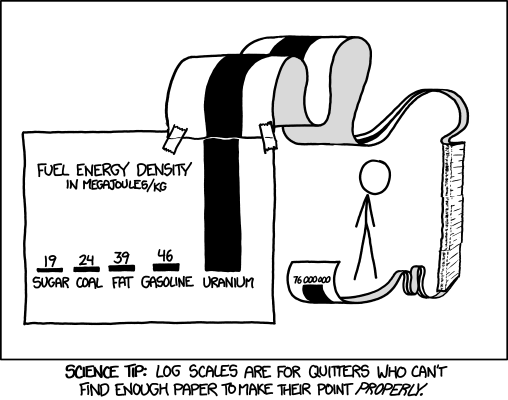
Whenever there is a discussion about nuclear I always remember this XKCD https://imgs.xkcd.com/comics/log_scale.png
Idk, when you because of that implementation, for 20 years pay for the energy 10 times more comparatively to coal generated energy, that seems pretty fanatical by me.
Only when you completely ignore the cost of its externalities, of course.
Not supported by the stats in TFA:
>According to the report, the gap between renewables and nuclear widened substantially in 2025. Global solar capacity increased by 510 GW to 2,383 GW, up 27% year on year,
Sounds like a quarter of the growth was in the past year.
https://ourworldindata.org/grapher/installed-solar-pv-capaci...
We solved fusion at a distance with cheap solar and batteries. And not a moment too soon.
They plan to increase 50% for Wind and Solar in 5 years, and possibly double in 10 years. Since 80%+ of all future planned Nuclear reactor are also in China, they would have more than double their renewable energy in 10 years. China is the number one in electricity production and usage, more than twice the size of US and 33%+ of the world. Given the size of China this is both exciting and scary.
and this: https://thumb.wikimedia.org/wikipedia/commons/thumb/b/bf/His...
China’s AI Dominance Rests on Harnessing Excess Energy - https://www.bloomberg.com/graphics/2026-china-ai-energy-futu... | https://archive.today/6dq8B - October 8th, 2026
- Official curtailment figures — effectively, the share of renewable energy that could have been generated but was never sent out into the world, because of insufficient grid capacity or demand — suggest about 9% of wind and solar energy was wasted in the first half of this year. That almost certainly underestimates the problem, given the scale of green production.
- China could have generated an extra 401 terawatt-hours of power in the first six months alone, according to the Centre for Research on Energy and Clean Air, a nonprofit supporting efforts to curb pollution — nearly as much as Spain and the Philippines’ combined annual generation. [My note: !!!]
Ember Energy: China Energy Transition Review 2026: China’s energy transition is moving toward “building while breaking,” as its clean energy system begins assuming functions long performed by fossil fuels - https://ember-energy.org/latest-insights/china-energy-transi... - September 2026
Bloomberg: Solar Surpasses Coal as China’s Top Source of Power Capacity - https://www.bloomberg.com/news/articles/2026-09-01/solar-sur... | https://archive.today/i3TSe - August 31st, 2026
China Crosses Energy Milestone as Coal Falls Below 50% of Power - https://news.ycombinator.com/item?id=49110187 - July 2026
China Keeps Beating Renewable Targets And Missing Nuclear Ones - https://cleantechnica.com/2026/07/25/china-renewable-targets... - July 25th, 2026
> China set a 2020 wind target of 210 GW and finished the year with about 282 GW. Its solar target was 110 GW, while delivery reached roughly 253 GW. The later commitment to reach at least 1,200 GW of combined wind and solar by 2030 was crossed in 2024, six years early. By the end of 2025, China had about 640 GW of wind and 1,202 GW of solar, for a combined 1,842 GW. Nuclear moved in the other direction: about 50 GW against a 58 GW target in 2020, and about 62 GW against a 70 GW target in 2025. The current goal of 110 GW by 2030 may still be achieved, but the previous record gives no reason to convert it directly into a forecast.
China: Renewables now top 60 percent of capacity - https://denkstrom.org/en/goodnews/china-renewables-500-gw-ca... - June 1st, 2026
> If China maintains expansion at the 430-gigawatt-per-year level, installed wind and solar capacity would reach roughly 2,700 gigawatts by 2027. That would be more than five times the entire wind and solar capacity in the EU. Whether this value is realistic depends mainly on two factors: expansion of high-voltage transmission lines connecting generation and consumption regions, and political will to actually decommission the coal power plant fleet.
Every year renewables consume another ~10% of fossil generation in China, and should push out almost all fossil generation in the next 5-10 years, at current deployment rates. China is relying on coal for peaking until their battery deployment rates catch up to negate the need for coal generators.
China Battery Storage Use Surges After Policy Shift, Ember Says - https://www.bloomberg.com/news/articles/2026-07-15/china-bat... | https://archive.today/QBXxV - July 15th, 2026
- "As the power system integrates more renewables, the true value of batteries to China’s energy transition is becoming undeniable," Yang said. China added a record amount of new battery storage facilities in 2025, ending the year with more than half of global capacity. Growth has continued this year, with installed lithium-ion battery storage reaching almost 150 gigawatts by the end of the first quarter, according to Ember. The country is targeting 300 gigawatts of battery storage capacity by 2030, up from 136 at the end of 2025, in addition to expanding its fleet of longer-duration pumped hydro storage to around 160 gigawatts from 66.
- The government ended co-location requirements last year and most new battery storage projects are now standalone systems that can earn revenue through a variety of ways, such as by purchasing electricity when prices are low and selling it when they rise.
- Still, China can do more to improve utilization as its systems still fall short of the internationally recognized benchmark of about 350 cycles a year, Yang said. If they had reached that level last year, they could have captured and stored an additional 23 billion kilowatt-hours of renewable electricity, enough to power Singapore for about five months.
How China Built a Big Lead in Global Race for Batteries That Last for Days - https://www.bloomberg.com/news/articles/2026-03-03/china-s-b... | https://archive.today/i7n3B - March 3rd, 2026 (Control -F "China Leads on Batteries That Can Store Power for Days" graphic)
- BNEF analysts attribute China’s lead in the sector largely to policy support. Beijing identified LDES as a crucial component of its net-zero roadmap in 2023. The following year, China’s energy regulator launched 56 pilot projects, which helped launch the current boom. The country has built a massive lead in other climate tech sectors as well, from solar panels to hydrogen.
("China speed")
Assuming we'd instantly switch from zero solar demand to unlimited solar demand, we'd need some kind of scaleup of PV manufacturing first, and with a fixed construction capacity of PV factories we'd see a linear rise in PV factory capacity - which would result in an exponential growth in yearly PV factory output.
But the same applies to the factories as well: the construction capacity is going to scale up as well, so as more PV factory part manufacturing becomes available we'll start to see an exponential growth in new PV factories, which would result in even larger PV factory output.
Scaling from "lab experiment and niche application" to "significant chunk of the grid" is a lot harder than scaling from "significant chunk of the grid" to "the entire grid" - especially with solar being embarrassingly parallel rather than requiring mega-scale deployments.
Solar just thrives in places without dependable established grids and has way lower buy in.
Two different tools for different things.
If you believe solar is ugly and deserts are beautiful, well, “beauty is in the eye of the beholder.” I believe clean, solid state hardware that will reliably produce low carbon energy for decades without causing any harm and potentially contributing positive benefits to its surroundings, with no other inputs required, is incredibly beautiful. Like simplicity, it is the ultimate sophistication (da Vinci).
The Great Solar Wall: China doubles down on its ambitious effort to tame deserts - https://www.scmp.com/news/china/science/article/3363108/grea...
Triple win: solar farms in deserts can boost power, incomes and ecosystems - https://www.nature.com/articles/d41586-024-00516-8
Swathes of Earth are turning into desert — but the degradation can be stopped - https://www.nature.com/articles/d41586-023-03621-2
There is very little actionable information here. Nuclear is still worth building, in countries that don't overregulate it (China is doing it, even while they export the solar panels that everybody is buying). Solar is hitting pretty steep marginal returns on the value of generated watt, because it's all running at the same time and not necessarily when energy is most needed. We still haven't solved cheap battery storage. etc.
Would be interesting to know how much nuclear vs solar they are building per year domestically.
we literally already have salt battery
If mainstream news sources do pick up this story, they'll likely cite this article as the source. That's how journalism works. It's not all investigative journalism blowing the lids off of things. They start with knowledge sources. They check the sources against independent ones before publishing, so that they're not just repeating propaganda, but they also tell you where the information came from initially. They may add context from their own knowledge, but the actual news rarely originates with them.
What is your note, precisely?
Not to discount your point of renewables having massive issues, they just simply do not compare to the destruction that is caused by getting fossil fuels out of the ground and the damage it does once we start burning it
We have a giant fusion machine in the sky delivering energy in great excess what we use, and we only capture a tiny fraction of it at the moment. We can make each household practically independent. Fission and (hopefully soon) fusion will be good for meeting grid demand when renewables can't, but a distributed grid is simply more resilient to everything, from local events to country and nation-wide disruption of central generation points.
.png)