70 pointsby colinprince3 hours ago5 comments
  • toasty2282 hours ago
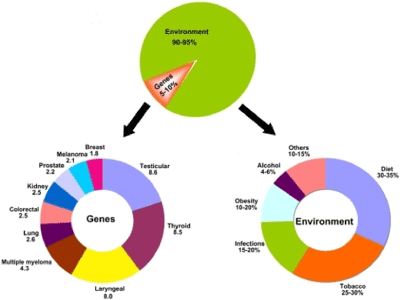
    https://www.oatext.com/which-environment-makes-cancer.php

    Always a good read, most cancers are environmental, and most of these are caused by obesity, bad diet and smoking/drinking, fix these four things in your life and you reduce your chances of getting cancer by 50%+

    • mapontoseventhsan hour ago
      I don't think that anything you said is wrong, but I also think it's important to note that on a long enough timeline your odds of getting cancer are 100% regardless of the way you live.Most people just don't live that long.

      The things you mention here make it happen sooner, but no amount of healthy living lowers your risk to zero and I think that's important to note when you say things like "cancer is caused by".

      Cancer is caused by math. This stuff just steepens the slope.

      • toasty228an hour ago
        It's also important to note that getting a random cancer at 80+ sucks orders of magnitude less than going out at 45 from colon or throat cancer in every measurable metrics you can come up.
        • devmor19 minutes ago
          I would heavily disagree with this - it depends entirely on the cancer you get. If it's something slow growing that would take a decade plus to kill you, sure - just trying to treat it would be worse than letting it ride.

          But my father died of cancer nearing age 80, (most likely mesothelioma, though we didn't do heavy tests as it was discovered late), and it was incredibly painful and miserable for him. He had fast growing tumors in his ribs, forcing bone to spike out and hit his lungs, the tumors that grew in his lungs caused constant pneumonia and kept leaving him unable to get enough oxygen to his brain to communicate for hours at a time.

          • toasty22816 minutes ago
            Would he have had a better time at 45 not seing you growing and missing 35 years of life?

            I'm not saying it's good to get cancer when you're old, I'm just saying if you had the choice no one would chose to get it earlier.

      • scottLobsteran hour ago
        Cool, let's make that timeline a step function with the risk of cancer being effectively zero until 200 years of life and cure cancer.
      • jurgenburgenan hour ago
        > I don't think that anything you said is wrong, but I also think it's important to note that on a long enough timeline your odds of getting cancer are 100% regardless of the way you live.Most people just don't live that long.

        “Most people just don’t live that long” is doing a lot of heavy lifting there. If you have a healthy lifestyle you would need to live for multiple centuries to reach 100% likelihood.

        • epihelix36 minutes ago
          > If you have a healthy lifestyle you would need to live for multiple centuries to reach 100% likelihood.

          Well, 100% likelihood is a bit silly, but the point of the person you were responding to is true -- we will all eventually die of something, and if it's not heart disease or dementia, it will almost certainly be cancer.

          The question shouldn't be "will I get cancer?"; it should be, "how long do I want to live a happy, healthy, active, independent lifestyle for?" If you exercise, eat a healthy diet, don't become overweight and keep your blood pressure low, you'll maximise your changes for living well, for as long as possible.

        • copperx39 minutes ago
          > If you have a healthy lifestyle you would need to live for multiple centuries to reach 100% likelihood.

          This kind of comment lowers the level of discourse dramatically.

        • lunchbucket21 minutes ago
          The risk is compounding, so no, centuries is not on the table without fully swapping bodies.
    • fabian2k5 minutes ago
      That paper links a random blog post as source for these statistics (reference 9). That's a huge red flag for me and not what I'd expect in a scientific paper. I find the numbers wildly implausible in any case since they only have two categories: hereditary and environmental/lifestyle.

      Cancer is caused by random chance. Accumulate enough mutations of the right kind and you get it. Of course you can dramatically affect that chance through genetic factors and environmental ones.

    • epihelixan hour ago
      And not just cancer. Top risk factors for dementia and heart disease are also diet, obesity, blood pressure, and lack of exercise.

      Basically, live healthily, and you'll have a (much!) happier and longer life.

      • fithisux2 minutes ago
        and you'll have (probably) a (much!) happier and longer life.
    • lanfeust62 hours ago
      What's interesting is how low alcohol ranks compared to obesity and diet. It makes the recent moral panic following loose interpretations of the Lancet study seem hypocritical, if not misguided. If anything deserves a "may cause cancer" sticker, it's nitrate-ridden processed meat.
      • ryan_nan hour ago
        Nitrate ridden processed meat already has a “may cause cancer” sticker on it (unless you mean a literal sticker warning when you buy meat from stores?):

        https://progressreport.cancer.gov/prevention/diet_alcohol/re...

        https://publications.iarc.who.int/Book-And-Report-Series/Iar...

        • shiandow5 minutes ago
          > unless you mean a literal sticker warning when you buy meat from stores?

          What else could it possibly mean?

          • ryan_n3 minutes ago
            I thought they meant it figuratively I guess.. I don’t know in hindsight maybe that’s dumb?
        • esperentan hour ago
          > Nitrate ridden processed meat already has a “may cause cancer” sticker on it

          Not in any country I've ever been in. Do you mean in the US?

      • ak_11129 minutes ago
        Is there really a moral panic? Apart from a few viral Twitter posts, I don't see a major sobriety push by my colleagues.

        Profits of main alcohol suppliers has certainly taken a hit over the last 5 years but this is arguably far more because of rise of remote working, inflation (drinking at pubs have become much more costly than before) and people in general just addicted to their phone rather than going out (similar to the impact on almost all social activities no just going to pubs)

      • tarentelan hour ago
        I like to drink. With that being said, there are a lot of downsides to alcohol other than an increased risk of cancer. Also, alcohol can lead to obesity and a bad diet. Is it ever healthy to drink? I do not know. I am going to do it anyway though.
        • epihelix25 minutes ago
          > Is it ever healthy to drink?

          No. But drinking every now and then makes so little difference it's not a huge concern. Drinking a lot, though -- that's more problematic.

          Like most of my friends around my age, I've cut out almost all alcohol in the last few years. None of us miss it. But it's still nice to drink occasionally, and I'm not going to stop entirely.

        • esperentan hour ago
          There's downsides to heavy or frequent drinking, sure. But since the cancer risk is minimal, what's the downside of a glass of wine or beer a couple of times a week?

          I'm less convinced of the negatives of this than I used to be. Humans are quite well adapted to alcohol.

          If it's something you enjoy, I'd say go for it, in moderation. It's probably less unhealthy than e.g. living in a city, eating processed meat, or working an office job.

      • purpleflame1257an hour ago
        Recent demographic shifts have given rise to a vocally anti-alcohol contingent in large parts of the Western world. There's substantial motivated reasoning.
        • throwaway_72749 minutes ago
          Which recent demographic shifts?
        • graemepan hour ago
          Its not demographics, its American cultural influence.
          • mbreesean hour ago
            In the US, there is a large demographic shift on alcohol drinking. What I've seen is not an explicitly vocal anti-alcohol stance. But younger generations just aren't as interested in it. At the very least what they consume is different.

            My personal theory is that they are scared of ending up on the Internet when they don't have control.

            • graemepan hour ago
              I do not know the US well enough to comment, but the US has always been a lot more anti-alcohol than (almost anywhere in) Europe.
              • mbreese39 minutes ago
                What I'm talking about is slightly different than that.

                This is more like alcohol apathy - not drinking, but also not explicitly anti-alcohol. That the more generational shift in Gen Z that I've seen. But, those sentiments can certainly change over time.

                • graemep36 minutes ago
                  What I have noticed in the UK is:

                  1. health concerns mean moderate drinkers drink less, but heavy drinkers have not changed their habits 2. young people seem to go more to extremes: either drink a lot or be teetotal.

    • jjice33 minutes ago
      I always get a kick out of YouTube and other social media people proclaiming what is "healthy" or not, when we all pretty much know. Eat fruits and vegetables and not too much junk food. Eating too much consistently isn't good for you. Drinking and smoking are bad for you. We've mostly known smoking is bad as a society for a good while now and outside of the old myth that a glass of wine with dinner was good, we know drinking isn't a positive for your health.

      And you don't even have to be hard and fast with any of that. Drink on occasion and eat stuff that isn't good for you on occasion and you're probably still getting 95% of the benefits. Not sure about smoking though.

      It's very simple at the end of the day. Simple != easy to do. Drinking is fun. People enjoy smoking. Junk food is appealing because it's relatively cheap and tastes good.

      The best biohack is to eat like your doctor recommends while we all nod along and silently ignore. Just eat what is widely accepted as good for you and you'll have a good chance at living a happy, healthy life.

    • znpy37 minutes ago
      for anybody else wondering: the environmental factors mentioned in the article (https://www.oatext.com/img/ORR-1-115-g001.gif) are:

      diet, tobacco, infections, obesity, alcohol, others

  • Frierenan hour ago
    > HPV vaccine hesitancy in Europe: side effects, uncertainty, and mistrust > When individuals mistrust those communicating about vaccines, perceiving, for instance, that they are not being fully transparent about the potential side effects of the vaccine, it can affect their confidence in the HPV vaccine even if they have received information confirming that the vaccine is safe and effective > This was seen with the rapid spread of You-Tube videos of young girls believing to have been affected by HPV vaccination in Denmark, Japan, Colombia, Ireland and the UK.

    Governments around the world are losing citizens trust. And that has terrible consequences. Trust is hard to earn and easy to lose. And the rise of far-right contrarian governments that use fear to destroy trust in institutions and gain votes are the main cause. Billionaires financing far-right governments end costing the lives of their citizens that will have poorer physical health.

    We may know how to reduce the risk of cancer. We may have vaccines for that infections. But if governments care more about power than serving citizens all that knowledge is for nothing.

    - https://www.hpvworld.com/articles/hpv-vaccine-hesitancy-in-e...

    • etcetcetcetcetaan hour ago
      Suspect this is caused by demographic shift, don't know any people who have even the remotest HPV vaccine hesitation over the past twenty plus years.

      Know that it is common among certain demographics though.

      • foobiekr26 minutes ago
        About ten years ago I was at a party and an Australian coworker and I were talking. I casually mentioned the HPV vaccine since his daughter was entering her teens. He declared, “I’m not going to turn my daughter into a whore.”

        You may be right that the demographics are shifting but not necessarily in a good way.

        • Nasrudith19 minutes ago
          Which brings to mind a horrifying and inappropriate counterarguement to such twisted puritianical logic - who says she is consenting if she gets infected? Is it worth adding cancer to a rape victim?
      • baud1472589 minutes ago
        what kind of demographics? I don't think HPV vaccine is a subject I've ever heard about in the social circles I've been in (whatever the opinion on the vaccine).
    • jimmar5 minutes ago
      > And the rise of far-right contrarian governments that use fear to destroy trust in institutions and gain votes are the main cause. Billionaires financing far-right governments end costing the lives of their citizens that will have poorer physical health.

      I'm old enough to remember when Trump was recommending the Covid vaccine and democrats were fear mongering about it. Trump was even booed at his own rallies for promoting the vaccine.

  • ck2an hour ago
    well they are finding forever-chemical and micro-plastics in all freshwater in the USA now and even in ALL mother's milk

    so safe bet that cancer rates are never going to be lower than they are today

    remember US also just deregulated all pollution from power plants, funded re-starting coal plants and dropped car engine efficiency requirements

    oh they are also trying to double oil-fracking output which toxifies groundwater and air for miles around it with offgassing

    every rocket launch and deorbit by starlink et all also put toxic pollution into the atmosphere

    so next decade should end well for cancer rates

    • scottLobsteran hour ago
      You can't be worried about fracking and coal at the same time in the US. The former is the reason for the latter's demise
      • ck233 minutes ago
        wow that's the most repeat fallacy, I even see in political commercials now

        we don't use domestic oil, we sell it overseas

        and oil until pop-up "ai" datacenters was not used for power production

        you are thinking about solar and wind power for coal's demise

        which now they are also defunding, even worse reusing the funds for coal investment

        • scottLobster10 minutes ago
          No, but we get so much natural gas as a side effect of the fracking that we literally can't distribute it all, it's effectively free. Which is why natural gas plants have been displacing coal plants for the last 20 years.

          You... really need to read more before forming your opinions

  • samso26an hour ago
    The striking part is that many infection-linked cancers already have prevention or treatment options,but access and uptake are uneven. That makes this partly a delivery problem: vaccines, screening,and treatment only reduce cancer burden when people can actually get them. i’d be interested to see the estimates broken down by how much could be prevented with tools we already have versus infections where theres still no effective intervention.
    • neoman hour ago
      Almost all your comments are flagged. Get yer clanker off HN buddy.
      • Pannoniae35 minutes ago
        FYI the prev comment is also clanker stuff, it's just purposefully prompted to inject grammatical errors. It's obvious from the word choice and the sentence structure, it's very stilted in an inhuman way. The wrong commas aren't a common error (unless you're 70+ yo) but LLMs keep doing "word ,another" and "word,another" to appear quirky

        esp when all the caps are missing but all the punctuation are perfectly present
  • crayforbrains2 hours ago
    [dead]