That being said, many countries consider it a national security issue not to be held hostage to foreign oil.
Are you serious when putting France in this list? Nuclear is such a cash cow here that EDF manage to make profits even while being forced by the regulator to sell a big fraction of its nuclear capacity below the operating cost and buying it back to them at market price! (We're talking about a multi-billon subsidies scheme, look for ARENH).
And that is despite (rather legitimate IMHO) regulatory constraints that have no equivalent in any other industry.
Nuclear isn't similar to the things that grow cheaper as the operators gain experience.
Or something like that?
Don't get me wrong, it's super deadly, but there are loads of toxins that are more deadly than plutonium. And while its radioactivity is seen as ultra scary, it's actually pretty nice, because you can at least detect it. Harder than beta or gamma, but still, it announces its presence.
How I wish I had a magic wand (spectrometer) that I could wave over my food to see if cyanide, ricin, mercury, or lead were there.
https://m.youtube.com/watch?v=cbeJIwF1pVY
Here's an Illinois professor going through the economics compared to a gas plant.
Nuclear power can become dramatically cheaper than other energy sources in the long run.
None of that is the real issue though. The real issue is for at least 8 hours a day, but probably more like 16 hours a day, renewables can generate power at well under 1/2 the price of what he calculated. So they won't sell the 9 units of power he forecast - it will be at best 4.5 units, and the nuclear plant even at his optimistic assumptions never makes money.
If you look at South Australia [0] - they are at 80% renewables now. At 80%, the average wholesale is cheaper than what nuclear can supply. The percentage will go higher, probably to around 90%..95%. They are and will achieve that with very limited (ie, cheap) storage.
But obviously that isn't 100% - so it becomes a question of what can fill the gap of 60 days or so a year the cheapest. Nuclear has no hope. Generating and storing ammonia using excess renewables and burning it when needed is one of the most expensive forms of energy available - but if you only need to do it for 60 days a year, it is still far cheaper than nuclear, because nuclear's primary cost is it's interest bill, not fuel.
The good professor paints gas fuel cost as a disadvantage. But when you are only burning it 60 days a year, then compared to paying nuclear's interest bill 365 days a year it's cheap.
[0] https://www.energymining.sa.gov.au/consumers/energy-grid-and...
Looked at it that way, I'm skeptical of all these new nuclear projects. No one has made SMRs work economically, yet we're seeing incredible improvements in batteries, and there's enough unexplored chemistry possibilities we don't have a reason to think we're near the end of the road on that.
In the darker northern parts of Europe, the German transition to renewable haven't really been a cost-saving success story (right?).
From my (very) casual Swedish vantage point, the wind build out here was a very government subsided race to zero marginal prices that barely helped anything?
* Incredibly sunny
* Incredibly sparely populated
* Functionally winterless
Like it's the perfect setup for solar.
Somewhere like Denmark, Japan, even the US Northeast does not have those.
There's a systematic bias among all energy professionals to both vastly underestimate the cost of building nuclear, and overestimate the cost of solar, wind, and storage.
Go back 5 or 10 years, look at the numbers projected, and it's just wild. I've never seen any other industry where there's such a mass hallucination among people that otherwise consider themselves "serious people."
The systematic bias against renewables and irrational exuberance around nuclear is true across all of those metrics.
Even people that make their living on renewables underestimate how quickly it gets cheap. Jenny Chase, famous for pointing out that people underestimate the pace of solar technology, also underestimates solar technology.
And the skepticism of batteries is similar. I can't tell you how many nuclear advocates have said in past years that grid-scale batteries are impossible because of "physics." Yes literally "physics" that they can't quite seem to cite.
It's just a continual shifting of goal posts as people's systematic bias against batteries are again and again disproven by actual deployments and costs.
An energy source with an EROI of 20 but which requires thousands of highly skilled people to tend it is going to lose to an energy source with an EROI of 15 that sits in a field and just works for 30 years.
> That being said, many countries consider it a national security issue not to be held hostage to foreign oil.
Spot on. That, plus... peak oil.
It is clear at this point that peak oil was another failed Malthusian projection. I don't think peak oil is guiding much national policy aside from the national security aspects.
Interestingly, Venezuelan extra heavy sour crude oil is not profitable to use at $55 a barrel, the price before the Iran war, but is profitable when it's over $90 a barrel.
It's easy to make money when someone else pays the costs but you get to keep the revenue.
Global peak is estimated to be around now (a few years ago maybe?).
Something like wind and solar combined with batteries would be a more sovereign form of energy generation that is (as a bonus) more decentral and less prone to attacks.
FWIW Russia produces less than either Kazakhstan and Uzbekistan
has fossil fuels been profitable? or just had most of the costs externalized? same with solar and wind - the negatives have been written off as free, whereas the environmentalists from russia have pushed to make sure that nuclear has every possible cost counted against it
As we hear downthread though, we'll have warp drives by then.
Plus you can stockpile it super easy.
That's plenty of time to source alternative uranium supplies presuming you haven't stockpiled.
Plus: Australia has an absolute ton of the stuff.
This is comparing to the base case of fossil fuels. But those have tremendous negative consequences.
wouldnt you instead count the net benefits to the whole economy from having that cheap and plentiful electricity?
The reliability of french electricity benefits both France and Europe as a whole. I cannot say the same about what germany is trying to do.
- https://www.powermag.com/flamanville-3-europes-hard-won-nucl...
- https://www.techniques-ingenieur.fr/actualite/articles/epr-d...
https://www.reuters.com/business/energy/hungarys-paks-nuclea...
> Nuclear plants along the Danube river in Hungary and Romania were forced to cut output this week and could be shut down completely in the coming days due to record low water levels.
In January 2017 a parliamentary committee reported: "The cost of decommissioning is likely to be greater than the provisions," the technical feasibility is "not fully assured" and the dismantling work will take "presumably more time than expected."
https://world-nuclear.org/information-library/country-profil...
Except for the winter of 2022 when more than half of French reactors were not running, which was especially critical because of the Russian War against the Ukraine. Coal reactors had to be reactivated in Germany so lights didn't turn off in France.
Or summer when reactors have to be shut down because the rivers are too hot or running low.
Germany activated coal to reduce dependance on gas, and Germany exported energy to France because of the maintainances ; you know, the old correlation =/= causation.
That one occurence over 4 decades, I would say we can dare to call it pretty reliable
Healthcare is the same. It just turns out subsidizing it from wages works because healthy people are more productive.
Profitability isn’t a hard limit. But if something isn’t internally profitable, it requires an external partner to get going.
The sun is an oil well. Panels are drills or pumps. Batteries are oil tanks.
Not having oil drill and oil tank factories in your country isn't a critical energy sovereignty issue.
They last 25 years. Enough time to spin up domestic manufacturing if you're really paranoid.
> or you need more
Lots of countries manufacture them today.
What chips are you talking about?
Again, by your definition, almost no country is "sovereign" for anything. Not fossil fuels, not PV and renewables, and certainly not nuclear. It's an impossible standard but only renewables get held to it.
When something is profitable in the sense that a few oligarchs make more an more money, I see it as a bug, not a feature.
I literally would’ve been better off flying to New York. I still have scars and nerve damage from the incredibly poor care in Italy’s medical system.
In the US, I was rushed into the ER in an ambulance and seen immediately after a car hit me while I was bicycling — and that was just because they were worried about the speed at which the accident occurred. They had me patched up within the hour. I was fine, road rash and sore for a couple weeks.
There’s no silver bullet here, but I’m very sure that healthcare is not a good analogy for nuclear power.
I’m also very sure that anyone that advocates for government healthcare should try actually using it in one of these countries. I hope you enjoy waiting and long-term adverse health effects from poor, delayed, and inaccessible care.
PS Spanish taxes are absurdly high...insurance in the US is still cheaper than the difference in taxes between the two countries. All that and an actual working economy and energy system.
The price is only good if you ignore the outcomes and what you’re paying on the backend through taxes.
I actually do since I'm Italian lol
Don't get me wrong, what has happened to you feels at best a bad practice, at worst something that goes on the news or that has a legal proceeding afterwards. I've known people with good and bad experiences, I can't complain too much about it. Can I ask in which region? Italian Healthcare is somewhat region-dependant
Fellow italian here, let's not act like our third rate ERs never leave people suffering for hours without caring that it may have lasting consequences. I understand it's partially due to understaffing, but this is the reality. My dad had this happen to him as well. Thanks
So literally just a broken limb. Non-life threatening, can wait. Sorry, triage is a bitch. Some patients will literally die within minutes/hours if not actively treated. Go figure.
> In the US, I was rushed into the ER in an ambulance
The second they dispatch an ambulance, you owe them how much exactly these days? $5000?
Terminally online people like you who lose all empathy when something they believe in is criticized are very funny and sad at the same time.
Subjectively applied, uncaring triage that leaves people poorly cared for is exactly what happens when you lack sufficient capacity, aren’t paying your staff enough to care, and staff's incentives aren’t sufficiently tied to their outcomes.
My father, an ER doctor in the US, was losing his shit over their quality of care when I FaceTimed him afterwards.
Your lack of compassion is also exactly what produces these kinds of systems. Who cares about the actual outcomes or the affected individuals, as long as your ideological ideals aren’t challenged.
> The second they dispatch an ambulance, you owe them how much exactly these days? $5000?
My insurance covered all of it. The driver’s insurance reimbursed my own.
And even if they hadn’t, I’d rather be in the hole financially than spend 12 hours in pain and have persistent issues caused by free health care doing a hack job putting me back together.
The US healthcare system isn’t perfect, but I’ve got at least another four decades left on this planet, and the cost of US healthcare is nothing compared to the cost of living out those decades in a body that’s not as healthy as possible.
You don't have the slightest clue what it means to be poor and in a financial hole. Like, it's impossible to explain to you.
Any argument that environmentalists run amok is the sole cause of nuclear's failure to launch has to address the fact that these two places, where environmentalists are a lot more likely to get a club to the head than a say at the table, are largely not expanding their nuclear power that much versus, say, solar in China.
…and then people wonder why nuclear isn’t competitive. When you hold one thing under a microscope because “radiation” scares people, we end up with millions dead per year from air and water pollution due to fossil fuels.
The talking point that they’re going green doesn’t stand up to scrutiny.
https://www.globalelectricity.org/china-electricity-producti...
So yes, it can be reasonably claimed that China is greening. "greening", not "green" -- 49.7% coal is still a lot of CO2.
https://finance.yahoo.com/energy/articles/china-pushes-coal-...
China is “greening” but we should be skeptical that it’s out of some lofty moral goal. If it was they wouldn’t be hoarding the production of rare earth minerals and would be freely giving away technology for the sake of the planet.
Why does the "why" matter? Tons of carbon are tons of carbon, right? That's what people say when you tell them about per-capita emissions.
> they wouldn’t be hoarding the production of rare earth minerals and would be freely giving away technology for the sake of the planet.
You can freely buy as many cheap panels and batteries and EVs and heat pumps from China as you like (unless your country is stupid enough to tariff or ban them). Those come with minerals. When they reach end-of-life they can be recycled.
What exactly are they "hoarding" that the planet needs to go green? It hasn't prevented Pakistan or Vietnam from going ham on PV deployment.
Well it doesn’t entirely matter but we should just acknowledge that it’s a geopolitical strategy and not really something they are doing for the planet.
> You can freely buy as many cheap panels and batteries and EVs and heat pumps from China as you like (unless your country is stupid enough to tariff or ban them). Those come with minerals. When they reach end-of-life they can be recycled. What exactly are they "hoarding" that the planet needs to go green? It hasn't prevented Pakistan or Vietnam from going ham on PV deployment.
Are you unfamiliar with China’s restrictions on rare earth exports for example due to alleged “dual use” as they continue to apply military pressure on democratic Taiwan? I’d encourage you to read up on these restrictions with respect to Japan for example who is alarmed by Chinese and North Korean provocations.
You can buy so many cheap panels practically only from China because they subsidized the industry so other countries couldn’t compete and build their own solar panels. Har har tariffs and bans are responses to these anti-competitive strategies. It’s not just the US, by the way. The EU is tariffing China too.
They are entitled to pursue these strategies but we are also entitled in the west to recognize them and combat them how we see fit.
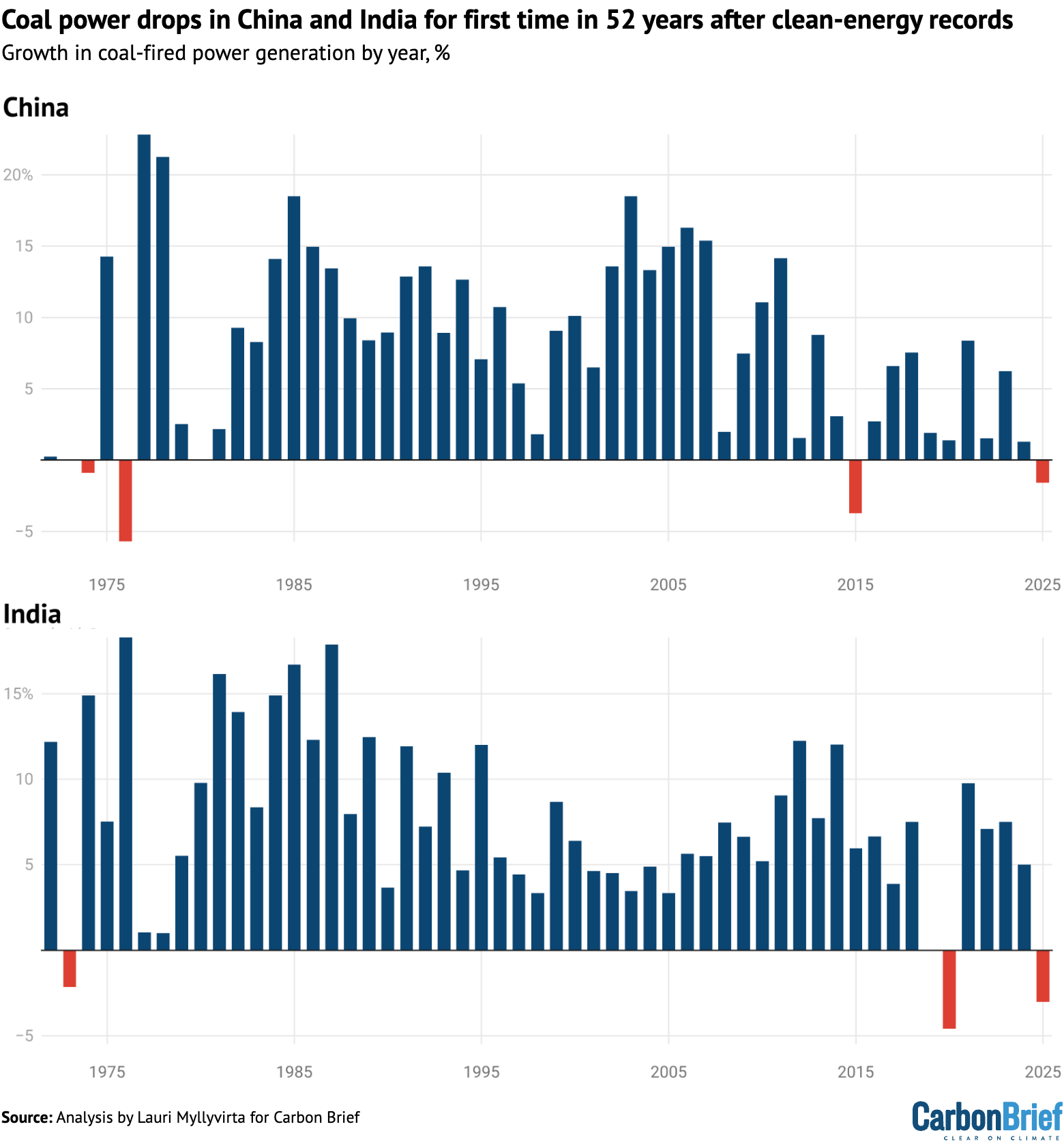
https://www.carbonbrief.org/analysis-coal-power-drops-in-chi...
https://www.carbonbrief.org/wp-content/uploads/2026/01/span-...
You can see the same dips hit at the same time for the same reason.
In terms of Chinese coal though there's a reason boosters always talk about percentages and not absolute number... one goes down, but the other keeps rising. Even if China continues on the current course in terms of tonnage burned they won't reach "peak coal" until at least 2030.
> After the first three quarters of the year, China’s CO2 emissions in 2025 are now finely balanced between a small fall or rise, depending on what happens in the last quarter.
And then goes on to describe how the largest drop (3%) is happening at a time when it just happens that fuel is increasingly expensive and scarce, shipping is increasingly expensive and slow, and the global economy has spent months grinding increasingly towards a terrible outcome.
People might as well brag about their incredible weight loss journey through amputation.
When you actually build things, throwing up a coal plant for 10 years because you need it while you grow your solar and battery industries or wait for reactors to cover your base load is just sensible.
All narratives about China always have this static world baked into them: "they're currently like this, and that's all they'll ever be". But China develops fast. Shenzhen was a farming village by a ditch. 10 years ago buying a Chinese car was inconceivable - I took delivery on one yesterday, etc.
At some point in the very near future China is going to hit a cross over point on their emissions and they'll start falling fast because reactors + renewables will be building out fast enough they'll want the coal plants gone - no one likes ruling over a polluted wasteland.
Edit: it can also be the case that they don't care at all about going green...but renewable energy technology is the most sovereign possible energy security. No one can take away your access to the sun.
They are installing nuclear power like no other country (1 GW yearly since 2014), and Wikipedia says that 50% of all nuclear capacity being built is in China (https://en.wikipedia.org/wiki/Nuclear_power_by_country): 37 new reactors, followed by India with 6 and Russia, Egypt and Korea with 4. USA and France, which are both pro-nuclear or nuclear neutral, are building 0 reactors. But yeah, China has interests against nuclear power.
You are not helping your case by spreading misinformation and calling other people misinformed by making a strawman ("radiation scares people"). I am against nuclear (or rather not pro-nuclear) because it is not economically sound, because it is massively subsidized by Governments for the private sector to profit.
Nuclear's share of electricity in China is below 4% and dropping. They do not use a significant amount of nuclear. That this insignificant amount of nuclear is more than any other country is quite telling.
It would also seem that investing into it may perhaps render significant gains into the future as R&D becomes more involved with actual running systems and funded (skin in the game?)
It seems the only ones who lost by abandoning their nuclear programs were European countries (specially Germany) in detriment of Russia and other Oil trading countries... It's even probable that much of the "bad press" nuclear has had for the past decades was in fact instigated by oil-producing countries doesn't it?
If not, reading a list of this helps:
https://en.wikipedia.org/wiki/Lists_of_nuclear_disasters_and...
But sure, oil leaks can be bad as well. Solar leaks on the other hand seem bearable.
I just don't think it is a good idea to replace something dirty with something else dirty that is indeed quite safe if all goes well, but is horrible if something goes wrong.
Italy has lot's of sun and wind (and geothermal potential).
We don't have time for perfect solution, do all of what you said AND THEN ALSO MORE.
Exactly. You can buy and deploy solar, wind and batteries as much as you want now. If you care about strategic independence, build factories for them.
But a nuclear reactor takes a long time to get build. And is likely way more expensive. If italy manages to do it fast and cheap - other countries will follow, but I believe it when I see it.
I'm all for improving the quality of life for society. In the end the goal is to live well, not to destroy our living conditions for a few oligarchs to make more money. But "profitability" is not generally optimised like this, unfortunately.
If a power generation system costs more to operate than the value of power we get out of it, it's probably not very useful. I think that's what we're talking about here.
There is more than money. There is stability (not depending on foreign oil, peak oil, etc), there is climate change, etc.
Then there's all the other effects of not having a high demand for hydrocarbons including less Middle East entanglement, less mining and drilling, more abundant and cheaper oil for uses other than burning it, etc.
There are good reasons to choose more expensive things, but "nuclear sounds cool" is not a good reason. There must be some sort of rationale and benefit beyond that.
Nuclear is far too slow to solve our emissions problems, there's no chance of us being able to scale the nuclear industry to be able to confront climate change on the time scale necessary.
In contrast, batteries, solar, and wind are scaling on their own, without the massive government subsidies that would be needed to deliver nuclear too late to help.
A lot of countries also use it to help subsidize (or help cover up the costs of) their military nuclear programs.
So, option a sounds great to me, but you clearly have some kind of agenda here, that maybe you could make clearer
Having the consumers of the electricity pay for has a lot of advantages!
In Italy battery backed solar is going to win from a lifetime cost perspective and it’s only getting worse over the next 50 years here. The solution isn’t government subsidies it’s making nuclear cheap and safe without subsidies at the same time.
While fission reactors are still the cheaper initial energy choice (like a future cancer patients love of cheap cigarettes.) Small Modular reactors are a fools errand for most places, as they have all the same security, labor, and maintenance issues of full sized installations. Thus, instead of repairing one of four turbines every few years, the contaminated components must now be reprocessed or safely hidden away on mass.
Maybe fine for submarines or aircraft carriers, but for massive infrastructure it is trivial to prove it causes major long-term problems.
Anyone that has ever purchased a property with an old leaky heating-oil tank nasty surprise site-reclamation cost... will understand the initial unit price never covers the actual clean up cost. =3
https://www.neimagazine.com/news/us-japan-in-smr-deal/
Italy should be buying proven French technology instead.
Given the outcome of Flamanville 3 and that the proposed subsidies for the EPR2 fleet are ruinously expensive France is unable to build competitive new nuclear.
The referendum that made nuclear energy illegal in Italy was held right after the accident of Chernobyl; people voted with their gut, not with their mind.
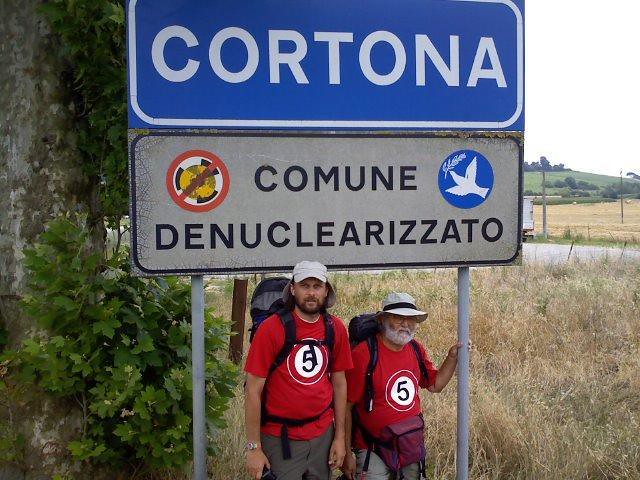
Curiously enough, some Italian town signs still have a small sub-sign reading "denuclearized municipality" (example: https://live.staticflickr.com/1421/712461235_e46a2c7db5_z.jp... )
Since all plants in Italy are closed since the 90s won’t it take decades and billions of tax euros to get them back operational again?
Studies are converging on renewable energy systems being cheaper in climates ranging from Australia to the Nordics:
Some recent ones:
Finland, 2025: nuclear scenarios 71–84% higher system cost; unrestricted least-cost optimization builds zero new nuclear. https://www.sciencedirect.com/science/article/pii/S036054422...
Denmark, 2026: system-level LCOE including storage, flexibility and system integration; renewables substantially cheaper than nuclear. https://www.sciencedirect.com/science/article/pii/S036054422...
Australia, CSIRO + AEMO GenCost 2025–26: whole-system modelling including transmission, storage and firming; renewables + storage remain the lowest-cost net-zero pathway. https://www.csiro.au/en/research/technology-space/energy/Ele...
In most countries which don't have the advantages of Australia or Finland, you do need a mix as the OP was saying
I only checked the first paper and it doesn't seem talk about what would happen if a 3 weeks bad wind event would happen in winter, and a rough look at the figures makes me think it just wouldn't work at all. I didn't check the other papers.
And the proof is in the pudding anyways, if it's that cheap and feasible to do, well let's see who's doing it.
I mean anything could happen but seems like a long shot
The argument is that small-scale nuclear reactors have been built for military and scientific applications so the tech is not especially novel.
What I think is unproven is whether SMRs can be built and run safely while being cost-effective to other forms of power.
I wouldn’t be surprised, for example, if it actually costs less to build and run one full-scale reactor than it does for multiple SMRs of the same output.
That doesn’t mean they won’t have a use.
And I personally have switched from bull to bear on that. I was rooting for NuScale but they're hitting the same thing as everyone else.
Meanwhile, battery storage has been on an insane cost reduction curve.
[1] https://www.sciencedirect.com/science/article/abs/pii/S03605...
[2] https://en.wikipedia.org/wiki/Cost_of_electricity_by_source#...
I guess ultimately the nuclear vs renewables discussion is coloured a lot by feelings nowadays.
Resources like this help a lot to form a more nuanced understanding grounded in reality - but otoh I have to admit that a lot of this goes over my head - like even trying to understand how the economy works around this is mind boggling complex. I’ll need a deeper look to understand it better and build a more informed opinion tbh
https://analysesetdonnees.rte-france.com/en/publications/ene...
US killing the linear no-threshold model is a good thing. LNT model assumes that absolutely no amount of radioactivity is safe, which is provably wrong.
And no you’re not solving it with a buffer (batteries or any kind of other energy storage for that matter)
https://www.nytimes.com/2026/09/20/world/asia/philippines-ba...
https://maps.eu-risk.eucentre.it/map/european-seismic-risk-i...
Sardinia?
>The legislation does not authorize the construction of any reactors. Instead, it creates the regulatory foundation needed before future projects can be proposed, assessed and approved.
Giant step for SMRs. I'm hopefull for greater NATO collaboration regarding energy security if SMRs prove commercially viable.
Radioactive material and a bit of water.. there's no reason to design those things a hundred times. France actually did that.
France is still shutting down its plants because the rivers are too warm in the summer. As for floating SMBs in the harbour, I don't think climate change will be kind to this idea.
Yes, but the potential market for GW-size reactors is fairly limited.
Now, whether the market for any of these SMR reactors is large enough that any of them will be able to see any of these supposed economies of scale is a big question.
That's because French nuclear power plants are designed to be directly cooled by river water instead of using cooling towers.
The biggest nuclear power plant in the US (Palo Verde Generating Station in Arizona) is cooled by evaporating the treated wastewater, in the desert.
You just can't easily retrofit them onto an _existing_ power plant.
Pretty much all the new thermal power plants are (including biomass-burning plants), except in places where cool water is not scarce.
It's weird to glomp onto that idea, as if it's some kind of a fatal flaw of nuclear power.
There is a lot of variation of layout possible within the constraints of the standard. However the vast majority of the hard work is done in a factory to standard sizes, and the onsite work is just final assembly to easy to change specs, so there would be no advantage to a standard.
The whole point of stud frame construction is that you can do basically whatever you want because it is overbuilt and all the connections and joints simple.
https://worksinprogress.co/issue/liberte-egalite-radioactivi...
There are minor variances locally, but you can make enough components common to benefit massively from economies of scale.
The AP1000 reactors at Vogtle were explicitly marked for the modular construction as a key selling feature, which would reduce time and cost. It came out 20B over budget and 7 years late.
In practice the production line wasn't as controlled as it needed to be and ended up delivering modules that needed significant rework. That caused modules to be delivered and ready out of order. In other words they bought a lot of project management complexity that was hidden behind the theory of modularity.
SMRs are turning out to be even more expensive than conventional nuclear power plants, which are so expensive compared to renewables that even without a risk premium they are uncompetitive.
AP1000 (reactor as Vogtle 3/4) in Taishan is estimated to cost $4M-6M /MW compared to $15M/MW+ at Vogtle. if Chinese safety standards seem lax, South Korea does regularly reactors at $4-6M/MW range.
Even Flameville 3 in France was significantly cheaper than Hinkley point C (same reactor type), which infamously required some quite ineffective Fish speakers. The EPR2 series (6 reactors) in France is expected to cost considerably less than Flameville did.
Key to cheap nuclear - SMR or otherwise is regular construction. SMR makes regular construction more likely as each plant is not a $10-20B+ capex that is a tough sell to tax payers particularly when it inevitably overruns, SMR also potentially have a bit less regulatory hoops to jump through due to their smaller size.
> Even Flameville 3 in France was significantly cheaper than Hinkley point C
Per wikipedia: initial cost estimate €3.3 billion, cost in 2020 (6 years before it was done) €19.1 billion, so 5.8x the budget. Supposed to enter operation in 2012, entered in 2026 "only" 14 years late.
These are terrible results.
That EPR2 series are "expected" to cost less says absolutely nothing. Flameville 3 was expected to cost 83% less too, and I except that if they swindle people for the money to build it we'll see it'll be just as much of an overrun.
The nuclear industry seem absolutely incapable of sticking to a timeline or budget. And any one of these failures should have been disqualifying. But they get to do it over and over again.
Flameville 3 is the first reactor for France in 21st century and suffers the frequency problem I am arguing. It was a path finder therefore only one was ever ordered. EPR2 is 6 under construction and France does have a track record of doing it consistently at scale for cheap(by nuclear standards).
The Asian giants all do it for cheaper because they build regularly, Japan (post Fukushima policy direction notwithstanding) and South Korea achieve overnight numbers of $5-6M/MW or less, so does China.
Regular construction is key, to the industry having a chance, without SMR that is never realistic anymore.
Right now we have politicians arguing that a £90/MWh strike price for offshore wind - where the construction of the wind farm is entirely encapsulated by the strike price - is expensive.
They are admitting Flamanville 3 like costs before they have even started building.
Nobody is saying nuclear is cheap it is not - we will be building a plant once in while for pure strategic reason no matter the cost anyway. The point is construction cost comes down per MW with higher frequency of plant building, and this is the case SMRs, we can get cheaper construction both Per MW and overall TCO in absolute dollar terms relative to large plants with SMRs.
https://www.bbc.com/news/articles/ckgzevzwxwro
I couldn't find immediate investments from Kushner etc., but will dig further.
In contrast, SMRs are being sold as something that you can weld together in your garage and use them as a replacement for your water heater. And you don't need all those large containment structures and gigawatt-scale turbines.
This makes it much easier to get funding, as you don't need to show that you have a firm agreement with all the suppliers.
I don't like this at all, but it _might_ result in us regaining some experience in building nuclear power plants.
I’m particularly interested in how they plan to finance reactors in a grid dominated by solar. I wouldn’t be surprised if they legally allow the building of new reactors but then fail to find investors. But perhaps they plan on using them as some sort of strategic assets and will just run them at a loss?
Solar is 15% - a lot but not yet dominated. Solar works at day and demand is also highest during the day so solar should not be an enemy of nuclear.
This is what the OP means - they make no economic sense on most modern grids.
France's EDF Warns Solar, Wind Surge Straining Nuclear Fleet Costs - https://news.ycombinator.com/item?id=47037839 - February 2026
https://web.archive.org/web/20260217122120/https://www.edf.f...
Related:
Wind and solar generated more power than fossil fuels in the EU for the first time in 2025 - https://ember-energy.org/latest-updates/wind-and-solar-gener... - January 22nd, 2026
> Wind and solar overtaking fossil fuels in 2025 can be largely attributed to a staggering rise in solar power. Solar grew by more than a fifth (+20.1%) for the fourth year running. It generated a record 13% of EU power in 2025, above both coal and hydro. This trend was widespread: all EU countries saw growth in solar generation compared to the year before, amid a huge expansion in EU solar installations. Solar provided more than a fifth of electricity in Hungary, Cyprus, Greece, Spain and the Netherlands. Renewables provided nearly half of EU power (48%) as unusual weather conditions caused hydro generation to fall by 12% and wind by 2%, but boosted solar generation. Wind remained the second largest EU electricity source at 17% of EU power, generating more than gas. Signs of a structural shift are clear across the EU, as wind and solar generated more electricity than all fossil sources in 14 of the 27 EU countries in 2025. Over the past five years, wind and solar have experienced massive growth (from 20% in 2020 to 30% in 2025). Fossil fuels have fallen from 37% to 29% in the same period, while hydro and nuclear remained stable or slightly declined.
https://ourworldindata.org/grapher/installed-solar-pv-capaci... (installed solar energy capacity goes brrr)
Nuclear has no real cons other than time/cost of deployment, and it should be a no brainer for a place like Europe without significant energy resources. Once the power plant is built, it provides 50+ years of nearly free energy. It's that or buying gas from Russia.
The uranium needs to be regularly replaced. Europe currently imports virtually all of the uranium used by its nuclear power plants. While Europe has some decommissioned uranium mines, they would have to be reopened, but the known deposits are estimated to cover less than the 50 years you cite, at current levels of nuclear production (much less when expanding production).
So if this is about energy independence rather than cost, I’m not sure that it would be such a great win.
So maybe not worry free, but if you are able to run nuclear reactors for power to start with, obtaining fuel for them in any scenario shouldn't be impossible. You got atleast a year or two lead time between refuelings, and it might be able to be stretched a little longer in an emergency. And even more time if you hold some in reserve.
But I just don’t get why it’s being discussed at all - its obviously so much more expensive and time consuming to build than the alternatives
That's not true. It's extremely expensive to operate for one, so expensive in fact that nobody in the private sector wants to do it without having nation states basically guarantee profits for the lifetime of the plant or accept all liability. Which in several countries means that he operator is the nation state. Like in France.
The profits are guaranteed by collecting extra taxes from the population, not by increasing the price of electricity. Which is why people believe France has cheap electricity when they really don't.
Also of course each nuclear plant carries a nonzero chance of a trillion dollar incident (we've had two so far) as well as a nonzero chance of millions of casualties. Both these cons are entirely unique to nuclear power plants. No hydro plant, solar plant, wind farm, coal, oil or gas plant can cause as much damage as a nuclear plant.
>t's that or buying gas from Russia.
Not at all, there are many options (including buying gas from someone else). Some options got viable so recently people still haven't realized it. Like batteries. They're cheap now, you know, and China can build as many as we want. China has also caused a severe drop in the cost of hydrolyzers, used to create e-fuel. E-fuel means you can use solar power in winter and during night, which removes the remaining weakness of renewable sources. Europe should spend every eurocent in that direction instead of nuclear. That's the path to true energy independence.
And anyway, europe still gets 70% of it's nuclear fuel from Russia. How is that better than gas?
It takes billions to certify a nuclear power plant, and it takes billions more to re-certify it every few decades, to say nothing of the costs of modernization.
To be clear, I consider myself generally pro-nuclear power, but let's not ignore the massive upfront and ongoing capital and operational costs that really undermine this idea that it's free power.
... and cost of operation and the fact that you have radioactive material you need to securely and safely store for quite a bit (which no one has figured out yet)
For at least the past decade, about all I've seen argued about nuclear is that it is not economical. I've been arguing that for around 15 years now.
That being said, it seems finally solar+wind+storage+a little bit of other stuff is becoming cheap enough that it's starting to make a dent in the emissions. Which is fantastic, don't get me wrong. But it's also sad we've lost decades.
Nuclear, moreover, keeps us on the tech tree for space exploration. I don’t think solar is going to lead us to fusion or antimatter powered spaceships.
I also don’t believe that fission, fusion or antimatter are on the same branch of the tech tree.
I mean, you need to radiation-harden your structural materials and electronics for both fission and fusion, and some hypothetical antimatter reactor is probably using an evolutionary version of EM confinement techniques from fusion.
But, yes, fission reactors are ultimately kind of ooga-booga (put a pile of metal in some water and run a steam engine) that's hard to characterize as on track for something sci-fi like an antimatter reactor.
Planets aren't going to be colonized like colonies were on this Earth. Economic growth and prosperity have decoupled not only from fossil fuels, but it's no longer a function of energy consumption in general. Humans simply do not flourish without the Earth ecosystem. The future you paint here is only credible to 13 year-old boys who just finished their third Jerry Pournelle book.
My mom is in her mid 70s and grew up reading Jules Verne and H.G. Wells as a child in Bangladesh. She still imagines a Star Trek future is inevitable. If anything it’s Gen Z that has a small and narrow vision of what’s possible.
What does that even mean? Will we have no more wars? Will we overcome capitalist ownership structures? Will we save our planets ecosystems from extinction? Will we finally be able to eradicate hunger and homelessness?
Or are we just talking more fancy gadgets for the rich at the expense of all of the above?
Hand him the nerds and you'll hand him the future, for better or worse.
Getting the tech without the social change first (e.g. what Musk et al are going for) gets you a Cyberpunk dystopia, not a post-scarcity utopia.
It’s notable that while Roddenberry had various humanist philosophies, TOS and TNG more than anything resemble the U.S. military officer culture, reflecting his Air Force service. You’ll see the exact same culture if you walk into an officer’s club at the U.S. Naval Academy.
I can tell you however, that in the real world, with real incentive structures, if we remove scarcity before we fix ownership, we will get a few feudal lords and the rest of us lacking any leverage their dependence on labour used to give us and dependent on their (historically rather limited) charity.
You cannot have a Star Trek future if you don't fix the social part first. Technological progress will make the social issues worse otherwise. There is no point of technological progress that will magically make the rich and powerful suddenly give up their wealth and power. Maybe in a made-up world, people are less power hungry and greedy. In the real one, more technology owned by a few effectively means that their concentration of wealth and power will just keep increasing at the expense of everyone else.
All new energy initiatives should be nationalized and out of the hands of the tech robber barons.
I don’t see research into fission power doing anything useful for spacecraft. The big bottleneck right now is getting stuff to orbit. The rest is easy, relatively speaking. And getting stuff to orbit is not practical with nuclear unless you use something like Orion, which has some downsides to put it mildly, and is already doable with 1950s tech.
https://ember-energy.org/countries-and-regions/italy/
> 49% of Italy’s electricity was generated from low-carbon sources in 2025, below the EU average of 71%. As of 1 January 2026, Italy was aiming for 69% of renewable electricity generation by 2030. For the country’s latest renewables targets, see our 2030 Global Renewable Target Tracker.
https://app.electricitymaps.com/map/zone/IT/fifteen_minutes
Record 2026 summer heat impaired nuclear generation in France, Romania, Hungary, and Bulgaria, so I'd be curious how they intend to solve for that as the climate continues to warm (reduced capacity factor from reduced output due to cooling constraints impairs the economics).
France to Upgrade Heat Wave Modeling After Record Nuclear Curbs - https://news.ycombinator.com/item?id=49790006 - September 2026
Europe's Heatwaves Are Putting Nuclear Power Under Pressure - https://news.ycombinator.com/item?id=49466909 - August 2026
Bulgaria's Nuclear Plant Plans First Output Cut Due to Low Danube - https://news.ycombinator.com/item?id=49376860 - August 2026
Record heat is drying up Europe's major rivers, as these striking images show - https://news.ycombinator.com/item?id=49283344 - August 2026
Bloomberg: Hungary Casts Doubt on Nuclear Plant Expansion After Danube Low Levels - https://www.bloomberg.com/news/articles/2026-08-13/hungary-c... - August 13th, 2026
Italy to issue half million non-EU work visas over next three years - https://www.reuters.com/world/italy-issue-half-million-non-e... - June 30th, 2025
Thats what EDF's stating their NUWARD SMR (up to 400MW) will cost in France, just as comparison. Not cheap for the taxpayers in Italy.
https://www.reuters.com/business/energy/frances-edf-plans-10...
Finland? Sure! Italy has far better, cheaper, routes.
Italy has all that right across the pond.
And no energy source can beat solar on the speed of build out. And when it comes to the energy the next few years is all about build out [for AI]. Countries who get it right - like China, look at their solar and new datacenters getting powered by it, may be US if the required thinking wins - are going to lead the world in the near to mid-term future, the rest are going to be struggling seconds.
Building nuclear today in the energy field is like building tanks in military whereis solar is like drones - i.e. we have choice between 2 classic paradigms - very limited vertical scalability with extremely costly units vs. unlimited horizontal scalability of extremely cheap units.
It would take 5-10 years to build the power plants and maybe with Chinese aid even faster
Only a severe energy shortage could motivate politicians enough to temporarily skip these, like they did for the LNG terminals. But you can't build a nuclear power plant of any size within a single legislative period so its just not going to happen.
Nuclear energy is a big business for intimates friends, so on the trend that it's a green tech (apparently no carbn footprint, but what about the depleted fuel?) they approved the reopening of this technology.
Why going for SMR?
Well, it's the penalties business model and SMR is ideal because they are on paper, no valid proven commercial implementation. A company wins the contract, in this case i'm not sure if they'll go for a open bid, the contract include research, design, building and so on. At some point the political wind changes, contract canceled and hundreds of milions in contractual penalties to pay. It is essentially a mechanism to transfer public money to private friends, with zero obligation to ever break ground.
It's from 19th century that they are thinking about a bridge between Sicily and mainland. The last time the project was revived, the playbook went exactly as described above: years of studies, cancellation and massive state penalties paid out to contractors for a bridge that still doesn't exist (Sicily and mainland are on different tectonic plates).
No mention there is no national deposit for nuclear waste, especially in a highly sismic territory.
I agree completely and would go so far as to claim that presently in 2026 that money-transfer mechanism is the real motivation for any nuclear project in any country. Renewable options are the better path now from a technical point, but politicians and their buddies can't easily make as much money from that.
It’s not competitive on cost anymore and we don’t have a good track record.
And it will not pass before the next legislature in 1 year.
I wonder how much solar, wind and batteries you could get for that, and how quickly it would be deployed
https://www.youtube.com/watch?v=ye012kzWJ3A (1:10:10):
"I'm virtue signaling because I'm Pro nuclear yes it's a luxury belief you're promoting something nuclear power is a luxury belief you heard it here first because they're going to put these things in poor communities and so it's never going to affect your life they're putting them next to Data Center in like Oregon like it's easy for you to say oh I support nuclear look how Progressive I am look how smart I am you haven't internalized the downsides [...]"
The atomic revival of Europe
Democracy is just lovely.
Have your citizens answer to a straightforward question on a topic twice, have them reject it, both times.
And the government will still go its way.
I'm not against nuclear per se, I'm just baffled at the "democratic" process.
It’s much less frequent than the usual democratic election cycle, where people are also allowed to reevaluate their positions.
But nobody asked, there hasn't been a third referendum.
I think the public opinion and sentiment has changed quite significantly since 2011 when the last referendum was held.
The current Italian government is massively populist so they wouldn’t do this if they thought people would disagree.
I don’t see any problem with the democratic process here - sure it’s a flawed system but I believe it’s still the best we came up with so far
A party can lose three election, and if they win the fourth, they still get into power.
If climate change is such a critical problem, then let's try everything to get this solved even if it costs more to do it. If you are only willing to do some solutions because it is cheaper then I don't believe you when you say it is important to solve.
And frankly, we don't know the full impact of climate change, so having as many alternatives as possible just makes sense. Hydro can be impacted by droughts which will be more common. Solar may be impacted if there are increased storms. Wind may be impacted due to stilling (slowing of wind due to an increase in co2).
Why not throw nuclear into the mix to ensure we do not run out of power?