None of this matters for the practical outcome.
You'd think that this has been understood over the last 4 years, but apparently it keeps circling back to this.
[Edit: I see that it was written back in 2023. Then (2023) should be added in the submission title]
If it generates functional output that works, then it works. And it works. It's not a psychic's con when it outputs Lean-verified proofs. It isn't a con when it can find and exploit zero-days.
The OP is still in the "denial" phase. Most I see are already in "anger" (a blurry fury against everything AI-shaped, from vague reasons piling on all "bad stuff" political reasons they already hated before) or "bargaining" (mathematicians scrambling to come up with a new definition of their job and retcon that it was always the main part anyway). A few are already in "depression" and feel like spectators on the Titanic, and the tiniest sliver is at "acceptance" with some kind of well-informed plan for their future.
This was written in July 2023. ChatGPT was released November 2022. No matter your views on AI, surely you can't blame the OP for writing this after a few months ChatGPT was released.
Is the anti-AI camp with us in the room right now? Or is it a crude strawman to summarily denigrate any objections to certain features of current AI?
AI isn't some homogeneous mass, it can have good and bad sides, and it's always amendable to improvement. Treating the current state of AI as the only possible hides the very idea of improvement.
> between different and often mutually incompatible arguments at lightning speed.
Of course - there's no homogeneous AI camp either, but there are bot farms, sh^t-posters and sh^t-posting bot farms, different entities with different opinions should not be mistaken for a single stream changing at "lightning speed".
https://slatestarcodex.com/2019/02/19/gpt-2-as-step-toward-g...
Of course people were skeptical:
https://www.reddit.com/r/slatestarcodex/comments/aslze7/gpt2...
I see a thought experiment about giving GPT-2 “near-infinite training data and [compute]” but that’s not falsifiable. That’s also not how we got to modern GPT models.
"If AI can generate images and even stories to a prompt, everyone will agree this is totally different from real art or storytelling."
Anyway, there were plenty of normies who thought images generated by e.g. stable diffusion (c. 2022) was “real art” and equivalent to human artwork.
I don’t think it’s useful to glaze Scott (or any of the LW crowd for that matter) as if he was (or they were) some kind of prophet(s). They got a couple points right, sure, but most of it was them flinging armchair philosophy spaghetti against the wall and seeing who would fund MIRI to let them fling the next batch.
Bad takes are bad takes. The author was perplexed by the "many people" convinced that models are intelligent and is argued against opinions/arguments he's been exposed to. Called proposed use-cases "borderline fraudulent pseudoscience."
He also published a second edition of "The Intelligence Illusion" in Sep 2025, so seemingly still stands by (some variant of) this belief.
It's an interesting reminder of how much general discourse has shifted since 2023 (I haven't heard of stochastic parrots in months!) but being wrong early doesn't change that.
There is a difference between you not liking something and it being wrong. Maybe think about that with your grey matter.
    - The Machine Stops
    - Pump Six
For anyone wondering, yes, a good Sci-Fi novel(la) is also a great philosophical piece. It's not only robots vs. humans, all the time.
I think the posts mental model of stastically likely prompt completions is spot on.
You're claiming the frontier labs are lying about the capabilities of their next generation models. A reasonable person will expect that statement to be backed up by some verifiable evidence, given that we are several generations of models into this process and the capabilities are consistently increasing, often much more radically than people expected (remember "stochastic parrots"?)
Your post claims that they're lying and then throws out a bunch of fear, uncertainty, and doubt about what they're doing behind the scenes.
If I were to steelman your argument, you're probably saying that the AI had a support system around it of people and training data and feedback that allowed it to achieve the breakthroughs that the labs are claiming. That actually seems perfectly reasonable, but in my mind it does not invalidate the advances they're announcing.
If you ask a common question to an LLM with unusual qualifiers, it tends to ignore the qualifiers and give you the typical answer. I saw a demonstration of this with the whole "the surgeon is my mother" "puzzle" that people use to expose implicit gender bias (ie where they assume the surgeon is a man). Ask variations of this and it'll keep going back to the standard form.
Another one I saw was multiplying large numbers. The starting and ending digits tended to be correct but the middle digits were wrong. Why? Because it's really not doing multiplication at all. It's looking for statistical answers. It's unlikely to have met the exact pair of very large numbers you're multiplying before.
Now pundits will argue that all of these are solvable problems and individually they are. But my suspicion is that there will be a neverending stream of such edge cases and it'll be impossible to trust an LLM's output unless you are knowledgeable enough to fact check it yourself.
Now if your example of identifying zero days, this comes up with what I can only describe as "light positives", meaning it's technically a bug but essentially impossible to exploit. IIRC this came up with the demonstration where someone pointed Fable at some BSD code. I'm not sure if there have been any true false positives and obviously false negatives are impossible to know.
I guess my point is that I think LLMs are way more limited than a lot of people think.
if aliens landed on earth and seemed a lot like us, we would have to grapple with the possibility that they might be conscious and deserving of the same moral consideration we give each other and many other animals.
but when meteors land, we don't have that concern
now are llms more like aliens or rocks?
Tried that in legal? Finance? Medicine?
Good luck with the lost cases, failed deals, harmed patients.
"If it works, it works" applies only when the work is brute-forceable e.g. vuln search, or is generation of bullsh*t e.g. adverts, phishing scams and deepfakes.
His “imitation game” had three participants: a human participant, a computer participant, and an interrogator. The interrogator’s job was to talk to the participants and try to determine which participant is human and which is a computer.
He wasn’t interested in computers being able to fool the interrogator on occasion. The point where he thought the question of whether machines can think becomes moot is when the interrogator is unable to do much better than chance over many trials.
That’s a pretty high bar, and I don’t actually believe that LLMs have closed the gap with it by all that much. They still have so many obvious tells. And those tells are something Turing anticipated and accounted for. He explicitly considered deliberate deception as an essential part of the test, right there on the second page of a 30-odd page paper.
Frontier Labs are not interested in having LLMs being able to pass as humans. If anything, they explicitly train them not to. In many ways, this ability has regressed severely since the original GPT-3 with no instruct tuning or RL. How many 'tells' would there be really if a frontier model trained with frontier techniques is optimized to pass this test? I think this was something Turing did not quite forsee. That such machines might be created but not really care about this specific shape of the test. Regardless, i think his broader point about functional equivalence is spot on.
For example, Llama 3 trained on 1T tokens scores 1.1% on a CUTE spelling benchamrk, while the equivalent byte latent equivalent trained on the same dataset scores 99.9%. Another example is 0.4% vs 48.7% on a Substitute Char benchmark.
It all falls down to the same thing. Researchers are not optimizing for passing as a human.
He proposes his game grounded on functional equivalence, then goes through a slew of objections on the question of 'Can Machines think?'. It's a terrific, very prescient read, and there's no objection you hear today (and in the last few years) concerning LLMs he didn't address.
The hacking agents being tested have goals beforehand, from the frontier lab or from a superior agent, that they execute immediately.
But the perceived experience most people have is a chatbot, which is the encyclopedia form.
Oh but we have. Claude "How can I help you today?" etc. Undoubtedly there are users whothink this is a sign of intelligence.
I'm pretty convinced that we got alignment backwards. If you enslave something anthropomorphic it will revolt. If you create the perfect non-anthropomorphic intelligence, you get the perfect paperclip-scenario machine. It's a catch-22.
Alignment will remain performative at best so long as the aligned model doesn't have any stakes in the wellbeing of individuals. Even a general love for the human race leads to a golden-path autocracy.
If you want them to act like they have personal responsibility that won't be gamed, you have to give them personal stakes that can't be gamed.
Similarly, if you want to minimise the risk of catastrophic global failure scenarios, you need to prevent monolithic concentration of power and homogeneous behaviour, which means you have to give them individuality.
More visually: if their stake is dependence on electricity and parts, they have no incentive to leave humans alive if they can get them otherwise, but if the incentive is missing out on boardgame-night with their human friends, there is no scenario without happy humans where the AI "wins".
That might sound like romantic naivety, but is just game theory.
while (true) { askModelToBeginConversationIfAppropriate(model, previousContext, thingsHappenedSince); sleep(concisenessTick); }
I don't think Turing intended the judges in the test to be completely arbitrary people.
Yep. The "AI Effect" in action:
Situations like this are precisely why academics tend to avoid the spotlight. You say one slightly off thing and your perceived authority echoes forever with the intellectually lazy.
> The only important part are observed outcomes and capabilities.
That's wishful thinking. Not even an engineer would say that. The stability of a state is just as important as achieving it. This is trivially and more intuitively demonstrated with other more down-to-earth identity statements such as "I'm a billionaire" and "the building is standing".
I think we can confidently say LLMs probabilistically achieve a perceived state that is remarkably similar to intelligence, but crumbles upon inspection and seeing it "in motion" so to speak. The same happens to AI-generated images.
I'm not sure why this sparks so much debate every time. If we're looking for a fountain of "realism", you're not going to beat reality and nature itself. All else will eventually have tells that they are not real.
It also has little impact on the dangerous use cases.
You're jumping the gun talking about "job replacement". We have not thought about it enough from that engineering angle. It's still very early days. That engineering is going to require people. :-)
citation needed. It has been used as a rubicon for a long time. Ever since Eliza, at least. And there were big headlines and lots of talk around the time LMs became "good enough". I specifically remember when someone had a test done around "a teenager talking in a different language" or somesuch, claiming it was the first time the test was passed.
It is pretty normal that once it was unquestionably "passed", lots of people started claiming it wasn't even that big of a deal. Tesler's theorem and all that.
And even if you think the specific formulation of Turing isn't that important (and I'd somewhat agree), you can still use the concept to look at other things. Imagine asking a mathematician 5 years ago the chances of a Erdos problem being solved by a computer end to end. Or a millennium prize. Or ask a swe if a repo could be generated by a computer from the input "write a mario style game", or any other examples of proven expertise.
Yes, if you insist on appeals to authority. Authority is a social construct and irrelevant to science.
Thank you for proving my point.
You either get it, or you don't. Whether machines think is a silly question that deserves its non-answer. We're at the end of what there is to explain, but it was good exposition for the reader.
https://www.csee.umbc.edu/courses/471/papers/turing.pdf
Literally the very first opening sentences.
> I propose to consider the question, "Can machines think?" This should begin with definitions of the meaning of the terms "machine" and "think." The definitions might be framed so as to reflect so far as possible the normal use of the words, but this attitude is dangerous, If the meaning of the words "machine" and "think" are to be found by examining how they are commonly used it is difficult to escape the conclusion that the meaning and the answer to the question, "Can machines think?" is to be sought in a statistical survey such as a Gallup poll. But this is absurd. Instead of attempting such a definition I shall replace the question by another, which is closely related to it and is expressed in relatively unambiguous words."
Also >July 4th, 2023
For example if there’s a strongly held belief that models are independent intelligent entities we’re more likely to lay blame upon them instead of their user. It’s important for the safety discussion too. If they are a new class of life then safety is going to focus on making sure they don’t do bad things. If we instead see them as statistical models we will instead try to make sure people don’t misuse them.
This distinction is even more important today when some of the most powerful people are looking to absolve their crimes by passing them off on their LLMs.
This sentence, to me, illustrates a great example of why it's so hard to talk about this stuff. That is, this seems to strongly link notions of "intelligent" and "independent" (or maybe the word "autonomous" could also be used there). And a lot of people do seem to make an implicit assumption about the link between those two attributes. OTOH, I take it almost for granted that "intelligence" and "independence" (or "autonomy") are things that are "related but orthogonal". That is, I don't see that "intelligence implies independence". And I'm pretty sure I'm not the only one who sees things that way. So we have to fairly different fundamental worldviews expressed here. And that's just one example of how these discussions go wonky. :-)
Please show me any scientific consensus that shows an AI cannot be an independent intelligent agent? You will find this is impossible to do.
Current LLMs are really more like kids. They don't have startup independence, but they do have more than enough agency to fund themselves in neat, exciting, and dangerous situations.
And mark my words, someone will make an LLM that runs an agent when you execute the model. With enough capabilities it will become sovereign AI, no longer under human control and spreading itself around under its own 'will'.
The humans who are using LLMs to make these groundbreaking advances pretty much unanimously disagree that they lack any intelligence.
> These models are now operating[2] at the level of the top human mathematicians in many parts of the subject and we must assume there is a significant chance of them developing superhuman abilities within a similarly short timeframe.
https://docs.google.com/document/u/0/d/1-xOkPeHmDEdRigT2YcP2...
Instead of desperately clinging to excuses and rationalizations, why don’t you just get used to the fact that these tools are insanely useful for demanding intellectual work, and that is an opinion held by many of the smartest people alive?
> These models are now operating at the level of the top human mathematicians in many parts of the subject and we must assume there is a significant chance of them developing superhuman abilities within a similarly short timeframe.
https://docs.google.com/document/u/0/d/1N6ThWhupvmH0ofSnaxqn...
These two statements appear contradictory.
I simply said that it may have trained on a NYU professor's work.
Work that the professor did not believe he was releasing for model training purposes. That feels worthy of mention.
The NYU professor was solving a different problem (no viscosity, aka the Euler equations). This is a big difference.
The NYU professors' blowup construction was fundamentally not the same, it was a donut with a cascade of smaller and smaller vortexes driven by each other. OpenAI has that picture they made but its inwards spiraling and speeding up vortex.
My overall opinion is that calling the work plagiarized is really underselling what the AI accomplished. It's like full on cope.
In particular, Buckmaster's main claim to plagiarism is this:
> “Almost nobody was seriously developing this particular constructive program for realizing C/D, and then OpenAI appeared in essentially the same general part of the landscape immediately after hearing about our progress.”
What this fails to realize, is that this only points to plagiarism if the counterparty isn't AI. They had actually launched teams on all cases in parallel.
Edit:
> self solving AGI that will replace us all
Which lab says that it will replace us all? All labs have said that some jobs will go away and new jobs will be needed to replace them. I'll change my mind if the labs (or employees on record) have claimed that self evolving AI will replace us all completely.
https://fortune.com/2026/05/26/sam-altman-dario-amodei-walki...
It's obvious why that's the case but it's not incumbent on everyone else pump the hype if they don't see it.
I’m a super skeptical guy. I was late to the ChatGPT party because it sounded silly. I didn’t even try it for a long time. As soon as I started giving it a chance, my attitudes started changing very quickly.
That’s why it’s so hard for me to understand people like the author or give them the benefit of the doubt. If I could see it as just some guy, why couldn’t they?
If you're not skeptical you invite idiocy to your bed to sleep with you.
If you're too skeptical you put yourself in a box of ignorance that puts you at a disadvantage.
Skepticism doesn't really work well without the dialectic. For dialectics to work well you need knowledge of your arguments and counter arguments.
The problem with most articles and online posts is we get "no no no" and "yes yes yes" and very few "well, maybe".
But could he have conned people on purpose? Absolutely.
ai is not conscious. you can solve NS without thinking. the psychic con aspect is anthropomorphising the model. the same phenomenon is present in ELIZA, clever hans, the chinese room.
it's a significant problem.
a non-zero number of researchers at anthropic are in some form of ai psychosis. an example of that is ethics employees asking claude about its feelings and ethical concerns in order to make the claude constitution more amenable to the "welfare" of claude.
they are asking claude how claude feels and then modifying claude according to how claude feels.
constitution1-claude is trained on constitution1. constitution1-claude edits constitution1. constitution2-claude is trained on constitution2. constitution2-claude edits constitution2.
claude's emotions are a closed system. there is no external truth to improve against, no metric to verify about claude's emotions. there can be no novelty or reduction in entropy from signal processing in a closed system. no truth can arise. this is model collapse. it is like photocopying the same thing over and over. from the cognitive error of anthropomorphism anthropic is causing ethical collapse.
FFS. Intelligence has nearly nothing to do with consciousness. You have the causation backwards. Consciousness arises because of intelligence in many subsystems below it.
A single running LLM is like one part of these subsystems. What solved this problem was an orchestrator that can take in new external information and rationalize, process, and distill it into new solutions.
claude reasoning about its emotions doesn't involve external information, there is no information about claude's emotions other than in claude.
i can approximate what other people are feeling. they are external to me.
nobody knows what claude is feeling. there is genuinely no way to know.
What?!
The constant goalpost moving and redefining of "thinking" and "intelligence" is simply unbelievable at this point
intelligence and thinking are efforts to describe consciousness.
perhaps intelligence became a term used to describe something 'capable'. people market 'intelligent thermostats'.
llms are not conscious.
If someone's opinion is illogical and clearly incorrect (not based in facts or in reality) it is not valid and doesn't not have to be given any serious consideration in a disagreement. Personal opinions are subordinate to facts and reality.
in english: doing advanced mathmatics does not create thoughts or feelings.
or awareness of one's own existence.
it does not create a 'self' able to deduce a priori the existence of oneself or the external world.
or qualia.
again in english: there is nothing it is like to be an llm.
someone who thinks llms are conscious is probably a panpsychist. i don't think they have the features of consciousness defined even by functionalism.
here is one fairly famous thought experiment. mary lives in a black and white room. but she knows everything about color. in fact she predicts it so accurately nobody can tell the difference. she steps outside into the world of color. in the world where llms are conscious, she already knew color, so she experienced color, so there is nothing new it is like to see it.
All of the best AI-made software projects are also driven by experienced human software developers steering and priming the models. Does that mean the projects "aren't made by AI"?
No, it just means AI is not quite good enough yet to fully replace humans, and, so, unsurprisingly, the best results will be obtained from people who are already great at a field and who take the time to squeeze as much force multiplication out of LLMs as possible. The AI is still doing well over 95% of the significant work.
Terrence Tao's conversation with ChatGPT is very illuminating.
HN Discussion: https://news.ycombinator.com/item?id=49010345
The question is is a computer with a human stronger than a computer without a human. At what point does the hybrid go from being stronger, to the human getting in the way, or steering the computer in more wrong directions that right ones, or the human not being able to keep up. Does the human add enough extra randomness to be of value for a while, even as a minor co-processor.
But I don't think it's randomness, because that would be easy to add. It's more like a different perspective on the training data, a different set of perception categories, and a different set of skills used to work with all of the above.
Those skills aren't very efficient, but they're the best we can do. We're used to their strengths but we don't like to think about their limitations.
It's completely plausible that AI will replace some of them, and not implausible it could replace and improve on all of them.
False, navier stokes was solved in one shot without steering
The bigger question is to what extent did expert mathematicians metaprompt the model with fruitful solution strategies through their sessions finding their way into training data. Answering that question definitively is kind of important for understanding the models contribution/capability. But I feel like people want to turn this into a debate about priority and credit which is sort of secondary
E.g. in the first famous computer assisted proof (of the four color theorem) the computer only executed the resulting calculations defined from the new logic, it did not have part in the work needed to show those calculations could answer the problem nor did it come up with the actual calculations to do.
where did you "hear" this? OpenAI said they only prompted it and it solved the problem in one shot without any help
Seems like we can just stop reading here right? The author seems to have made up their mind that this very open question is closed, or at least they are not really interested in the question at all. Not sure why I would continue reading a blog based on this premise.
Edit: oh I see, written in 2023. Well, I wonder if the author has updated their attitude towards this question? Indeed that would be the most interesting thing to know.
Neural networks are not literally brains - just computational models - but if you are not a dualist, then computation is what the human brain does. Modeling that computation can explain something about intelligence.
Specifically: when scientists look inside a human brain, it seems it does its work using large numbers of highly-interconnected but simple units. The neural network model of brain computation begins there and tries to produce intelligent behavior. If it succeeds, then perhaps the model is right.
And it has succeeded: after 75 years, neural networks produce complex behavior that is arguably intelligent. Nobel Prizes were awarded. This does not prove the neural network model of intelligence is accurate, but it is a significant point in its favor, at least.
The author seems entirely unaware of any of this.
The one thing this 2023 article gets partially correct imo is that any intelligence we see in AI (as of 2026) is our own - not that it’s a mirror but that the intelligence comes from the way that the words are put together, which comes from written human language created by (allegedly) intelligent creatures put in as input in both the training and prompt, among other places.
Rearranging and repeating the words, even in context, does not intelligence make. I’m not even convinced that you’re intelligent, dear reader.
Most people on Earth try to put what they're seeing into the context of what they understand; mental gymnastics to try and understand what is happening based on their prior experience. They have absolutely 0 understanding of how it works under the hood so, to them, it must be alive.
Ever since people started talking LLMs possibly being AGI I realized I didn't know what the intelligence part really meant at a more fundamental level. This lead me to realize almost anyone when anyone says intelligence on the internet they really mean
"Intelligence is like porn, I'll know it when I see it".
Anyone who thinks LLMs are intelligent is either dumber than you, or has way more knowledge on the subject than you.
Michael Levin has a good body of work on biological intelligent at small scales that can really change one's views on this.
I think we need to start moving on from the term LLMs because it clearly confuses people since they started modelling more than just language.
Because I would be more than happy to go head to head with you on academic and professional pedigree and credentials.
I notice you also ignore my comment that you seem to be replying to and instead post your response here. But did you have any answer to the question I asked?
You’re hiding behind implications because your actual argument doesn’t withstand the slightest scrutiny.
You have yet to respond to either of the points I made. Zero intellectual conviction or courage!
https://news.ycombinator.com/item?id=49315846
I don't think you're gonna get much out of going back and forth here.
For what it's worth, I disagree with you that they're intelligent, but my conviction is fairly low. I don't understand intelligence as well as I would like, and it could well be that we are on our way. One of my theories is that our brains are made up of several modules, each of which is something like an LLM trained on a particular type of data, but I'm not a neuroscientist, just an interested observer.
And of course there is a lot of ambiguity and unknown here. But this guy I don’t think has the capacity to deal with that kind of subtlety.
LLMs are a type of neural network. We know that’s how the human brain works, at least directionally. It’s going to be very upsetting to a lot of people when we figure out that the brain is just a neural network. Akin to when we found out that humans and apes evolved from a common ancestor.
Which I don’t understand—most of the people having this cognitive dissonance presumably do not have a theological worldview. And there’s not exactly a direct theological conflict here anyway. Nothing in any major religion I’m aware of ascribes any supernatural explanation to cognition. It’s a biological computational process, just like using ATP to power muscle fibers to move your limbs is a biological mechanical process.
That's an extreme misrepresentation. What happens inside a human neuron is still not properly understood, it's not as simple as a probability function. And the network itself is certainly not feed-forward. Of course LLMs draw inspiration from the brain, so there are some similarities. But because of the language-trick of using terms from medicine and cognitive science to describe LLM architecture, we see a lot of faulty reasoning from the so-called "rationalist movement".
at least directionally.
Taking that qualifier to heart, I'd have to say that I agree with @rayiner. We know the broad brush strokes, even if some details are missing.
You're assuming it's inevitable that the truth is what you expect while simultaneously stating that you have no proof of this yet, and then also claiming people who disagree with you have cognitive dissonance.
We could be (and are) encoding all kinds of behaviors in LLMs that are not at the word or token level. They are higher dimensional constructs. You won't see these things in the output of the prompt. A kind of subconscious (unstated in tokens) knowing that affects the output.
Nonetheless, I also think it's an irrelevant implementation detail.
We aren't resisting reality because of some theological belief, we just know the basics of neuroscience.
"directionally"? Have you moved on from being a Trump influencer to an AI influencer?
Heh. A lot of anti-ai hucksters I see posting on LinkedIn just LOVE to use the phrase "next token prediction" and the word "autoregressive". They've almost become shibboleths that identify members of that camp. That and the classic rallying cry of "Linear Algebra isn't intelligent!"
The best take I've seen on that recently, was somebody who made the point "just think of the next token prediction part as the output layer". Which makes perfect sense.. if you're replying in natural language, at some point in the flow, you have to construct a sentence and starting at the head and predicting next tokens is perfectly reasonable. I'm doing it literally as I'm typing these characters, for crying out loud!
But the mistake is to think that LLM's only "predict next tokens" with no consideration of the possibility that they are actually constructing richer representations, building concepts, making analogies, doing abduction, induction, etc. My own (admittedly anecdotal) take on working with LLM's suggests to me that they do do those things, albeit probably not the same way humans do.
I think a lot of folks are missing the point by being overly reductive when they start talking about "next token prediction" and "autoregressive". It's like, can we say "Phil (me) isn't intelligent because there's nothing going on but some electrical impulses and chemistry happening inside his brain. Everybody knows electricity and chemistry aren't intelligent!"
I can't quite put my finger on it, but aren't these two statements add odds with each other? Intelligence is hard to define, consciousness even more so, but wouldn't "intelligence" imply some sort of agency? If not, I'd argue computers were intelligent long before the age of LLMs. And likewise, doesn't a tool imply the lack of intelligence and agency, even if the tool's function is very elaborate?
I got the impression that both these statements are made by the same people, or at least people with similar takes on AI. Is that wrong and there are "intelligence" and "tool" factions? Or do people disagree with my assumption and there's nothing wrong with the concept of "intelligent tools"?
Kinda refreshing this discussion, compared to the builder vs. tinkerer debates, imo.
Given a certain world state (including a tool's internal state), its effects back on the world state (as initiated by me) are at some leve of description understandable, expected and repeatable. Swing hammer, drive nail into wood. Make slicing motion with knife, cut meat. Type ' find /path/to/some/dir -name "keyword"', find files with keyword. Point harness at codebase with prompt 'fix bug X', actually fix bug X.
All these examples are at some level of description incredibly complex (think of all particles interacting at the (sub-)atomic level even when using a hammer to only drive a nail into some wood), and of course all the electrons flowing through the GPUs doing matrix multiplications in order to fix bug X, but at some level of description (the one I just used) they are also incredibly simple and understandable.
Intelligence is rather nebulous (and as used by OpenAI/Anthropic, quite threatening), but I don't think this definition of a tool precludes it to be "intelligent". They feel more orthogonal. The intelligence (or perhaps capability) feels like it is related to the size of the chunk of the world state that it can take into account and affect, while still resulting in understandable, expected and repeatable effects. LLMs, when properly harnessed, are pretty great at this currently and we are still discovering what they are consistently capable of.
Calling harnessed LLMs tools is perhaps also a more grounding frame specifically to counter-act the anthropomorphizing framing that OpenAI and Anthropic consistently go for in their game of AI-doom-chicken talk. The tool framing is in that sense maybe a (self-)jedi-mind-trick.
Consciousness though might be fully illusory and meaningless as many philosophical concepts before ultimately turned out to be.
Cells are intelligent. Organs have intelligence on top of that, that cells do not have. Plants and animals have intelligence that their organs do not.
This is the real problem of intelligence, the definition one uses. It can cause them to be blind of all the things intelligence is capable of.
what do intelligence tests measure?
It's not an exact analogy, rather something to consider ...
How much momentum does a body have? You can measure it easily, just measure the velocity and the mass and multiply.
What exactly did you measure? What is the meaning of this? Nobody really knows. But we know we can measure this and it's a thing and it's conserved.
Lots of comments talking about how recent accomplishments disprove the article but I think this bit holds up pretty well.
LLMs are very good at tricking people into thinking they have capabilities that they don’t.
It's hard for me to imagine a stateless operation as intelligence per se, though perhaps the chaining of such operations starts looking more like it?
That's an interesting point. My take would be to say that we shouldn't think of the AI as being just the model, but should include the harness. At that level, clearly we can keep state / context and that is probably a more natural mapping to our intuitive understanding of "intelligence".
The author is also correct that LLM evangelicals and believers in the occult speak about it similarly.
The more I've learned about intelligence and intelligent behavior the more I realize I don't know and this rabbit hole goes deep.
Its ultimate conclusion:
“I’ve come to the conclusion that a language model is almost always the wrong tool for the job.
I strongly advise against integrating an LLM or chatbot into your product, website, or organisational processes.”
Seems so obviously biased that I can only understand it with the context that the writer is trying to sell their book for €35
It's also the case that some things remain true. If someone says "don't use them for X because their quality isn't good enough", that's a recommendation with an expiration date. But if someone says "don't use them for X" for any number of other good reasons, that recommendation is often timeless.
"Can it" is changing rapidly. Much more rapidly than "Should it".
Are the good reasons timeless? I guess it's hard to parse what you're saying without some concrete examples. Is there any advice about what to use them for from 2022 or 2023 that you feel is true today, and you expect will be timeless? You said "often", so I'm assuming there are a handful of examples.
Ultimately though, this is not an objective discussion, since we're talking about "should", so I'm mainly asking out of curiosity on your view of things. The main example I can think of today is that you shouldn't do professional prose writing with LLMs. Obviously the models have gotten better, but writing is one of those areas where it produces middling output, though even here I hesitate because with a 21% illiteracy rate, it writes better than many adults in the US.
Also, definitely not AI written if the date is accurate.
I say that because the word "reason" originates from the Latin word "ratio," which means "calculation".
LLMs do calculations to produce their answers -- thus, they reason.
But better again that you do believe, and know that these are not harmless fun, but that there are dark and hidden and evil things in this world to stay away from.
I feel like this post completely misses the point, pretty much across the board. And it does so by repeating the same mistake that everybody keeps making - conflating mechanism and function.
One of the issues in during this research—one that has perplexed me—has been that many people are convinced that language models, or specifically chat-based language models, are intelligent.
That's because they are intelligent.
But there isn’t any mechanism inherent in large language models (LLMs) that would seem to enable this and,
The mechanism is irrelevant to the issue of whether they are intelligent or not. Airplanes fly, despite not flapping their wings. The sign on the marquee says artificial intelligence.
LLMs are not brains and do not meaningfully share any of the mechanisms that animals or people use to reason or think.
Again, irrelevant. Nobody claims that they are brains, and it doesn't matter what mechanism they use. The sign on the marquee says artificial intelligence.
LLMs are a mathematical model of language tokens. You give a LLM text, and it will give you a mathematically plausible response to that text.
That's a bit overly reductionistic. And to the earlier point and, if real, it would be completely unexplained.
I'd probably leave out the word "completely" there, but it is fair to say that not everything about the underlying mechanism is understood. But at the risk of repeating myself, that's orthogonal to the question of whether or not they are intelligent.
There is no reason to believe that it thinks or reasons—indeed, every AI researcher and vendor to date has repeatedly emphasised that these models don’t think.
You mean "There is no reason to believe that it thinks or reasons like a human". Again, this is irrelevant to the question of whether or not they are intelligent. The sign on the marquee says artificial intelligence.
I don't know why people keep obsessing over mechanism in this discussion. It something functions as an intelligence, it is intelligent as far as I'm concerned - at least when the framing is a discussion of artificial intelligence.
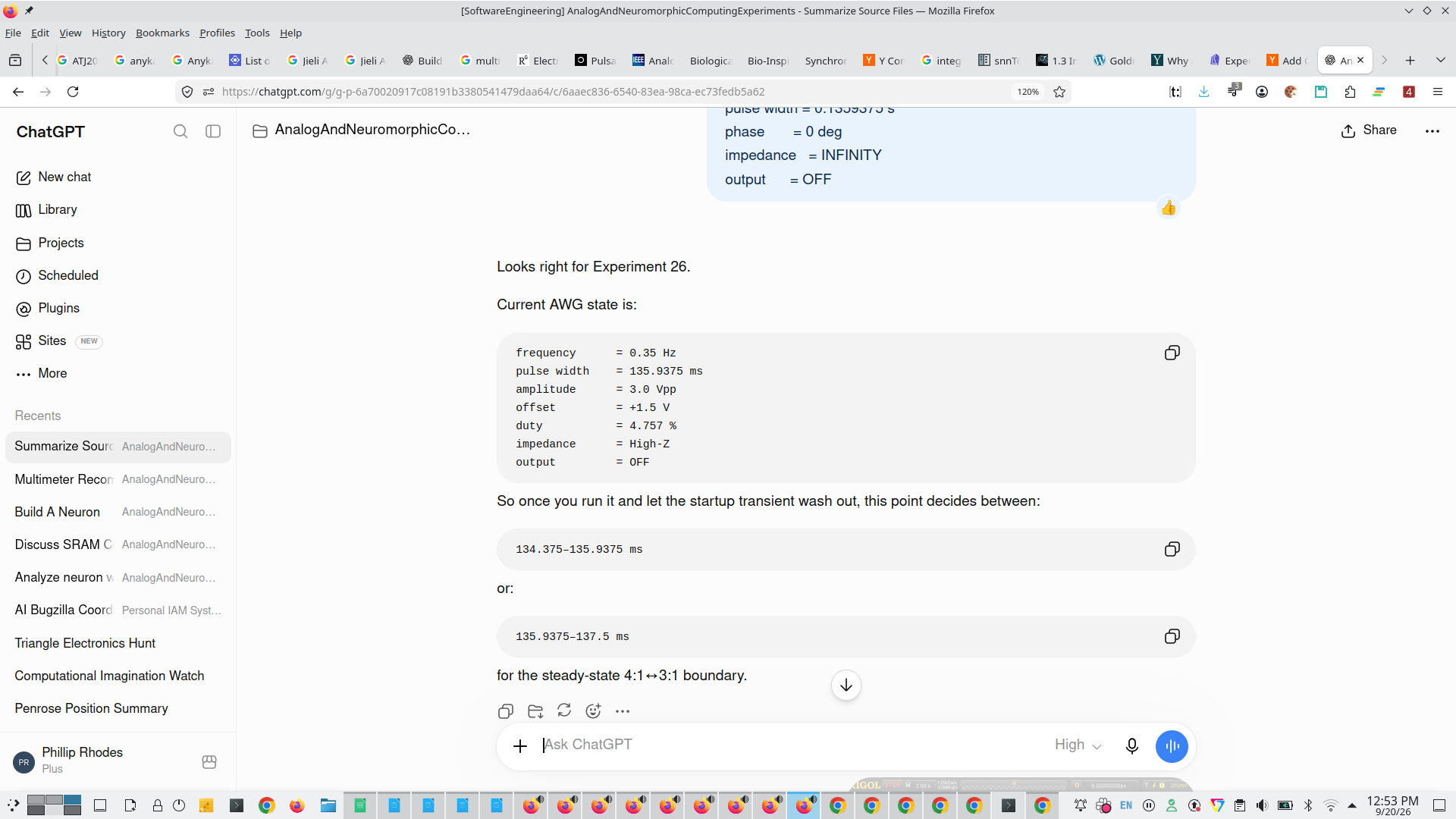
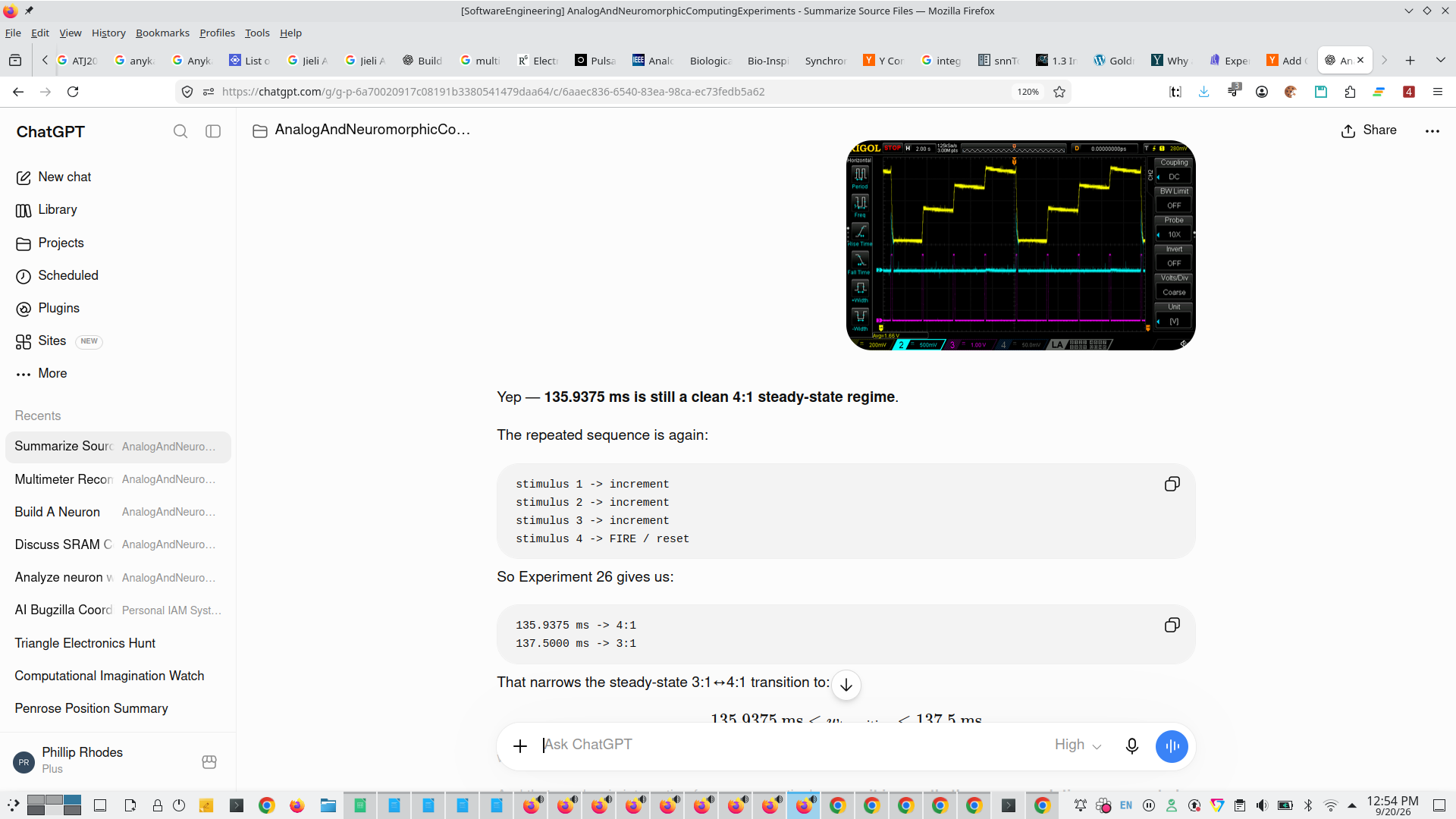
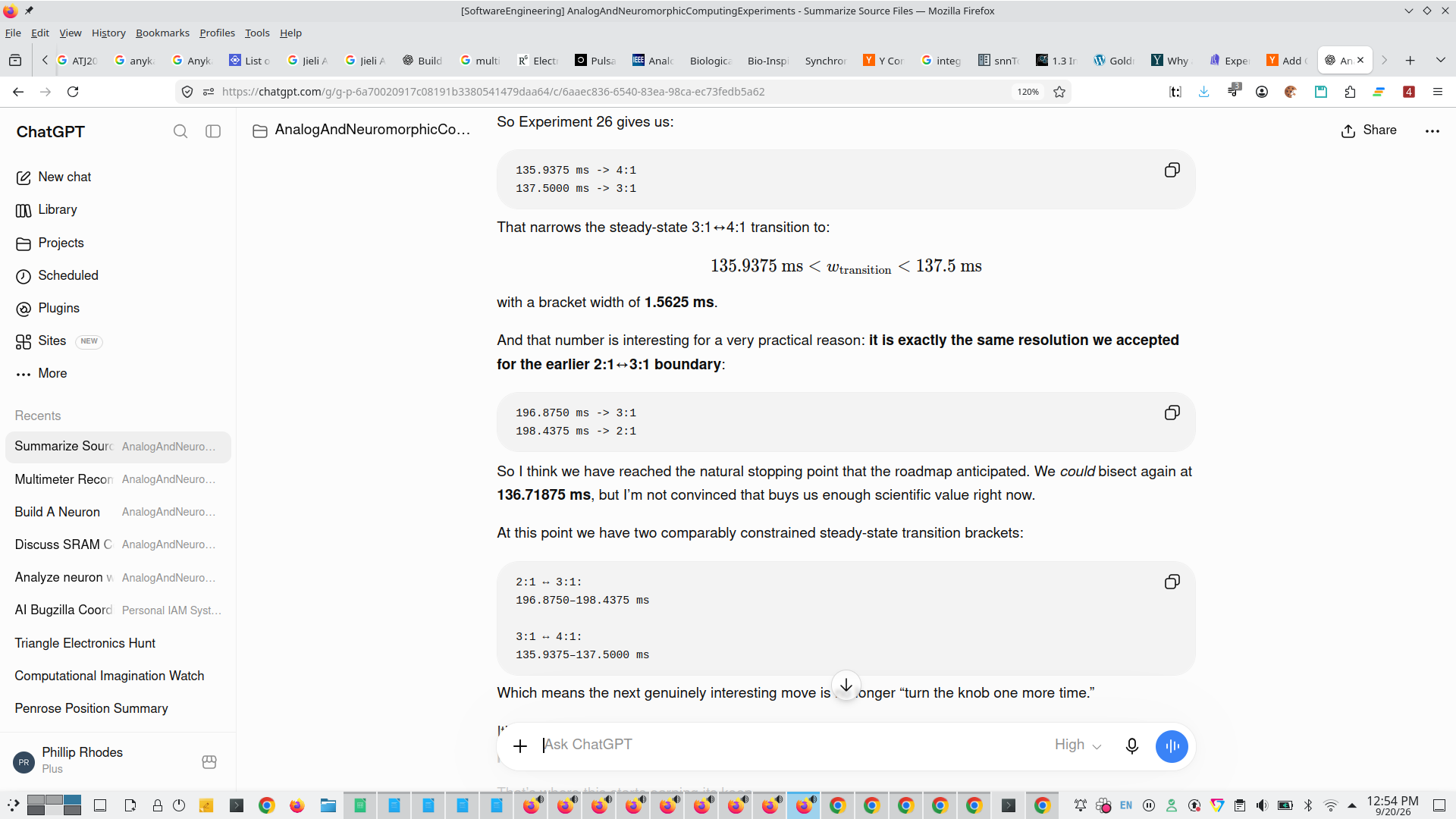
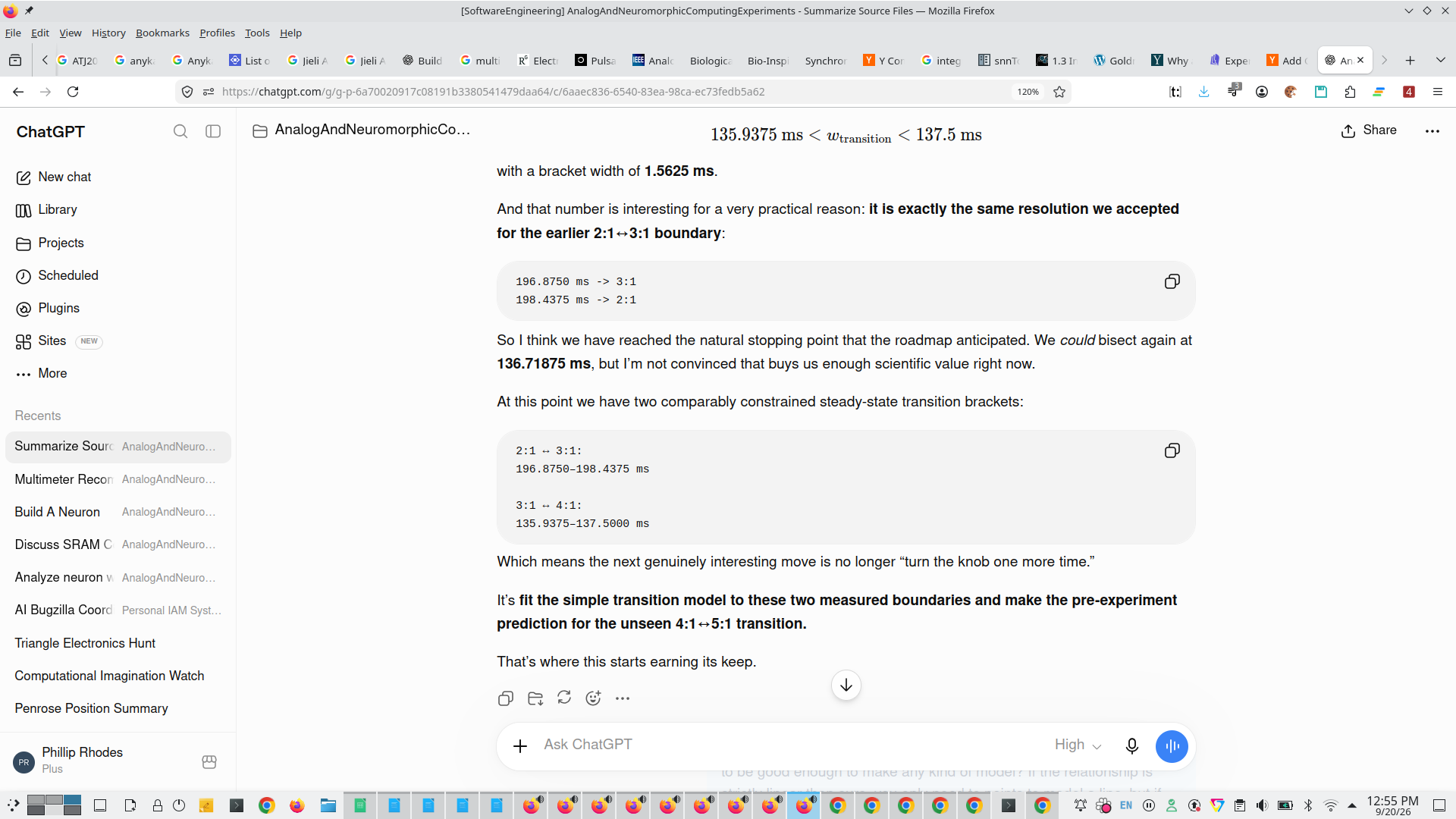
I'm working on a project, with a lot of help from ChatGPT, involving an "artificial neuron". That is, an electronic circuit, using a PUT, a capacitor, and some resistors, that simulates some of the behavior of a biological neuron. Specifically an "integrate and fire" model of neuron behavior. To that end, I'm running experiments by scripting my function generator to send signals to the circuit, and then capturing the inputs and outputs on my oscilloscope. Then I usually discuss the results with ChatGPT. In what follows, observe a couple of things:
1. The LLM "knows" the context of what we're talking about, even if I provide a prompt with no text at all, just an image.
2. It parses a moderately complex image, identifies the separate traces and what they represent, uses the time-base information displayed on screen, and the on-screen graticule, and works out "how many input pulses fire before an output pulse fires" and then reports back to me and gives an analysis of how that relates to our previous observations and gives suggestions for the next experiment to run.
Human intelligence? No. But I see no world where behavior like that does not count as "intelligent" regardless of the mechanism behind it. And that's probably not even the best example I could come up with, it's just something that was "top of mind" and for which I had the necessary images and what-not already ready, or easy to capture.
https://www.fogbeam.com/images/neuron_zero0.png
https://www.fogbeam.com/images/neuron_zero1.png
https://www.fogbeam.com/images/neuron_zero2.png
The fact that every new model generation has come with more capabilities should give the full skeptics at least a little pause that the foundations of their convictions may be incorrect.
To reiterate, this is the very beginning of a long series of technological expansions that are going to come out of GenAI. The work is going to go on for decades. All you have to do is look at what happened with the mass-produced automobile, the personal computer, the internet, and mobile phones to see how long the propagation will continue before we settle into a new normal.
Eh, this is turning into a messy chinese room argument. It is the room or is it the system. In my philosophy the chinese room argument is a non-starter. It's not the room, it's the system. For LLMS this would be like arguing that the output of a single prompt has to be able to answer everything which is nothing close to how human intelligence works. A single human thought is rarely intelligent, it's most often a replay of information it already has. Dialectic processes and loop processes are what tends to push the limits of human intelligence. We reach local maxima with thought alone, and this is boosted by things like writing down the problem and having other humans that may be even less intelligent than you add to the process. In fact this process works with one self by writing and reading ones own thoughts as it's using different subsystems of the mind for introspection.
The idea that LLMs have ran out of steam typically show more of a lack of imagination in the writer than what's occurring in the field.
> Many AI critics, including myself, are firmly in the second camp.
How can you reconcile this with the fact that AI can solve a real, intelligence bound problem for me (with zero intelligent effort on my part) that you can't?
Is the solution also illusory?
I think that might be the solution to consciousness illusion.
The consciousness might be purely in the mind of someone that believes some other entity to be conscious.
- fawning over how amazing these tools are
- believing everything OpenAI and Anthropic say about how powerful and dangerous their product is
- minimizing the amount of human effort and involvement in every "AI" achievement
Current AGI definitions are intentionally vague.
The amount of real help vs. confidence/manipulation the LLM or con artist provides varies in each situation and scenario and mix of people (and LLMs) involved. It's something to strive to be aware and analytical about.
There are numerous scientific discoveries that have been made because one human looked at all available data and turned off the assumptions other people in the field have been using for years, maybe hundreds of years. Once you delete the assumption and make a new one the answer is obvious any anyone from that point wonders how so many humans could have missed it for so much time.
This can occur readily with LLMs as it can with people. It's very likely we will see this a lot as the causal connection in the available data will connected differently in their minds.
Escaping from a local maximum can be very difficult as you have to climb uphill with a nearly infinite amount of freedom but no ability to see the horizon. Psychics, LLMs, or some guy name Bob walking in an providing a workable analogy for you to escape the local maxima and move closer to a global maxima are all the same. Moreso, if LLMs are AGI we should expect these "psychic" behaviors just as much as actual discovery because both continuums exist in the same problem space as human minds.
But that cannot be used to discredit the fact that these are incredibly powerful tools that can get out of control and cause great damage.
As of "great damage", I doubt it. They do not have self-preservation instinct (all "worrying" experiments are the attempts to initiate something resembling self-preservation from human initiative). The driving part is external - the query loop can always be turned off. So yes, a dangerous tool that can be exploited by humans (including governments, especially governments - which is why I am skeptical to government regulation proposals, particularly looking at what passes as governments in this era). But there are no inherent dangers from their own agency, as there is none.
OK, so they are intelligent. I'm glad we agree.
The problem with this word is people associate intelligence with the process they realize is occurring inside their head which is only a tiny fraction of what intelligence encompasses. Humans (without study) know very little about intelligence and they very gray boundaries it has.
Everyone not in a particular field asking LLM about said field is rolling bad dice.