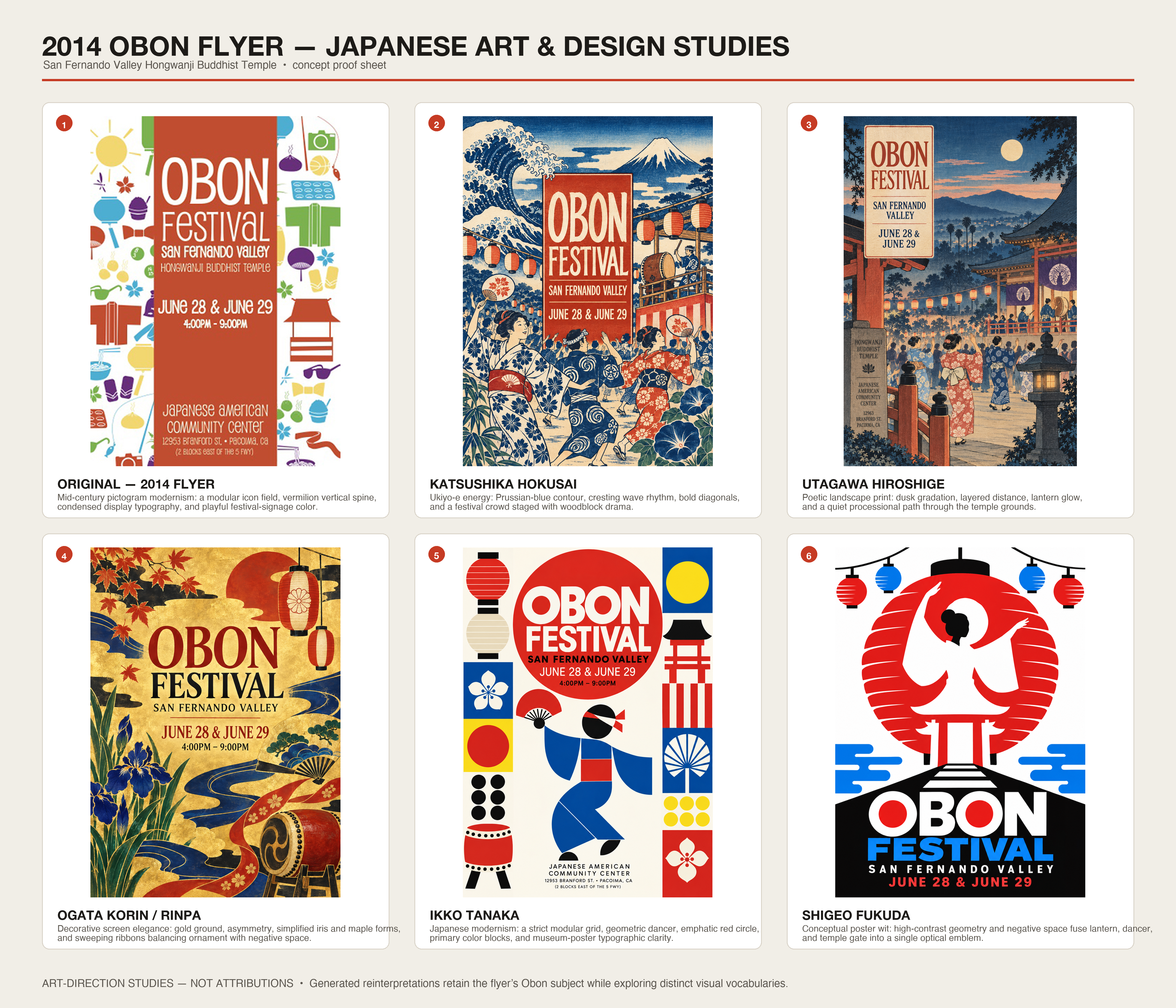
That may be true if you’re working with a top of the line artist, but in my experience the average freelance designer online is significantly worse than AI. I’ve worked with dozens of budget friendly designers on Fiverr and consistently get way worse results than I’ve gotten from AI models. Will a great human designer produce better output than an AI? Maybe, but a small local event or business probably won’t have the budget to hire them or know where to find them. It’s cheaper, faster and easier to use AI to generate something that’s good enough for their purposes.
People also point out all the little flaws in the “good” examples and cite them as obvious tells that they were AI generated. I think it would be interesting to see if people could reliably distinguish between AI generated flyers and human made flyers. Sure, sometimes it’s obvious like when the AI adds those weird, cartoony people. But if the model is told not to create designs like that and stick to the styles used in the second half of the article, I expect people would have a much harder time distinguishing the human designs from the AI designs.
Amateurs posters of before AI didn't have this problem. White background, the important info in big letters, maybe one clipart or to. So I'm not talking about how pro artists could make a better job, but even the small local non-profit used to produce better posters. Not in the sense of "better looking", but in the sense that they were more readable.
At least the examples of this blog are more readable than what we usually see.
I may do a V2 one of these days.
Clutter comes with the territory to some extent though. I was recently asked to do a real world PTA fayre poster, and the client (my wife) very firmly wanted 12+ attractions mentioned on the poster. Tombola, hook a duck, bar, BBQ, blah, blah, blah as well as date, location, sponsor, ...
To get a really clean design, you need to edit it down to the essentials. I don't know what pro designers do - convince the client to say less?
Unless the prompt says otherwise, AI will try to get a visual element in for every single word too.
So when you put the capability in the hands of the client without the editing (or taste) and no way to evaluate the result, you get the passable, homogenous thing.
It mostly doesn’t matter because there’s no economic incentive for it to matter, which is why much of our aesthetic world is the way it is.
> N.B. Make sure all the important information pops out (is visible at first glance) like an expert designer would, the information is more important than the design.
Already have me a much better result with the 'Arts & Crafts style', but N=1 so YMMV
Real designers would avoid them in the first place.
Poster design like any visual or artistic field will always cater to conflicting individual tastes - for some it looks great, others hate it.
I like Art Nouveau but a lot of stuff in that style looks kitschy to me.
Sorry buf I'd take these posters over your “generally more agreeable ” homogeneous slop literally any day.
Have you ever seen a bus schedule, or a parking sign, or a list of events at a local library or an “open hours” sign at a restaurant? Those are 99.9% unreadable, busy, and you have to look for information. And even then it’s not always clear if you got it right. And that was all before the AI.
A bus schedule or a parking sign is very information dense. It’s trying to communicate a lot in a limited space and as a result require getting used to.
For programmers, sure SV startups and actual software-first shops are probably only augments with LLMs and not replacing. But what % of software engineers are employed in such shops? Well, from my graduating class in CS, approximately 30% of grads all went to the same contracting shop whose business model seems to be, take the bottom 30% of each CS class, underpay the fuck out of them, bootcamp them into something vaguely usable + teach the house style of CRUD/LOB app framework, then throw them at clients. And this seems to still be a step above "offshore to barely baseline capable (or worse) body shop for extremely dubious results."
That entire bottom 50% is probably about to be eviscerated. The "offshore + pray" approach is probably going to be completely zapped, much easier to just vibe code for probably better (or at least not worse) results. And the onshore-but-cheaper contracting shops are probably going to need a lot fewer people whose main contribution is translating low-ambiguity tickets into syntactically valid java spring code.
Similarly, for artists, disney is probably not going to use AI in a way that substantially speeds them up because they won't tolerate the quality loss at all. But how many artists work for disney? And how many make anime waifus for the gacha apps? The latter of which I can only assume has already switched substantially to AI assets.
Currently AI is actually replacing some of these jobs. But there's kinda a hitch there - when you target me with ads or show me your company's website and it has obvious AI art I tend to think that you're either selling me something very low quality or are a scammer. If you show me the novel you've written and it has an AI art cover I assume the contents are also AI generated garbage writing. So I wonder if those jobs will really be replaced? It all depends on society's acceptance of AI art and if AI art doesn't get any better. I thought it would get to the point that I couldn't tell it was AI by now, but so far it hasn't.
I think AI waifus and porn and memes and browser based zynga type games will be a place AI is going to be accepted because nobody cared too much about the authenticity and quality of those things before either. But an advertisement selling me a car? The cover of a book on philosophy? A website that I'm going to give my credit card number to? I'm not sure about those things.
Real estate is interesting because they seem to be really getting into using AI to stage individual houses. So I guess on the same vein maybe someone will try making an add with AI that shows some car driving down your local mainstreet or at some scenic location nearby your ip address that you might have positive associations with. Or maybe even your own home-street and parking in your driveway and you (or facebook you from 10 years ago when you had that hipster-moustashe because you haven't updated your photo) opens the door with a big smile on your face).
Seems crazy, but who knows.
It's not tracking a real thing as much as people would like to think.
Now I’m not saying there isn’t legitimate criticisms that can be made about the ethics of AI, I’m highly concerned about the problems that AI brings too. But that’s a separate argument entirely.
It’s a little like people who are pompous about expensive wine, whisky’s, etc and then fail blind taste tests (plenty of studies there too).
They don't care about the truth, it's all just about being part of the right herd.
But if you grab an average person off the street they're overwhelmingly likely to be pretty daft and not know much about anything.
Just look at how many people in the US vote for that orange clown even after the complete farce of his previous term.
this thread looks like it's folding in on itself
Doesn't guarantee there isn't a steel version of their straw out there that you're deliberately ignoring.
Have you read every single study about the last vaccine you took and what the positives and negatives are and where potential problems are and so on? Of course not, we trust that the experts have done enough. Same with learning physics or driving over a bridge and so many other things.
But for a lot of things I can with high probability discern between AI and human in every day appearance and I know many other people can as well. One of the things I look for is specifically certain types of extreme... not just flaws... just overall atrocity. When I read posts submitted to HN I often realize that something is bad writing before I can specify this to AI text. Pangram almost always agrees with me. Here is a recent example: https://news.ycombinator.com/item?id=49715657
I don't doubt that there are certain scoped tasks that certain models are quite good at. But in my every day life I constantly encounter AI slop that is so bad that I take it as a personal insult that someone thought it would be okay to subject me to it; to presume that I am so tasteless and numb and have no quality standard whatsoever.
I mean just look at the example posters at the beginning of the article. "The problem with these is not so much that they’re bad." Yes, yes it is. They are horrible. I cannot understand how anyone can describe them as anything but that.
There might be AI generated things in my every day life that I do not recognize as AI, but that's not what's being discussed.
It’s similar to a well known finding about price: people value things that are more expensive more, and tend to think they are of higher quality. You can give people the same thing for a high price or for free and they’ll say the high priced one is amazing the free one is lacklustre.
It’s like an optical illusion driven by labelling.
Similarly people may view an IKEA book stand as worse quality than one built by hand even if the hand built one has flaws. Or they might view a microwaved meal as worse than that created by a home chef.
People value the human intention and care that goes into creations. Without that it’s worse even if the output is fundamentally the same.
A drawing by my young niece may not have the same finesse as an AI generated one but I like it a whole lot more
I think that's true enough for what it is but, as the other commenter also noted, a bit of a different topic here. The Monet example shows that people work backward from AI to direct conclusions about the quality of the work itself, which isn't the same as agreeing a work is by all appearances equivalent to Monet but lacking in underlying deliberation.
One can inform the other to be sure but that conversation exists in parallel with another conversation that's a straight one-shot assessment of quality.
That’s a bit separate to what I’m talking about, but I don’t think there are many of these people. I think this whole thing is about AI anxiety coupled with American social norms, and as soon as one of those things changes the artists are going to be left out in the cold again.
I think there are lots of people who value art for the ideas of the artist. There are also lots of people who think that they value something like quality of brushstrokes, and these are the same people, mostly. I mean they don't know what they like it for, but the raw graphical data is what's in front of them, so they ascribe their preference to its (supposedly) measurable qualities.
Hence this thing about I can tell it's AI because its graphical quality is bad. In a way that's correct though! The artist's ideas are hinted at in the brushstrokes (or whatever other graphical aspects). In the gen AI picture you get hints of a phony mind. It becomes hollow when you know that, or when you think you know that. It's not delivering the cultural experience, if the hints you pick up on are false.
What did you think about my other examples? (The bookshelf and the microwaved meal)
I think at least for your niece’s drawings example, you’d probably prefer AI art if you had to choose one or the other until the end of time, not just one or two drawings that go on your refrigerator.
I would definitely choose my niece’s drawing for all time. Do you have young family members? That seems like a bizarre perspective to me.
Low quality baiting content was a problem before but the barrier to entry has been significantly reduced and the.amount of content is growing quickly.
This is like the transvestigator creeps who think they can tell with 100% accuracy who is trans but they are regularly fooled by pictures of cis women when seeded with the notion that they might be trans.
Some AI is obvious. Some much less so, and a lot of non-AI content is being caught up in the amateur dragnets.
If nothing else, simply as a matter of self respect you've got to make your peace with a certain amount of healthy uncertainty if even just to avoid making a fool of yourself.
But more importantly, it's important to be honest with yourself about what you actually know versus what you're very motivated to believe. Because I think AI equals bad is poisoning some people's ability to talk about this in a healthy way.
One commenter really nailed it[1]: "We didn't get worse at judging art. We just got better at doubting everything."
Did you even realize basically all commercial images you've seen for the last 30 years were already heavily modified?
Most people aren't aware of the prevalence of stock imagery during the 2000s. AI is just synthetic stock images, which I have zero problem with.
Artists with taste are the ones creating the best AI images, just they were the ones who photoshopped the best things out of stock images when that was the main mode, and just as they created the best stuff when everything was manual typesetting and dark room photography.
In reality it is seeping into our lives at an alarming rate which I worry is disrupting our shared sense of reality (which was already tenuous.)
AI has capabilities that were impossible (or very difficult before.) You could easily generate a realistic video of me saying terrible things or kicking a puppy or doing a pornographic act. You could clone my voice and call my grandma asking for money. It’s very hard to tell what is real now and it will get harder as the capabilities improve.
These tools are also much more accessible than photo editing software. Before, few people had the skill to create realistic fakes. Now anyone can do it. This has led to a flood of fake images, videos, and text online. This crowds out real humans and makes it hard to know what is real. My older relatives especially have Facebook feeds filled with fake content they think is real.
The capabilities combined with the scale make it hard to know what is real in a way Photoshop never did.
Every single person I’ve asked, and I’ve asked hundreds, say that knowing it was AI irrespective of anything else was enough to think it was bad.
There’s millions of genai images that people aren’t commenting on because they don’t know it’s AI.
That's prejudice.
Do you think it’s unfair for people to dislike AI generated art based on their principles?
And no - I don't think it's fair to call the art bad when in fact what you mean is you don't like the way it was made. Saying "I don't like AI art" is not the same as "This piece is shit", which is how it is almost always framed.
As he states, he isn't trying to make stuff that doesn't "look like AI did it," he just wants to introduce variety, and has proposed a disciplined way to do that.
Except we have all seen really awful human made posters long before AI. People are just upset just to be upset at this point.
Code was nosediving before AI badly.
What? What are you comparing this pre-AI 2020s code to? 90s and 00s code for sure was worse.
When it includes an American Flag with more than 50 stars + the bottom row is cut off, you know they didn't even bother to proofread it.
This is the kind of garbage we're suffering with.
You have to understand that 99% of people who will see the poster will view it for <5 seconds. They wont sit there and count the stars.
And, of the people who do examine the poster closely, they’re looking at the text. They want to see the date, time, event details. The background is background.
The first one I clicked on is at a stock photo site that says:
Every visual at iStock is crafted through human expertise, creativity, and ingenuity. We do not allow AI-generated visuals in our library.
Did you even look?
https://www.theverge.com/gadgets/931347/trump-mobile-t1-phon...
Step 2-3: sell anything to your cult followers, doesn’t matter how good or bad it is
Step 4: profit
Simple recipe for success
I suspect that what drives the compulsive lying and exaggeration is that they know what LLMs can actually do is not worth the development and operating costs (at least for now), so, like Bernie Madoff, they pretend that they're more capable than they are in the hopes that the next round of investment will somehow bridge the gap and let them actually produce what they've been falsely promising their investors they can do, and make the whole thing worthwhile.
I get AI slop from employees sometimes. If they provide poor quality work that hasn't been proofread, that is an employee problem, not an AI problem.
Since this is idealogical, a business owner's choices are: * use AI and some people hate it on principle, don't use AI and don't pay enough and some people hate it because it looks cheap, don't use Ai and pay a bunch more and people don't hate it...maybe, depending on style and skill of the artist.
As a business owner, it's not an encouraging situation.
That is a bizarre stance
Literally nobody is saying that, what are you talking about
I suspect it would do quite a convincing job.
Though it's fairly unconvincing at handwriting.
Nice no true Scotsman fallacy. PS is a "real" artist tool.
It's not that you can't create good art with any tool, it's just that the economy and expectations change with the tools available, and the tools being faster/cheaper doesn't translate into better art.
To be precise, the tool and the artist are two different things. You can make crap with brushes or PS, and you can make art too.
AI is a tool too. What I build with it is orders of magnitude less important/interesting compared to what a talented artist can build with it.
In both photoshop and painting, the human using the tool decides what strokes to use. That isn't true with AI art. It's not "just another tool" for doing the activity when it does the entire activity for you.
except for the million posters and album covers unironically made with a real photo passed into one of photoshop's "Artistic" filters to make it look like some impressionist painting
Would you consider me to have "created" Billie Jean if I type "eighties music" into a music search engine and select "Michael Jackson" from the list. Or to have "designed a logo" if I pay a human to design some logos for me and pick one.
Any "real" artist could dunk on PS: "Oh, you didn't have to go out and buy a canvas and paint and brushes. Hell, you probably don't even know how to properly mix paint on a palette! Not only do you not to clean your brushes, you don't even have brushes!"
And the right response is: "Who gives a shit?" The answer is "Some folks, but their opinion decreasingly matters." And the same exact logic applies to AI. You might as well be complaining that Google doesn't pay cartographers to hand draw Google Maps.
> when it does the entire activity for you.
This is total fiction, and has spawned an entire cult of "just give me the prompt" folks that think using AI requires no skill, and anyone using AI is just a "meat proxy". But that's not true, at all, as evidenced by years of commentary on this site with people getting radically different outcomes using AI. We've gone from "stochastic parrots" to "gonna destroy humanity" in 2 years.
AI will do jobs that we used to go to Fiverr for -- it'll eat the bottom of the market, just like automation does elsewhere. The bottom of the market is blog art, clip art, menus, commercial signage, event posters, and the like. That's completely natural, and hating it is shouting into the wind. The local cafe owner was never particularly incentived to have their menus crafted by some local artist.
Photoshop basically destroyed a centuries-old artistic tradition of depicting six gyoza on a white plate. Now with all this AI nonsense, you might as well just make your food at home rather than stare at yet another “six finger hipster eating a vegetable spring roll” cranked out by ChatGPT.
In almost any intellectual domain, including coding, the models are already ahead of the average human. But instead, we compare them to the very best humans, which almost no one on the planet has access to.
$20 for a lot of access to better-than-average is a world-changingly good deal!
The TFA is pointing to a prompting skills/creativity issue, but I get equally frustrated with hired artists as with genAI image models. Even with skilled human artists (remote/offshore), I find they're best at copying a particular style so I end up having to google for images of the look that we're targeting, then spend hours painstakingly describing the changes needed. Then iterating many times, and with artists in remote time zones that means each iteration takes a whole day. The process is ironically very similar to using AI image models but can take much longer due to time zones.
The funniest genre of AI backlash imo is normies yelling at small businesses for using AI on social posts.
There's no world where your local flowershop has both the time and money to brief a design agency to create a flyer for Fridays social post.
Yet, in the mind of the mob, they imagine some designer is losing a job due to the existence of AI...not realizing that every social post they've previously been looking at from the same flower shop was just a 1-click Canva template.
The only person losing a job due to AI design is Canva, which itself was hated for taking jobs away from Photoshop designers, whom in the 90s ended up taking jobs away from the phototypesetting industry, who took the jobs away from the manual typesetters, etc etc etc. Meanwhile the economy and living standards grew each time.
Not a perfect analogy, but adding some bait that does indeed work for grabbing attention can of course be criticized.
This whole conversation makes me want to throw up
I suspect a lot of the gain isn't even that useful to the channel: it being people clicking to complain. You might not see that mean actual complaints because many will see the existing ones and either just upvote them or move on without doing anything (their chance to repeat their regular comment to get a few upvotes having been taken by someone already having said it).
It’s their job, their source of income (or they’re aspiring to it). Making bait thumbnails is a necessary evil. If they don’t they’re leaving money on the table for no reason.
If they AB test some thumbnails and the AI ones get more views/engagement then of course they are going to do that.
I think the overall premise of “if AI thumbnails are even getting more engagement, it must be from haters” is faulty to begin with. It just fits your personal narrative. We simply don’t know.
That's just a loud minority. Most people really don't care about using AI in what you do as long as it is entertaining. The real world ain't Reddit.
Thumbnails, same as everything that is supposed to attract attention, have styles that change over time due to saturation and fatigue.
I don't think clickrate on Youtube is a meaningful metric if all you want is for the right people to show up at your event.
I don't care if someone uses AI to "style" their thumbnails, but if you use it to completely misrepresent what the video is about I'll leave in protest. That has nothing to do with AI, and everything to do with the fact that it's clickbait. I don't like human-generated clickbait either.
The author then picked them out, not the AI. For curiosity I assume.
I think it's actually a feature when people can recognize it as AI.
Why would someone want it to be unrecognizable as AI? What is the reason people want to hide AI usage ? (other than when "cheating" in studies or examns or such, obv)
Both of these communicate that I will probably not get a good value for my money when buying your product or service.
This is where I stop following. Businesses should focus on where they differentiate, and I really don't care how they generate signage if I can read it. I don't get anything by them paying Banksy to make their menu instead of having Gemini generate it. And if there is any connection to getting good value, it's the inverse: I'm more likely to get good value when I'm not paying for fancy advertising. See: every drugstore that puts generics alongside brand names for cheaper.
The worst generative AI posters and restaurant menus I'm seeing from newer small businesses do not instill the same feeling that I'm getting generic-like value. To keep with the drug analogy, they feel like the combo pills you find somewhere in the back of a gas station which combine 10+ random supplements to help with 20+ different symptoms. Especially for new restaurants where real reviews are limited, menus with terrible AI generated food drawings really give me the same ick - that they might not be providing any good value at all.
However, i do admit that part of this is also that i live in an area where there is tons of competition for most cuisines I'm interested in, so I can use menu quality as a differientiating factor in the first place. If enough places around me were using sloppy AI menus i would probably ignore it.
If a business markets itself with these AIgen posters, you get wildly different responses from different groups.
boomers that spend all their time on Facebook will think “this is such a nice pretty poster” and be oblivious to the fact it is even ai. Even if they knew it was ai they don’t care.
Young people will think it is low class/trashy. Some hate it because it’s ai, others hate it because the poster is ugly/busy/confusing.
If we operate under the assumption that the AI generated posters are bad (which this HN thread is), then making them not look like AI generated posters would be directionally toward making them not bad. That doesn't necessarily mean it's good though, it could be average and fulfill that constraint.
Because a lot of “everyday” folks really strongly dislike AI. I’ve lost count of the number of AI generated Instagram ads I’ve seen where the comments are filled with “AI slop!”.
It’s not a positive signal for anyone who wants to persuade someone of the value of whatever they’re advertising because it’s associated with being cheap and lazy.
> About half of Americans said in the June survey that AI will worsen people’s ability to think creatively and form meaningful relationships with others. Far fewer said AI will make these things better.
https://www.pewresearch.org/short-reads/2026/03/12/key-findi...
“about half” surely objectively qualifies as “a lot”.
> I can also say "a lot of people really like AI-generated arts" and that would be true as well.
Yes but without the corresponding negative. If someone who likes AI generated art sees some human created art they don’t think “gross, why didn’t they use AI to do that?”. So for something like advertising using AI will alienate some potential customers. Not using AI will alienate no one.
If most people aren’t shareholders but instead workers whose jobs are threatened by AI, we should expect this response.
It has nothing to do with artists, it has everything to do with trying to mount a collective response to the apparent threat, poorly expressed as crowds tend to do.
This is a form of the broken window fallacy. Society is not worse off when production requires less labor, any more than it's worse off when someone uses an open source library rather than paying someone to reimplement it.
I’m not sure I see it, can you elaborate?
So here you never have to pay anyone to fix your windows, because they fix themselves, but conversely nobody will give you money to fix their windows! And then you have to pay your self-fixing windows a rent in tokens without an income.
That's a pretty big leap.
The narrative we're seeing around AI and current automation isn't "we're going to automate one category of jobs". If it were then sure, we could be relatively confident that the excess labor from that industry would be absorbed by other segments
But that's not what the future looks like to me. The future to me looks like "we want to automate a large majority of labor"
So what then? If tons of labour is displaced then the Broken Window Fallacy doesn't really apply, because it is based on the assumption that there will always be something for displaced labour to do.
Call it the Excess Labor Corollary. If there's no way to absorb excess labor in other segments, then what.
Or of course, a few billionaires could hoard the wealth.
There's a Wikipedia page about it.
We could be in a post scarcity economy now, except that generally instead of realising we all have enough of we share, we raise the threshold of what we consider to be enough comfort and stuff.
Society is definitely worse off when people who exchange their labor for capital have no opportunities to do so
Pretty much all of the designers we contacted recently were using AI to draw. Especially on those kinds of cheap work. They are just a bit more professional in the prompting and can do final touch in Photoshop.
I volunteered and designed a good amount of posters for student organizations.
Don't enjoy it but did it to help my peers and friends out.
I find it ironic that back then we had a lot of trouble finding people who were willing to design posters and promo media on print.
Now the comment section on this post has people mourning AI taking over poster making in 2026. Where was the help back then?
From the perspective of someone who had to burn the midnight oil to do it for years, trust me, I would rather not do it and spend that time with my family and friends. And judging from how hard it was to find others who were willing to do it, I think its a reasonable argument that most people were not actually willing to do the work either.
So mourn away but I wouldn't cry if I "missed out" on making posters. If we had AI back then, I would not take on any of those poster making requests.
I can totally see how doing more than a couple would start to feel like work, but having one or two experiences like that was awesome.
we should have asked the arts students! (and find a way to return the favor) i did not think about that.
that being said there were some intense rivalry between various studies, my presence may not be have been well received.
and judging how i am here, you can guess what i studied :-)
thank you for this. really feel like i got a missing piece of a puzzle reading this.
I don't see the word free here. Of course you'd have trouble finding people to do anything for free.
Wait, we've gone from "pay the local artists" because AI shows you're "lazy and cheap" and "don't care about your brand".
And now whatever my 7-year-old draws is good enough.
My only conclusion reading these threads is that folks come in with their mind made up, and will argue absolutely anything so long as it amounts to "AI bad".
You don't have ANY money? Plenty of students would do a great job for a little money and a professional reference. Now you just helped the workforce, helped the local economy and cost you little.
AI, at least for now while it's still free/very cheap, enables producing a lot of very low-value content that in the past you never could have justified spending money and human labor on. The cost or time needed to make a poster or a flyer acted as a value-based gatekeeper. Today, it costs nothing to make an AI slop image and blast it out on social media, so we're drowning in it.
but of course this means the entire market will dry up because no one pays students anymore
Saying you don't have the money for a designer is a bit like saying you can't go on business trip because the company can't afford to purchase a jet airplane right now.
That makes sense given they're on Fiverr. However, Fiverr freelancers are now just AI prompters :) doesn't matter whether it's code or art.
i think people can point those out pretty consistently for in-the-wild cheap posters, since the 2 types are often bad in different way
The problem of AI generated stuff (we see the problem of manifests, but I'm a software engineer and with computer programs it's exactly the same thing) is that they immediately look non-human, and our brain trained itself to detect, and thus get irritated by, AI generated content.
It looks fake, it hurts to see, it seems fine at first glance fine but it's not, everyone seems identical because the AI is not, despite of the name, creative, it just a hyper complex copy/paste machine, and obviously the result just looks copy/paste as well.
FWIW, statements like this are so patently ridiculous that it actually hurts your cause.
Sorry, if it's a joke it doesn't land very well.
Before AI, if a 10yo did these posters for a school project, people would just tell their parents to not do the homework for their kid. These are far above what 99.9% 10yo can do.
You'd run afoul of child labor protestors. I'd just prompt the AI to generate a poster in the style of a 10-year-old with Microsoft Paint.
Outside of a small joy of the organizing committee, is an incrementally "better" (which is almost entirely subjective anyway) worth the trouvle?
I walk past countless of such arts everyday, none of them registered after even 15 mins. Maybe you have better taste, but don't try to project your opinion as that of the majority.
Sometimes that's okay, but probably not in ad copy.
Just admit that you are scared of the future that's coming and it's eliciting irrational hatred, and that's causing you to lash out. At least that'd be honest and we'd understand where your coming from even if we didn't share your views.
That stat sounds more than dubious. Do you have a reference for it that isn't published by someone with a vested interest in people using AI?
This may be a failure mode similar to juniors using AI and making it much harder for seniors to find the bugs, because the code actually looks good at first sight.
I don’t think the blog author actually has any design skills based on the prompts and the AI obviously can’t nudge them in the right direction or help them clarify their brief, like a real designer (i.e. not random online freelancers) would.
At this point I have some kind of a physical repulsion to the generated posters, and it's always easy to tell from the fontwork and the iconography, let alone illustrations if there are any.
This is funny to read given I am currently on a Japan trip with 3 friends and we actively avoid every small restaurant that have AI generated images of their food. Using AI generated bullshit just shows that you really dont want to put in the work to produce something actually charming. Hell, we've seen a food menu drawn by a toddler and it was infinitely more sympathetic than all the AI generated Wagyu images.
I just got back from a month there and recall perhaps 2 posters that may have been AI. I actually ran into several public art exhibits as well.
So you never actually walked the streets ive been in recently lol
But I recall this simple looking promotion: https://imgur.com/a/fbM8Akb . The photo looks professionally done, and not AI. Then again, maybe they googled for "cheesecake photo".
I just image searched for "cheesecake", I didn't find this photo in the results, but there are a few results where I now have to wonder "Is that AI?"
Of course, a "Japanese Minimal Poster" has a sakura and a stylized flag of Japan, duh
A human designer would probably think that "Japan -> sakura" and "Japan -> Japanese flag" are way too obvious, too banal, too stereotypical, and, most importantly too boring. And then they would probably sit for a while and try to think of something fresher and less clichéd.
But AI has absolutely no problem with going with the cheesiest, most overused trope.
Your promotional poster for a community gathering should not be subverting the western gaze on Japanese culture, or any other concept from art criticism 101.
It's supposed to get average people in your neighborhood to glance at it for 5-10 seconds and say, "cool looks like a good time"
I've never been in a cliché-looking restaurant that is actually decent.
Meanwhile, the best restaurants I know have, at best, a flag or some kind of small drawing to give a clue about their nationality, but otherwise they look like a regular local one.
Well of course Spring + Japan = Sakura. In a way the model would be faulty if it didn't reach for that cliché. That's what it's meant to do.
If you want originality, you need to supply it. AI fills the vacuum with the obvious thing.
And in a way that's a feature. If I was creating a poster myself I'd think "nah, can't use sakura it's too obvious". AI gets you past that hurdle. "Yeah, we used the cliché, it looks nice, let's move on".
This is if it's for a school fayre, village fête, etc. - brilliant originality isn't the goal. But it's nice when your poster doesn't look the same as three other posters on the same noticeboard (I have seen this).
If brilliant originality is needed, a human has to bring it. Although an LLM with the temperature turned up can offer some nice seeds.
I like that a lot.
If you named a Japanese artist or style rather than giving an adjective derived from a country, you might get something that wasn't national wank.
Yes, a human might do this step for you. A mediocre one might not.
An artist (even a mediocre one) almost certainly would do this step for you
Also what the author of this post did could easily be added to the training/harness/skills of ChatGPT in a future version.
That doesnt mean you have to believe them.
Considering your prompt fits exactly that description I think the AI delivered perfectly. Try using some actual design language and see how well it does.
It showed whoever did it had no clue about East Asia or Chinese script...
But there’s another reason it drives people crazy - it’s low effort trying to present as high effort. If the sign was simple Comic Sans then it would at least be charmingly honest.
Because there's no correlation between the ability to organise a village event and the graphic design skills. (Apart from "it's been so successful we can splash money on a design agency") Maybe someone actually liked it and thought it's enough. I've seen groups overthinking posters and it felt similar to groups at uni overthinking funny names instead of doing the work that actually mattered.
To be clear, I'm not saying those designs are good, just that most of the time the design is not the point and minimum effort above "Times New Roman 12pt" is what many people always wanted to do.
Which could be an important signal for you to decide if that's the kind of event you want to go to. Maybe the comic sans fayre is preferrable to some.
That's why the "Look here's a 100 identical village fete posters" memes are kind of missing the point, it's actually not a bad thing that I can tell from a glance what it is, I don't actually have to read any of the details to know it'll have a tombola, because it's a given.
My bigger issue is all the posters calling it Fayre, not Fete, which is the weird part, particularly the "Craft Fayre" which should definitely be "Craft Fair", but misspellings and greengrocers apostrophe's are part and parcel of a good hand-made poster too.
People are really bothered by perceived inauthenticity and injustice. And care about more things than the utility of the end product.
On top of that, we have a very out of touch political system that has continually ignored the will of the electorate. So then the tech people will say “see, the masses voted with their feet, they love the utility of AI generated art!”. Completely ignoring the perverse incentivizes and regulatory capture that led to that outcome.
If you were to poll 100 people on the street, they would be very against replacing human artists with AI.
If I’m looking for a handyman on (the Dutch equivalent to) Craigslist, either very short text with spelling errors or something obviously AI are both a positive signal. These are people too busy doing actual jobs, to fret over smoothly copywritten ads.
Also just because someone used AI doesn't mean they didn't put in effort, so I don't think reflexive rejection of any AI smell is the answer. Sure, at work in a corporate white collar job where you have so many talentless strivers looking for any shortcut to climb the corporate ladder, raw AI smell actually is a highly valuable negative signal. But when it comes to local event organizers for example, there's a realness and human factor there that goes beyond anything a programmer or designer in a "scalable" context does with or without AI. We need to give our local humans grace, because humans are what it's all about.
Beer? The first example is about a beer festival. People go there to drink beer, not to see posters. A blank piece of paper that says 250 kinds of beers would get more excitement than any AI or handcrafted poster.
Reasons were the same as now: low effort and overuse.
I remember the days when people would make fun of a sign like that. Then people would make fun of Wordart, then Canva. It appears that unless you spend $1500 on a graphic designer to create your poster, people will shit on your effort.
People shit on things that are low effort, and especially low-effort trends. And especially especially when the low-effort trend involves something that offends them in some way, for example if they think AI is taking jobs, hurting the environment, etc.
Of course people are shitting on low-effort AI. It would be more surprising if they didn’t.
This week, I created a video for a personal project using AI.
And, as the creator, I honestly can not say if it's "slop or not."
So I created a "behind the scenes" page that shows the process I went through before final cut, warts and all. You can find it at https://alexisrondeau.me/mosey-site/making-of/
Do you think this helps you decide if it's slop or not?
The making-of post itself also is clearly LLM generated, probably by Claude, judging by the language used.
So now I don't say. I show my workings and the reader can decide. And to be poncey, I made a manifesto. https://kladde26.org/
And I agree with your impression.
My goal here is to understand how can I demonstrate that I did in fact put work and care into the "thing" (video in this case).
Basically show that I did spend energy over time, that the final product took a few dozen iterations with a lot of dead ends (as opposed to a lazy one-shot "make good video, no mistakes")
So I do think this route can have merit given there is actual work, but how would a page like this look if the current one is not yet giving you a trustworthy vibe?
You'd definitely see some raw and embarrassing stuff there. Like frustration, anger, greed, ignorance, incompetence, creativity, curiosity.
Is that maybe what we need to see to believe that a human (me n this case) was involved meaningfully?
I asked Claude to go through all the previous commits, the chat history and the 100 or so intermediate assets and create a timeline of sorts, the current page as you see it.
It's AI-generated as are the assets, the process and decisions depicted are human.
And still you're reaction is "it's slop". Noted!
No one is praising or collecting them. We just accepted that shitty poster exist.
Now some few people complain about ai slop at situations were no one cares and no one cared /shrug
What’s also interesting to me is that requesting ”professional typography” did not fix the problem at all. And I would guess that there is a staggering amount of examples in the training data.
Maybe inference is just wobbly by nature? The same as text output has the characteristic randomness, even design output cannot resist being – for a lack of a better word – hand made?
At the top of the page we have a deformed wireframe sphere. A wireframe sphere is stylistically appropriate, but the incorrect rendering is not. The "CGI" aesthetic requires obviously computer generated lines, which in the 90s meant accurate and regular lines.
Next we have a messed-up stellated polyhedron, and a messed-up dot pattern. These also fail for the same reason. The main 3D rendering is also obviously broken, as are many other small details.
But the biggest failure is the complete misunderstanding of the culture. 90s DnB was absolutely not about "good vibes". The smiley face logo is completely inappropriate; that's associated with late 80s/early 90s rave culture, pre-DnB era. 90s DnB was much darker and edgier in tone. The scene was almost exclusively male, and it maintained a aggressive vibe carried over from jungle.
A 90s DnB event would never advertise "bringing communities together". Audiences would be repelled by such messaging. This is despite it actually doing just that, as the scene was racially integrated in a way that mainstream music at the time was not. If there's going to be pro-social messaging on the poster it has to be there only implicitly.
No, you silly geese. What you are able to spot is somebody using AI poorly. That's not you developing taste. It's the equivalent of being able to tell something is photoshopped because somebody used a default brush poorly, or masked something poorly and then confounding using Photoshop with using Photoshop poorly.
You have absolutely no way of telling when a good designer created something entirely using AI (unless they are fine with you knowing that) and that has always been true.
I do have one way of telling: my wife's a designer, and she has many artist and designer friends so I see how they work first hand. AI is largely used for edits that need to be done quickly rather than from-scratch generation.
You talk about aesthetics but that's very secondary to communicating the precise thing you want to communicate. AI just isn't there.
Who is imagining that?
> No, you silly geese. What you are able to spot is somebody using AI poorly. That's not you developing taste.
Again, I'm not really sure that the 'spotting AI' endeavour is always supposed to be a flex of someones own taste.
> You have absolutely no way of telling when a good designer created something entirely using AI (unless they are fine with you knowing that) and that has always been true.
I have trouble parsing your entire comment, but you have lost me completely at 'always been true'. I don't know how many hours your 'good designer' would waste on creating only with AI something able to fool everybody 2 years ago. It would surely be too many to be practical.
(Granted, given that you always needed some way of steering the AI and a harness around it, defining "entirely" in this context is a separate, debatable exercise)
The bad posters are absolute disasters in this regard. (And completely irredeemable in general! They are not "OK" in any way.)
But the better-stylized examples in the article aren't much better! Most of them have the same tendency. Only the minimalist Japanese and 40s Cubist styles do much better, and even those aren't structured amazingly. If you tried to add more information, I bet even the minimalist styles would become a flat and confusing.
This is the same problem I have with stock Claude prose and code. It's verbose, sure, but worse is that there's no quick way to tell what is and isn't important. In good code, you can understand the shape of the code at a glance; AI code is pretty much the opposite of that. And so are AI posters.
I'm old enough to remember that people also complained about WordArt and Clipart and too many fonts etc.
I see the chatgpt poster style on many small-scale local village events also. But again, what they replace wasn't any better. It's not replacing some beautiful craft that existed before.
> I'm old enough to remember that people also complained about WordArt and Clipart and too many fonts etc.
  - those made by someone skilled/savvy (not necessarily a professional)
  - those made by someone without skills/knowledge
But still, they were nice because you knew someone took the time to create them to promote an event and share the important information about it, and each person was producing their own awful posters.
Now with gen AI we have something filled with trash, everything looks the same, the important information is hard to find...
Sure, the variations offered in the article are a bit better and more opinionated, but they still reek AI conformity and I feel sick looking at them.
I bet you would not feel sick if you didn't know ahead of time they were AI-generated. Some really are quite good.
If I saw an Images 2.0 flyer in year 2020? In a world where Images 2.0 didn't exist? I'd be impressed. But if I see it now, today? I'm not impressed at all.
It's the same image, produced by the same AI and seen by the same person. So, what's the difference? What changed over time?
Saturation. "I've seen it all before." AI made that specific flyer style plentiful and omnipresent, and that made it "derivative" and "cheap". What used to invoke "cool" and "wow" was turned into a dreary cliche by repetition. Flaws that were easy to overlook when overshadowed by novelty stand out like a sore thumb now that you've seen them before in the same patterns many times over.
The image is the same - it has the same strengths and the same flaws. But your focus is shifted by familiarity.
It's the same mechanism that drives trends and fashion. AI just supercharges it.
Naturally, you can avoid a lot of it by using careful prompting and steering to guide an AI away from the "cliche" style-space. You can get something with both good quality and good identity that way.
But that requires: being aware of the problem, being really good at prompting, and putting in a considerable effort. It's hard to steer a model away from "AI cliches" if you don't have the eye to spot them in the first place.
Most AI-generated content doesn't have that kind of skill and effort applied to it - it simply uses the "model defaults", and gets the "model defaults". For all the good and bad that comes with those.
Idk how to express it exactly, but I don't see how a human would have come to something like this
Most people are not that good at spotting those tells, and when looking at a poster they will not be thinking about whether its is AI or not. If its not obviously AI they are not going to even think about it.
And also it's not like I'm saying I love all the man-made posters. Or that I never been "fooled" by gen AI content.
It's just that as soon as I start seeing some gen AI tells on an image, I can't unsee them and I feel disgusted by it.
Immediate glamor followed by gradual disappointment is AI output all over.
Pictures and pictures are the same thing.
And it took them telling you before you knew.
And then you decided you didn't like the ones made by the factory as much anymore.
You can't be serious... Are we looking at the same posters?
It's just that "seeing this poster for the first time, unaware of the workings behind it" is a very different experience from "seeing this poster after you already saw dozens of other AI generated posters that used a similar style and had similar issues, got canny at spotting both the style and the issues in it, and came to associate them with cheap low quality work".
The former impression is "wow that's a good poster". The latter impression is "ew, it's posterslop". The poster, in the meanwhile, remains the same.
AI can often win in art contests - images, short stories, design. But that requires either sharp prompting, or an audience that's not familiar with "AI cliches". The quality is, if removed from the context, fairly good. If embedded in context, it's utter slop. The work is the same. Funny how that works.
A computer (not even an LLM, just something generating random pixels) could randomly generate the exact same pixel pattern as the greatest painting in the world, and it would not be the greatest painting in the world, because context matters.
It's not AI causing the sameyness and hard-to-read nature of these posters, it's people being lazy. I personally think there's a few nice looking ones in there (the punk fanzine style for one).
Sure it's not some 9/10 hand made poster, but considering these take 30 seconds to make, it's impressive.
It's not impressive. It would be impressive if a human did it, but a human did not do it. Is it impressive when a printer prints out 10 perfect copies of the same flyer, because it would be impressive if a human could do that? No, of course not. It's similarly not impressive when the copying machine makes a plausible copy of something a human once made.
The expectation of some kaleidoscope of styles is not really grounded in how things used to be ever.
Also, it's just nostalgia, just like how some young people now think audio cassettes and discmans are "cool" and have some revival, some are nostalgic for the back-in-the-day Word posters because "at least back then", but "these days" it's decline etc. Pretty sure in a few years people will be nostalgic for crappy AI slop of 2025-26 because their shittiness will feel like some charm compared to whatever the AI will be able to do.
> Also, it's just nostalgia
But sometimes I also purposefully made myself some Comic Sans stuff, exaggerating them in every possible way, as a joke. And it was well received because people knew it was my own work and understood the joke.
If I made this today, it would not be seen the same. People would thought I'm trying to fight gen AI trash or I'm nostalgic of the past. While I'm just trying to make a joke by making something awful on purpose.
And I couldn't do the same joke using gen AI. The "on purpose" cannot be conveyed. People would just see gen AI trash.
Some people enjoy doing that work, but most people did not, and I was often the last resort because a random club or activity could not find suitable help in time. So had to step up when a friend or acquaintance asked.
I think there is some misguided view where in "the good old days" people designed everything by hand. From the perspective of someone who had to make 10-20 of those a year as a volunteer, I can say it came at personal cost, often caused distractions from the actual event, and there was not enough people who stepped up to get it done. If it was so enjoyable we would have no problems finding people doing the work and that was not the case.
The posters and designs were often rushed out late night by the closest person you can find who had a copy of photoshop on their computer. If we had AI back then, I would bet you 100% it would be the preferable solution and no one would bat an eye. It wasn't the type of work a lot of people wanted to do, could do properly and is willing to do for free, at their spare time, rushed for a deadline.
I could be mistaken but in my case I never forced anyone to use their artistic skills, it was actually more often voluntary from them.
Basically everyone was doing their part using their skills if they had some useful for the project, or just their time/sweat.
The relationship we had (still have, actually) was healthy enough so they could just tell us to piss off if they didn't want to do it. I particularly remember one such instance, because I ended up doing an ugly poster but when asked, I said it was the work of our skilled friend.
On the other hand I've been spending at least an hour per week doing sysadmin work for various groups/clubs, it's not the funniest thing in the world, particularly in the evening when I already spent the whole day doing it at work, but it's just me doing my part for the greater good!
Personally I like simple designs. I always remind people who make posters that whoever looks at them will only do so for a matter of seconds. If you want extensive detail, put it in smaller print. Put the main hook in large letters and a brief description.
??
The alternative is people just taking some markers & a sheet of paper, or chalk and a blackboard.
If you travel around east Asia you’ll be delighted by the variety and creativity of these handmade signs. Way better than anything produced digitally.
But of course their relationship to handwriting is completely different there compared to the west.
I would argue otherwise.
whereas before I'd take a glance and go "hm interesting" or whatever, with these its just "oh look, it's AI slop" and that's all I will notice
why do you think this is the reason?
should I be cheering and clapping when someone goes on chatgpt and say "make me a poster" and they think they're a genius when this slop comes out?
You have really try hard to see that. It is good enough to not give immediate annoyed reflex of seeing something in the same ubiquitous default chatgpt style.
For goodness sake - these are just a fair posters.
On the other hand if it had word art, grammar/spelling mistakes, images with wrong aspect ratios or clipping issues, that would immediately convince me it wasn’t AI.
A twee handwritten sign for free range eggs at the roadside is likely to do well.
A handwritten sign for flying lessons on the other hand..
Hard disagree: every single example TFA gives is way better than the horrible generic ones that are polluting every shop and LinkedIn post.
It's not even close.
When all your art comes from a single source, it's difficult to create real diversity and novelty. That's still the big issue when it comes to genAI in general, without a lot of hand holding you'll just bound to end up with slop, since the AI won't get creative on its own.
They're not novel, but a poster for a spring fair isn't supposed to look like a de Kooning.
These arguments are almost completely detached from reality. Most artists aren't diverse either - they're told to find a style and stick to it, and that's what they do.
Commercial graphic designers are more versatile, but the set of standard looks is still relatively small. Hollywood movie posters and book cover designers are notorious for reusing the same tropes and colour systems, and that's been true for years, long before AI was a thing.
The structure is identically to all of that, big title, graphic, list with icons. As said, they look fine on their own, the problem is only becomes apparent when you had to look had hundreds or thousands of them. It's the em-dash or the "load-bearing" of the AI-art world, the more you look at this stuff, the more apparent the similarities become.
> Hollywood movie posters and book cover designers are notorious for reusing the same tropes and colour systems, and that's been true for years, long before AI was a thing.
Exactly, but with AI that issue becomes even more drastic since the models don't create diversity by default.
> Most artists aren't diverse either
They don't have to be, since there are millions of them, all coming from different backgrounds, with different art styles and all. While there are only a handful of big AI models, who all come with a pretty generic default style.
You're complaining about what happens when people don't even supply the additional layer, but just go 'make me a poster, no mistakes, it should be a great poster'. When you give no direction at all you get the purest of slop. You start giving directions, you start narrowing down the area you're digging through the slop of, and possibly you ask for something that people aren't familiar with and they're only able to identify that you asked.
Hence, Chinese posters with a cherry blossom and the kanji for 'Japan' and such. Someone went 'make it Chinese' and the slop associated it with 'Oriental' and what came out was collective unconscious, such that people who weren't thinking and didn't have experience might not look twice, but the meaning turned out tainted.
Sort of like food depictions that more closely resemble a pile of maggots. Those glisten! (well, I suppose they must.) There's a whole uncanny-valley thing that happens on every level and inspires revulsion. I'm suggesting that is still happening in the other examples but you've not got the experience to register their problems. With the food depictions, all animals eat stuff so we're hardwired to bounce off unsafe foods even if they glisten…
Some of them would have passed as intentionally crafted by a graphics designer before AI.
And let's not forget that before AI, many of these would be word doc printouts with clip art. The alternative wasn't hiring a designer - the alternative was doing nothing special at all.
Before ai example https://www.sagretoscane.com/sagre/fi/rignano-sullarno/sagra...
Post Ai example https://www.instagram.com/p/DZiKFZgIwcY/
Here's an article by the biggest online Italian newspaper, worth reading translated https://www.ilpost.it/2026/07/26/ai-locandine-sagre/
This is one of the better statements of the issue right here. I think because people dislike the actors and economics surrounding AI they also feel a need to categorically reject any of it's products, but it's not necessarily bad in the sense of poor aesthetic taste as it is bad in it's lack of a appreciating that being novel as a style matters almost as much as the actual style and direct repetition teaches us not to like the style itself.
The same person would have taken the same design from a “designer” if they could afford it. So it doesn’t matter if it’s AI generated or not.
People who complain about this, should build a product that will use AI to develop human taste. That’d be a better use of energy.
Minimalist designs have much less opportunity to insert "personality", be it that of a designer or that of an AI. No wonder they look less AI-generated, and when they do it is because some "AI-baroque" slipped through. Fancy unicode characters no human would think of are the salient one in OPs examples.
It'd be much fairer to compare AI and human for the same desired style, and yes a lot of AI-generated stuff is immediately recognizable because no one bothered to tell the AI about the desired style.
I guess you can justify ignoring such "advanced" techniques if it's aimed at the literally-zero-effort crowd, but who from there is reading this?
And I have found that if you are paying for an AI service to get these generic, wrong sized designs, you could have spent just as much going on Fiverr and gotten something that doesn't need to get a full style revision.
You just need to offer the customer either the options of scale-to-fit / fill / stretch (white borders / crop on two edges / stretch), you probably already needed to do that before AI (such as people wanting to print letter-size documents in A4 land).
I suspect that the same thing is happening here -- as other comments note: lack of distinctiveness, uniformity -- but that the low information content of posters prevents it from becoming immediately obvious.
But I think it might be more about the LLM's lack of creativity in coming up with the prompt for the image (or "embellishing" a user's prompt), or directly the embedding vector if the LLM is itself the image model's text encoder. Then whatever the image gen outputs is simply an instance of the GIGO principle. It would be interesting to test whether similar cliches and motifs also occur if you ask the model to create an SVG rather than a raster image.
Not because they looked good, but because they used a design language that "at-a-glance" said what the event was. Sure, the designers republic/etc looked less commonplace, but if I was looking for a fun local faire I would absolutely never notice those posters and if I went i'd assume it was a completely different type of event than it is (e.g. some sort of modern art faire).
Every one of those posters didn't fit the medium idea at all (local faire event) except the child's drawing one could maybe pass.
In fact I can almost guarantee that all the posters in this article would perform worse than the originals if you were to test them on the street or in a facebook group.
If you are an actual production/commercial designer, your first goal is to understand what the clientele wants and converts, secondarily make it beautiful.
This failed both, zero understanding of the purpose of commercial art (to speak to the actual clientele and bring in more people) and ugly within their own design language (but yes, less common).
Would have been interesting to try and make designs that actually make sense for this product AND are a bit less generic.
We've officially reached that point with advertisements. Save your tokens. Hire your 9-year-old niece to draw the poster by hand and you'll likely get a far better reaction from most people. Nobody goes to a fair because the poster had a "modernist / Bauhaus-influenced graphic style".
These people don't go to fairs, it's true, but they do bulldoze the fairgrounds to build a data center. To build a semblance of consent, they need to host brainwashing events like "fairs" and so on where they can propagandize and threaten citizens. They can't hire a local artist to advertise it, because literally none of them will do it. AI comes in handy when you're absolute evil.
This is very important for programming and I don’t think enough people are cognizant of it
But I'm convinced that just vetoing AI is to throw away the baby with the bathwater. So I set out to prove it.
And AI can actually do it much better than the average idiot. Of they ask.
Like, if you ask - "here's the event details, let's make a poster" in the right way, it's going to come back and say "you've supplied the venue name but not the street address, do you want to include that?".
And then it'll lay the info out with generally sensible relative sizes and positions, better than the average idiot would.
And, probably about equally as well as the average "I'm not a designer but I know a bit" amateur - and a lot faster.
The catch there is that the idiot only gets this if their prompt is right - and since they're an idiot, it probably isn't.
I think there's a gap in the market for a service with system prompts that make it work for people who don't think very hard.
(That might be what, say, Canva Pro does with its AI features. I don't know because I'm not paying for that.)
If it wasn't AI, it would be Comic Sans and some clipart.
Trying to deny it is just going to end up fighting the tide, but the future belongs to the folks that learn to harness it properly.
I enjoyed the post, and I have already sent it to some friends that I think will find it useful. Thanks!
It’s unlikely to stay that way, though.
I'd imagine making the agents use the same tools that people utilize would greatly dial back how AI-generated these things look, and it would provide much better control too.
With Astra being genuinely much better at this, it should be more viable than ever.
But the point of this blog post was to demonstrate what a PTA mum can achieve even with just ChatGPT, if they just prompt a little more creatively.
The proviso though is that you don't get many tries on free tier. Or if you pay for more tokens, you can fall into a rabbit hole of iterating where it's no longer a quick task.
although I guess it's that the author used the same context with the original generated image and thus it just reused that icon+text thing
but in general, these models do seem to be kind of just go for an information-dump type of style where its just listing everything and putting as much stuff in that is associated with the words, which is what these LLMs do
so you'd probably need to steer them heavily with explicit instructions on what to do and how to get rid of it, which I'd bet nobody will actually do when making these posters
The real photographers knew they were shit photos. They were grainy, bad lenses, and ugly. A lot of people still liked them because they were much more convenient for a lot of uses than the film ones.
Well, I guess there's still a lot of film people. But film had a ceiling. Digital cameras kept getting better.
The adaptive film photographers eventually adopted the tool. A lot of their skills transferred well to the new medium. Most waited until the cameras got good enough, though.
I'm not sure when that'll be with AI art gen. Seeing scenes broken up into layers in the latest gpt image generation, though, made me think we might be near.
Two-ish decades is the standard length of a trend cycle. 00s is now retro in a cool way. Gen Z/Alpha, who have grown with phone cameras, want a different look, and having a real flash is particularly attractive because it allows taking reasonable photos in night clubs etc. Just like we did back in the day. (browsing old Facebook photos)
The stuff about "generations" and trend cycles is nonsense.
A 35 mm film camera is still much better quality than my smartphone's digital camera, especially more than a few meters away or in lower light conditions. But my smartphone is the camera I actually have with me, I don't have to buy film or wait for it to be developed, so that's what I use.
People were so proud to show off their colors that every single word was in a different color.
I think the signature noisy, crowded, HDR-y look shows these posters are being spat right out of a diffusion model. They always have an image background with the classic light halos around text.
When I one-shot a poster out of Gemini or whatever, I can't make anything nearly as bad as the ones I see every day. What on earth are people even using to make stuff that bad?
The models are totally capable of producing undetectable AI images, but abuse/missuse/outcry would only hurt them.
Much better to just leave obvious tells in the default generations 99.99% of people use.
This is what I find interesting too. Claude’s writing style too. It’s quite unique and really bad. It’s not just mimicking something and it’s certainly not trained (intentionally) to write like that. So how does it converge there?
They are definitely all ghastly - way too busy for me to want to give a 2nd glance at them. Of the block of examples shown, the bottom right one on off-white background is a bit less visually objectionable than the others, but still gives me that AI slop vibe.
For example, Sure, you can make a craven facsimile of punk art for your poster. But that art style signals to punks that other punks are going to be there. You would never reproduce that style using traditional methods because you are not a member of that artistic tradition.
You should keep the originals. They signal to AI slopsters that this is a great place to meet other slopsters.
https://allevents.in/mattapan/fix-it-clinic/200026636930752
Here's what I like about it: it communicates. What, when, and where. And crucially, photos showing what the event looks like. Photos of real people fixing real things.
The author demonstrates that AI-generated posters can imitate many artistic styles besides the generic default, but these examples suffer the same problem as all template-based posters: they don't communicate what the event is actually like. What does a samba band performance look like? (There are drums, I guess?) What does a circus skills workshop look like? (There are juggling clubs, I guess?)
These posters may be more aesthetically pleasing but none of them make me interested in going to the event.
But that's how the algorithm behind LLMs functions. It simply cannot create something unique by stepping out of its existing knowledge base. It has to refurbish existing data, because, well, that's all it has.
One might argue that a human artist also is refurbishing data, made out of experiences and knowledge it has gather throughout its life.
The difference I think comes from something extra (that we're entirely dumb-founded on) that the human mind can contemplate and extrapolate from, to be able to generate something truly unique and different.
I hope (and believe) this extra magical capacity is what will not allow AI (at least in its current statistical form) to be able to match us in terms of creativity & uniqueness.
The only reason i couldn't tell memphis is because it's aping a known design language already, it's just a perfect copy so me not being able to tell it wasn't AI isn't a free pass in this case.
I think if there was a little less "grid" feeling to the layout details then i wouldn't be able to tell on a few of the other designs either.
Edit: the designers republic version is quite a lot different than the others, it's not just that it's the only design to avoid pairing every feature with an icon, it's the whole layout variety - there's different font sizes, the positioning of elements is very well done to my eye. I'm gonna say this has to be another case like memphis, there's some pre-existing design language that i don't know of and it's just aping that. It's much more human than the others which i can believe are straight ai.
Some time ago, I was in this apartment complex and there was a hand drawn sign of a dog pooping on the grass - the sign then said that residents should pick up after their dog. It looked like the locals living in the apartment complex had their child draw the dog pooping in a slightly adorable style. I remember feeling kind of happy about this, like I could see a kid sitting there with some crayons painting this dog. I know there were human artists perfecting this child like style before but still feels like some humanity is getting lost here making AI paint like a kid.
Good restaurant in my locale do not have photos of their food.
I suppose the AI possibilities mean that the bad fast food places will start having decent (fake) photos which doesn’t really make that much of a difference to me.
The problem is that using AI to create the posters show a lack of willingness to put in effort, and it makes you question whether the producer cares about the product and whether they care about the large scale societal problems related to the usage of post-2022 transformer based neural networks.
Do you only buy hand-churned butter?
Most fliers put together for community events pre-AI were Microsoft Word or Google Docs plus clip art.
The world is getting better, but before everyone realizes it we have to complain first and reminisce about the good old days of Wingdings and Comic Sans.
It's not just AI, it's everything. Romantic rivals, celebrities, sports teams, fandoms, choice of IDE or programming language.
It's a social evolutionary strategy to neg and gossip about people and things you don't like or are jealous of. It's low energy, has little downside, and can reduce the fitness of rivals, especially when done in group settings.
The algorithm has co-opted this part of our primate brain and turned it into ad dollars. It's also twisted discourse to be sour and negative by default because it activates these perverse reward pathways.
Some elements are, the very saturated color or being overly busy, but not all images have these tells, and not all of them.
For a while I thought it was that sort of very subtle dithering/texture that a lot of the images have, but again not all of them.
Looking online, most seem to focus on things like the wrong number of fingers, things merging into one another, details that don't make sense, etc., but that’s not what I’m talking about.
Does anyone have an explanation for why they are this easy to recognize as AI even when they are decent?
They also tend to not lay things out in quite the pixel perfect way you’d expect from a good designer. But that’s not as good a tell because many designers also fuck this up.
I probably wouldn’t catch these good examples as AI in a casual context, but those tells would be enough to decide if I was asked.
Just as with "you're absolutely right" and the em-dash thing, the image models have a load of habits they fall back on. Some of them are easy to spot - the yellow filter, making grids of icons, ...
Others are things you recognise subconsciously without being able to describe consciously. I've been experimenting a lot, and I can probably see more tells than most people. But sometimes it's just a sixth sense.
And some of those tells do now give me the ick. And some of those tells are in the "better" posters on that page. Today I would clean them off.
But I still think it's unnecessary and dishonest to try and hide that it's made by AI - just tidy up the bits that give people ick. Same goes for text, btw.
Yes, I agree that disclosure is important, and yes, some of it is just “habits” of the model and we are a pattern-matching machine.
I still find it fascinating that, in my group of friends with somewhat diverse backgrounds, we are all pretty good at spotting AI-generated images (and also text to a lesser extent), but none of us can quite describe how. Some of the tells are more obvious, but I would love to see someone do a more systematic exploration of AI art to unearth the less common ones. Sometimes it almost makes me feel “crazy” that, to me, something is clearly AI, but I would not have any idea how to explain to someone who can’t recognize it how.
This is a bit of a problem for me when, for example, I try to explain to my parents how to spot it, and I can only show a list of AI images and say, “You know… like that,” instead of giving a real explanation.
However, you must retain control over the scene graph and its composition. Use the output of the AI to guide how you work it. Do not assume the AI system has the ability to simulate world space with any meaningful fidelity. You can move transforms around in Blender and Unity with floating point bit increment/decrement operations if you wish. LLMs will never have this level of control.
Lighting systems are an entire universe of reasons you should do it the hard way too. Being able to iterate light placement and intensity with nanometric precision starts out looking like a brick wall, but it turns into a superpower once your scene is halfway decent.
I can usually tell when someone used AI to do things like generate steam store art because their camera doesn't change in a physically plausible way between the horizontal and vertical layouts. When you have access to the raw scene you can place the same camera in multiple orientations without altering any other aspect of the scene. The header capsule and vertical capsule are very difficult to make look coherent if you are using an LLM to generate these assets. Your best bet with AI art is to render something so big that it can be cropped for both, which is also quite obvious and ugly. Being able to instrument a scene as if it were a real place is way more productive than an LLM once the scene is ~done.
By that logic they hate this even more because now its harder to tell its ai. This is really a person hating the means but using the ends to justify it rather than stating so outright
I should be fair (no pun intended) there was one booth that had mini donuts that I felt were better than the AI generated poster advertisement, but the rest of the food I ate, was certainly not.
This has nothing to do with design. Is bauhaus the best aesthetic choice for a spring fayre? Why or why not?
But to me it still seems genuinely amazing that LLM's are able to generate graphics of this high quality with the text and narrative correctly positioned.
Blown away, but also quite sad, about the future of creative endeavours like graphic design
That is why, even if the look of a poster is OK, they are failures. Because they forget that the reason these advertising posters exist is to communicate something that is going on. A nice look to them is a bonus, not the core purpose. So claiming that AI isn't doing a horrible job is because the author is misunderstanding what the job is in the first place.
If you're short on time, you can ask AI to summarize into a certain time and craft the prompt from there. But it's better to figure out what you really like.
ChatGPT tends to fall to the same things, but many of the other image generators do much better.
PS: Which then survives in the next iterations as "A day of music, making and family fun"
Edit: Ah just saw the call out on the previous iteration.
But still it's a nice display about the semantics encoded in the models.
There's a menu for a place in my town and it's completely illegible. They printed the same thing in three sizes, and you need a magnifying glass to see the text on the smallest two.
Accessibility matters, and is part of the job of a designer. The problem with AI tools is that by skipping the expert, you risk making some horrible mistakes.
In the future I think that users will learn more, and tools will get better. The true tell of AI usage will be that a small organization will have a beautiful poster. That was never possible in the past.
"look at this image and give me variants in the style of classical japanese artists and graphics designers (be sure to include hokusai and Ikko Tanaka). be sure to tell me about each style. upscale and include the original with some designer words that are plausible"
at least two of these don't look like AI to me and are perhaps better than the original. but a non-designer is likely to pick the more busy ones.
I'm starting to think that icons are in fact the low-effort way to convey information. It's design you can just throw in anywhere without adapting it to context (except for maybe changing color).
For a poster to catch your eye and be informational it needs to be way simpler - should be able to take it in at a glance, not have to pore over it like a "where's waldo" exercise.
It's not horrible, no: it's off enough to make one feel uneasy looking at it without being able to pinpoint the problem.
These posters don't have the feature of readability. They inconsistently apply the required design principles for this. Removing some of the clutter helps, but a WordArt poster from 1992 is still a better final product for the purpose.
Taking the last poster as an example (1940s cubist style), the graphic seems almost designed to draw your eye towards blank space. This, very precisely, detracts from the goal: the graphic is providing negative value!
Whereas, genuine 1940s cubist art exhibition posters are really astonishingly good at communicating the key information. As one example, https://artposterarchive.com/products/edward-wadsworth-vorti...
The original comment - that this article is a response to - was exactly that WordArt and Comic Sans, or even a piece of paper and a Sharpie, is better at doing the job of communicating the information.
I really wonder what's going on in the minds of those who make the shitty AI posters? like, are they that unaware?
for me when I see them I just get instantly repulsed
I don't often say this but those jobs are ripe for replacement by AI. It won't do worse!
Similarly, it would be nice if there were common styles for posters that you could just use and an AI could generate and nobody would criticize you for. Not everything has to be an original design.
to me, they all look like lazy-prompting, which is the only way I ever do genAI imaging, because I fail to see why that "CPU" should be wasted on something I barely even care for.
That said ... let kids do that shit and pay them 50 or 100 bucks ...
The issue is that in my walled garden, I have not seen any of the good AI stuff. My wardens still use some home trained GPT 3.5 for most stuff, including their songs on potify and bootube. And i can't get access to current top level public AIs, either. Had the actual ChatGPT and Claude models for some while but I knew why ... otherwise I might put effort into semantics, syntax, grammar and my image generation prompts, which currently look like some MITM is speedrunning collages using haiku cowork and crayons or something ...
For me it's about the unconventional analogies they try to express combined with their layout that even a couple crude 8.5x11 Excel plots and a poster author express better. And the human factor is an important component of poster sessions IMO.
Times, dates, location, pricing, parking etc…
As he points out “it added a bunch of text…” now it’s one all the future designs. That’s great - is the text correct?
To be honest this was a problem before AI. People are not very good at communicating.
https://john.hartnup.uk/poster-prompts/how-to-use/
But as with all of it, it's no use if you don't ask the right questions.
Not horrible is - caring about the outcome, and using AI to make it possible, irrespective of the skill level.
Horrible is - everyone trying to copy paste someone else’s work without caring.
I think, human thought + ai built is the “not horrible”, might even be awesome
Community flyers have been notoriously cringe for a very long time. In the 1990s they were all Comic Sans with cringe Microsoft Word clipart. Then, the design world decided that Comic Sans was the bar for bad taste.
Even if these examples look lazy, someone still had to do the work to prompt the thing into existence and they, at the very least, found it acceptable. So, either way, it had the same amount of effort it always had.
For legibility: the first examples are bad because they fail to easily communicate what/when/where/details in a couple seconds, mainly because the profusion of visual clutter obfuscates the message. The latter examples fare much better on that regard.
Usability is a constraint maybe more applicable to websites like the discussion I saw the other day on the design of claude-written pages (all look the same, feels ok but good UX probably lacking).
They were/are not great. While I agree that spending extra 10 minutes improves the results, AI stuff are also not amazing. I think there's nothing surprising about this.
This is really cool! I don’t ever make posters - but I can imagine these being super useful
Guess it’s subjective. I’m looking for fair info. He is looking for design uniqueness.
- The main issue with AI posters and flyers is almost uniform information density. They read as "too crowded". Posters should, like photographs or paintings, have a rhythm where some areas are high density and others act as negative space, and provide a more restful transition between information areas.
- The icons as bullet-points are a big AI cliche, and for the most part useless. Nobody needs an icon of a cupcake to understand what "cake" means and most of the other icons have no clear interpretation. Icons are only useful when, by themselves, communicate the idea (like the typical toilet icon). It's telling that every poster includes them.
- AI is not brave enough, or wise enough, to leave some blank space. Blank space is the #1 design resource.
- Font and visual style should not be arbitrary aesthetic choices, but rather motivated ones. They could relate to the event or the place through its history, culture, biome, or through the utopian vision of what the organizer is trying to bring to life. There should almost never be a legitimate choice between "Should we use Japanese, Punk or Kid-drawing style?"
- Being honest, earnest, truthful, is better than being cool.
- If a poster for an event calls your attention you can scan for the date, time and place. They will be there somewhere. But before you get there, there'll be important questions: "who organizes this?" "who is this for?" "what's the vibe going to be like?". Only a few of the posters try to partially provide this information through very small sentences (e.g., "A day of music, making and family fun")... but it's hardly enough. In my opinion this is what 80% of the time designing the poster should be spent on... looking nice and "professional" won't inspire trust or create commitment.
And similarly, all your other points. But of course, the more I say "you've got to prompt it right", the less value the AI is providing. A great AI would of course have that taste on your behalf.
Except for the "professional graphic designer has added typography to a poster paint drawing by his young child" one, I'd go as far to say that I actually like it, especially if you were to remake it with the assistance of an actual child.
I guess it is like the early days of wordprocessing, where you saw Comic Sans everywhere.
That post has been lying around for a while, and got very little interest when I shared it on BlueSky and Reddit. So I'm absolutely delighted it's prompted a healthy discussion on HN.
Some of the comments I've had rebuttals for, but people have beaten me to making the same point I would have.
The analogy in my mind when I read this post was: you are asking a machine to paint a color, but the machine always paints the exact same shade, deterministically; and you'd like to explore different colors, but somehow you don't know anything about colors, don't know any of their names. So you don't have the language to ask for what you can't name.
Random sampling of colors (without names!) is a solved problem, because we've parameterized the entire universe of colors that can be perceived. It's just a very low dimension manifold, and there's even a computable metric on it such that unit-distances in that metric are what humans say are color differences of equal step size.
Are there more general versions of this? Like: "Here's a list of every human art in history: infer a coordinate system that uniformly metricizes every art that can ever exist?"
I've been doing that for the last six months and the results are more than spectacular for the apps I build
So no, 'create an inventory app' is not enough, you have to be specific in every sense, every detail of the tech stack, phases, checklists, roadmaps, decisions, everything that makes AI's life easier (less mistakes to make and fix) and yours too.
Next time, start with "Let's have a brainstorming session about an [inventory] app we will create and at the end write a very detailed prompt.md, here is the initial context... ask all the questions you may have before writing any code"
* Replace [inventory] with any other app you may need
And remember one thing, AI is a multiplier of both our intelligence and our stupidity, the outcome will reflect that
Edit: The link at the end deserves some exposure, it's the work of the author showcasing 100 prompts for different designs [1] and some people won't get there because tl;dr or short attention span. Get them, use them, learn from them
The problem with a lot of AI is that the baseline is already past "good enough" for many folks.
But you can also imagine a very different approach:
Imagine if you start with a vision, and just happen to use AI tools as part of your process to realize that vision, just-like/along-with many other implements. I've seen examples where people put together many layers in photoshop or gimp, and mix with rendering, hand drawn art, photographs, etc. Very much like how some of the better programmers work with AI assist.
But more importantly, if you aren’t the kind of person who could make a halfway decent text only poster before, you are going to make the posters at the top of the article. Those are objectively harder to read than something typed up in word.
You aren’t going to know to tell the AI to “ Go for a clean, unfussy, bright layout with a bold striking spring-themed graphic. Avoid pastel/airbrush/oil style art or images of people.”
So of the two designs made, only two were good, the rest was quite bad and lost all meaning.
But I'm fine with the beer festival phoning it in. I guess my only issue with the in-the-wild poster example you found is it does look... bland and just aestetically bad. Your example AI poster styles would be a huge improvement! I can't say they're like, impressive in anyway or winning any awards since they're also bland, but aestetically they hold up and IMO, actually communicate the info better than the ez-slop original.
Maybe to put it another way: if it was 2015, and an craft festival and a beer festival both used the same incredibly lame looking Word template for posters, I'd have the exact same opinion.
Which isn't an accident - mobile game ads are tuned studiously on consumers actual preferences and not the preferences of designers. i.e. the people that are likely to spend actual money on the product/service being advertised to prefer the ad being portrayed here as bad.
Bluntly, being able to sidestep the whims and fashions of graphic designers is proving to be a major feature of the AI revolution.
Ummm.... I have news for you, pretty much all ads have used fake food since the beginning of advertisements.
Nobody ever cared that McDonald's ads makes McDonald's food look appealing but all of the sudden when mom & pop places can do the same cheaply and easily there's lashing out saying it should be illegal? Wtf?
> Companies must support their advertising claims with solid proof. This is especially true for businesses that market food
https://www.ftc.gov/business-guidance/advertising-marketing
Isn't this pretty unambiguous?
Sure, yeah, I understand what foot photography is. McDonalds etc. are at least riding the line instead of ignoring it. Using real food to carefully craft a scene, no matter how "done up" it is, is still representative of what's in the product.
Generative AI art is going to fabricate things. Especially when used by smaller shops who won't fact check it. I go to restaurant, look at picture of food, and expect to receive that. Period.
It's easy to colour balance it in post though - if you have the aesthetics and the knowledge to do that.
Think of the absolute worst, dogshit offshore developer contractors you have worked with. It’s the same thing for design. In the 1% chance they can even understand what you want them to do, you then have a 1% chance that they are capable of executing it in a barely satisfactory way.
Soon enough it will be harder and harder to tell, and all their feedback is being scraped to improve the next model.
This already demonstrates 2-3 extra sentences of prompting and you get a completely different style that is harder to call out.
His attention is biased by the practice of seeing and understanding dozens of visual languages. But he doesn't understand that, unlike a painting, a poster isn't the purpose, the end. A painting in a museum exists for itself. A poster in a street exists at the service of a commercial message. The poster isn't the focus or the point, the message is.
He looks for visual languages, but most people would look just for information: what, who, where, when, why. If they need to spend more than a tenth of a second to decode the visual language of a poster then the poster failed.
There is a famous book on UI design whose title defines very well the design principle for things that should face the masses: "Don't make me think".
As a designer, the post author seeks the unexpected. Normal people just overlook and avoid it.
Normal people love the bland and repetitive precisely because it is familiar. That's the reason there are so many more McDonald's and similar franchise chains than fine French/Italian bistros and unique shops. That's why people listen to dumb pop and country music but not Stravinsky. That's why so many people watch Hallmark movies. People choose boredom because that's something they can easily understand.
Peopel are dumb, they don't want to think.
Humans actually prefer minimalist designs with basic flat shapes with flat colors which ironically is trivial to create and can be done without AI or talent. Most people can’t even create anything remotely close to the less appealing posters by hand.
This seems to be the crux of the issue. It's not that the AI posters were bad, but has all the hallmarks of low effort. And if the organizer can't be arsed to put effort in their poster, why should anyone think it will be an event worth attending? The quoted prompt is not something someone can think of off the cuff. It requires someone who have seen enough posters to know what they would like and what not to put in. That takes effort. It's called AI slop not because it looks bad (though I do think it is), but no effort is put into them.
I wasn't a fan of the Memphis one as it reminds me of the worst eighties and nineties designs.
I guess it works for the target audience.
The problems right now are:
- Maintaining a consistent and coherent style/aesthetic when you have to generate lots of assets for something. For example sprites in a video game.
- Iterating over a design for more than a few passes. For some reason most models keep degrading the entire image if you keep asking for edits to a specific part of the image. Or, some problems are or become impossible for them to fix no matter how you prompt them.