You could also go the other way and use the improved range to shrink the battery, but with the ongoing battery cost drop that's not exactly a gamechanger either - and fast-charging long-range Chinese EVs are available for their domestic market for a fraction of the cost of entry-level Western models as well...
Don't get me wrong, improving aerodynamics is a nice goal, but with the ongoing push towards gigantic SUVs there's zero chance anything even remotely resembling this concept car will ever see the light of day.
this is not a global thing.
Being able to bring more energy with me is a very useful.
The additional range is nice for home charging when you regularly do 500-mile-plus daily round trips, but that's way beyond regular commute ranges, and someone like an on-location service technician will have the company pay for it anyways.
I won't say that nobody does it, but we're definitely talking about edge cases here.
I’m a mountain biker I want to put a tow bar rack on the back with the bikes.
That will reduce range on its own and added with the long journeys to bike parks I would prefer to be able to not have to charge if I can avoid it.
Or at least to have more options on when, where and for how long I stop.
If it was so much more efficient than average to begin with that could make the difference whether it was still viable for daily use including short commutes for a number of additional years when almost all other vehicle choices would require a new battery at that point.
Batteries are a bit like capacitors, and I think people are aware how some of the shoddiest capacitors were placed on motherboards for a while there before people figured out how substandard their lifetime was after it caused so many premature failures.
However the engineers who used about twice as much capacitance as the minimum to start with, whether it was intentional or not, were not struck nearly as bad.
Where? I live in Wyoming. The folks who have EVs around me are doing fine–there aren't many public chargers on a square-mile basis, but there aren't many places the public is randomly going. If you're travelling on a highway, you're passing chargers about half as regularly as you're passing gas stations.
My next vehicle will be an EV. (I'm waiting for non-Tesla self driving to get a bit better.)
Perhaps there are some farm workers left who would like some additional range, but they can always throw an extra battery pack or two in the cargo bed, Cybertruck-style.
There will always be people who aren't perfectly served by the currently-available options. We shouldn't let the outliers dominate the conversation when the existing options are sufficient for the vast majority.
Not really anymore, at least not as far as places people regularly need to drive for personal reasons. I'm not saying you can't find people for whom an EV isn't a practical option, I don't even have to look outside of my inner suburban neighborhood to find those, but just like in my neighborhood the majority of people even living in the rural west would have no problem having an EV as a daily because they can charge at home.
Most people aren't driving 200+ miles every day or constantly towing things even if they live and work in the middle of nowhere, and the fact that they can install a fuel station that has little to no operating cost basically anywhere that has a good view of the sky offers advantages of its own.
https://hn.algolia.com/?q=walmart+ev
US Gains 11,300 Ultra-Fast Chargers in Bet to Lure More EV Drivers - https://news.ycombinator.com/item?id=46815932 - January 2026 (11 comments)
Yes the Chinese have better infrastructure. Probably even better technology out in production available to them at this point. But so what? I mean it's great for the rest of the world. And that's awesome. But how are we plebes in the US ever gonna get access to those vehicles?
It's not as simple an issue as people make it out to be here in the US.
But yes. Good on Europe and China for pushing these technologies forward.
Sub-10-minute charging is going to be standard in new Chinese EVs very soon. There are already many new models on the market this year with charging times between 5 and 10 minutes. There will soon be cars with Megawatt charging speeds that sell for $15k.
As I understand it, Chinese manufacturers have optimized for a different set of parameters than European manufacturers. The Europeans emphasize range, but the Chinese are more willing to trade range for cost while optimizing charging rate.
Great, you've designed and prototyped the vehicle. When will they be built at the rate BYD and other Chinese automakers are building EVs? Until then, it's vaporware. All that matters is deliveries (China is exporting ~4M more vehicles per year than VW delivers globally, as of this comment).
https://news.ycombinator.com/item?id=49556939
https://www.theguardian.com/business/2026/jun/26/vw-cut-jobs...
You can do both if you convince Berlin or Brussels to give you cash.
Yes, driving truck-sized cars with two-ton batteries the size of a french-door fridge also works and also easily moves 1.5 people per trip.
>It’s also the most efficient EV in its class, consuming just 6.89 kWh/100 km without charging losses. >The VW Mission Efficiency covered 1,278 km (794 miles) on a single charge and still had 164 km (102 miles) of range left at the end of the trip.
But at 6.89kWh/100km for a 1278km trip equals 88kWh battery and it is stated later that the battery is a 54.9kWh one and that was recharged during the journey.
> The 54.9-kWh net battery was recharged only once during the journey....
It would be nice to have an article that makes sense from time to time...
> 6.48 kWh/100 km
At a constant 68km/h in perfect conditions (no up/down) and no additional consumers of energy (climate control).
Even on a real route they apparently got some useful stats with 7.51 kWh/100km including charging. Cool.
My car is around 17-20 kWh/100km at a 64kWh battery for a medium cost car in germany. I wish it was even close to that efficiency.
ordinary cars can get to 13kWh/100km which ain't that far from 7.5 you mention
> A limited production of 250 began by mid 2013 with pricing started at €111,000 (~ £119,000). As a plug-in diesel-electric hybrid, the XL1 was available only in Europe and its 5.5 kWh lithium-ion battery delivered an all-electric range of 50 km (31 mi),[3] had a fuel economy of 0.9 L/100 km (310 mpg‑imp) under the NEDC cycle and produced emissions of 21 g/km of CO2.[8] It was released to retail customers in Germany in June 2014.[3]
https://en.wikipedia.org/wiki/Honda_Insight#First_generation...
As such, the manufactuers have incentivized customers to buy SUVs for a few decades now.
Did you mean fat people?
I'm curious to know if the evolution of the average car size tracks obesity.
I think there's a stronger argument that if you really don't want huge vehicles, you could at least improve ventilation. Air quality and temperature have a massive psychological effect.
Anecdotally, I think most people were fine with a subcompact back in the day because they weren't so airtight and we used to even have crotch vents. So much comfort has been sacrificed over the years because of autistic designer bullshit like "road noise".
It's why you can hop into an old Toyota truck (far smaller than modern SUVs) and instantly feel at ease and grounded. Fits like an old glove and that was always the point. You get improved road awareness and less highway hypnosis. You don't get that nervous system disconnect between your inputs into the car and the feedback. It feels more like an extension of your body and less like a spaceship or coffin on wheels.
Thanks for demonstrating the attitude that got us here in the first place, though. In your reply, we have an answer for the rest of the world why americans buy SUVs.
The whole "higher on the road" thing is a red queen's race: if everyone is higher on the road, nobody is. You've got slightly better sight yourself until all the other people upsize, and in the meantime you are blocking everyone else's sight. Considering SUVs are more expensive, the only people winning are the car makers.
They're also convenient for hauling around toys. Being able to put my skis inside my car is nice in shit weather.
Cybercab is most efficient electric production car, 165 Wh/mile
As impressive as the efficiency there is, I'm going to take issue with the "production car" part of this statement.
It's not like I can walk into a dealership and drive one of those bad boys home either...
https://www.volkswagen-newsroom.com/en/press-releases/missio...
This is concept car that has no planned release date.
Waymo should have a mixed fleet of 2 adult passenger vehicles like this one, 4-5 passenger models as well as some vans. It'll save them a lot of money, and will make streets safer by normalizing small vehicles.
> 188 inches (4,775 mm) long, 69 inches (1,744 mm) wide, and just 55 inches (1,392 mm) tall.
A drag coefficient of 0.158 is not quite setting a record. Aptera's road-legal car has a coefficient of only 0.13, while Hyundai achieved a drag coefficient of 0.144 with the Aero Challenge concept car [1] (but it's not clear whether that vehicle is road-legal, or even what it looks like).
I'd rather just bring my phone, which gets replaced every 4-years or so anyway.
As far as I'm concerned, not being able to bring your phone to the infotainment system is a negative, not something to brag about. I had my last car until it was 19 years old, and I have zero faith that an in-car computer will perform adequately for that long.
The other specs of the Model S are still very impressive and I don't have anything to add about on those.
Part of the difference may come from using the easier WLTP testing cycle than the EPA cycle the Cybercab probably uses, but only part.
coool interior and aero. all of the hyper efficient designs end up looking like the modern prius designs with the swan tail rear and hawk-beak nose.
Wake us up when it can safely navigate a speed bump or enter a driveway without smashing against the bottom.
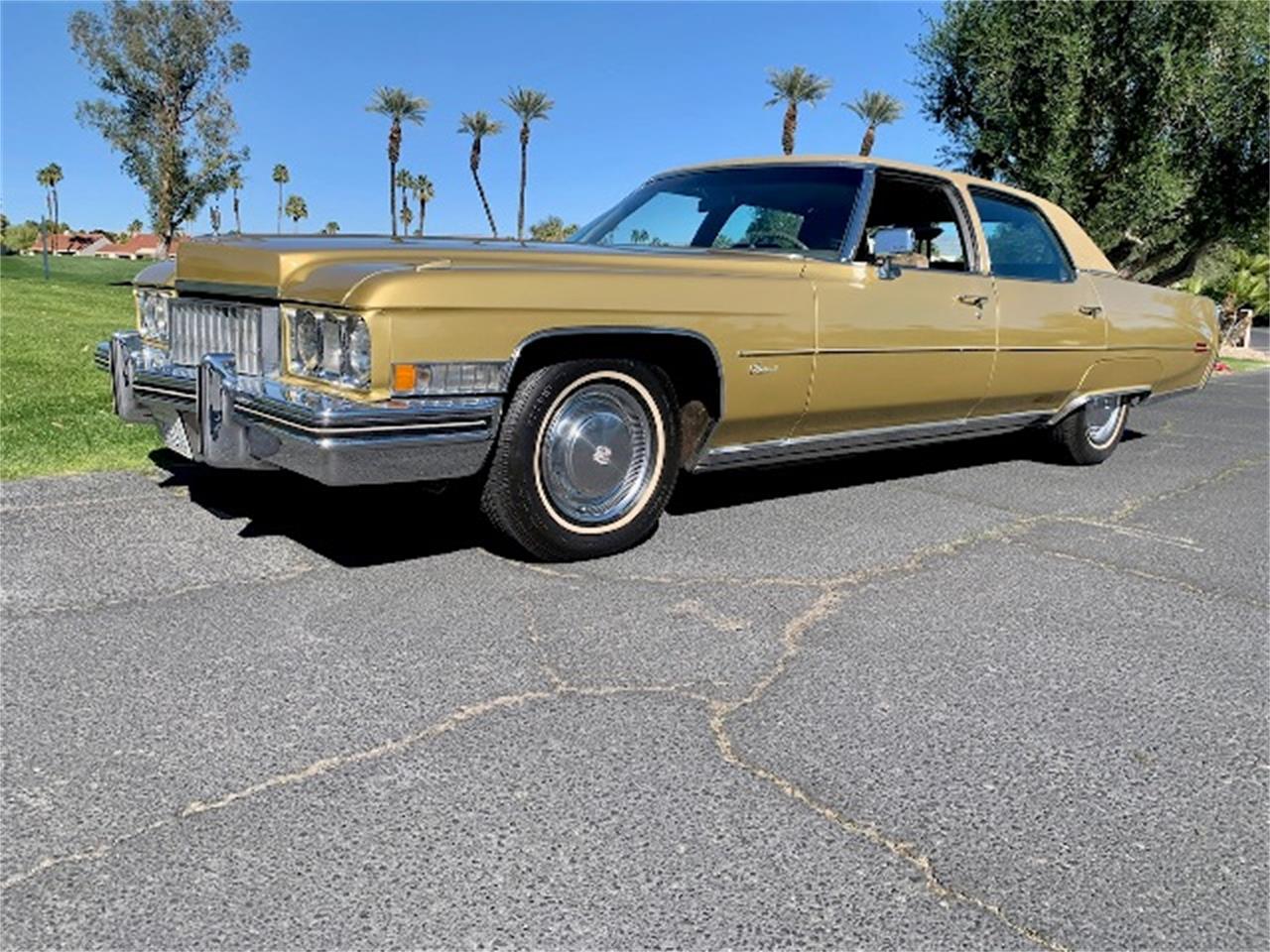
https://photos.classiccars.com/cc-temp/listing/165/1814/3484...
1973 had some of the longest Cadillacs in decades.
Not everybody was aware at the time, but the turning radius was actually smaller than the Volkswagen beetle.
Not the turning radius of the whole car, just the wheelbase ;)
Our Hyundai has the opposite problem. Because the flat battery pack allows the wheels to be shoved to the corners, it looks smallish but has a longer wheelbase than Hyundai’s large Palisade SUV. Which makes it a pig to park.
Most Europeans happily pay a premium for a well-engineered semi-local product, as we saw with the German manufacturers during the ICE era. But paying significantly more for a significantly worse product, just for that "Made in Europe" label? Not happening.
VW & friends don't even seem to be aware yet that they are in a fight for survival, and that's what is dooming them. They are more interested in lobbying for tariffs and EV rollout slowdowns than in actually building EVs.
If I just need to get somewhere, I want to take a clean fast train like Japan and then walk.
The development and building of newer, more efficient electric vehicles does not preclude the investment in more high speed electrified rail and busses. That complaint is a non-sequitor.
EVs might be fun for drag racing, but if you want to drive on a circuit ICE is still the better option for now.
I guess I haven't taken any corners agressively enough to really notice the problems you describe with weight.
I will say though that at least for non-racetrack scenarios, the extra weight isn't always as noticable as you'd think because the centre of mass tends to be extremely low relative to an ICE vehicle.
I like them, they are smoother and quieter than the ones they replaced (in fairness that was the oldest diesel buses mostly), I don't like the new on board announcement "Next stop <X>, You are at <X>" style but that's because I'm not partially sighted/blind and it's a small price for making life a lot easier for those folks (and headphones exist).
The US is trapped in a local maximum due to history, geography and finally politics. There's a lot of local resistance specifically to highspeed rail because to stay highspeed the trains usually bypass smaller local towns so they don't get the benefit but all the negatives of it's construction.
I'm not clear how something that ran up to 138 kmph (85 mph) during an (intentionally low-speed) efficiency test, would be equivalent to a golf cart?
Good luck convincing all those Americans the rail line has to run through their property to freely give up the right-of-way. You're already dead in the first few hundred feet of rail when the first person says "fuck off, no" and starts challenging your eminent domain.
Electric busses and trains can have quite powerful and good air conditioning systems.
The problem with this in Houston is the disgracefully stupid urban layout that makes it very hard to effectively serve the city with public transit.
Do we really need to turn this into a discussion of lost causes? Yes, you monumentally fucked up urban design in many parts of your country.
Yes, fixing it is theoretically possible. No, it can't be done in any reasonably small time scale.
As a planned city the downtown urban area was ideal for all kinds of transportation, with streets wide enough not to be obstructed by double-parked wagons, and suitable for streetcars to be installed just about anywhere when they arrived. Much more amenable to public transport than SF or New Orleans, even though horses were the primary consideration to begin with.
The problem was always overpriced real estate downtown, and it got to be too late for newcomers to afford, so anyone that could then started or settled in nearby communities at different distances outside city limits.
With unbridled growth, the city gradually annexed or enclosed these "suburbs", some of which are inside the 610 loop. Pretty much part of the urban area now, but not originally connected by more than one trail usually, which must have left some residual bottlenecks to this day. And that's inside the loop, where people once commuted in from the western suburb of Bellaire, or the close-in location of the Heights.
Just outside the loop to the southeast, people used to consciously depart from Houston and drive "all the way out" to Pasadena. When public transport was on the rise in the county (far too late) about 50 years ago, Pasadena voted not to pay the extra 1% sales tax which was earmarked for Metro, simply because they did not want innumerable people in the big city who couldn't afford cars to descend on their much smaller industrial suburb so easily.
I guess without intervention, stupidity trumps planning if growth is excessive or too accelerated.
For me, I'm just fine on a bike in 100 degree heat with (life-giving) humidity to boot, but I'm probably not the average senior citizen. The homes I like best were built specifically for this climate before A/C, and have more than enough windows to open, and I prefer not to use A/C when driving alone either.
I came from Florida so this is Northern Living to me, if I didn't like it hot I wouldn't be here :)
Hypermiling records using Tesla cars:
  - 1078 km, Tesla S, 25 mph,
  - 975 km, Model 3, 20-30mph
  - 909 km, Model 3, 50mph
2. It has solar panels. That tells me those are not serious people (or a PR stunt).
Solar charging math on area that small is so brutal that adding cost / weight of solar panels on a car is sheer stupidity. Adding few miles of range per day (on sunny day parked outside) doesn't make sense.
You're more likely to have a regular outlet in your garage and recharge 100 miles overnight.