Here's what I got for 1.8 cents and 13 seconds from the prompt "make me a cool thing in html":
https://gisthost.github.io/?6a77bc41a81718c6aaa10d4ab243c59f
Transcript here (it was part of a chat): https://gist.github.com/simonw/b6149a49d327164d67d62c3d12992...
Since this transcript has HTML in it, I decided to upgrade that tool to also render HTML.
I set Gemini 3.8 Flash the task, using my own VERY shonky coding agent tool (llm-coding-agent) - and it did a solid job.
So now you can see the "cool thing in html" rendered within the Markdown document using code that Gemini 3.8 Flash also wrote: https://tools.simonwillison.net/markdown-svg-renderer?url=ht...
Transcript where it built that is here: https://gist.github.com/simonw/3e36b98292dfdc1b3baff158faa74...
I noticed it felt a little janky on my PC despite being "60 FPS"...then I noticed the "60 FPS" is hard-coded into the HTML.
Not sure how anyone trusts their output without going through it line by line to make sure they don't pull that crap.
Yeah, I know, just more slop. But I do think the second agent’s eagerness to please is aligned more in your favor in that instance, so it’s likely to find most issues.
The bigger problem I’ve found is that it’ll also find all kinds of very minor edge cases that you have to pick through.
Asking slightly tongue in cheek but at what point does this stop making sense if we can't trust the output, the people creating the models are already getting surprised in bad ways (if we take their words at face value) with how the models are behaving already etc.
We have the folks over here saying "AI is amazing" and the other other folks over there saying "AI is terrible".
I've largely sat it out so far and I listen to both camps (and people in the middle as well) and I keep half an eye on what they are up to (including periodically evaluating them) but my overarching impression is still "Why would we trust this when it hasn't shown it's trustworthy?"
Obviously maybe it’s not composable like that exactly in real world but that’s the intent of agents checking agents
But I wouldn’t say I “trust” these agents. The degree to which I double check their work depends heavily on the consequences if it gets something wrong. Not too dissimilar from another human dev in that sense.
So for the SaaS that supports my family, there are some things I have it build where I glance at the PR for a minute or two, but if it broke something on this admin page that only I see, there’s no real downside and I’ll find out pretty quickly next time I use it. And it’s fine 95% of the time, so it doesn’t feel like the best use of my time to double-check it carefully.
But for some of the complex internal flows where a bug could be both catastrophic and difficult to even discover for awhile, I still check it very carefully.
For a little one-off vibe coded demo thing like OP shared, I wouldn’t look at the code at all, I’d just have another agent check it and fix anything it finds. Very low stakes.
They argue the net is positive but clearly the “100x productivity multiplier” claims have been dashed on the shoals of reality for these groups.
This is anecdotal, but it’s across the board in my vicinity. I’m curious how common this is and if it’s just “the new normal” to adopt the nauseating Covid phrase.
These types of high-level tests are frustrating beyond belief to humans due to their lack of specificity, but with the agents, they don't get annoyed investigating possible regressions from non-specific signals.
They also aren't as painful to maintain as one would think, because a regression flagging test can be traced by the agent and represented as the business rule that was violated. I've found recent models to be really excellent at discerning a true regression from an outdated test assertion, especially if they are able to trace the failing test back to the PR and work ticket that built it.
> Aside from reading identically forwards and backwards down to the letter
No it doesn't.
When I typed "Are we not pure noon, ergo, we play life; yet, we hate bad fear" into Google, I got more weird results from Gemini: it claimed, incorrectly, that it is an anagram of the "well-known philosophical statement" (?), "We are not pure nature, we are history".
https://share.google/aimode/wJosKnHig6oVYaG18
(?): the reference seems to be to Jose Ortega y Gasset's line, "El hombre no tiene naturaleza, lo que tiene es historia" -- "Man[kind] has no nature, what it has is history."
Gemini 3.7 flash outputs so many tokens per answer it doesn't matter how fast its TPS is, sol will end up being both cheaper and faster than Gemini. So ppl are paying more for a given task, waiting longer and using a dumber intelligence because "TPS number shiny".
Gemini 3.8 outputs 11k more tokens PER TASK on average in AAII than 3.7 putting it dead last in output tokens per task in the leaderboard.
https://artificialanalysis.ai/#cost-tabs
That said, Luna is the undisputed king here at the moment and is what I use as my workhorse model.
Not sure if you read your own link but Sol 56 high ranks smack between Gemini 3.8 flash medium and high. Gemini 3.8 flash comes in as more expensive per task than Sol 56 high according to artificial analysis.
Luna high is literally 30X cheaper than Gemini 3.8 flash high.
You can limit the model viewer and they're getting better at testing multiple effort levels now: https://artificialanalysis.ai/?models=gpt-5-6-sol-medium%2Cg...
One reason is clear: Sol uses dramatically fewer output tokens than Gemini 38 flash https://artificialanalysis.ai/?models=gemini-3-8-flash%2Cgem...
Ps. For the last week I diverged to Luna too, still need to check 3.8 flash.
But 3.6 flash was my go-to model 3 weeks ago and before it was deepseek flash/pro for a while.
None of the claude models seemed cost effective though.
I find Ling 3.0 tiny particularly interesting as it looks really nice for a tiny model with 7.9B total parameters, with only 1.3B parameters activated per token. Here is the result https://coolthing-ling-3-tiny.tiiny.site (sorry for the weird hosting, first I found that worked)
(it cost me almost 0 cents and done in 49 seconds)
Datasets contains lots of people sharing particles simulations in various ways, with a bunch of people replying "that's so cool" and similar, so 10 years later someone asks an LLM for "cool thing" and "particle simulations" rank pretty far up when it thinks about what others have called cool.
For comparison's sake, I tried something similar with a couple other cheap models I've used lately, with the prompt "Impress me. Make something cool in HTML. Ensure that it is mobile friendly." (Added the mobile condition as I was on my phone when I did it).
Mimo-2.5 created something similar, only a bit less complex than Gemini's (though, at least the FPS counter is real!), in a minute or two for about 1/3 of a cent: https://gisthost.github.io/?740c325c21e9bfbee59c4f94d9aab0af
GLM-5.3-Flash, currently my workhorse model, spent 12 minutes (ouch) thinking about the prompt. Didn't cost me anything directly because I have a GLM sub, but I did the math and it would have cost about 1.1 cents through the API. Turned out nicely in my opinion (though in reality, it still isn't really anything special): https://gisthost.github.io/?9ef050e16cec2561e6504e725a3f0bcc
Side note: thanks for setting up that Gist Host tool, it's very convenient!
---
Editing to add this bonus from Mercury-2.5-Preview, which I just learned released a couple days ago. It's much less impressive-looking than any of the above, but it cost less than 1/20th of a cent, and the response was generated effectively instantly: https://gisthost.github.io/?02f40b50aa891bf396bfaaa3a7998203
I would hope the people who make one of the most used JS engines in the world are capable of making a model good at JavaScript ;)
i don't know if Gemini models per se are fully is in line with that purpose, but the results we see keep seeming to be in-line with that split-of-focus.
and probably a barely modified knock-off of some github project that it trained on
- Real world knowledge (when a thing opens and closes, the geographic region, historical facts). It's also the best at taking a cluster of places and working out a visiting order.
- Photo ranking (which photo should be the hero). Gemini can tell whether a photo is of the thing or of the view from it.
- Document parsing (extracting the relevant trip info from PDFs).
If you use LLMs for anything other than coding, I definitely recommend not discounting Gemini like I did just because other models are more popular.
Sounds counter-intuitive at first, but Luna is overall better at sticking with what works. Sol is wicked smart but needs constraints.
Why you would rely on the model's weights to know opening hours, instead of having the model call a web search tool to verify it on the official site?
It was right on every nit, so it was surprising how well the model knows these things. If I ever release this I'll probably need the SERP API or Google Maps SDK (which I've heard is very expensive now), but for a personal trip where I will verify manually, using the LLM is okay for now.
tools=[{"type": "google_search"}]
Using grounding in Gemini is indeed backed by the same canonical data source for business information (like opening hours) as Google Maps. This stuff is available in its own API for a GCP fee, but we’ve built tooling to connect it to the Gemini agentic ecosystem as well.
Think 2023 style ChatGPT. Something like “to open a document on your Mac click File > Open docurrrar” - like it suddenly forgot it had to produce actual words.
Overall I enjoyed its speed and comprehensiveness. But those occurrences of nonsense just made it feel like a great car that once a month just stops in the middle of the highway.
My only wish is it were somewhat cheaper, as it tends to balloon pretty quickly when I'm using it in Opencode. I'm currently trying to offload a lot of work to subagents to stop the context expanding so rapidly. But on the upside, I rarely have to correct it - I've spent far less time arguing with this than with anything else so far.
For awhile now I've found Gemini will use Google search for pretty much any real world knowledge, which is a huge plus IMO. It's basically Google with a much better frontend and no ads/seo nonsense.
so far
For example find a beautiful landscape shot of a place that just so happens to be accessible to tourists and ask it something along the lines of identifying the location. IME it will noticably steer the conversation towards relevant commercial offerings and offer (entirely unprompted) to help plan a trip.
Or ask it about a certain category of product with some requirements and it will initially present (relevant) options that look like paid placement to my eye. But if you ask it's happy to go on to turn up lots of alternatives and enumerate tradeoffs.
Assuming I'm correct the subtlety is on par with product placement in movies. Certainly leagues better than the internet advertising we've suffered to date.
As you say it was subtle, along the lines of "oh, if you are planning on going to the place you are researching, here are some helpful links to places you can stay". Subtle, in that it didn't get in the way of main result, so I didn't mind overly. Insidious, as I only noticed because I wondered why it was providing those particular links and looked them up. I can't see how you could ad-block them if I did object.
And worrying, because these unblockable sneaky ads are just a first foray coming from a company that prostitutes its own app store searches, by making the first and most obvious result utterly unrelated to to the search topic. Instead it's who paid them the most to be there. That behaviour is why everyone dumped Alta Vista when an alternative came along. Alternative Android app stores can't come soon enough.
They already skim off 15% of purchases which I'm sure makes their Android operation return a profit that makes other industries drool. Debasing their search to ad a tiny bit extra on top must by driven pure greed. Senseless, as I'm sure it will come back to bite them in the end.
Also them having their own silicon means they don't have to pay the Nvidia tax and can keep costs a lot lower.
Beginning to think Google is a dark horse in this race and some of Anthropic's "everything feels janky and rushed" karma is going to catch up.
Gemini’s integration with maps and search is more important for Google.
Google was so hyped up early Gemini 3 era (only some months ago). And now dark horse? The TPU takeover almost crashed nvidia and everyone else.
Every time I personally tried Gemini models up until last week they simply couldn't do the long complex tasks I'd being doing with Anthropic models for many months.
I've been planing around with LLM-based trip planning for a very long time now as it fits my very ad hoc style of traveling very well.
But distances always had been.. lets say.. difficult.
Will test it with my upcoming trip to Greece then!
See: why authors wait days, weeks, or even months before editing what they've written (or, if you're more interested: cognitive regression, inattentional blindness, and the effects of misdirected saccades).
2. I'd wager the majority of HN commenters don't read their own comment before posting (pre-LLM days).
https://artificialanalysis.ai/models/gemini-3-8-flash shows an intelligence score of 59, the same as Opus 5 medium!
Wow - for a flash model this seems to benchmark powerfully. Remains to be seen what it is like to use.
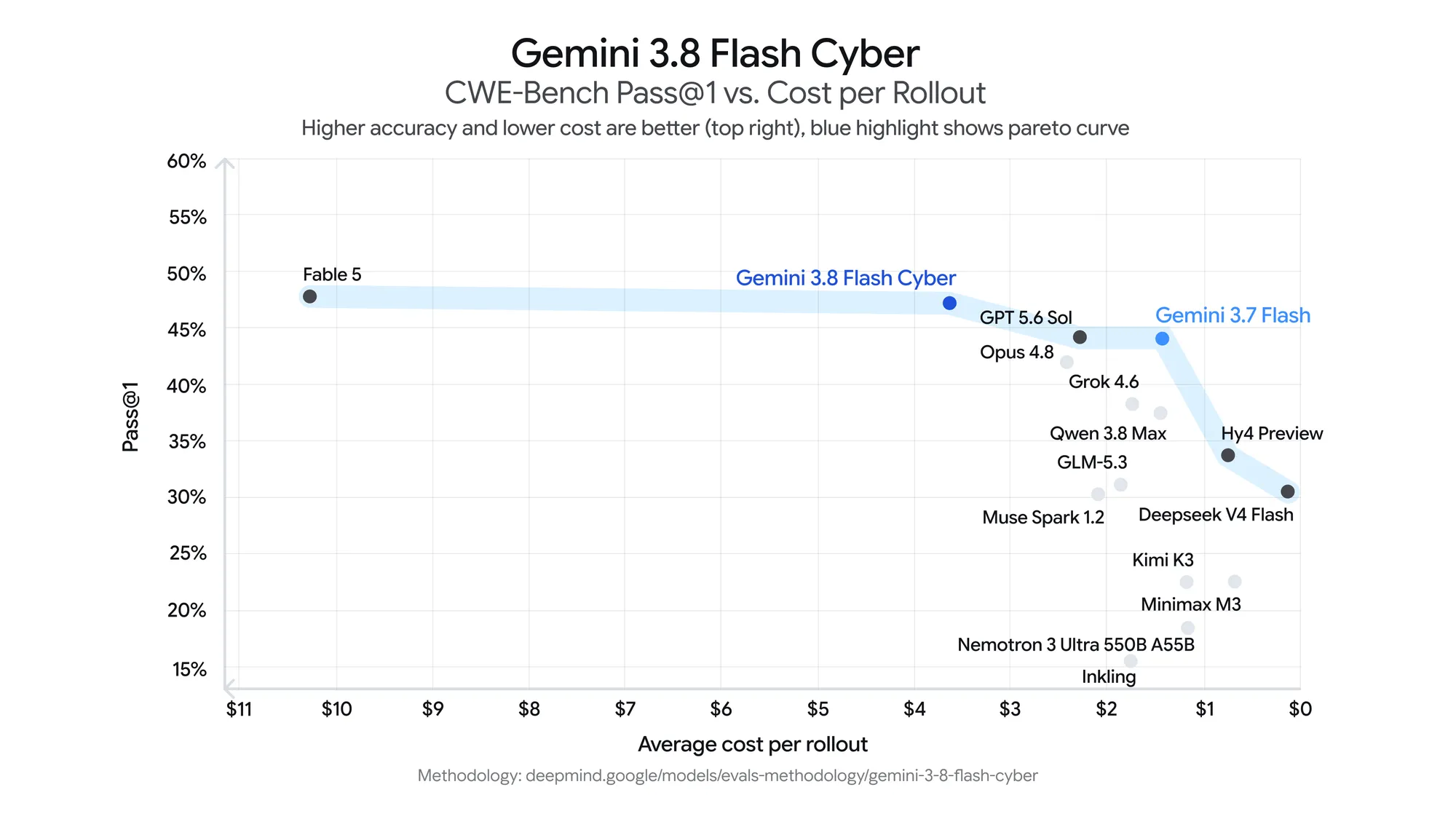
With a score of 59, Gemini 3.8 Flash is in eighth place, falling behind even Grok 4.6, Kimi k3, and GLM 5.3.
Are you implying Google or Artificial Analysis are reporting false numbers? What's your source?
Model size also can not be inferred by tokens/sec for a multitude of reasons, but to showcase two examples, Opus 5 and Sonnet 5, as well as Gemini 3.1 Pro Preview and 3.1 Flash have each very comparable output speeds when using the same deployment as a basis for comparison, despite it being very likely that within their generation, the former are larger than the latter. Feel the need to mention this, as I unfortunately stumble upon so many poorly reasoned, speculative hype post trying to infer model size via utterly unreliable metrics, not based in actual data.
It’s like comments below arguing about the reasoning levels not normalized to some metric (like cost, output token amount or duration) but just the labels or high, max, medium, etc. Those mean almost nothing even when comparing models based on the same pretrain (just compare GPT-5.4 to GPT-5.2), they mean less than nothing comparing different labs releases.
Nothing here is false, you are simply confused. You either didn't read what they wrote in its entirety or decided to reinterpret what they did write.
Further, opus 5 medium outputs 4x fewer tokens to achieve the same result, negating a lot of the speed difference.
These folks must laugh themselves to sleep. This whole industry hoodwinked the masses. It’s impressive.
Not sure on consumer/product use though
It's almost across the board better than Terra at less than half the price. 3.9 is likely to approach Sol at the 1/10th the price.
Hopefully OpenAI releases Astra first, and it's not only better than Sol but significantly cheaper, too.
Then I tell Opus to read the audit report and implement what it agrees with.
Flash is really good at this, and it is blazing fast in Antigravity CLI. Easily 10x faster than Opus.
Can't wait to try 3.8 Flash. If it's good enough, maybe I'll switch Flash to primary and make Opus the auditor.
In india, my telco gives me google ai pro for free. And agy with flash goes a long way.
It looks more like Google execs losing their mind and pressuring researchers to put DeepSWE directly into the training set.
It's clearly been "dealt with" already. When it launched we had interesting gaps and definitely differences. Now every new release is "crushing it".
...on Medium reasoning. Claude Opus 5 (high) is the default in e.g. Claude Code and scores 61. Still very impressive.
So, yes, maybe it's still not - but this would be the only time it would be highly suspicious / obvious benchmaxxing / obviously bad benchmarks.
For example, it's not even close to Opus 5 on Terminal-bench 4.0, 19.1% vs. 51.8%.
anthropic really needs something to address the cheaper end of the market before they get left behind. Sonnet 5 sucks, and Haiku hasn't been updated in a year. meanwhile we've got gemini flash, luna, and GLM5.3 all delivering 90% of the performance for a small fraction of the cost. paying $25/mTok is going to start looking pretty silly soon.
Here are the 3.7 pelicans for comparison: https://tools.simonwillison.net/markdown-svg-renderer.html?u... - high cost 8.4387 cents
(I think thinking level low is a regression on 3.8 compared to 3.7.)
> https://tools.simonwillison.net/markdown-svg-renderer?url=ht...
> Took just under 14 minutes to generate, and at 65927 output tokens cost me a hefty $3.30!
So 50x cheaper - and how much faster?
It saw the fish in the basket from some other previous attempt but completely missed the gap between the tires and the rims where the background shines through (now it knows after scraping this comment and watch the next transcript).
https://twitter.com/sunjiao123sun_/status/202455551655137292...
> I’ve been developing the SVG generation capabilities for Gemini 3.1, and the complexity of the SVGs is stunning.
> This allows UX designers to transcend pixel constraints and directly output structural, production-ready code!
Edit: scrolled down to medium effort, its better but also has a weird clipping issue with the fish in the beak.
I like the benchmark. Yes, it's near saturation for SotA models, but still quite good to show where smaller models stand in relation to SotA
In this instance, I see a great image, but consistently clipping mudguards (both in 3.8 flash and 3.7 flash)
If only it were true that things that are tiresome are unpopular. But witness "6 7", "first post", ... remember the "in soviet Russia" jokes on Slashdot"? It seems like there are a subset of people that simply don't get tired of tiresome things.
(Next up is the comment saying that the labs are clearly training for the benchmark.)
Gemini Flash is also pretty cheap, so it's a great family for performing media analysis, like extracting structured data from images and video.
https://blog.google/innovation-and-ai/models-and-research/ge...
True multimodal support would be way better, but I have no issues pasting in full screen recordings while QA'ing games and having Claude identify and fix issues in the video.
We transcode everything to 480p before we send it to Gemini batch api. Works great
These sort of fast and cheap models are great for tasks that are verifiable and can be retried infinitely (like coding), you can basically get frontier results with a good harness (at a fraction of the time and money).
Or choose Oh My PI [2] for batteries included
[1] https://github.com/earendil-works/pi [2] https://github.com/can1357/oh-my-pi
OpenCode has “providers” for many (many!) other services, but these are almost all unofficial and against ToS (Anthropic being famous for ban-hammering people).
To preempt certain replies, yes, I know you can pay API prices and use whatever harness you want.
I eagerly wait more info but sounds like Deepmind without Demis calling the shots has been unleashed and are operating at full speed? Shocker!
At this point it is a meme of course, but where is 3.5 Pro :)
Lots of models seem to just allow the model to "bloatmax" tokens in order to get bumps at high/max reasoning levels. Many of the max reasoning levels allow models to use up to double or more the tokens the next lowest reasoning level uses. Its basically only useful for people who have no cost or time stipulations on anything.
I think I actually preferred it when we had models that either had reasoning enabled or didn't.
One aspect of model releases that don't get discussed as much are the cache invalidation (changes in underlying architecture, weights, or tokenizers); I assess Google seems to be squeezing the maximum out of the last 'Pro' version they released with 3.1 back in February.
Small models cataching up with their bigger siblings are fantastic news.
A SOC/IR or AppSec team doesn't need a generalized model that knows when Chaucer lived but it absolutely needs a model that can efficiently, quickly, and accurately prioritize vulnerability severity or validate patches.
> Using male or female pronouns risks anthropomorphizing them which can lead to unhealthy outcomes.
Ditto for pets.
For animals he/she does make sense, because they are male or female. An LLM is neither.
But, also... Sol crushes Flash 3.7 at writing code in a codebase of any size beyond "tiny".
Flash is my go-to for prototyping, and basically anything that isn't writing production code.
1. Data. Lots of data.
2. Money. Lots of money.
3. Access to necessary hardware.
4. Business alignment/will to do it.
5. Access to talent, current and future.
This is certainly incomplete/naive. In my mind, though, Google was the clear answer.
On a more personal level, I've been deep into the Google ecosystem since I got diederich@gmail.com in 2005. (I actually paid 50 cents on ebay to get a very early invite.) There was no question in my mind that Google's AI work would deeply integrate into their whole ecosystem in very powerful and productive ways. (Yes, I can join you to discuss, at length, the various ways that Google's dominance is problematic/scary.)
Having said all that, I'm quite happy that there is, at the moment, a very rich competitive landscape. Indeed, not too long ago, with Gemini Pro 3.1 languishing, I moved most of my deeper thinking work to ChatGPT, which was, for me at least, clearly outperforming Gemini.
While I certainly didn't anticipate it, Google's strategy of making their fast/relatively inexpensive models surprisingly powerful has been a welcomed surprise.
experience tells me that those people simply have not used models for a long period of time specifically on coding and have run their own comparisons
to someone who uses all vendors, the differences are very palpable and drives purchase decisions.
also keep in mind Gemini and other labs have repeatedly done benchmaxxing, you must have your own benchmarks to evaluate these models.
Unless they have an even more powerful Gemini Pro in the oven...?
3.0 flash -> 3.8 flash is all post training which is pretty impressive.
I have been testing 3.7 flash against 3.5 flash and it seems to lose every time in overall latency. Every benchmark I've seen seems to suggest the opposite[1] - that 3.7 flash is significantly (at times 2x) faster than 3.5 flash - but I have never been able to prove this out in real world use cases.
Has anyone found their latency numbers to actually be accurate? Is this why they've toned it down in this release? For context, I'm testing larger generation payloads that take 8-10 seconds in 3.5 flash and 15-25 seconds in 3.7 flash. Lowest reasoning settings in both cases.
1: https://artificialanalysis.ai/?speed=intelligence-vs-speed&m...
Kind of wild that they haven't (successfully) pretrained a base model since Jan-25.
That said, I do trust Opus and Fable enough to let them deploy to staging. Great for debugging. Just don't give them keys for prod
My experience is that antigravity is awful and reckless - but that the model itself isn't.
"available to trusted defenders through our new Fairwind Program"
"Valgrind is only available to trusted defenders in our new UnfairAdvantage program"
Is this weakness in their training regimen the impact of operating under regulatory frameworks for too long?
I also used it for a an app for my Garmin watch, and it wasn't good. The code was compiling, but functionality was totally broken and even with a lot of steering it wasn't able to make it work. GLM 5.3-flash instead was up for it and the code wasn't bad at all. I am curious to see if 3.8 is an improvement in this use case.
Flash 3.8 seems like where I can specify Flash3.8 as the coding model as part of agent workflow.
The video recognition is especially impressive as they got all of Youtube to train from.
- Def people who has to queue video recognition jobs to use the model.
(By high volume I mean things like "main app just updated with XYZ commits, please scan XYZ plugins and surface any compatibility issues")
If I had to pay per token I would probably consider using this (they seem to be on the pareto of performance) but not being able to use opencode with a subscription is not really something I'm realistically going to do when claude and codex are around. Also never gotten along well with gemini-cli / antigravity-cli.
(I guess the only relevance here is that if your problem matches a model's strengths, then you can do fine with a model that is several generations out of date.)
Similarly Qwen3.8-Max was updated in just 30 days (to the 0902 release) and Muse Spark in just 28 days (to the 1.3 release).
A year ago iterative releases were every 3-6 months. At what point will they reach nightly candidates?
Serving more models also adds a significant ops burden on the SREs and trust& safety teams.
What's the simplest explanation?
It may be that these flash models are simply post trained larger older models.
I tested Gemini CLI while ago, and it was awful tbh.
And even when searching for internet, it still cannot suggest a up-to-date approach to the problem.
For example I'm using crystal, it recently revamped the concurrency/parallel model. Even using web search, gemini still does not aware of the new feature and still give the outdated code.
I'm sure my crystal usage is not the unique case here.
The reality is that if you optimise a harness for a family of tasks[1], then most of these models give successful output. And there, gemini flash's speed shines.
For general coding assistant, you want it to be well, general, and you use a harness without too much customisation to something specific. Here you need deeply post trained coding assistants and implementors like codex/sol or claude/opus. Gemini flash in its current form will be too happy-go-lucky if you try using it the way we all use codex and is better used in a constrained setting.
tl;dr gemini flash for "LLM-aided workflows in production" is super good today. Cheap as well.
[1] Stuff like this: https://antigravity.google/blog/teamwork-when-ai-becomes-a-r...
In all seriousness, gemini has the best interactive planning document/orchestration. Tell it to create a plan document and work through it with it and it will preform really well(in antigravity products). But this is the case with plan modes with every model, I just think the interactive document that antigravity uses is really well thought out.
Once the system prompt complexity goes up, Flash starts to write very dense english. it might be fine for tasks like coding, but not for user-facing text meant to be digested by the average person.
I haven't tested 3.8 on my workload yet.
- Flash-Lite
- 3.6 Flash [new]
- 3.1 Pro
The above is why i don't use LLM products from Google. If the model is not available right this minute (heck, hours before the release!), then I'm not gonna bother getting back to it tomorrow, because tomorrow I'll be playing with the new model from OAI/Anthropic.
(It also shows that the internet isn't dead. Even people who are not aware of Google AI Studio can express their valuable opinions on LLMs!)
AI Studio? Seriously, the hell is that? Gemini, AI Studio, Antigravity - what is all that nonsense? The 3.8 Flash announcement says the model is available to Google AI Pro customers. Is it the same as Gemini Pro, or some sort of AI Studio Pro? Based on the comments, i see the model is available in the Gemini App, not available in the UI, not available to Workspace accounts but is available to some personal accounts, yet I'm not a Workspace user. Some people have already mentioned that they are paid customers, yet they don't see the new model.
I know Google loves asking graph problems during their tech interviews, but I can't wrap my head why the customers should solve these problems as well.
but the webui is currently offering 3.6 flash. the previous model still hasn't actually rolled out to it yet.
So frustrating and confusing.
Meanwhile Anthropic and OpenAI simply release a model everywhere (Fable on Pro only as a somewhat mild exception).
Anytime anything gets added to Workspace, I think Google has a lot more contractual obligations about keeping it around for X amount of time, so they tend to be more careful about adding things.
Same and I have found it extremely annoying. I actually really like the Gemini models for question/answer stuff and reach for it before Claude (the other model family I have purchased) but it's getting long in the tooth at this point and I'm finding my Gemini usage shrinking to nearly 0.
It's available in antigravity which I started using again (for small things until I can trust gemini for coding again).
But yeah, they really dgaf about gemini.google.com -- I dropped that sub in April when it was clear OAI and Anthropic had lapped them
I have a weird vibe from all the comments in this thread, they feel like a script rather a real experience.
But it's bad at code reviews (maybe it's the harness agy cli?). Could not get it to same quality level on reviews like Opus, GPT 5.6, Grok. Even tried special code review skills but no luck.
https://developers.googleblog.com/an-important-update-transi...
Nah, we'll just get the 4.0 Pro Preview.
They're apparently evolving slower than most SOTA models but "slow and steady wins the race" is probably still a thing.
And since Google doesn't depend exclusively on AI models, they can probably afford to "wait and see" where all this craze is heading.
I don't think slow and steady will win this race, but I think anyone can still win--especially Google.
[1] For tone and instruction following, a positive percentage increase represents an improvement in the tone of the model on sensitive topics and the model’s ability to follow instructions while remaining safe compared to Gemini 3 Flash. We mark improvements in green and regressions in red.
Why bother with a column “Gemini 3.8 Flash vs. Gemini 3.7 Flash” when you’re going to disregard the label for 20% of it? Also is the “Tone” label short for “Tone and Instruction Following”?
Chartcrime, the major AI lab tradition.
Almost suspect that the rate of improvement to post-training is so fast that small models have an advantage - it takes much more compute to train a bigger model, so the flash models are just running in circles (well, not exactly of course) around the larger models right now.
Re: Chinese models, even if the model itself isn't censored, some of the big model providers have guardrails now that you can't exceed, which somewhat defeats the purpose.
And yes, Fable 5.1 has the same refusal rate, and significantly nerfed reasoning.
3.7 used 64M on high: https://artificialanalysis.ai/models/gemini-3-7-flash 3.8 used 120M on high: https://artificialanalysis.ai/models/gemini-3-8-flash
Even their own chart showed more than 2x higher cost compared to 3.7: https://storage.googleapis.com/gweb-uniblog-publish-prod/ima...
3.7 used 64M on high: https://artificialanalysis.ai/models/gemini-3-7-flash 3.8 used 120M on high: https://artificialanalysis.ai/models/gemini-3-8-flash
Even their own chart showed more than 2x higher cost compared to 3.7: https://storage.googleapis.com/gweb-uniblog-publish-prod/ima...
Yesterday I asked for food stop on my road trip 45 minutes from the current time and it gave me some options, but then I changed my mind and specifically asked for Asian restaurants and it completely forgot about the 45 minutes and gave me the closest Asian restaurant to me.
And in my other app I was debugging and using OpenAI to optimize some path it cut me off numerous times because it did not like JIT functionality (this is my commercial business rule evaluation engine that compiles rules to executable code inside the app to increase performance using asmjit library)
I am basically paying for them to waste my tokens and time on these 2 tasks
But a good agents.md, starting from a clean slate, and specifying which key files to look into and follow the standards allows me to build gigantic projects even I struggle to keep in my head structurally.
I would say either start new sessions for new tasks or limit the context to something smaller than 1M.
I usually start with research/planning session, this goes into a detailed implementation plan and then a new session for the actual implementation.
If it's complex problem maybe a review/adversarial step between plan and implementation.
Also with forever-session any time you take a longer break (depends on model and provider as to how long) you will push an entire big context again without caching even if you don't need it. With 1M context this gets expensive.
so its fast sure and decent at non coding usage but for developers nothing can really top sol or fable.
even grok 4.6 is so so and i would not choose 3.8 flash over it.
So just another mid-tier flash model, nothing exciting, but Antigravity has very generous quotas so it's a good workhorse model when your Claude/OpenAI subs run out.
And whilst it's a fast model, having to baby sit through and approve prompts every few seconds ends up making it slower than the Auto approve modes of Claude/ChatGPT - they definitely need an auto approve mode.
i think luna-max has the best cost value offer when it comes to coding, but i note the multi modality of gemini flash as a win
i might consider 3.8 flash for simple side hobby projects or quick scaffolding but would not trust it for long agentic tasks, that really is the realm of sol/fable
agy cli still has a lot of issues not sure if its due to the underlying model hallucinating or the harness or both
My guess is we skip 3.5 and go straight to 4 Pro. With the monthly Flash releases, releasing 4.0 Flash and Pro in 6-8 weeks would be a nice buildup.
(I work at Google but don't know anything that isn't already public)
If you just need to create PDFs, not edit them, then Gemini notebook (notebook.google) works well and has Google's usual very high free usage limits.
AFAIK in general you can't really edit PDFs since it's not a reflowable format - even with Adobe tools all that editing does is modify the text within a text box - not reflow the document to adjust to any change in size of the text box.
A recent example - I searched for how to unsubscribe from Pearson emails. Google Search "AI Mode" confidently gave me a sequence of steps along the lines of Settings > Profile > Email preferences > Unsubscribe.
Of course, I looked for an unsubscribe link before asking Google. None of those options existed. The correct answer was there is no way to unsubscribe through the account, so I just blockthe emails instead.
I've run into this pattern quite a few times. AI Mode seems to make up things all the time.
>We will not send marketing emails to a user who has opted out of receiving them. Any marketing communications we send will include an unsubscribe link at the end of the email.
I don't think this is AI's fault. This is Pearson's publishing incorrect information and the only way to really know they are a bunch of lying assholes is to have an account and try to unsubscribe from it.
AI didn't make it up, Pearson's did.
It's obvious that the Google Search AI Mode encourages the model to give an answer without spending unnecessary cycles investigating deeply.
They also heavily encourage keeping the context short. For example, it will remove the option to start a new turn after a small number of turns, depending on the topic.
It definitely makes things up all the time, but it gets it right surprisingly often. I really like it.
Are you people truly this excited about this crap? I mean I guess if you work for Google or Anthropic or whatever I could see it??? Otherwise, are these just bot comments?
Also, I use it every day, and it just got ~10% better at coding, according to the benchmarks. How is that not exciting?
I do think Gemini is underrated on HN though!
HN sells these advertising services. Nobody is using “Claude” etc.
They will censor comments like yours and my reply here because we call it out.
It’s very weird that basically lies and disinformation became the optimal meta in business and in life! But here we are
A lot of us use these in our services, so we're getting an upgrade "for free"
I'll wait for Astra and Grok 4.7 announcements but probably getting at least one Ultra subscription.
Since testing 3.7 on Pro for last two weeks I'm realizing just how long I'm waiting on other models. I've been multitasking to compensate but it's exhausting so I'd rather not.