For my style of coding (quick back-and-forths and corrections) it makes a big difference if a model comes back in 1-2 minutes compared to 5-10, and I am happy to pay a bit extra for that.
If you own a graphics card you bought for gaming or a laptop you bought for doing schoolwork there is $0 in cost of local AI tokens, because 100% of the cost was assigned to doing other things.
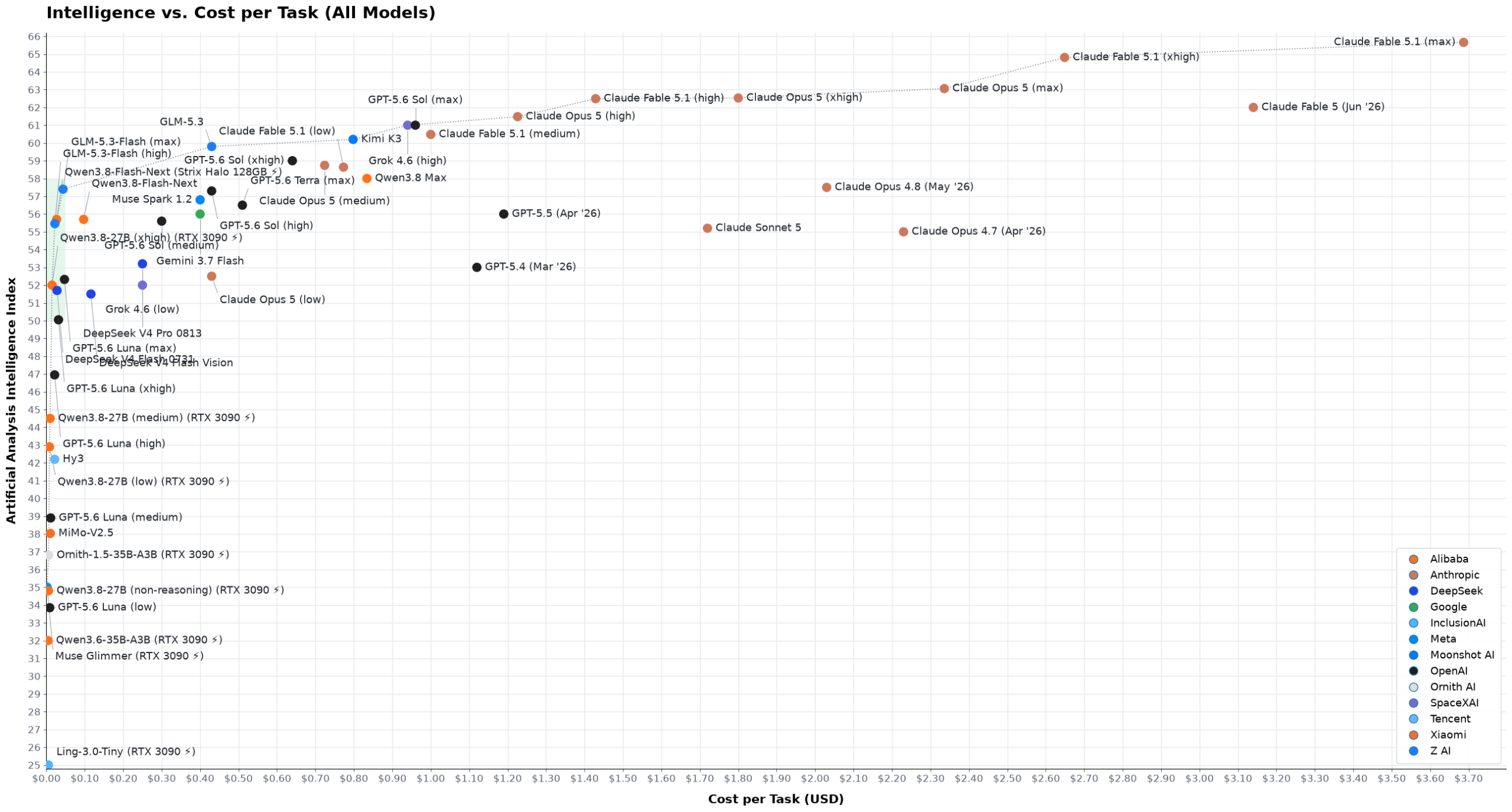
> The first issue I have with it is that it uses a logarithmic scale on the cost axis. Using a log scale is the only way to make you spot the difference between a model that costs $0.015 per task and one that costs $0.032, while the same plot contains a model that costs $3.69 — almost 250 times as expensive. However, the net result is that the viewers can no longer appreciate the immensity of the price difference between the cheap models and the heavy ones; nor can they realize how inconsequential the price differences are between the cheap models.
This is an asinine complaint, and nobody can seriously tell me that the last plot on their page [0] is more readable than the AA one [1]. If I'm using a model at the lower range of the cost scale for whatever list of tasks, and i switch to another model at the lower end of the cost scale, my spending might double anyways! This should be reflected in the plot, and linear scale doesn't do it justice.
It's also much easier to see the mentioned pareto frontier in the log plot than in the linear one.
I can see why they disagree with the pricing determination for open/local models, but I don't think there is one clear right way to do it. So how do they do it instead?
>Hardware is priced at zero, on the basis that both an RTX 3090 PC and a 64GB Strix Halo are desirable gaming/work machines anyways.
...oh
Would have been nice to mention explicitly how the pareto frontier changes with those new calculations.
[0] https://openteams.com/wp-content/uploads/2026/09/all_models-... [1] https://artificialanalysis.ai/#intelligence-comparison-tabs
What will happen is that this will be the third consultancy with a lofty narrative after Enthought and Anaconda that Oliphant established. It is always bait-and-switch.