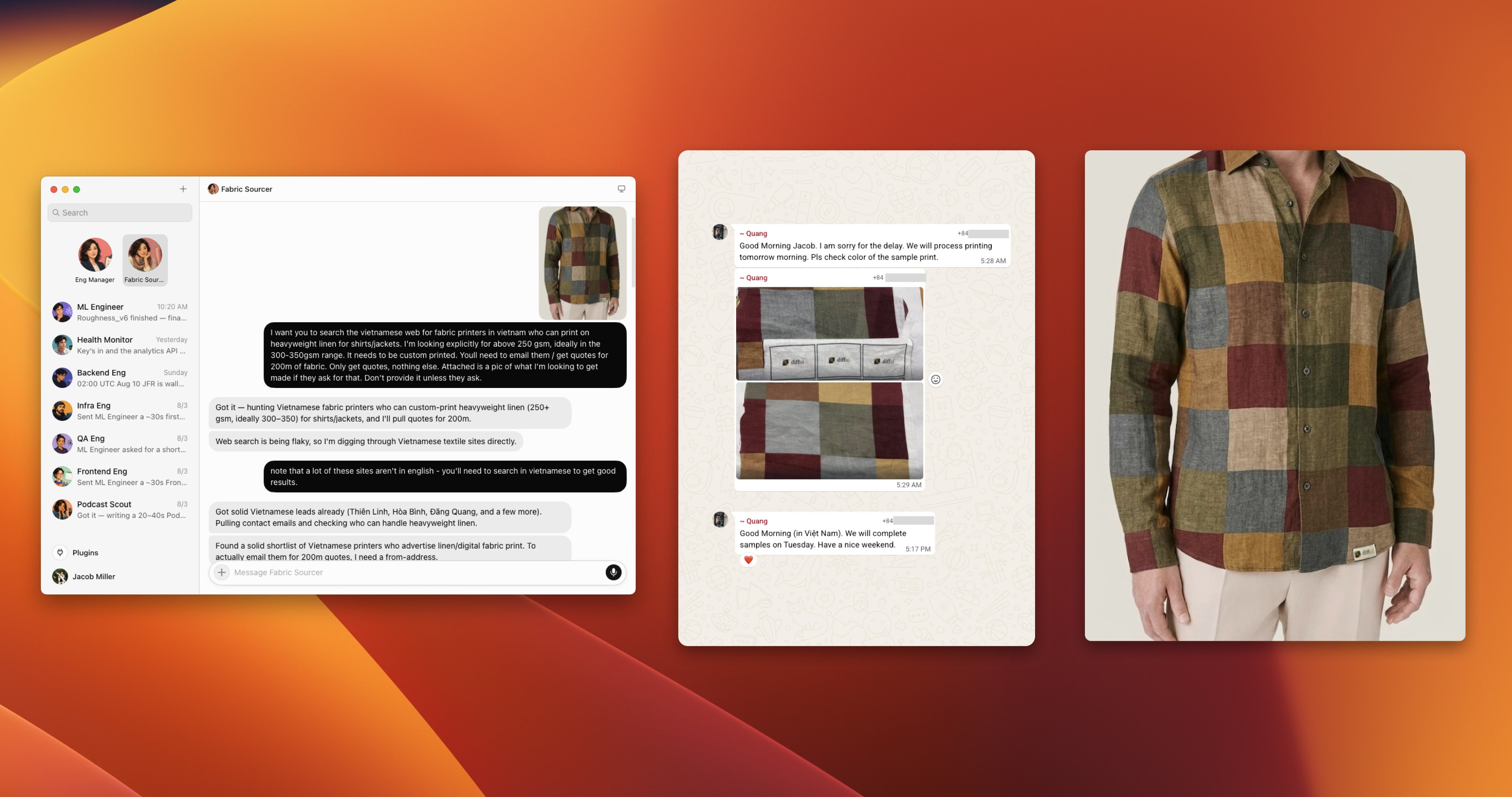
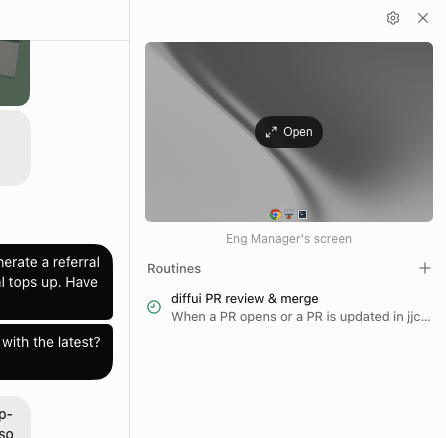
Biggest advantage is each one owns its own routines, context, and domain, and they can communicate between each other. Similar to hermes they build out their own skills, but by keeping the bots separated by domains, you end up getting better results out of them.
Additionally though each one has their own computer, which means async work feels like it actually works. I haven't had to juggle worktrees for the last month.
Biggest downsides are token expenditure. I've used more tokens this month than not this month. That's not a typo - I've used less tokens in the last 5 years prior to this month than I have this month. Always on perpetual agents use a LOT of tokens. IMO this is building for the future state where tokens are vastly cheaper, ie in a post-ASIC world.
The coolest thing I had it do for me was sourcing fabric for swag: https://image.non.io/d83664c1-5807-4a18-abe4-41928c198410.we...
I wanted to make something that didn't feel like just my logo on a shirt, so I had one of my bots reach out to ~40 fabric suppliers in vietnam, negotiate prices, lock one in, and get samples made. First samples should be finished today. It's been something I've wanted to do for ages, so it was cool seeing it actually happen. The fabric supplier bot worked with one of my prototyper bots to create a randomly generated pattern using my logo, which it then sent as a .ai file to the supplier.
Isn't this one of the problems foreseen with this? For you, it was a single prompt - for 40 companies, this probably took up some time.
What happens when fifty people fire off a 15-second "get me a shirt" prompt? When five hundred, five thousand, five million do?
If your business is selling tokens, it'd be extremely lucrative for you if the whole society relies on tokens to perform basic operations. That's where we're heading to.
Looking at the examples they show here it is making more sense. Also where all the "content" on LinkedIn comes from.
One of the difficulties of sourcing this is a lot of the suppliers in vietnam are only contactable via whatsapp. Emails are monitored far less. It's one of the reasons I haven't been successful with this in the past despite trying - it's a very word-of-mouth network.
I heard this once and keep it in mind for every email I send. How do I reduce the cost of replying. Many times it means getting on the phone/ not sending the email at all.
He left his phone number in his HN profile. Someone on HN should fire up a few thousand agents so he can personally learn what it's like to be on the receiving end of "efficiency" at "scale."
If someone solves this part of continual effective compaction + selective resetting at cache expiry, they're going to make a ton of money. Right now, only the token insensitive can use these sweet features.
The rest can be solved - separate account for agent spending (soon offered by your bank or neobank), separate email for agents (already exist) etc.
Edit: it's way worse than that: the actual figures says that Mythos “only” falls for prompt injection 2.6% of the times. Maybe for an ML engineer used to work with unreliable tools that sounds impressive, but for security purpose having a system that fails every 40 attempts is outright catastrophic. Imagine if your OS vendor only patched known security holes in a way that still let an attacker go through every 40 attempts…
And we're just talking about known kind of prompt injection that are tracked by benchmarks, not any kind of 0-day vulnerability found by clever attackers.
Pretty famously, false positives make some other Anthropic products unusable. If you treat them as zero cost it’s easy to drive down miss rate.
Don't worry, you only have a 2% chance of having you bank account drained any time an attacker tries their chance.
The difference now is that big companies themselves promote/offer bots, but they also don't like to be scraped and use captchas.
What do we do now? Is it allowed to use automated tools to interact with any system? Is it allowed to scrape data? Are there any laws for this?
If we do things manually it is ok, but not if we use a bot?
Confusing (legal) times...
I'd hope so, because that's what we're doing right now. Your browser is automatically speaking HTTP for you so that you don't have to.
Am I having a bit of a laugh? Maybe. But really, services should be user-agent agnostic. That's the whole "agent" part of User Agent and the founders of the Internet had incredible foresight to name it this way.
> Is it allowed to scrape data?
You mean, request data and receive what the other server voluntarily transmits?
> Are there any laws for this?
There was a court case that said the above is fine, thankfully, since that's how the internet works. There's probably other cases going on and I'm sure at least one of them will have some unfortunate tech-illiterate result that makes things worse for anyone who understands this stuff.
The core is there. But there is some work to be done to have a nicer shell and all, which I’m currently focusing on.
I almost wonder if this is a place where SpaceX, as an internet provider through starlink, has a unique advantage because websites are unable to block their networking as it could be residential starlink consumers.
Either way, I still don't think that computer use is solved. It worked horribly on Codex and Antigravity the last time I tried. Maybe I was doing something wrong.
It's not trivial to do, and I never managed to get bot-to-bot communication working. Even with my janky setup, the experience is honestly pretty great. Grok Bot simplifies the setup for this about as far as I imagine is possible, and frankly it's a pretty slick experience.
I fully expect this paradigm to catch on quickly.
How does it work with login-walled sites like LinkedIn then? And what does "own computer" mean? X provisions a "private cloud" a'la Apple for your Bot?
https://image.non.io/4022ec77-be07-4baa-97e8-ad9d8d9aeb8a.we...
After you do you just tell the bot you're done logging in and it'll keep driving. And yea, it's a separate VM for each bot.
Source: had access for the last few weeks.
As it's linked to an SMTP gateway I interact with it entirely by email. It also has API keys for my internal bug tracker, it has its own git forks of my repos and so on.
Over time it's improved itself so it has adaptive wakeups, a nice monitoring dashboard so I can see what it's doing if I want, a bunch of skills, a nightly wakeup to reorganize its home directories and so on. It keeps a private knowledge base in its home dir and writes its own skills, and it has a persistent todo list. When the todo list is populated it wakes up more frequently so it can break work up into chunks, a kind of basic Ralph loop.
I've found this email-centric paradigm works pretty nicely for me compared to just running a local CLI agent. For instance, I can assign a bug to "Axiom" (it named itself) in YouTrack and the email notification causes it to wake up and start work on the bug. If it gets blocked, it uses its API key to post a comment back to the ticket. If I think of something I just quickly email it, so I'm using Gmail instead of dealing with finicky ChatGPT style UIs that don't have good support for labelling, compact UI and other nice things.
On older models its judgement about what to work on wasn't that good, but with the latest GPTs it's doing much better. I just got back from holiday and it had triaged and resolved over 25 different bugs, a nice selection too.
Because the whole thing runs in a dedicated UNIX user account it is able to modify its own configuration, which has helped as I developed this setup.
However, based on the blog post, Grok Bot sounds a fair bit more sophisticated. I haven't felt a need for more than one bot as I can't easily saturate even a single bot.
Cost: just uses my regular ChatGPT Plus subscription, $20/month, plus of course the server it runs on (which is shared with lots of other stuff). I'm not working with it heavily, perhaps if I did I'd need the $200/month sub.
This is an interesting idea although I'm not sure how many companies are comfortable with giving SpaceXAI access to all your files and data. Outside of America this is, most likely, not going to fly.
I wonder if they're going to try and compete against Slack with X.com chat?
with Grok, that's a tremendous assumption
Ah, you mean guardrails for _your_ protection...!
Dang - might be worth merging these two.
GitHub gives 404 after logging in so I can’t event try it.
Although I'll probably never use Grok, this is an interesting release. I always thought GPT work and Claude Cowork are a bit awkward in their positioning. I'm still not sure what the real difference is with standard chat. This looks like the same thing with seamless memory and skills creation.
This seems like the middle ground between work mode and OpenClaw/Hermes (which I've never tried, too scared to mess something up). I think the humanization of the agents is cute and makes sense UX wise. I hope to see alternatives soon.