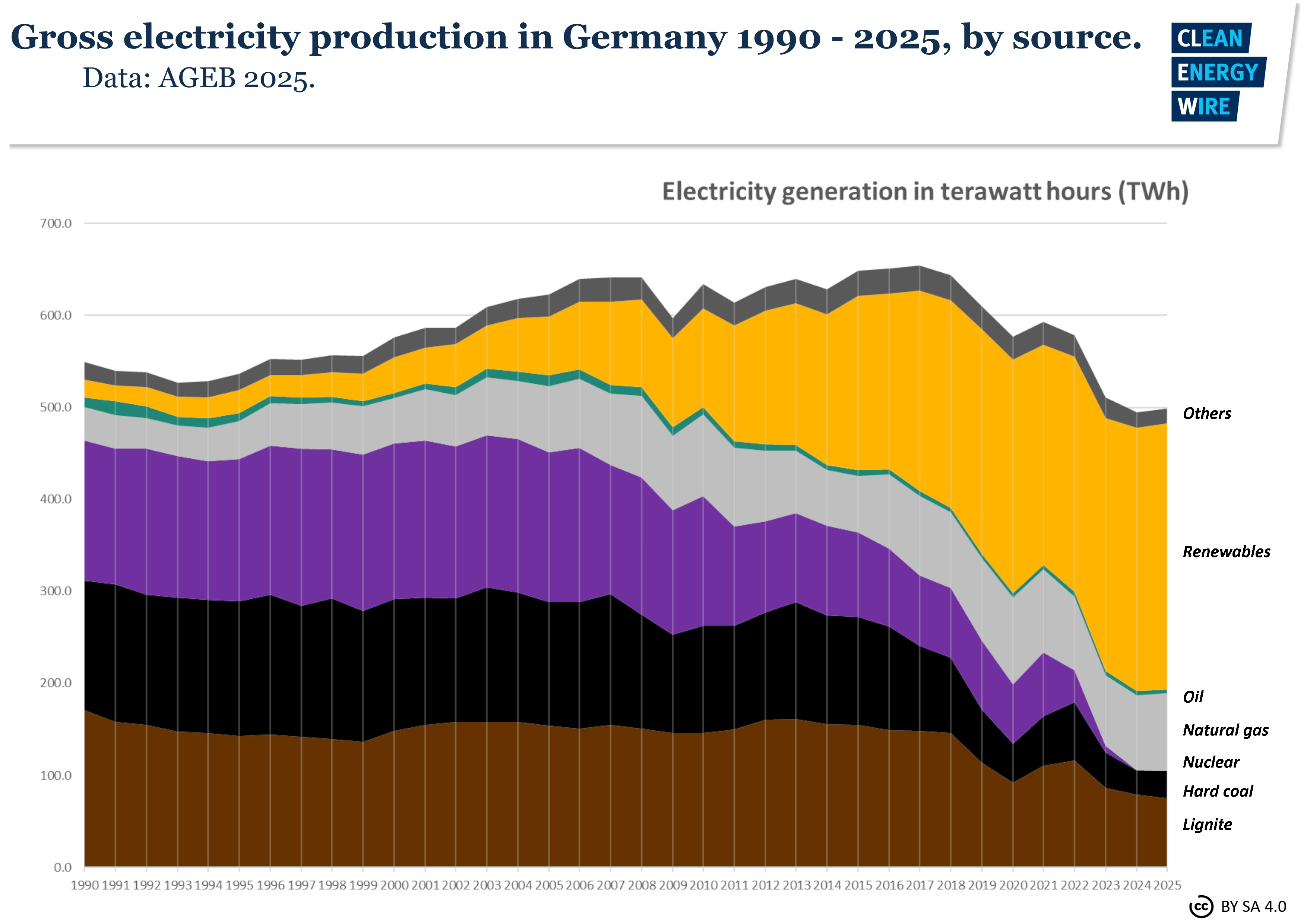
I agree. This is why we are building offshore wind and not subsidizing fossil fuels, right?
While paying out 1.2 billion dollars.
> RWE U.S. Offshore secured these leases from the U.S. government with a long-term commitment to develop offshore wind capacity in American waters and invested more than $1 billion toward the leases and the development of these projects. These leases provided legal rights to develop offshore projects and represented years of planning, investment, and partnership with federal agencies.
> After careful consideration, it was determined there is no path forward to permit these projects in the U.S. for the foreseeable future. The settlement resolves RWE U.S. Offshore’s legal claims and provides $1.22 billion in settlement funds.
https://www.rwe.com/en/investor-relations/financial-calendar...
For a guy in the ai and cybersecurity industry you seem to have incredibly poor judgement Gyan.
And this isn’t a comparison that ignores inflation. AEMO publishes its historical wholesale electricity prices in real June 2024 dollars. South Australia’s average wholesale price in 2023–24 was A$79.53/MWh, compared with roughly A$95/MWh in 2012–13. It was also 40% lower than the previous year’s A$131.90/MWh. [1]
AEMO also specifically identifies increased rooftop and grid-scale solar output as one of the factors contributing to lower wholesale prices. [1]
So there’s a fairly straightforward example: South Australia reached roughly 74% wind and solar generation while its inflation-adjusted wholesale electricity price was lower than it had been around a decade earlier.
That obviously doesn’t mean renewables were the only factor affecting prices - electricity markets are influenced by fuel prices, interconnectors, demand, storage and plenty of other things. But it does disprove the claim that high penetration of wind and solar necessarily results in higher inflation-adjusted electricity prices.
[1] https://www.aemo.com.au/-/media/files/electricity/nem/planni...
I'm sure this wont be enough or acceptable though will it. It never is.
Lazard Levelized Cost of Energy+ 2026 - https://www.lazard.com/media/kcfconhf/lazards-lcoeplus_vf.pd... [pdf]
> Renewables Remain Lowest Cost New-Build Generation; All Generation Faces Increasing Cost Pressure: Despite rising and inflationary cost pressures across all generation technologies, renewables remain the most cost-competitive form of new-build generation on an unsubsidized basis and will account for the majority of near-term capacity additions in the U.S. Continuous upward revisions to demand projections have driven a sharp increase in announced new-build gas generation despite a 15-year high LCOE, which is expected to continue to rise, and historically long development and equipment delivery timelines.
https://ourworldindata.org/grapher/installed-solar-pv-capaci...
The World Crossed a Major Solar Milestone [3TW] - https://news.ycombinator.com/item?id=49151977 - August 2026
> The world has reached the 3-terawatt threshold of solar power, with the first terawatt taking 10 years to deploy and the next two terawatts taking less than five years.
> Forecasters expect the world to deploy more than 9 terawatts of solar by 2036, with poor countries' share of solar deployment expected to start growing again from this year onward.
> The main constraint for developing countries to adopt solar power is the lack of accessible financing, and the growth of solar power is also limited by the need for energy storage, such as lithium-ion batteries, to absorb excess power.
The global clean tech supply chain will still be around when the US comes around.
Ember Energy: China Cleantech Exports Data Explorer - https://ember-energy.org/data/china-cleantech-exports-data-e... (Updated monthly)
https://en.wikipedia.org/wiki/Trump_International_Golf_Club_...
You seem like you've been successful in life, you didn't get that way being low-effort, so let's apply that level of effort toward this community that has brought so many people together for their love of technology.
> While paying out 1.2 billion dollars.
for nothing. to literally replace some energy with no energy.
https://www.theguardian.com/environment/2025/sep/09/fossil-f...
The entire sector is a catastrophic, institutionally corrupt scam.
https://www.imf.org/en/topics/climate-change/energy-subsidie...
Consider the taxes on gasoline.
Based on what our media and our education system teaches us, one would have assumed that common sense and sound logic would prevail in a democracy, but rather what we see is insane nonsense, paranoia, and misinformation (including about vaccines) prevail in the U.S., to the point of burning piles of money (including the 1.2B in this case) just to satisfy a childish and bully like need to spite and trigger the progressive side (like talking about causing more pollution with the goal of “owning the libs” or triggering “delicious liberal tears”). And we’re talking about massive negative externalities with increased pollution. This kind of childish bully behavior is as though you had a neighbor who cared about not littering in public and the streets being clean, and you just threw garbage on the streets to upset her. A ridiculous level of immaturity, truly.
Meanwhile, we have totalitarian dictatorships (like the Emirates which has heavily moved toward zero carbon electricity sources like solar and nuclear) behaving far more logically, rationally, and soundly with a view towards the long-term rather than the short-term.
this is my point, too
renewables, especially solar, just have gotten very competitive to a point they will gain ground even if not subsidized
and I believe we will see (and in some niches have already seen) this happening for electric cars, too. They are plain simple just better technology which for now is still in the earlier stages.
How much relevance wind will have we have to see, it's less advantages then solar and less easy to deploy. It's pretty good in some very windy northern (i.e. also less solar efficient) places and often iff it's extremely windy it's not extremely sunny and if extremely sunny it's often not extremely windy. This makes them complement each other quite nicely. So I still see a future for it even outside of the more northern regions.
this way of thinking, is not very useful and can be pretty harmful, just because something is imperfect doesn't mean it's fully broken. Just because people have always manipulated democracy doesn't mean it "basically just shadow government".
And sure, the US is a very bad case, _especially_ in recent years. But also let's not forgot that for most of it's history just one of the countless scandals of Trump would have been enough to highly risk impeachment for a president and be equal to political suicide. I.e. there has been quite a bit of limits on corruption and influences from behind the scene. It's just that the US went and broke itself. And yes a two party system was never truly democratic, it's still better then a one party system nor the same as a full shadow government.
Which brings us to another point, there never was "the" shadow government, just many different people which had way to much influence behind the scene in not so democratic ways. A shadow government implies some form of organization/structure which actually governs and then puppets in front, but that was never really the case in the US AFIK. Even today it isn't as a lot of the escalating corruption is just pretty much out in the open by the governing people, instead of in any shadow, by people not in a official position.
The difference you’re spotting is the leaders of those nations have some remaining incentive to care about the wealth and wellbeing of the country they’re leading beyond the expiration date of a 4 or 8 year term.
For better and for worse, they have that, the US doesn’t.
Neither China nor the UAE can be said to have a purely benevolent dictatorship but it's not purely tyrannical either. So not surprisingly they're better than democracies in some aspects and worse in others.
That communist country also likes the current war in Iran. They get all that oil cheap for their reserves stockpile.
You can have idiotic authoritarian governments that ruin the economy. China and Vietnam were exceptions among communist countries, who switched to a form of market economy, when they saw that central planning was poverty-inducing and nigh impossible to do.
The problems we're seeing in democracies might lie with the level of disinformation for electioneering purposes that is permitted under free speech today.
Also, you can swear on whatever you want here. It's the person's choice. You could swear on a copy of hitchiker's guide to the galaxy if you wanted.
So if politicians base their decisions on "common sense", they confess to not being able to use experts that refine their knowledge and position about a topic.
A "common sense" strategy is therefore what is most popular and on the basis of the understanding of laymen without deeper understanding or knowledge.
Don't pretend the current US admin is anything but corrupt and stupid.
And what of the night?
Freeze in the dark.
Or pumped storage. Or lifting a really heavy thing and letting it fall slowly.
Or retaining an amount of fossil fuel capacity to be turned on during peak consumption and sun and wind dips while still focusing on renewables and storage with the goal to reduce the duty cycle of peaker plants to zero.
Nuclear? Gas and coal peaked plants?
We can at least plan for an eventuality that is likely to happen. How much planning is/was there when gas suddenly gets cut off?
Maybe what you meant to say is that the position isn't, in fact, "common sense", that it is neither sound or prudent?
(1) https://www.merriam-webster.com/dictionary/common%20sense
The dictionary definition is in spite of the fact that the phrase "common sense" is more often than ever being used to rebrand what was formerly known as "common lack of sense".
They wouldn't say it if it wasn't false :\
Oh, but the ju$tifi¢ation is all too real for having that kind of "common sense".
You also need to distinguish between expert opinion and elite opinion. The two are not the same.
In Poland the closest phrase to "common sense" is "na chłopski rozum" which means "according to villager's mind/smarts".
There are also a lot of folk remedies that have been disproven as medicine. They too were ‘common sense.’
"You know what they call alternative medicine that works? Medicine." - Tim Minchin
(Even simple things like "an apple a day" - apples are fine, but foods like berries, kiwis and avocados tend to have both lower sugar and much higher nutritional content.)
Gene therapies, targeted cancer treatments, blood pressure medication, antibiotics, surgery, joint replacements, sterile practices, vaccines, hormone replacement therapies.
Ha! Like the common sense to dam migratory river systems to make hydroelectric power. Good idea at the time, and who cares about salmon. I have a toaster, and a percolator, and a new fangled “ice” box (formerly chilled by ice, now a maker of ice).
S/ My common sense says 1.2B compensation to not do something we otherwise need is bananas as opposed to the common sense—pound salt response. Good thing I’m not in government, yeah. /s
It’s only $1.2 billion to not do the thing.
To do the thing would require paying the original contracted amount.
Whatever that might have been.
Melbourne, well Victoria the whole state, is looking at a similar scenario for rail tunnels many believe serve little purpose.
Around $1.2 billion to stop the work now and pay the early termination penalty. Plus maybe another billion (estimated, who really knows) to bury the tunnel boring machines and remediation work.
Or something like $200 billion to complete the work and operate the rail network over some number of probably too many decades. Although this number seems to increase at a regular cadence.
A new road tunnel was recently completed and people who use it often report they are the only vehicle in the tunnel.
Meanwhile our roads haven’t been maintained in a decade and are literally falling apart. It’s not uncommon to hear reports of multiple cars being recovered after suspension and wheel damage from the same section of poorly maintained road in one day.
All of this in a political and economic setting so corrupt the now former state Labor Premier came out and admitted knowledge of a criminal element having infiltrated the union that represents the workers on the projects. She was recently replaced with her deputy. As if that helps.
Electricity prices have also increased by something like 150 to 200 percent more than inflation over the past 20 years but mostly the past 6 years (so this decade) because state and federal governments seem to want to insist on ramming Net Zero down our power lines, yet we export around the same amount of gas as Qatar. And we have the worlds largest know uranium deposit and yet we have a ban on nuclear power reactors.
Please explain?
except this is AFIK just plain wrong
much more relevant factors seem
- spikes in energy need, mainly AI in recent years
- extremely badly handling of power grids in a high multitude of ways not related to net zero (like seriously, the German grid is pretty bad compared to an optimal grid. But compared to the nonsense many parts of the US have, it looks like a pristine optimal solution.)
- health/environmental protections _not to be confused with climate protection_!! Not wanting your citizens to have massive health issues due to air pollution, acid rains etc. has _nothing_ to do with net zero. People tend to somehow always conflate it. But a lot of the policies the US ended up doing (compared to the ones they say they want to do) where more about that then anything climate related.
- inflation statistics being... badly done. Like if most relevant daily use products have price increases noticeable above inflation then your way to measure inflation is the problem.
And a lot of the net zero things, tend to actually produce relatively cheap energy, even if you include cost for e.g. some gravity energy store and similar buffers. Just if you don't properly modernize, then you can run into troubles. As part of the US has never been in favor of renewables at all you can guess what happens there wrt. making decisions to which make things work compared to decisions which hinder things and then blame the technology instead of your bad politics.
It'll provide power for decades with little maintenance and not much further in the way of environmental issues now that it's built.
They’re so destructive to local ecosystems that environmental groups have blocked any new hydroelectric dams being built in Australia for over 40 years.
All modern concrete eventually fails, and dams are notoriously difficult to remove and replace.
Fortunately they last long enough that if you paint them pink and plug a torch battery in to them they can remain somebody else’s problem for quite some time.
Then there is the Theory of Bounded Rationality which tells us expertise may exist but resources, time, energy, info, attention etc etc may not therefore bounds and limits of expertise alone must be recognized and solutions reached are satisficable rather than optimal. Aiming for optima when other factors havent been sorted just creates new problems.
Grandma doesn't bake with "common sense", she is using the specialized knowledge of cooking & baking.
You've clearly never baked before. Baking is a chemical science. You have to adjust temperatures for your freaking elevation relative to sea level. Granted some recipes are pretty forgiving, sure, but far from all, and some are downright merciless in terms of complexity and effort required.
Even people who do it constantly have items that just don't turn out because it's legitimately hard shit.
If making sourdough were 'common sense' then _everyone could do it correctly on their first try_. They don't. Most fail and never try again because the skill level required for sourdough is too high.
I'm an _expert_ cook, but I'm still having to go through the frequent failures of learning how to pickle with brine (fortunately, my failures have been mostly edible and have not turned moldy). Even vinegar pickling requires a certain level of expertise before you can do it successfully, even though that level of expertise is _roughly_ "knowing how to boil water".
But that leaves out the government and all those interested parties so we're never ever getting that.
But at the scale of a city or state one home uses close enough to zero power that it being a net user or net producer of electricity is irrelevant.
Scale up to tens of thousands of homes and suddenly you need an organising body approximating government to manage those homes being net users or net producers from moment to moment.
Additionally most cities tend to want to have commercial and industrial users of electricity, and energy more broadly. Your home solar & battery does approximately nothing to help them, and if any of the data is to be believed has resulted in electricity prices increasing for everyone.
https://www.defensenews.com/global/europe/2024/11/11/why-swe...
> Why Sweden nixed new wind farms for fear of missing Russian missiles
> BERLIN — Sweden’s government this month blocked the construction of 13 offshore wind farms over concerns that they would shorten the country’s early-warning window for a Russian missile attack.
> ...
> That is because wind farms can interact with radar signals, reducing the quality of the situational air picture or even outright blocking out parts of the sky.
Other possibilities than radar concerns is that the stopping of the project here hinders corruption, or is corrupt itself, or it moves corruption around (as in both the old project and new project was corrupt). Whatever the case, a way to avoid corruption would be helpful. Perhaps like making it market-driven and contest-driven as much as possible. Solar and wind is already significantly cost-efficient and market-driven despite their significant drawbacks like not producing energy consistently and on demand. If the main challenge is creating domestic production of wind turbines and solar cells instead of being reliant on other countries and without state support ending up being mired in corruption, perhaps some bidding and contract process that moves the financial risk onto private companies, such that the government never pays in advance, could work.
I agree with posts here saying that a mosaic or plethora of energy sources should be used. Wind, solar, fossile, nuclear (for big countries like the USA at least), geothermal, etc. In general, energy companies should not be focused on just one kind, but lots of kinds.
Living here where this happens. They are stopping it for two reasons:
First on a national level they want to concentrate on their renewed push towards building new nuclear power reactors, means wind has to take second fiddle: https://www.government.se/press-releases/2026/06/sweden-take...
Second, on a local level, the far-right party "SD" is voting agaisnt wind power in 96% of the cases.
As presented here, the national government is declining 84% of all requests of requests to build wind power, ad on the local level the right wing parties vetoed wind power at a rate of 64-92%: https://research.chalmers.se/publication/?created=true&id=09...
Modern nuclear obviates the need for any other form of electricity generation.
Gas is plentiful and works well. Counties have been shown to be willing to buy and sell it despite multiple hot wars.
Solar and wind plus batteries aren’t renewable as evidence by the fact that none of them grow on trees.
Driving through my childhood area up north a few weeks back I was also surprised by the amount of solar going up, for comparison this is an area _north of_ Anchorage/Alaska with less than 3 hours of sun around Christmas, but already by late January (usually the coldest period of the year) there is over 6 hours of sun a day (so with high pressure cold peaks with less wind, the 6 hours probably eases the power bill quite a bit).
An interesting fact about those solar installations was that the panels were mounted almost vertically (probably to avoid being snowed over but also useful in the winter since the sun mostly just shines from the south anyhow).
Northern Germany is much more specialized into wind power, and the south is more solar intensive (though solar is more evenly spread throughout the country than Wind, thanks to ease of installation, and the fact that it still produces tonnes of electricity in the summer).
Solar should be built in Alaska, but wind and hydro is what should be actively subsidized and supported by the government. The market can take care of solar penetration in Alaska if you let it.
Doesn’t Germany now have some of the most costly electricity in the OECD?
For a while there we kept hearing about plug in balcony solar in Germany.
Electricity generation used to be a solved problem, now it’s so bad people want to connect solar on their apartment balcony.
And we’re supposed to believe this is progress?
Some of the deep south get by with electric heat, but they aren't in places where the cold is a typically a legitimate danger to health and safety.
That said most of Europe doesn't heat or cool adequately, Spain and Portugal barely heat their homes in winter and boy it gets cold with 41F/5C nights. Then Germany/Switzerland refuse to use A/C even though the summers get to 95F/35C. Just a few days ago a friend told me he went to the doctor and the doctor passed out during examination from the heat.
ps. Not sure why it's downvoted, I think people read something into my comment that I didn't want to express.
Long-term this is true, and it makes sense to ban gas boilers (potentially with some exceptions): electric heat is significantly more efficient, and can run on renewable energy. But that requires a big investment in infrastructure build-out (heat pumps) which will take decades, and we definitely need to be careful that we handle the transition without screwing people over.
So now we’re back to government subsidies, which routinely prove to drive up the price of whatever is being subsidised, especially at the scale of residential homes.
And your solution still results in the living room / dining room and other shared spaces being inhospitable in winter / summer, so you’ve underestimated the cost at least significantly.
Kitchen, dining, bathroom, three or four bedrooms.
I’ve never seen a split system in a bathroom, but I’ve definitely seen freezing cold bathrooms, or bathrooms with a radiant heater on the wall or heat lamps on the ceiling, which occasionally get left on all day and destroy electricity bills.
Ducted systems almost always extend to the bathroom, and almost always cost AU$15,000 or more to install.
Well we’re certifiably not going that.
No need to wait decades to look at the recent data.
London can’t even work out how to properly ventilate their underground rail network.
The solution is obvious: built nuclear power and refrigeration (heat pumps).
Where it’s too cold either nuclear and heat pumps and / or district heating, or burn gas.
Or people can melt in the summers and freeze in the winters. Because that is exactly what “renewables” have been delivering.
Don't disagree with you there.
> London can’t even work out how to properly ventilate their underground rail network.
This seems unrelated. It's not an energy problem: it's a problem with lack of space in the tunnels and lack of places to build ventilation shafts due to the issue not being considered 100 years ago when the tunnels were built.
> Or people can melt in the summers and freeze in the winters. Because that is exactly what “renewables” have been delivering.
I think this has very little to do with renewables. In particular, solar is perfect for reducing "melt in summer" cases (it's almost always sunny when it's hot) (and I'm not sure where has freeze in winter problems).
The issue seems to be more that weather has gotten hotter, and infrastructure needs to change in response to that (inevitably slow and expensive).
Modern AC units are heat pumps the same box cools in summer and heats in winter, more efficiently than a gas boiler.
What is your stance on heat pumps? Conservatives here, who use the same talking points as you, are against them and they prefer to use oil and gas.
And is 5c a extreme night temperature? Where are you from? I'm not from Europe I think.
First it was the fish ladders. Then it was a bunch of whining about how reducing the water level variation on the river is bad (particularly illustrative because this is the exact opposite logic your ilk uses when talking stormwater). Lord knows what the complaint is these days.
Why don't you just be honest and say "no"
Even if they could operate 24/7 it would still not be enough power to satisfy current demand. Then there's the waste they create once parts need to be replaced, which is much more frequent than non renewables.
It's all very messy and there is no silver bullet.
Even in Texas/California photovoltaic output in the winter is measly, anywhere more to the north and it's effectively inexistent. Solar+storage requires massive overprovisioning, to the level that it's cheaper to burn literal money.
Windmill farm outputs tend to dip during summer and peak over winter. With a given minimum power output windmills + photovoltaics + storage is massively cheaper per unit of yearly energy. Of course, if you value any semblance of network stability.
Solar+storage is clear path towards either guaranteeing reliance on fossils or brownouts. The smart energy meter you got that encourages running the washing machine during cheap hours will ensure that you voluntarily go dark during undersupply as the cost will skyrocket.
The northernmost point in Texas would be at the extreme southern edge of Europe. The northernmost point of California is level with the sunny French Riviera. Hell, even frozen Minnesota has about the same solar potential as northern Spain...
If Europe can make solar work, so can the states (assuming a similar level of investment)
Can you cite a region in Europe that physically independently covers its energy needs with solar+storage alone? </snark>
Stress on physical. Even if some regions claim renewables fully covering energy needs, that's at best on accounting level, those regions are still fully dependent on power import/export and simply could not function in an island mode for any extended period of time without at the very least brownouts. Quite importantly, it's always renewables, not solar.
The dispatchability problem is a real pain. Pool together wind + solar + hydro and the variability in power (!) output drops to levels possible to tame with realistic grid-scale storage sizes.
I am not talking about intra-day balancing here. It's the yearly cycle that comes to bite you. In my corner of Europe, if I wanted to go completely off-grid with solar+storage I would need storage well into the mid single-digit MEGA watt-hours, for the house needs (HVAC and DHW taking the lion's share) alone. That's laughably unrealistic.
> The northernmost point of California is level with the sunny French Riviera. Hell, even frozen Minnesota has about the same solar potential as northern Spain...
Yes, the southern states could probably make do with something like 3-4x overprovisioning, but that's still massive. So massive that any sort of windmill capability will outcompete any sort of COTS storage.
I wonder how it would fare with just 100 kWh of storage, something you can still easily put together.
Plus stored power, plus biomass, plus nuclear, plus gas.
90% renewables is better than 80% renewables. Throwing up our hands and saying "we'll never reach 100%, lets pack the whole thing in" isn't a sensible approach.
That is substantially moving the goalposts - nowhere in the world has built out sufficient solar to make that claim yet. The question is whether they can get there.
If you look at the table[1] for installed solar per capita, 9 of the top 10 countries are in Europe (the odd one out is Australia), so they are definitely giving it the old college try
Citation needed
Thats with all my appliances being electric and superfluous crap running like a 24/7 file server running. Because my power is so cheap I don't have any problems running that kind of stuff.
Compared to other countries, repairability is higher where labor is cheaper and people are more price conscious. We're at late stage capitalism where any chance of lost profits is seen as criminal.
There's a really strong incentive to keep energy generation cheap, because pretty much every social and political issue is downstream of it.
China understood this and is not just betting on both solar and nuclear like mad, they're also burning coal (so that the EU btw can cosplay being green, while offloading the production of many things it consumes to China).
As a result energy prices in China are something like 7x cheaper than in Germany.
Those with lots of energy saw their GDP growth in the 21st century while those like the EU, with ultra pricey energy (due to stupid decisions like closing nuclear power plants only to then reopen them) saw hardly any GDP growth, inflation-adjusted in USD, in the 21st century.
No GDP growth means ever more poor people and ever more indebted governments.
I'm all for transitioning away from fuel and coal, but do it pragmatically. We don't need communists (that'd be the "green" parties [1]) who want to make the lives of everybody miserable taking decisions related to energy.
[1] green people who, like watermelons, are only green on the outside and then bright extremist red on the inside
Going into the future, multiple energy sources will power future civilizations, multiple battery technologies will store energy what is wrong with multiple solutions as long as you make provisions not to completely destroy the environment you live in.
Source?
Subsidies aren't universally a bad thing. This is silly thinking.
- calculate expected total produced electricity which can be used
- divide one by another
- if one if majorly cheaper and chose it then that is the "common sense" strategy of choosing what works best
yes the "all cost" part is tricky to estimate.
yes you don't choose a "single technology and only use it", resilience always works best with redundancy and diversity.
still you can run the number, you can estimate error bars, and sometimes this gives already clear answers. Like a technology being quite expensive even if you lose the lowest (unrealistic cheap) bar for all costs? Then that is a bad technology and it doesn't matter that you have very wide error bars as you are already looking at the optimal choice.
----
EDIT: Me going of on a tangent, maybe ignore :/
Some technologies complement each other well (like most like solar + wind + some gravity storage, as both can have uneven output, but (at live where I live) extremely windy days are often reduced sunny and extremely sunny days often not so windy, and gravity storage can handle "dunkelflauten" sufficiently (and is has already been build and is in use(!), not some hypothetical tech like some people pretend it is)).
But also some technology works against each other, e.g. non _fully_ subsidized nuclear sells a roughly constant power output at a constant (and quite high! if not highly subsidized) cost. But if other electricity can "sometimes" produce supper cheap electricity for some hours, days or even weeks then nuclear can not compete _at all_ during this times, makes losses and need to increase the yearly average price to compensate. Which makes it even less competitive. Hence in a actual "dynamic/free" energy market nuclear makes no sense even if you ignore long term waste storage or risk for contaminating essential parts of your country risks. Still a _fully_ subsidized nuclear base power level might work if you can't generate enough electricity in average through other means. Still this IMHO makes it somewhat of a "only if there is no other solution, not competing on the free marked" choice, i.e. a bad choice you might have to do but might be able to fully avoid (e.g. by using hydro power).
Oh and please stop brown coal, especially low quality brown coal. In all categories of health damage, environmental damage, climate damage it has _horrible_ scores both during mining and usage even for modern versions with filters etc. Sure it looks cheap on paper, but it's maybe THE worst kind of power source there is. Especially if run on low quality coal and without modern filter technology. Brown coal should be a "never choose this no matter what" choice.
Of course, leaving aside how petroleum is subsidized [through the department of defense].
While ecologists usually are in favor of subsidies, subsidies incentive people to consume more, which exhausts our Earth. We should develop less, i.e. we should develop in accordance with a higher facial cost of energy, which sometimes implies having a smaller home and fewer industries, which is what would happen if we didn’t sponsor solar or wind energy [or coal or fossil].
A company can increase their profits by growing and increasing both what they spend and what they earn. But a company can also increase their profits by reducing what they spend without decreasing what they earn. Almost all companies are constantly trying to do this.
It’s EU socialists who want to raise poor people to the level of consumerism of rich ones. Not capitalists. Capitalists would be happy to let them be poor.
In the EU, it’s trying to help-and-attract poor people by millions which strains the Earth. In the US it’s a special breed of capitalism where the state colludes with rich people to subsidize the big corporations at the detriment of nature and citizen.
Welcome the world of transactional opportunism.
I wouldn't be surprised if the majority of Netflix's true overhead were actually DRM and account management, rather than the international distribution of perhaps a petabyte of multimedia data, most of which doesn't change. (https://news.ycombinator.com/item?id=33456782 estimates half that; https://redlib.catsarch.com/r/NoStupidQuestions/comments/6mf... estimates a tenth of that.)
I don't know the true numbers, because I'm lazy, but [DG] says that storage OCAs can take 6.5 TB of traffic for a fill window, so we can take this as a lower bound for the storage. I'll use my earlier 1 PB overestimate for the total catalogue. Assuming that every OCA has the same data on it, this is (at least) 0.65% of the catalogue. Assuming a Zipf's law distribution of popularity for 20k titles, this means the Open Connect network can serve the top 130 titles:
  >>> range1 = lambda i: range(1, i+1)
  >>> sum(1/i for i in range1(130)) / sum(1/i for i in range1(20000))
  0.5198676299332914
Modify Netflix so you have to request an item from the back-catalogue a day in advance, or something, and the cost to serve the long tail of Netflix goes waaaay down. (Considering that Netflix used to work by sending you physical DVDs, which have more than a day's delay to them, I don't think this is unreasonable.) If you want to get costs down even further, combine this with some custom UDP-ish torrent protocol, and make it peer-to-peer among users (not just the Open Connect network).
But if you go too far in this direction, people will start asking why they're even paying Netflix in the first place. Netflix has to remain an infrastructure provider, not just a rentier, if they want to preserve their business model.
The sea is not part of Donald Trump’s property.
So tl;dr: I would absolutely want to have windmills as my neighbours again. Datacenter not so much, but they are also substantially bigger, though not taller, than windmills.
To undermine my own point further, Battersea Power Station in London is iconic. In particular the control rooms were very well-styled with lots of art deco ornamentation, anyone who's listened to Quark, Strangeness and Charm by Hawkwind will have seen it as it's the source of the album art. To be honest I think the idea that ornament in general is bad did a lot of visual damage to the world.
IMO that's the consequence, not the cause, of the infrastructure: https://en.wikipedia.org/wiki/Hambach_surface_mine
Or sometimes the consequence of the closure of that infrastructure with no transitional plan: https://en.wikipedia.org/wiki/Merthyr_Tydfil
The latter is absolutely worth caring about even for the greenest of green energy. Even just PV on rooftops, when a town becomes a ghost town.
The feeling is mutual
I don't know where Trump got the idea from. Perhaps he thinks they work like fans?
Light car traffic is ~50dB.
@iso1631 is saying that wind farms (and by extension, their supporters) think Trump is ugly and noisy. So, they mutually think this of each other.
I mean it’s common sense
[1]: https://www.c-span.org/clip/white-house-event/user-clip-trum...
These people are not interested in coherent policy. They say whatever they want to justify it, we know it, and they know we know it. It’s an intentional expression of domination.
Just another thing to prosecute and rebuild.
Also, for further insights on some of the unstated policy, I recommend reading the project 2025 document as well. [2]
Perhaps by “coherent policy” you meant “sound” or “effective”? But as it stands it certainly is coherent.
[1] https://www.whitehouse.gov/wp-content/uploads/2025/12/2025-N...
[2] https://www.documentcloud.org/documents/24088042-project-202...
My hot take is: be ready to move fast when the winds shift and we can get back to building instead of harm reduction.
("Progress occurs one funeral at a time." -- Max Planck)
It's framed as US government giving $1.2b to German company not to build something (which is weird in its own right). But after drilling into it (correct me if I'm wrong):
RWE is a large German utility
It paid $1.2b for development rights and invested a bunch of money.
The US passed policies that made it impossible to develop the plan.
So it's essentially a negotiated unwind of government-issued property/development rights. US changed the rules, made the lease ineffective and compensated the leasee. But the deal was that instead of RWE just taking the money they agreed to other development projects related to natural gas (better in my opinion).
You might disagree with the policies that made these wind farms impossible or whether the buy out of federal leased land is fair to one party or another. But I wish articles actually cared enough to describe the situation clearly.
Questions I would like mentioned in the article in place of Trumps rhetoric about "big ugly windmills" is details about the actual restrictions that made it impossible, history of it, impact, etc.
Of course "common sense" ought to probably include "Not cooking ourselves".
I am personally for building nuclear and compulimenting it with some wind and hydro, but that is not related to what things are subsidized but because nuclear and hydro has worked really well here in Sweden providing reliable power and while wind has a spottier record I think diversification is good.
Today the reaction is pretty much silence and the same goes for useful infrastructure ie the rail system is pretty much 1950s technology across the United States.
Is this the result of government by lobby?
Has anyone mentioned the expected cost per Mwh of this project to get a sense whether this made economic sense, or are we talking Biden admin adjacent vanity political project paid by rate payers?
Just for reference, the hopefully-cancelled Empire wind near me had a 20yr PPA of $155mwh, which makes Vogtle (-~$170mwh) look like a steal.
More numbers and less foaming at the mouth, please.
They say one thing and do another!
Edit: I meant to say wrapping their stupid acts under the disguise of 'common sense' is a stupid act in itself.
Funnily enough, the most striking part was the pure stupidity of a lot of it - seems so strange, but every day it seems I hear another really stupid story and think ... huh, maybe it really can be like that.
Interesting. Sounds like a counter-point to Hanlon's razor: "Never attribute to malice that which is adequately explained by stupidity".
I use Hanlon's quite a bit to explain nonsense I see day to day, but this is a better one in some ways. It shift the conclusion of "but if only they were shown the right way" to "they know what they are doing and are looking out for number 1".
Hanlons razor is about motive and "size of mental models". Stupidly small, or comprehensively large.
This other thing you note seems to be about scale being low or high. Individually fine-grained, or collectively coarse-grained.
I suspect mistaking either dimension can result in grossly misinterpreting a situation.
The lowest, most fine-grained level of individual self-interest looks a lot collective stupidity and failure to meet the collective's interests.
Democracy supposely recalibrates from these mismatches. But so do more drastic and unruly options, when democracy has failed.
Now I wonder if depending on the scale, one model is better suited. Or maybe they both can be modified based on the scale.
Maybe self-interest is easier to reason about than the interests of a group. Conflicting self-interests can lead to compromises that result in what looks stupid in the end.
Not to mention this all rides on the stupidity and emotional fragility of literally tens or hundreds of millions of voters; anything less and the project would never be possible. That's one reason debilitating the education system at all levels has become a top priority of the current administration (the other being suppression of the free thinking and often liberal or left-wing politics that historically exist at universities).
Meaning for example, what about empires that actually survived or adapted? What did they do that we know exactly didnt the Roman Empire do that saved them? How does zeitgeist impact this in the sense that what ruined Roman Empire might save a nation today?
Not trying to be negative, Im jsut geniunley curios because then if I was in government, Id be "yeah I see the same. I mscared as fuck were messing it up, but then what should we do?" because you see, everybody is giving at advice with very diverse and extreme ideas on what should happen. Probably with most of them you and I wouldnt be OK with (do Dictatorships work? ...).
Or simpler, we all agree on the problem. What are all the solutions and how do we know theyre the correct ones? Thats what Im thinking about the last years.
Empires are pathological developments of nations. They don't tend to survive all that long.
And the Byzantine Empire shrunk greatly after the first few hundred years. Most of its life it was more like a Greek nation that sometimes managed to expand to control parts of the old empire.
Eh, inheritance implies the predecessor willed it to you upon death. In the case of the "Holy Roman Empire" the predecessor died 334 years earlier with no successor. This isn't a case of inheritance, it's a case of just making shit up.
The "byzantine" empire did inherit the name though. They continuously used and claimed the name "roman" from when the roman empire split (and called both halves roman) right up until 1453, even their language was called romaic. That we don't refer to them as roman to this day is really a strange success of propaganda.
> And the Byzantine Empire shrunk greatly after the first few hundred years.
Which by itself sort of contradicts the claim that empires historically fall quickly? The roman empire began in 27 and in 565 it controlled almost the entire Mediterranean. Sure a few hundred years after the split (which itself is a few hundred years after the beginning of being an empire) it shrank but that's a long time.
Really the Roman Empire did very well on this one, depending on when you date its final end to. But the pattern is there, especially if you look at the more rapid and more recent collapse of the Chinese empire, with the result of the Imperial line extinct and the successor state stuck on a relatively small island.
All administration exists on a spectrum from bureaucracy to personal intervention. You can break out Max Weber here, but it is generally agreed that a state needs a bureaucracy to be effective on a large scale. This machine "works" when it is functioning uniformly and according to process in order to achieve goals, and it breaks down when it is disrupted by a system of personal grift, favor, corruption and favouritism.
So the collapse of China runs roughly: poor leader (dowager Empress Cixi) -> ineffective state -> pushed over by foreign powers (European states vs Boxer rebellion) -> even worse leader (Puyi, last Emperor of China, took the throne at age 2) -> pushed over by foreign powers again (Japan) -> internal collapse of remaining China (Maoist rebellion).
Edit: forgot the Taiping Heavenly Kingdom rebellion, which belongs on the front of that list at about 1850, which is yet another civil war that killed somewhere between a quarter and a third of the population of China!
It would be a fun alternative history to swap the Japanese and Chinese leadership of the 1850-1950 era, such that Japan remains a feudal agricultural state and China got the Meiji restoration. How many carriers do they arrive at Pearl Harbor with?
> we all agree on the problem. What are all the solutions and how do we know they're the correct ones?
That is not at all how the last few years have worked, because an astonishing amount of lying about everything from basic facts to obvious outcomes is polluting the discourse.
Funny you should say that
And "cognitively [un]developed" is a weird way to say it; I wouldn't call that a "bland" term at all.
Interesting premise, do you have a source to back it up?
Edit: or is this a creative way to say "younger" that sailed over my head on first read
It is much more likely that our economic system rewards hostile behavior and that money has outsized influence in politics and a criminal justice system which lets rich people get away with crimes. That money correlates more with hostile behavior then lead, Instead of blaming lead, blame capitalism.
Just think about all the people who put lead in the gasoline in the first place, did they go to prison for their crimes, or did they make a bunch of money and retire in luxury.
You're wrong on every count and simply spreading disinformation. Please don't do that.
Im no history expert but I know there were other Empires thru different times and sizes and places, and since now they're not the same, they "Failed"? Did they fail exactly due to the same problem or others? Are we treating those too? What is our method and how strong did we criticize it and see and understand it flaws?
At a time with fake news, AI slop and whatever the Internet has become today, its our job to treat every statement with the highest from of critical thinking at our disposal.
1. It struggled to remain "solvent" because it lost taxable provinces relative to the costs of wars, administration, etc.
2. It took years for it to eventually "fall". It didn't just magically disappear overnight.
Brexit is a particularly 21st century phenomenon, a failed attempt to retreat to autarky.
>Never attribute to stupidity what can be attributed to self-interest.
¿Por Qué No Los Dos? Really seems to speed up the process more so than I've seen since the Nixon malfeasance.
* Smart Decisions can be celebrated
* Stupid Decisions can be "5-whys" root-cause analyzed
Shaming, and all that, can be left aside. And instead focusing on the possible Wins.
A success-oriented approach, of applauding and ranking The Most Smart Policies, could be a way forward. It's innately motivating.
Democratic Decline is real. Voter apathy is real. Gaslighting by power-focused politicians is real, and lack of a "service" mindset by those politicians, too. This is compelling stuff, obsessing over doom, and it's demotivating.
Celebrating The Most Smart policies is something I enjoy. E.g. on YouTube there is a Good News channel which lists "top 10 good pro-environmental / pro-social actions":
The author is the podcast host of ”History of Rome”, which is also great, and he does the audiobook narration perfectly.
> eventually opting for authoritarianism
The Roman Empire was always authoritarian. You might be interested in the collapse of the Roman Republic, where the abuse of slaves and farmers for the indulgence of the middle class and elites led to a popular clamoring for the strongman general Julius Caesar to impose justice (through dictatorship) on their "republic" by force, because their republic had never represented the demos.
Republicans are in a personality cult and establishment democrats are stuck in the midpoint between expoliting people the same way and expecting to win because they're "right" and "deserve" victory without the real consent of the people, equally as self interested but worse at it. The quiet racism of establishment democrats might save us by marginalizing muslim democrats -- there are a few of them like Mamdani who aren't allowed in the club and are thus actually thinking for themselves beyond self-interest and the corruption of the establishment. They as a group might save us.
If you want someone to blame, target the DNC. In a time of dangerous foolishness they utterly failed to and are continuing to fail to provide an attractive alternative.
If you want to help, give money to David Hogg.
You absolutely can blame the goalie for failing to defend the goal.
The Empire was relentlessly invaded by tribes like the Visigoths and the Vandals, and they even sacked Rome multiple times in the 400s CE. There was a huge amount of political corruption, and no, I don't mean anything like what's going on in the US. Military leaders and royal guards fought each other for power, leading to frequent civil wars and leaders who didn't last long. No one wanted to join the military and so it had to hire foreign mercenaries who didn't really have any loyalty. The Roman Empire eventually split right in half because a single ruler could not project power over the entire territory. The Western Roman Empire spoke an entirely different language from the Eastern Roman Empire (Latin vs Greek)!
I'm sorry, but I keep hearing these comparisons from people who seem to have a very shallow understanding of history and are looking for patterns because they read online that the US is crumbling. Maybe, maybe not, but it is not the same thing or even similar. The differences are far more than the similarities.
The Romans pretty much had their way. Their decline happened pretty much in the same way all civilizations end the elite’s participation in defending the empire or their civilization became less and less in short decadence sound familiar? Arguably the Civil War was probably the last war where the largest percentage of the elite actually participated in fighting the war and that percentage has gone down in every war since.
The United States from its founding until about 1990 had its way but now the shine appears to be coming off slowly. The way it currently looks 2100 is probably going to have a new number 1.
The demand for energy is higher than ever due to AI data centers, but I guess the next model is more important than a habitable environment.
Parts of the US are literally on fire.
* https://firms.modaps.eosdis.nasa.gov/usfs/map/#d:24hrs;@-100...
These people are living in parallel societies, where they are completely detached from the reality for many people living in the country. And that is not merely a problem in the US.
... while an offshore wind farm was once in DT's sight in Scotland.
The coordination between them is amazing - being able to pull this off in multiple European countries, the US and Canada at the same time.
So it might be correct to say that fires can be healthy for forests, but "supposed to" is more difficult to assert.
I just finished limbing, brush clearing, and preparing burn piles from a section of my forest because removing fuel is good, but most forests in America are young planted forests. They have smaller trees, less diversity, higher than typical density, and small trees that can cause fires to climb to crowns (where they then become deleterious rather than helpful.)
If we were to return to indigenous practices of regular burning, we would likely see healthier forests. But I'm not sure we'd see as much timber production from them. Since that's what most forests are held for... I don't see practices moving away from trying to maximize timber while minimizing cost any time soon.
I'm standing by my claims. However understand that I am in no way contradicting anything you said.
Not that you shouldn't be careful, you can get yourself hurt in a natural fire (but it shouldn't be such a large fire that it kills you). Leave no trace should be your goal. Even if fire itself is something that doesn't matter, there are lots of other parts of leave no trace that that will also result in less fires.
https://www.datacenterdynamics.com/en/news/doe-data-centers-...
also - 1 year is a lot, if we actually act diligently to stave the warming crisis and to prepare for some of the effects through changes to construction & infrastructure.
Still, I would agree that Data Centers are just one particular aspect of the struggle against global warming.
We are seeing stuff like AMD buying Taalas, with their Llama 3 8B on a chip, being able to push 17.000 tokens / second.
Generated in 0,033s • 14.212 tok/s ...
People need to understand, that even AI companies do not like to build datacenters and the high energy needs. It cost them money and they are also looking at ways to develop better hardware / solutions that gives them more inference for cheaper (what means less power draw / heat generated).
Climate change is real, caused by humans, and the fires were seeing are absolutely exacerbated by the effects of the climate.
However this is the _least_ on fire the world has been for a while because it's usually Asian and Africa that are rampantly burning and they're improving land management techniques enough that it's tamping down on the worst of the burns.
Progress isn't evenly distributed
> The next fight is already brewing, over a Green push to accelerate the phase-out of coal-fired power generation in eastern Germany. In a draft resolution, seen by POLITICO, the party wants to bring the coal exit forward from 2038 to 2030, as is already the case for mining regions in the west of the country.
https://www.politico.eu/article/german-government-coalition-...
… Are you sure you are talking about the Greens and not CDU or CSU which they occasionality form government coalitions with?
Like all such articles they present a LONG list of politicians with "we're committed to/promising to/... phase out coal". And then a statement or two by the executive that they're increasing coal usage because they have no choice.
The problem is that there is no option left BUT coal.
Yes, keeping the remaining nuclear plants running would have reduced emissions and electricity prices somewhat. A 2024 Energy Policy study estimates the 2022/23 extension lowered German wholesale prices by about €9/MWh. That's a real effect, but nowhere remotely close to "the nuclear phase-out doubled electricity prices." The huge price spike was primarily the European gas crisis. You know, the one for which LNG terminals had been built.
Nor did Germany replace nuclear with coal. Coal generation subsequently fell to levels not seen in decades, while renewables grew substantially, so German emissions fell as well.
Attributing the nuclear exit simply to "the Greens" is rather selective history. The original exit was SPD/Greens, but after reversing it in 2010, Merkel's CDU/FDP government legislated essentially the final phase-out schedule again in 2011. So basically: every party that was at the levers of power.
You could make a perfectly reasonable argument that shutting existing nuclear before coal was bad climate policy in hindsight, because of the gas crisis. But I don't think you need to resort to the rather dubious claim that it doubled electricity prices as a singular cause.
https://www.ffe.de/en/publications/merit-order-shifts-and-th...
China is laughing at the prices Europe agreed to buy Russian gas for:
https://asiatimes.com/2026/07/power-of-siberia-2-deadlock-cr...
I get the idea that Germany would buy Russian gas in exchange for not having to spend on the military, but 2014 clearly showed that it didn't work. And Germany still doubled down on gas after 2022.
Now the argument seems to be that Germany will buy American gas so that it can get lower tariffs.
I don't see how Germany can compete with a China that refuses to reject the cheapest forms of energy, whatever that is (both nuclear and coal are cheaper than imported gas).
On July 9, 2026, the Bundestag passed Germany's new electricity-capacity law, which subsidizes reserve/dispatchable power capacity as coal is phased out. SPD and CDU/CSU voted for it; the Greens and Die Linke voted against it.
The Greens specifically argued against a long-term fossil-fuel lock-in, while Die Linke argued for renewables and batteries instead of subsidizing new fossil gas plants.
The law itself is primarily about new hydrogen-ready/gas-capable reserve plants, not coal plants.
Source: https://www.zeit.de/politik/deutschland/2026-07/kraftwerksge...
Did you read something into spwas comment he didn't actually say?
2021 30.2%
2022 33.3% (the year that nuclear was shut off)
2023 26.0%
2024 21.2%
2025 22.4%
Complete phase out is scheduled for the 2030s.
If we emit more than 0, then we're in trouble.
Needless to say, we're in a lot of trouble.
Worth scrolling through this if you have been midwit-pilled into thinking humans have no levers of control on this question: https://xkcd.com/1732/
Please explain your alternative hypothesis.
They don't grind corn.
Is it supposed to be a some kind of cheesy insult? It just makes you sound stupid if you call them windmills.
Or perhaps you get angry at people who call light utility vehicles "trucks"?
Language evolves. People accept colloquial definitions. Wait until you learn about pencil lead, koala bears, dry cleaning, and peanuts. Windmill is absolutely acceptable if it's understood by people to mean wind turbine, which it is.
Current deal is pretty clean and a win for both parties. US gov won't be drawn into a lengthy trial, RWE gets their money back, US gets a similar value investment, RWE gets a safer investment and a likely friendly government. US made some 40mil from the deal, or more likely 1-200 mil considering inflation; on the other hand RWE didn't lose their whole investment.
Over the last year, wind - mostly offshore - has generated more than 35% of electricity here. Gas is down to 27%. It's really, really good. And it looks cool.
We are building lots. Of everything.
This is about one company bending the knee, not an entire industry or population.
Some internet commentators may wish to unhelpfully point out that no matter the US federal efforts, renewable development will always be above literal zero, and so "we haven't stopped." But it's not a very useful contribution to the conversation.
https://www.reuters.com/legal/litigation/stalled-us-permits-...
https://www.bloomberg.com/news/articles/2025-08-26/us-renewa...
There are dozens of similar articles about dozens of different projects and mechanisms used to stall those projects. Yes, I concede the level will almost certainly remain above zero and so "we haven't stopped." Good-faith adults know what the conversation is about and can either engage in it or opt out of it instead of resorting to excessive pedantry.
Did you read the headline?
Do you know what article you're commenting on?
Best of luck on the next round though, really cool and awesome game!
Can you stop playing the game of owning people with teenager level zingers based on you yourself being too thick?
The individual has promptly been dealt with and put in a reeducation camp. I will talk to your local commissar so that your brave act of psychological self defence in this message board is rewarded with +50 extra social credits.
Renewable energy sources heavily reduce this factor, make countries more independent from imports (other countries) and slow down the catastrophic effects of increased atmospheric energy due to greenhouse effect of carbon-based energy sources.
Conservatives should be the top number one supporters of renewable energy because of more independence from other governments and better conservation of the environment.
But alas, the only thing they like to preserve is their personal greed.
From that angle, Idiocracy is notably BETTER than our current situation.
We're now onto Captain Planet baddies. Ridiculously childish cartoon carictatures of greed and evil are now in charge
Compared to coal plants, which are _extremely_ cool-looking. /s
They are not pretty but what they lack in beauty they make up for with danger to the local community from leached chemicals, underground fires and landslides.
I prefer to live near wind turbines myself.
What the hell is happening over there? Why can't they get 'energy' despite being a scientifically literate nation. France has a far superior energy policy so it's not like you even have to travel beyond a few miles to see a wildly different price for electricity. At this rate French electricity will be half the price in a few years compared to German electricity. Germany is making mistake after mistake on energy. From Russian dependence to Nuclear scepticism to now accepting money to not build renewables.
Sure, keeping the entire nuclear fleet from ~2000 would have maybe helped, but would have required very costly (economically and politically!) investments over the last few decades, and those basically went into renewables instead which turned out fine.
See: https://ourworldindata.org/grapher/electricity-prod-source-s...
It's also funny how air conditioning powered by electricity is discouraged, while air conditioning in ICE cars or gas heating in buildings are at the very least tolerated. It's crazy if you think about it.
Germany itself has a huge offshore wind industry, which is probably how they have companies that planned to do the same in the US.
No wait, they’re not learning it the hard way because they’ve already got rid of them. Phew…
Taxation and cost for the net are very different with a higher price for the connection in France and a higher price per kWh in Germany. In the end for a normal use of electricity the prices are very comparable.
https://ourworldindata.org/grapher/energy-mix?tab=stacked-di...
So losing to China is a feature not a bug. I think This explains Republican obsession with countries like Russia and Hungary that are certainly a few steps down the economic ladder from us.
China is really only building new renewables, almost 100x as much net renewable capacity per year compared to nuclear.
https://ourworldindata.org/grapher/energy-mix?stackMode=rela...
Coal+gas electricity is basically the same fraction in China than in the US.
But countries like Germany or Spain are significantly ahead in this regard, with much higher fraction of electrical energy coming from solar/wind.
See: https://ourworldindata.org/grapher/electricity-prod-source-s...
But my point is that it fills (in China) a very similar role for the electric grid and countries don't get to choose what fossils are in their soil.
The US using relatively more gas than coal is not any kind of laudable achievement, it's simply whats cheaply available.
Norway does not get any credit in my book for being full renewable either (because they have "free" hydro power literally everywhere).
The scale is so crazy that these numbers rarely make sense on their own.
https://www.dpg-physik.de/veroeffentlichungen/publikationen/...
China is concerned with not having to import energy. They don't care much about climate change.
https://www.reuters.com/business/energy/china-generates-less...
> That [coal] share was well down from 65.5% in 2016, previous NEA figures showed.
> Renewable energy's share grew to 41.2% — topping 40% for the first time — and of that wind and solar accounted for 24.6%, Xing added. Wind and solar's share was up from 9.7% in 2020.
That said, renewable sources are so cheap and consequently economically appealing that not even the incredibly dumb Trump admin can stop them.
So this means, slightly less than half is other sources (hydro, solar, etc)
It is the third largest coal producer, behind India and China.
We did it with gas. Now look at Norway. We could've been like Norway.
But of course it doesn't have the same incentives of China.
In any case, you can't expect stable policies in a country with a winner-takes-all democracy.
Your initial comment seemed to imply that these actions are the rational downstream consequences of the US's incentives. Now you seem to be suggesting that maybe it's not, but it's just the actions of the current administration?
Not sure what policy stability has to do with anything. If anything it's a further indictment of your point. A successful energy project will span multiple administrations to come to fruition. It takes just one administration to kill a project... as illustrated by TFA. This is not in fact explainable as a rational response to the US's incentives.
China isn't rich in fossil energy? That's news to me.
They are the world's largest coal producer and still create over half of their electricity from coal. The difference to the US is that China seems to realize that this strategy isn't a long term solution.
Not everyone, but a majority. The minority is looking for ways to stop it, but it requires getting literally everyone else to work together. Which means any disagreement among them results in a loss, and more of the same evil.
If you include all of the non-voters as tacitly consenting to it, then it's an overwhelming majority.
That's not entirely accurate; quite a few non-voters were prevented from voting in one way or another. But most non-voters chose not to vote. Quite a few were explicit about having some disagreement with the primary opponent and concluded that the two sides are equivalent.
Being allowed to chose between two evils every few years isn't democracy.
As has been famously stated, democracy is the worst system, except for all of the others. I think people often underestimate just how bad it is.
The need for any sort of alternative system to first-past-the-post should've been plainly obvious in the '00 election. The problem is the people that could change that were elected under a first-past-the-post system and don't want to lose their current advantage.
American democracy. Other democracies have multiple viable parties and candidates.
You are a completely braindead individual with zero thinking capacity.
If it isn't democracy now, it's never been democracy.
Democracy is not a legal framework but a cultural outlook that requires a sense of civitas. Which is mostly lost in the west (and in most other places, too) where deference to individual power has been allowed to become fully ascendant.
We rightfully decry the state authoritarianism in places like China, but their current seemingly superior ability to accomplish broader community betterment goals seems less to do with their political structure and more to do with still having some sense and confidence and optimism that people can in fact work together.
Meanwhile official small-l liberal ideology in North America fundamentally does not believe in this at all, and the ascendant far right is openly aggressive against this concept and an explicit "might makes right" ethos is becoming more and more triumphant and embodied in Trump.
Trump will eventually die and rot but the Stephen Millers of the world will still snake around in the background looking for the next pseudo-strong man to stand up and smirk all over a compliant population that has lost its desire to work together and just wants to submit to the loudest asshole in the room.
No constitution or election or political party saves the country from this. People's power does.
A majority did not choose this.
The minority doesn't have a charismatic leader to rally around so we don't have a "movement" that can fight back against the corruption at scale. Democrats need to stop taking the high road and start thinking "WWRD?" and out do them.
I mean it. This both are same evil is either bullshit or completely wrapped non existent morality.
https://www.npr.org/2025/06/26/nx-s1-5447450/trump-2024-elec...
Biden was so bad, people showed up in droves to vote for anything else. That's how we ended up in a war with Iran.
Trump 2 is so bad, people will show up in droves to vote for anything else. The downward spiral continues.
https://www.noahpinion.blog/p/americans-hate-inflation-more-...
People really did not like Trump they just didn't like incumbents more.
It's almost like if the Democrats ran a competitive primary this whole situation could've been avoided.
It is really weird to me that such a thing as lobbying can be legal. Or the fact that you can donate to an election campaign so that they have more money to influence people.
And it is even more surprising that the vast majority of US people don't even question these things. I have the theory that American exceptionalism hinders their critical thinking when it comes to these kind of subjects. Ie "If we decided to do it like this, it means is the best way possible".
I can't recall any situation where the news report that someone is bound to win because people view their platform as superior, and not because they raised the most money.
I believe that such cases do exist (Mamdani would be one), but it seems that the traditional media intentionally insist on only reporting the money raised (i.e. promote the establishment-sponsored candidate) to make people give up on their vote.
The ethical US has rolled over already.
This is something that is extremely hard to accomplish in the US. It would be akin to all of Europe voting on the same day and trying to falsify an election in each country. The logistics of this means that you need a lot of participants, and someone is going to blow it (and the whole thing unravels).
That is not the same as interfering: Jackboots at the polls, screwing with the mail, ID requirements.
These two things are NOT the same.
> This is something that is extremely hard to accomplish in the US.
Yet I seem to remember Al Gore winning an election, still Bush became president. Right? EDIT: link https://en.wikipedia.org/wiki/2000_United_States_presidentia...
One side says bullshit, the other side says "look at all of the fucking evidence of your eyes"
I don't see myself ever being able to trust the US again. Maybe if they manage 2-3 decades without conservative idiocy, but the Epstein class would never allow that.
I think the bigger issue is a two party system. The checks and balances can clearly be gamed as this administration has proven.
Some of this has the same roots in social media and dodgy money (esp. wirecard), but not all of it.
It's not like the Trump administration is stopping off shore wind projects here... yet.
ofc smart/evil/dumb are all simplifying things way too much since its not like humans have video game like attribute sliders. Im very aware of that, this is not meant to be taken that seriously.
Absolutely shameful what the USA has become.
Like, I don't doubt that they will go and build gas projects, and might even use some of this money to kickstart it, but presumably RWE was already pretty far along the pipeline of preparing this offshore buildout, and there's likely a lot equipment orders, staff, ships, etc that they'd rather not cancel, and would rather redirect into another project if they can.
Maybe that's copium from me though, just sad to see a big wind project go to waste.
https://www.reuters.com/sustainability/climate-energy/rwe-ha...
But a very lovely species of bug may at some point look down and marvel at the beautiful new world they've conquered. And I guess we've collectively decided we're happy to give them that.
Also hasn’t earth already survived many mass extinctions and came back stronger? Maybe this is just the next mass extinction event and the cycle repeats.
It’s quite arrogant to think that everything on earth revolves around humans don’t you think?
That's mostly it. Another factor would be Trump getting donations from the oil & gas industry.
Of course, since our government is flat broke, it's going to be more from interest on the debt.
The rest of the quote is actually about how it's meant to give people time to think, but it has clearly become an autonomic action.
There is really no way around this, no silver lining. After years of working to get these programs implemented, to have the admin just willy-nilly spend money (what money!?!) to have them STOP. It hurts man.
Building new infra will extend beyond trumps term, so it's possible they do "planning" for 2 years, new admin comes in, and they abandon the plan and go back to putting the money in wind.
So the lignite-burning energy dinosaur from Germany accepting a billion dollar bribe to divest resources from clean energy into fossil fuels is totally in character for that company. Shame on them.
Isn't the $1.2B deal a subsidy for conventional gas?
> The administration signed a similar $129bn (£96bn) agreement with Charlotte-based Duke Energy last month in exchange for the termination of the company's offshore wind lease in the Carolina Long Bay area.
  Gov: valued at $129 million and reinvest that same amount in additional generating capacity


Duke: will reinvest nearly $129 million in additional generating capacity, which may includeBut there are truly so many options to choose from which add up to more and worse still. Maybe we'll put our heads together and discover something to stop it eventually.
The neo-industrialist in me thinks it would have been cool to see that driving the 1.
But you can hardly call dredging and filling all that open ocean habitat conservationist.
I don't care how energy efficient it is. It's dystopian and depressing.
Thank you. :)
Geniuses.
I would love to know the thought process of this administration because it feels like a fever dream.
Given the degree of corruption and criminality, a more appropriate metaphor might be "smash and grab".
Of course they're typically not smart enough to have realised that first, but "I was too stupid to understand that I've doomed myself" doesn't mean you haven't doomed yourself.
"Trump has sought to boost government support for fossil fuels after campaigning for the presidency under the slogan "drill, baby, drill"."
That's insane, even though half of Republican supporters believe in climate change, and almost all Democratic voters do too. I can understand cutting government spending on the transition to green energy when projects are unprofitable, but what is the point of cutting it for profitable ones? If I'm not mistaken, energy firms like RWE are even threatened with lawsuits if they continue building wind turbines. Other coal investments are even more insane.
[1] https://www.theguardian.com/us-news/2026/apr/18/trump-admini...
This does not mean that renewables or offshore wind should not be built it just means that the regime around how sites are awarded, and how power purchase contracts are made need to be reworked.
A lot of the world is struggling with this (recently UK re-tendered for Mona lease area with much more favourable conditions than r4 initial lease).
Generally speaking I think the best approach would be to have almost zero / nominal lease fee, then have a competitive auction around a two sided CFD - if the market price is below the strike price the state makes up the difference, if the market price is above the strike price the excess goes back to the state.
Can you explain where you got your information from?
* The leases were already paid for (in total) in 2022-2023 for $1bn.
* The expected output would have been 7gigawatts annually, which is a 5-7x return per year on paper.
* The sale of the lease is due to a regulatory blockade, not a traditional cost benefit analysis.
We do live in a dystopia don't we?
invest in your own solar, or other forms of renewable energy - get an ev.
And coal?
Donald Trump pledges 'any legal means' fight against windfarm. US tycoon saying proposed offshire turbines will 'compromise' golf resort – and ruin his sea view: https://www.theguardian.com/world/2011/aug/05/donald-trump-l...
Donald Trump continues to battle Scottish offshore windfarm plans. In his second letter to Alex Salmond, the businessman said the turbines would have a negative impact on Scottish tourism: https://www.theguardian.com/environment/2011/sep/28/donald-t...
In most locations, unless you have extremely stable weather, it's ideal to have a nearly even mix of wind and solar capacity, since wind is rather strongly anticorrelated with sunshine.
It'd be very reasonable to assume "this" means wind here.
Simple examples: energy efficient lights seem to have no downsides, better insulation helps my apartment building retain heat, more efficient electronics mean that my homelab servers pull like 100 W total and public transport probably removes a bunch of cars from the road and increases air quality and decreases traffic jams (I can get everywhere I need that way, there’s literally train, tram and bus stops like 5-15 minutes away).
Efficiency is good, but this isn't true. Decades into LED-ification we still suffer shit-tier PWM strobing, poor dimming, disruption to wildlife and human life, and streetlights turning purple en masse.
(The last two are installation and quality issues, but when driven by lowest-bidder compliance with simplistic "efficiency" mandates that's what you get).
Air conditioning is quite nice if you find yourself living in a hot environment, for example. But do we really all need smart watches? Or cameras everywhere? Or LLMs, for that matter?
> There must be a cap where quality of life is good enough though, right?
Maybe in some hypothetical future, but even the fantastical world Star Trek TNG has improvements on quality of life that could be made.
I think part of the problem of today lands on the post-cold war and certainly post-911 media landscape. There just aren't optimistic future. Distopia is more popular and certainly more numerous than Utopia.
Effectively all history of life was focused entirely on finding food, water, maybe shelter and safety, and breeding. Where do we draw the line and stop making new things just because we can?
I have nothing to base this on so its just a hunch, but I'd expect quality of life would increase for many people today by removing, rather than adding. Work a little less, buy a little less, have fewer distractions, etc.
Also energy consumption per capita is more than 2x higher in the US compared to Germany, while quality of life should be roughly similar. (In my personal opionion quality of life is better in Germany).
Energy use per capita will continue to rise in the medium term globally, but it's stable to slightly down over the last few decades in the US, say.
Fossil fuels are very inefficient compared with alternatives like EVs and heat pumps and renewables.
It seems reasonable to want a government to help ensure externalities aren't being ignored in prices, but not to regulate them by saying how much and what types of things people can use. I don't want my government allocated a set amount of energy I use, for example, but I would be fine with them ensuring prices accurately reflect the true cost.
Ironically they often do the opposite, subsidizing energy and food costs which make things cheaper and hide externalities.
We need answers, not revert to a world of catholic sin
Change your car to run off electric, great
Change your city to transport 1000 people by train rahter than 1000 separate cars, great
Power your AC from your off-grid rooftop solar, great
Whine that people need to stop using AC, stop eating meat, stop watching TV, it's just harmful.
I didn't say people need to stop using AC, I don't even agree that eating less meat would help, and my only mention of TV above was in reference to people deciding to turn it off when they leave the house, not to watch less of it.
My main point, though, was that moving around how we use energy, and of what type, will do a lot less good than finding ways to use less.
Risky geoengineering projects like stratospheric aerosol injection.
Direct atmospheric capture of CO2.
The latter is the safer option because it's just restoring the atmosphere to a known good state. Direct atmospheric capture of billions of tons of CO2 per year will take enormous amounts of energy. We're going to need a lot more nuclear power plants if there's any hope of pulling this off.
Alternative is World War Three when large parts of the planet become uninhabitable.
If I have to convince someone that 1) the climate is changing beyond historical patterns 2) I know the chemical/mechanical processes at play and 3) we caused it just so they turn off the TV when they leave the house or enjoy their current car a few years longer, its a situation that will never be resolved.
It is clearly not really feasable (at least not now). To me it just seems like the fossil fuel industry is doing the tobacco industry playbook of pushing stuff that doesn't actually work so people don't even try the stuff that does work: using less energy, and using less carbon intensive energy.
We really can move to less carbon intensive energy, there's lots of options all around us. Yes it means a systemic change - which is exactly what the fossil fuel industry doesn't want.
Do you think we should return to medieval heat and light?
Prompted an AI this:
It's year 2005, and you're an AI on an alien planet. you get a piece of news from the future from a planet called Earth. Tell me what you understand from the text and what you think about it: (then pasted the article text)
Is this claim substantive at all?
If a flock of flamingos or geese are doing a low pass it's possible they get shredded by them.
If Godzilla tries to get out of the water near them it's possible it gets hit in the head. Also he may destroy them since Godzilla is, as we all know, a nuclear energy proponent.
There also needs to be a conversation of if the executive branch should even have the powers to stop this. A a YIMBY person I believe their power should be limited to verifying the permits were filled out correctly (and I believe in reducing paperwork for them), that is they cannot say no to this if the process was followed.
winning winning winning winning winning winning winning winning
Is no one worried about this?
We'll hit other constraints long before that happens.
There may be some local effects. I think the main one is one cluster of wind turbines effecting the output of nearby clusters (and effects within a cluster). Pretty sure they account for this when engineering wind farms, with the effects actively being studied.
Still short sighted and stupid, of course.
Oh God, what now, we've finally bombed Cuba?
"...$1.2B deal to pay..."
Oh thank God!
"...halt offshore wind projects"
God damn it.
I wrote a book on the issue. I think the next best thing we can do is work together to amplify our voices to the point ignoring us is no longer politically convenient.
The same generation who groused about how bad snow used to be (Up to rooftops!) and make fun of people who struggle in what little snow we get right now are the same people who are posting in comments sections "Earth has always changed temperature"
Just... Why? To protect a few hundred jobs in America? They could have just given a small portion of that money to these workers and they would stop complaining about job loss. 1.2 Billion is a big number.
https://www.youtube.com/shorts/uyLiON_f5c0
https://www.bbc.com/news/uk-scotland-north-east-orkney-shetl...
Nobody else ever spent this much money to NOT have cheap power 8-/
They are literally a non-stop crime-spree against humanity
But if the Dems don't get 52 in the Senate absolutely nothing will change and might get even worse, likely much worse
In other words, even if there's a feedback loop, an election won't magically fix everything.
†: in fairness to them, they are almost uniformly opposed to Trump's adventurism in Iran and mostly not supportive of the Jan 7th slush-fund, and will call out both when pressed
Afaiac MAGA is just a the white/dumb/uneducated version of jihad.
like yes there was binding commitment to RWE getting some level of subsidies, hence he had to "pay them of" around the amount of profit they have likely list, and probably more
but... compared to not paying that much more in subsidies _and_ getting more electricity out of it which the US seem to currently be quite tight one this seems to be a terrible bad deal
---
EDIT: Sorry for the rant below, it's just pretty annoying how dishonest non fact based politics has been becoming where I live:
furthermore you can stop future subsidies, so if wind energy is as "fake" as he claims this is something RWE would be stuck with not them, even if it drive them bankrupt it wouldn't be a USA problem (and more a German one)
so the only way this deal makes sense is if you a) hate wind energy and want it cone irrationally b) know it actually works and as such would "stay around" for sure (or if you really really really care about birds, no way this is true for Trump)
(And also practically it already has proven that off shore wind farms can work profitable, so b, isn't really a question. But I guess if you have a president who says all the wind farms in China are fake for show while China produce roughly as much wind energy as all of the EU together then sure you can't except logic).
In general the amount of nonsense you hear when it comes to the topic of renewable energies is pretty crazy both in how people "proof how bad it is" .. based on early technology from well over 20+ years ago, systematically ignoring relevant components of a complete solution, pretending certain already in-use technologies don't exist and don't make sense etc. To ignoring issues with whatever technology they favor and often comparing wrongly calculated "non subsidized" renewable prices with "highly subsidized" non renewable prices. Don't get me wrong it also is done the other way around. But at least where I live, that direction of propaganda isn't really relevantly used while the other direction is spread everywhere non stop (while also pretending that any honest calculation is supposedly "faked" because it doesn't fit their world view).
Another problem is that the actual impact on bats for _offshore_ wind seems unclear. Yes it happens, bats do migrate across sea areas in some places. But we have very little knowledge about bat migration routes and amounts in such cases AFIK.
Being so obedient to Mr. Trump, who in turn now faces allegation of being more involved than was previously already known with regards to Epstein's sexy islands, is a lose-lose situation Mr. Merz. USA paying german companies to abandon green energy plans, also ties into that. If Merz would have something called a spine he would not be so addicted to the money and instead reject the USA trying to influence Europeans and Germans negatively here. Because that money is ultimately bribery money for RWE. Shame on RWE as well.
It seems at a glance like we should have just built the turbines, not paid off or stiffed them.
Since we seem to desperately need more energy, currently expanding with every other short term high polluting source we can.
German energy company RWE has said it will abandon its offshore wind projects in the US after reaching a $1.2bn (£892m) payout deal with President Donald Trump's Department of the Interior (DoI).1.2B gives you a 1-1.5GW nuclear power station that runs at 90% capacity 24/7 365 (minus occasional maintanance and refuling) day or night, wind or no wind.
Most nuclear power proposals are just LARPing as "cheap" as they pretend subsidies don't exist.
In addition you have to shut nuclear power plants down in summers due to lack of sufficient cooling. That means you need to plan alternative replacement power generation.
Er... That seems optimistic. Even in China, which is the current world leader and has significant advantages of scale, nuclear capacity costs $2-3bn per GW. The most recent US construction (Vogtle 3 and 4) took 14 years and cost $36bn for two reactors of 1.1GW each.
I also believe in a free market, and power should be subsidised equally per MW (MWh maybe?) this takes the politics out of a structural necessity. If you want to push a political agenda - great - but do it on political topics.
Then, there is the supply chain argument: the specialized turbines, components, vessels and manufacturing chains are manufactured overseas and imported to support Wind. RWE is itself German. It’s good to reduce dependence on foreign supply chains.
Fishing and maritime was also cited as a concern.
Onshore Wind is used (see New Mexico). Offshore Wind is a harder sell.
Gas/nuclear/geothermal is a better investment for the US than Offshore Wind.
The fact that we're still basically entirely reliant on the middle east and other foreign producers for our domestic fuel supply suggests this isn't really that big of a deal. Even in the middle of a war that is generating massive profits for the oil industry, no one is suggesting they should add refinery capacity or convert existing ones to use domestic oil.
This move is about the president's personal vendetta against offshore wind and satisfying his financial backers in the fossil fuel industry.
The US is the largest producer of oil and natural gas in the world. We’re also a net energy exporter.
We import some crude because our refineries are set up for it. That’s a long way from being “entirely reliant” on foreign fuel.
https://www.eia.gov/energyexplained/oil-and-petroleum-produc...
https://www.eia.gov/dnav/pet/pet_move_impcus_d_nus_Z00_mbblp...
https://www.eia.gov/dnav/pet/pet_move_exp_dc_NUS-Z00_mbblpd_...
And most US crude imports come from Canada, not the Middle East.
If the Middle East suddenly stopped it would cause a disruption but that’s very different than saying the US is reliant on the Middle East.
For offshore wind, not nearly as clear. The US still lacks a lot of the specialized vessels, ports and manufacturing capacity.
Solar has bigger upstream dependence on Asian wafer/cell production.
And with solar, I can't imagine that would be fast to stand up production for... but we're attempting the Herculean task with modern chip fabs. Would panels be harder than that? They both seem existential needs for the future of the country.
The other advantage of offshore is that it can support the truly massive wind turbines. Onshore wind turbines are a lot smaller.
Maybe we should put the $1.2B into that sort of thing, then?
I think that ship, as it were, has sailed.
> The concerns about radar and wind turbines do not seem fake when private sector military companies try to offer solutions for it.
Contractors - especially military ones! - love to sell solutions to fake problems (or fake solutions to real problems) if they can get away with it.
Huh? That’s quite a whopper to drop as if it’s an obvious truth.
It’s good to diversify supply chains. Eggs-in-one-basket is bad for many reasons, even if it’s your own domestic basket.
Trade interdependence is good for competition, reduces risks from disasters, and creates disincentives for war.
And the market apparently thinks offshore wind is a good investement for the US, to the point where the government has to pay companies not to do it.