I know why pick-ups have gone up in cost (though I don't think it's quite to 2.5x levels like suggested here since the pandemic), but wooden posts and barbed wire, it's less clear why those are so much more expensive now.
It's basically, because everything else has gotten more expensive. Labor + fuel + wear and tear on equipment + raw materials.
Inflation of a single thing, will have effects on anything down stream of that thing.
And then there is the "greed" aspect, though overstated, where a company will see that costs have gone up in other sectors, so they raise their accordingly. This has been claimed, but I'm not sure how much it actually happens.
Don't forget taxes (tariffs) have also increased substantially. Even if a supplier isn't paying tariff's, if their competitors are they can often just raise their prices, or their prices go up due to the supply/demand shift.
Saying "greed" comes from people who fundamentally believe economics doesn't exist, or don't understand it. Everyone in the economy is "greedy". Consumers want to pay the lowest possible prices, and producers want to generate the most profit. Nobody starts a business to be a charity, and businesses will always set their prices to maximize profits.
If prices have gone up, the question to ask is why. Is there not enough competition? Have input prices risen? Why are consumers willing to pay more? Saying greed is just a bullshit boogeymanization that politicians like to spout.
Exactly - this is literally econ 101, no appeals to "greed" needed.
As they say, the cure for high prices is high prices. You already saw this in a number of different areas. Fast food prices outpaced what people were willing to pay, so people stopped eating out and businesses needed to adjust accordingly.
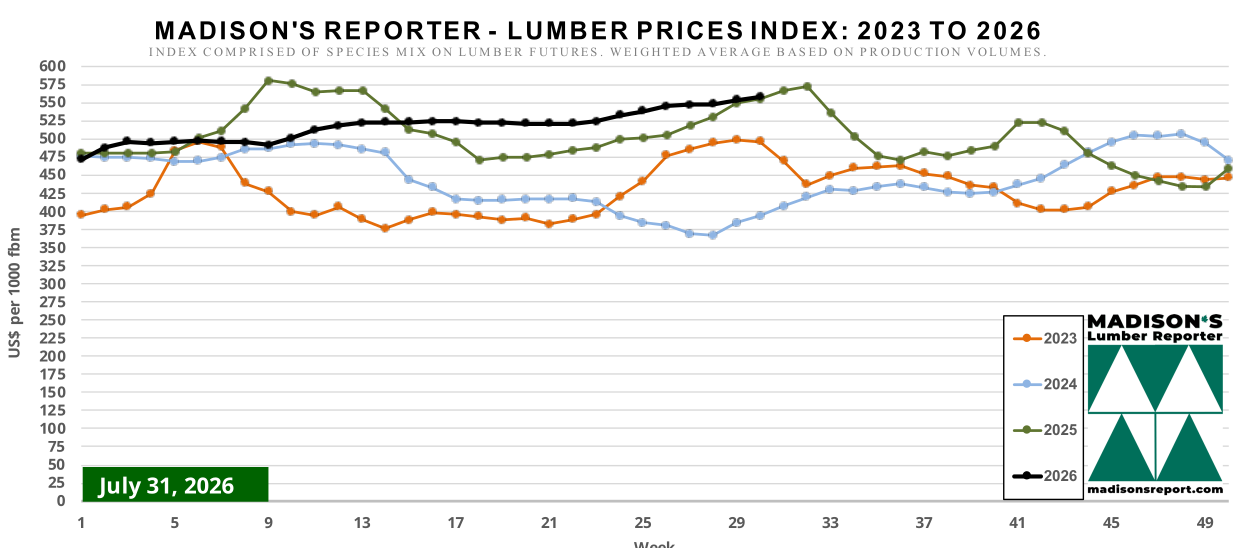
Now is the perfect time for someone being overly dramatic to say "In the 2 years since July 2024, lumber prices have increased 47%, significantly higher than inflation".
But someone else could also say "Lumber prices are the same as July 2025 even though inflation has risen" or "Lumber prices are up just 10% in the 3 years since July 2023, lower than the rate of inflation across these 3 years".
[1] https://madisonsreport.com/wp-content/uploads/2026/07/IndexG...
https://tradingeconomics.com/commodity/lumber
Roughly ~400 index pre-Covid. Roughly ~580 index the past year. 45% inflation, compared to 30% reported inflation by BLS from October 2019 to June 2026.
So yes, lumber prices are definitely beating inflation.
Not sure what you were trying to say by playing around with the numbers in the last 4 years.
Mills did ramp back up, but it’s unclear to me if they used it as a chance to do so slowly/preserve margins. Lumber never got close to pre-pandemic levels.
Tariffs probably also play a role here. About a quarter of US lumber comes from Canada, and barbed wire is just steel with a little bit of processing.
For products with little value add there’s not anywhere for the tax to be absorbed, and no real way for domestic producers to quickly scale up, even if they wanted to.
The people who sell the barbed wire and wooden posts presumably like to be able to eat, so they need to raise their prices to be able to afford groceries, etc.
People under-estimate the cost of logistics and transport. Every inch of travel for any input, component, or the final product has to be paid; and even a wooden fencepost typically moves between at least 5 different locations before reaching retail.
Let's use wooden posts as an example:
  1. Forest. Trees are cut down into logs, and then transported to...
  2. Lumbermill. Logs are cut to size, and then transported to...
  3. Treatment plant. Without it, your fencepost won't last for every long, and then transported to...
  4. Distributor location. And then transported to...
  5. Store (e.g. Home Depot or whatever). And then you pick it up, or get it delivered to you.
See UFA.com for Canadian prices. Keep in mind, there's a lot of variance in what people prefer to use, I'm just giving what I've always used and while prices have gone up, it sure hasn't gone up 2.5X here.
I am seeing way more active paddocks of grazing cattle now as compared to a couple of years ago. The world is complex and there is never an expiation that can be given in a short soundbite, but the primary driver is no doubt that higher beef prices compelled more people to try and raise cattle, which resulted in them needing supplies required to raise cattle, and fences are one of those things you need to establish a secure paddock. The increase in demand for fencing supplies, without a corresponding increase in supply, necessities an increase in price.
> Four companies - Tyson, JBS, Cargill and National Beef - control around 85% of American beef processing.
> That high level of market concentration has drawn accusations of price-fixing, even from President Trump.
> So you might expect that those four firms are currently making huge profits from high beef prices. Yet the opposite is happening.
> Tyson, the biggest of the four, reported in May that it had lost more than $500m on beef in the first half of its financial year.
Along with the high price, that's one more reason to not buy it.
Poultry and even pork are about an order of magnitude more efficient.
It's interesting how long the market was wildly subsidized to hide the true cost of beef.
Which isn't really a negative to me, but I think people should be honest about what is actually necessary to get the benefits of this form of beef production.
what a pointless thought-terminating cliché
> You're clearly imposing a self-serving moral judgement on other people.
Just because you are the wrong side of morality does not mean they are incorrect
When I tried to search for the details, I found only that it was a traditionally meat heavy diet.
USA - 37kg/capita
UK - 18kg/capita
We're not exactly shy of roast beef on this island either - the French nicknamed us "rosbifs" for a reason.
A sudden spike in price requires a change in the market - e.g., the Chinese suddenly starting to eat more beef, wildfires wiping out grazing land, fuel price spikes making it more expensive to ship the product around, screwworm outbreaks reducing cattle headcount, crackdown on migrant workers reducing available labor for meatpacking plants, etc.
They are? That's not my personal experience, but maybe there's something unusual in the part of the US I live in. I mean, beef sausages exist and you can get them, but you generally have to choose them intentionally.
https://www.oscarmayer.com/products/00044700000045-bun-lengt...
Some people really look down on these kinds of products though and see this as a "mystery meat" of extremely poor quality cuts. The whole phrase of "knowing how the sausage is made" comes to mind. So that's then in comparison to "franks", which are often 100% beef and are often seen as higher quality:
https://www.oscarmayer.com/products/00044700073377-jumbo-bee...
Are they higher quality? Eh. They're probably about the same in the end. One big thing pushing up the popularity of beef franks over pork/chicken/turkey mix is an impression of Kosher hotdogs being of very high quality during the time when meat packing was really bad, so lots of even non-Jewish people will often see Kosher dogs as superior. Which, for obvious reasons, have beef and not pork.
Brats are usually pork. For example:
https://johnsonville.com/products/original-bratwurst/
This is then true for other kinds of common sausages as well. Kielbasa is usually a pork and beef combination, maybe with some chicken or turkey:
https://www.hillshirefarm.com/products/smoked-sausages/00044...
They even make a point to say "smoked sausage" versus "beef smoked sausage".
https://www.hillshirefarm.com/products/smoked-sausages/00044...
https://www.hillshirefarm.com/products/smoked-sausages/00044...
Things like chicken sausages are also quite popular.
https://www.aidells.com/products/lunch-dinner-sausage/007640...
And one can't forget things like andouille sausage which is quite popular in a lot of Cajun dishes.
https://www.aidells.com/products/lunch-dinner-sausage/007640...
Unrelated to this, but I have Alpha-Gal Syndrome, the anaphylactic allergy to red meat, which is spreading rapidly as the ticks colonize every square inch of nature in the US. In Arkansas 20% of people tested on a big free testing day were sensitized to the galactose-alpha-1,3-galactose molecule (AGS is sensitization + symptoms, not just sensitization.)
I think that things are going to get weird with beef in the US in the next few decades.
"Four companies - Tyson, JBS, Cargill and National Beef - control around 85% of American beef processing.
That high level of market concentration has drawn accusations of price-fixing, even from President Trump.
So you might expect that those four firms are currently making huge profits from high beef prices. Yet the opposite is happening.
Tyson, the biggest of the four, reported in May that it had lost more than $500m on beef in the first half of its financial year."
What effect does this have on the person?
>A study of blood samples from military recruits, taken between 2001 and 2007, found that nearly half the recruits from south-central Missouri, where Ellison lives, had allergy antibodies for alpha-gal. [...]
>Only a fraction of people with antibodies to alpha-gal become allergic to it, and those who are often don’t realize it. Some react only to red meat. Some also react to milk, cheese, and other animal products that have alpha-gal. The symptoms are so delayed that people often blame them on food poisoning, irritable-bowel syndrome, gluten intolerance. In the U.S., according to the Centers for Disease Control and Prevention, as many as half a million people have alpha-gal syndrome, but other researchers suspect that the number is higher.
https://www.newyorker.com/magazine/2026/07/06/the-tick-that-...
I agree that somewhat distorts the effect of inflation, but at the same time it has to be done for inflation measures to make any sense. Otherwise we'd still be measuring the prices of heating coal and whale blubber.
We ar perfectly capable of intelligently changing how we calculate inflation. And the current administration's idea that if an American stops buying something because they cannot afford it anymore, means inflation went down is delusional.
What do you propose then? All the places where the BLS is "intelligently changing how we calculate inflation" creates controversy: hedonic/quality adjustments, substitution/weight changes, owners equivalent rent, the list goes on and on. What it practically boils down to is that people have an agenda (ie. inflation is high or low), and if the official numbers doesn't seem right to them, they accuse the current administration of fudging it, even if there's no evidence of methodology change.
right now we are in a whole economy experiment to see how long you can increase margin through price increases and shrinkflation.
The in between you have all the bad from monopolies in the forms of cartels.
"The rancher is selling calves for record sums, but is not better off because he has higher costs. The feedlot company is selling for all-time high prices, but it also has to pay them in the first place. The packers are losing money because there is a limit to what they can charge. Restaurants and supermarkets also can only increase prices by so much."
At the end of the day as more and more people want to consume the same products the prices for those are going to just go up.
When I see folks really hammering on price increases for products like beef or gas I can't help but think of how absolutely screwed we are in terms of addressing climate change if it involves consumer behavior.
Gas prices are a little less clear as it seems primarily the increases have been due to Iranian destabilization in the Middle East and less so tariffs, but gas prices do effect each country differently so increases here in the US are a lot less painful than, say, Singapore.
I agree with you that increases in the prices of both are good for reducing carbon emissions. I think it's interesting to see how folks are reacting to, what in my mind seem to be still incredibly low prices relative to the negative externalities. If we factored in the destruction and harm we're doing to the planet gas in the US should probably be more in the neighborhood of $20/gallon or something (that's a made up number and I'm just guessing) and beef probably should be quite a bit more expensive too. Though I think it's also worth pointing out gas prices are still lower than when Russia unjustly invaded Ukraine and if we can stomach those we can stomach these too.
Many markets don't really have 'competition'
But if you want to follow that train of thought with that faulty premise, then sure yes we must stop communism to lower prices because the OP says that oligopoly is solely responsible for price increases, so it follows that further restriction on market participants further increases prices. I don't agree with that premise, but if that's your view and the OPs view then it would be logically consistent for you to also advocate stamping out communism to lower prices.
(Also communism doesn't follow the same rules as monopolies.)
They advocated for competition instead of ogliopoly. You decided to talk about a completely different and irrelevant way there could be a lack of competition. Even if your conclusion is right, that they would be against communism if it was a realistic threat here, there was no reason to bring it up.
I could say that a bunch of badly placed volcanos would reduce competition and they must be against those volcanos. Such a statement is technically true but it's a non-sequitur.
Both things can be true.
https://www.foodnavigator.com/Article/2025/07/28/food-fraud-...
https://scijournals.onlinelibrary.wiley.com/doi/10.1002/jsfa...
I wouldn't mind this up to a point. One of the things that I find really irritating about most US restaurants (I'm an American, if it matters) is that the portion sizes tend to be far too large.
You're going to have to change those habits anyway because even without inflation that has been ongoing since the pandemic began you still have a lot of pressure to push prices higher on beef and other "luxury" goods as global demand continues to increase, the environment becomes worse off and requires further regulation, &c. It's perhaps a head start, but the long term trend isn't toward lower prices regardless of the impact of inflation (for example).
I also rarely eat in a restaurant, but when I do I make it a great one (to me -- I'm not talking only or even mostly about highfalutin places). Aside from being a better inherent experience, it also makes it more of a special event, which increases the pleasure I get from it. Any fantastic thing experienced frequently ceases to feel fantastic.
The truth is that most people can cook better (and healthier) food than most restaurants. The value proposition restaurants provide is mostly experience (a lovely night out in a pleasant environment where you're being waited on is fun) and convenience (just because you could cook it better doesn't mean you want to, particularly for lengthy and involved dishes).
Just wait till El Nino hits this year.