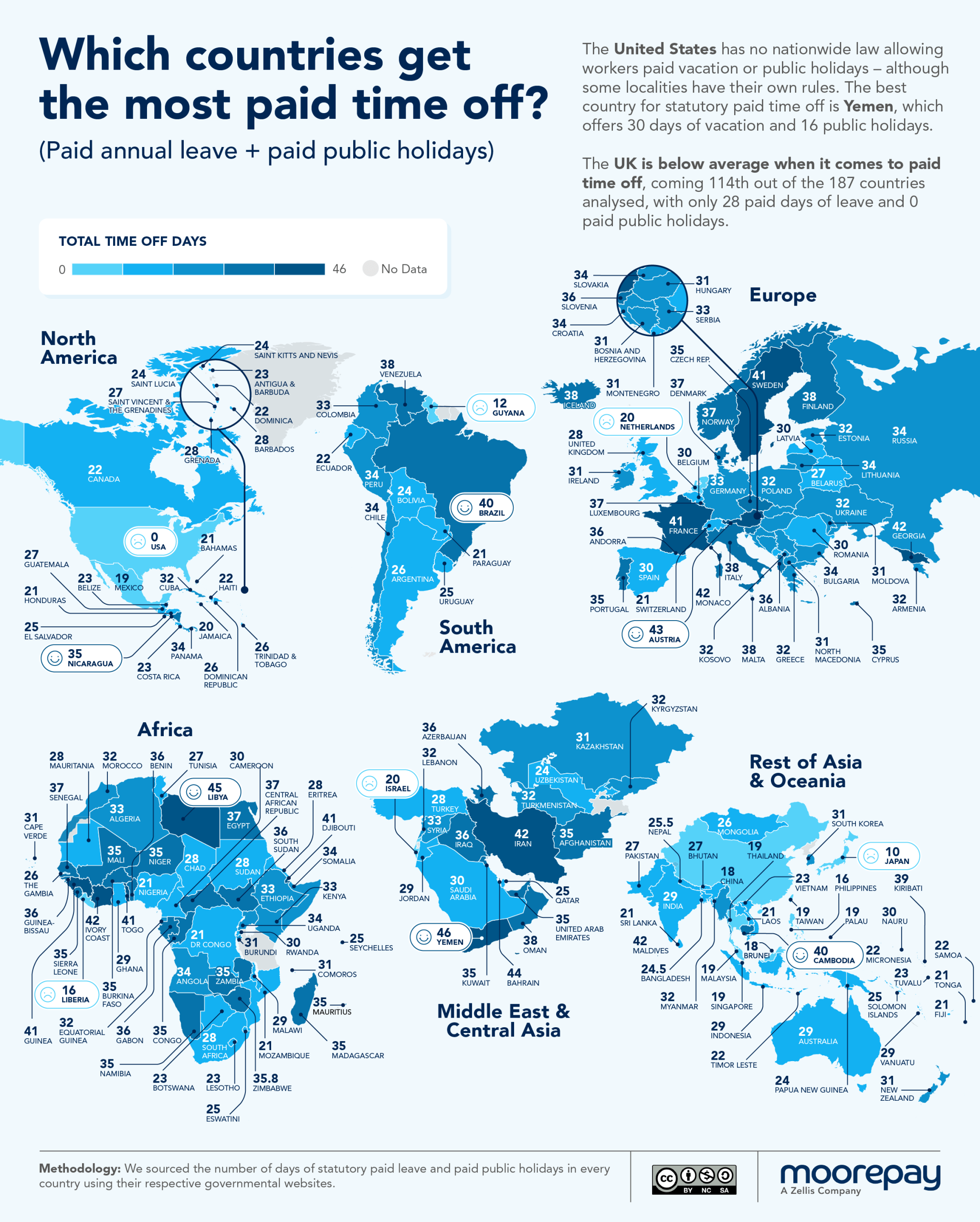
Edit - the original source even had the audacity to label Yemen with a “smiley face” since it has the most paid days for the region.
Could be better for sure, but a graph showing the US as having 0 days of paid days off because the federal government doesn't mandate anything is misleading at best. Average US worker after 1 year of employment earns 7 sick days and 11 vacation days. And likely has some state and federal holidays off as well, and could very well qualify for state required PTO and sick time. But that doesn't get clicks and attention.
More data, if one is curious:
Including sick days makes the calculation worse, not better. Sick days typically don't exist in Europe. If you're sick, you obviously just don't go to work. What's the point of infecting the whole office?
On average, workers in Europe take about 2 to 3 weeks off each year due to sickness in addition to their vacation. In fact, if you're sick during vacation, that doesn't count as vacation time, at least in some European countries.
> "workers in Europe take about 2 to 3 weeks off each year due to sickness in addition to their vacation"
It looks like in Germany it's 20 days a year - https://www.dw.com/en/germany-sick-days-absentees-mental-hea...
Are you all really that sick? Shouldn't the availability of lots of sick time and your "superior" healthcare system decrease your illness levels? Doesn't seem to make any sense to me.
Sick leave in my country is not full paid, it is 80%, so people are not that keen on getting it if not needed. On the other hand they are not hit that dramatically if they are sick.
If you want to measure general health, you could go for example for life expectancy. Or if you care about the healthcare system itself you could go for infant/maternal mortality. Or if you want to measure efficiency you could go for spending per capita.
Life expectancy in the US is lower because we're all overweight. Infant mortality isn't a standardized metric, so it really shouldn't be used to compare health systems, even though people try to do so all of the time. A lot of infant mortality in the US is due to there being 1.5-2x as many births to mothers under the age of 20 (versus what one might see in Europe), which is really a societal problem, not a healthcare problem.
A lot of those sick days are also childcare.
In most places in Europe the first sick days are not comped, so any missed day is a missed paid day. When social security comes into play they tend to pay the base pay of the position.
That would mean that if you miss a week because of an illness you might see a salary reduction close to a fifth of your monthly salary. That's something that most people don't have the luxury.
Apart of that most companies treat any medical leave after the third (yearly) as suspicious, which needs extra investigation.
So as we might not have a limit, and it's relatively paid, most people do meagre use of it.
Work is a privilege.
Perhaps there's a reason it has declined since.
In the 60s people would often die from ailments that are now solved with routine outpatient procedures.
Cars were cheaper too but it turns out all that emissions and safety equipment costs money.
How does one even measure that? And who would even try and claim that?
> when corporate taxes were much higher
The corporate tax rates in the 70s and 80s were just as high as they were in the 50s and 60s [0]. And the capital gains taxes were actually lower during the 50s and 60s than they were in the 70s and 80s. Why did inventiveness stop if the higher tax rates were helpful?
   1952-1963 Over $25,000 52%
   1975-1978 Over $50,000 48% ($50k in 1978 is ~$21k in 1952)
But surely Reagan did some bad things, right?
   The maximum tax rate on capital gains was capped at 34 percent for 1987
   From April 1, 1954, through Calendar Year 1969, the maximum tax rate on capital gains was 25 percent.
Grift in the 50s and 60s was pervasive and everywhere. Eisenhower was warning about the Military Industrial Complex in 1961.
[0] https://taxfoundation.org/data/all/federal/historical-corpor...
SmartPhones, Cloud, AI.
Just three things that happened in the past 20 years and were brought to the world by US companies.
I think what the article is really about the rest of the country. In Europe, even service industry people get 4-6 weeks off per year. In the US service industry that is unheard of.
BTW if work would be a privilege, you would have to pay to do it
eh.. many western countries have comparable taxation rates. That's not true.
Regardless it would be nice to have the choice to work 75% the hours for 75% pay. Not many jobs offer that, though.
Everything in the US is built around maximum value extraction for corporate profits, and I believe this is just another cog in that system.
Healthcare being so tied to your employer is so anti-labor it's unbelievable.
A few states inside the US upgrade federal holidays to state holidays to required paid time off. Most don't.
In the US paid holidays are a corporate "tradition" more than a regulated common good.
Even US federal employee holidays vary between agencies and branches of government.
The referenced source includes an image with all of the values: https://www.moorepay.co.uk/app/uploads/2025/07/01_Which-Coun...
And more often then not an employee _has to_ take the exact amount of vacation that's mandated in their country.
I wonder how much vacation time the people who invented the transistor took each year.
Edit: up to three mentions of transistors now. Bizarre
Better imo would be - if I personally accomplished something meaningful and valuable and 'earned' time, then I am strongly incentivized to take time. Also it taking time will help my health and wellness meaningfully then I should also be incentivized to do so.
But that seems impossible to setup if we aren't all our own business owning entrepreneurs.
Regulations are means of pushing the bottom line back at scale. They should be unnecessary in ideal humane society, but that’s not a thing. I wonder whether there’s a way to shift the culture somehow… but there seems to be no political will for that, because it’s certainly not any popular agenda point.
But I bet you know what the cavity magnetron - invented in Scotland - is. You probably used one today already.
Cellular phones were invented in the UK and Finland. The US didn't even have them until the first couple of generations were obsolete here.
Transistors were invented in Germany, although they were made practical in the US, I'll them that.
discovered penicillin
AT&T threw money at smart people and said, "Do stuff. Then we'll see if we can use it"
No one does that anymore.
[0] Defense contractor Raytheon most specifically.
AT&T paid people to fuck around. Claude Shannon, father of Information Theory, founder of Artificial Intelligence, and namesake to Anthropic's flagship product, was also busy building flame-throwing trumpets and rocket frisbees while creating entire new fields.