But we've known since the 1800s that it follows from female education (and this seems independent of culture, it was first observed in France, but you can see the same trend in any African country, or even Iran), which is favored.
I don’t think it’s that straightforward, material conditions in combination with massively lower mortality in all age groups and a shift in social values must be playing a significant part
I'd suggest the main issue is that the world is so complicated that the younger voters just don't know what to organise and vote for. In the US in particular, they seem to basically be running an experiment every single election to try and figure out who they need to vote for to get some sane economic policy and stop getting involved in stupid wars. No success so far but you have to admire the process. The only people not getting the message are the people paid off to ignore it.
[0] https://en.wikipedia.org/wiki/List_of_countries_by_median_ag...
I think it's a fair assumption that majority of the 50 year old think about their retirement (meaning around 30 years into the future).
As far as the presidency goes, it's hard to draw any strong conclusions due to the small sample size and flawed two-party system. Our last two presidents have been very old, but neither was particularly popular with the voter base as a whole. Plus, Bill Clinton and Obama were very young and were elected just a decade or two prior and enjoyed a higher margin of victory and approval rating.
The median age of the population in the US is 39. The median age of the Senate is 65. In other countries 65 is retirement age. So you could say, yes "America" (the US) is a gerontocracy.
  What period are we talking about? In the monarchy, the Senate were all men who could no longer serve in the military, generally believed to be at least 60 or older, and generally numbered 100-200 men.

  With Sulla's reforms in the 1st century BCE, you had a minimum age of 31, total population of about 600, with about 5% of that group needing replacement every year. The "elder statesmen" then were for the most part those in their 40s and 50s, with the handful of Senators who were older and had beaten the odds still around, [ ... ]

  By the Flavian dynasty, if you had military experience you could join as early as 25 and the body was as many as 900-1200 by the end of the 2nd century CE, filled as the Emperor saw fit.
( Yes, Reddit .. but one of the better (for accuracy and comment quality) corners )
We really have no clue how it worked. If anything it probably was more related to being a head of a prominent clan/family.
The periods 293 through 219 BC and 166 to 9 BC are vague because of missing Livy volumes and lesser (or no) alternative sources for those ranges.
Aside from age, being a (primary major family) Patrician was a factor for some of the Roman Kingdom, at other times the pool expanded to include minor Patrician families. During the Kingdom the Senate largely worked as an advisory council to the king, grinding through legislative details, and more or less being responsible for the election of new kings (variously with or without input from "the people").
> Patrician was a factor
We don’t really understand the patrician vs plebeian split and how it functioned before or during the founding of the republic. Again there is evidence it was only fully established decades later.
There were some 700+ years of Rome before they occupied Britain and lasted for longer than the current age of the US senate system after that occupation.
During that long arc Roman senate ages, prerequisites and duties changed multiple times.
As for Livy, sure, like many historians attempting to cover several hundred years of events there are biases and myths laid as fact, etc. Even the events of the last twelve ears aren't agreed upon by all despite petabytes of live video and digitised records drilling down to the sale of individual shoelaces.
With birth rates in free fall for last twenty years, what did we expect?
Millennials received kick in their teeth when entering adulthood and around the time when was the moment for a last (or the first, finally) child. Real estate market had never been cheap either. Exactly overlaps with falling birthrates over the last twenty years.
Looking at other countries, "interestingly" Russian invasion of Ukraine basically wiped out childless millennials on both sides. Putin noticed that's the last chance to monetize the demographic opportunity and hopefully that was his last fart.
The common thread is that these are generations that climbed the class ladder early on, when infrastructure was lacking and there were opportunities. They had many children, jobs were plentiful, and medical advances delayed death, which meant that upper-level positions never opened up and the older generation just stayed put.
The Boomer generation naturally worked hard when infrastructure was scarce, and they succeeded under harsh physical conditions, so they find it hard to understand the generations below them. Meanwhile, the younger generations are despairing over the fact that the class ladder has been pulled up. Success is a universal desire, after all.
The older generation was in a harsh environment, but they were seated in the front row of a growing pie. The subsequent generations have better consumer goods and education, but the entry price for core assets and status has gone up, making success much harder to achieve
At the core, the real issue is the need for wealth redistribution. But in that process, the people who failed to climb the Boomers' class ladder are left behind. And crucially, as societies modernize, people tend to have fewer children, which shifts voting power away from the younger generations, making the problem even worse. In other words, everyone knows the future needs to support the youth, but doing so would cut into their own pensions and make their old age harder. And since most people are unwilling to give up their vested interests, the situation becomes even more difficult.
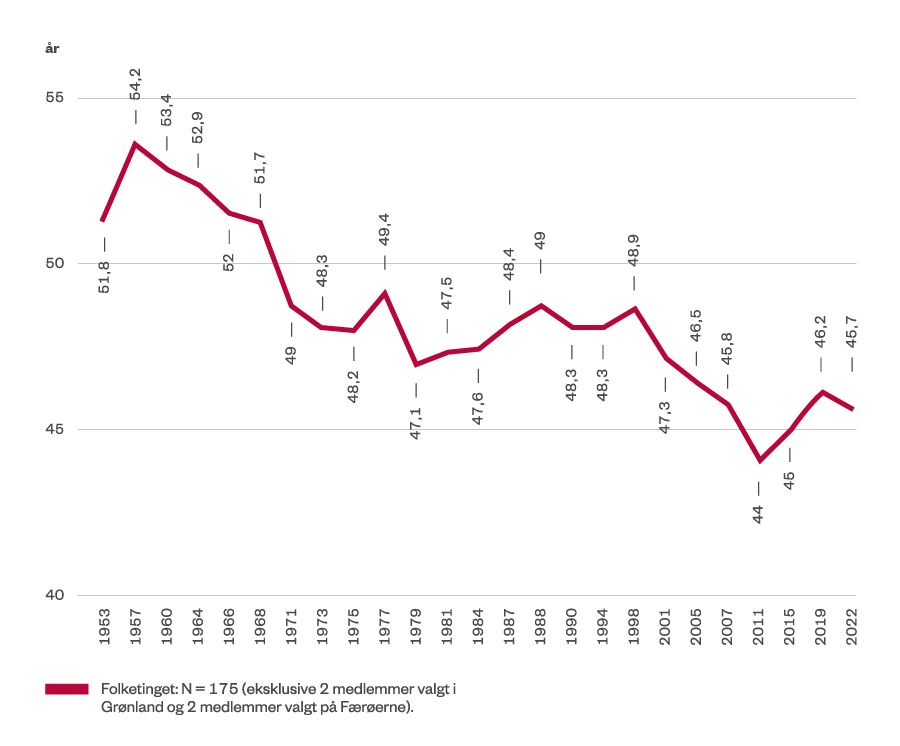
Average age is 44 years !!!
The oldest is 72. Youngest is 23. Majority is 30-54. https://www.ft.dk/-/media/sites/ft/billeder/infografikker/ta...
source: https://www.kristeligt-dagblad.dk/danmark/det-nye-folketing-...
The fact many of them assume the modern economy works the same way when in fact it's a much harsher environment is a curious phenomenon.
So having good social security helps everyone. Unfortunately my country ( IN) does not prioritise that part.
boomers vs millenials, reds vs blues, south vs north, city folks vs country ones
There has been a class war going on for at least four decades in the US, and the lower classes are on the loosing side. All you have to do is look at growing wage gaps in that period. We can come up with all sorts of just-so stories, but the simple answer is that the rich have captured the US government, and it is being governed primarily for their benefit.
https://www.sentencingproject.org/reports/mass-incarceration...
While the population of the US has gone up by ~1.6x during that same period.
Seeing as convictions aren’t spread evenly across income brackets, a poor person’s chances of being in the carceral system outpacing population growth by a factor of ten doesn’t really jibe with the whole “there’s never been a better time to be poor” thing
Oh, also communism, Marx ideas were a catastrophy for Eastern Europe. Greetings from my vacation in Bucharest
There's plenty of poor/impoverished boomers, blues, reds, city and country folk
Those conflicts are all the pretexts - they believe that it's actually class war and the other labels are all used to avoid calling it by its name.
What OP meant was the income and wealth gaps are they only things they care about, not the only things that are real.
https://www.cambridge.org/core/journals/perspectives-on-poli...
I for one look at Trump or the previous Tea Party change in the Republican party as anything close to having a static group of elites controlling the country
When I was young, the voting age became 18, me and all my friends could not wait until we could vote and we kept it up as we aged. Many in my generation were that way. Then all of a sudden the young stopped voting.
So if young people want to change things, get involved with politics get off your phones and make noise. But it seems there almost is a conspiracy is going on these days to distract the young from "real life" to keep them out of politics :)
What's quite mindblowing for an outside observer is that the birth year of American president has been almost constant since 2001. I know that millennials are irresponsible and unreliable brats, but c'mon... they're over 40 now.
This is a massive change from the situation of most of human history, where your life was extremely likely to be substantially similar to that of your grandparents, so anything useful they had learned and could pass on to you was likely to continue being useful. The rate of change in human life really started to accelerate with the industrial revolution, now some three centuries old; but humanity is now in a state where massive changes are happening much faster than the passage of human generations.
Yet everytime I deal with healthcare I encounter some <30 years old kids who learn medicine from scratch and have only 5 minutes of their time for me. Reading about medicine fells like reading science fiction. We seem to know everything about a human, yet in practice you might die or become crippled even from a trivial problem.
And this why immortality is bad and death is not to be cured.
https://en.wikipedia.org/wiki/List_of_presidents_of_the_Unit...
JFK, Nixon, Ford, Reagan and Bush 41 all served in fairly junior roles in WW2, even if Reagan just made training films and so on. LBJ pretended to serve in the same war. (He went out on one bombing mission as some kind of observer and was awarded a Silver Star, after which he stopped bothering the military and went back to his real career.)
----
Anyway, the article's author seems to be quite the hard-line capitalist:
> "The only plausible way to keep public pensions solvent... is for retirement ages to rise as life expectancy does."
So, even though society's productive capacity is incredibly high, having risen and risen over two centuries of industrialization and mechanization - supposedly the problem is that older people are slacking off. This is (mostly) false. Most of the basic material wants we face today are artificial. That is, people don't starve because there's not enough food, they aren't homeless because there are not enough houses and apartments, they are not left untreated for medical conditions for lack of doctors and nurses etc. That's not to say that there are never shortages of materials or of trained professionals; but what the author is essentially saying is that working people need to shed blood, sweat, and tears more so that the insufficient share of the fruit of their labor, that actually goes back to them (= us), becomes sufficient.
This is not dissimilar from a feudal lord, who takes most produce as tax, telling his tenant farmer that if he wants to have enough to feed his children, he should get some of them to also work the fields so that there's enough to go around.
People don't actually starve today, because food scarcity is now a problem humanity has almost-entirely solved (the exceptions are war-torn parts of sub-Saharan Africa, not anywhere in a developed country). But there are many people who are homeless who would be if housing costs were somewhat cheaper because the housing supply was bigger; and there are many people who don't get enough medical attention because the time of doctors and nurses is scarce and therefore expensive - this is why there's so much interest in using AI for medical questions and examinations.
Housing supply is scarce because of regulatory capture: homeowners and real estate companies have the strongest incentives and massive resources to keep it that way.
Medical attention is scarce because of regulatory capture by those doing those jobs: the numerus clausus is still a thing, and not in any way defensible.
The parent is right: scarcity today, especially in developed countries, is completely artificial, because it serves those who benefit from it.
"The economy is precarious and someone has to pay for that. This is a you problem. Don't look at us. Nothing to do with decades of neoliberal piracy."