By comparison, the worst US state for heat related deaths, Nevada - a literal desert - has >10x fewer deaths per capita than Greece.
https://vividmaps.com/comparing-latitude-of-europe-and-ameri...
US states like Texas and Florida have no latitude equivalent in Europe. Los Angeles is farther south than all of Spain.
At the same time, the UK, much of Germany, and Poland are farther north than any state in the US lower 48.
Heat waves only became a serious problem in Europe in the last decade. The vast majority of buildings predate the need for air conditioning by several decades - and in plenty of cases by several centuries. The buildings are designed around being livable in a pre-climate-catastrophe climate without needing air conditioning - which is perfectly achievable if you aren't stupid enough to build a city in the middle of a desert.
Adapting all those buildings and streets will take time. Blindly putting AC everywhere and forcing everyone to drive from building to building in an ACed car isn't going to work, that kind of wasteful behavior is how we got into this situation in the first place. You need to redesign the heat management, and you need to start with things like mandating shades to prevent heat from entering buildings in the first place, and planting trees to avoid the heat island effect.
AC will indeed be needed to deal with the final heat peak when outside night temperature is in excess of 30C, but it isn't the one-size-fits-all solution for every heat-related problem it might seem at first glance. If your AC needs to run for more than a few days per year, you've seriously screwed up.
To hear Americans jump at the chance to comment about Europeans and their AC usage. Jesus it’s like they have found their little pet peeve to express all their frustration towards. Perhaps because we grumble every week there’s a school shooting and you feel you have to take petty revenge somehow. Every thread on social media is Americans whining about ACs in Europe, or lack thereof.
Don’t you guys have anything better to do than feel superior because most of us simply cannot have AC, for one reason or another? Meanwhile you have voted for a president that says climate change is a hoax and is investing in coal, for Heaven’s sake, and still here you are, gloating.
If I could have installed an AC unit where I live, I bloody would have.
Now if you’ll excuse me, I haven’t had a good nights sleep in a week, and won’t for another week.
You can install an AC if you get the right politicians in that will change the laws. If you don’t have AC it’s your own fault.
TBH, a lot of distaste Americans have for "Europeans" is basically a distaste for DACH residents weird sense of superiority. Most other Europeans are much more pleasant to be around with.
- "We don't need AC, It's only hot a few times during the year." - "Oh what a terrible heat, global warming is getting worse every year."
Pair to that the fact that in many places windows don't open all the way due to bureocratic regulations and many interior designs are very questionable in terms of air flow and you get some unpleasant scenarios.
But it's always funny how many people don't really realize how soon the AMOC will likely collapse (probably within the next 30 years - definitely within the next 70 years) and just unlivable most houses will consequently become, as what we currently consider an extreme winter would consequently become a mild one... The infrastructure just hasn't been built for -20°C
I have one of those portable evaporative coolers and they don't need much power (50-100W). I have one and measured ~110F input and 78F on the output side using nothing more than water and a fan, pretty remarkable. The trick is staying out of direct sunlight, and the body can cool itself well with the same mechanism. Sweating is extremely effective due to the low humidity.
You mean against human-induced global warming.
But are you really going to tell me that you me that tho evidence that temperatures are getting warmer is bunk? For starters check out the top diagram here: https://en.wikipedia.org/wiki/Climate_change#
Would you argue against the physics of greenhouse gases? https://www.quantamagazine.org/physicists-pinpoint-the-quant...
Are you too young to have noticed climate changes over time in your life?
Edit: And the accumulation of greenhouse gases in our atmosphere: https://en.wikipedia.org/wiki/Carbon_dioxide_in_the_atmosphe...
> the fact this is how hot it will be from now on
That sounds to me like an acknowledgement that, in fact, the climate has changed.
It's not bunk but there is a lot of lying by omission and lying with statistics. In the worst cases politicians use Climate Change to make very specific and incorrect predictions that aren't substantiated by the science (i.e. the ridiculous prediction that the polar ice cap would melt by 2014).
You can just pick up a book or an old newspaper to realize that hot weather has happened before. I live right outside the hottest place on the planet Earth and nearby Death Valley recorded 134F (57C) in 1913.
The consensus, with increasing solidarity, from the 1990s through until now is that the sun is much the same as it has ever been for the majority of modern human civilised life and has contributed minor amounts to the observed changes of the past century; those changes primarily driven by human caused change to the insulation properties of the atmosphere.
  \1 Jack Eddy overcame this with a 1976 study that demonstrated that irregular variations in solar surface activity, a few centuries long, were connected with major climate shifts. The mechanism was uncertain, but plausible candidates emerged. The next crucial question was whether a rise in the Sun's activity could explain the global warming seen in the 20th century?

  By the 1990s, there was a tentative answer: minor solar variations could indeed have been partly responsible for some past fluctuations... but future warming from the rise in greenhouse gases far outweighed any solar effects.
  \2 Couldn't the Sun be the cause of global warming?

  If the Sun were to intensify its energy output then, yes, it would warm our world. Indeed, sunspot data indicate there was a small increase in the amount of incoming sunlight between the late 1800s and the mid-1900s that experts estimate contributed to at most up to 0.1°C of the 1.0°C (1.8°F) of warming observed since the pre-industrial era.

  However, there has been no significant net change in the Sun’s energy output from the late 1970s to the present, which is when we have observed the most rapid global warming.
\3 The Basics of Climate Change: https://royalsociety.org/news-resources/projects/climate-change-evidence-causes/basics-of-climate-change/And it raises the heat outside of buildings. Not so good for people who have to be outside, think first responders etc.
"just turn on the AC and keep burning the world down" isn't really the answer.
No it doesn't. Seriously, where does this meme even come from? It should be pretty obvious just from a solar insolation map that AC is just noise vs the sun. The energy usage is tiny vs vehicles or non-heat pump heating and only electric. What changes temperature overall is the balance of thermal retention by the atmosphere vs radiation into space, hence why net increases in GHG are so dangerous. And at the ground level similarly how heat is dumped to atmosphere. Greenery, whites, shade etc is good, asphalt, mass standard glass is bad (hence many cities being heat islands). Old, leaky units sure, we absolutely should work to reduce that. But it's astonishing how people claim AC makes the outdoors hotter so consistently.
> A significant degradation of external thermal comfort can also be seen in the simulations, as heat released by AC systems warms the outside air (see figure 3). The temperature increases due to AC depend on the time of day and on the characteristics of the heat wave, mainly its intensity. On average, the duration spent under high heat stress conditions in the streets is increased by about 20 min per day because of AC.
https://iopscience.iop.org/article/10.1088/1748-9326/ab6a24#...
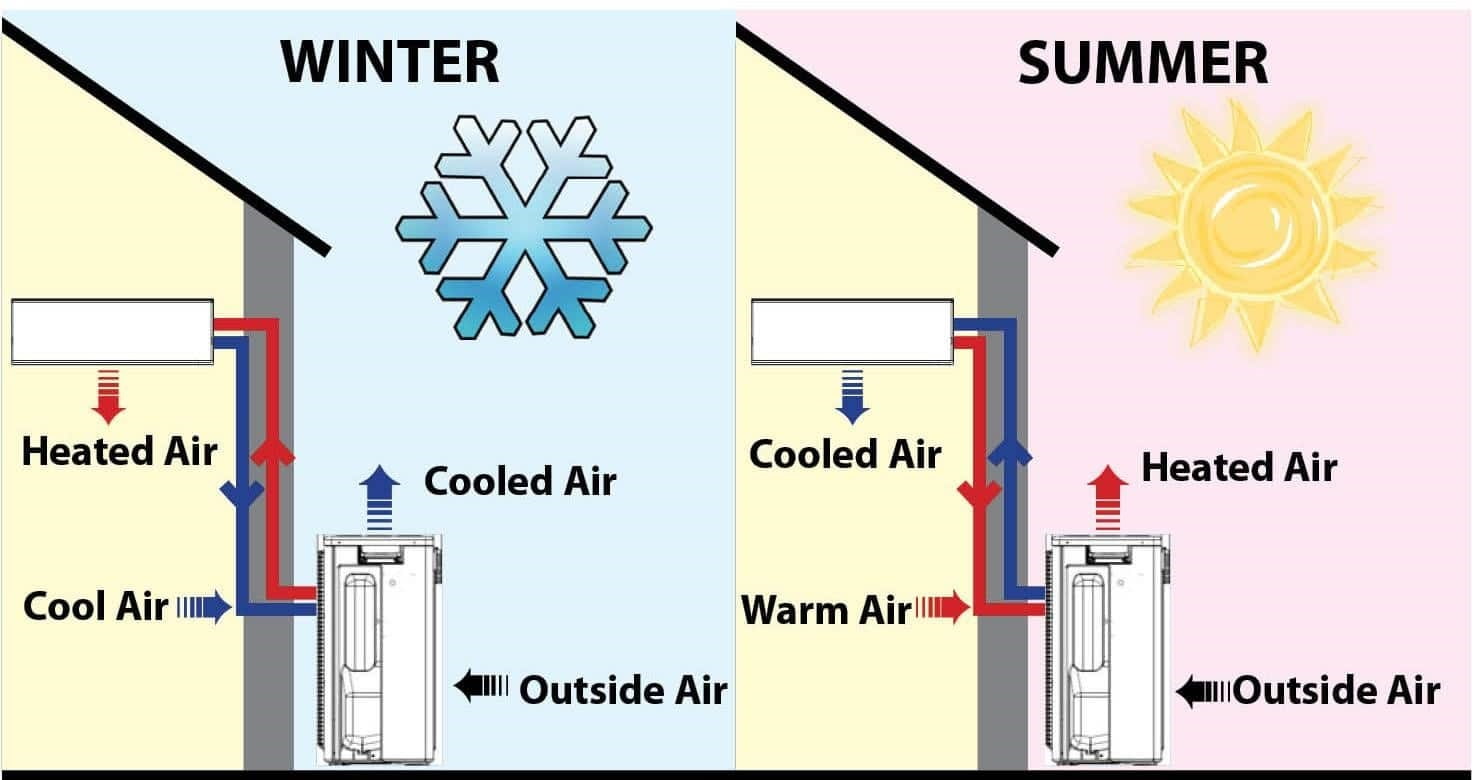
Yes, it does. It may be small temperature increase but AC use increases outside temperatures. It is just physics.
Here is a simple diagram: https://www.lozierheatingcooling.com/filesimages/heatPump.jp...
In reality equilibrium is restored quickly (and the thermal mass we're cooling/heating here is insignificant anyhow).
This doesn't mean that there's zero heat added locally (as many seem fond of suggesting): The compressors and circulation blowers and fans don't run for free, and every Joule of electricity they consume is ultimately converted to a Joule of heat in a process that wouldn't occur in the absence of aircon. That's not zero.
But in very broad strokes, it's not very significant. It's somewhat akin to running a refrigerator inside of a kitchen.
With aircon, the refrigerator is the size a whole house. That certainly sounds huge, and it is huge. But that refrigerated building is inside of a room that is the size of the Earth's atmosphere, which is very obviously vast in ways that kitchens simply are not.
It doesn't really matter. Millions of homes with aircon don't mean much when the atmosphere is millions of times bigger than they are.
No heat is created either, that would explicitly violate the first law of thermodynamics. An air conditioner powered by solar energy (or anything solar powered) ends up releasing the exact same amount of "excess" heat as the sunlight would have if it hadn't been absorbed by the panels.
As an example of thermal lag: My present home doesn't have aircon upstairs. I've got a room with a west-facing window up there, and I just happen to chart temperatures in that room.
The daily temperature peaks in that room during the warmer months tend to happen at night -- sometimes, as late as midnight. The daily temperature minimums tend to happen around noon.
This suggests that solar power is least-useful for that particular room when solar availability is greatest. It doesn't overlap very well at all.
(I'm still looking into installing fairly modest solar rig, though, just to help offset my own baseload when I can and maybe make extended power outages more survivable.)
It would actually be a much better global warming mitigation strategy to install bidirectional heat pumps (A/C in the summer, heat in the winter) that runs on electricity (which is increasingly produced using renewables) and then get rid of fossil-fuel burning furnaces.
> provides diagram with zero evidence that AC meaningfully influences temperature
Clap, clap.
Humans have a really hard time understanding compounding risk. But there are billions of us. How many billions of drops can you handwave away?
The sun = 175 quadrillion watts of heat.
The heat from running ACs is not significant. It's also additive with all the other existing forms of energy use we have. Unlike greenhouse gases, which are multiplicative.
Air Conditioners do not produce a net heating effect unless you power them by burning fossil fuels.
Our current cities and infrastructure are designed to be black heat sinks to soak up heat and hold onto it and ground level. But there is research into what would happen if we flipped that design around.
This is an outdated attitude. PV solar panel output correlates really well with air conditioning demand, no need for storage. Overcool your thick-walled masonry buildings during the day as a form of energy storage.
They don't create heat. It was there in the first place, just a different location.
Of course air conditioning is reasonably well suited to be a solar load during peak hours, but in most parts of the world if everyone just installed AC units like are common in many parts of the US it would mean a huge amount of extra fossil fuels burnt.
Especially as air conditioning are heat pumps.
Would have helped solve the large dependency on natural gas heating for free as a byproduct!
NB: a friend in construction explained this to me so I could be wrong but it would explain why even pretty fancy new apartments with heat pumps have no cooling.
You'd think the government could subsidize aircon like they did solar for years, and both of those things combined would translate to very pleasant summers spent in energy neutral air conditioned homes.
This isn’t true. I’ve lived in 3 places in London with single glazing. They’re surprisingly common. All new properties come with it but the majority of our housing stock is old.
There’s also little comparison between air con and double glazing. One will be helpful for 4-6 months of the year and reduce my energy bills. The other will be necessary at most 1-2 weeks a year and will cost me thousands of pounds up front. Most people simply can’t afford that.
If most people can’t afford a heat pump, why do we entertain the idea of making them pay an order of magnitude more to better insulate their home, which doesn’t even work in the end?
You’ve been misinformed by European media. Please do your research, it’s all online.
On top of that, until a few months ago, government subsidies for heat pumps didn't apply to the versions that include air con so anyone who did get a heat pump didn't get that version.
>> why do we entertain the idea of making them pay an order of magnitude more to better insulate their home
We don't. There have been various schemes over the last couple of decades where people could have this done for free or at very low cost.
>> You’ve been misinformed by European media. Please do your research, it’s all online.
I suggest you do the same.
Besides that, just know you’re participating in a system of belief that needlessly kills thousands each year (and many more to come, if you believe as I hope that climate change is real). Just dwell on it a little. Thousands dead because of ideological comfort and resistance to change, which in and of itself is a weird form of climate skepticism.
If you answer this, please address each of my points from both comments. You have adressed none so far.
Edit: Turns out, sash windows are more commonly found in the UK (compared to other European countries), but still not as common as in the US. So, UK = not as hot (so far), thus still probably not worth it (yet) as a market.
But you should still be able to get two tubes fitted into any kind of window with the right seals. If you were really up for renovations you could get closeable exhaust holes punched through your brick or something maybe.
And yes, there are options for tubes/ducts for the more common window types. Like tilt-and-turn windows, horizontally sliding or all the other kinds of inward or outward opening windows - but most of them are the ducted portable units the original comment was speaking of, which aren't great. There are also some better portable split units, but those are pricier and the install is not as easy. (They're great though.)
Best of the best is about 15-16 SEER
That's entry level central HVAC efficiency
Minisplits are far higher, 20+
That's completely false. They work just fine despite not being terribly efficient at least provided you install them correctly (but that caveat naturally applies to any window unit).
In fact despite the low efficiency using only one in a single room is likely far cheaper than cooling the entire house. It's the same principle as an electric space heater versus a whole home heat pump.
Of course running a minisplit only in the one room would be substantially better but for a 1 kW unit the difference is less than $1 per day (unless you're subject to the California electric grid I guess).
It's not just the resistance but the price. There is tremendous price gouging in the AC industry. The real cost of a mini split system is the low hundreds of dollars but good luck finding one for that price in Europe. If it were regulated as a life critical technology and not as a luxury then it could be substantially cheaper.
1. Energy is very expensive relative to the U.S. 2. Houses are old old and retrofitting air conditioning is very difficult 3. Houses are more than 1 story with many small rooms making portable and window mounted units unsuitable for a whole house
All modern apartment buildings in London are built with air conditioning because a central air system and district power make it cost efficient.
If you visit a hot place like Dubai or Bangkok, there are endless indoor malls with air conditioning that serve as a place to shop and a third space. Much of Europe doesn’t have that.
The U.S. specifically is also very car-centric. You walk out of your air conditioned house into your air conditioned car and drive to your air conditioned mall. Much of Europe… isn’t. People walk, you can’t avoid the heat.
Yes, certainly, there is a cultural resistance to air conditioning but adding air conditioning to homes isn’t going to stop people dying, homes are the least consequential part of heat in day to day life. Health advice in a heatwave is pretty much: don't go outside.
Heat as the primary factor, vs heat related deaths is significant.
Heat is a system stressor. There's plenty of people having heart attacks and dying from weight related issues that probably got pushed over the edge by a hot day in Nevada that are missed in official stats.
It doesn't affect life expectancy much, because most deaths are among the elderly (70% over 80 IIRC).
In France, the same exact situation would be reported as a heat casualty leading to heart attack.
Oh but what's the problem, just add more air conditioning! :facepalm:
Sure we would, since AC has nothing to do with it.
By creating and artificial climate in all or our homes we are so disconnected from the world that we think technology will fix it.
Just wait fro the wildfires to blow up this week in the western US. AC will not help.
But climate change is bullshit, right?
Well, not really ignoring it, more like making it worse while setting giant piles of bills on fire.
Its going to be a huge challenge because the buildings are not designed with that in mind, many buildings are hundreds of years old making these sorts of renovations notoriously difficult and expensive, but it has to start because climate change is only going to get worse and worse.
Most of Europe has a "registered building" system, where buildings above a certain age are considered historic. Renovating those buildings is an extremely difficult, expensive, and bureaucratic process. You generally need to preserve the period-appropriate look and materials. An AC unit sticking out of a wall won't pass muster.
Even newer buildings are problematic. an acquaintance of mine lives in an upper-middle-class apartment complex that was finished two or three years ago, and their architect has some claim in the contract that prevents residents from installing AC units to "preserve the building's unique look."
The US is build around privately-owned housing (and hence creature comforts) a lot more than we are, so AC is a lot easier to implement there.
Global warming intensifies differences in weather patterns. Hotter hots, colder colds, more intense storms, etc.
Most people have an intuitive understanding of what an average is, but "distance from the average" is mystifying to them.
"This number is small but it means BAD THINGS" isn't a very good message
Our continent has more extreme weather than Europe... we've adapted accordingly because we value human lives. Have you?
The entire United States had 2,325 heat-related deaths in 2023, which is the all-time high.
Do the math (US pop 340M vs Spain 49M) and it gets really ugly.
[1] https://www.reuters.com/business/environment/spain-records-h...
We do a lot of things wrong but AC isn’t one of them.
(Unless you’re in the PNW where they never needed it before recently, and somehow continue to build units without it)
I imagine the buildings there just aren't built to support that heat plus the body height of hundreds or thousands of attendees?
The human body has a natural resting temperature of about 37°C, and metabolism of course generates more heat constantly, so we constantly have to shed that heat. When the temperature is low, we can rely purely on conducting the heat into the atmosphere to shed the heat (which is probably why internal body temperature is higher than the atmosphere!). At higher temperatures, conduction is less efficient, or sometimes even adds heat load into the system (at above 37°C, obviously), so we start relying on evaporative cooling (i.e., sweat) to cool us down.
The wet-bulb temperature is the minimum temperature that can be reached by evaporative cooling. So when the wet-bulb temperature is in the mid-30s °C… people start to become literally unable to regulate their core body temperature, and the heat is lethal. Wet-bulb is largely a combination of the temperature and humidity, but unfortunately, it's not typically reported in most weather reports, so people go off of the air temperature (and the humidity) that is reported.
Which is a long-winded way of saying "the humidity matters a lot for how much a given temperature is bearable." I don't know what environment you come from purely by rural New South Wales, but my first guess is the semi-arid and thus low-humidity bush regions of the state, which means the apparent wet-bulb temperature of 37-40°C would be a lot lower than the equivalent 37-40°C for most of the humid continental climates of Europe.
I grew up in a humid city and summers were unbearable. Now I live in a dry climate and 30°C is pretty comfortable.
The humidity here it's hell. You feel 35C like ~42C in dry climates.
https://www.cell.com/trends/genetics/fulltext/S0168-9525(20)...
Last summer my house got to 39, and I didn't have AC (it was broken). I think I'm still recovering.
There’s something about 85F/30C and 80%+ humidity that prevents the temp from going much higher for a longer period of time.
Their climate resilience seems low.
> The event will finish with a fire side chat
Is this a prank?
It's corpo speak for "a more casual discussion"
Glauber's salt is a PCM phase-change material that melts at 90F / 32.4C and starts absorbing thermal energy.
>Venue: LSE Shaw Library, Houghton St, Old Building, London
https://halls.lse.ac.uk/story/25006031/deal-with-the-uk-weat...
> LSE halls (like most houses in the country) don't have air conditioning, it can be quite suffocating.
I blame LSE. Uni should provide safe and comfortable environment for students.
Maybe examine the reflex to dismiss out of hand without evidence?