https://www.jerrypournelle.com/reports/jerryp/iron.html
"Pournelle's Iron Law of Bureaucracy states that in any bureaucratic organization there will be two kinds of people:
First, there will be those who are devoted to the goals of the organization. Examples are dedicated classroom teachers in an educational bureaucracy, many of the engineers, launch technicians, and scientists at NASA, even some agricultural scientists and advisors in the former Soviet Union collective farming administration.
Secondly, there will be those dedicated to the organization itself. Examples are many of the administrators in the education system, many professors of education, many teachers' union officials, much of the NASA headquarters staff, etc.
The Iron Law states that, in every case, the second group will gain and keep control of the organization. It will write the rules and control promotions within the organization."
Those who recognize this will be at peace since they understand the soul of bureaucracy.
The part that is also usually glossed over is how exploitative the production is (low pay/awful hours), even if it’s sometimes self-inflicted.
https://en.wikipedia.org/wiki/Self-licking_ice_cream_cone
>In political jargon, a self-licking ice cream cone is a self-perpetuating system that has no purpose other than to sustain itself.
>History
>The phrase appeared to have been first used in 1991–1992, in a book about Gulf War weapons systems by Norman Friedman, and On Self-Licking Ice Cream Cones, a paper by Pete Worden about NASA's bureaucracy, to describe the relationship between the Space Shuttle and Space Station.
[...]
I would totally be pissed as someone in an “organizational” role of someone reduced me to someone “not interested in the goals of the organization”, but magpi3 didn’t do that. They correctly stated a pattern. If you are around organizational/administrative people, ask yourself honestly if the pattern isn’t the least bit accurate…
The essential problem is that if one person spends their time e.g. fixing bugs in the code and another person spends their time weaseling their way onto the budget committee because they want to divert resources to their cronies, it's the second person who ends up on the budget committee. Then the first person gets laid off so their salary can be redirected to the cronies.
There are various ways to try to inhibit this with varying levels of effectiveness, essentially checks and balances. But the kleptocrats will be constantly trying to circumvent, weaken and vilify the things designed to constrain them. It's the sort of thing in the same nature as "the price of freedom is eternal vigilance".
I find it to be very true after almost 30 years in the working world, and I always keep it in mind wherever I work.
* People who understand that the existence of the organization is necessary for the goals of the organization
On the contrary, the existence of a mismanaged organization nominally dedicated to a given purpose often prevents its nominal goal from being achieved, because people assume giving time or money to that organization will be the best way to further the goal. Then the organization squanders them when those resources would otherwise have gone to some other organization or people with greater effectiveness towards the goal.
This gives rise to another type of person within an organisation. Someone opposed to the goals of the organisation, and who understands this all too well.
There are also private schools (some famously called public schools like Eaton or Harrow, but most actually just private companies often with charitable status).
Schools are usually fairly small organisations and generally the management have risen through the ranks as teachers, year heads, and so on. It isn't a sector in which fortunes are made.
So, yes, I think a range of funding and organisational models are possible. But note the role of regulation (direct inspection of what happens in classrooms on a regular basis without much in the way of warning).
In the real world, in the same line as the article suggests, there was a brief time when the "puts you back in control" browser needed you to change the following about:config settings to disable the force-pushed ai:
browser.ml.enable, browser.ml.chat.enabled, browser.ml.chat.sidebar, browser.ml.chat.menu, browser.ml.chat.page, extensions.ml.enabled, browser.ml.linkPreview.enabled, browser.ml.pageAssist.enabled, browser.ml.smartAssist.enabled, browser.tabs.groups.smart.enabled, browser.tabs.groups.smart.userEnabled, pdfjs.enableAltTextModelDownload, pdfjs.enableGuessAltText
A bit of community feedback later, and we've got one big "off" button, and me wondering which footgun the executives will shoot themselves with next.
At the same time, they did listen to the feedback and deliver. It now has a genuinely good interface for it where you don't have to opt out of everything, but can opt-in where you want it. It's not just a big off button, it's a general out-out including new features, but that then exposes individual opt-ins if you want for each feature. Most other browsers won't respond at all. Firefox is still by far the best browser out there for people who care about their privacy.
Especially on HN, Firefox just gets so much more hate than software that is way more user hostile for much less bad behaviour. I'm not saying we shouldn't hold it to a higher standard when that is what it's selling itself on: clearly we can't allow "not as bad" to let it slip into worse and worse, but at the same time, I don't understand how the narrative seems to trend towards "they are essentially the same as google" when that is so clearly not true (to be clear, not saying you are saying that in this post, just that's the vibe of HN's commentary as a whole).
It's a recurring pattern of not reading the room
Everyone was forced to be exposed to it. To see it. Only after that happened, did they let users disable it.
It's effectively the equivalent of a spam campaign.
Using Firefox is a political choice. People use it because it's one of the few remaining traditional browsers which isn't a tentacle of Big Tech. Chasing the competition and adding the stuff your users are actively trying to avoid isn't going to work.
What? They didn't make these 10 distinct features one single all-or-nothing button? They let you switch them on or off individually?? How dare they?!?
What? They shipped new features to the browser...turned on?!? Instead of spending all those development hours and then...hiding them behind a setting by default?
I need "AI" in my browser, so I don't use the AI features. No data was sent anywhere. No 4 GB model was downloaded. Nothing happened, except for a popup saying "hey, by the way, if you want to do X, just press this button here". It's just UI elements. No AI-related code runs, no data is sent to AI companies unless you directly tell the browser to do that.
Imagine if Firefox shipped a brand new GPU-accelerated compositor, improved hardware video decoding and WebGL/WebGPU. You people cry about why they didn't add a big "disable GPU features" button? And that they dared to enable this by default?
The issue was they shipped AI features built into everything and the only way to switch them off was to "about:config" a bunch of settings, they shouldn't have shipped it without the off switch and "Open about:settings and then disable things manually" isn't control for the average user.
The user has the choice to not use these features. It's not like Firefox was sending data to AI companies by default. But if you want to completely make them disappear, so you can live in your fantasy world where LLMs were never invented, then yes, that's a niche personal preference and an advanced customization. That's why it goes under about:config.
PS: I do actually find Google's ai thing in the search useful now and again, so no fantasy world.
The master AI switch doesn't actually change whether the browser uses AI features - it never does unless you specifically run them. What it does is hides them from the user, pretending they don't exist.
Browsers that don't respect their users' choices about using AI do things like automatically download large models in the background, integrate cloud-based speech recognition and synthesis as an API available to any website and make the default search engine which they also own show LLM slop above actual results.
Firefox usage has been declining for a decade. Doing nothing, or just doing the exact same as before, is popular with its fans (including me). But wouldn't it perhaps just have lead to an even more rapid decline?
I worked at Mozilla for a bit over six years and really enjoyed my time there. There were lots of brilliant people attracted by the mission and the work was technically interesting. I left in part because I came to the conclusion that the answer to these questions was no. Google's distribution advantages with Chrome and getting boxed out of mobile by the bundled Android/iOS browsers was simply too much to overcome by making a better product. People can gripe about Mozilla's management or product decisions all they want but the fundamental problem is the structure of the web browser market.
It's obviously impossible to say, but when we look at things that did happen due to Mozilla's financial decisions we have some major disruptions. Besides the already-mentioned Rust and Thunderbird examples we also have the years-long rebuild of the extension system where Firefox, once known as the leader in customization, offered less than 20 extensions for its mobile version and deprecated who-knows how many. I find it hard to believe that these actions didn't affect their market share, goodwill, or both.
I am in favor of Mozilla launching initiatives to support the browser, but right now I think they are using the browser to support their initiatives.
The move to WebExtensions was painful, but it also made it possible to easily port Chrome extensions to Firefox, which was a great boost for the extension ecosystem, as well as being the thing that actually made mobile extensions possible.
I do agree they should've made the transition period longer though. There were like two years in between where some of the big Chrome extensions hadn't been ported yet, but their original Firefox counterparts were already killed. That probably made a few users move ti Chrome, but that was already during the great Chrome migration, so I can't imagine this made a huge difference.
As for the effect of extensions, my feeling is that people care less about them now but used to care more about them back then. I think Firefox main selling point was always "my cousin who works in IT told me to install this instead of that", and once Firefox angered those power users away (at the same time when Chrome was trying to bring them in) the effect compounded.
I don't mind experiments, but if you're the "we put you back in control" browser then please build an "off" switch in from the start.
AI is however a potential avenue for raising money.
I meant to use that as a recent example of the kind of decisions that Mozilla leadership repeatedly makes, that don't match up what their users want.
How? By selling the position of preferred model? They can do that without implementing it in a way that means people who don't want it at all have to jump through hoops to opt-out.
Being able to turn AI summaries and such off by default was the final reason I started paying for Kagi. I know they use ML in the background no matter what, but as long as I get links to resources relevant to my search, that I can read/judge/summerise as needed, first and foremost, how they produce that list is not the issue.
not at the current employee and costs. But do they need to do that? Do they need to produce new products (and pay the cost to do so)?
Why can't they be lean and mean? Focus purely on browser experience without any BS, without any upsell? And there are volunteers out there that willingly contribute code/fixes for free.
Yeah they have rolled out a lot of nonsense I don’t care for, but they have also rolled out a lot of features I regularly use and enjoy. You can’t please everybody, but ultimately I’m glad it’s not “just a lean browser.”
Leaders are accountable for their decisions, their statements, their strategies, and their care for the organisation(s) that they lead.
Yes.
A product like Firefox depends on word of mouth. There was not a *single* announcement or decision by the Mozilla leadership in the last 10 years or so which would make me recommend Firefox to others, instead every single time it pushed me away a little bit more. I have hardly ever seen such a fundamental alienation of their core audience, even for Silicon Valley standards ;)
On the other hand, part of the struggle was my fight against the web as a """platform""", with its many privacy and security issues that accumulated as W3C APIs were added like hot cakes and websites exploded in complexity. Firefox provided the control necessary through addons, thanks to its vast community of likeminded people. Nowadays, a lot of the privacy controls have landed in firefox proper, in part thanks to the tor browser upstreaming, if you know where to look.
* Wanting niche features that don't benefit other people than those in the enthusiast core, thus preventing the company from gaining market share and revenue.
* Ever-increasing expectations in terms of visible feature delivery (e.g. e10s was widely seen as a failure despite being foundational to move off a single thread model and increase browser responsiveness).
* General conservativeness in terms of anything that breaks workflows (famously [1], but also see the criticism of Firefox redesigns over the years, etc.)
* Most importantly, lack of proposals for monetization from said audience (donations do not cut it and smaller and more important projects such as OpenSSL, etc. have also been underfunded from time to time, so nvm funding a browser's development), while also opposing the typical monetization mechanisms, e.g. ads.
These things end up constraining a company from spending more resources to improve a growing product, as they don't have any. While more capital-intensive industries such as phone manufacturers often just choose to appeal to mass market at the cost of giving up their enthusiasts[2], Mozilla always wanted to hedge its bets, and has failed to go in either direction.
Therefore, it is not unexpected that Mozilla is failing, and only survives through whatever meager donations come through, and revshare from Google by placing them as the default search engine.
You did not read the comments of this submission?[1]
This is common.[2][3][4][5] And those were comments which were easy to find because they said Firefox and VPN. Many other comments said they should focus on Firefox solely. Or eliminate all side projects.
> People even want to donate money for browser development, but can't due to the foundation structure.
People can give money to Mozilla Corporation by purchasing Firefox Relay, Mozilla Monitor, Mozilla VPN, or MDN Plus.
Rules for businesses to solicit donations are strict. Mozilla would have to be more careful than most because people confuse non profit Mozilla Foundation and for profit Mozilla Corporation. It is well known in fund raising most people who say they would donate will not donate. And many of the small minority of Firefox users who said they would donate implied or said plainly a condition was Mozilla would abandon other income.
[1] https://news.ycombinator.com/item?id=48515030
[2] https://news.ycombinator.com/item?id=48225892
[3] https://news.ycombinator.com/item?id=47434873
Fair, there are complaints out there, but I'd rank the response very mild compared to AI and the upcoming Nova design.
> Many other comments said they should focus on Firefox solely. Or eliminate all side projects.
Of course, since most of their money comes from search royalties for having Firefox users.
> People can give money to Mozilla Corporation by purchasing Firefox Relay, Mozilla Monitor, Mozilla VPN, or MDN Plus. Rules for businesses to solicit donations are strict. Mozilla would have to be more careful than most because people confuse non profit Mozilla Foundation and for profit Mozilla Corporation. It is well known in fund raising most people who say they would donate will not donate. And many of the small minority of Firefox users who said they would donate implied or said plainly a condition was Mozilla would abandon other income.
Yes, but what I'm saying is there's no general opposition from "enthusiasts" to Firefox making money like the parent commenter stated. The more popular take I've seen is to support Firefox via paying for VPN, etc.
What users want is a working browser that gets out of the way and them browse the web. That's what Chrom(e,ium) is. It's like air, it's everywhere but you can't see it.
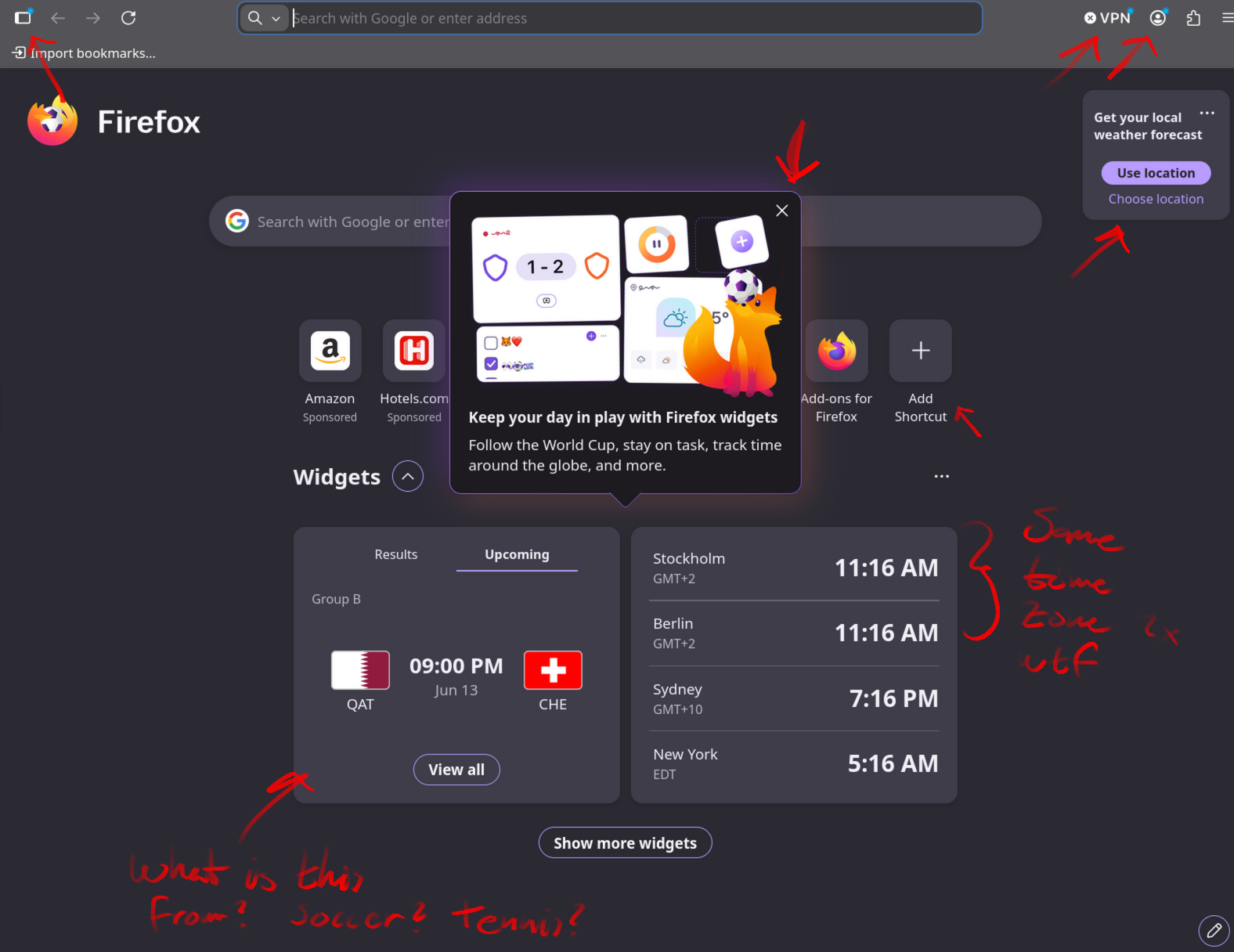
Firefox is not. Every time you open Firefox, there's a new dialog announcing some change or shilling some product. It's cut from the same cloth as that car that Homer Simpson designed. Every time you open Firefox, it works a bit differently, so you have to unlearn some habit and learn a new one[1]. This is friction. This grates. You have some task to perform, which is why you opened the browser, but now you your blood pressure is up 20 points because firefox can't just let you browse, it's always telling you stuff in a dozen different channels, popups, toasts, notifications, there's always something it throws in your face, often multiple calls to action at once. So you say for fucks sake, and go back to chrome which just lets you browse with none of that nonsense.
These are all the calls to action I get when I open firefox. Which I opened yesterday as well, so it's not a clean install.
https://www.marginalia.nu/junk/firefox.png
Why is there a dialog announcing widgets, when I can see the widgets already? It's literally telling me what I see on the screen. Why do you need this exposition to inform me of something that is plain to see in front of my eyes? It's like bad fiction writing, except in the form of annoying UX.
Like is anyone working on Firefox actually using the browser, in its vanilla configuration? How can they not see how infuriating it is to be a Firefox user?
[1] 5 years ago we changed which kitchen drawer we keep the cutlery in, and I still reach for the wrong one every time.
Also the context menus are super noisy, I tried cutting some bits out in config, but there's just so much crap in there. Obviously all the AI stuff, but also just the basics; right-clicking on a tab has a sub-menu for "Close Multiple Tabs" which hides "Close other tabs" and "Close tabs to the right" which are probably what I use the most. In Chromium they're top-level menu items.
And it went through a phase a few months ago where the context menus were sometimes offset or goofily sized; I think that's fixed now.
I guess it's easy to criticise, but it just doesn't feel like this stuff is well aligned to actually using the browser, whereas Chromium feels like a solid product.
At this point I think it's clear his resignation was not voluntary. Maybe the other offer was sincere, or maybe it wasn't; I'm not sure how we could tell.
I'm telling you this to highlight that volunteers where a huge part of Mozilla.
But on the last day they announced that they were moving the day-to-day conversations from IRC (an open protocol) to Yahoo Messenger (a closed protocol). I felt sort of betrayed in that moment: the company that was all about openness and to which I dedicated countless hours doing unpaid work for and even more years evangelizing for was imposing its volunteers and employees used a proprietary app to coordinate. That didn't sit well with me. At all. I basically lost interest.
This was in 2015. Last I heard MDN introduced ads (I wouldn't know, uBlock is pretty effective) and is not showing contributors to a page on the page itself anymore.
So yeah, the part of OP saying how Mozilla managed to piss volunteers resonated pretty hard with me.
Makes me think in 10 years time the web will all be discord-like data silos behind infernal subscriptions and/or dark patterns with ads.
What a wonderful thing we've created.
It wasn’t because Mozilla stopped using GP’s favorite chat software. It’s because GP was a believer in the mission and the principles. Switching from an open system to a corny corporate one made the whole illusion fall apart. Mozilla was a corp all along and they took their volunteers for a ride.
Who else would be likely to look at what a web page is trying to get the browser to do, e.g., trigger requests for ads using Javascript. There are a variety of places to look, it is not like this is seriously hiddden from those with even the slighttest curiousity
That a former MDN volunteer is apparently disappointed by ads on MDN yet satisfied with MDN anyway because of a community-sourced browser add-on. An add-on that can be rendered useless at any time by the browser vendor, including the one that puts ads on MDN
It is not unimaginable that one day uBlock Origin may cease to work on Firefox when Mozilla is actively working on such things as "making ads more private"
I thank the volunteer for their past work on MDN, I'm not singling him out, nor am I holding it against anyone for thinking this way, but I wonder how many uBlock Origin users believe themselves to possess some "specialised knowledge",^1 for lack of a better term, but would be all but helpless against advertising without a solution provided by someone else, e.g., a browser extension
The point I'm making is that today it seems like "knowing which app to install and how to install it" is considered specialised knowledge instead of actually knowing how to avoid ads to an extent where if the app stopped working they could devise another solution
There are definitely some HN users who can do it, and you, dear reader may be am ongst them, but it seems, based on the comments I have seen over the years, there are many, many more who cannot. In that sense it is a bit like the IRC comment.
The more one understands about online ads, the more clear it should be that so-called "ad blockers" is only a temporary solution at best, and these only work with web browsers
IMHO it is important that more people who wish to avoid ads become more curious about how they work instead of only installing a browser extension and concluding the problem is solved for the long-term
1. Many calling themselves "engineers" for example
Speaking as someone who hasn't run their own bouncer in 10+ years.
So far, I've only found clients with different bugs. Calling them good would be a stretch. Passable, perhaps. But the scene as a whole is more of a choose-the-bugs-to-live-with situation than choose-a-good-client.
I've never thought of matrix as a mature technology ever since.
even mastodon figured out federation.
[1] - https://thelounge.chat/
[2] - https://convos.chat/
No wonder people don't want to join it.
(Saying that as someome who has his own bouncer.)
Email really could have been great, but html and bad actors have made it so much worse than it needs to be.
Literally every single modern chat platform has support for stuff like that, and for a reason. Discord became popular because it combined those modern chat features with the ability for every community to create its own private little "server" - while at the same time making it trivial to participate in multiple "servers" at once.
IRC servers do also support profiles.
I think the real “issue” with IRC is that its users generally prefer the minimal UI. So there isn’t an high enough demand to make prettier UIs. But there are web clients that are a little less basic.
For what it’s worth, I’m in that minimal camp too. I wish I could still connect Slack to IRC.
I consider it a feature that acts as a filter.
So in many cases, you don't need a VPN to prevent revealing your actual geographic location.
Discord could well run on top of IRC the protocol and be open to federation without any change of UX.
It's not inherent to the protocol. https://ergo.chat/ does not have netsplits (from having a single server) and https://github.com/Libera-Chat/sable replaces the server-to-server protocol to eliminate netsplits as well.
And even when not eliminated entirely, they are infrequent and barely visible on well-managed networks like Libera.Chat. Many chat platforms have more (and longer) outages than Libera has netsplits.
> missed messages
Solved by most server implementations using https://ircv3.net/specs/extensions/chathistory
> bot wars over channel and nick ownership
Solved decades ago thanks to NickServ and ChanServ (though I'll admit they are ad-hoc additions on top of the protocol). And ~15 years ago we got native support for authentication (https://ircv3.net/specs/extensions/sasl-3.1)
Just looked it up and there is IRCv3 to fix this, but idk what the state of that is.
Sure it does, when all browsers have more or less the same, and the context makes clear we're not talking about the mere programmatic consumption of HTTP (like through some REST api).
"But it's a protocol and not a client" is pedantically irrelevant, given that the clients for that protocol all follow the same conventions. The parent already said they meant the UX of it "which is arguably similar between implementations".
Besides, protocols impose some concepts and models of interaction and consumption, which informs any UX created on top of them. So it's not like that client sameness is merely accidental and unrelated to the protocol either.
Also apparently they are non-tracking ads, and so provide only a small fraction of income that tracking ads would bring, but that would go against the ideals of Mozilla.
So I'm seeing the ads as a net positive. (And am surprised that the people visiting MDN don't use an ad blocker anyhow).
I feel the same way after seeing what they've done with AI chatbots in the sidebar. Five cloud providers. No local AI option. I don't see a reason to use Firefox today and it's been my main browser since it was called Phoenix. I use it only because it's what I've been using for a long time. There's no relationship between Mozilla of today and the group that placed the ad in the NY Times in 2004.
The AI chatbot thing was just the latest happening, but it shows how devoid of meaning that organization has become when you have a technology like AI and nobody even looks to Mozilla to provide leadership on an issue like that. Sure, send all your data to a large cloud outfit, that's the corporate world of Mozilla in 2026. It would actually be shocking to see Mozilla promote AI data privacy. Ironically, the local model I run the most is provided by Google, and it's not the least bit surprising that they're making it possible.
Since 2007 in my case which is when I started using Linux at home. The distributions I use come with Firefox as the Web browser (Ubuntu, Debian and latterly Slackware).
I do find myself turning things off more now than I used to.
IIRC they had a partnership with Yahoo around that time. Interesting to hear it went that deep. Notable: Yahoo Messenger was shutdown in 2018.
Many of Mozillas product decisions prove that the Mozilla corporation is not aligned with the interests of FLOSS. I can't donate to Firefox or Thunderbird specifically, neither at the feature or product level. There is no way to ensure my donations go to enriching these products, instead of profit generating features that benefit the Mozilla corporation. One example is the container VPN proxy, which only allows you to implement a VPN per container if you pay for Mozilla VPN. This is a feature that should be universally available to all users, and all VPN providers, but they locked it behind a paywall for profit.
The is the same (logically analogous) reason I no longer use Reddit after the API changes in 2023, after using the platform for 15 years, and has become common among newer FOSS startups like OpenAI, minio, and bambu; using the philosophy of open source &/or unpaid community labor to achieve a certain level of trust, growth, users, funding, and market saturation, only to screw them all over in the name of profit. This for-profit parasitic greed and corruption in FLOSS is the antithesis to the philosophy of the FLOSS community.
In a sane world this type of community exploitation would be criminally prosecutable. Reddit decision makers would see the inside of a prison cell; the moderators and commenters – as well as the developers who built the 3rd party apps that grew the company from nothing for over a decade – would be given shares/ownership, and paid from the company for their time and labor; same for every other scammer that exploits these "bait-and-switch" deceptive tactics to succeed in businesss. Unfortunately for us all, we live in a world ruled by parasites.
"In 2018 she received a total of $2,458,350 in compensation from Mozilla, which represents a 400% payrise since 2008. On the same period, Firefox marketshare was down 85%. When asked about her salary she stated "I learned that my pay was about an 80% discount to market. Meaning that competitive roles elsewhere were paying about 5 times as much. That's too big a discount to ask people and their families to commit to."
In 2020, after returning to the position of CEO, her salary had risen to over $3 million. In the same year the Mozilla Corporation laid off approximately 250 employees due to shrinking revenues. Baker blamed this on the Coronavirus pandemic"
Thunderbird is no longer owned by the Mozilla corporation, so now you can donate directly to them.
I think it’s pretty safe to assume that forking the code is a low incentive for change
Also, I'm afraid that's not sustainable in the long run. How long before Mozilla makes a change so big to introduce some nasty feature that it becomes impossible for forks to stay up to date with upstream? Do they really have the resources necessary to maintain an actual fork and not just a customized version?
holy fuck, hahahaha! the only thing worth a damn they own other than Firefox, and they're enshittifying it. perfect timing too, now when LLMs probably halved the traffic it gets.
whatever happened to their Google money? they were so dummy rich they could afford spending millions on the three letter thing "advocacy" not so long ago. did that dry up or what?
To me, ad blocking belongs in extensions. The job of a web browser is to show web pages as intended according to the standards. It includes all the ads, tracking, etc... the page has put in. If you want to block stuff or deviate from the standards in any way, that's what extensions are for.
And extension like ad blocking are an arms race, websites will deploy countermeasures to make them less effective and to which extensions can respond. Again I dont want the core browser to participate in an arms race. Keeping it free of vulnerabilities is already hard enough not to fight against standard behavior.
As a reminder: Extensions execute with post-decryption access to the websites you view, and they update to new code silently and without asking for permission. HTTPS might as well not bother existing if you have extensions you do not have incredible trust in.
Firefox's VPN service also has its privacy-related uses (yes, I'm aware of the limitations), but I think it mostly serves as a possible source of non-google revenue for Mozilla.
All Mozilla (and Firefox) needs is to be run by developers, not the fucking MBAs.
1. Could do all the stuff chrome does as well as chrome. (Eg, canvas rendering speed etc). So I can actually use web apps.
2. Just doesn't ever have anti privacy code, pro ad code, etc in it.
I use brave and a self managed lan which is just an ad hoc half assed attempt to reach the above goals. Because there is no other option.
"Nothing more," you say.
The chief focus should be Privacy... Privacy and Performance... Our two chief focuses should be Privacy and Performance... and Cross-Platform Executables with Functional Parity... Our three chief focuses should be Privacy, Performance, Cross-Platform Executables with Functional Parity, and Safety on the Web... Our four chief focuses should be Privacy, Performance, Cross-Platform Executables with Functional Parity, Safety on the Web, and ruthless Efficiency in Preserving Battery Life... Our five... no... Amongst our chief focuses... Amongst our non-trivial chief focuses that users think are easy... are such elements as Privacy, Safety on the Web, Cross-Platform Executables with Functional Parity... I'll come in again.
Software Engineering Apologies to...
[0] _ https://en.wikipedia.org/wiki/The_Spanish_Inquisition_(Monty...
According to 2025 filings, 86%+ of revenue came from the Google deal.
Google pays Mozilla because of the browser. How would shifting focus to the browser make that worse?
How do you block ads and invasive trackers? DNS only?
There was once a time where IE was only ever used to download Firefox... Mozilla squandered that.
But I'm not sure how much they could've done. Maybe they could've invested a ton of engineering resources into a project similar to Firefox Quantum earlier, so that Firefox didn't leave as much room for a leaner browser? But half the reason people complain about Firefox today is that they broke XUL extensions, which was an absolutely necessary step in making Firefox a competitive, fast browser. I can only imagine the backlash they would've seen if they did that before Chrome ate their lunch.
And I'm not sure how much it would've really helped, since 1) Chrome would've still been a less bloated browser simply through having been around for a shorter time and having fewer features, and 2) Google would've still had immense marketing opportunities by plastering Chrome ads all over Google Search etc.
That's when Google realized they had to do something. The market could not be allowed to be dominated by a pro-freedom, pro-privacy product.
since then it has been downhill since.
    - Kept Rust and sold best-in-class tooling like IDEs to enterprises.
    - Polished Firefox OS and distributed apps in their store for a 1% commission.
    - Kept Servo and made the most secure and fast browser that no one else had made.
    - Partnered with OEMs to offer Firefox as the default browser.
This is just a path to irrelevance. Firefox had the ambition to be the default browser, what Chrome is now! It's a shame if they're going to spiral off into their niche.
I do not think that this was that confusing. People [1] looked around at the beginning of the 2010's and saw
1) Mobile usage was growing exponentially and desktop was... not [2].
2) Every mobile OS shipped their own browser by default, or even went so far as to prevent other browsers from being used at all (iOS) [3].
3) Because Android and iOS both had non-trivial marketshare, neither could be called a "monopoly" so there was no way to use anti-trust law to get Firefox on devices as was done with Windows (not that this would have been a compelling strategy even if it were possible).
People took that set of facts and concluded Mozilla needed its own mobile OS in order to stay relevant.
What they underestimated was the amount of investment needed to make such an OS and get it on devices and the amount of time it would have to exist in a state of not being very good before it could compete with the established players (who were not standing still... people forget how bad Android was in the beginning). But if you look at the actual world we ended up in, with no mobile OS from Mozilla and a total Firefox marketshare that is less than desktop Safari's, it is hard to say that initial conclusion was incorrect.
[1] Full disclosure: I was a Mozilla employee at the time, though not involved in any of these decisions.
[2] I would say "desktop was shrinking", but to everyone's surprise it actually remained fairly steady in absolute numbers, although it did become a smaller slice of a much larger pie. In 2010 everyone expected it to shrink, though.
[3] Mozilla did ship a re-skin around mobile Safari to try to get some brand presence, but was still at the mercy of what web standards Safari chose to implement, and you could hardly call it a first-class experience. Eventually iOS loosened their rules, but no one could have predicted that back then.
Boot-to-Gecko is brilliant because honestly most apps today... are Web pages packaged in an "app". Most PWA with desktop shortcuts (and ideally offline responsive mode) show that. Very few "apps" genuinely need to be apps.
Consequently being "just" a phone with basic connectivity and delegating the rest to the browser made perfect sense.
I didn't work because it didn't make sense or wasn't technically feasible. It didn't work because anybody who made a mobile OS wanted THEIR own walled gardens. The fact that today we are stuck with Android an iOS shows how needed it was and still is.
It would be great if Mozilla as an organization tool the opposite approach of Google and if they started a project you knew it would be supported for the long run and if not internally it was handed over to the community of users and stewarded along, sort of how Apache seems to adopt projects but mostly for corporate/enterprise users.
That's why Firefox continues to be a niche browser. Its actual goal, never outright stated by Mozilla leadership, is to occupy just enough market share to prop up their behemoth benefactor.
I've been a loyal Firefox user since forever - reading, writing, web dev I do is always in Firefox. It's a first app I always install. I'm grateful Firefox exists, and the world (at least mine) would be much worse if it wasn't around.
I don't like Mozilla is taking money from Google - I'd prefer if it was all community driven, to the point of a community owned co-operative, but I'm probably delusional.
Yet, I'm hopeful for the future.
They still have not fixed their build system. Meson/ninja or cmake would be alternatives. Nothing to have them abandon mozconfig ... this is legacy code. The rest of the world moved on. Mozilla lives in the past.
FWIW the Firefox build instructions [1] look a lot saner to me than the Chromium build instructions [2].
[1] https://firefox-source-docs.mozilla.org/setup/linux_build.ht...
[2] https://chromium.googlesource.com/chromium/src/+/main/docs/l...
And one would hope they stay there, because all the newer stuff is far more user-hostile.
One of the first betrayals was putting ads in their new tab page, the forced AI comes as a Mozilla tradition now of user respect as marketing only.
At the same time it simply may not be a viable business. Firefox was popular originally because Chrome didn’t exist and Internet Explorer especially 6 back was awful.
The browser is now an OS on top of an OS, it requires massive resources to maintain. So Mozilla has a cursed mission now and related or unrelated in any case they’re full of it and have lost my respect. Open source and user respect still means something to me even if it doesn’t to Mozilla.
Interesting language with a passionate community / cult, but the value to Mozilla was vanishingly close to zero.
Now - we really need a viable alternative to the Evil Google Empire. For a while I had hope that ladybird would be that competitor, but that died after I was banned from github, as well as Kling making some really strange decisions in the last year or so, with weird explanations; most recent one the "we don't need external contributors so we close that down" (in part also due to the rise of AI slop spam, which is indeed annoying, but Kling is a strange guy really). I gave up on Mozilla many years ago already, though. The key insight I had was when one mozilla dev explaind that all linux guys use systemd + pulseaudio. So, using youtube (which annoys me because the evil Google empire controls it as well), I had no audio on firefox. Chrome on the other hand played fine (I only used alsa). So, the same machine, almost the same software stack (excluding pulseaudio; I did use system back then though), means that one browser plays audio fine, the other does not. Now, I could recompile firefox and enable non-pulseaudio audio ... but look at this:
https://www.linuxfromscratch.org/blfs/view/svn/xsoft/firefox...
mozconfig? In 2026? Seriously?
There is allegedly a python-only alternative. I tried it. It did not compile.
This is not the only issue I had. Many more problems existed with Mozilla and I also think that becoming addicted to Google money killed Mozilla. It is a dying shadow and has been for a long time. Yes, we need alternatives, but Mozilla failed us many years ago already.
I don't have a real solution against the evil Google empire. It's not even only Google; many companies are part of the evilness. I am almost beginning to sound like Richard Stallman, though I don't feed off of my feet - but the main point here is more to have real alternatives. Firefox is useable, no doubt, but it's not going to change the control Google has over the world wide web. We need something much more fundamental - control by the people. Everyone sees what Google and co are doing. Something has to change fundamentally, to stop Google parasitizing on the rest of the world. But for this you also need to have software alternatives that work.
The only thing I can come up with is to make all components of the browser/www stack as modular as possible and to also come up with alternatives. W3C also betrayed us when they demanded DRM into everything. I don't want that. Next in line will be mandatory age sniffing. This is currently ongoing. It will be extended. Systemd already added support for it; Poettering tried to do damage control but clearly failed: and reddit censoring like crazy - https://old.reddit.com/r/privacy/comments/1rzykul/the_system... as is typical.
https://askubuntu.com/questions/1387154/using-alsa-on-firefo...
https://github.com/i-rinat/apulse
SeaMonkey may be an alternative. It's closer to what I want than Firefox.
Maintaining a browser engine including patching the latest vulnerabilities when someone points Mythos at your code is a really hard problem, my feeling is you need a certain size of organization and funding as your table stakes.
Someone should convince the EU to look into funding a new browser, maybe.
This is a bit ironic, because... there's a bunch of low hanging fruit that are lacking and that keeps driving the nerds off of Firefox. Take Meshcore/Meshtastic or, frankly, the entire ESP32 world for example - in the Chromium ecosystem, you can use WebUSB and WebSerial to flash and communicate with these things from the browser. It does not get more convenient. Meanwhile, WebUSB still isn't supported in Firefox at all and only two weeks ago Firefox at least gained WebSerial [1].
[1] https://www.heise.de/news/Firefox-151-Endlich-Web-Serial-fue...
I was floored when I discovered that Firefox rejected Web NFC because they were afraid of it being used on specific outdated Yubikeys. I could understand if they were concerned about it being used to steal credit cards, but the Yubikey scenario is just so out of touch. I can only hope that Web Serial represents a pivot away from that.
I would like to see Mozilla's entire board leave Mozilla... in a PERP WALK.
I wanted to stay but the strategy was wrong, to my own moral compass.
Consequently leaving in silence, without being able to express why, and maybe even what could possibly be fixed, feels like giving up.
Leaving while telling whomever might want to hear what problems were, and possibly how to fix them, helps to move on while being truthful.
1: reminding the average population that corporations are just abstract human pyramids and made up of normal people.
And
2: doing that through a very human, biased, and filtered perspective that can provide some genuine insight into the function of these opaque systems.
Now, does the average consumer of hacker news get all that? Probably not, but I do think insider perspective is still valuable.