The only downside is that preference is given to regularly scheduled services, and the remaining space is first-come-first-serve, so on the busier routes there's a decent chance you'll have to take a large detour instead, or sit in a siding waiting for a while.
Usually you would hire a train from a train operating company, and those companies are not required to rent out their trains - although several have been set up explicitly with that goal, of course.
Japanese Railways wanted to build a train that can run at full speed (~300 km/h) on the standard gauge (1435 mm) regular Shinkansen lines but also use the narrow gauge (1067 mm) existing lines at slower speed. Those older lines would not have to be rebuilt for the Shinkansen standard & there would still be significant time savings:
https://en.wikipedia.org/wiki/Gauge_Change_Train
This failed to produce a viable train, resulting in falling back to track rebuilds or using relay trains that connect directly from Shinkansen to the local rail line on the same platform.
I wonder if it was not just the change in gauge, but tolerances as well.
I got to see "Dr. Yellow" running on the shinkansen line and it checks everything out.
https://en.wikipedia.org/wiki/Doctor_Yellow
I wonder if the slower-speed lines have looser tolerances.
Then maybe running the gauge-change train on the slower lines might kill the train's tolerances before it moves back to the super smooth high-speed lines.
There's a station on the main line that loads full sized cars with tanks on them onto little bougies that take them up into the mountains for training.
To be eligible to run as part of an Amtrak train any car must past all FRA rules/guidelines, which a Euro-spec car absolutely will not without hundreds of thousands of dollars of work.
It would be MUCH cheaper to start with a car already in the US and meeting those standards. Much, much cheaper. Still not cheap, but in the realm of the practical.
On the China/Mongolia border on the other hand they disassemble the train, lift the train cars up one by one (with passengers inside), switch out the boogies and then reassemble. 3 hour process, you can fully sleep through it and not notice.
(Although in some cases you are woken up for border formalities.)
Yeah although you can just stay in bed for this. I've been on the train. The Chinese officials just wake you up, stamp your passport, and off you go to sleep.
Then the Mongolian officials came on, asked me a couple questions to see whether I respected their country, why I was going there, grumbled something unintelligble, stamped my passport and moved on.
Much better than getting in line for 2 hours if you ask me (which is what happened at the Bulgaria/Turkey border and the Georgia/Armenia border when I crossed those)
These aren't American trains.
The above is what I gather from reading their websites. However there is no club close enough to me for joining to be reasonable and so I didn't verify the above.
-- Jeremy, Peep Show
https://www.kleinanzeigen.de/s-anzeige/bahnhofsuhr/343129269...
Well anyway why couldn't they have removed the circle on the end of the second hand and called it a day? Regardless of how I feel about the legal situation how is that circle worth $20 million to them?
[0] https://en.wikipedia.org/wiki/DSB_Class_MF [1] https://en.wikipedia.org/wiki/DSB_Class_MF#IR4_%22InterRegio...
I’m sure there are other mini ones out there.
https://drivingcreek.nz/activities/driving-creek-railway-tou...
https://drivingcreek.nz/activities/driving-creek-railway-tou...
Very niche, and it’s run by Larry Paikin, 93-year-old father of legendary Canadian journalist Steve Paikin.
For those of this persuasion in the Montreal area we have https://exporail.org
Free public transport, bikes and shoes for everyone
I've always wondered why they've been so generally unsuccessful; conventional elevated rail works fairly well, and at least in theory they should be much cheaper and less obtrusive.
Underground metro systems mostly started off as deeply weird and proprietary, as well (look at this one, weird gauge, tiny little trains, originally _cable_ operated: https://en.wikipedia.org/wiki/Glasgow_Subway), but nowadays they're _fairly_ standard, say.
Monorail operations aren't cheaper, at best their construction is cheaper. But if you need interchanges it gets more expensive again.
Its simple really they over very few actual advantages while having many disadvantages, so when they are built its usually because some monorail builder managed to convince some local politicians despite most experts saying they should just build normal rail.
"The buyer is responsible for organizing loading, transport, customs clearance, etc., as well as any associated costs. The vehicles are available immediately and are delivered uncleaned from the storage location (Bonfol train station). "
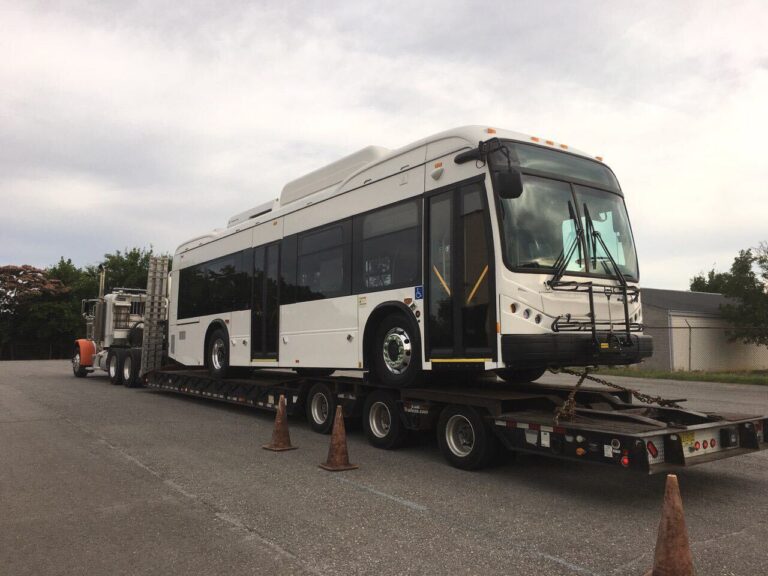
It's always the same deal with rail stuff. You can find old cars for cheap (locomotives not so much, they tend to be worth a lot more than scrap value in spares). The catch is always the transport. I've seen this more than a time or two on rail enthusiast forums. Somebody buys an old caboose or boxcar to just drop behind their house for a couple grand.... and then discovers it's gonna cost at least 3-4x that to move even a few miles. Usually need a heavy duty low boy trailer (https://heavyhaulers.com/blog/wp-content/uploads/2021/01/low...) and a fairly heavy duty crane at both ends.
1: Everything can be bought and sold in this economy, and all the large and weird machines we pass by in our lives have whole production lifecycles where there are firms specialized in making them, and those that use them, and for money everything can be had.
2: In the 90s and 2000s in Switzerland the "warehouse sales" resulting from decommissioning companies and offices were rampant! There was a certain wealth and breadth and a minimum of equipment needed to do any work, and there was also a certain pride in using good equipment. The 90s/2000s switch to the neoliberal economy and getting by with less and less led to many mergers and obsoletions and the like and many beautiful products could be had. Some had also just ran their time. For example drawing tables from the pre CAD days. The world is grand and I'm nostalgic about the days of abundance and overengineering, but I don't mind they won't come back.
You might be able to make a good deal here, buy a bridge for 100 bucks.
You tried driving in central London? Are you mad?
It's in reference to the criminal exploits of confidence man George C Parker.: https://en.wikipedia.org/wiki/George_C._Parker
The federal goverment beurocrats provide arms length objectives, and the coorporation figures out how to acheive them.
SBB profits do not feed into the government general fund, but must be used by the corporation to pay down its debt or invest in future infrastructure and services.
There are now a lot of complaints/demands that they should be required to make more affordable housing with their portfolio.
For CHF 40 you can become a Rega patron and then they will usually pay whatever the insurance didn't cover, I think, but technically they don't have to.