Instead of that I'm choosing to vote with my wallet and mostly stay away until this is resolved. Skyrocketing inflation is not doing anything to change my mind either.
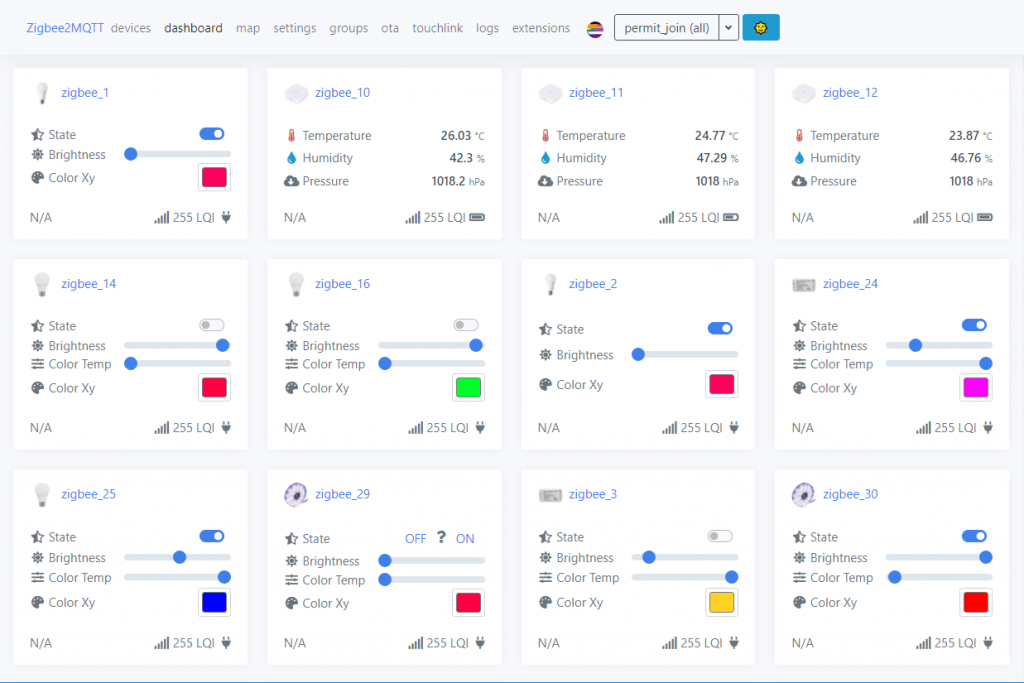
I've settled on a ZigStar Stick for my always-on Raspberry Pi and stick to compatible devices[0] only. I even just stick to the dashboard of Zigbee2MQTT[1], as Home Assistant[2] feels too bloated for my use cases.
Self-hosting and open source will certainly win in the case of smart homes.
[0]: https://www.zigbee2mqtt.io/supported-devices/
[1]: https://flemmingss.com/wp-content/uploads/2021/09/zigbee2mqt...
That Matter light bulb still needs something to control it, but the light bulb is not tied to one control ecosystem -- at all. It works with any Matter-supporting system.
That bulb can even work multiple different Matter systems concurrently. Which sounds dumb, but that helps smooth our transition periods wherein a person switches from one system to another. The old system can continue to operate just fine while the new system is implemented, and then once the new hotness is behaving Good Enough the old one can just be switched off.
There's also complications around networking. Matter over WiFi works great if your networking gear can withstand potentially hundreds of devices connected. Matter over Thread seem to work under specific conditions, but I still haven't been able to pair the first device.
There's also potential issues around device certification.
All in all, Zigbee is a more reliable platform for the moment IMO, even though I have some issues with it as well.
I get all of the features I think I'd want out of something like a light bulb or a wall switch that just responds to commands and reports status. :)
None of my stuff uses Thread yet. I'm cheap, so I tend to buy home automation gear at the very low end of the market and Thread just isn't quite there yet.
Anyway, Zigbee.
I was using Zigbee when that still mostly bare dev and demo boards, >20 years ago. It was neat then (I was using it to consolidate RS-485 serial comms between a bunch of gear mounted on different radio towers), and it's still neat today.
But in home automation, Zigbee has been problematic for me, with devices going offline and coming back according to some unseen agenda. I've gathered that "right way" to fix that is apparently to use repeater-capable devices here or there, but meh: I'd rather build a proper wifi network (with hardwired access points) than buy weird stuff I don't need, put it in places where it isn't otherwise useful, and let Zigbee form its own unsteered mesh.
It just makes more sense to me to build a single wireless network, than to build multiple wireless networks. So I built a proper-enough wifi network with some Mikrotik hardware and that's what I use.
But I still have one Zigbee device (a temperature sensor) and it's been working fine for years. I don't track the rate at which it eats coin cells as well as I could, but I probably get a little over a year out of a random Chinese cell and they don't cost much.
In terms of wireless bandwidth: I find it only sensible at this point to consider 2.4ghz to be trash. It's not worth preserving. Internet speeds (and needs) keep increasing, and that means that 2.4ghz decreases in relative usefulness for work that requires high speed data. And all of my serious devices have 5ghz radios, anyway, and have had them for a long time.
Its biggest strength is also its biggest limitation: Penetration through walls tends to be better, and that means that the band gets stuffed up with noise from the neighbors more than 5ghz does.
It seems OK to make phone calls using a Bluetooth headset at short ranges, though. And it's plenty good-enough to tell a light bulb to turn on or off, run a music streamer, or play with esp32 and pi pico projects.
So even though many others seem to despise the concept: I'm quite deliberately centered on using 2.4ghz wifi for home automation stuff. It works well. I think I reached this position rationally. :)
Interestingly enough, I agree that cheap Matter over WiFi devices work well. I have a bunch of Moes lightbulbs and they worked out of the box, except one that seems to lose its connection after a few minutes of pairing - still pretty good out of about 30, each costing £3-4.
The bigger brands are the worst offenders - SwitchBot, Meross and Tapo are all problematic to an extent.
I'm also just building a solid WiFi network for these devices. If nothing else, I can troubleshoot WiFi a lot more easily than either Thread or Zigbee.
But this seems not to be a well-advertised way of doing things, unfortunately.
Stop pestering me because you think I haven't given you enough money yet. Go away.
But it is available as a plug-in appliance, and they're getting better and better at the Just Works aspects all the time.
And in a world where everything is relative, it's a hell of a lot easier to get started with Home Assistant than it is to get started with something like KNX or Crestron.
And half of them completely disable local network access... Like why?!
The automatic cat feeder works well. So does the roomba. I like my automated blinds but will stick with manual light switches. I consolidated my home theatre remotes. Note how they’re all seperate problems.
The smart home is here. It’s just that it was never a use case for a singular smart home platform. It was always 1000 seperate problems to solve that in no way ever belonged together and the experience was always worse when trying to combine it.
I have a singular smart home platform with one exception: my Dreame cleaning robot. Everything else is either integrated into KNX (lights, appliances, pool, window blinds, etc.) or Ubiquiti (cameras and doors).
But again, new building and I made the mission clear: everything has to fit into this system. Was an interesting work for the electrician ;).
These devices already have a precedent, your apple tv or google/amazon speaker thing. I think we will see these probably become LLM/model/AI gateways in the future.
I would like to explore some open source solutions though, it would mean setting up a local system on a Mac mini for speech recognition and local processing. Bonus is you could use Anthony Daniels (KITT) as your assistant voice.
>I use Home Assistant (https://www.home-assistant.io/). It has an integration for lots of manufacturers. Single app, single entry point, cross manufacturer automations.
The useful things I do use it for are:
-heating control to take advantage of cheaper electric rates (I’m on 15 min spot pricing)
-automatically setting EV charging times to optimized cost
-a remote to start and stop a water pump to water plants in the garden, optionally with a timer
-a remote to consolidate a couple of lights that I want to turn on and off simultaneously to watch movies.
That’s it. Controlling my pool heater would be good but unfortunately it has a safety that trips if the power is interrupted. I’ve been using this system for years and simply cannot think of much else I want to automate.
I live in Bend, Oregon. We have hot summer days, cool nights, and sometimes really bad wildfire smoke.
I can save a lot of money on AC if I open the windows at night and use the attic fan to pull in outside air. But if smoke rolls in, then we'd all be breathing 200+ AQI air all night.
I have outdoor AQI sensors, which if the AQI spikes, will close up the house and turn on the air purifiers.
> Why would I want to automate lights?
We're bad at remembering to turn lights on and off. We like having our porch light on an hour or two after sunset, but don't need to leave it on 24/7. We also have stairwell baseboard lighting that's completely unnecessary during the day, but very nice to have already be on if we get up in the middle of the night. To each their own, though. These are just nice to have. The AQI automation is an actual health benefit to us though.
I suppose that it does make some things less frustrating.
The days when I'd come home from work and see that the porch light got left on all day or find that the pantry light has been left on for hours are all behind me. That's not as important (money-wise) with LEDs as it was with incandescents, but it's good.
It's also fun -- for me, at least -- to think of ways to automate things.
Like: I have a bedroom that tends to get hot on sunny days and overlooks a busy road, and I don't like feeling like I'm on display. So I'd like those blinds closed at night, and open during the day. Sounds simple. I can do that the old fashioned way by opening and closing the blinds with my hands.
Except: If it's hot in there, then maybe they can just stay closed during the day.
Except: Maybe I can let ambient daylight in, and only close the blinds during the day during times when the position of the sun allows for direct sunlight to pour in.
Except: If it's cold in the room and it's during the heating season, then that sunlight is useful energy that saves me money and they should stay open.
Perhaps I could manage all that myself manually every day (and maybe I'll remember to try to get it right, or maybe I won't bother trying at all), or I can code something up one time that does it for me. The latter might not actually be less work, but it's more fun and it's probably going to be more reliable than I am myself.
I have some security stuff setup to turn on a siren when tweakers poke around my open garage and doorway after 11 PM. It doesn’t do anything else, this is just a way to scare them off a bit and to let me know something is up. H the light will also turn red if detects a person at the door (again to ward tweakers off or make them feel watched at least).
I’ve been recently discovering the joy of robovacs, except we have three floors and so I found we need three of them, ugh.
Wait until you're disabled and there are days you can't get out of bed.
Having your bedroom lights fade in at low brightness a few minutes before your alarm goes off is also really nice.
If you live in an area that's not great time wise there are also a lot of arguments to be made for making it look like your home is occupied when you're away.
I also have a porch light that used to have a light sensor, but those sensors keep failing after a few years, and it's a hassle. Instead, Alexa has a schedule for that porch light switch, and you can specify "turn on at sunset" and "turn off at sunrise", and it's perfect.
And I have an Alexa rule for turning off the other lights that it controls (living room, dining room, family room, hallways, but not the porch light) at midnight. Simple and useful in case I forget to turn the lights off.
These days a smart home doing that slowly getting brighter thing regularly fails.
Tech Enthusiasts: Everything in my house is wired to the Internet of Things! I control it all from my smartphone! My smart-house is bluetooth enabled and I can give it voice commands via alexa! I love the future!
Programmers / Engineers: The most recent piece of technology I own is a printer from 2004 and I keep a loaded gun ready to shoot it if it ever makes an unexpected noise.
My garage remote is in a PIN number lock box next to the garage. Open lock box, press remote, close lock box.
That’s smart.
Smart home works? good
Smart home dies? remove the smart switches (held in place by magnets) - and the buttons of dumb switches are exposed. Lights have power-on behavior configured, so they act as dumb lights in this case.
1) after closing the box, randomize the digits: humans are pretty bad at randomization, imagine modeling the randomization delta it won't be perfectly uniform, and the different discs would display similar distributions of rotation. Suppose spinning a disc to randomize it, one might have a peak at delta=+3 and sidelobes with lower frequency. Just a handful of observations when the codes were randomized will reveal the relative positions of the true code, and the only missing information is 10 possible global rotations, which is easy to brute force
2) A second approach is to not let an attacker learn anything by always presenting them with the same information: instead of randomizing, always reset to the same value (0000 or 9999 or any other value of choice). But in this case another attack becomes extremely easy: acoustically detecting the number of indentation clicks used per wheel by recording: without access to actuation direction that gives 1 bit of direction doubt per wheel or only 2^4 = 16 combinations left, easy to brute force.
Anyone installing recording gear to record the clicks, or trying lots of combinations would - in addition to drawing unwanted attention - be pretty dumb to invest the time as there are much better and easier targets.
And good point, didn’t mention that, I do randomize the pin digits.
It is all tradeoffs between security and convenience. We aren’t hiding state secrets and that opens lots of options.
Then I remembered that I have to make shortcuts to bridge two products, it fails half the time, my ikea bridge has to be restarted every 30 minutes, and my smart garage door opener takes 30 seconds to respond now.
So on second thought, yeah, this all sucks.
(I'll see myself out then.)
Apple has this reasonable offer:
  - Buy an Homepod/Apple TB as a home station
  - Everything works locally, even the internet is down.
  - no Accounts.
  - only one privacy policy: Apple's
  - but ofc, you can control everything remote, and Apple makes sure its easy and secure.
  - If Apple does not deem it worthy, it will not get implemented. [1]
  - Things that should be simple are not. Try to set the lights to turn on 10 minutes before your alarm goes off. I'll wait here.
[1] It has been a few years, but last time I checked, CO2 Levels still can only be reported as labeled Levels ("high/low/.."), with the actually ppm Value hidden in some auxiliary value. No way around it, Apple needed to put CO2{ type: integer, range: 0-10000} in some json some where, and they did not come around to do it for like half a decade, at which point I stopped caring.
I had a very similar use case: turn on my espresso machine (via smart plug) 20 minutes before I wake up. It should have been simple, as I already have a sleep schedule with a wake up alarm in the system. It turned out to be such a complicated hassle, that it put me off from using HomeKit for anything more complicated than “press a button to turn on a lamp”.
Also, wouldn't be hard to put in a solution to block that type of traffic over the mic.
https://www.reddit.com/r/sonos/comments/1desj5c/sonos_update...
There's been generation after generation of lighting control. There was a 1950s/1960s thing of putting everything on relays with 24V control signals and panels full of rocker switches. There was x10 in the 1980s. There were "smart" light bulbs in the 2010s. It's just not all that useful.
I mentioned this a few years ago, after I came back from an "Internet of Things" meeting in Dogpatch, in San Francisco. The Samsung guy pitched a refrigerator with a tablet mounted in the door. It didn't really have any more functionality than a refrigerator plus a tablet, but cost more. I asked him why, and he told me because there's a fraction of the population that likes to show off their kitchens, and it would be marketed to them. There were a few other IoT things pitched, all forgettable.
What struck me at the time was that we were in a room that really needed intelligent control. It was an office/meeting space, about 5000 square feet, in an old industrial building. Openable windows looked out on the bay, and there was a manual system with a shaft with a chain fall and a rack and pinion system to open the windows. A similar mechanical setup controlled windows in an openable skylight. The room also had a modern HVAC system, ceiling fans, and lighting.
None of this was coordinated. What should have been happening was that, as people came in and the CO2 level went up, the bay side windows and skylight windows should have opened, to get the CO2 level down and cool the room a bit. As the sun set and the outside temperature dropped, the bay side windows should have mostly closed, the ceiling fans should have started in the upward direction, and the skylight windows should have stayed open, to prevent the room from cooling too much while keeping the CO2 level down. Lighting should have increased as darkness fell. As it got later, and people started to leave, the bay side windows could close completely and the fan RPMs could drop. When everybody left, as noticed by motion detectors, the system should have dimmed the lights and done a quick fresh air purge - skylights open, bay windows open, fans to max in the downward direction. Temperature would drop, but unless it went below 60F, no need to turn on heat on an empty room. Then everything seals up tight for the night. Very little energy consumption. Tomorrow is another day, and the room should continue to react to the people load.
But no. You rarely see that kind of control. Except in hotel function rooms. Hotels put in systems like that because they have big rooms with widely varying people load, and customers who complain if a conference room is stuffy or hot or cold. Hotels have significant HVAC costs, and it's worth it to have the HVAC systems adapt to room usage. Honeywell and Johnson Controls sell systems for this for commercial buildings. They have both inside and outside sensors, and can operate fans, dampers, and HVAC separately.
In practice, it started opening and closing shutters for no reason, when clouds obscured the sun, and then went away. Or even when some sort of reflection hit some sensor, somewhere in the building.
I'm sure it's doable, but unlike factories, where automation is related to income and thus profits, most commercial buildings are built by the cheapest of cheaters, and so they will skimp on sensor, on intelligence, on integration, or whatever, just to follow the minimally-compliant features. So you get all kinds of erratic behavior, lack of redundancy, stupid intelligence that ends up overridden by humans.
Schools and colleges have the same HVAC problem, with huge variations in people load, but don't have the same incentive to get it right.
(I once found a computer room in the Gates Building at Stanford that had two packaged air conditioning systems at opposite ends of the room. One was heating and the other was cooling. You're supposed to get a control box that synchronizes your HVAC units when you have more than one, but they didn't. Each was running on its own thermostat. Huge energy consumption with an error like that.)
Few verticals outside of video storage could support a monthly subscription putting negative pressure on supporting a shipped product.
Most smart home products are anti-social and had a low k-factor. You don’t want to share access to your scale to more than a handful (2?) people. This makes market adoption slower than a social networking app.
Touched on in the video but median shelf life for these $200 products is 8 years. Thats very “bad” relative to most other consumer hardware. Especially say a $1500 smartphone that’s replaced every 2 years.
Actuation rates on many categories are abysmal. Your smart smoke detector may go years without sending you a message. Compare to say screentime for ChatGPT on mobile averaging hours per day.
Interestingly a lot of those floundering smart home products became thriving businesses when pivoting to smart office focus. Subscriptions go up, user counts go up, utility goes up.
A smart device that doesn't need a subscription to feed and keep track of, doesn't consume hours of my life trying to get my attention, doesn't get shared with the world, and doesn't bother me with needless bullshit? It just quietly does its thing and it also lasts 8 years?
That sounds great! Count me in!
(Actually, I'm already a member. My personal favorite smart devices come with open-source ESPHome firmware pre-installed, and they have all of the features I've described above. These manufacturers make their money by exchanging money for widgets in simple one-time transactions, not by being sneaky under-handed rent-seeking slimeballs who live to optimize ways continuously extract money out of my billfold for the rest of my life.)
My one issue, while building a custom HA controller is... There's no standard for discovering the HA controller and have it join WiFi... So that will require an app. Just to do mDNS and TLS bootstrapping. Maybe I'll use a cloud relay and Web Bluetooth for it. Would relieve both issues and provisioning could happen in any browser supporting Bluetooth.
Ideally my house should have 3 phase power, but I'm not yet inconvenienced enough to go through the headache of getting this organized. This means that at any time my maximum power draw can be 13.8 kW (60A at 230V).
Generally this is enough, but I have on occasion tripped my mains due to drawing too much at a particular moment, I have the following significant power draw items:
- 4x underfloor heating circuits at 3kW each.
- 2x electric geyser at 2.5kw each.
- Electric oven and induction stove, not sure on amount but I think they can collectively pull 6kW easily.
- Pool pump at 0.6kW.
- Inverter re-charging batteries at night (I only have 10kWh of storage and want backup power at night in case of a power outage), I can configure maximum draw here, but could probably pull up to 8kW if I wanted.
- PHEV at 3kW.
When we had regular load shedding here (South Africa) it was very easy for the power to trip if I didn't manage things, particularly if I left underfloor turned on in the winter at night. What would happen is that power would have been off for ~2 hours, then comes back and everything on a thermostat would turn on AND the inverter would start charging its battery.
If I proactively turned the floors off then I wouldn't generally have an issue.
Even without a power outage, it is possible to trip things when using stove/oven with underfloor heating turned on or if both the geysers happened turn on their elements at an inopportune moment.
IoT can allow this to all be managed, it can have rules like:
- Don't run ALL the underfloor heating circuits at the same moment, alternate between them.
- If the stove/oven is in use, don't turn on the element for either of the geysers, it can wait.
- Temporarily stop charging the PHEV or inverter's batteries until there is less power demand.
- Temporarily turn off the pool pump if it would help.
It can also create other opportunities around solar energy production, you can do things like have only "excess" energy go into your (PH)EV provided it has a minimum charge level.
Other automations which I wouldn't mind:
- Exterior lights on a schedule based sunrise/sunset.
- When I'm away it would be nice to be able to remotely turn on/off particular interior lights and open/close curtains at particular times of the day.
What I actually have automated:
- My alarm system has (not great) app, I have wired it up to my garage door so I can remotely let in the armed response security company in the event of the alarm going off and I'm not at the house.
- I use the Tuya ecosystem to automatically turn my geyser and pool pump off on a schedule and if there is a power outage or load shedding. This allows me to heat the geyser still even if there is a power outage and it's the middle of the day with lots of sun on my solar panels.
HA is something I want to look at one day (when I have more time), meanwhile the Tuya ecosystem is very useful considering its minimal amount of time investment required.
1. I give you money
2. You give me widget.
3. That's it. "Customer relationship" over.
arguing with an AI that is intentionaly obtuse, is not what anyone wants when its time to try enjoying your home. noone needs to have a conversation with thier lightswitch, its for turning light on or off not pretending to be your pal and trying to exploit emotional reflexes.
i have a broken record for this, "stop wasting time and effort trying to pretend to be human, and get to work building something that does what its told to do."
This feels like "I am not seeing ads anymore therefore it doesnt exist"