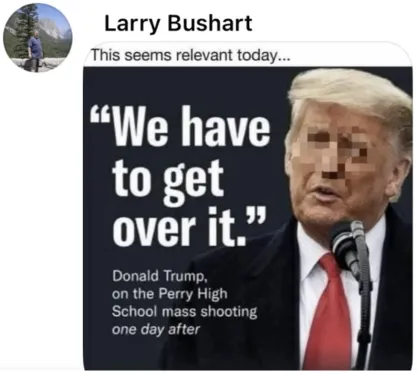
Police don't face criminal charges for this.
https://www.thetimes.com/uk/crime/article/police-make-30-arr...
Of the 90% many will accept their fault and receive a caution or warning
Edit: and none of those cases would involve pretrial remand/jail
This is the problem with going after 'harmful communication'. It is not something that can be defined precisely, which allows government officials to choose to interpret it in whatever way they want when the enforce it. Obviously in these cases, the courts ruled against the official's interpretation, but that didn't stop this guy from having to spend 37 days in jail before they released him.
As they say "you can beat the rap but you can't beat the ride".
While it is good that the UK version doesn't send you to pretrial jail, you still have to fight the charge. You have to respond, spend time in court, hire council, and hope you can convince the courts that your post doesn't fit the definition of incitement to violence.
This has a chilling effect on free speech, even if all the cases are eventually thrown out. This is a tactic the Trump administration has used repeatedly. Go after people in court for things that are clearly not illegal. You make the person fight the charges, both in court and in the public eye, and then the cases are dismissed eventually and the administration moves on. All it does is make people factor this in when deciding how to act; is my act of protest worth having to fight this in court?
https://en.wikipedia.org/wiki/Arrest_and_indictment_of_Pavel...
> If a trans-identified male is in a female-only space, he is committing a violent, abusive act. Make a scene, call the cops and if all else fails, punch him in the balls
This seems like a straightforward call to violence to me. And he was released after police ascertained that he had no intent to act on these statements.
If someone made posts along the lines of "Christians are abusive, punch them" would it be surprising if CBP took them aside for further questioning?
But in general US law sets a high bar for claims of incitement. Your hypothetical statement would certainly be considered protected speech. That is, of course, not to say that you would not be a victim of vindictive prosecution ;)
Even at his age of 60 (I'm getting up there), I wouldn't have made that deal.
https://www.newschannel5.com/news/newschannel-5-investigates...
> “The machinery of government should never be weaponized against any American, and it is this Department’s intention to make right the wrongs that were previously done while ensuring this never happens again,” said Acting Attorney General Todd Blanche.
https://www.justice.gov/opa/pr/justice-department-announces-...
He'll dole out small amounts of it to J6ers and other supporters in a public display of rewarding loyalty, but enriching himself is always the prime directive over every other concern.
More succinctly, down this path lie guillotines.
Also, the body of federal law and regulations is so vast that smart people estimate the average person unknowingly breaks roughly 3 federal criminal laws per day[1], giving the federal government the legal ability to arbitrarily arrest anyone they want.
[0] James Duane, You have the right to remain innocent, 2016
[1] Harvey Silverglate, Three Felonies a Day: How the Feds Target the Innocent, 2011.
I genuinely don't think certain charges relating to preserving one's freedom should even be a crime in of it self.
Unless you endanger others in an extreme manner, things like "resisting arrest", running from police, or attempting to escape prison shouldn't be charges within themselves.
People love the phrase "you can beat the rap, not the ride", but that essentially gives broad power to harass and damage one's life without recourse sans extremely expensive legal routes. In this example, a man lost his freedom for 37 days over a bogus charge and was paid by the taxpayers to essentially shut up.
I’m sure that would never be abused.
If dylan roof was allowed to live his full natural life in jail, there would be race riots in the US by the end of the press conference.
Generally, I'm against incarceration for that reason. I think the relatively muted violence of it is too easy to stomach for the public, which leads to people letting the system get sloppy. For public and infamous crimes, however, where the question is not "what act took place", but rather "did this act constitute a crime, and if so, what is the punishment?"-type cases, I'm perfectly fine with capital punishment being on the table. We trust public officials with significant authority, and abuse of that authority is utterly irredeemable. Frankly, for elected officials I'd support a "two-thirds vote and you hang" policy. If you want power, and seek out power, you have an immense responsibility to live up to your constituent's expectations.
The ones that were executed would have been alive for the exoneration if we they had been given life in prison instead.
I guess that last part is the perspective I'd change, for a more compassionate world. I'd much rather ask "did this act constitute a crime, and if so, what made the person commit that crime, and how can we help them not do that in the future again?".
My compassion for my fellow man is why I suggest we wait for them to commit a crime before punishing such behavior.
The US military is subject to a higher standard, the Uniform Code of Military Justice. Penalties for US service members breaking the law or codes of conduct are much higher and much more severe than civilians. The US military makes routine example of law breakers and misconduct.
The US police force, by contrast, is civilian. They are not licensed, commissioned, or subject to additional standards. Certainly not nationwide standards that would bar police removed from their post from finding similar work elsewhere.
We should pay our police officers more, make them undergo nationally standardized training and licensing, and then hold them to a higher standard if and when they break the law.
Police court-martial.
Honest question, is this currently true?
I wouldn't say in most. In many they wouldn't
The current implementation of it- where you need to have "clearly establish" a Constitutional right with a prior case in this region- is based on Pearson v. Callahan from 2009, and it takes a terrible Supreme Court precedent and makes it even worse. This has created the patchwork "no case in the circuit has clearly established that a police officer must not make a warrantless search on a Tuesday in May" sort of quibbling.
The work of legislatures has been to roll back qualified immunity. Colorado, New Mexico, and California have removed qualified immunity for their law enforcement officers at the state level. LEO's can still claim qualified immunity for suits under federal law, but they cannot for some suits brought under state law or the state constitution in those states.
The Supreme Court has also, at the same time they've made it harder to hold police to account, made it harder to hold politicians to account, gutting bribery laws and expanding "free speech" to include paying politicians. And the recent idea that a President can't be prosecuted for any "official acts" is also nonsense created by the Supreme Court. This isn't Congress fault, there were laws that prevented it. The Supreme Court just decided that they didn't want to enforce those laws.
The Supreme Court at the root of a lot of the dysfunction in American politics, and somehow still has more respect than they deserve.
> California [has] removed qualified immunity for their law enforcement officers at the state level.
According to https://en.wikipedia.org/wiki/Qualified_immunity#State_law, it's Connecticut, not California, as the third state which limited qualified immunity.
I'm not a lawyer, and I have never lived in California so I don't know how much that covers. The QI removal I knew best was Colorado (CO's law also made individual LEO's have to pay with their own money, up to certain limits), and was doing some googling which listed California and New Mexico.
The real problem right now is how the courts determine if an official was acting in good faith. Right now they are assumed to have acted in good faith unless it has already been “clearly established” that what they did was illegal. This means that the official can argue that they didn’t know that their actions were illegal because no prior case ever dealt with that exact fact pattern. This works far too often and has let a lot of very guilty police get away with their crimes. Still, some police officers _are_ held to account, so it is not actually impossible.
It'd be an interesting thing to see garnishing of wages, deductions from pension funds, or loss of some kind of bonus system to help balance the scales.
I had to spend money to sue the local unemployment office because a bureaucrat there illegally cut off my unemployment payments. They lost and had to pay me back in arrears but that money came from the taxpayers(so me and you) and that asshole who did that is still working there just fine collection golden handcuff paychecks and a gold plated pension when she retires.
All civil servants need a form of direct accountability with consequences for their mistakes at work, especially when malicious and repeated. Currently they're untouchable and the taxpayer foots the bill for their mistakes with no repercussion.
The suit was filed against Perry County, TN, not the state or federal government. A quick google says that its budget is $33M, so in fact this is a very impactful settlement for the county.
No they won't face anything like that. They'll claim they were just enforcing hate speech laws to protect the country's leadership from far right supremacists and will be let go scuff free.
You also won't get $835,000 from the state for being falsely imprisoned. You're lucky to get maybe 5000 Euros for your trouble.
In Germany for instance the politicians are protected by law against negative comments from the public. You can't even call them fat or the send the police after you. Sure you wont' get locked up for the fat comment, but the point of the police going after people with mean comments is only intimidation, to get people to self censor and stop criticizing the leadership.
Americans with their 1st, 2nd, nth amendments, have an overly rosy view of the EU justice system which is far more lenient to law enforcement and speech crackdowns.
Ultimately the US lacks some sort of Federal "inspectorate of police" that would be able to ban people from being law enforcement officers or at least require e.g. retraining or restriction of duties, without leaving it up to frankly corrupt local authorities.
Double-edged sword though when the Feds get captured by the Party, though.
I don't think this is true, or at least it's not entirely true.
Various states and law enforcement agencies have an office of the inspector general which at least should provide some oversight. We also have the courts and individual officers and agencies can be sued in the court of law which also provides a means of oversight. You seem to be suggesting that everything is corrupt, corrupt local authorities, corrupt feds captured by the party. I think that level of perceived corruption is not reflected in operational reality.
Some states or local police organizations do in fact look at past police records for applicants. There's a bit of variation here, but it's probably a bit better organized than, say the EU where outside of other bureaucratic hurdles I don't believe there is any real way to stop some German citizen who should be banned from being a police officer from moving to Estonia and being a police officer. Though perhaps I'm wrong and there is an EU-wide database that all countries and their police forces use?
I know the UK isn't in the EU, but I just bring that up as I think it may be a bit closer of an example.
Eh, just fire him and garnish a portion of his future wages to pay back the cost to the city.
> In most European legal systems a law enforcement officer overstepping his legal authority would face criminal charges for it
Do you have a recent example?
Every settlement against the police should be taken from their pension fund. This is something I've been advocating for decades now, because it creates an incentive not to do things like this. Right now, good cops don't patrol bad cops because it won't affect them. By aligning the incentives right, it will mean good cops will force out the bad cops quickly.
I did not expect to read that the victim was a retired law enforcement officer. This whole case is weird. I’m glad he won a settlement but I would like to see some actual accountability.
It’s pretty toxic that people don’t want to take responsibility for their own government in a democracy. In this case, it’s especially bad, given the sheriff is elected by the people directly. But I’d go even further and say even where control is less direct, we need incentives for voters to take this stuff seriously.
Adding a line item to their property tax bill showing how much is paid into settling lawsuits will not make people think that they should demand more accountability. They will think that it should be harder to take legal action against the police.
I think part of the problem here is that this is usually hidden from visibility (intentionally) by officials because it reflects negatively on them.
It may make the news for a day or two, never get seen by the majority of voters, and get swept away later under the deluge of distraction most "infotainment pretending to be news" provides.
---
Go further and just list all government settlements/court judgements underneath the elected official in charge of the branch responsible.
If citizens had granular voting power (i.e. liquid democracy), this would make more sense. As it stands you get to vote for team red or team blue once in a while and hope that their votes impact that line item you’re concerned about.
Still, this idea bears merit for other reasons. Americans routinely underestimate how much money is spent on Social Security, healthcare, and debt payments, and overestimate how much money is spent on education and infrastructure. More clarity into that could help build real political momentum to actually balance the budget.
* We does not mean everyon every time - it means the people from whom an official vests their power.
They do not mention what their cut of that will be, but since they also do not specifically state they were working pro bono, I'd imagine it'll be around 40-50%.
Victory would be if the Sheriff and others involved actually went to jail.
Until that happens, expect other power-trippers to keep doing such things. After all, what do they have to lose? Not a penny! Since the fine comes out of the pool of money that taxpayers collected!
But it should not get paid from taxpayer money, instea the offending officer ahould pay it
Thus, the appropriate remedy should put pressure on the conduct of the whole local government, whose use of tax-payer funds is accountable to the electorate. Punishing just the one officer by depleting his private resources won't move toward systemic reform.
And finally, on the principle of the matter, the officer can't and doesn't jail people on his own power and private authority as a citizen. He does so on the power and authority of the government that grants him his office. His actions as a private citizen did not harm the man. His public actions as an agent of the government harmed the man. In other words, the government did wrong, through the officer.
I know it gets more complicated, especially with larger cities--and doubly so where states have control over police departments or similar. But in general, in a great number of cities and localities, this judgment alone would have a big impact on oversight and governance of the department, probably even if the governing body also disliked the plaintiff's political views. $835k is almost 3 mills of property tax revenue in my city. So, that's my $0.02.
My doctor is required to carry malpractice insurance. Those who commit repeated egregious mistakes become uninsurable.
Make cops do the same.
Try electing more sensible politicians and put more checks and balances into work to stop this from happening again if you don't want your tax money wasted on this.
And to say the least, I doubt the officer has $800K.
Digging further[0]: "Morrow and Weems have been sued in their personal capacities and could “be on the hook for monetary damages,” a press release from Bushart’s legal team at the Foundation for Individual Rights and Expression (FIRE) said. Perry County, Tennessee, is also a defendant since it’s liable for unconstitutional acts of its sheriffs."
So, it sounds like most of the burden is placed directly on the shoulders of the guilty "officers of the law".
0: https://arstechnica.com/tech-policy/2025/12/man-sues-cops-wh...
We need to tame the impulse to throw people in jail for doing things we dislike, not just point it at different targets.
I see several comments saying that criminal charges should be brought over this. That is not the way.
Some who are in jail should not be. Some who aren't in jail should be. If I locked you up for a month over a meme, I'd go to jail for years.
Turning it into an escalating back and forth of each side trying to imprison the other, is not conducive to the kind of change we need. To take a recent example, while I don't particularly like James Comey or Letitia James, I don't think they should have been targeted. That kind of stuff is what happens when it escalates to each side calling for the other side to be locked up.
you're implying that the two sides are morally and legally equivalent, and both are just engaging in retaliatory squabbling. that is a ridiculous implication
one "side" routinely flaunts the law, steals from the public, abuses and ignores the courts, and has a complete disregard for civil rights, legal procedure, and credibility. it uses the DoJ as a personal henchman, stringing up frivolous charges targeted at political enemies.
the other "side" is trying to enforce the law.
I view it differently. To me there's the pro incarceration side and the anti incarceration side. Both parties institutionally are pro prosecution and have failed to reign in abuses.
Both sides have abused the courts. Instead of arguing over which side has abused them worse (I may not even disagree with you on that!) I prefer to focus on reducing the potential for abuse.
Sounds great in theory but at the end of the day the backstop to bad behavior is force, one avenue of which is incarceration.
This is just the paradox of tolerance.
Agreed. Cases this knowingly frivolous, for example, should be treated as the criminal kidnapping or false imprisonment it would be if any other citizen perpetrated it.
Changing the system means removing the potential for abuse of power, not punishing abuse of power after the fact.
The point of such a thing is to deter similar conduct in the future.
The fact that this isn't a crime, and that qualified immunity typically means they can't even be held responsible civily, is part of what encourages police to commit misconduct like this.
The only folks punished here were the local taxpayers footing the bill.
The core problem here is that the system allowed an innocent person to stay in jail. That needs to be fixed on a system level, not by trying to punish people after the fact for bad outcomes.
No; the system got the innocent person out of jail and a hefty settlement for their trouble. The system is now, unfortunately, allowing the guilty parties to stay employed as cops after performing a kidnapping.
> That needs to be fixed on a system level, not by trying to punish people after the fact for bad outcomes.
An accidental positive on a drug test is a bad outcome.
Locking someone up for more than a month because they posted a photo of the President and a quote he actually said is a crime.
I also think every party involved in that failure should be fired and rendered unemployable in the field.
At a certain point, punishing abuse of power after the fact is the only way to discourage the potential abuse of power. Like there is nothing that actually stops you or me from going and kidnapping someone. And that same dynamic applies to someone who happens to also be a sheriff who controls a jail due to his employment. There is no magic wand for the system to wave that makes it so that the individuals employed by that system can't simply break the law.
Personal civil liability and firing can also help.
You are demonstrating what I think will be one of the most pernicious outcomes of the Trump administration's transformation of the Justice Department: the blurring of lines between law enforcement, criminality, and corruption as the institution is debased and public trust is lost.
I am not both sidesing. I'm saying that there are better reform options than adding additional criminal statutes that are likely to be abused.
Put simply, do you want the Trump administration to be able to bring criminal charges against any prosecutor or judge that they can argue brought a bad case?
America has one of the highest rates of incarceration in the world (used to be #1) but suggest that maybe we're overcriminalized and you must be talking nonsense.
Or do you not? All these things happen in America, and the officers involved almost never face meaningful consequences. Where do you draw the line, if at all?
Rape and murder are existing crimes, and they should be applied equally to police officers.
I think that the core problem with the system is not individual bad actors, but overcriminalization and the acceptance of that by judges and juries. To solve that you need actual reform, and adding a new crime that would inevitably be weaponized is not the way.
The whole concept of holding people "accountable" is the wrong frame. It's precisely that mindset that created this highly flawed system. I want to reduce bad things, not to feel good because people who did bad things are punished.
And when you think about how to prevent bad cases from being brought, you need to systematically reduce the power of those who can make such decisions.
Added: I do want strong civil liability for these cases, which we do have, which is why OP was able to get a good settlement. We should expand that to federal cases and lower the threshold.
No, but they clearly follow from what you have said.
> Rape and murder are existing crimes, and they should be applied equally to police officers.
Okay, but they aren't, because police enjoy broad immunity and benefit of the doubt from (and during) prosecution. How do you suggest we fix this?
Additionally, I am not sure you appreciate the magnitude of harm that can be caused by locking somebody up for months. They can lose their house, their job, their pets, their kids. They miss important life events. The payout in this case was fully justified, though, of course---since the officer himself was not held accountable---it is the taxpayer who will foot the bill.
> The whole concept of holding people "accountable" is the wrong frame. It's precisely that mindset that created this highly flawed system. I want to reduce bad things, not to feel good because people who did bad things are punished.
Holding people accountable is not the same as pursuing retributive justice for its own sake. I agree that the latter is bad and that it is pervasive in our justice system. But I don't agree that we shouldn't hold people responsible in any way for what they have done, especially if there are no mitigating factors.
I appreciate the massive harms done by incarceration, which I why I support vastly reducing it.
How about kidnapping and false imprisonment, as in this case?
What kind of mindset do you need to have where you think the only way to prevent someone from doing something is via the threat of imprisonment after the fact? The vast majority of people don't do this, and that's because they don't have the power to do it, not because they don't want to.
Makes sense.
They falsely claimed he'd made an actionable threat. We can't remove their power to request warrants and arrest people for legitimately threatening others, right?
They misused power.
I think there are ways to have a system where judges do that, without having to criminally prosecute either cops or judges.
But they lied to obtain the warrant.
Would welcome reform that makes it harder to lie on warrant affidavits, although again, that should be civil in nature.
Yes, we call that lying by omission.
They knew that information would result in the warrant not being granted, so they left it out.
Nobody should have this power, and then abuse of power wouldn't be an issue.
It's nearly impossible to get paid for malicious prosecution by the federal government. Read up on https://en.wikipedia.org/wiki/Hyde_Amendment_(1997)
>A 2010 investigation by USA Today "found the law has left innocent people... coping not only with ruined careers and reputations but with heavy legal costs. And it hasn't stopped federal prosecutors from committing misconduct or pursuing legally questionable cases."[5] The investigation "documented 201 cases in the years since the law's passage in which federal judges found that Justice Department prosecutors violated laws or ethics rules. Although those represent a tiny fraction of the tens of thousands of federal criminal cases filed each year, the problems were so grave that judges dismissed indictments, reversed convictions or rebuked prosecutors for misconduct. Still, USA Today found only 13 cases in which the government paid anything toward defendants' legal bills. Most people never seek compensation. Most who do end up emptyhanded."[5]
The case in OP would never have settled if it was against the federal government rather than a state. Also, the feds cap the amount paid for wrongful imprisonment at $50k/year, by statute.
We need a way to make the federal government pay out for malicious prosecution cases, just as OP got paid.
See e.g. Douglass Mackey. He posted some misleading memes on Twitter about the election, falsely claiming that people could vote by text, and got arrested and found guilty at trial until eventually the 2nd circuit said that what he did wasn't a crime. Should he be compensated? Should the prosecutor and judge in his case face their own criminal prosecutions?
We'll see. https://www.justice.gov/opa/pr/justice-department-announces-...
> See e.g. Douglass Mackey. He posted some misleading memes on Twitter about the election, falsely claiming that people could vote by text, and got arrested and found guilty at trial until eventually the 2nd circuit said that what he did wasn't a crime. Should he be compensated? Should the prosecutor and judge in his case face their own criminal prosecutions?
"falsely claiming" is a pretty big distinction between these cases, yes?
https://en.wikipedia.org/wiki/Douglass_Mackey says he got off, in part, because no one provably fell for his trick, not that the behavior was legal.
Of course any two cases are going to be different, and the guy posting memes on your side is going to be more sympathetic to you than the guy posting memes that you don't like.
That's part of my point. If you create a criminal statute that applies to OP, someone is going to try applying it in a case like Mackey's. If you don't think it should be applied in Mackey's case, how would you word it to cover just the cases you like and not those you don't?
> That meme — which Larry didn’t create or alter...
> Weems admitted in a later interview that he knew at the time of the arrest that Larry’s Facebook post was a pre-existing meme that referred to an actual shooting that took place in a different state, over 500 miles away…
He didn't create it, the meme was accurate, and the cops knew that. Every bit of the conduct they attempted to punish was clearly legal, and they knew it.
The opinion you reference is at https://ww3.ca2.uscourts.gov/decisions/OPN/23-7577_opn.pdf.
"cannot alone establish Mackey’s knowing agreement" clearly indicates that things would have been different if they could have established that conduct.
Anyway I don't see how you'd word a law that only applies to the cases you like and not the ones you don't.
Also, other people will like different cases than you, including the judge and jury in whatever case gets brought based on the statute you're proposing.
Terms like "willful" and "intent" are all over our laws and would work just fine here. Assessing that is why we have juries.
This comment has too much snark, but anybody who says the Trump administration won't do something because it's illegal/against norms __hasn't been paying attention__
I'm saying that for decades, people who were maliciously prosecuted by the federal government had effectively no recourse.
It's good to change that, and I'm hopeful that the new fund does some of that. I would prefer to change the system to vastly reduce the threshold for finding the federal government liable in such cases.
> Kathleen Williams, the judge handling the lawsuit, dismissed the case on Monday and, in her filing, admonished the government agencies, notably the Justice Department, for failing to be transparent about the settlement.
> She said no agency "submitted any settlement documents nor filed any documents ensuring that settlement was appropriate where there was an outstanding question as to whether an actual case or controversy existed."
https://www.npr.org/2026/05/19/g-s1-122938/irs-trump-settlem...
You'd have to change the law to allow for prosecutions in cases like this, and that change would likely be weaponized in other cases.
I think it's a shame this doesn't come with criminal charges, though. False imprisonment? Kidnapping?
His trouble isn't just from the time in jail, though. It's from all the Trump supporters who harass him as well. Previously, and in the future.
(And let's face it, the outcome here was guaranteed, and the inevitable settlement was always gonna include attorney fees or be done pro-bono.)
You can almost never hold anyone in government accountable. You are forced to sue your own community to get some shred of justice while the actual people who violated your rights face zero accountability.
Tell lawmakers who want your vote this November that you want an end to qualified immunity. Agents of the state should not be less accountable to the laws of the land than regular individuals.
> Weems admitted in a later interview that he knew at the time of the arrest that Larry’s Facebook post was a pre-existing meme that referred to an actual shooting that took place in a different state, over 500 miles away. But Weems and Morrow left out that extremely important context from their warrant application.
What level of taxpayer due dilligence are you envisioning here?
No, he did not literally campaign on those specific words.
Did he align himself with people who have and continue to violate the First Amendment (among many others)?
Yes.
> What level of taxpayer due dilligence are you envisioning here?
About 5 minutes.
Basic responsibility sits with those who commit the act.
1. Make Trump meme 2. Go to jail for N days 3. Profit ($22k per day)
Nice ;-)
Political opinion is always protected.
To those of you downvoting, please articulate why you think something deserves a downvote. As it is, I can only assume rather hypocritical double standards. Someone saying something anti-Trump is ok, but someone saying something anti-Leftist (or Clinton) is not?
(For the record, I 100% am on the side of the guy who was jailed. Just as I am on for the guy who retweeted that meme in 2016. Abusing government power is unacceptable no matter who it benefits.)
In the other, it was false information, a grand jury indicted, and a jury convicted. The appeal rested on the government struggling to demonstrate a) anyone actively fell for the information and b) the conspiracy element. (https://ww3.ca2.uscourts.gov/decisions/OPN/23-7577_opn.pdf)
Somehow, this distinction is... bias?