77 pointsby celsoazevedo7 hours ago12 comments
  • winfredJa7 hours ago
    I’m pretty sure solar roof was introduced as a way to pump stock when Tesla was doing poor financially
    • peterisza4 hours ago
      I think it was a genuine attempt but they failed to find a simple enough solution.
      • moffkalast2 hours ago
        Invisible solar is a genuine use case in areas with shitty power tripping HOAs, but even regular solar takes a decade to break even, so if you sell something like that at inflated Tesla level prices then they simply never will and there is no reason to buy them in the first place.
    • vasco6 hours ago
      And to misdirect the acquisition of Solar City, famous for being run by Elons cousins to basically pocket all the tax credits, but which was not going well.
    • habitue4 hours ago
      I'm no Musk fanboy but I think this kind of maximally cynical take is tiresome. They thought it would work, they expended significant engineering effort and money making it real and producing it and selling it to customers.

      The simplest explanation is that they did all that and the market didn't want it. The economics of traditional panels outweighed the aesthetic advantages of tiles and they're pivoting. No conspiracy or fraud need be invoked.

      • u1hcw9nx2 hours ago
        But fraud was involved.

        Financially it was part of SolarCity bailout (Musk's cousin). It heavily heavily penalized Tesla shareholders and smelled of a family bailout. Solar Roof was announced so hastily in October 2016 justify the merger and stave off massive shareholder lawsuits. There was little effort in the roof development after bailout was a success, minus the bait-and-switch lawsuits.

        There was genuine concept level development at some point, but it was developed into product after they knew it did not work to keep lawyers happy.

      • oliwarner3 hours ago
        > They thought it would work

        That's the problem though. Thinking your product will get by on looks when it's clearly outcompeted on performance, price, availability and longevity. That's not just optimism, it's delusion.

        • cheschire3 hours ago
          Pretty sure this didn’t help either though:

          > Customer service complaints are pervasive and consistent. Tesla Energy has a 2.6 out of 5 rating on SolarReviews

      • xingped3 hours ago
        You're not entirely wrong on it being a maximally cynical take, but I think it depends on where the idea originated. Yes, they expended a lot on engineering to make it real, but you can do that with any idea. I think what matters was if it was a feasible idea put forth from a reasonable source or if it was another grand delusion from Musk that everyone just had to make as real as possible despite their own misgivings on the idea.
        • queenkjuulan hour ago
          Imo basically this, the attempt to make it work is downstream of musk deciding it had to be attempted. Musk can decide to spend money on a project whether or not it's genuine or feasible. This seems a clear cut case of musk designing a bad product and engineers doing their best to implement it despite the nonsensical constraints
      • alfiedotwtf3 hours ago
        Of course the market wanted it. I wanted it. My friends wanted it. But we couldn’t buy it because it was vapourware !

        From this to self-driving cars in 2 years to tunnels that will change public transport… maybe Musk should prototype and see what’s actually possible before telling the market. I mean come on - it’s borderline fraud in order to pump stocks - there’s got to be stockholders that are forming class actions as we speak

        • SXX3 hours ago
          Both self driving craze and car tunnel madness is only possible at all because how car centric US mindset is. If you even try to suggest that people could instead use good public transport and pedestrian infrastructure they would look at you like you are some sort of crazy.

          Musk just takes car centric society pipe dreams and sell it back to them.

          Like OMG you transiting to work and can safely stay in your phone 99% of time. In other countries this called train or a bus. Solved in London with 1863 tech.

    • ekjhgkejhgk3 hours ago
      Enron Musk.
    • Veserv5 hours ago
      Nah, Elon Musk faked the demo [1] so he could defraud Tesla investors into bailing out his cousins.

      [1] https://mansionengineer.com/2018/08/10/elon-musk-tesla-and-t...

      • echelon_muskan hour ago
        > Musk unveiled on October 28 at an event at Universal Studios’ back lot in Los Angeles, on an old residential set used in Desperate Housewives

        > There’s a reason that they announced the idea on a fake block in a fake neighborhood with fake houses!

        Interesting read.

  • unsnap_biceps6 hours ago
    Did any other manufacturers build their own version? It seems like the right long term idea but the lack of other players seems to indicate there's some underlying issue that isn't solved yet.
    • riffraff5 hours ago
      There are a few companies, I remember Invisible Solar which produces modules which look like traditional clay tiles.

      The market pitch is different tho, they are aimed at providing less effective solar for places where you have a hard need to keep the old look, old churches, monumental buildings and such.

    • shellfishgene4 hours ago
      Even just searching in Germany there are at least 4 companies making different designs. I guess they must be selling quite well. Most make non solar tiles of the same size and design for shaded parts of the roof.
    • ZeroGravitas4 hours ago
      There's a few competitors.

      The market shrank because standard panels and their mounting techniques got more aesthetically pleasing and cheaper.

    • killjoywashere6 hours ago
      GAF did. There are two issues: 1) too expensive 2) not modular. I like that I can separate my solar decision from my roof decision. Panels make that possible.
    • torginus2 hours ago
      I mean in general it could be a right-ish idea. I myself have noticed when buying solar panels after replacing shingles that basically the per sqm cost of solar panels is like 2x of shingles (of the not super expensive kind). It could be easily more economical to use a modern version of this to replace your roof.

      On the other hand, Tesla's solar shingles are tiny compared to panels, more in the shape of actual shingle strips, means tons of connectors, wiring losses, dangerous shorts (these things carry 10s of amps) etc. and probably a nightmare to troubleshoot.

      I would not get these for any reason other than aesthetics.

    • para_parolu6 hours ago
      I did consider but there are 2 issues. 1. Efficiency. Not all roof parts can be exposed to sun. You overpay 2. You need to time it with roof change
      • ikr6783 hours ago
        Home insurance also (ie replacement cost after damaging weather event).
        • queenkjuul30 minutes ago
          I can't help but think that this essentially ruled it out in much of the country -- i get the impression Tesla doesn't tend to consider Midwest markets in their initial engineering
    • cyberax4 hours ago
      The problem is the cost. Tiles are pretty small, and you need to wire them together. This means a lot of small-gauge wires going all through your roof.

      Multiple tiles also need to be connected in series to get reasonable efficiency, so you get plenty of failure points where one bad connection can cause a significant part of your solar roof to become useless. And you won't be able to easily fix it.

      You can obviously fix all these issues, but it makes tiles too expensive.

      • ageitgey2 hours ago
        I looked into it seriously at one point.

        Essentially, you are adding another zero to the cost to have hidden solar. A 20k solar install becomes a 200k+ solar roof install.

        Even if the final result is great, the economics shrink the possible customer base. Basic solar has gotten so cheap that people aren't worrying if the investment increases the value of the house itself. But very few people are willing to pay 10x for a thing that will never pay itself back in energy or home value. It's like putting a pool in your house - a few buyers will want it, but a lot will run from it because they don't know what to do with it.

        So as a result, the target market ends up being super rich dudes in gated communities - the same kind of people buying custom 100k hifi systems and home cinema rooms. It becomes an upsell for people with unlimited budgets.

        It's just not a mass market product when the competition is 10x cheaper and dropping daily.

  • ospray7 hours ago
    When they rolled out the product with tiny tiles I always thought musk was being to ambitious. The smaller the tiles the harder a solar roof gets.
    • hleszek3 hours ago
      Why are tiles small BTW? Could we use tiles as big as normal solar panels?
      • torginus2 hours ago
        My guess would be they are the same size as shingle strips, to make it easier to work with for regular installers rather than specialists.

        These things carry a lot of current though, so I would certainly not trust anyone without proper tools and training to put them on a roof.

  • pram5 hours ago
    I don’t think it’s that good of an idea because only 50% of my roof was good for solar power (that is what faces the sun) so having the entire thing be panels is mostly a waste. I’m sure this is the case for a lot of houses. When I had panels installed, adding them on the “bad side” would only gain a few kwh.
    • DanielHB4 hours ago
      From what I remember they also sold cheaper tiles that looked like the normal ones, but actually didn't have solar panels for this exact problem. I don't think this was much of a factor at all why this didn't work.

      The main issue was that normal large panels got a lot cheaper way faster than expected and custom sized ones like that end up costing too much by comparison.

    • lathiat4 hours ago
      This is sort of over stated generally.

      In Australia where North is “optimal”, even South facing panels produce only 20-30% less and East/West about 15%. It does vary a bit by latitude but it’s not at all pointless to install them in other orientations in many places. I have not done the math to see how much of the world this extends to, but it applies to a fairly large chunk of Australia. Source: https://www.solarquotes.com.au/panels/direction/

      Tesla’s system also had non solar tiles so you could just skip the panels in whichever parts you wanted.

      Roof construction is quite different here to the US though. We never have the plywood layer, it’s either ceramic tile or Colorbond steel directly onto usually wooden sometimes steel beams.

      • awestroke4 hours ago
        Australia is pretty close to the equator
        • aeronaut804 hours ago
          Depending on which part you consider it’s also halfway to the South Pole. Cape York to Tasmania is almost 33° of latitude.
          • lathiat4 hours ago
            Right. Sydney is at 33.9 S and Darwin is 12.4 S

            Quote from the article:

            In Sydney, south-facing panels typically produce around 30% less energy than north-facing ones. The steeper the roof, the less they’ll produce. They’ll also produce much more energy in summer than winter.

            In the far north, the difference isn’t as great and in Townsville south-facing solar panels will only produce around 15% less energy overall than north-facing ones. Because Queenslanders generally use more electricity in summer than winter due to air conditioner demand, the fact that south-facing panels have considerably higher output in summer can improve self-consumption.

            In Darwin, south-facing panels produce about 17% less electricity overall than north-facing ones, and, like in Townsville, they have considerably higher output in summer than winter.

    • nolist_policy5 hours ago
      Panels are so cheap it doesn't matter.
    • pavon4 hours ago
      I don't think you typically install PV tiles on the entire Tesla Solar Roof. They have matching non-solar tiles, and you choose how much of the roof will be PV.
  • jrmg6 hours ago
    Surely there’s a middle ground where a roof is made of something big and panel-sized, rather than a conventional roof with panels as another layer on top?
    • ygra2 hours ago
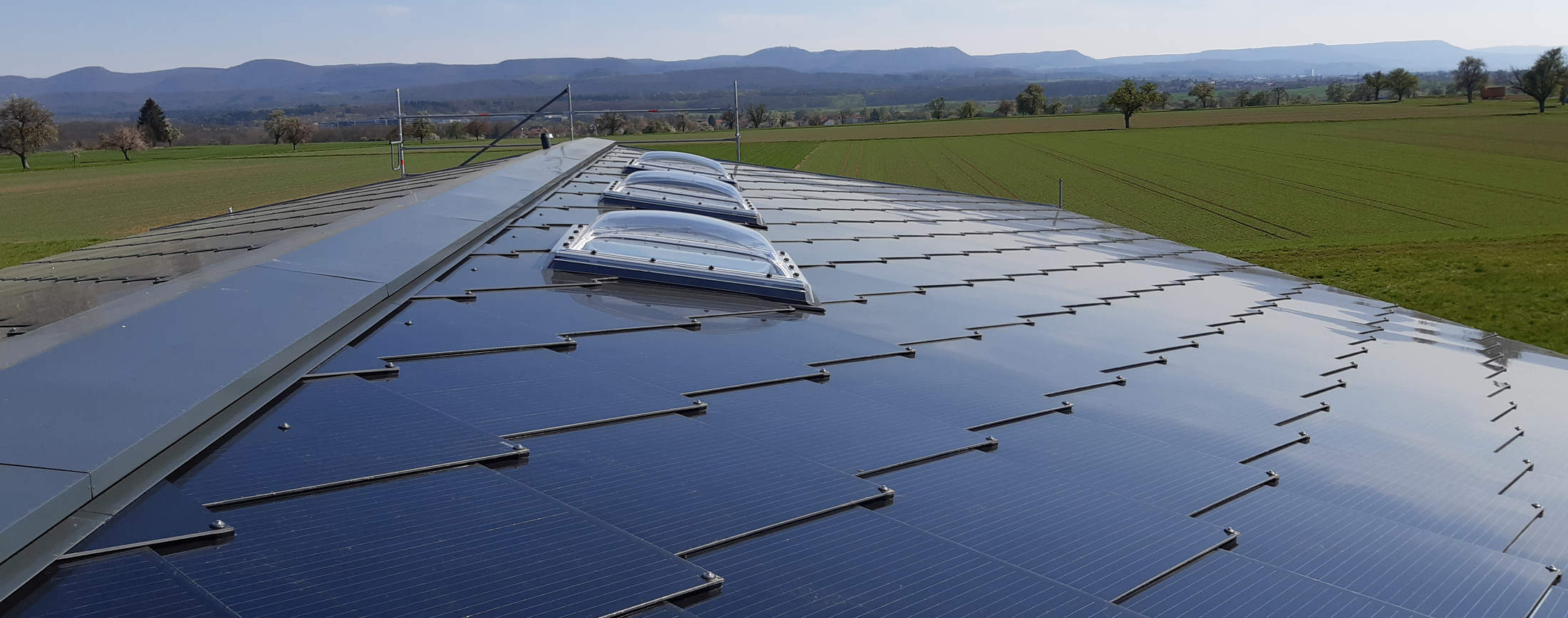
      This is the roof of an industrial building near here which seems to go with that idea:

      https://nabendynamo.de/wp-content/uploads/2021/06/20210426_1...

      While not quite panel-sized, it's much larger tiles and there's not another roof underneath. Probably makes most sense with a new roof, though. The problem is that when a roof lasts 50--80 years, that's not a very big market just for new roofs.

    • IneffablePigeon5 hours ago
      The middle ground is integrated solar panels, where you have normal sized panels but they are flush with the rest of the roof and there are no tiles underneath them. There are normal tiles surrounding the panels. This is the style I tend to see now for new builds, but it’s more expensive than just layering on the panels if your roof is already in good shape.
      • danans5 hours ago
        > The middle ground is integrated solar panels, where you have normal sized panels but they are flush with the rest of the roof and there are no tiles underneath them

        Flush with the rest of the roof seems like a mistake. What if you need/want to replace them with a different sized panel?

        • christoph5 hours ago
          Horses for courses relly. I think the panels are all standard sizes now as well? When done tastefully, they almost seamlessly blend with the tile (limits tile choices), certainly from a distance. Some new builds near me, you can’t really see the panels until up close. Raised panels do have an issue in that birds/rodents/etc. nest below them and can cause major damage if unchecked. This is why pest protection (unsightly up close) is a must. The major cost of dealing with nesting under panels comes from the labour and probable need for scaffolding etc. to resolve - i.e. minimum of £2k.
        • RealityVoid5 hours ago
          That and op said it's more expensive. Why would you do it flush, then? Looks? Eh, I prefer practicality over form and many architects would agree with being more honest.
    • KaiserPro3 hours ago
      THere is a middle ground which is this: https://www.wienerberger.co.uk/products/roof/in-roof-solar.h...

      The big problem is that because there is no real ventilation, the panels get hotter and don't produce as much power.

      What you put under them also has an effect on how waterproof your roof is long term, plus when you need to replace them finding ones that are the right size are also a pain.

      • youngtaff2 hours ago
        There’re commonly used on new build houses in the UK — new roofs in the UK have a waterproof but breathable membrane under the tiles

        Also see https://roofit.solar/ used in a few houses… mainly self build a or architect designed

    • 6 hours ago
      undefined
  • scotty794 hours ago
    I hope somebody figures out at some point how to do roofing with large integrated panels that could be solar.
    • defrost4 hours ago
      Yeah, BlueScope Steel (Australia) did this with three separate prototype designs from 2012 - 2015 that were manufactured, installed and currently have had a decade of all weather on house trials.

      The Australian market is largely adding trad PV panels to existing housing, but there are signs of greater uptake of integrated PV + weather proof + thermal insulation roofing panels by architects and hopefully will be seen more on new mass produced housing plans.

      ~ https://arena.gov.au/projects/integrated-pv-solar-roofing/

    • youngtaff2 hours ago
      This Estonian companies does that https://roofit.solar/
  • Freedom26 hours ago
    As someone who owns a Solar Roof, this news is disappointing. Many of my friends have said it's the best roof they've ever seen, and I even sometimes get compliments from people who drive past.
  • Teever6 hours ago
    Tesla's inability to produce solar panels is why I'm most skeptical of the whole terafab datacentre in space stuff.

    Everyone gets caught up in the thermal management stuff and the power density stuff and whatever but to me that's a red herring.

    The real issue is that Tesla has never known the ability to produce solar panels at scale and Musk said in that recent interview with Dwarkesh that he intends to do all the solar production in house.

    So where's he getting the sand from? How are they going to purify it at scale? How are they going to turn it into ingots and then wafers and then cells and panels when they haven't even been able to produce a slim fraction of panels without all those extra steps over the past decade for their roofs?

    And if the goal is to have the industrial capacity to do all this in a few years and produce solar panels on the scale that he's talking about -- why doesn't he just lay those bad boys down en masse on Earth and solve the impending climate crisis and our current energy shortages?

    It just doesn't make sense.

    • pyrale4 hours ago
      > Tesla's inability to produce solar panels is why I'm most skeptical of the whole terafab datacentre in space stuff.

      I'm split on the datacenter-in-space stuff. I don't know whether I should disbelieve it because there is, obviously, no good way to evacuate heat in space, or because Musk talked about it, and he has an uncanny track record of not upholding his promises.

    • kortilla5 hours ago
      You are mixing up Tesla and SpaceX. SpaceX already produces solar panels for the 10,000+ satellites it has in space.
  • christoph5 hours ago
    This current crop of tech bros and companies really is the worst for humanity. Failed tech and projects I can understand, but it’s the total, consistent and persistent lack of care and disregard for people, customers & the planet. They never clean up their own mess either, and I even disliked the kids who did that at playgroup 40 years ago!! The sole ambition is always money & power. I read that article aghast at multiple points.

    I recently had 9.2kw of solar panels installed in the SE of England, the actual cost of the panels themselves was ~£1k. I’ve seen new installs going up with standard cheap panels nicely inset, flush into the roof itself. The roofers themselves have told me they are cheaper than a traditional roof due to the decreasing price of panels and ever increasing price of tile. Got a listed property with a slate roof? Solar could save you potentially £10k+ according to one roofer I spoke to.

    Panels were and always were going to be dumb commodity items. There’s literal fields literally filled with the things everywhere. Compare to say something like the PowerWall which they still sell bucket loads of and I have one myself, Elon be damned…

    However, the PowerWall still suffers from that worst of all tech bro sins of trying to limit YOUR access to YOUR data. I wanted to add an ESP CYD to display all my Home Assistant data when we had solar installed to help us as a family see what was happening in realtime. It’s incredibly useful - In typical HN fashion I rolled my own and avoided ESPHome, making it just how I wanted and I love it! 3d printed case and all! Boots in 2 seconds and just works!

    I had obviously and wrongly assumed the PW3 would be easy as pie. Getting realtime data out of the PW3 is a freaking Kafka-esque nightmare… the only workable solution to which was setting up another dedicated ESP32 to connect directly to the PW own perm on wifi and weird custom API and shunt the data over BT. Tesla could break it all at a moments notice with an update and i’ll be out of hours trying to fix it. The whole thing is cat&mouse hoop jumping, the likes of which I haven’t seen since the earlier console hacking days. Tesla will display the realtime data through their servers, through their app, but if you want that…

    Anyway, please everybody who’s all gung ho on the Anthropic and OpenAI hype trains remember - every single big tech company has had the exact same disregard for you, your family, your home and your planet since the start. It’s probably more consistent than Moore’s law at this point. Nothing is going to be different this time around.

    • someluccc2 hours ago
      The monstrous tech bros destroying humanity by bringing about electric cars, intelligent machines, mapping the world, bringing information to anyone anywhere.

      I on the other hand, Maximus Virtus, am a net gain to humanity when I hack into tech products for visualizing my home’s data.

  • Animats5 hours ago
    "The economics never worked either. An average Tesla Solar Roof costs approximately $106,000 before incentives, compared to roughly $60,000 for a traditional roof replacement plus conventional solar panels — a $46,000 premium. The payback period stretches to 15-25 years, compared to 7-12 years for traditional panels. In 2023, Tesla settled a class-action lawsuit for $6 million after customers accused the company of bait-and-switch pricing, with one plaintiff seeing their contracted price jump from $72,000 to $146,000."

    Ouch. The whole point was that it was supposed to be cheaper.

    • lnsru4 hours ago
      Integrated solar panels into the tiles are batshit crazy expensive compared to regular big solar panels from China. I was looking how to install them (some other vendor, not Tesla) and was shocked - you can’t plug the small tiles connected together directly into inverter. There is additional power electronics box in between. Economically it makes no sense. The single installation around is at the guy‘s house who had successful 7 figures exit. Of course, the roof looks awesome.
  • transfire6 hours ago
    Sad. A great idea ruined by poor business practices.
    • _fizz_buzz_5 hours ago
      I think it had more to do with the reality of the market. Solar panels have become incredibly cheap and that's because they are mass produced and standardized. Everything in the manufacturing process has been optimized. Now it is technically of course possible to make them other form factors, but artisinal solar panels are simply so much more expensive and cannot compete in any meaningful way with regular panels.
    • angry_octet3 hours ago
      It was a bad idea from the beginning, technically and economically it sucked, the only possible utility was areas with strict heritage constraints which forbade normal rooftop PV.
  • sidcool6 hours ago
    Yep. Fred Lambert, the usual suspect.
    • bartvk5 hours ago
      He is very critical of Elon Musk, but I never caught him writing something false.
      • jfoster4 hours ago
        If you read his articles over the years you would continually think that Tesla should go out of business in the near future, yet they never do.

        He might not specifically lie, but puts such a negative spin on anything Elon-related that the overall result is essentially a lie.