No one is doing that, these people don't exist. No matter how hard corporate America wishes they did. This is why AI doesn't sell. This is why companies like Microsoft and Dell are pulling back on their AI claims and why Apple has nearly wiped it off their site all together, seriously go check out apple.com, not a single mention of Apple Intelligence.
At this point I'm convinced that marketing has been completely taken over by shareholder shills, marketing to customers they wish they had instead of the real customers that exist.
> No one is doing that, these people don't exist
I don't know what world you live in but I personally know at least 4 people (all female interestingly) who regularly use ChatGPT to give outfit advice and when clothes shopping. One has manually taken photos of clothes laid out separately so she can put different combinations into ChatGPT and ask if they work together.
I don't live in the US.
And I did use AI recently when shopping for a car. After doing a bunch of research on my own, I decided why not try feeding my criteria into ChatGPT and see what it recommends. And it did actually recommend a couple of models that I had not previously considered, including one that I ended up considering very seriously.
I also pointed it towards some used listings and asked questions like "does this listing have ventilated rear seats" - and it was able to respond that it likely doesn't, and told me where to look for the controls in photos to verify for certain. I probably could have figured out on my own with a bit of digging, or else contact the seller, but this was a pretty quick and easy way to get the information I was looking for.
Is that gross?
I didn't look too closely at the Googlebook, so I don't know why I would use that instead of just an app on my MacBook. But at some point when competent models can be run on comodity hardware I think hardware and OS-level support for AI will definitely become a selling point for me. We're just not quite there yet.
If Google was launching a new laptop that was meant to run models locally I would be really excited.
It's probably a nice feeling when you can put in a list of soft requirements to ChatGPT et al and get a list of things it recommends, but I would suggest you are a fool if you think those listings aren't bought and paid for.
In an era where the gap between a 'good product' and a 'bad product' is growing ever larger and the price is not an indicator of anything, the onus to actually become knowledgeable re: "How to identify products worth buying" is becoming greater and greater. If you are using AI to do the shopping for you, not only are you not building that muscle, you are actively weakening it as a chatbot convincingly recommends something to you based on unverifiable platitudes about 'quality' and 'value' - a recommendation that was, again, bought and paid for.
So yeah, that's gross and I would argue pretty strongly that it's just as brain rot adjacent as something like Tiktok. Like Tiktok though, I expect it will see at least some level of popular use, and also like Tiktok, I think it'll end up making the population dumber on average.
As if the products you find in mass market brick'n'mortar stores are any different.
Yes, if you engage with the 'designed marketing channels' for products, you will end up with junk. If you want to have stuff that isn't junk, you need to do some leg work. A chatbot will not do that for you.
Not super relevant to the Googlebook ad, but in case the perspective is interesting to you: I'm quite tall (194cm) but not very wide, so I usually struggle with buying clothes online. I used AI to scrape a bunch of clothing stores to see whether they sold a men's shirt with an LT or slim fit size, in stock, and matching a particular vibe.
That's not how that works; "someone is doing this" doesn't prove a rule "no one is doing this" -- quite the opposite
"The exception that proves the rule" is for things like "closed Thursdays" (rule = open on other days), "no parking after 8 PM" (rule = parking allowed before 8 PM), "no refunds on games" (rule = refunds available on other items), etc.
Or more succinctly, as first-year law students learn: Expressio unius est exclusio alterius — to state one thing is to implicitly exclude others.
https://definitions.lsd.law/expressio-unius-est-exclusio-alt...
> I can imagine lots of cases where people with specific needs would find benefit from the “AI clothes buying” experience,
That is kind of the idea of serving the long tail. Everyone is unique, and there are a lot of everyones.
That said, I don't get online clothes shopping. The fit is 80% of the product.
isn't that what search engines were built for? we've just forgotten how to build a search engine that's not just an ad factory, so instead we're putting an ad factory into our new search engine?
I feel like I see a brand new way of saying “something that people don’t really want” on a near daily basis nowadays
- mining the 95th percentile, leveraging the Pareto Principle
- optimizing and ubiquitizing under-optimized paradigms
- pioneering agentic solutions to aggressively expand product frontiers
- innovating high-risk strategies to serve underserved markets
- digging deep into the inner recesses of my being and extracting what's left of my soul through my nostrils
And so much more.
I don’t want to believe LLMs are the future of shopping either, but it’s wrong to dismiss actual successful users with hot air.
I have a half dozen facebook marketplace searches going. I used to automate craigslist searches before craigslist became irrelevant. It's nothing complicated but "AI searches for me and notifies me" is better than me remembering to look.
Well obviously you shop for clothes, but nowhere like the way people who like clothes shop for clothes.
Finding clothes is about matching the vision in your head. If you’re the type that just buy clothes whatever, this is not a problem that exists in your world.
For the average consumer, clothes fit them.
There is no generalizability from a niche possible here, since the mass market is already served.
Beyond that, even if we limit it to height alone, there are hundreds of millions of people who are much shorter or much taller than average.
Quality is amazing, fit is incredible, and the price is only 20-30% more than off the rack, but the clothes can last a decade+.
Sometimes the ancient solution (meet another person with a measuring tape) is the best one.
Love the idea but difficult problem to fix.
I wouldn't buy a deeply-ingrained AI laptop even if you paid me, and even then I'd install Linux on it in a heartbeat.
Just asking a web search / browser-enabled chatbot, as you are now, is already close to the optimally efficient tool for you. Unfortunately, aggregating results from many disparate retailers into one seller-neutral page filtered down to what you uniquely need today is no longer considered optimally efficient by most web retailers. Just like they erected barriers to stop being indexed by unaffiliated shopping aggregators, most large retailers will try to stop automatic aggregation of their current inventory (or lack thereof).
Sadly, we're now in a post-enshittification world where Amazon's learned removing search features like requiring or excluding terms increases revenue and Google's learned giving you the search result you want first reduces ads served.
My friend is probably 5" shorter than me. A small on him would be too long.
So he's always on the hunt for things that fit him properly in both dimensions.
It is deeply annoying we have to do this.
It's a frustrating existence.
"I don't personally know enough people doing what a mega-corporation with a massive market research team with multiple layers of market research audits has concluded people claims to want, so I'm just going to diss the product"
It sounds totally insane but we’re the minority here. That’s why Google is a $4.5 trillion company.
Sure some stuff sticks but most falls off the wall and is axed barely half way into the product life cycle.
Pepole around me don't even know what google is doing besides search and probably maps.
I'm the person with an adblocker, the others are not.
Who is Googles target audiance? Its not me. I might only be a target for when i run some IT Platform in my work as an architect.
I think this is an easy question to answer: 1. what's your monthly ad spend? 2. how many ads did you view lasy week? You're probably not their target.
If you're not failing often, you're not an innovative company.
This has always been the way Google has worked. This is why they are literally the most successful company in the history of the world.
They also have failures, then again most companies have failures as well at all points in the product cycle.
Failures like YouTube, GMail and Android?
“Just had a baby, generate a shopping list for my registry”
“For each major item on registry, research and recommend the top 3 products. I care about GreenGuard certification. I’m not price sensitive.”
“I’m looking for new shoes. I’ve previously owned XYZ models and here’s what I liked/disliked. Can you recommend shoes I should consider?”
It’s immensely helpful. It replaces what I used to do before which was typically search for “[product] Reddit” and read and sift through a ton of comments.
It’s not perfect but the volume of transactions I’d have to do research for is high enough and the return policies easy enough that it makes mistakes feel much easier to correct.
I want to make a picture from me, add perhaps height and one or a second other metric, then i want it to generate styles for me, finetune it with me and then it helps me buy it.
I'm waiting for this for ages as i HATE shopping but I would find it nice to look better.
Nonetheless, when I saw this page for the first time, i was very impressed with the case not with anything related to softeware. Might be a second type of device which might be a good alternative to an apple product. Framework and now this (perhaps)
Despite this, adidas does not have a tall thin filter despite them selling tall thin shirts in shops.
I do not know why.
Now i have to start searching around what brands have this option to filter.
I do not know why ecommerce online is so shit at least it feels shit for me.
If AI would find something in that price range and it would just work, man i would be happy.
Building your own is expensive, which is a stretch to cover with the margins of ecommerce and not go broke. And the off-the-shelf things are shockingly bad in their core functionality (e.g. Shopify, which may actually be the most developer-friendly and innovative, has no native concept of a color swatch that works the way you'd expect, nor does it have filtering other than by a single, painfully-manual, non-composable "tag" feature). Shopify's got a huge ecosystem of one-trick-pony "Apps" that add all the missing features, but running 50 "apps" doesn't fix things either - not only can they be fundamentally incompatible with each other, but nothing can fix the underlying deficiencies of the core data models (or if I'm being more charitable, their suitability for one's unique business domain).
Brands fit for the country of the store. For example, you won't find anything for a tall but not wide person in Singapore, except a few special stores, that won't be Adidas for sure. Unless ordering from overseas (and that costs nice money).
Because market. 1% just isn't worth it.
I saw a demo - it took you, put a piece of clothing on you, and showed in realtime how that clothing moved on your body in the size you'd selected. I think it even picked the size.
It’s amazing how confident you are while being completely wrong. A pristine internet rant.
Also aren’t you concerned your behaviour is marketers’ wet dream? They now dictate what you should consume.
At least i'm not buying pants every month.
Btw. you know who is buying my stuff? My wife :P
Welcome to HN? :)
God this is so annoying. The actual functionality we need is not there or is half-assed.
Not only the actual functionality people want is missing, but the functionality they're nagging us to use is missing./
Switch to a consumer Gmail account and loads of Google features start working.
Also the homepage search widget, the app drawer search, and chrome address bar search are three near identical experiences, yet with enough differences to be painful. Either unify them, or make them distinct!
Unfortunately, they do. "Normie America" loves that shit. It's why they've been pushing it so hard: it's one of the few areas they're getting serious traction in day to day life.
Also, Japan is a cheap travel destination right now. Two people can do a 14 day trip easily for $3000 total. That's not nothing but it's also in the realm of many middle class people regardless of where they live.
I think this is more you than me. The middle class in America is still strong. Is it weakening and eroding? That is also true.
> Shelling out three grand for a two-week vacation is simply unattainable for the vast majority of the population.
Would you quote me where I said it was the majority, let alone vast?
Well, actually, depending on the data and who you ask, 40-60% of Americans spend $3000 a year on travel. Is 60% the majority? I'm not good at math.
https://www.ngpf.org/blog/question-of-the-day/question-of-th...
https://www.nerdwallet.com/travel/studies/summer-travel-repo...
So really, you may be the one who's disconnected from reality. Not to say that things aren't getting better, I think they're getting worse. Just that you've got a bit of a doomer mindset.
The data provided simply isn't sufficient to support the claim.
Though, people "want" a lot of things that actually end up making them less happy. So responding to demand doesn't necessarily make it a good thing, but only time will tell.
Mate I'm in the EU and neighbor has got a statue of big gorilla on his balcony.
The EU is just as consumerist as the US. I can't tell you the number of young dudes who think they look cool because they're wearing a fake Hermes manpurse and who wear a cap as if a videoclip from the 90s from Vanilla Ice just called (don't get me wrong: I love Ice Ice Baby and I read Vanilla Ice is a good person. But it's 2026).
And there have been several EU companies getting funding to create an "AI personal shopper app" (all getting pwned by Google and other big players).
No really: the EU is incredibly consumerist too.
You are not every other person. People are different from you.
While I 100% agree Ai is getting shoved down people's throats by tech giants, I would never presume to know how people are using it.
More people are discovering it, at least, as a better search box than Google. There's at least data behind that.
It isn't too far of a jump to then have it shop for you as well.
One thing that is interesting with stories like this: the wild, emotional responses Ai-related news gets out of people.
Part of this is that we are increasingly in self-selected communities of people just like us. Prior to the Internet and social media, you more often interacted with people that all you had in common with was spatial location and a dash of socio-economic status. It wasn't an unbiased slice of the populace, but it was at least less biased.
But today, it's much easier to have all of your social interactions limited to a social media bubble that reflects yourself.
That in turn makes it really easy to believe that whatever is true for you must be true for everyone because it seems to be largely true for all the people you see on a daily basis.
My friend just bought a Pixel instead of an iPhone because it had better AI voice chat integration, he's non-technical and has been on iPhone as long as I remember
*except maybe Valve.
The pressure to turn on the money faucet is very real, and as soon as they do, the AI shopping experiences are going to just mean “run an auction and steer the user to the highest bidder”. Like how Amazon, google, etc all have been doing it for ages. It’s way too profitable for them to ignore.
Always has been. What do you think pays for all the “free” stuff on the internet?
Call me crazy but I don't think that "discovering how much oranges cost" is a big enough pain point for most people to spend hundreds of dollars on smart glasses to solve.
This has btw. nothing to do wheter or not AI does actually have positive impact on society or not - it is the feelings that matter, not objective facts.
I went to the apple.com homepage, literally zero mentions of Apple Intelligence, just a dropdown option under iPhone's menu items.
Really? I must be hallucinating the multiple people I know who do this here in Portugal. Clothes, random parts for stuff they need. They just point a camera and ask for it, often iterating. They clearly prefer the chat interface that somewhat also limits their choice, instead of the plethora of ad-filled websites that are hard to navigate. I'm aware this poses several problems we will need to solve, but it's still happening.
Related: Bar some of my somewhat AI-resistant friends and some older relatives, almost everyone I know (including college students I teach to, my dad, friends, non-tech co-workers...) no longer uses google as their first choice (they do fallback to it if they need to). They all use ChatGPT, Claude, or Gemini. Used to be just ChatGPT but now there's a relatively equal divide. And an ever-increasing number of them are clearly using AI for pretty much everything else (proof-reading, writing e-mails, building spreadsheets, tiny custom apps for themselves, creating music, images, jokes, memes, photo editing/touch-ups, student evaluation, school material preparation/creation, personal/intimate advice, and much, much more.)
It is especially fascinating to note that, with the exception of AI-assisted coding, there is clearly more AI usage among the non-tech folks, as so many tech people are immensely resistant to using AI for something other than work. It's clearly shifting, though, as I see more and more of those AI-resistant people slowly also using it in their daily lives, as opposed to "only for work".
In fact, if HN hates it, there is a higher chance the product will be successful
Will Bookmark it so that it becomes one of those legendary HN quotes
Unless these things are much cheaper than a Macbook Neo, I don't see it succeeding.
It is not "shopping for clothes with AI". It is recreating the dressing room experience from home, and it likely will be a table stakes for online shopping in the near future.
I was even at a shoe store the other day and just took a pic of a whole shelf full of sneakers and asked claude to explain them for my use case (running vs tennis).
It combines research with a buying decision, which most eCommerce sites don't currently do (except for just listing hundreds of reviews)
A big part of Stadia failing was it didn't get traction, and a big part of that reason was Google's history of just giving up on products out of nowhere, so very few people were willing to give Stadia money with the risk of everything they bought vanishing. Then, when Google did give up on Stadia out of nowhere, Google said they'd refund everyone everything they spent - the kind of pledge that might have encouraged more people to actually give it a try.
Then again I heard anecdotal stories from a lot of developers that Google was a pain in the ass to work with because they didn't understand anything about working with game studios; it was just "we'll give you X money to bring your game to Stadia" when that money didn't make it worth taking developers away from the platforms they were already publishing to.
A bit of a tangent here, but the tldr is that I think this has been the case for quite a while.
I don't have any stats to back this up, and maybe someone does and will prove me wrong, but marketing doesnt feel significantly more effective than it was, say, 50 years ago, and yet the main reason every scrap of data about our personal lives is harvested is supposedly for marketing. Maybe it turns out theres just not that much you can do with the data, I'd certainly hope so, but I think a lot of it is just down to the fact that marketing execs don't actually use the data in any meaningful way, like you say marketing to customers they wish they had to buy the idea they were gonna do either way.
Like I remember a decade or so ago, the promise/warning was that advertising and entertainment would seamlessly blend when it can be tailored to exactly you, to the point where people happily and willingly watch advertisements. We got the opposite, adblockers are extremely common, companies have to strong arm you into even looking at their ads, and people count down the seconds until they can press the skip button
Which is weird because Apple Intelligence + Shortcuts is the most underhyped corporate use case for AI. For my money, it’s the quickest and easiest method a non-programmer can use to prompt-build a program that both works and that they can understand.
Yeah anecdotal, but it just doesn't strike me as how people shop.
There are several AI companies now with billions in yearly revenue that didn't even exist a few years ago. Many more with many millions in revenue. Saying AI doesn't sell is completely delusional. You're in an anti-AI bubble.
Litterally hundreds of millions shop with AI today.
It's just never worth the hassle of buying/using a Google product. Never.
Their cloud services are nothing but hot air but their hardware support has been excellent for the past few years. Easily beats other major manufacturers. I'm still annoyed that Apple won't tell you how long they will support their hardware. Other competitors manage to be even worse.
but if you buy this for the gemini integration, what are the odds that google actually sticks with that, or two years from now are you going to have a laptop that lags behind the feature set available in the gemini app for mac because they didn't sell enough of these to bother continuing development?
Nest Secure Google Home Stadia Daydream Glass Nexus Pixel Slate Pixelbook Chromecast Audio OnHub Jamboard
Two or three years is not even close to the support Apple provides. It sealed the deal for me and I switched to iPhone.
Google’s hardware track record is a joke compared to Apple.
https://www.heise.de/en/news/From-June-20-EU-gives-smartphon...
In other words, manufacturers aren't required to publish updates at all, but if they do provide updates they have to make them available to users for five years after they stop sales. This only stops the case where a manufacturer ships a device and publishes updates for the device, but then takes those updates offline after they stop selling the device (but before 5 years is up).
https://www.theandroidportal.com/motorola-android-update-loo...
I'm having a hard time googling it since every result that comes up is about Google cancelling Nexus phones entirely way back when, but I remember a lot of Nexus users were kind of PO'ed about it.
For example: https://support.apple.com/en-us/102772
45% battery on iOS 18
25% battery on iOS 26 (which corresponds to iOS 19)
...
This is 2026
https://www.ladbible.com/technology/iphone-ios-update-26-del...
(sadly got stuck with that degraded phone because the Apple Watch that refuses to pair if you run iOS 18)
Only the iPhone XR in that test is on iOS 18. It scored behind all of the models on iOS 26.3 except for the iPhone SE. But that's not a useful comparison because who knows what condition the XR's battery is in at this point, and nothing else ran on a comparable iOS version.
Not sure what point you were trying to make with that video, but it doesn't really demonstrate cross-version battery performance.
All of this is only relevant cause apple devices are often used for so long after release (5-7 years, this message typed on a 5 year old iPhone) [1] (random source, more available on google.com) while statistically few android devices last long enough in consumer pockets for this to matter (2.5-3 years is average)
[1] https://www.reddit.com/r/Android/comments/9uha1o/android_vs_...
They started throttling devices based on battery age after "Batterygate" in 2016, after a wave of news that their phones were suddenly shutting off on high load because the batteries terminal voltage dropped. They do not "artificially slow down before a new release".
The were sued because in their typical arrogance, they neglected to _tell_ people about that. They did not lose, they settled a class action suit.
As a result, they made battery management and state a lot more transparent in iOS, as they should have done in the first place.
Claiming malicious planned obsolescence, as you did, requires facts not in evidence.
If it's not malicious, then it's gross incompetence, but at the end of the day, it will still eventually require to purchase a new Apple device, when a downgrade would have been enough.
It's not the first time even: https://www.thecooldown.com/green-business/iphone-update-iss... <iPhone user sparks debate after device becomes ruined following mandatory update: 'This is just ridiculous'>
It's a long-term issue, because even if it will get fixed in two years, then the battery damages due to severe drain are permanent, and this is to be paid with your pocket, or again... upgrade to a new iPhone.
It's not the first cycle like this, slower software is deployed to all iPhones, older iPhones lag, and you have to purchase the fresh new iPhone.
==
  "Apple implemented unfair commercial practices", the Italian competition authority said in a statement (after fining Apple).

  The companies encouraged users to upgrade operating system software but did not make clear the increased demands that new software would make on smartphones, according to the authority.

  This "caused serious malfunctions and significantly reduced performance", which provoked users into upgrading their devices, the authority said.

  https://www.bbc.com/news/technology-45963943
This is about the generic software updates.
The main issue is that you have no path to downgrade, no way to use your own OS, and your only choice is to hope for an update from Apple that will revert back your device to its normal way of working, or, purchase a new phone, which won't have this issue.
It's literally impossible that they have not noticed, so if not planned obsolescence, at least, it is intentional degradation of existing products (or that their team is not able to notice...)
It's rather the other proof around that we would like to see, that Apple did not know the impact of what they are doing. If they knew, you know what it means.
I mean... settling means you lost, almost by definition. You were sued and then paid the person who sued you. Settling is the result of almost all lawsuits where the company knows they were at fault - why would you go to trial if you know you're going to lose?
Now, don't get me wrong - your overall point could still be correct. Many companies who still do believe themselves to not be at fault, offer a settlement purely for the reason that it's cheaper in terms of legal fees (or perhaps less of a PR nuisance, or just generally lower-risk) than going to trial.
No, since "settling" is something both sides do, if it were losing, it would be both sides losing.
Settling is a decision to compromise to mitigate the cost of litigation (and in the US, which does not have loser pays as the default rule, that can be quite expensive even if you win) as well as the risk of loss. You can’t really characterize it as being more "winning" or "losing" for anyone one party without a much more detailed consideration of the specific terms and the expected costs of litigation, etc.
Yeah... you can. The party suing received $500 million. That's a win.
Yes, a settlement has to be agreed on by both sides, but that doesn't mean the party suing didn't win. It just means that, maybe they could have won more.
Where you and the parent commenter are correct is that, the result of this case is not the same as a court verdict regarding the legality of Apple's conduct. That part true - if we're talking about "was Apple truly intentionally killing their phones to get you to buy a new one", the outcome of the case says nothing about that.
But to make a statement like "they didn't lose, they settled" is just misleading. Almost every company that has ever done something illegal settled, that's not an argument either. This case had at least enough merit to spook Apple into coughing up over half a billion dollars ($500 million to the class action and $100 million to the coalition of state attorneys general who sued Apple for deceptive practices). (Again, not proof of guilt but at least evidence of the claims having some merit.) In the grand scheme of things they definitely lost.
They also announced a promotion for unlimited cloud storage of photos and then shrank and JPEG massacred the photos. That part of my photo library is still visibly trashy to this very day. Every time I browse my photos, I am reminded that google did this.
I’ve never used anything they made long enough to get there.
If they announce a support lifetime they stick to it.
For other products they'll just decide they're done with it and give you a little warning period. Maybe some store credit or another bonus depending on the product.
Why anything AI make me want to buy a whole laptop? I can use AI from websites, apps, etc. already.
* unless it gets merged dozens of times into other similar projects.
Pixelbook.
Chromebook.
Google Pixel.
What's next? Nestbook? Drivepad? Geminiphone?
If I buy one today, is it guaranteed to run the newest OS in 3 years?
Back to a world where every device needs the OS specifically built for it.
"Check out this unbelievably cool product. It's a walled garden though that only works as long as we maintain it."
That's cool, but we're not spending actual money on something you're gonna kill.
"No, we promise: this time, it's different. We're not going to kill Stadia."
Nice try, Google. We've read the Boy Who Cried Wolf. We're not buying it.
"No, really. We know we've fucked up repeatedly in the past, but we pinky-promise. This is for the long term."
Okay, we'll dip one toe in, but only one, because we still don't trust you.
"Well, they aren't buying enough games on our service. I guess we should kill it after all."
WE FUCKING TOLD YOU SO!
Obviously that's not much recompense if you were a game developer lured into some exclusive publishing deal, or even just someone buying a Stadia Controller, but c'est la vie I suppose
[0] https://arstechnica.com/gadgets/2022/11/google-refunding-thr...
Getting the Stadia controller goes a long way, methinks. If you have one laying around, you can install the de-clouding firmware Google provided that converts it into a Bluetooth controller with excellent ergonomics and feel.
It might be cheaper and faster now, but will that still be true in a few years once Google has gotten bored with the project? Are they going to use this service to spam me with AI slop like they do everywhere else? What happens if a Google bot nukes my Google account, will that cut off my entire internet with no warning as well?
I'm not famous enough to raise a social media storm when they screw me over so it's a big risk doing business with the company.
Yeah, the general approach to get support has been to be famous or to marry a Google employee, but the churn rate on Google employees is at the point that the latter is unsustainable.
I really don't see the market fit for this, I guess the android integration. But my god, I'd die of cringe if someone asked me about my laptop and I had to say "googlebook". Believe it or not, these things matter a lot, particularly if you're trying to target a young audience.
I loved my Pixelbook, fantastic piece of hardware. When that ended, I went with an Acer Chromebook. Works fine, just not the same.
I would go for a Mac Air or Neo, but only if I could install ChromeOS.
I will most likely get a Googlebook, and would be more likely to do so if it was not named Googlebook and did not have Gemini built in.
To each their own, but this is absolute insanity.
I now have a machine that boots almost instantly and just works without maintenance, upgrades, or compatibility issues. I can throw it in the river, and for $300 get a machine that will be up and running in about one minute. I can use multiple machines (small/cheap to bring on a trip, laptop for casual working, larger machine for more serious work, even at the same time. I have full access to everything from my iPhone, or access to some computer anywhere. I use remote VSCode via Crostini to do development work (terminal, vi, Codex, Claude Code) on a bunch of beelink boxes and Hetzner servers.
I cannot run installed software and I am dependent on Google for email, files, photos. For the latter, I have backups of my email and files (photos are not as easy).
Life is simpler this way.
I take more risks with my Chromebooks than I do with a MacBook, such as mountain-biking with it or leaning it in a car when visiting sketchy neighborhoods. Chromebooks offer a good-enough on-the-go, full-Unix experience, with an all-day battery. Sure, M-series Macs have higher performance and >20h batteries, but those nice-to-haves re well in excess of what most users need, most of the time.
We are way out of context window, occupied by OS chores.
Life was simpler when we were dumber, but now, no. Stop lying.
Windows is a hot mess and frankly I wouldn't recommend it to anyone outside of gamers. For the technically competent, there's nothing to gain on Windows, and it will just get in the way. For the those less technically inclined, Windows means complexity and viruses. Also most Windows laptops suck major ass.
MacOS is better, especially if you have an iPhone. But even MacOS is a bit too complex for the less technically inclined. If you have an android phone, then a chromebook is 100% the way to go for those people. Also, chromebooks get crazy software support these days, on par with macbooks.
It also locks you into the cloud services of an advertising company that loves harvesting your data to help find new ways to sell you things.
>It also locks you into the cloud services of an advertising company
this is pretty much any company these days. microsoft is guilty of the same.
What it actually appears to be is we have a market where undemocratic business leaders are deciding the direction of technology in a country that only seems to benefit them and not the population.
What a terrible mindset to have and I sincerely hope you never have any capacity to yield power in your life.
Like them I think I am also surprised not because that isn't the case, but because it's wild to see that take on HN, which skews way more towards privacy/owning your compute.
If you care about privacy, Linux and BSDs are the only options, but actually good out-of-the-box Linux laptops are few and far between.
Except for Chromebooks, of course.
(I just installed Windows a week ago without an MS account, and it was a 30 second step during setup to skip an MS account. The steps to get rid of the macOS nag are daunting enough that I just live with it permanently.)
The only restriction to 3rd party apps are unsigned apps. Very rare these days, mainly small hobby projects. You can still activate them through the System Settings.
But as long as you accept that everything you do is in a browser; which is reality for the vast majority of computer users, there's no real lock-in. You can just as easily use the browser version of Microsoft Office as the browser version of Google Docs.
You're certainly locked into Google for the browser and for updates, unless you do a lot of work. But it's been a while since it was common to get commercial OS updates from a 3rd party.
[1] https://www.xda-developers.com/how-use-chromebook-without-go...
Tell that to my partner's grandfather, who managed to find and install malware chrome extensions on his chromebox.
I wish Framework would keep supporting ChromeOS but alas. You could put ChromeOS Flex on one - it doesn't have Android apps, which is fine for me, and it does support the Linux environment, which is excellent.
I have used Linux for 20 years, but only for development, and I will only develop on Linux.
For everything else (email, files, photos), I want a browser. Used to be Mac/Osx, but got tired of being managed by it.
Just my preference. You can do everything on Linux, just never felt comfortable with it.
...basically, I have "nerd cred" and run linux on my desktop, but for my laptop I wanted: disposable (no leaky hard drive), zero maintenance (no kernel modules for sound drivers), battery-portable.
90% of the time I'm wanting `vim` + `git` + `ssh`, and 20% of the time i'm wanting to run some random stuff locally. Chromebook is basically zero friction and 1/10th the price (and 1/10th the capabilities) of a "very nice mac laptop", plus you can pop into a very capable linux VM (w/ passthrough GUI support) without a lot of ceremony.
Windows laptops are out of the question, and pure linux laptops (until only very recently) were of marginal support and low battery capabilities (especially "close it and stuff it in a backpack for 3 days").
What century did you write this in?
"""last week: Pop!_OS 22.04: kernel 6.17.9-76061709 — module BTF validation cascade boots system to emergency mode #3961
Thanks for taking a look,
Quick update — I'd already recovered before seeing this comment. The path that worked: boot Pop_OS-oldkern, run sudo apt install --reinstall linux-image-6.17.9-76061709-generic linux-modules-6.17.9-76061709-generic && sudo kernelstub, reboot. 6.17.9 came up clean. The reinstall's postinst hooks ran update-initramfs automatically; /boot/initrd.img-6.17.{4,9}-* are both freshly dated 2026-05-06 (~11:44 / 11:46), and kernelstub copied them to the EFI partition. Verified: journalctl -k -b 0 | grep -iE 'btf|failed to validate' | wc -l → 0. """
lsmod | cut -f 1 -d ' ' | grep snd | wc -l
Dell has sold laptops with first-party Linux support for nearly fifteen years, to say nothing of other smaller OEMS.
As for the battery issues during sleep: that actually has to do with a combination of the BIOS settings + downstream ramifications of secure boot (and how the old-fashioned "hibernate" used to work). Unfortunately, that isn't specific to Linux. My MBP has the same problem, and so do the same laptops running Windows.
In the end, after hours of frustration, my solution was to print the document from my (amusingly, Google Pixel Android) phone.
Where ChromeOS shines is that it has never been affected by severe and numerous CUPS security vulnerabilities like CVEs 2024-47175 through 2024-47177, which were unauthenticated remote vulnerabilities, while Ubuntu and Fedora (and all other major distros) were affected. Why? ChromeOS sandboxes the hell out of these kinds of subsystems. CUPS runs in a PID namespace, network namespace, mount namespace, on a read-only filesystem, with seccomp filters. It cannot use the network, ever. It can only communicate over a pipe with a network proxy. The proxy is only active if and when a user tries to print. The proxy is also in a seccomp jail that prevents it from doing anything except enumerated network traffic and the pipe. The proxy is written in a safer language than CUPS itself, and protects CUPS from malformed, malicious inputs by validating both PPDs and print requests.
It's nice to run Linux on a machine that was built to run Linux. No silly windows key, no fighting with firmware that was built for windows first. I have a Chromebox that was a great mini desktop and the pricing was nice. My first Chromebook ran FreeBSD pretty well once it was no longer needed for ChromeOS, etc.
You have to shop carefully, you want something that's easy to put a MrChromebox firmware on and doesn't have any known issues with the OS you want to run. It's been a while since I purchased a ChromeOS device and the current state is different than it was then; I'm not sure how easy it is to find reasonable options now, but there were plenty of good options in the past. You also want to be sure that it has enough ram and storage for you needs or that those are expandable, but I think soldering ram and storage is pretty common across the range.
It feels like the wrong tool for the job in both directions. If you wanted a host platform for Ubuntu you'd choose something else, and if you wanted platform software for a Chromebook ChromeOS is the right choice.
I'm going to need a citation on that, especially performance. Doubly so if Crostini is put into the mix.
> [...] updates things like peripheral firmware that Ubuntu isn't even aware of.
Like what? WiFi cards, etc.? Isn't that generally in kernel already? What kind of updates do you think are not done by Ubuntu or another Linux distro?
Last I tried ChromeOS was on the Pixel Slate way back when. A buggy, unstable, clearly not properly tested, unperformed mess that I would not wish upon my enemies. Glad to see it has improved to usable now, but that it is better than any other Linux distros, I can't say how considering even being on par with e.g. Fedora would have been a miracle not to long ago.
Happy to admit that purely on the UI/UX, ChromeOS is very solid in my opinion, arguably and subjectively the most consistent and user friendly designed desktop environment I know. Far more consistent than anything MSFT or Apple have provided in quite some time, everything looks like it should, placement is easy to grasp and reliable with a clear identity. Consistency wise, only Gnome can hold a candle to the strictness with which the ChromeOS team execute their vision, though there is the clear divergence in the Gnome team pushing new UX innovations and concepts even if they are controversial and may need to time to learn, whilst the ChromeOS team seems purely focused on the most clearly easy to master approach one can take.
Multiple reasons. ChromeOS ships an optimized, platform-specific kernel, built using LLVM with LTO and AutoFDO. No other distro even attempts this. The only one that has even considered it is CachyOS that offers optional LTO, or Gentoo, where you can DIY LTO, but neither supports FDO.
Another reason is that Chrome GPU acceleration actually works on ChromeOS. IPU webcams work, too. On Fedora, Arch, and others you'll be patching and rebuilding kernels to get IPU.
> Like what? WiFi cards, etc.? Isn't that generally in kernel already?
This is another aspect where the ecosystem is the advantage, not the technical details. Chromebook makers are required to furnish firmware updates. ChromeOS will update (silently, without user intervention or notice) everything in a Chromebook: SSD controllers, battery management, radios, touchpad, USB PD controllers, the Titan security chip, the CPU, whatever. This is very different from the situation on random Linux+hardware combinations where the only source for many of these updates, if they are available at all, would be to reboot to Windows.
Ok. How significant is the difference they gain from that? If this yields such major gains, there must be benchmarks showcasing it. At the same time, there must be reasons why something isn't widely adopted if it can provided tangible upsides. Would be very surprised if Clear Linux (rip) and similar in spirit distros didn't go far beyond those optimisations, if they can yield measurable benefits. Even then though, there are measurable performance tradeoffs for anything running via Crostini which I know for a fact any compile time optimisations won't make up.
> [...] where the ecosystem is the advantage, not the technical details. [...] SSD controllers, battery management, radios, touchpad, USB PD controllers, the Titan security chip, the CPU, whatever.
I just checked and I think you are confused. ChromeOS uses fwupd [0], literally the same toolset and even sources (LVFS) to e.g. Ubuntu [1]. There is no difference in ecosystem, there is no advantage for ChromeOS here. I have to also point out that these are not "silently, without user intervention or notice", Google says so themselves [2] (except for UEFI/firmware but that was the only one you excluded in that list). Fortunately too, you wouldn't want ChromeOS (or any OS really) to do such major changes silently for many good reasons.
The "technical details" are important here. They are the same, they are not automatic, they can't be superior one way or the other. It is really neat that these solutions are so robust and reliable users of ChromeOS can start to think they must be some special secret sauce, when in fact they are just FOSS solutions we have had for a while. Heck, even the verification/testing isn't unique to ChromeOS.
> [...] random Linux+hardware combinations where the only source for many of these updates, if they are available at all, would be to reboot to Windows.
This does both Chrome OS and the FOSS projects it is built around a disservice and is not true.
It is great if everything feels polished and I feel the UX is great on ChromeOS, which may lead someone to think it is better than alternatives even where it can't be. But in regard to updates, how could they be, they are literally using the same solution with the ChromeOS team being happy to give credit and admit such.
[0] https://developers.google.com/chromeos/peripherals/fwupd-gui...
[1] https://documentation.ubuntu.com/project/SRU/reference/excep...
[2] https://developers.google.com/chromeos/peripherals/fwupd-gui...
It's a great stopgap OS for older hardware.
Similarly, but I would extend that to mac mini/studio, but I would like Linux on it. I like hardware, but I hate the OS there.
Is this satire?
/s
I think that the appeal of this product is that the Wintel monopoly of years ago is dying. If the Googlebook is well executed (as the Apple M1 line was), it can be an option for Android users who wish to move away from Windows but are not knowledgeable enough to use Linux. I think the only problem here is Google's track record of abandoning product ideas. A new product like this requires multiple iterations to get it right, but if Google abandons it as soon as the results are not what was expected, it will not have the time to mature in areas like gaming or app support.
Emphasis on AI and connecting to your phone. How many Iceland trips do students make?
Presumably school districts are just going to see different marketing.
Source: My wife works IT for our school district.
I used to work for an ed-tech company that was specifically focused on software for chromebooks and in talking with customers the biggest selling point of chromebooks for schools what their price. The school issued devices get absolutely beat to shit and they just expect a certain number to be decommissioned at the end of the year. Most schools are looking to buy the cheapest thing that does the job and the small group that have the money to actually buy premium devices are going to gravitate toward Apple products.
If Google is selling these for less then $500 then maybe there's a place for them, but like we saw it with the Pixelbook, there just isn't really demand for an $1000 chromebook
If it is both, then all the Neo needs to do is have a browser only mode and goodbye Chromebook market.
Until other manufacturer step up their game, there will be years and years.
8GB of RAM for MacOS is a concern. ChromeOS is probably more RAM efficient..
Based on? Chrome tabs taking up gigs of RAM would make me think ChromeOS isn't going to be very light on memory.
My suggestion, if they really want to go this route, is to shorten it to "gBook".
Seriously, what’s the draw? The 8 gigs of ram? The 200 gigs of storage? The major lack of ports?
A 13" iPad Air with 8GB RAM, 256GB storage and a Magic Keyboard is $1648.
The iPad has a notably more capable CPU, for over double the price.
An Android tablet isn't a capable replacement for a MacBook/iPad. (And I don't know that you can get even get any 13" Android tablet with a reasonable keyboard case for a discount over a MacBook Neo.)
A phone has great battery life and standby power management. What’s the problem with running a different OS on it if it works just fine?
Different stuff for different folks I guess. At work all files are on the cloud, I have a NAS and a computer I can remote into for development. A Neo is just perfect to make all of that mobile.
As for tablets, I’d only recommend one if you need a stylus for drawing or a smaller form factor. I think that is the market where the Neo is competing, that is where you have a point.
i'd hate for my computing choice to lack fashion forward qualities -- I wouldn't want to be embarrassed at Gate A-13 with my new Apple perched on my lap proudly while waiting for the next question from my adoring fans.
I hope they appreciate the new color!
real talk : my favorite excuse for using an Apple product throughout my life is the tried and true "my company stuck me with it and I hate this piece of shit.", so I find it kinda fascinating that they're such cult objects -- and to be fair I am sure i'd say exactly the same thing if I was ever stuck in a company stupid enough to try to make me be productive on a fancy chromebook, too.
Of course their market size is going to be smaller when you're leaving out the sub $1000 dollar market.
Even games which used to run on mac mostly stopped after 32bit support was killed.
Jokes aside, there are some games with competent Mac ports and if you only have an M-series Mac, you can find some titles that play nice. But most of the stuff that you’d play on a PlayStation or on Windows is simply not available.
And pracically _nobody_ does native Linux games, they're all just running Windows games through Proton, and faster. So fast actually that Proton is Microsoft's performance target :D
But yeah, Proton is so good now that I don't think there's much impetus to port. Test on Deck/Steam Machine/Proton, sure, but not so much port. Steam Play also handles runtime container stuff for native Linux games so that can be pretty good and stable itself, but I've definitely had situations where switching over to the Windows version via Proton is a better result than the native Linux one.
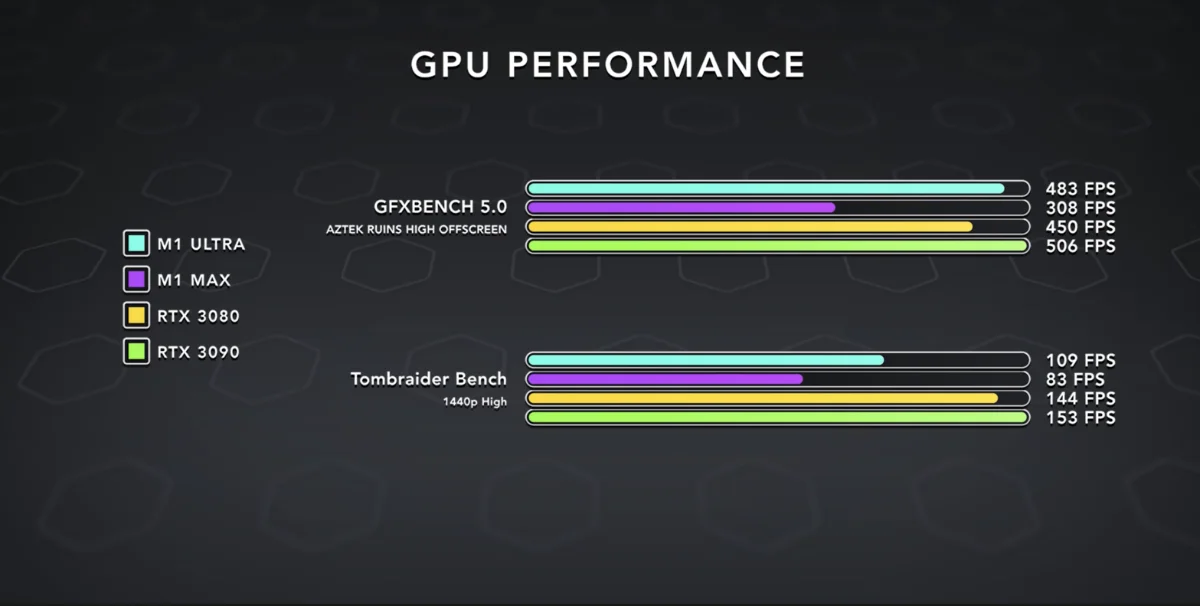
And Apple GPUs have only gotten better.
[0]https://techjourneyman.com/img/blog/m1-ultra-vs-rtx-3090-ben...
My question is, what games are people playing on Mac? Tomb Raider is one of ~6 AAA titles that was ported to Mac in the last decade. All the other big-ticket games - GTA V, Arc Raiders, Elden Ring - are all hamstrung by Apple's terrible translation software and don't run much better with Crossover either.
Apple Silicon, strictly speaking, is the least adept hardware that you can own for gaming. If you are a gamer, almost every single other GPU on the market would perform better for your needs.
Slay the Spire 2 is in early access and has some major issues running but I suspect that’s some issues in the game engine because it’s not framerate but some sort of hitching that makes button presses not register.
YapYap which is an intentionally retro ugly 3D style runs barely in a playable state on the M1, but it got me through in a pinch when my kid wanted us to both play.
If I want to play AAA I fall back to my desktop, you can stream using Moonlight or Parsec but unless both sides are wired it isn’t great.
My 16" M1 Max is kinda crap at running games - I'd put it somewhere around cheaper laptops with 3050 series GPUs.
I would recommend the same. I absolutely love my Neo. It's such a nice machine for the price.
My 2013 MBP was going strong with Debian until the battery started puffing up last year, and I finally had to recycle it.
I get it, I know I'm not their market, but it still pains me because it was a great laptop.
Why pay $500-700 for Mac Book Neo for the same low processing power experience that you can get on a Googlebook for half the price? Especially considering you can install linux on it natively.
Other then that, Gemini is the biggest advantage. Google can offer Gemini for free because its TPUs are orders of magnitude more efficient than Nvidia stuff. Even free tier Gemini is really good considering it can integrate with a bunch of your stuff like google docs, and the lower last gen models have pretty generous usage limits.
Overall, if you are in Android ecosystem, you don't really even need a cheap laptop anymore, considering things like Samsung Dex exist.
What makes you think a googlebook will be half the price of a macbook neo?
Also, a used M1 macbook air is $300 on swappa/ebay and will be even better than the neo anyway. It's still more performant than every other non-Apple ARM based laptop/chromebook on the market and will have far superior build quality.
Lol. There is zero chance the low end mobile phone SoC shipped in those is remotely as fast as a six year old M1. Even flagship SoCs from qualcomm and samsung still do not exceed it's performance yet.
Go look up some benchmarks, the Kompanio Ultra 910 is very comparable in speed to the Apple M1.
It's not really a "low end mobile phone SoC" - it's a Chromebook-specific chip with Cortex-X925 and Cortex-X4 cores.
Cortex-C1-based SoCs are faster but only available in phones to date, which gives them less thermal room.
Anecdotally, I own both an M1 and a Kompanio Ultra 910 device, and they feel subjectively very similar from a performance standpoint.
Good point, that could work. Buy this and you get so many years of Gemini for free and such. "Why pay Anthropic $200/month for Claude when you can buy this and get Gemini for free for a few years". OpenAI and Anthropic are not going to make their own devices most likely either to compete.
I pre-ordered a Neo on a whim to use as a couch laptop alongside my work laptop and gaming computer. It's so fast. It blows everything out of the water when it comes to interactivity.
Plus the whole build quality, screen, touchpad and speakers are all so much better than the work Latitude. Linux support is lacking, but it's still a full usable Unix.
Of course, there are more than 2 options for laptops. Thankfully those two shit companies didn't get to round up that market yet.
Might have been more interesting if it were under a separate company that Google owned a large portion of, rather than carrying the Google brand. Then again, maybe the Google brand isn't toxic to the wider ecosystem of buyers. I still think consumer-hardware-wise Google is the Safeway Essentials version of Apple but others might think Gmail or Google itself which consumers consider best in class.
Please not schools…
The Chromebooks are probably cheaper than the hardware itself could be, but that's a good demonstration of the issue.
I don't think we need any computers really. They'll be inundated with computers and technology their whole lives. They'll figure it out. Just keep this tech out of the classroom altogether.
We've had computers in the classroom for over a decade now, scores and learning has not gone up. It's a failed experiment.
They'll have computers at home. And the evidence seems to point in one direction: the more exposure kids have to devices, the more stunted their development tends to be. Add to that the class division, where rich kids are increasingly raised with strictly-policed device exposure, while poor kids' classrooms are littered with iPads and Chrombooks, and I think we can start making blanket statements.
Shipping enterprise desktop hardware with AI integrated features will likely be a priority to improve the cloud footprint amongst fortune 500.
It's a "most loved" brand according to https://rankings.newsweek.com/americas-most-loved-brands-202...
I was anticipating an "AI phone" from someone like Google, not an "AI laptop", although it seems to be Android compatible so maybe that is coming next.
My guess is that they wanted to name this Geminibook but couldn't for some ultimately uninteresting reason.
ChromeOS devices fall out of support on a timeline. Google sometimes extends the timeline for some devices, and new devices have a longer timeline than in the past; maybe it's better for Education targeted devices, but the Chromebooks I've had for personal devices stopped getting updates and you're left with whatever state it is in; my first one stopped getting updates in the middle of the printing switch where cloud printing was discontinued and local printing didn't actually work.
My understanding is that Google has announced they will stop development for new ChromeOS devices and ten years after the last device is released (not purchased) support goes poof ... and I imagine support activity for the last 5 years of the last device's ten year support will be a lot less than the first 5 years.
That said, its hard to justify the prices for these premium Chromebooks. When I picked them up they were heavily discounted with some developer code or other.
I also agree with the shaky future as far as being able to actually opening these things up with developer tooling. It seems like they've simply been on a path to rollback all of that.
Chromebook Pixel 2013 had that atrocious function key row that didn't align with the rest of the keyboard and where made of different material and had terrible travel. The Pixelbook had some terrible PWDM issues with the display and iirc it also had severe ghosting issues. Not to forget the cut in performance of these mobile fanless Intel chips because of Meltdown & Spectre. I think the Pixelbook's WiFi/Bluetooth module made by Intel also suffered from hardware faults where using Bluetooth could degrade WiFi performance and vice versa.
Beyond that, this is a laptop that is running a really shitty, 'apps only, no you cannot do anything useful with this' operating system. I have an awful lot of complaints about MacOS's relatively restrictive use cases, but it's still at least a General Purpose OS. Android on laptop is very much not.
This is an overgrown phone with all the trash that comes with a phone, and the very finite use cases that come with a phone, only now it has a keyboard. It's solving none of the problems with Android as an operating system and doesn't seem to even be interested in doing that anyway. The marketing is demoing use cases that don't even exist.
So I repeat my question: Who is this for?
This thing will be killed early 2028...
If you price that up to $1,000 (which some Chromebooks definitely do), then I start to ask a variation of the same question: Why did you buy that?
Google should totally be experimenting with what can be done, but it seems to be a bit odd that they put something so uninspiring front and center like that.
https://www.reddit.com/r/Android/comments/1tb8xls/introducin...
[Edit]
And, the feature set references the 'AI mouse pointer' from this Deepmind blog..
Most people don't really seem to care about data collection when it comes to AI usage. A lot of people who will feed Gemini/ChatGPT/Bing/Claude/shady clusters across the internet for bargain bin prices/Mistral every detail of their lives will probably be fine with Gemini as long as it doesn't interfere unnecessarily.
You can point or select anywhere on the screen and it understands and searches the context. If you select a text block, even text inside an image, it allows to copy or search the text online. Otherwise it can search the image.
I use it often. It's intuitive and fast even on non-flagship phones.
I'd wager their A/B tests went well enough to warrant a port from phones to their new "Chromebook".
That assumes you intended to use AI. People are going to accidentally upload random private content to google.
At least one DE I've used (MacOS? KDE?) even had it as an official macro that would make the pointer 10x bigger when you shook it
> If a friend sends you a picture on your phone and you need to email it from your laptop, the file is just there — no need to email it to yourself.
So are there really people who will email a photo to themselves from their phone to… send the photo in an email?
Interesting to note that there is no mention of processor or operating system in that post. I’m guessing that it’s Android in a laptop form factor which I suppose might be something that some people would want, but I’m not one of them.
There is also localsend, but plainapp needs to run in only one device.
I all the time use my phone as a camera (esp. for coin photography) than e-mail the photos to myself as the most convenient way to get them on my desktop where I can edit them with GIMP etc.
When on wifi, the photo backup upload starts immediately. If it doesn't (possibly due to your settings, this used to be my issue) you can manually open the photos app and tap the backup now button.
Google Drive would be another option to transfer, but would be more work (about same to "share" as email, but less convenient to access on desktop).
The e-mail way is actually quite convenient since on the desktop you can just download all the photos you sent in one go - they appear as a zip file that you can then just extract to your working directory, rather than having to save one at a time.
I got mad when I bought a Chromebook thinking it was a cheap laptop I could install any OS on only to find it was boatloader locked and the model I bought hadnt been cracked yet. Say nothing of all of Google's recent practices with Android. This whole thing just sounds like the plague.
...as computing shifts from operating systems [to intelligence systems](TKTK)...
edit: hah, maybe someone from Google saw my comment. This has now been fixed and TKTK replaced with https://www.reddit.com/r/Android/comments/1tb83gy/making_and...
I had an instance of it this morning: Claude proposed a shell command containing a URL and it used this format, which is broken in context.
I'm really enjoying reddit just completely roasting the entire concept in the comments.
This is the biggest UI upgrade I've seen in a long time. I see why Google would build a whole device around it. Local LLM intelligence merged into the UI is all but inevitable.
The belittling comments on this story are deafening, but there is a real advance here that could diffuse fast, and more than incrementally democratize compute.
I mean if you think about it, the type of person to own an android phone and care enough about phones to join a community is pretty much guaranteed to only be a tech geek.
A disaster from the first step.
Yeah but what about Windows Explorer? They've been passively blocking SMB access forever at this point (by disallowing ports below 1024).
I would not be surprised if Googlebook's file browser goes via the cloud.
What does this mean? I'm in Australia so I would expect Sept-Nov.
But since I've only ever heard of American companies use seasonal typed release dates, my first instinct is to assume this is an American site and therefore American Spring - but Googling 'spring season usa' tells me Mar-May. And we are already in May.
So then I have to scroll to the bottom of the page to see what region this might be in, and it has got Australia selected. I change to UK, scroll to the top, and it has changed to autumn.
So, it is actually Australian Spring. That actually surprises me since most pages like this would not be updated to reflect my region, and so I would never expect this kind of text to be localised.
Let's just all use unambiguous wording and units :)
So it does say fall on web archive
A Googlebook is something "above" a Chromebook (maybe the AI featureset imposes hardware demands that Chromebooks can't service) but is still made by third parties. I suppose they're keeping Pixelbook for first-party devices.
The most interesting part to me is the "Create your own widget". I'm really interested to see bespoke UI become a first class citizen. Why _can't_ I just ask Gemini to build a widget that serves the data I want how I want it?
Building "small" UI is for the birds, just expose the API and the basics and let users tell the AI what UI they want.
Everyone and their mom will have their own hyperspecific custom apps prompted into existence
Something like Claude Code with stricter sandboxing built into the OS for consumers
Not just desktop either but also on phones
Most people who haven't reddit would assume googlebooks are made by google
I will never trust them with a hardware purchase ever again.
To be fair, how would they even verify this? Unless it's outright broken (eg. no cell reception), someone with a "defective modem" is basically indistinguishable from the 99 other people with a perfectly fine phone, but nonetheless want their phone replaced for various nonspecific issues about cell reception.
I swear if I see it in real life I'm going to spray holy water on it.
A.I., data collecting at every level, horrible incoherent ui.
Hit me daddy !
MacBook neo @ $499 and the ability to finance it leaves almost zero room in the US market for an Android laptop.
*edit
It looks like will be a ChromeOS successor and their demographic will be schools?
Anyway, this will be fun to see price point, manufacturer differentiation (surprised that Google isn't building this themselves) and reviews. Hard to see how it competes with the Neo at $499 that can run a full Desktop OS and integrates well with the ecosystem.
Have you interacted with the 'general public' in the last year or so?
Every non-technical person I know uses AI for 'fact checking' now, as well as 'doing the math' before deciding something, despite these two literally being the well known blind spots of modern AI. People have adopted AI suspiciously cleanly into their habits and workflows.
The only person I have seen being weary of AI recently is a labor activist, for good reason.
There are a lot of people here complaining about AI and Google and Android and Ads and clothes and marketing and whatever. I'm assuming a lot of that is HN anti-AI derkaderbs bias, with some Apple/Google tribalism for good measure. Yeah Gemini might be shite at writing code, but Gemini Web / Android is by far the best executed and most useful conversational/consumer AI assistant out there (at least in my experience, it's not even close).
I'm not a Google fan by any means, but credit where credit is due, I don't see a timeline where they don't end up completely owning genpop consumer AI. The more I think about that the more convinced I am, and the more I feel uncomfortable.
What operating system will it use? No comment.
Will I be able to play games on it? It has AI!
If you don't want to associate with past Pixelbooks and want to highlight Gemini, why not Geminibook or something like that? Does Google not have faith in the Gemini branding?
Random thoughts from a nerdy mind.
I've been pretty skeptical of Google laptops ever since.
This pattern extends to so many goods in modern life. Washing machines, microwaves, etc aren't worth the time of a local repairman. Repair is economically incompatible with its life cycle.
Clothes are replaced, not stitched. And after a few washes at that. Cars, phones, etc, consist of proprietary parts all sealed up.
I'd add that experiences like GP help expose that the main difference in most products between 'premium' and 'disposable' is in the branding and the price tag. With few exceptions, most companies that used to make the respected brand of the thing (e.g. Sony, G.E., Craftsman) now churn out the same garbage as you used to find 30 years ago in a fleamarket with a brand you'd never heard of - and that's if they don't actually outsource the design and/or production to that low-bidder company and simply license their logo directly to them.
And that's because these are all public or PE-owned companies, and it's a shortcut to easy short-term quarterly growth if you can cut your costs while keeping your price high or almost as high (after all, you're a "Premium Brand" so you can leverage your past reputation to trick customers into continuing to pay that premium).
Please take a look at poor countries of the world like Pakistan. They have a repair culture. They have vehicles from the 80’s out on the road doing daily driving work instead of being used as vintage show pieces. It’s a poor country, this is a necessity. But nevertheless seeing the repair culture there in contrast to the disposable culture in the western world makes me pause.
Here in Mexico there are plenty of "unofficial" laptops/mobile (Apple, Windows, Androids) repair shops that even receive your device by DHL/UPS, fix it and return it. Because the labor costs are low enough to make it worth. The only downside is that most of the spare parts are imported from the US.
And a consumer usually has a much higher return from working in his specialized field to earn money and buy a new product, than spending time with difficult repairs of a broken product.
Difficult to determine causality in that system. All we can say is places with expensive labour tend to have expensive real estate. (The confounding variable, I imagine, is immigration.)
I am afraid Google's business model is incompatible with this approach as they have almost no customer service because it doesn't "scale". Actually, what they are doing is turning customer service costs into externalities, i.e. environmental waste.
In fact, in "shithole countries" where everyone wants to emigrate from, it is exactly the opposite: i.e. you try to fix everything even if it takes sooo long.
And the reason people want to leave certain countries is for totally different reasons than not wanting to repair something. In fact, I would say with quite some certainty that emigrees who repaired first before leaving would still do it after emigrating.
The real reasons, in my opinion, are: 1) it takes skill and will to repair something yourself, 2) something new generally feels better than repaired/used, 3) logistics make replacing/repairing less cost efficient, 4) with every replace, companies have a new touchpoint to try to upsell their customers, 5) it takes less time to go to a shop and replace than repair, 6) it takes some giving a shit about the environment to prefer the more complicated route. And probably more.
The reason almost nobody in first-world countries is getting their microwave repaired is because it often costs more than buying a new one. This is because the new unit is manufactured overseas in a place with cheap labor, but the existing unit has to be repaired locally with expensive labor.
Of course people aren't emigrating because they don't want to repair things. But they are often emigrating because they want to live in a place with high labor costs (i.e. high salaries), or for other reasons that are very strongly correlated with high labor costs.
1. The waste is still a tremendous shame, both in the materials that will realistically never be recovered in 'recycling', and in the toxicity that results from a lot of that trash created.
2. Jobs in repairing lots of things were arguably pretty good jobs, and we've traded these for, best case, more complete drudgery retailing/supply chain jobs as we get a new laptop every year or two instead of 5 years. Arguably a bigger failing of our economic system, which doesn't seem capable of adapting to global trade, or this shift we're discussing here, nor AI, but still a bummer regardless of fault.
I think in abundant society people would be able to have nice things and the time to take care of them.
It requires specialized and local labor. For products you can ship back to the assembly line, this can sometimes work. If you need a local technician, on the other hand, because the assembly line is in China or the product is heavy, yeah, it very well may be that there is no niche where repairs aren’t a material fraction of a new product.
Given the right guidance and difficulty level, I would enjoy fixing things in my washing machine.
No, it's the exact opposite, because the consumer is on the hook for the purchase price as well as any repair costs.
Labor is an input too. Fixing something in a way that saves some materials, but requires hours of skilled labor and specialized equipment doesn't straightforwardly mean you're saving overall.
When our fridge stopped fridging, we got it fixed for $300: this included replacing the compressor and the coils. When our dishwasher stopped washing, we paid $250 to have 3 or so things fixed at once. And so on.
I don't know if any appliance makers offer this, but if LG still offers it when we eventually replace, they're going to be on the top of my list.
No, it's because repair involves labor and unless we ship it across the world to take advantage of people making a dollar a day it's just not worth it.
The cost of making and importing stuff from the third world is just so cheap now that it's simpler to get a new one then to have someone making a living wage in the west fix it.
The rose-tinted era of things being made to last never really happened. For each of the old survivor washing mashines, refrigerators, vacuum cleaners, and Casiotron wrist watches that are still out there doing good work, countless thousands of others were recycled or landfilled because it was better to buy something different than to fix the old one.
It was never cheap to pay someone to work on stuff. The costs of hiring professional labor and the overhead associated with that labor (for service techs, that means things like vehicles, buildings, inventory, tools, training, insurance, book keeping, and covering next week's paycheck even if this week was slow) have always been expensive.
Parts have always been relatively expensive, too. Availability of parts has always been somewhat hit-or-miss.
It seems like an unpopular opinion, but I don't think it came to this. Instead, I think that it started off this way, and that it simply remains this way today.
So, sure: $150 for a new widget? Not so bad. Maybe a pro could get it done in a few hours (maybe they can even get two of them done in one workday!), while perhaps it will take you a day or two to work through R&Ring this thing on your own for the first time.
Whether the total investment (including time) is worth it to you is a personal decision, but that kind of decision-making is also not new. :)
Unlike a lot of hardware and such in our homes, this mostly just boils down to people refusing to learn and is incredibly easy to remedy. Basic stitching is not super difficult. My partner has very light knowledge of stitching, learned it mostly as a kid and never used it much, but has repaired plenty of my clothes. I'm wearing stitched jeans as we speak (pocket got caught on a hook and tore nearly off). Typically gives my regularly worn clothes an extra year or two of life.
Strata Pixels, Nest Cameras Google Smart Speakers Nest Home Security system
but then I broke my Google Pixel 1 watch. I ended up chatting with service in India and they pretty much told me that there was no way to fix it. After that, I quit buying all things Google and switched to Apple. Now I only buy Google software products, no consumer devices.
If anything, Apple is in general the worst on this particular metric. Switching to Apple because you had a repairability problem with another brand is kinda funny.
Are there stories where Apple straight up said they wouldn't repair a watch? I thought they'd repair it even if the repairs were more the the replacement value.
It's a total disaster and I will never buy Google hardware again.
Love their SaaS offerings though!
It was my travel laptop for at least 5 years.
It was expensive, but the quality, performance, and durability was top tier. And it lasted 5+ years.
The Pixelbook also had a "Google Assistant" button built in the keyboard. Should be easy enough to relaunch the hardware and swap in a gemini button...
And if you're not in North America (or EU), chances are very high that any repair to Pixels is going to be either not possible or will cost you dearly. I personally had a terrible experience of this with Pixel 7 Pro that was in warranty and had a water-related damage, since then, I've stayed away from any device made by Google.
I wish they'd had open bootloaders, but I seem to recall you had to keep it in developer mode which required a nag screen, or something along those lines, if you wanted to run your own OS on it.
Has any of this changed?
Also, I tend to take with a grain of salt any comment that starts with "it's easy/simple/obvious", especially if it doesn't provide details or a link.
I've repaired my MacBooks multiple times before (although not one in the last seven years, so maybe they are totally unrepairable, but I doubt it).
The main issue is that Apple will want to replace everything to avoid you coming back and saying it didn't work, when it's actually a different issue.
I understood the technical need for soldered on memory (physical limitations of SODIMM got in the way of power and speed requirements), but the soldered on SSD is just inexcusable considering flash memory is very much a wear item.
I have a macbook but my father had dropped my m1 air (which my brother has gifted me) accidentally from his car on literal straight concrete bricks from a considerably high height.
The damage is literally close to none aside from just a very small bump* but later I realized that if it was any other laptop then it would've been smashed to pieces but Apple's aluminium body came into clutch.
I am not much of apple's fan but I wish to give credits where its due and so from my anecdotal evidence it wouldn't have been the case with atleast my mac air.
This thing is crazy light, has a decent battery life and survived quite a high damage with tis but a scratch. Credits where its due to Apple hardware engineering.
I don't wish to oversell apple tho but from my anecdotal evidence, it handled pretty good in real life stress test and I am super happy with it surviving that drop with almost literally no difference, so there's that.
"AppleCare+ covers fall and accidental damage (drops, cracks, liquid) for a reduced, fixed service fee per incident. It offers unlimited incidents (or up to two per 12 months, depending on the plan), providing a significant discount over out-of-warranty repairs. A service fee, such as $29 for screen repairs, applies"
Advertising aimed at the actually rich is usually more about saving time, "elevated" experiences, or building legacy.
Oof.
Very upfront: "Don't pay attention to RAM, processor, battery, monitor, price, etc. We're not telling you that, because you'd laugh. We're selling access to web services. Lower your expectations, get excited for AI. Please clap".
Very rough. Moore's lesser-known cousin, Les, predicted transistor density-per-dollar would actually start to decrease over time. I guess Google's ready for that world?
And even the most virulently pro-AI people I know aren't using any of these services Google is trying to market as sexy. Who is this for? "Make a band poster for my kid", could they have chosen a sadder example?
It doesn't help that the first result on Google for "Google book" is Google Books. Even their "AI overview" is helpfully telling me about the specifications and pricetags of books on Google Books.
Anyway, you didn't miss out on anything by not bothering to look into the details. There are no details. No specs, no nothing. Only "get notified" for when it comes in fall.
It's a shame because I love the Pixel series and they're doing it a disservice by not marketing it better. Apple's copy on the other hand is generally excellent.
This really just feels like an incremental upgrade to ChromeOS, with a new name to distance it from a brand that's synonymous with "cheap crap schools give to kids."
For me, unless you can run LLM's and whatnot locally (which is not the case on this undisclosed low-end hardware), "AI" just means doing some API call to a web service and have it serve me some freshly made up tokens. You can do that on a potato. The fact that they happily announce something that can be done on any other cheap-ass laptop as the main selling point, means this product is nothing special at all.
I think LLMs have the potential to make computers work how we’ve always envisioned them to (i.e. 60s sci-fi), but I’m also not convinced a dedicated laptop is the right form.
With that said, a 128GB RAM MacBook Pro is getting tantalizingly close to running useful local LLMs.
If the Googlebook was announced as a machine capable of running a small Gemini model locally, I’d probably enter back into the abusive relationship I have with Google hardware and preorder it…
No, it isn't. If you're making hardware product, sell me hardware thats worth it. No spec sheet, just AI pushing. Chromebook 2.0 where the chromebook was a browser for an OS.
Not for me anyway.
This thing, like all other google/android products, will be DOA, and the ones actually duped into buying one will be left with a paperweight in a year or two when the cheap hardware inevitably breaks.
If so, there likely will be some variation in the cases.
Built for Gemini?? No thanks.
I am just lost. I wanna watch a documentary on how this kind of thing gets thought out and made and approved by a lot of people and then comes to being annouced as an actual hardware product.
Care to elaborate? I have no ide a what you're talking about here.
Edit: Probably Android at the core, and then a desktop-grade Chrome browser on top.
Also
> Intelligent Window Management The OS learns your workflow patterns and proactively arranges windows, prepares files, and opens apps before you ask.
Bleh.
Edit: Oh, it is that. A fan decided to make an LLM write a promo page assuming the role of Google marketing for an unreleased, unannounced project and make up all the details.
I’ll be blunt and say this looks like a rebrand of ChromeOS with a normal keyboard and AI slapped in it.
Chromebooks are associated with low quality garbage that people only buy if they’re desperate.
I don’t think this product will be successful. Someone buying a laptop at all needs more compatibility than Google’s OSes offer. Even with Android apps, those are all really shoved in haphazardly.
Why am I buying this when I can get a MacBook for $499?
But Fuchsia won't be in the Googlebook because there's no Chrome browser for Fuchsia. (In early 2024, Google officially stopped trying to port the full, desktop version of Chrome to Fuchsia.)
It was just a speculative research project and a bunch of bloggers went wild declaring it the end of Android, Linux (Android of course sitting on Linux), ChromeOS, etc. That was never real.
Zircon is still under development with recent RFC's extending the memory synchronization and attribution model for processes.
There was also more extension added to one of the key disk formats in March which has an eye to more flexible long term evolution and adaptation to particular device form factors.
The publicly available evidence does nothing to support your claims, entirely the opposite.
I used to work on Fuchsia, I have not for many years now and have no idea what their current roadmap looks like, but I do know where to actually look up what's been done recently, which is all public and you could do as well.
Anyway I have no idea if this has any fuchsia code in it.
Okay? Is this impressive? Do you think it shows something? Bizarrely whenever people point out how much of a flop Fuchsia is (relative to the hype a decade ago), there is always someone like you citing commit count. Weird.
The vast majority of the commits are tiny commits to change a version number or rename a test. Or to pass some lint tests. I know tiny two man shops that have much more substantial commits each day.
I didn't say it was dead, though did I? Not quite sure what kicked off your bizarre defensive, asshole-ish screed. I specifically said that it most likely will be a tiny runtime for VM processes in Android.
But Fuchsia, announced A DECADE AGO, remains utterly irrelevant, aside from a couple of poorly received, dogshit Nest devices. And we know that Google massively downsized the team and basically moved on, and from people I've talked to it is now basically a make work project.
Yeah, the chances that Fuchsia powers this device is 0.0000%. I hugely doubt it even appears on the device at all.
So the dream, as constantly restated on here, is pretty clearly absolutely dead.
I don't know about you but these AIs ran out of internet data to train and I volunteer all my blood, sweat, tears and movements to improve them.
If Google is now pushing this "intelligence‑first" desktop experience, how much of that work is likely to stay in the proprietary ChromeOS/Googlebook layer vs. land in upstream ChromiumOS?
Google really struggles with product. Money doesn't buy everything.
Google basically said “here’s a mysterious glowing rectangle” and expected us spec junkies not to immediately start clawing at the walls for a datasheet, and losing sleep for weeks on end until we get them.
Ie the other day I wanted to track my clipboard history, and I preferred to trust a locally coded & executed AI-generated clipboard history mac app over a random github project.
Now obviously trusting AI has its own concerns vs trusting people, but interested in other ways companies will reimagine interfaces with AI
Coupling these with Gemini is so detached, especially when everyone screams Local LLM.
I guess they don't want the baggage from Chromebook because Chrome is a given Google wants people to think Google == AI the way they think Chrome == internet.
We may not like Copilot but the truth is Google's OS is already delivering what Apple Intelligence promised on laptops and phones. Google has a lot of customers, a good amount of Apple customers seem to want Apple Intelligence. I'm interested in seeing how Google does against Apple (and curious what GoogleBook will cost). It's important to remember that it was in the works long before MacBook Neo was announced and maybe even before it was rumored.
That said, Googlebook is a terrible name and reusing Pixelbook would have been way better.
Edit: It lists five OEMs, so it's not a Pixel equivalent, not Google-made hardware. Which makes it funnier, actually. Like if Windows laptops from every OEM were called Microsoftbooks.
Typical of Big Tech spirit.
If it ends up having ML-centric hardware, like a version of their TPUs, the story could change, especially if they don't try to keep it locked within their ecosystem. Local AI is the future.
I can’t wait for local llms to get more powerful
Say what you want, a cheap Windows laptop at least has an edge on obscure software compatibility over MacOS and a notebook running any modern Linux distro gets the luxury of user control. ChromeOS meanwhile has neither. Paying more for worst in class software compatibility inferior build quality, design and restrictive lock-in sounds about as appealing as a chicken tartare from the value bin.
Prior to (again) getting a MacBook Pro, I wanted to make a high end Laptop (ASUS ProArt P16, about € 3500,- back then) work with Fedora, but purely on a basis of build quality and input feel, it was unusably poor. That trackpad deserves a place in hell and if that (or likely a worse one given cost cutting) is what the Asus and Acer models get, competing with the Neo is a cruel joke.
HP and especially Lenovo fare better, I can at least live with those though a Neos input is nicer if we compare their current devices at the same price, so unless Google is willing to heavily subsidise a brand that, let's be honest, is unlikely to garner any loyalty, I can't see them being overly competitive either, given the software limits of ChromeOS.
ChromeOS can run desktop Linux software and Android software, so it definitely isnt worse than Mac. Its probably even better than Windows. Of course, if you need Mac/Windows software, Web/Android/Linux alternatives might not exist or might be worse. But the devices are hardly lacking software compatibility.
For reference:
> Cameras aren't yet supported.
> Android devices are supported over USB, but other devices aren't yet supported.
> Android Emulators aren't yet supported.
> Hardware acceleration isn't yet supported, including GPU and video decode.
> ChromeVox is supported for the default Terminal app, but not yet for other Linux apps.
Source: https://support.google.com/chromebook/answer/9145439?hl=en
Why are these features compelling? I went through the whole page and still don’t know what OS runs on this laptop… the value prop for this is incredibly unclear.
I wish it was framed around the OS and how it can run on a wide range of devices (similar to android and chrome os) and become something more in time (maybe with apps that can be developed outside the android ecosystem with a desktop experience in mind).
99% of users don't give a damn about that. This is a play for kids in schools, so they get used to their operating system.
I am saying that, as a developer (is it really only 1% of laptop owners?), the pixel/chromebooks were not really that useful.
Who knows, maybe that's changing with whatever OS this is running.
But... Google owning my hardware? This feels so out of left field. I must not be the target audience.
This seems like their pixel experience but on a laptop.
I'm not sure I'm their target audience, but if it can be a macbook neo quality device with chromebook, I can see a market for it.
I'd be more likely to believe them if they had already implemented this feature on their Pixel phones, but they haven't so I expect it probably isn't "done".
1- Chromebooks have made huge inroads in schools because they’re easy to maintain, share, upgrade, and they’re very cheap.
2- Obviously, running desktop software is a huge new piece of the ecosystem, but isn’t this customer already opting for Windows/Mac, who have extremely robust 30-year ecosystems and suites like Office, iLife, Adobe, etc that will obviously never build for this platform
There’s no way Google OS ever hits any kind of parity of exclusive software that is unavailable on Windows/Mac. Best they can do is run Android apps. This also introduces a high new threat vector to their existing customers who might not want it.
Lastly, what will this do to Chromebook buyers who are now wondering which OS will be actively developed in 5 years?
As for this project, I think part of it is just the conclusion of internal power plays between Chrome and Android. The other half is probably the same fear as before: if Microsoft puts their own AI closer to the user, Google will have a hard time keeping up. So the best defense is to have your own "AI-first" OS.
Keep in mind that Microsoft doesn't need to win to hurt Google's bottom line. For example, if Bing captures 5% of search through OS- and browser-bundling strategies, that's still a 5% that Google can't have.
i have always liked netbooks more than chromebooks (but I really only ever had the samsung NC10, specifically for the keyboard). i really miss that thing. these days i am wary of the gewgly eyes on my digital person, so i'ma pass on this til someone less on the radar makes another platform pop.
where to next! linux on risc-v? steamOS on ARM? screenless lozenge wirelessly coupled to an EEG that makes me hallucinate images?
I use gemini extensively (and claude). But - do I need this integrated in my laptop? Don't quite see it. And it's hard to beat Apple on hardware now.
I wish they'd just make ~ pixelbook with ubuntu... it'd be such a powermove, and they if anyone could pull it off
I was excited at first by this, but the "designed for gemini intelligence"... like what does that even mean
Don't get me wrong, I'm still disappointed. But mainly because it looks so superficial. I was trying to work out what's new and it just looks like an Android device (or Chrome? I can't tell) with some party trick Gemini features sprinkled on it. There isn't anything technically interesting here.
I'm still waiting for someone to ship a truly AI native device - something with the right sandboxing and UI layers to let an AI model truly understand and work with the device natively, but safely. The OS SDK itself should natively incorporate all these elements as first class primitives. And the model would be trained heavily to explicitly understand and work well with them.
On the other hand, if maximized windows work properly and Linux apps are still supported and they have a Snapdragon X2 Elite Extreme version, I might be interested. The Snapdragon is very competitive with Apple's M5 even including single core performance and battery life.
I personally would want to also be able to switch off the telco signal.
Perhaps the bay would be in the laptop screen itself and the two screens could operate side-by-side - or in the main body and the phone would go dormant.
People do this when the system is stuck or something is not working for some reason, and this will just add extra burden when that happens.
It's such a bad idea that I can see Microsoft immediately adopting this! (Opens up three variants of copilot, one deprecated and spins without getting the API handle right.)
But at least your AI can then tell you it will all be okay eventually.
Also, I find it funny that they have burned through the "chromebook" and "pixelbook" branding already, leaving them with the less snappy "googlebook." Not sure if the third time's the charm here.
- Annoying startup animation (at least it's skippable)
- Minimalist copy that is that is also very hard to parse for meaning.
- Elements jarringly appear and disappear as you scroll.
- Only has examples of tasks that are easier to do on your phone.
Edit: spelling
- laptop manufacturers and customers preferring Linux over Googles os shenanigans
- Apple Unified Business Platform, that is going to take an enormous piece of the enterprise pie
One day an exec will say lets reduce wasteful projects and cut this.
Well, I am still waiting for the price. If it is $450 or higher, I'd just get a MacBook Neo at that point.
Except given their recent behaviour I have very little trust that they won't execute that in the most user hostile fashion they can come up with.
I don’t know what normal person wants this though. The Neo is enough for most, and if I need more I’m probably going to want a real os. Not ChromeOS++
It's hard to treat this part seriously while seeing HP logo on the page.
Zero chance in hell this surveillance device comes into my home.
Such a nice Latop!
Agents will need a different level of understanding of your activities across different surfaces to act effectively, IMHO the OS is the perfect place to offer it.
Nobody wants AI embedded into the OS spying on you every move.
Just think of all the times that you're happily using a browser and now these sites are going to demand you install an app after they detected you can because of the user agent. Ugh.
From TrendForce's analysis:
"The laptop market's 2026 shipments have been revised down from the previously expected annual growth of 1.7% to -2.8%, and further adjusted to -5.4%. Brands with highly integrated supply chains and more flexible pricing, such as Apple and Lenovo, have more flexibility to handle rising memory prices. However, low-end and consumer laptop brands face difficulty passing on costs and are constrained by processor and operating system requirements, making further spec reductions difficult."
Google can obviously just make this machine more expensive, but to launch a completely new brand of consumer laptops in a year where production is already very constrained is only going to exacerbate the core issue.
They missed a great opportunity to create a special user interface experience supporting multiple tasks (e.g. Gemini-CLI, anti gravity, Gemini-chat, browser) while sharing the same context . It could have been an awesome developer device . Imagine virtual desktops all sharing the same context with various tools : Gemini-CLI working on infra and artifacts, Antigravity running development , Gemini chat generating graphics assets. Hardware enabled with special shared memory / NPU.
Instead, I see a Chromebook with the nagging MS Edge “right click for copilot”.
Are Google PMs really just saying "let's take existing product and shove AI into it"?
Let me elaborate if it isn't obvious. If it is higher, people will just use their regular laptops ie. there will be no use case. If it is low, it will find it's use. Like when I am travelling, this would be amazing.
"We’re bringing together the best of Android, which comes with powerful apps on Google Play and a modern OS that’s designed for Intelligence, and ChromeOS, which comes with the world’s most popular browser."
https://blog.google/products-and-platforms/platforms/android...
Many have tried desk/laptop and phone integration before, but it never seems to work smoothly, which surprises me because it doesn't seem that hard, at least to run phone apps on the larger screen (with some icon modification, etc.); and it doesn't stick as a feature, which surprises me because I'd think almost anyone would want to easily integrate the two.
I wonder why this time will be different? Is there demand now? Does Google have some trick up their sleeve? Do they have a universal development platform that makes it easy to write apps for both platforms?
Is this a rebranding of Chromebook Plus? For those who haven't been following the laptop form factor recently, Chromebook Pluses with Mediatek Kompanio Ultra SoCs are the best deals in laptops today. If this is just a Chromebook Plus with a fashion light bar, I'm not interested.
Oh god, it's a curse. In 2026 we should be getting laptops with 128 GB of RAM. Instead we get some "new model" over and over, with 8GB.
1988: 1MB
1992: 4MB
1996: 16MB
2000: 64MB
2004: 256MB
2008: 1GB
2012: 4GB
And then, from around 2014 or so, for the last 12 years, we've been kind of stuck on 8GB for some reason. There wasn't a ram shortage in 2016, so why didn't the average computer come with 16GB? The trend continuing would mean we'd have 64GB average machines by 2020. So what happened?
I'm sorry but these Taiwanese brands Acer and Asus are the bottom of the barrel. Bad build quality, clunky keyboard, bad speakers, everything plastic etc I never had a "premium" experience ever having the luck using one. They just can't make something simple as a Macbook Air/Neo
If their intention is to target the general public, then I think they're out of touch with reality, and it doesn’t seem targeted at AI enthusiasts either.
Either they live in their own bubbles where their lives revolve around constant shopping, traveling, throwing parties, and doing creative work...
Or they're not bothering to do basic observational research around how normal people live.
The irony is that most of these things would be better solved by a bot you can text. Create a thread for a trip or whatever, have it text you when flights are delayed or cancelled, reminders, let you ask it question, etc. So just...a chatbot.
> 1. Check responses.
Eh sure. Everyone will totally check the vibe coded "widget". Is this really all that's necessary to discount all responsibility when that widget deletes your disk and kills your grandmother?
I'm shocked, SHOCKED how bad google is at copywriting, and it clearly not mattering.
Maybe someone could invent a format for presenting text and images over the internet that didn’t each require each text presenter to write custom (buggy) shader code?
Any one would be a slightly bad sign for quality, all five are awful.
Yet another product range with lots of options, but not a single good one.
Gross. I thought the Windows 11 miscreation was bad enough.
also, second question in re sideloading:
do the Googlebooks get the 24 hour fuckoff window for enabling sideloading or can I just walk granny through loading an .apk direct on the laptop
Plus the fact that they’ve clearly just ripped off the exact shape of a MacBook, but thicker and shitter.
I hate AI.
Launch blog post up top perhaps: https://blog.google/products-and-platforms/platforms/android... (https://news.ycombinator.com/item?id=48111082)
- it's owned by Google. Google is the worst tech company out there to trust your data
- it has AI all over the place. Overuse of AI depresses me. And a laptop is something very personal to me. I don't want to be depressed every time i open my laptop
- the "files" functionality is cloud-based. That's insane. I don't want my files in the "cloud". I want a file system
I run linux, and still own Macs (because their hardware is great on laptops). Of course I'm not the target audience. But still.