I spent some time on legged locomotion back in the 1990s. It was clear then that you wanted torque control, and I did some work on the theory for that, trying to solve it from first principles, not machine learning. Got some nice theory and a patent out. But the parts just weren't there to build such things. As the article points out, the key to this is motor back-drivability. The final drive has to survive shock loads, and it has to dump forces into the motor, where the magnetic fields can take it. As I've quoted before, "you cannot strip the teeth of a magnetic field", a comment from early General Electric locomotive sales. (Locomotives are Diesel-electric, not Diesel with a clutch and shifting gearbox, because the clutch required is huge. Yes, it's been tried.) That's something few areas of engineering cared about, with the exception of aircraft flight control systems with mechanical backup.
Pneumatic actuators looked promising, but proportional dynamic valves were big, heavy, and about $1000 each. Linear motors (not ball screws) looked like the coming thing back then, as 10:1 power/weight ratio had been achieved. But that technology never got much further, and Aura, the biggest player, collapsed in a financial scandal. Series elastic actuators were (and still are) a race between the spring compressing and the ball screw motor starting up. Hydraulics were too clunky; Boston Dynamics built a 400 pound mule, but the Diesel power pack never worked. Direct drive pancake motors were used by some SCARA industrial robots, but those were too big for leg joints. I thought someone would crack the direct drive problem eventually, but nobody ever did. We're still stuck with some gear reduction.
Some of the exotic ideas for muscles mentioned in this article go back that far. The McKinney muscle is old, and not too useful. There was some interest in electrorheological fluids, fluids whose mechanical properties change when an electric field is applied. That didn't become useful either. Shape-memory alloys were a dead end; liquid cooling can overcome the slowness problem, but not the inefficiency problem. Everybody went back to good old electric motors, although they became 3-phase AC instead of DC. It helped that the drone industry made 3-phase motors and their controllers small, cheap, and powerful.
Academic robotics groups were tiny. MIT and Stanford had less than a dozen people each. Progress required hundreds of millions of dollars for all that custom engineering and R&D. The level of effort just wasn't there. Nor would throwing money at the problem prior to machine learning have led to useful products.
It's impressive what's been accomplished in the last five years. It took a lot of money.
At the top level you have the actual environment, with those meme videos of the robot trotting through a car park, getting kicked off balance, and recovering. The whole point of those tests was to demonstrate how robust their tech was to non-precomputed disturbances.
And between the two you've got the direction and planning layer, telling the robot to go from A to B with some set of suitably convoluted parameters that nobody but the operators would have understood. That planning layer might do all sorts of pre-computation and simulation but it needs to do it in the context of a noisy and possibly adversarial environment. That's equally true for Atlas as much as it was for BigDog, even when there's nobody actually kicking it. What I suspect the precompute and simulation is doing at that layer is a) checking for physical viability of the requested route, and b) parameter tuning in response to sensor readings over a number of runs. Not telling the robot the exact sequence of motions. But I'm nowhere near those teams (oh, I wish) to comment on whether that's true - maybe someone else round here is.
it's indeed a mess.
Even if private labs have a viable platform solution, people won't care unless they can clone it for free. Not a lot of incentive for design change, but building Kryten 2X4B-523P would be hilarious. =3
on edit: apologies if my analogy is not the best.
From what I can understand this is the Robbie Dickson in question: https://www.huffpost.com/entry/lessons-from-a-serial-ent_b_9...
Nobody has a problem with companies using AI to edit articles, create images. But when even the writer is an AI persona, the trust factor gets destroyed.
As a lay person, I have limited knowledge of this field, yet am extremely interested. Unfortunately AI gen content is being used widely to spread spurious information/fake news etc. So my knee jerk reaction to AI gen content is - "this is going to be fake".
If the information you are trying to convey is true, and is technical/objective in nature, then why shy away from associating your identify to it?
> https://cdn.shopify.com/s/files/1/0554/0567/4694/files/strai... The middle component has teeth on the inside half way round, should be smooth on the inside.
> https://cdn.shopify.com/s/files/1/0554/0567/4694/files/inver... 4 of the 5 orbiting threaded rollers are perpendicular to the screw thread, so wont do anything.
> https://cdn.shopify.com/s/files/1/0554/0567/4694/files/ball-... Ball doesnt fit in the screw thread, just 'squashed' to make it fit?. Screw thread isnt consistent.
> https://cdn.shopify.com/s/files/1/0554/0567/4694/files/stiff... Classic 3 interlocked gears.
> https://cdn.shopify.com/s/files/1/0554/0567/4694/files/optic... Has the elastomer been ripped when the key was inserted?
> https://cdn.shopify.com/s/files/1/0554/0567/4694/files/biolo... Another gearbox that doesnt do anything...
The rest of the website seems filled with just as much slop too...
It's a new phenomena. Recently got a book on agentic AI which looks like OpenAI docs with added generated water.
Opentorque actuator
- The "orbiting threaded rollers" in figure 6 are not meshing with anything (not that they could, since they are orientated in the wrong direction).
- The ball of the ball screw in figure 7 deforms the screw and the roller screw "meshes" with a flat surface.
- The guy on the pogo stick in figure 14 is jumping himself rather than putting his feet on the stands of the pogo stick.
- In figure 16, a key penetrates the elastomer skin of the optical tactile sensor, destroying it.
- The gears in figure 20 touch perpendicularly.
Really, it is hilarious. This will teach me a lesson or two.
The pattern ‘something — The « metaphor » <qualifier> ‘ screams Gemini. Gemini seem completely unable to generate a section title that doesn’t follow this annoying pattern.
Could it be just the illustrations? I'm not knowledgeable enough to judge the text contents.
Legged robots overall have more implementation complexity, spend energy just to idle standing up, but can go over much more varied terrain provided the controller is good enough. There are ways to adapt wheeled bases to different terrains (eg. larger wheels, whegs, RHex, rocker-bogies) but we know how to use legs to locomote over many terrains from personal experience, while the perfect wheeled/non-legged locomotion system perhaps remains to be designed.
There's also the way robotics is going toward data-driven methods, which in some forms (ie. imitation learning) require human teleoperation data. Here having the robot mimic the human form makes the mapping from human joints to robot joints easier (compared to other morphologies where you'd need to figure out how to best approximate a human motion with the joints/joint limits your robot has, though this is not impossible).
But yes, for a factory or commercial environment it doesn't make too much sense. It would be cheaper to adapt the environment, and many commercial environments are already designed to be accessible for wheelchair users anyway.
> Besides that, our entire technology is based on the human form. An automobile, for instance, has its controls so made as to be grasped and manipulated most easily by human hands and feet of a certain size and shape, attached to the body by limbs of a certain length and joints of a certain type. Even such simple objects as chairs and tables or knives and forks are designed to meet the requirements of human measurements and manner of working. It is easier to have robots imitate the human shape than to redesign radically the very philosophy of our tools.
I’m willing to bet we’ll have a humanoid robot that can drive a car before we have level 5 autonomous vehicles.
And by can drive a car I mean a general purpose humanoid robot that can do basic household chores like move the car and wash it with a foaming brush and a hose.
I don’t mean the robot will be capable of sitting in any regular car and doing level 5 autonomous driving.
He didn’t craft it for literal interpretation on HN 70 years in the future.
1. Asimov wrote that because he needed robots to be indistinguishable from humans for plot reasons.
2. We do 99% of our tool use with our arms and hands. We are already very good at building robot arms. We are getting better at robot hands. We can build robot legs, but they're very expensive and they pose a major safety risk for the robot itself and surrounding humans (because the robot can fall if there is a failure). For most applications, why not just put biomimetic hands and arms on a rolling base?
Of course, all this humanoid robotics research is still useful because if you can build a fully humanoid robot you can trivially build a torso-on-rolling-base robot. I sort of suspect that most of the humanoid robotics companies already know that the vast majority of their sales will be in that category.
We can have optimized automation in warehouses/logistics, but if you talk to any site manager you learn very quickly that no one wants any downtime or impact to their operation to introduce new machinery or optimize traffic, etc. If it is not built with that from the start it's very hard to introduce it later on unless there is a very clear deployment path and cost structure.
And boy, robotics currently has any of those today. Sure, move those billions in to R&D. Time will tell.
Ok, so maybe a robot with wheels could solve most tasks, but it would still be severely limited: couldn't climb stairs (which would make it unsuitable as a domestic robot in a house or multi-storey flat), couldn't drive a car, truck or any other vehicle designed for humans etc.
Its predecessor was a stair-climbing wheelchair: https://en.wikipedia.org/wiki/IBOT
One of the codenames for Segway was "Ginger", a reference to Ginger Rogers, because the codename for iBOT was "Fred Upstairs" (a pun on Fred Astaire).
And the other thing is, why is the washing machine itself not seen as a specialized robot? Like if you're designing a machine to machine machines, doesn't it make sense to revisit the whole thing?
I see a lot of videos lately, mostly from China, and I'm curious what everybody is using.
I really want to build one of those, they look great fun. (specifically in context of the article I want to see what happens if you lower the CG. Harder balance problem, but might reduce some of the instantaneous torques)
> The "Zero RPM" Problem
> When a robot bends its knees to stand, the motor must constantly fight gravity. There is no skeletal structure to lock against. To an electric motor, holding a static load—known as stall torque—is the most punishing state possible.
Why not just add some kind of brake that can fully or partially lock the joint?
Also the brake components are never in the same plane as the drive components, so now you have additional forces to engineer for.
- I wonder, is it possible to give a reason to the flag?
- Is flagging the submission without comments the right way to go?
For me, it is important that slowly but surely it goes through that AI slop is not what is accepted here on HN. Yes to have whatever LLM helping with grammar, spelling, etc. but the content should not be the output of a one shot "write me a blog post about humanoid robot actuators" prompt.
Many figures seem to be either missing key information (e.g. Fig. 5: the elliptical deformation is not shown - a human artist would have created a very different figure to explain the concept) or plain wrong (Fig. 6: the threaded rollers have the wrong orientation, Fig. 7: the ball is much too large for the bearing and the whole figure seems nonsensical at first glance).
And if the author did not spot these obvious problems with the figures, they either have no clue, accept sloppy work, or didn't even read the article they generated. That article is not really good advertising for the company's products.
(That the link behind the author's name leads to their Wikipedia article which seems to be a revised copy of the CV on their website is interesting, too.)
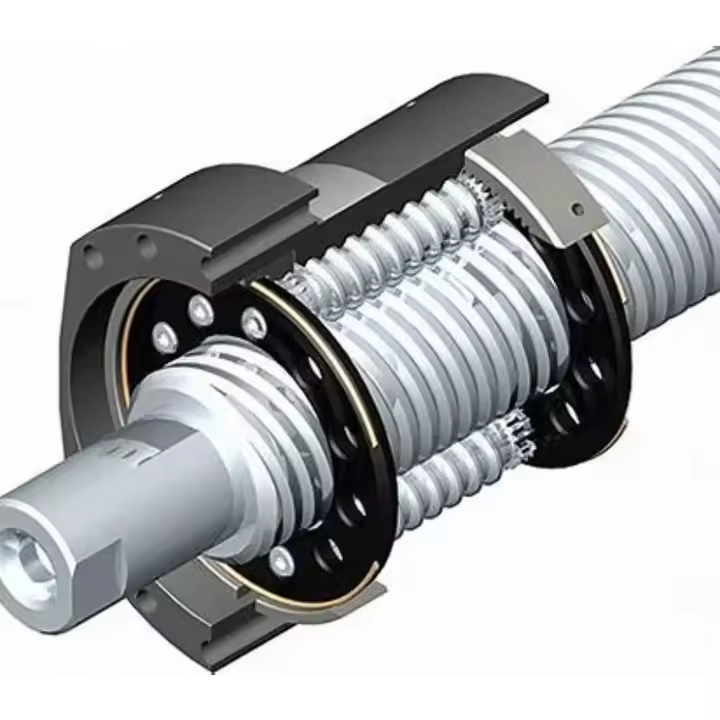
Here's an actual schematic: https://ae-pic-a1.aliexpress-media.com/kf/Sd3fe9841e4ed4871b...
Why these screws are used instead of just threads? Because rolling friction is lower than sliding friction. You can use less or more of them trading friction for shock resistance.
It should be fairly straightforward to control dynamically so you can use pretty much any motor and gearbox.
Put the robot on rollerskates break the wheels for the occasional stair.
Also: something every human actually kind of knows. You need to take impacts on muscles, not on mechanical connections. Even if we had the actuators required, you also need perfect control. The only way actuators can work this well is if they properly predict the impacts so that the power of the motor ("the magnetic field") can absorb nearly all the impact. If you try to take the impacts even on human bones (that are very solid and self-repairing) they will break surprisingly quickly.
My opinion is that the need for high reduction is only because we can't have high voltage on the motors. If we either had very small distances between the magnets and electrical wires (think micrometers), or we have voltages in the 100s to 1000s of volts, we don't have to make this poisoned choice. (in a way, VERY small distances between magnets and wires is how human and animal muscles do it. But they go all the way down to sub-10 nanometers)