I have Radarr and Sonarr running on my homeserver. I switched my model to cloud Claude, pasted the API docs of said apps and told it to make 'search, add, remove, update, and statusupdate' available in a small MCP.
It took 7 minutes, I switched back to my local Qwen3.6 model and I haven't touched the webinterface of Radarr and Sonarr in weeks. I just ask the model.
Everyone now gets a chat with my (telegram) AI bot in stead of relaying requests through me.
I have been looking into a decent local device. DGX Spark, Mac Studio etc... I think I am willing to spend on this, it really does feel like the 'iPhone moment' for me: I am not going back to individual front-ends for everything when my AI bot is a unified frontend for all API based software.
Overseerr is a thing.
Yeah I'll just have them text me and I'll paste that into my AI chat and it'll be done.
Authentication to Overseerr is done with a Plex account. No new accounts.
2) How does Overseerr help? I've never really understood it if I could give my family access to Overseerr over a VPN I could just give them sonarr / radarr directly.
Currently the profile is fixed. I guess they can delete movies but I can re-downlaod in 5 min so not a massive problem. I'm on a rolling-delete schedule anyway as my hard drives fill up quickly.
It's nicer to use than Sonarr / Radarr, and a single interface for people to learn. It has suggestions for people that need that. There's also MCP for it, so instead of setting up N MCPs for Sonarr / Radarr / The Next Arr, you set one up for Seerr.
You can also link people's Plex Watchlist. So the whole request / add to Sonarr/Radarr can be done from anywhere they use Plex.
This of course assumes you already have Plex or Jellyfin exposed to the public internet without a VPN.
If you're already forcing users to use a VPN for Plex/Jellyfin then hosting Overseerr locally and making it accessible over the VPN should be trivial.
Using an ai for that is pretty wasteful.
OP said he does local inference, and you are complaining about 'wastefulness'. OP brought the request service to where his friends already were. For them, this is probably the better solution. Seerr cannot expose itself to discord/telegram and requires users to have another account. I mean, sure you can have the AI code those too.
There are plenty of ways to solve problems, and some people do it differently. Sometimes, just to see if it works. This is a good thing. Not everyone has the time nor inclination to maximize efficiency.
Seerr can use Plex accounts, assuming people are using OPs Plex library, there's no new accounts needed to be made.
> OP brought the request service to where his friends already were ...
Another thing Seerr can do is scan the watch lists of any connected Plex accounts, so assuming the friends are already using Plex, they'd already have access to it.
> Not everyone has the time nor inclination to maximize efficiency.
Wasn't that a thing LLMs were supposed to help with?
And then for ‘big’ work I tend to switch to a cloud offering. With a 128gb mac I would be 100% offline probably.
Though egress is heavily restricted for OpenClaw and everything is behind a FW.
So rather than having to go to a bunch of different websites or apps to get things done, I've linked them all to Hermes (via skills) and chat with the Hermes agent on my phone.
I want a movie? I just say download XYZ. Shows up in Plex 5 min later.
I want to research something with multiple different perspectives? Rather than going to OpenWebUI and using that, I just asked a Hermes agent to examine an issue from multiple different viewpoints and get back to me with a conclusion.
Maybe by the time they sort it out there will be an M5 Ultra Mac Studio with a full terabyte of RAM.
Not sure who’s buying these or if it’s just people dreaming about finding a rube.
A M1 MacBook Air will perform virtually identically for most if not all laptop computing class tasks.
(If I were building a Jellyfin server today, I'd probably use a MacBook Neo.)
Given its RAM size I’m not going to be spinning up VMs, but in terms of general purpose computing it’s more than adequate. And, out of the box, you get a word processor, spreadsheet, presentation, video editing, digital audio, web browser, and a bunch of other things. Xcode is free. This is easily a laptop you can buy and use for years in 90% of settings.
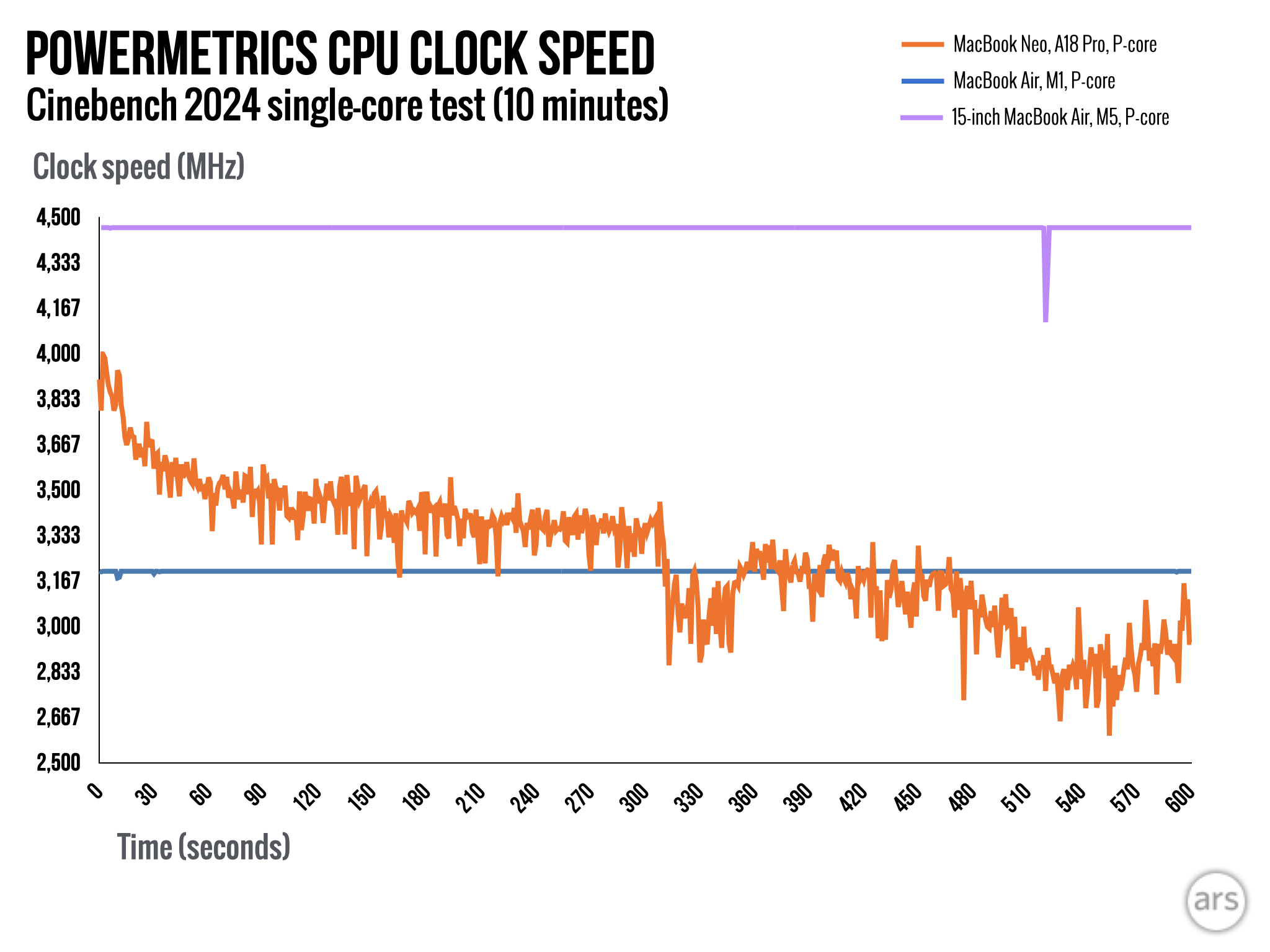
The M4 and the neo share the same CPU architecture but the M4 has 4 performance cores at 4.4ghz, while the neo has 2 performance cores at 4ghz.
The neo also does not have any CPU heatsink so it thermal throttles after only a few seconds:
https://cdn.arstechnica.net/wp-content/uploads/2026/03/MacBo...
The actual code I am using for this is:
    #include <stdio.h>
    #include <sys/time.h>

    int gettimeofday(struct timeval *tp, void *tzp);

    int main(int argc, char *argv[]) {
      double xmin, xmax;
      double ymin, ymax;
      double x, y, xs, ys;
      int max_iter;
      int i, px, py;
      int width, height;
      volatile double wx, wy, t;
      double start, now;
      struct timeval tv;
      int count;

      xmin = -2.0;
      ymin = -1.5;
      xmax = 1.0;
      ymax = 1.5;

      max_iter = 1000;
      width = 200;
      height = 200;

      xs = (xmax - xmin) / (double) width;
      ys = (ymax - ymin) / (double) height;

      gettimeofday(&tv, NULL);
      start = (tv.tv_sec * 1000000.0 + tv.tv_usec) / 1000000.0;
      count = 0;
      now = start;
      while (now - start < 10.0 /* && count == 0 */) {
        for (y=ymin, py = 0; py < height; py++, y += ys) {
          for (x=xmin, px = 0; px < width; px++, x += xs) {
            wx = 0.0;
            wy = 0.0;
            for (i=0; i < max_iter && (wx * wx + wy * wy) < 4; i++) {
              t = wx * wx - wy * wy + x;
              wy = 2 * wx * wy + y;
              wx = t;
            }
          }
        }
        gettimeofday(&tv, NULL);
        now = (tv.tv_sec * 1000000.0 + tv.tv_usec) / 1000000.0;
        count ++;
      }
      printf("%d iterations in %.2f seconds.\n", count, now - start);
}As far as I'm concerned, if I can't work because they have my laptop for a week, especially because I pay for AppleCare and have to leave it with them, it's not much different than an insurance policy that lends me a rental car while mine's in the shop.
Also, there should be some universally accepted way to have access to your data and a secure personal computer in the duration your device is getting repaired.
Yes, exactly. When getting your car repaired there’s loaners or rentals to allow you to keep driving. Why isn’t a loaner computer a standard thing?
Some people occasionally returning products—that they intended to keep or not—is not like all of the energy grid being consumed by data centers, nor is it like all of the wetlands being paved over for suburbs.
Just bough a used mac today!
Apple doesn't make much of a fuss about it but their chip performance is laughably ahead of the other chipmakers.
The Mac Mini M4 gets a score of 3788 in Geekbench[0]. The top of the PC processor chart is 3395[1]. It's not even Apple's latest chip!
PC processors can only keep up by adding more cores, but real world performance in many workloads is enhanced by having a smaller number of higher performance cores.
But single-number outputs like that are useless. Is the number ~10% higher because it's consistently ~10% faster at everything, or because it's 100% faster on a minority of things and slower at everything else? The first one is pretty unlikely when comparing processors with different designs, and indeed that isn't it:
https://www.phoronix.com/review/apple-m4-intel-amd-linux/4
https://www.phoronix.com/review/apple-m4-intel-amd-linux/5
https://www.phoronix.com/review/apple-m4-intel-amd-linux/6
https://www.phoronix.com/review/apple-m4-intel-amd-linux/7
The CPU in those charts with a similar TDP to the M4 is the Ryzen HX 370. You can see that the M4 is ahead of it in a few of the tests (C-Ray, DuckDB, PyBench, FLAC) but in even more of them the M4 is at the bottom of the stack. (Only a third of those charts are actually performance; each performance chart is followed by two power consumption charts.)
And the ~20W TDP is a nice parlor trick (the HX 370 is the only one on the list that competes with it there) but in a desktop CPU that's pretty irrelevant. Whereas if you compare it to the CPUs that can be had for a similar price (e.g. Ryzen 9700X, 65W), it's only ahead in C-Ray and FLAC while losing quite badly in most of the others and subjecting you to unupgradable soldered memory that the PC hardware doesn't.
Meanwhile doing ray tracing on a CPU instead of a GPU isn't much fun, and FLAC is an audio codec so a ~10% improvement there is probably not going to be a big part of your day if you're not a full-time sound engineer. So does averaging those kinds of things in to make a single benchmark number make sense? Or should you be looking at the results on applications you actually use?
The Pro has more P-cores and fewer E-cores (8/4 or 10/4 instead of 4/6), but even the 10/4 configuration starts at $1399 instead of $799 and for the extra $600 you can move from the 9700X to the 9950X3D (16 P-cores) and have $200 left over.
Which is obvious if you spent more then half a microsecond thinking about it, because apple silicone barely draws any power - it's performance is fantastic in it's niche, which is squarely within what a home user cares about - but it's not leading on benchmark performance, because that's not what apple designed it for
The reason its coincidentally good for local ai inference is also just down to the fact the embedded GPU has shared memory access to the system VRAM. That means low performance/throughput but large memory.
Which is great for home use, but once again not gonna top charts.
And the fact that's possible should've already proven that Apple's decided on trade-offs that did not enable bleeding Edge performance, hence not going to top benchmarks.
But aside from that amount of transfer ability you should've been able to manage, you're ignoring that apple silicone is still being beat on all performance benchmarks even with stock settings.
Apple chose a performance profile for their chips, and it's not "highest performance while sacrificing cooling and energy usage". Others did. And apple did well not chasing benchmarks, as that'd be the epitome of idiocity for their target market. They're not targeting high performance servers with massive cooling setups. They're targeting mobile workstation and entertainment devices.
They do not have any need for bleeding Edge performance trade-offs. They need power efficiency and enough performance to feel snappy on all workloads people will run on these devices - which isn't benchmarks. because none of their users _need_ highly sustained processing power. its just not something they'd ever target.
and im not even adressing the fact that geekbench is notorius for being absolutely shit at showing actual processing power.
If you want to run local models, another advantage is Apple’s unified memory architecture. The biggest Mac mini has 64gb ram and Mac Studio has up to 512gb. Compare this little box to what monster Nvidia gpu system you would have to buy to get the same memory there. And how much your PG&E bill would go up. That doesn’t account for the shortage of basic $600 Mac minis though.
Personally, I would rather pay a few bucks for Qwen or just use gemma4 which runs on a potato. But I guess we are all different.
The take away is that some of the Apple hardware hits a sweet spot for performance and price which may change in the future but for now it's causing a lot of demand so people can run inference without GPUs.
Also Macs keep a lot of their resale value so you can use them for a while and then sell them for sometimes 80% of their original value.
I recently bought one for my k3s cluster, and it was the cheapest 16g ram I could get by a decent margin.
Most likely the limiting factor is the crunch that chip companies are going through.
The 192GB M3 Ultra was on sale at the local Microcenter for $200 below what Apple's own site advertised. Since I knew the RAM shortage would significantly increase the price of the M5 Studio when (or if) it finally did come out, I decided to buy the M3. Time has shown that was the right decision.
What annoys me most isn't the Mac Studio and Mini. It is the Neo. Someone must have done a poor job in demand planing. ( As well as pricing ). Only 5M unit till the end of the year when they are now increasing it to 10M. And it will likely miss this education's year cycle in the summer.
Hopefully they do better with A19 Pro Neo. Mac could reach up to 400M to 500M usage share. Roughly 25% of PC market.
The thing is that the Neo is actually useful.
I am old enough to remember the iPod nano -- Especially the 2nd generation. They were effectively low-priced and smaller iPods.
Apple sold millions of these much much quicker than the iPods and iPod minis (which came right before). Especially in 2006, it was _the_ "Christmas gift" just before the iPhone, iPod touch and later iPad mini took over. Possibly Steve Jobs' demo where he showed how they fit into the otherwise useless small jeans pocket helped convince the world.
The iPod nano effectively wiped out the competing music player market.
The Neo reminds me of the iPod nano and iPad mini. It is smaller and cheaper version of an existing successful product.
I think the iPhone SE and E are the outliers.
That said I remember everything you said and 100% agree - the nano killed everything around it. It’s been awhile since Apple had a similar home run; not an excuse for the clear lack of vision/leadership but a factor nonetheless.
Is the memory not part of the SoC?
I wanted to build a gaming PC, and now that's out of the question, even though I can afford to buy one in the current state. I just refuse to participate in this, so I quit.
There are thousands of great games that run on older hardware that would last me a lifetime of gaming.
Consumers always get the shit fed to them.
At some point even the most economically liberal people will say that enough is enough. Making money and building capital is perfectly okay if you're working hard, but if you use said money or capital against the rest of us (who chose a different life) then we have a problem.
My M2 studio was the only computer I ever owned that had issues with the USBC ports not working with certain cables (and for the price, it should have had better performance).
I've owned a M2 Mac Studio, PowerMac G5, Mac Pro. Every single one had flaws that you would consider inexcusable on PC Hardware priced half that amount.
The PowerMac G5 had terrible video cards (the liquid cooled ones also had issues with leaks, but ignoring that). The Mac Pro also had terrible Video cards (they were PCI-X), but also Fully Buffered ECC ram (which cost substantially more than any other ram)..
Apple still can't even manufacture a proper mouse (who the hell puts a USB C port at the bottom).
It's ridiculous..
If Linux distro's had a way to integrate Android as a first class citizen (like IOS is in MacOS), it would greatly boost the number of apps available in ecosystem, and have a huge impact on MacOS I feel. Waydroid is good, but, it still is too clunky (I'd like to see something more like Wine for Android, where its native)
Do you wish you could go back to macs?
Will you be around to police the discussion the next time something having "Microsoft" in the title is submitted and the shit-flinging-at-Windows-and-the-PC-world contest starts regardless to any relevance to the topic at hand?
Tim Cook, the supply chain master leaves house the moment the very reason why he got hired in the first place is in dire straits.
I don’t think that the successor will likely change that, since Cook made sure, no one is remembering Jobs anymore and as top manager won’t pass a reversal of many of his decisions.
So he will lead through a CEO he controls. Only if the new guy takes on the battle in the name of product there might be a chance but this would mean, Cook and the new CEO have to be dismissed. So popcorn times, I think Apple is going to stay as boring as it got, while the quality constantly declines.
The Neo isn't just a bet on low prices - it's a machine that convinces people they can get away with less RAM. In the middle of a pricing crunch, why wouldn't you ship an 8GB machine like the Neo?
Its a win-win, Apple gets to ship a brand new SKU in volume despite the RAM crunch, and they get to punch into a previously untouched market.
That 32GB or even 64GB is considered a minimum to be able to run some word processing, chat app, fetch remote content, and display funny cat photos is preposterous. In terms of information storage, these are absolutely immense numbers.
The infinite treadmill of chasing for more RAM and then immediately proceeding to carelessly fill all of it at the first line of code is part of a deeper, wasteful, and self-imposed obsolescence process.
We don't need more RAM, we need more frugal software.
I am able to do all of those things pretty fine with 16gb ram cheap msi laptop.
Says this on a post about the powerhouses all selling like hot cakes, with many months long waiting times.