In a prisoner's dilemma, you can choose a risky option (stay quiet), but the potential reward is that if the other prisoner also stays quiet then you both go completely free. But if one prisoner instead speaks up and accuses the other prisoner, the accuser gets a short sentence and the one who stayed quiet gets a max sentence.
But in this scenario, there's no payoff whatsoever for the risky option (pressing the blue button). 100% of people choosing blue and 100% of people choosing red lead to the exact same outcome. So why would it ever be rational to choose blue?
This "dilemma" would make more sense if getting over the 50% blue threshold caused some additional positive outcome, like world peace or a cure for cancer.
Suppose the problem were worded in a more concrete way: "I have a large container ship that I'm draining the ballasts out of tomorrow. If less than 50% of <whatever population we're working with> get on the ship, it will capsize and everyone who chose to get on it will die. You can choose either to get on the ship (blue button) or refuse to (red button)."
Would one hold a person guilty for not getting on the ship? Would a perfectly empathetic person even board that ship?
He did extensive polling with different framings to see how these affect the outcome.
There are some people very upset that physician assisted suicide is legal anywhere.
People may pick blue wishing to die. People advocating others to pick blue are either would-be serial killers or would outlaw physician assisted suicide given the chance.
I think if you played the game for real, blue would get maybe 5% of the vote, tops.
The entire reason to campaign for red is to reduce the dead percentage.
Voting blue is voting to possibly die, either because you want death or in risky solidarity with others who voted to possibly die, who may have chosen by mistake. Voting red is voting for those interested in death to die, along with those who chose blue by mistake, and along with anybody who voted blue in support of those who voted blue by mistake.
So we can have a blue campaign that says "we must not allow even one voter to die, we must all pull together and vote blue", and a red campaign that says "please don't be a giant crowd of idiots who risk death, just accept that maybe two voters aren't going to make it because one was depressed and the other had an involuntary hand movement, and everybody else play it safe and vote red".
This is a ridiculous situation, and Jonathan Swift unfortunately died in 1745, so the best commentary I can offer is "I don't know".
By choosing red you will kill some people.
Blue is purely a win-win for me, so it's rational to only choose blue. Reds have their own value judgement.
"Rationality" is a useless quality to debate here.
Most of the world is not as individualistic as Silicon Valley engineers believe in their own ivory towers after decades of reading Ayn Rand.
(1) https://en.wikipedia.org/wiki/Mutual_Aid:_A_Factor_of_Evolut...
(2) https://www.optimallyirrational.com/p/the-true-story-of-the-...
I don't think I want to live in a world in which they all died out.
So the blue side would also include the people who are good at game theory...
I suspect if you played this game, lots of tight-knit, high-cooperation groups would undertake coordinated campaigns to ensure the survival of their members by ensuring everyone votes red.
https://www.researchgate.net/publication/277354081_Social_cl...
https://www.pnas.org/doi/abs/10.1073/pnas.1118373109
https://www.sciencedirect.com/science/article/abs/pii/S22141...
If you altered the game to say that only some fraction of the population get the choice, and everyone who doesn't get the choice is assumed blue (or, is killed if less than 50% of voters choose blue) then there's some question to be explored here. But at it stands there is literally no reason to choose blue.
Choosing red is choosing to most likely kill yourself.
Depends on the scenario… or the number of people in the experiment. A sufficiently large number of people will guarantee votes in both bins. The specific scenario (reading this outside of a vacuum) will also have knock-on effects.
Eg: reading this into the current political landscape in the US vs reading this into another toy problem about jumping off a cliff or not will have very different outcomes and ethics.
"Give everyone a magic gun. They may choose to shoot themselves in the head. If more than 50% of people choose to shoot themselves, all the guns jam. The person also has the option to put the gun down and not shoot it."
The "dilemma" is asking to what lengths we should go to save people choosing to commit suicide, and does that change when they are unintentionally choosing suicide due to being "tricked" into it.
Everyone who voted blue in such a case could think they were the one vote. And they could be right.
Why? To contribute saving the others who chose blue. How isn't that moral?
That isn't to say I categorically judge anyone who would choose red.
If there's good reason to believe a majority and especially a supermajority would choose red over blue, then choosing red is indeed the only rational choice, and convincing overs to do the same is the only way to save lives.
What I like about the question is that it can be used to measure whether a society is low trust (majority red) or high trust (majority blue).
However, where I take issue with the article is the assertion that it's impossible to get a blue majority, especially in the face of polling that suggests such a majority already exists. The article's claim that choosing red is the only moral choice seems at best to be self-delusion.
The utility of choosing red and the morality of convincing others to follow suit maximizes the larger the currently expected pool of red gets, sure. However, while choosing blue has less and less personal downside the greater the expected majority of blue there is, similar to red, the morality of choosing blue maximizes the closer you get to an even split, since it's the product of the potential lives saved by going blue and the likelihood your individual vote will push it over the edge.
Personally, I'd choose blue. I'd rather sacrifice myself than be party to the deaths of billions of people, so if there's even some hope at convincing the majority to go blue, I'd feel obligated to stay with it even if pre-polling suggests things initially tip toward red. I'd also be a bit wary of living in a society now devoid of anyone willing to self-sacrifice. I'm not convinced most people choosing red give that any thought.
The people saying they'd vote blue would never actually do it. People support lots of altruistic things in the abstract, but almost nobody does it when it involves real risk and sacrifice. The cost of saving a kid in Africa by donating malaria medicine and insecticidal nets is only about $5,000. How many people do you know who will cancel their Hawaii vacation and donate that money to an African charity?
Every time you choose to take a vacation, or get a tricked out Macbook Pro, etc., you are in a real way choosing to allow some kid in Africa to die. But you do it anyway.
Blue is the only moral and logical choice. If red gets over 50% and you picked it, therefore contributing to the "red" outcome, you are now effectively a murderer. Plus you now get to live in a world where everyone else alive are sociopaths that picked red, where everyone with a conscience is now dead.
You also can't count on everyone picking red, or "if you picked blue, then you voted for suicide".
It's reasonable to assume that, leading to the button press event, the usual low-trust, "every man by himself" types will rally for red, with the usual excuses, where high-trust societies will make it clear that it's your moral duty to pick blue, to get the votes to the 50% threshold and ensure no one dies. Around the world there would be debates nonstop that would permeate every social circle and families. You'd have huge arguments where the typical selfish types would scream at their family members "how dare you say you're going to press blue, do you want to leave your poor mother alone without their only child?", only pushing red-leaning voters more into red and blue-leaning voters more into blue.
Plus, if you look at the possible outcomes:
- Red wins, you picked red: Depending on where you live, a reasonable portion to the large majority of the population is now dead. The ones alive have, by definition, a strong bias towards individualism and noncooperation. It's extremely likely civilisation will collapse. Pick your favourite fictional dystopia and you might have a reasonable chance of it actually coming somewhat real.
- Red wins, you picked blue: You are now dead, but at least you don't have to live in the world above.
- Blue wins, you picked blue: Things carry on as normal and your conscience is safe in knowing that you didn't vote to kill and that over 50% of your fellow humans also didn't vote to kill.
- Blue wins, you picked red: Things carry on as normal, but you now have a guilty conscience, or, if your vote was made public, people around you know you would have killed them to save your skin.
Assuming that the red/blue choice doesn't have a theological valance, you'd have a lot of tight-knit Mormon, Muslim, and Orthodox Jewish communities surviving in the red scenario. I suspect also all the highly authoritarian Asian countries.
Maybe if the required percentage was lower this would compute better in my brain lol
If you want a dilemma, it must be inside the model, for example: a 10% of the buttons are miss wired, and the system register the oposite color
So if red wins, at least 10% die. If blue wins, everyone survives. Now you have a dilemma. Which button would you press?
PS: If a country has 20 cities and one of them has a big majority of red-pressers, is it moral to nuke it out of existence?
Though in a sense, i agree it's not really a dilemma because only sociopaths pick red in real life. See also intense and spontaneous cooperation in times of crisis (catastrophe, war, etc). See also research on mutual aid as key factor in species development: https://en.wikipedia.org/wiki/Mutual_Aid:_A_Factor_of_Evolut...
This expands on The Prisoner's Dilemma by increasing the population and increasing the stakes. We're still thinking about cooperate/defect actions, but we're also forced to acknowledge that not everyone is a rational actor and we cannot relay on the all-defect option as would be the expected outcome of The Prisoner's Dilemma.
OR. Red is for people who understand statistics, blue is for people who like to gamble.
Red is for people who don't think beyond the end of their nose. Okay, you're very smart and understand statistics, but what about the following groups: friends, family, spouses? If they don't pick red, and they die, would you say life is completely fine because there's less "dumb" people or would you possibly think: "hmm, it kinda sucks that they died, maybe I should've picked blue?"
GP is correct that red is the anti-social / myopic option.
Why wouldn't they?
When we suspect some people are not cooperative then it gets reciprocated
Everyone picking red saves everyone.
Blue risk their lives to safe others, red safe themselves.
Blue won’t get survivor’s guilt
1. People who can't read pick randomly.
2. People who can read, but are too dumb to model or care about other people pick red.
3. People with enough intelligence for basic cognitive empathy pick blue.
4. People a little smarter and think through game theory overall pick red, and think they are smart for doing so.
5. People smarter than #4 and capable of seeing the big picture realize they don't want to leave people who choose #1 and #3 dead, so they pick blue.
6. People who realize the game theory optimal strategy is to announce you're pressing blue and convince everyone else to press blue, but privately press red.
There are probably more layers to this but the whole debate involves people getting upset at each other and accusing people of being in groups they are not. Red group #4 accuses blue group #5 of being #3 (not thinking beyond basic cognitive empathy). Blue group #5 accuses red group #4 of being group #2 (too dumb to model how others act). It's almost a perfect ragebait question.
As for which camp I am in, I am pressing blue and think you should too.
But in fact the thought experiment doesn't say there are teams or groups at all! The reader imposes that part on their own, unconsciously at first, because of the description's emphasis on colors.
I predict that running the same Twitter poll with flipped colors — so that red means "I die, unless a majority of my fellows pick red" and blue means "I survive no matter what" — would yield a majority for blue too. What was previously justified as the "virtuous" choice (blue) would now be justified as the "only intelligent" choice (blue).
You get to feel intellectually superior choosing the only option that can lead you to die. The simple answer is everyone should pick red.
The simplest answer is that everyone should pick blue, actually.
This is because choosing blue results in no consequences, but choosing red does result in consequences. Why not choose the simple option? It's literally the "no consequences" button.
Seems like these reds are overcomplicating a simple question.
Except we all chose red because its the obvious choice and now you are dead.
A 70% or 90% requirement, or just explicitly framing it as "do you step into the human grinder" would make it vastly easier to aim for 100% red, but we're dealing with the literal words of the "everyone lives button" here.
You should try to get everyone to pick red, not blue.
Also, regardless of these specific consequences, people who are rational/ethical will by default choose blue because it is a good color.
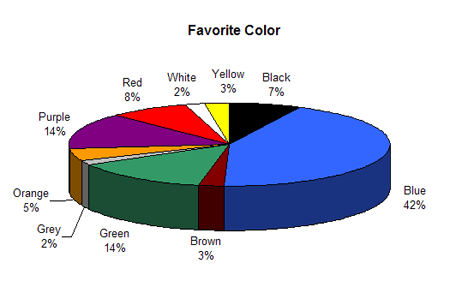
See also, people by default choose blue at 5x the rate as red, really putting a dent in "red==rational" conjecture: https://www.joehallock.com/edu/COM498/media/graphs/fav-color...
I hope this makes sense!
There is only one Nash equilibrium, which is for everybody to pick red. This is also strictly dominant for each player (if they choose red, they have a 100% chance of surviving, while if they choose blue, they only survive if > 50% of other people also choose blue). Knowing this, every participant has an incentive to choose red.
Bro... Game theory laws like Nash equilibrium dont apply if the population is irrational. Which it largely is!
Good luck explaining Nash equilibrium to a baby.
If there is a game in which you choose between two buttons, you know everyone will get this same choice, and one button says that you definitely live and the other button says that there's a chance that you will die, adding more rules to the "maybe death button" can not make it a more rational choice.
This is actually an experiment that I would get behind doing in real life. I will pick the red button. We could do it every morning.
There are enough collective action problems with real and obvious benefits leading to catastrophe without the need to create more unnecessarily, or to have any confidence in in a world full of strangers' collective ability to solve them. Campaigning for blue is actually murder; you've encouraged a situation that may result in the deaths of 49% of the population.
Also, I think that's a simplistic view of intelligence.
Am I talking about the game, or a preemptive nuclear strike that has a good chance of knocking out the enemies ability to ever launch?
I would say that its hard to underestimate the social estimates of these things. A person who will genuinely be impacted by it themselves would fall into these traps more than one might think. History has many examples of fascism that some suggest that these periods of turmoil are the norm rather than exception.
Once again an obligatory message about how the world faces some genuine issues but instead of fixing them as a civilization, We would much rather prefer to have scapegoats and this goes both ways and might be true in a certain way and at a certain path both sides are too extreme to ever collaborate for the most part that a nation of once great strength might die a slow exhausting death if nothing changes.
I have come to the realization, The world has always been like this and it might always be like this. Its messy but also one can imagine this as a side effect as the mere coexsistence of our species in such massive numbers might demand polarization.
Some people create initial changes (for greed, genuineness etc.)
people then follow it (true belief)
people then meet other people and become friends with them and create a community.
new people are born or who change because of the community aspect (Since most things are nuanced, it is easy to frame anything and sometimes everything into such communities.)
The original people who made the thing dies/are out of power and new people from the community join.
these communities gain influence and decide the decision making but the heads of such communities are prone to narcissism or any other ways to draft as much as attention as possible as it seems that all attention is (good attention??)
More corruption follows, even the people of community are impacted and they might hear criticisms but the lock-in is too much. Stockholm syndrome.
Everyone else face the consequence and someone new creates a new movement and create another set of intial changes. Competition between multiple colors follows, we also see cooperation between red and blue to prevent outside competition.
In such sense, change creates change and cycle repeats. It is up to our interpretation on if there is any idea itself which can remain logical if its implementation or implementors get corrupted in a sense similar to erosion of the main values.
more than anything, humanity wants a community. a human somehow wants acceptance and validation for himself and he is selfish in the sense that he will put a blind eye sometimes if he isn't virtuous to damage outside his house (sometimes inside as well) and he wants a community because that is the only way he functions within a society of millions and billions while monkeys cant operate on more than hundreds.
More than a political critique, my point is, we should be more aware of this human tradeoff from empirical evidences and open up this blind spot and perhaps be more aware about it.
I’d probably turn my mind to resistance and refuse to push any buttons if possible.
Prime candidate pool: 4chan.
If the question was restricted to local communities with 0 internet access, I would be more inclined to press blue.
But on a global scale? No fucking way.
A lot of this analysis depends on accurately guessing how people will react, so it's probably hard to say any strategy is game theory optimal without a lot of unrealistic simplifying assumptions.
In a world where you're able to convince a lot of people anything, it might better to convince everyone to press red. If it looks like 99.99% of people will press red without your influence, you're probably best off spending your time convincing the .01% who might press blue not to do so.
It also has the upside of not making you a dirty liar. I wonder, what would Kant think about this hypothetical?
We learn something about humanity based on the results of the poll. It's naive to think that 100% of people will press the red button. Some people will die if red wins. I think pressing red is selfish and violent, in that it can result in the death of human life by their own unwillingness to cooperate.
If we are not willing to work together in order to protect each other then I have a very pessimistic long-term view of our future. If every blue-presser dies, then our average cooperation level will only decrease, and the population will be over-saturated with defectors. I'd rather just go out now then deal the those consequences.
Both sides have a mental bias, and just can't see each other's "reasoning" because of it.
We blues think of reds as selfish, because we can't conceive of anyone not thinking of the worst outcome for others, and being empathetic about it, making it one's own. And they see us as "virtue signalling", or getting some external value of some kind (recognition from peers) because they can't think of any other explanation to justify that behavior, when it is just pure bias towards sacrifice. Sacrifice is just that, giving something without asking nothing, which does not make sense for a red. Reds think we are dumb but society needs a little more blues than reds. Otherwise it probably collapses.
I'm such a proud blue. in fact... ;)
Those who press the blue button are trying to save those who press the blue button. If they weren't trying to save each other, they wouldn't have to.
EDIT: The mere existence of blue-pressers makes being a red presser violent and selfish in my opinion.
If we all work together to make sure that as many people press the red button as possible, then we can minimize the damage. The problem with the blue campaign is that the outcome gets progressively worse until it gets to the best outcome. 49% mortality is high and terrible unless you are very sure that the red campaign is going to lose. The ethical take on the red side is to minimize blue votes to zero.
Why? The logical conclusion of this game is that everyone presses red. There is no reason to press blue and leave it to chance. The article talks about it, but without further rules it would be absolutely nonsensical to press blue.
Like if there was some additional rule like "oh and if more than 90% press red, everyone dies" or something, it gets more interesting. But as is everyone answering blue is virtue signalling.
>I think pressing red is selfish and violent
Most of humanity is pressing the red button every single day, again and again. From every culture, creed, religion, loads of red button presses.
But I guess everyone thinks the world is like he wants it to be in this respect.
* many people (at least toddlers, people with dementia) are going to press blue roughly by accident. See the lizardman constant
* other people will not want to be responsible for any deaths and will press blue out of a sense of moral imperative
* many other people are going to take this into account and vote blue out of hopes we can save everyone
You should vote blue.
1.) The pure form where the button presses and restricted to legal agents (i.e. people with credible legal standing over their choices). 2.) The mixed form with the caveat listed here inclusive of all humans whether they are even physically capable of pushing a button. 3.) you could also go for a more expansive scenario that takes 2 to the extreme and includes animals as well.
1.) gets to the game theoretic form of the question. 2 muddies things, and 3 sets up a case for blue since the non agentic voters asymptote to 50-50 and a slim edge is morally preferable to killing half.
Surely some of those groups are going to be filled with selfish red pickers. Should the kind coordinating players still go blue? All the red pickers are going to lie that blue is sensible. I suspect that more coordinators will die in this way than the always blue pickers if every coordinating player went red.
So now the full-world version only has the law of large numbers on their side, but they have no way of knowing just what percentage of the population is a selfish red picker. Going for team blue is the much riskier option that can yield catastrophe.
But this is HN, so people are going to discuss it just because it is fun to discuss it.
If you pick red you survive.
If you pick blue and at least 50% of people picked blue, you survive, otherwise you die.
There's 0 advantage to picking blue, none what so ever, the only reason you'd pick blue is because you assume there's some subset of people that is so unbelievably stupid that they'll pick blue. You're sacrificing yourself in the hope of saving them.
IMO, the reality is that everyone you think would pick blue would actually pick red. Very few people are that stupid, and even if they are they probably also have access to someone not as stupid who will tell them to press red.
The only people you'd be saving are other suicidal white knights that pick blue to save those imaginary "blue pressers", and the outcome of that, since that blue pressing base doesn't actually exist, is that you're all just committing collective suicide for absolutely no reason.
What "blue pressers vs red pressers" says about our society is best left to philosophers.
You can choose to protest (blue button) and if over some threshold of people then conditions reset. Otherwise protestors are killed off, and red buttoners survive, but with increased oppression.
Sorry for bringing the mood down with this topic. I'll go back to playing Papers Please! now.
It takes a period of worldwide prosperity and, perhaps, substantial foreign entanglement to allow revolutions / coups to actually improve the situation of people living through them.
> Every person in the world is provided a gun. If a person wants to, they can shoot themselves in the head. However, these guns are special so that if more than 50% people in the world shoot themselves in the head, the guns will all jam and everyone will survive. Or, the person can choose to set the gun down and walk away.
You could do both experiments with dogs instead of humans and roughly 100% of dogs wouldn't manage to shoot themselves with the gun, whereas if you forced them to press one of the two buttons (e.g. keeping them in a room until they press one by chance), roughly 50% would press the red one. So the two experiments differ strongly w/r/t to how likely it is for a "non-thinking" organism to choose each option.
Until you remember the millions of children in the exact same scenario.
A logical reframing is not equivalent though! We know everyone else gets the same frame, and most of the problem is predicting what other people will do when presented with this particular two-button frame.
Things that I need billions of people's help for are on the top of the list of things that I literally can't do.
We can get together and do great things. Whether that's science and industry or simply not murdering everyone who doesn't press red.
a. every incremental actor improves the overall picture with their individual choice (however small, even if it takes a threshold to be "solved": think, recycling, vaccines) b. every individual actor actor's choice has no _direct_ impact until some threshold is met (maybe voting?)
THIS situation, however is very different: every individual choice for blue makes things WORSE up until the threshold is met. And not just a little, but a LOT worse. That's not normal collective action territory, so we shouldn't be assuming the same kind of reasoning. The stakes of missing the threshold are not "aw shucks" or "keep trying, there's more chances later!" The stakes of missing the threshold are "everyone who cares about the threshold is dead."
I can't think of anything IRL that falls into this category?
I suppose: People on one half of a standoff standing down when the other side will also stand down if everyone on the first half does. Not exactly a common problem to see outside of movies... but in principle it follows a common pattern. An individual lowering their guard is bad (if it ends up in a fight), but if everyone lowers their guard we get to avoid the fight.
Whereas most thought experiments try to balance two things equally, which creates a lot of debate, this one pushes the options as far apart as possible without quite going fully black-and-white (which would sound like, "If you press the red button, you live; if you press the blue button, you die."). This creates less disagreement, but maximizes the size of the disagreement that remains.
The problem is posed to the world. You have children, and they ask you what they should do. You tell them to pick red because you're their parent you can't bring yourself to have them risk their lives for some noble purpose.
According to blue buttoners, this parent is an evil person, right?
This is about predicting real people!
People are not perfect rational actors.
Good luck explaining your Nash equilibrium theory to your 6 month old niece and nephew who are good pick blue because it's their favorite color.
You aren't gonna get an all red movement to succeed. There are a small minority who will vote red or blue regardless of the community sentiment - and some of those people will be kids who would probably grow up to be smarter than your game theorizing selves if they are given to opportunity to grow old enough to fully mature.
Full propaganda team blue.
The reality is that we don’t live in a vacuum and the framing of red vs blue is almost certainly not an accidental alignment with political colors. If you are in the US, voting blue is also highly correlated with broader empathy characteristics.
It’s telling that some folks think 100% voting one way is just as attainable as more than 50% voting a certain way. The strong irony here is that they themselves would likely not change their vote to help get to 100% no matter which direction that happened to be. This is also why we are roughly split in half with only a small percentage actually voting differently than their identity politics allow.
Besides the obvious choice of not pushing any button, so very rarely -- if at all -- are there only ever 2 options. The entire "thought experiment" leans into some fantastical unrealistic scenarios and plays on peoples "fast thinking" by saying here are 2 options I made up, tell me which of these 2 groups (us or them) shall I sort you into? Neither.
That’s why dictators try to limit protests, not just because of the protests themselves but because they don’t want people to know how many others are willing to protest.
If the choice is between:
a) continuing to live under bad conditions if you press the red button, but if more than half press the red button everyone who pressed the blue button dies, and
b) if more than 50% press the blue button, everyone will live under good conditions,
then the differences between living under red conditions and under blue conditions becomes a factor. If red conditions and blue conditions are identical, hide the blue button, it is evil.
It would be easy to self justify picking red as 'it's not unethical killing, it's self preservation' but I'd still bet on society being more socially minded than not, for betting otherwise would mean i think society as an idea of togetherness is a total illusion. If choosing red, after, it would be non existent.
Though also to me the experience of life is starkly temporary; dying early or not doesn't really matter to me so i'm not surprised other's emotional conflict varies here. But as a result personally, losing the existence of something unique to experience (togetherness) in preference of something otherwise fleeting, even the self, isn't very interesting to me.
https://en.wikipedia.org/wiki/Altruism
https://en.wikipedia.org/wiki/Altruism#Scientific_viewpoints
evolutionary game theory
As if it’s the decision that somehow matters, as opposed to the systemic dysfunction and incentives that mandated the decision in the first place.
I’m an increasingly reluctant blue pusher, because I am aware that societal incentives reward individual greed when traded against societal harms; that is, those who sacrifice others are rewarded proportionate to the amount of others they sacrificed. I want to cooperate, because historically that has been the source of our collective survival and growth as a species; however, at this specific moment in time, I would be greatly rewarded if I harmed as many people as possible, as thoroughly as possible, to enrich myself.
If all you’re looking at is the binary decision, red makes sense. Except taken in the context of the wider whole, red pushers should be rightly vilified and excommunicated for prioritizing their own survival over the survival of the whole.
The world would be a more selfish place in a generation after the experiment.
Presumably parents press the button for their babies.
As a family you would have to agree to all push the same colour otherwise you run the risk of only some of you dying. As a group decision I would think everyone would agree on red as the safe bet. Also making altruistic choices for children has two edges - and many parents would put their children's interests first not some strangers.
If you're the first person in line to vote, picking blue is neither logical nor moral. There are no other blue choosers who you need to support. "But there will be people who vote after me" well that's their decision to make. "People will vote randomly" okay well if they can't take living or dying seriously, that's kind of on them. Choosing the zero risk option when everyone else has the exact same zero risk option isn't selfish.
It's not selfish to choose red because everyone else has the choice to choose red. There's an unknowable risk with choosing blue. Choosing red only exposes blue choosers to the exact risk they decided to take.
Reframe it to eliminate the silly savior complex and it sounds ridiculous:
There's an infinitely long trolley track. You can let the trolley continue down the track, or you can divert it in your direction. You might get smooshed by the trolley by diverting it, but at least someone standing further down the track won't divert it and smoosh themselves.
There's several reasons why someone might make the "wrong" choice, and reaching 50% + 1 on blue is way easier than reaching 100% on red. And sure enough, the polls I've seen have shown blue with a majority every time.
Those who think the population is too stupid to behave in regards to their own self preservation might choose blue in an attempt to 'save everyone' and kill themselves.
Only one singular choice has zero risk of death, and its red. Everyone chooses red and we all survive.
edit: specified who
It's not really about the numbers, though, is it? The red button future is now a mix of game theoreticians, Objectivists, and people who like the color red. The proportion of parasites is up.
In the first case you contend with living in a world after a catastrophic population loss — likely including at least some of your loved ones — knowing that had some of you and your fellow survivors voted differently, nothing bad would have happened.
In the second case, you don’t care at all. Because you’re dead.
So, now we agree? Red option it is every time.
The thought experiment demands that the phrasing that was used actually be used, and you don’t get a chance to show the dumb blue people how smart you are before they pick their button.
So we all choose option Red and you, the hero, chose Blue. Congratulations, we will write some nice words on your tombstone.
The only reason I’m in my tomb is because you and people like you voted to kill me instead of voting to do nothing. Luckily for me, I’m dead and don’t care.
Congratulations! Enjoy your life with people who think like you.
The point remains, only one singular choice guarantees your own safety. And another has a Chance of death. Take the stupid choice because you think everyone else is also stupid? Thats your choice.
If that's the case then it's truly impossible to save them.
Your assumption is there is more than 50% of people who will vote blue or could be convinced to do so.
It's a terrifying thought that there could be such a deficit of empathetic people. But without any evidence you're just hoping based on your own beliefs that over 50% believe in blue like you do.
What if I'm not afraid of dying. But I'm just not willing to throw my life away unless there's decent evidence it could succeed and we could get above 50%
In this instance of course what you're proposing is very mild: you think they should suffer one another's company - which you imagine would be a terrible experience. Unless you further imagine that they'd like it? But my impression was that you thought they'd have a bad time, and since they're your non-compassionate outgroup, you very compassionately don't care.
Can you force people on red or not?
Seems difficult to guarantee you don't kill a bunch of kids each button press cycle...
Many people aren't old and developed enough to reason it out yet...
If this is repeated I'd certainly be on the team of trying to convince people to go blue... Otherwise the chance of someone randomly pressing red every time before they get to the age of 5 or whatever seems too low to guarantee the long term survival of the species... I guess it depends on how often it happens?
I think it's meant to be one time.
> Seems difficult to guarantee you don't kill a bunch of kids each button press cycle...
Seems extremely easy to guarantee that I don't kill a bunch of kids, just press blue. It's only the red-pressers who might end up murdering kids. By pressing blue the only person I am putting at risk is myself.
Red button pressing is killing people that didn't think/act like them. You don't need to feel guilty about it, because this type of thing happens all the time.
Then, they stopped.
Otherwise all I'm taking away from this article is that people don't think deeply about survey questions before answering them.
Politically speaking, in the US where everything is rigged by corporate media and a uniparty of capital interests with red/blue facades (where blue manufactures consent for red every step of the way), the only winning move is to not play.
Interestingly there are variants of the question where "no one pushes any button" should also be a "winning condition". The original problem states "if less than 50% of people press the blue button only people who push red survive" which rules this out, but it could be changed to "if greater than 50% of people choose red, then only red pushers survive" (allowing for people to opt to be a non-pusher). Or it could be "if greater than 50% of people choose red, then only blue pushers die" (with the non-pushers also being spared).
I think the latter is more interesting since now there's a moral consequence to voting vs abstaining.
Or you could lean into the political framing. I bet if the vote were retaken with question phrased as "if greater than 50% of people choose red, then people who pressed blue die", you might end up with some switchers who vote purely out of spite. Or maybe that framing makes it feel like voting red has a more significant moral consequence (actively condemning people to death) that the original question doesn't, so it results in more people pressing blue.
I feel like it's fine that wingsuiting off a mountain is legal. I don't feel a need to beg some stranger not to do it. Both myself and that stranger are perfectly aware there's a decent chance their choice will result in their death.
In the world where <50% press blue, you know that everyone alive (the red pushers) would save themselves rather than take a risk helping you or those who aren't clever at game theory problems.
I don't want to live in that world, so blue for me. And it's the fault of everyone who pressed red should I die.
The other button certainly won’t kill you, but will kill everyone who pressed the first button — if and only if enough people besides you press it.
The other one does not contribute to homicide.
The right answer, by the way, is to not press either button. "The only winning move is not to play."
There's a cruise ship that needs to have a certain weight in order to not capsize. That weight threshold happens to be at 50% of the population (for whatever population we're considering in the original question). If the ship capsizes, everyone on it dies.
You're given the option: either get on the cruise ship or don't. Not to take an actual cruise, not for some other intrinsic prize, just file on it for a minute and then get off.
I don't see how those who refuse the risk of dying on the ship are complicit in the deaths of those who willingly choose to hop on it knowing the risks involved
0: https://slatestarcodex.com/2018/10/30/sort-by-controversial/
Everyone will press the red button and everyone will survive.
The idea behind claiming you'd choose the blue button is to appear noble and altruistic, I suppose; but I struggle to even understand that instinct. Risking one's own life to possibly save the lives of others who are demonstrably completely capable of saving themselves doesn't strike me as particularly noble.
People are irrational. I guarantee it’s likely that a lot of people would actually do it.
> The idea behind claiming you’d choose the blue button is to appear noble and altruistic.
Not at all. If the majority of people can’t be bothered to press the button that says “nobody dies as long as half of the other people say nobody dies” rather than “you don’t die,” I’m happier not being around. It’s purely selfish and blue is a win-win.