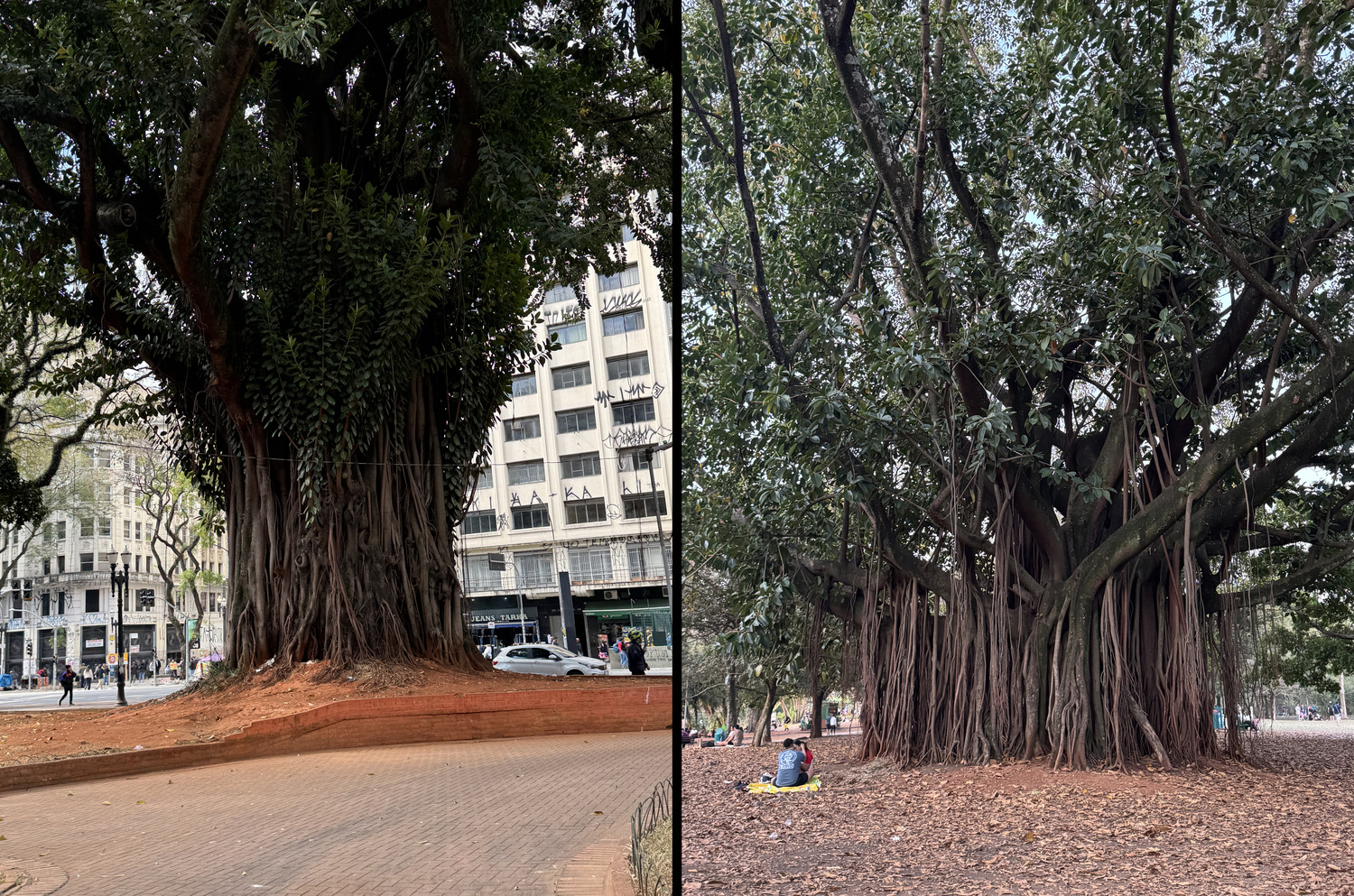
Two examples right from downtown São Paulo,
Young Eucalyptus trees have leaves that are rounded and are arranged opposite to one another. However, when mature the leaves of a Eucalyptus are lance-like and are arranged in an alternating fashion. This to me is quite unusual.
In areas where they are introduced, they also become quite invasive by practicing something called alelopathy, whereby they introduce toxins into the soil to prevent competing tree species from taking hold.
While I'm at it, Eucalyptus trees have very very dense wood which means the wood burns very hot. This makes it even worse for forest fires where Eucalyptus trees dominate.
(I knew my botany studies would come in handy someday. I just never knew when!)
Those things are tough, and they grow really fast in the right climate.
https://eukaryotewritesblog.com/2021/05/02/theres-no-such-th...
A better comparison is "Fliyers", that include most insects, most birds, bats, pterodactyls and perhaps a few gliding and kitting animals. It evolveded and disappeared a few times.
You'd think that now that we have LLMs, the actual in-your-face empirical evidence of a system that can effectively navigate the complexities of the real world without being fed, or internally developing, rigid ontologies, that people would finally get the memo - but alas.
If you're interested, check out Rupert Sheldrake:
https://www.sheldrake.org/files/pdfs/papers/Is_the_Sun_Consc...
https://www.indefenseofplants.com/blog/2017/12/12/the-travel...
https://www.woodlandtrust.org.uk/blog/2025/08/ancient-yew-tr...
A wikipedia dive session is likely to get more and more specific into trees (attacked by twees!); an encyclopedia flip session is more likely to go across a wide variety of subjects.
[1] https://en.wikipedia.org/wiki/Wikipedia:Database_download
> Recent 2024 analysis confirmed it is at least 16,000 years old, with possibilities ranging up to 80,000 years, making it one of the oldest living organisms.