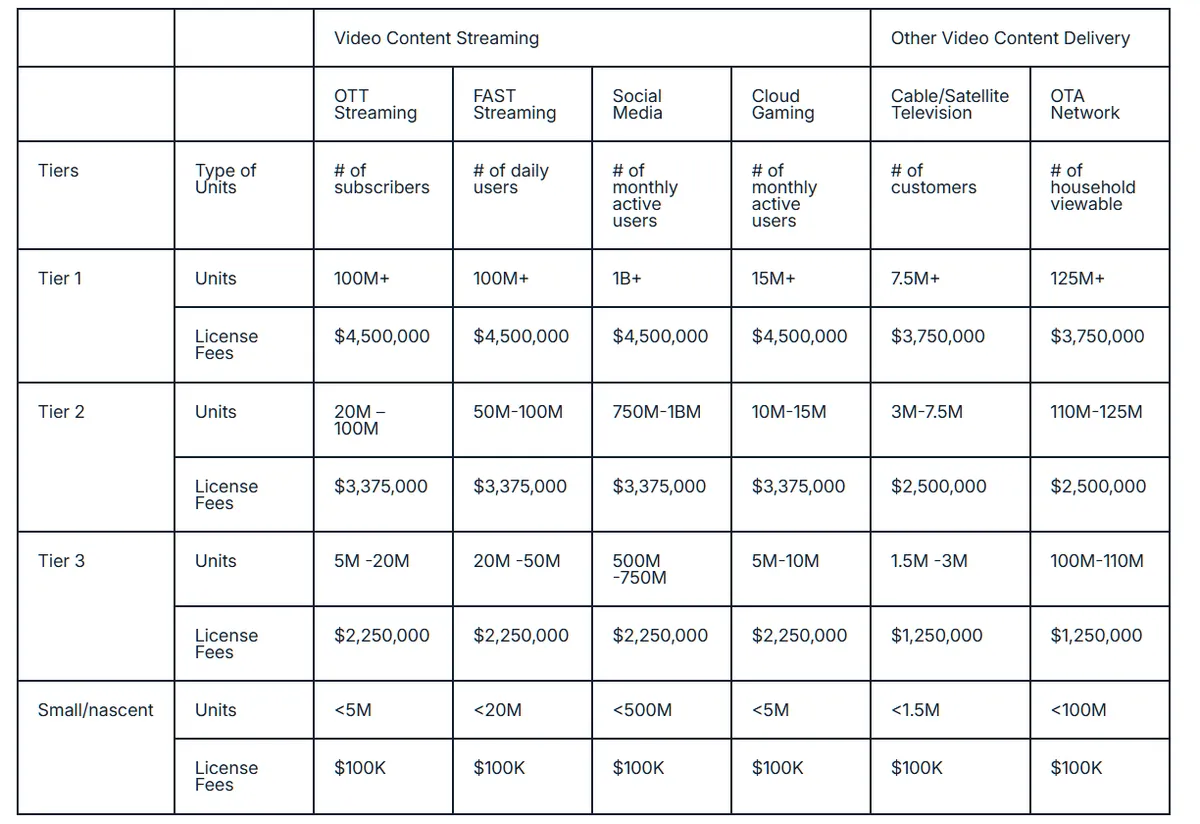
That makes me feel even more strongly about throwing proprietary and predatory codecs in the trash and opting to use AV1 et al wherever possible, it's better anyways and surely close to a decade after coming out, we'd expect devices to support it well enough.
A lot of people, myself included, are still using quite old hardware. The GPU in my daily driver is ~10 years old at this point. Between crypto, COVID, and this AI craze raising GPU costs by insane amounts, it hasn't made sense to replace it with something newer. I know I'm not alone on that...
I very much understand how the licensing alliance likely was bothered by the fact that they are leaving money on the table, when TikTok's revenue per user is $50 a year, and a cable subscription is easily $800 per year, with the high-end reaching $2000. The big players aren't going to notice much. For the small players, nothing changed.
[1]: https://cdn.mos.cms.futurecdn.net/3wzYaofEETCfXdQmREx9BK-120...
Also, let's not forget that the majority of devices still don't have AV1 hardware decoding support. For example, Apple only recently (2023) added support with iPhone 15 Pro and M3 Macs.
Apple has been actively obstructing open video formats for a long long time—Apple is the reason there isn’t a baseline format for <video> in the HTML5 spec, for instance. (Or at least there wasn’t when the spec was still a well-defined document with a version number; I see no merit in keeping track of the “living” one.) Incidentally, Apple is a member of MPEG-LA and claims to hold numerous patents covering both AVC and HEVC.
At this point, whatever harms befall Apple’s users due to lack of Apple’s lack of format support are entirely Apple’s fault.
Like many other such frivolous patent lawsuits, Dolby hopes to either scare the other company into making a deal in order to avoid bigger legal expenses, or to establish a legal precedent if their cunning lawyers can convince a technically incompetent jury that the H.265 patents are applicable to AV1.
This is the kind of trial that should have never been decided by a normal jury, but only by a panel of neutral experts in this field.
Part of the idea with AV1 was that with the constituents also holding such a massive warchest of patents (plus big tech being richer than god), they would countersue and demolish anyone that tries to bully AV1 users.
Where is all that might? Was it all just saber rattling, and are they basically going to let the AVC / HEVC patent holders make a fool out of them?
I'm no expert, but Google having designed AV1, I can certainly imagine a world where the codec infringes upon HEVC just enough that the lawsuit fees would come out in the wash.
The experts may be biased, but when they open the mouth and try to argue their position their bias becomes obvious for the other experts and it can be contradicted with logical arguments.
Unless all the experts work for an interested party, it would be very difficult to impose an incorrect verdict, because it is impossible to argue in its favor without having exposed immediately the mistakes in the argument.
On the other hand, with a standard jury most people will be unable to see what is wrong in the arguments presented to them and they will not be able to distinguish truth from lies in such technical subjects.
Instead of paying the ransom, a streaming company should transcode their movies to a royalty-free format, like AV1 or VP9.
Even big companies like Dell have preferred to disable the H.265 codecs in the computers they sell, instead of accepting similar demands for greatly increased royalties, and I think that it was the right choice.
Existing licensees are grandfathered in to the old price.
Also I'm not responsible for whatever happens if you do this.
The patents are still valid in USA, Brazil and a few other places.
If you're just hosting videos on your website you are probably using High Profile which was standardized in March of 2005, i.e. more than 20 years ago. That doesn't stop VIA and MPEG-LA from claiming they still have relevant patents, but that claim is dubious and hasn't been tested in court.
Maybe Google should finally make good on their threat to only stream YouTube in royalty-free standards.
Some patents remain valid in USA, Brazil and a few other countries.
So that firm might try to squeeze every penny they can before the expiration of the patents.
Basically, you can consider AOM to be a licensing alliances, where the fee is zero.
For now they try to bully some smaller companies with the threat of the big legal expenses that would be needed to fight these claims.
Hopefully the Licensing Alliance never ever ever gets another customer ever again. Hopefully no one uses any of their new encodings. This is an untrustworthy company, that always have been out to fleece the industry and hold back humanity. Licensing Alliance embodies Lawful Evil, is a stain on the patent system as a whole. It's hard to find the words for how awful, how enraging this cabal is. Ugh. What an evil drain.
We should be able to use computers for audio and video, and it shouldnt involve kings ransoms to some jerks who are better at paperwork & lawyering.
All that work on av1 and av2 looking more and more civilization ally essential as times goes on.