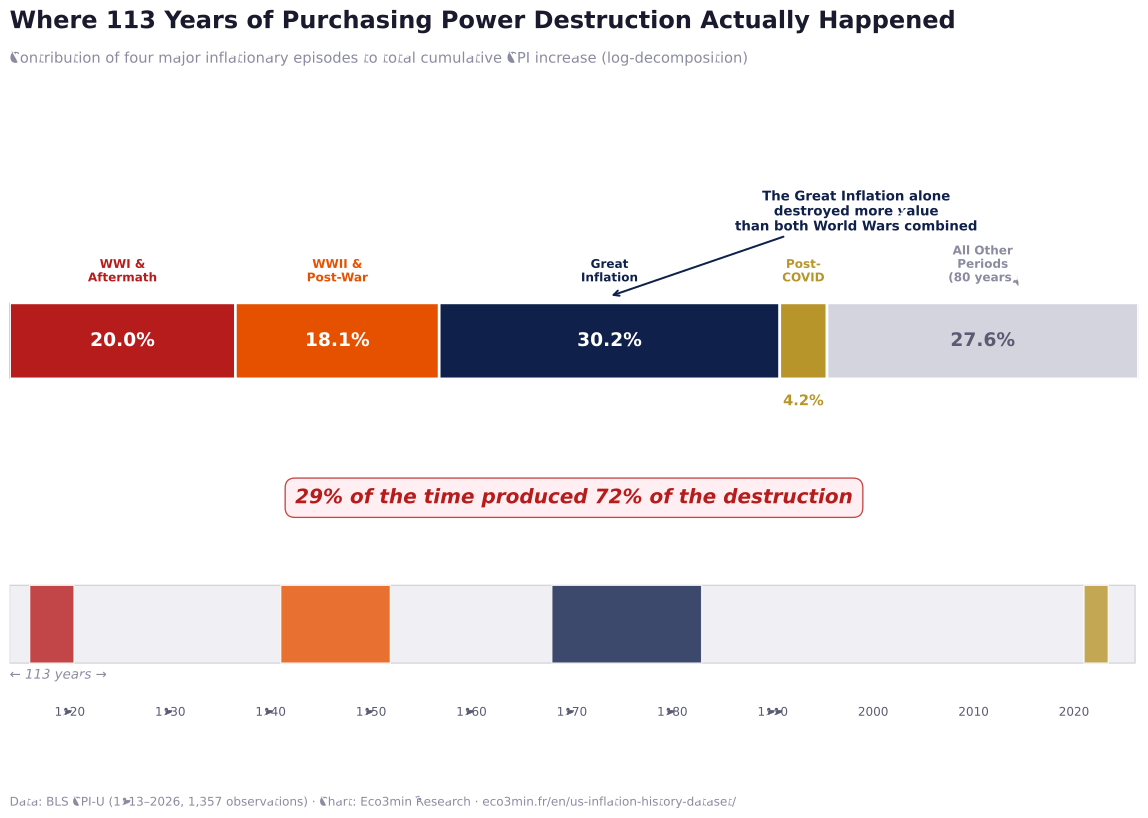
Finally the events are quite cherry-picked. It is a conclusion looking for a result, when the statistical reason for choosing those 4 events simply isn't evident when you look at the data itself. There is no mathematical rule you could apply to your dataset that would distinctly highlight those 4 periods.
You'd have nowhere to charge it. Electricity would be more expensive than gas even if you did.
You'd benefit almost nothing from the technology. There's no internet. Not much of it would work. And it wouldn't really help move you forward technologically, as it's just too advanced.
Before the printing press, very few people in Europe owned even a single book. But even a lower class, modern European might easily own several dozen books. Depending on how you account for this, you might conclude that the given lower class, modern person is among the richest people in Europe in 1400. Or you might not properly account for the wealth of a 1400 European noble and rank them as middle class by modern standards.
It's simpler with commodities like a bushel of wheat, but still complicated. Depending on what you are trying to explain, you can use different methods but there is not straightforward way to convert the cost of something in one time period to another time period.
https://www.officialdata.org/us/inflation/1800?amount=1
Doing a spot check, this means $1 in in 1913 is equivalent to roughly $32.83 today.
Modest, stable inflation is good. It encourages investment & discourages deferring consumption for indirect monetary reasons.
“Stable” is the hard part.
Inflation obfuscates the value of money and therefore of goods, services, etc. In an environment where value is volatile, it makes sense to keep moving, keep trading, because you might come into possession of something that was undervalued before you owned it, or that you'll need in a future when it would otherwise be too expensive. The people who skim off the top of all of this activity love this environment.
Deflation, on the other hand, makes value readily and immediately apparent. What was speculative and risky goes to zero and people hold onto things with intrinsic value. Those who skim profit off of economic activity hate the slowdown, obviously, but maybe you need periods of this to reset when valuations becomes too far removed from reality.
Is it a bad thing for people to buy what they need, when they need it, instead of being forced by inflation to anticipate their needs further and further out?
And yes, earlier variations are more impactful because compounding.
I will say that a better representation would be a logarithm of the inverse. The problem with doing it this way is that later changes look very small. $1.00 to $.99 is the same y-axis delta as $0.05 to $0.04 but the latter is very different.
#1 creates oversupply of dollars and #2 and #3 lower demand. This study supports the idea that wars can indeed destroy purchasing power.
Trump attacked Iran thinking that this would somehow be good for the US, except it's weakening the petrodollar because it's pushed Iran to simply accept Yuan for oil.
USD reserve = print USD for everything liquidity to sustain debt financed existence where Triffin hollows out industry, and financialize everything because having stupid amount of liquidity incentivizes certain behaviors.
Petro-yuan = PRC gives swap lines to trusted partners to buy oil denominated in yuan in exchange for things like resources. Hormuz ships ~1 trillion USD worth energy that needs "swapping" - incidentally PRC imports around ~2-3 trillion, more than enough to cover.
So think petro-yuan = PRC gives trusted countries with resources that PRC bonds credit lines to buy yuan denominated energy (possibly at discount), in return they guarantee PRC resources or other commercial/geopolitical arrangements. It will be narrow, not like USD brrrting reserves.
This benefits PRC because get to have leverage over "need" transactions (countries need energy to survive, it's no negotiate) while US keeps supporting "want" transactions by reserve debt servicing blackhole that US cannot extricate itself from until it debases / technical defaults. PRC best game plan is... assume privileged part of exorbitant privilege, while leaving US the exorbitant.
So no one is going to take up a lot of yuan trade unless that changes or they are forced to.
But that puts China in a bind. Liberalizing their currency is going to require very careful and slow actions, China threads this needle now in a very fraught way. If they openly start trading oil at any real size in yuan that will break their peg as you’ll be able to trade through the oil markets.
This is the main reason there isn’t more petro yuan already, it’s bad for China.
> So no one is going to take up a lot of yuan trade unless that changes or they are forced to.
Related on the “forced to”point, this is where Russia is stuck with its crude oil sales to India where the payments have been made to it in Indian Rupees. There’s almost nothing that Russia can do with the Indian Rupee. This is a huge and growing problem because India’s imports from Russia eclipse its exports to Russia by more than 10 times. [1]
[1]: https://www.financialexpress.com/india-news/india-russia-sum...
So no one is going to use a controlled currency for a hard liquid commodity. So if China wants petro yuan they have to liberalize that, which will break their peg.
China could have more international trade in the yuan before all of Americas recent misadventures. But that has cast consequences for their economy, and possibly the ruling elites power structures.
You can spend it in China, right?
One big thing that has prevented CNY from becoming a reserve currency is that China has explicitly said it wants to preserve its ability to heavily and suddenly restrict capital flows in and out of China. If all of a sudden you can't redeem CNY outside of China inside it that makes it a very poor storage of value.
You can't spend US dollars either, in 99% of the world.
They do not need to liberalize currency. They just need to have stuff people want, and leverage to force them to transact in PRC preferred currency. Previously this was hard, PRC had goods, and affordable prices = reduce friction/switching cost vs USD liquidity, but USD liquidity still made USD transaction preferred. PRC had no leverage for others to transact in yuan.
But in persistent high global energy environment, if PRC controls basically global supply of cheap renewables... and 30% of GCC oil vs Iran enforcing petro-yuan, they have stupid leverage to snow ball system. Again key is this for 30% of GCC oil exports if Iran locks down (big if), it's not global petro-yuan, it's Costco membership only access petro-yuan.
30% of global oil is inelastic existential survival leverage, if PRC wanted to charge in blowjobs countries would pay in blowjobs, currency liberalization doesn't matter when selling water in desert.
All of that happening with the worlds biggest oil producer, its second biggest manufacturer, who is food independent and has the worlds most powerful military just lets it happen. And no shooting war breaking out between them.
I’m betting on slow currency liberalization and a transition to a multi currency petroleum industry and subsequent inefficiencies in global trade. But feel free to bet how you want.
> make any sense
GCC petro-yuan scenario is predicated on BIG IF that Iran can control Hormuz oil. Rest is the downstream logic for ~10 years, i.e. before any alternative buildout/pivot by GCC states to some how insulate... which apart from Saudi, they might not (too small). This also why PRC hasn't exactly enthusiastically signed up despite IR offer, because it would burn GCC bridge when IR fate uncertain. But if alternative is IR can hold hormuz hostage, PRC would rather participate in petro-yuan than not, at which point having priority access to energy, possibly at discount is net win. Note in this case IR as SLOC guard dog actually has leverage over PRC, gating energy access also offer PRC cannot refuse.
> US
Hence big if, if US has appetite and capability to break Iran, and it matters US settlement/conditions, because if US reasserts control over Hormuz oil and tries to throttle PRC oil as victory, then PRC may go all in on Iran support. Situation is fluid, the wild card is in fact US or ISR deciding to simply break GCC oil. There is still plenty of room for escalation and shenanigans.
Think about it, every single mother fucking year, the US roughly buys 1 trillion dollars more on services and goods from the rest of the world, than it sells.
It has this privilege/curse basically because the US dollar IS the world's global commerce and finance currency.
It's resource curse on steroids.
Saying it’s not an advantage is to assume those in control want to have manufacturing in the US, while such noises are made there is very little action beyond capricious crony capitalism tariffs that no normal business can possibly rely on.
It seems both you and I agree that manufacturing is an essential component to war-fighting and the health of a nation, but I think it is safe to say that you and I have effectively no control over what the US does.
Agreed. Which is why the Chinese do NOT want their currency to become the Petrodollar or world's reserve currency. They know that that is what destroyed US Manufacturing. China wants to maintain their manufacturing dominance. They've seen what de-industrialization has done to the US.
"Kill all the sparrows"
Unless of course everybody is forced to buy your currency to get an essential resource. This causes: - the currency to maintain value better - puts you in position of other countries having to maintain a trade surplus with you so they can actually purchase said resource - the oil producers end up with great amounts of your currency, which they have to spend, getting a political foothold in your country.
Petrodollar almost certainly was devastating to US economy. And like most resource curses, it's like a drug - you need to stop taking it to get better, but it will hurt as hell.
Only cheap labor can bring manufacturing back to the US. Are Americans willing to work in factories for the same wages as the Chinese and Indians? I don't see it happening.
Under conditions of free trade with low-wage countries.
Free trade with low-wage countries is a policy choice, but a lot of people confuse it for a natural law.
Create enough poverty and soon people will be willing to do an awful lot of things.
How do you bring down costs? generally you'd need to restrict real estate. Lock down rent costs for both residential and commercial.
The Heritage guys have a weird perspective where they idolize the early Federalist US and the Reagan Era. Prosperity for the common man wasn’t a highlight of either era, to put it mildly.
In 1790s New York, for example, “local control” meant that many of the people of upstate New York were a sort of serf-like tenant living on the estates of the great men, Dutch patroons who played ball with the colonial and State political infrastructure. They had the freedom to pay rent until their landlord was willing to let them go. That existed into the 1840s, when the country started getting woke.
So we can address housing issues with creative solutions. Why do poor people need their own apartments? Stuff them into a tenement. You can easily fit 15 people in a two bedroom apartment so they can build drones or whatever.
But the US is a major manufacturing nation anyway. US manufacturing output is more than half of that of China while having only a quarter of the population.
When groups like the far right say bring back manufacturing they are just posturing to those voters who have been disadvantaged by changes in the commercial landscape that reduces the number of unskilled and semi-skilled jobs. If they really cared about those people they would support massive improvements to education and training so that at least the next generation had a chance rather than idiotic schemes to 'bring back' the kinds of work that no one needs.
Not every kind of "bringing manufacturing back" brings the same kind of wealth and quality of life.
And the Heritage Foundation is not in the business of improving quality of life for everyone, or even the average American.
Most billionaires will lose both money and power on the timeframe of a couple of years due to the destruction of the value of the dollar. Even internally to the US.
Some may gain both. Someone will probably gain both, and the odds are good some billionaires are included.
it's worse then them not being right
the only way a weak dollar would majorly matter for bringing back production is iff production is cheap
so a 20% weaker dollar must not come with 20% higher "dollar" prices (living cost, salary). You need to decrees living cost and dollar value in lock step (i.e. weaker dollar without inflation!). But this seem impossible IMHO. And if we look at what happened, if anything, it went the other way.
And if you try to force it anyway you are basically saying "we effectively disown most money of most US citizens" and use that to try to attack manufacturing, while likely not relevantly affecting the wealthiest.
That is just plain evil.
And not very surprising if you consider that many "manufacturing countries" have pretty horrifying working conditions often not "that" far apart from slavery.
Worse this likely wouldn't work either, because iff your countries population doesn't have the money to buy stuff anymore, and investments are risky, why would you even bother to produce there? To then export to countries where investments into production lines are more reliable? Like how is that supposed to work?
Naturally things can be different if we only speak about high-tech / high-end manufacturing. But the current steps do not seem promising to archive that either:
1) this kind of manufacturing lines need even higher investments, i.e. act even more allergic wrt. trade instability and uncertainty
2) Trump has brought some high tech manufacturing into the US with a mixture of force and bribes/subsidization. But honestly it looks a lot of it is mostly hollow promises, not making a relevant difference long term.
3) More then one case where companies did agree had a lot of big problems. One of the biggest issue being, that missing in depth know-how requires temp. importing people which can make sure things work while teaching that know how (if you want things to get going fast. If you go slow you can send your people to other countries to learn.). But a destroyed visa system makes this a high risk for anyone coming to the US and did lead to more then one person like that being detained and deported by ICE. The other risk is if this people don't teach enough you become dependent on foreign workers in a strange way for a while.
Either way nothing in the current politics seems to be actually well thought through ways to archive (relevantly) more manufacturing in the US long term. But everything seems to be designed to destroy the wealth of the majority of US citizens.
A team of 10 SWEs can create a product worth $1B with the cost of 10 laptops. You get ten people worth $100M each.
To create $1B in value with any kind of manufacturing business, is going to take hundreds of people utilizing millions in various costs. You end up with something like 10,000 people worth $100k each once you wind your way through all those supply lines.
As to how much actual money was taxed at 91%, we don’t really have records for that but certainly the top 0.01% paid significantly more in taxes as a rate than they do today.
Oh, they fight that actually.
The endemic anti-intellectualism among white communities (especially rural and southern) has resulted in a steady decline of white people in well-paying professions in America. If you count the Jewish as a separate group, white people are likely a minority in corporate America. Combined with social upliftment of other groups ("wokism") and the opioid crisis (that has disproportionately affected hinterland communities but immigrant groups seem immune to), white people are sliding down the American totem pole. Trumpism, alt-right, anti-woke, and the general resurgence of racist rhetoric are basically just reactions to all this.
These people want manufacturing because manufacturing is largely considered a "white people sport". If America becomes a manufacturing-first society, the hope is that it puts white people at the front and center of American society again.
JD Vance wrote a book about this.
I don't see how this can possibly be true.
> that has disproportionately affected hinterland communities but immigrant groups seem immune to
Or this, especially in light of data such as this: https://www.cdc.gov/nchs/products/databriefs/db549.htm
White American overdose deaths per capita are 6x that of Asian-Americans.
Oh boy am I gonna need some actual data for this claim.
You can construct the definition of white collar in a way that makes it seem like it's mostly white people, but among high paying job titles within a company, absolutely I would say there are fewer than 50% non-Jewish whites.
This is one of the main points of bigotry. The facts don't matter. So when a person says something obviously ridiculous like
> among high paying job titles within a company, absolutely I would say there are fewer than 50% non-Jewish whites
the proper way to interpret is "I feel like there are too many unworthy people working there," where "too many" is entirely subjective and could be as few as one.
Not at all. That was not my implication even slightly. I'm non-white btw.
Race is generally a misused concept because 99% of the time people actually mean culture, as anyone from any race can be part of a culture.
In my experience, you wouldn't know most Jews are Jews unless you start quizzing them about their religious practices.
But I don't resent the people who stepped up to fill the jobs.
Rather, I am disappointed that these amazing jobs were basically gifted to US residents, but my fellow white people "Opted Out" of these high paying jobs.
Manufacturing is just their preferred lie to get otherwise intelligent people to support their insanity.
It's a very different thing to fire a $5m missile that you imported vs one that you made domestically with all-domestic components and labor.
Expending what it already has is true but doesn’t really help. It’s not like we’re going to sit here with a reduced stockpile forever. Those munitions will be replaced. The fact that the spending comes after using them rather than before doesn’t change the equation much.
Our wars are pre-paid for. America spends $900B/year on the military. Use it or lose it.
But if Iran does successfully force countries to stop using the petrodollar by only allowing countries trading in yuan through the strait, then we could actually see that reverse. IMO destroying the petrodollar is the primary clear "victory" Iran could achieve from this war
China is actually the second-best contender now due to its growing military prowess. But it still might not be at the level where it can carry out the aforementioned task anywhere in the world without exception, like the US can. Hence the dollar will most likely stay.
A neighborhood with just a Walmart doesn't have higher purchasing power than a neighborhood with just a Whole Foods.
Having "high purchasing power" just means that you have access to low quality options that people in "low purchasing power" countries don't because there isn't a market for it.
Erase US government debt via hyper-inflation, and let the people that will still have liquidity buy all remaining assets the middle class will be desperate to sell at pennies on the dollar.
With what? The euro, yuan? Or weapons from france?
I hate to admit it, but it's much less that the US is great because it's the reserve currency, and much more that the world reserve currency is the dollar because the US is what it is.
Weapons are expensive, and it only makes sense to buy them from a country that specializes in them. And a country that makes weapons at huge scale is likely to be big enough tilt the direction of the country to be all the ugly things the modern US military industrial complex is.
https://www.rts.ch/info/suisse/2026/article/les-usa-detourne...
The US is not a reliable weapon supplier anymore. Contracts don't mean anything anymore.
The supposed "Military Industrial Complex" that Ike warned about died years later, and the end of the Cold War buried what little remained. The F-35 is basically the only big military construction project we've had in a very long time, and it comes at a few hundred airframes per year.
In WW2, we were producing 10k+ rather advanced airframes every single year. In each category.
The company that designed and built the M1 Abrams Tank doesn't really exist anymore for example. We, like Russia, might not really have a capability of building 4000 hulls in a short timeframe, which is table stakes if we are actually concerned about a war with China. We were able to do these things back in WW2 because we, through central planning (not a free market), reorganized like 1/20th of the economy into building war assets. FDR decreed that we build 120k Shermans. We eventually managed 50k.
A lot of the supposed "graft" and pork of the defense industry is about giving it a lot of leeway just to stick around. Once you lose domain knowledge it's gone forever, you have to expend considerable resources to rebuild and recollect it. No, documentation doesn't count. Reading all of our notes hasn't fixed the fact that Russia and China can't build the exceptional jet engines we can.
Ukraine are butchering Russians for 870 USD per dead soldier.
The USA has the most expensive weapons in the world, the problem is that much of it is obsolete.
Also, some countries started to use other systems beside SWIFT to transfer money.
https://open.substack.com/pub/endtropy/p/trumps-enormous-c-l...
China doesn’t seem to be squeezed when they seem to have a deal with Iran to buy in yuan.
If your currency is falling against foreign currencies but prices are also dropping domestically, you get deflation. This was happening in China a couple of years ago, and they were exporting this deflation to other countries.
Because we try to figure out how things like "strengthening" and "weakening" of the dollar fit in, and we actually have policies much more intelligent than, weaking of the dollar! Collapse is imminent!
If anything the data points at "inflation targeting works and is producing slow and steady inflation" rather than "inflation comes in concentrated bursts".
Out of them, there's one single interval that most people that talk about it refer as "the end of the good times" (but yeah, I've seen people refer as good times too) and the COVID pandemic.
Look at student loans vs the cost of college:
1958: Federal program to encourage science and engineering. 1976: Remove restrictions on bankruptcy dismissal of this debt. 2005: Same rules for private loans.
Today college has a (as someone here so eloquently put it) a cruise ship ascetic, and has far more "administration" than "eduction" in terms of raw staff.
Tv went from an expensive box (fixed cost) to cable (monthly fee) to on demand programing (several monthly fees, and with ad's).
A phone used to be a single item in your house with a monthly fee. It was an item so durable that you could beat a robber with it and still call the police (see old att, black rotary phone). Now its an item per person in a household, that you can easily loose, might break if you drop it, and costs any where from 200 to 1500 dollars.
None of this is inflation in the traditional sense, but it does impact the velocity of all money in the system, and puts pressure on individual spending in a way that isnt even accounted for in this chart.
I wont even get started on housing, but I will leave this chart behind and ask those who care to point to the housing crisis on it: https://fred.stlouisfed.org/series/RHORUSQ156N
2% is an arbitrary number that just looks good and seems to work. The issue is that that target is very much not set into stone, as central banks often disregard or take too long to take action when inflation shoots up. And never, ever do they try to compensate afterwards with a lower target for a time.
You can have a government spend way beyond its income making inflation spike, eroding their own debt at the cost of cash savings purchase power and the central bank just sit put and wait until inflation runs too hot to then increase rates that then cut way before inflation is on target. As we are having right now in basically every country on earth.
And making it not an option leads to the situations where rich buy assets that are only go up and become richer. Average Joe meanwhile does not own assets and gets poorer and poorer
I think your chart shows the "that inflation slowly erodes purchasing power over time." That doesn't mean there aren't periods of change - if you study economic history at all you know about the Great Depression and stagflation - but for ~50 years it's been pretty well managed.
Inflation due to money supply increase being like a tax is a fundamental economic result that doesn't need to be rehashed. If you were to counterfeit a trillion dollars and spend it, what happens? You get more things, reducing the remaining supply of things, and everyone else has the same amount of money but chasing a smaller amount of things, so their purchasing power per dollar goes down. It acts as a wealth transfer from other currency holders to yourself. The same applies if the government creates money, but in that case it's called a tax because wealth transfer to the government is termed taxation.
C'mon. Whether you agree or not, any time spent in the field will expose you to this philosophy. If you disagree, ignore. There's no need to go through implicit ideas.
- Spin down the federal reserve, establish a US bank and adjust the self-loans against the future into a solid repayment plan at a minimal interest rate.
- Reestablished precious metal backing to core currencies (gold, silver, etc.)
- Establish constitutional amendment establishing non-living entities and restricting speech rights as such. If a CEO wants to donate personal funds, cool, no corporate backing to political organizations full-stop.
- Strong protections and some spending in favor of domestic security and production.
- Drop subsidy spending for GMO commodity foods and byproducts. Eliminate GRAS protections against any "food" that didn't exist in the US food supply before 1880. FDA acknowledgement when more than one region considers an engineered food product as unsafe, minimally processed animal and plant products excluded.
Doesn't that mean $3.05 in 1914 us worth $100 today?
Technically, it does mean that $3.05 from 1914 is worth $100 today, but that's not a useful way of thinking about this. I.e., if your great-grandfather put $3.05 in an envelope in 1914 and you opened it today, it's still $3.05 worth of money (ignoring wheat pennies being a collectors items and whatnot).
I think it is astonishing that we accept that in a best case scenario of sustained 2% inflation, we are literally planning for the value of the dollar to be cut in half every 36 years.
Our system is designed to encourage asset ownership, not cash saving. If you stuff it under a mattress for 36 years, yeah you'll get fleeced. But buying assets is the way to keep up; an investment of $100 in the S&P500 in 1990 and never touched would be worth $4,120.93 today.
Some folks will see a $100 bill from the era and see an old $100 bill. Some folks will imagine what that $100 took to save back then, and what it bought.
FWIW my brain automatically went with "the goods that can be bought with $100" - such as what I could buy in a grocery store today with $100 would be about what I could buy with $3 back then.
I never considered the other reading until this thread. It was obvious to me the author meant "you can buy 97% less stuff today with the same $100".
It's a bit of an odd comparison since you're using two different units for dollars to compare the basket vs purchasing dollar. The clearer way to say it is that today's $100 basket of goods is equivalent to $3.95 basket of goods of 1914.
At the end of the day, the dollar or any other currency, is just a conversion tool for [value created] to [goods/services received]. A ratio of 3/1 is equivalent to a ratio of 300/100, even if 3 and 1 are 99% smaller than 300 and 100. The numerator and denominator can move out of sync, creating periods of strain and arbitrage while they equilibrate, but what really matters is how much xyz you get per hour of work at job abc. And overwhelmingly we are leagues beyond 1914 in that regard.
Also this way of framing "As of February 2026, the US dollar has lost 96.9% of its purchasing power relative to January 1914. This means that $100 in 1914 would buy only approximately $3.05 worth of goods today" is of course math-correct but difficult to understand intuitively.
I think it makes more sense to explain it in the opposite direction or in both directions: "$100 in 1914 would buy only approximately $3.05 worth of goods today, or equivalently, $100 in 1914 is worth ~ $3278 nowdays (because 100 / 3.05 ~= 32.78 "
This also makes it easier to understand that the term "millionaire == person that has 1 million USD" only makes sense around 1914, because the equivalent amount of wealth nowdays would be "millionaire == person that has 32 million USD"
Anyways, I liked a lot this visualization https://mlde8o0xa4ew.i.optimole.com/cb:VNTn.d9a/w:auto/h:aut... that visualizes the compression in time of the big value changes.
It's still a bad chart because of the "the great inflation destroyed more value than both world wars combined" claim, for two reasons:
1. It's not clear (from the chart at least), that the claim is true. 20.0% + 18.1% = 38.1%, greater than 30.2%, but the quote claims otherwise. True, the red and orange segments cover more than just ww1 and ww2, but if more granular data is available why not show it?
2. "destroyed more value" might be technically true if we define "value destroyed = inflation", but it's a non-intuitive definition to use. If you asked someone about the value destroyed in ww1/ww2, they'll talk about europe being bombed out, not higher inflation.
If you had $100 in 1914 $10 coins you would have $24,800 in gold.
Nowadays, the Dead internet theory isn't even trying to hide it, its so blatant nowadays.
Can someone explain to me how post-covid is considered one of the 4 episodes?
it looks to me that the dips at 1933-1936 or 1956-1958 are much more significant - are these just "regular" inflation? Are we ignoring these because we can't tie them to some specific current event?
My parents bought a house in the 1970s. Because of the inflation that occurred during that time, incomes and expenses rose, yet long-term debt obligations such as fixed mortgages remained unchanged; their mortgage payment was the same in year 30 as in year 1.
I guess another way to say it is that during an inflationary period, the people who HAVE money suffer the loss of its purchasing power. But the people who OWE money benefit from the dollar not being what it used to be.
If seeing this graph has taught me anything it's that war is hell on many levels - including economically.
This article also doesn't seem to account for the median price of a single family home.
Interesting, but not quite as dramatic as I assumed from the title.
It's the issue Russia is facing right now in Ukraine. Even if Putin wanted to stop, his economy has turned entirely wartime, when it ends the country crashes on itself.
The commonality between all four of these incidents is that they correspond to severe supply shocks:
- During WWI and WWII, industrial supply was rerouted by force to the war effort, leaving normal consumer demand unfulfilled.
- During the oil crisis of the 70s, a critical energy input to the American economy massively increased in price due to sanctions placed on America.
- During the COVID-19 pandemic, a significant chunk of workers were paid not to work, as a form of deliberate supply destruction to avoid the spread of a novel coronavirus.
In a "normal" economy, supply is flexible enough that you can print money and nobody even notices. The supply curve is smooth and gradual, so prices only rise a little. When supply is constrained, however, prices rise to whatever value is necessary to curtail demand, because they have to. The supply curve is a brick wall.
A lot of money is printed.
Also, war is not an activity that generates wealth (but to some it does, obviously).
https://ips-dc.org/report-state-of-insecurity-cost-militariz...
The moon gods have spoken in the tea leaves and we have lost the Mandate of Heaven.
Likewise, a millionaire isn’t a millionaire until about $10M.
In 1971, the United States ended the convertibility of the US dollar to gold, effectively bringing the Bretton Woods system to an end and rendering the dollar a fiat currency.
This allowed for the global reserve currency to float which allowed for global credit expansion at the cost of the dollar value but with the benefit of more overall dollars (monetary velocity increasing)
This is what politicians want because it makes the dollar printing machine the most powerful thing, hence why everyone hung on the fedchair words every few months.
So the USD is already hyperinflated but the price relative to other currencies is still high.
Once that price collapses (and it eventually will and increasingly soon) the entire US will look like the rust belt.
I also read an article here that suggested trump's bombing of iran during peace talks at the same time as israeli attacks established that if israel attacked then USA would also be a valid combatant (which wasn't the case previously). So this bombing of iran's nuclear facilities earlier was sort of a trap that made it so that israel could rope us into any conflict at any later time- which they did this time, they threatened to strike iran with or without us.
Lastly, I imagine that success in decapitating the venezuelan regime gave trump and his cabinet confidence in going to war.
This whole war seems good for israel but in the long term it doesn't really pan out in the long term for them either. It is sort of the cart leading the horse. There is a theory proposed by prof. Jiang (PredictiveHistory) that this war was catalyzed by a certain apocolyptic eschatology of jews/christians in a couple high places. Whether the Netanyahu or Trump adminstration is captured by this chohort or just pursing short term goals is hard to say, but this is the only explanation I can find for who benefits long-term from this action.