https://arxiv.org/html/2411.19506v1
Why is it so hard to elaborate what AI algorithm / technique they integrate? Would have made this article much better
Already the case with consulting companies, have seen it myself
    let v0 = 0
    let v1 = 0.40978399*(0.616*u + 0.291*v)
    let v2 = if 0 > v1 then 0 else v1

    let v3 = 0
    let v4 = 0.377928*(0.261*u + 0.468*v)
let v5 = if 0 > v4 then 0 else v4... // inputs: u, v
// --- hidden layer 1 (3 neurons) ---
let v0 = 0.616*u + 0.291*v - 0.135
let v1 = if 0 > v0 then 0 else v0
let v2 = -0.482*u + 0.735*v + 0.044
let v3 = if 0 > v2 then 0 else v2
let v4 = 0.261*u - 0.553*v + 0.310
let v5 = if 0 > v4 then 0 else v4
// --- hidden layer 2 (2 neurons) ---
let v6 = 0.410*v1 - 0.378*v3 + 0.528*v5 + 0.091
let v7 = if 0 > v6 then 0 else v6
let v8 = -0.194*v1 + 0.617*v3 - 0.291*v5 - 0.058
let v9 = if 0 > v8 then 0 else v8
// --- output layer (binary classification) ---
let v10 = 0.739*v7 - 0.415*v9 + 0.022
// sigmoid squashing v10 into the range (0, 1)
let out = 1 / (1 + exp(-v10))[1] https://archive.ics.uci.edu/ml/datasets/HIGGS
In my experiments, linear regression with extended (addition of squared values) attributes is very much competitive in accuracy terms with reported MLP accuracy.
https://opendata-qa.cern.ch/record/93940
if you can beat it with linear regression we'd be happy to know.
From around when the term was first coined: "artificial intelligence research is concerned with constructing machines (usually programs for general-purpose computers) which exhibit behavior such that, if it were observed in human activity, we would deign to label the behavior 'intelligent.'" [1]
At some point someone will realise that backpropagation and adjoint solves are the same thing.
It’s impressive, honestly.
It's not about linear algebra (which is just used as a way to represent arbitrary functions), it's about data. When your problem is better specified from data than from first principles, it's time to use an ML model.
https://www.youtube.com/watch?v=8IZwhbsjhvE (From Zettabytes to a Few Precious Events: Nanosecond AI at the Large Hadron Collider by Thea Aarrestad)
Page: https://www.scylladb.com/tech-talk/from-zettabytes-to-a-few-...
(Probably not for this here though.)
- FPAGs like this one are generally COTS.
- All the experiments use GPUs which come straight from the vendors.
- Most of the computing isn't even on site, it's distributed around the world in various computing centers. Yes they also overflow into cloud computing but various publicly funded datacenters tend to be cheaper (or effectively "free" because they were allocated to CERN experiments).
Some very specific elements (those in the detector) need to be radiation hard and need O(microsecond) latency. These custom electronics are built all over the world by contributing national labs and universities.
CERN builds a bit.
Who says CERN needs to be cost effective?
I was just answering this question. LLM logic in weights is fundamentally from machine learning, so yes. Wasn't really saying anything about the article.
Much of the early AI research was spent on developing various algorithms that could play board games.
Didn't even need computers, one early AI was MENACE [1], a set of 304 matchboxes which could learn how to play noughts and crosses.
[1] https://en.wikipedia.org/wiki/Matchbox_Educable_Noughts_and_...
I didn't know what a Jujube was, but I got the idea.
So they aren't "burned into silicon" then? The article mentions FPGAs and ASICs but it's a bit vague. I would be surprised if ASICs actually made sense here.
> To meet these extreme requirements, CERN has deliberately moved away from conventional GPU or TPU-based artificial intelligence architectures.
This isn't quite right either: CERN is using more GPUs than ever. The data processing has quite a few steps and physicists are more than happy to just buy COTS GPUs and CPUs when they work.
Some tried to hold out and keep calling it "ML" or just "neural networks" but eventually their colleagues start asking them why they aren't doing any AI research like the other people they read about. For a while some would say "I just say AI for the grant proposals", but it's hard to avoid buzzwords when you're writing it 3 times a day I guess.
Although note that the paper doesn't say "AI". The buzzword there is "anomaly detection" which is even weirder: somehow in collider physics it's now the preferred word for "autoencoder", even though the experiments have always thrown out 99.998% of their data with "classical" algorithms.
Isn’t this kind of approach feasible for something so purpose-built?
> CERN is using extremely small, custom large language models physically burned into silicon chips to perform real-time filtering of the enormous data generated by the Large Hadron Collider (LHC).
> This work represents a compelling real-world demonstration of “tiny AI” — highly specialised, minimal-footprint neural networks
FPGAs for Neural Networks have been s thing since before the LLM era.
> [ GENEVA, SWITZERLAND — March 28, 2026 ] — CERN is using extremely small, custom large language models physically burned into silicon chips to perform real-time filtering of the enormous data generated by the Large Hadron Collider (LHC).
Like (~9K) Jumbo Frames!
Like anything else, once you work with a system, it gives you ten ideas where to go next...
Are you perhaps confusing Groq with the Etched approach? IIUC Etched is the company that "burned the transformer onto a chip". Groq uses LPUs that are more generalist (they can run many transformers and some other architectures) and their speed comes from using SRAM.
I think a better question would be "when are FPGAs going to stop being so ridiculously overpriced". That feels more possible to me (but still unlikely).
5 years ago we would've called it a Machine Learning algorithm. 5 years before that, a Big Data algorithm.
> 5 years before that, a Big Data algorithm.
The DNN part? Absolutely not.
I don’t know why people feel the need for such revisionism but AI has been a field encompassing things far more basic than this for longer than most commenters have been alive.
When I was 13, having just started programming, I picked up a book from a "junk bin" at a book store on Artificial Intelligence. It must have been from the mid-80s if not older.
It had an entire chapter on syllogism[1] and how to implement a program to spit them out based on user input. As I recall it basically amounted to some string exteaction assuming user followed a template and string concatenation to generate the result. I distinctly recall not being impressed about such a trivial thing being part of a book on AI.
In the 1990s I remember taking my friend's IRC chat history and running it through a Markov model to generate drivel, which was really entertaining.
> The AXOL1TL V5 architecture comprises a VICReg-trained feature extractor stacked on top of a VAE.
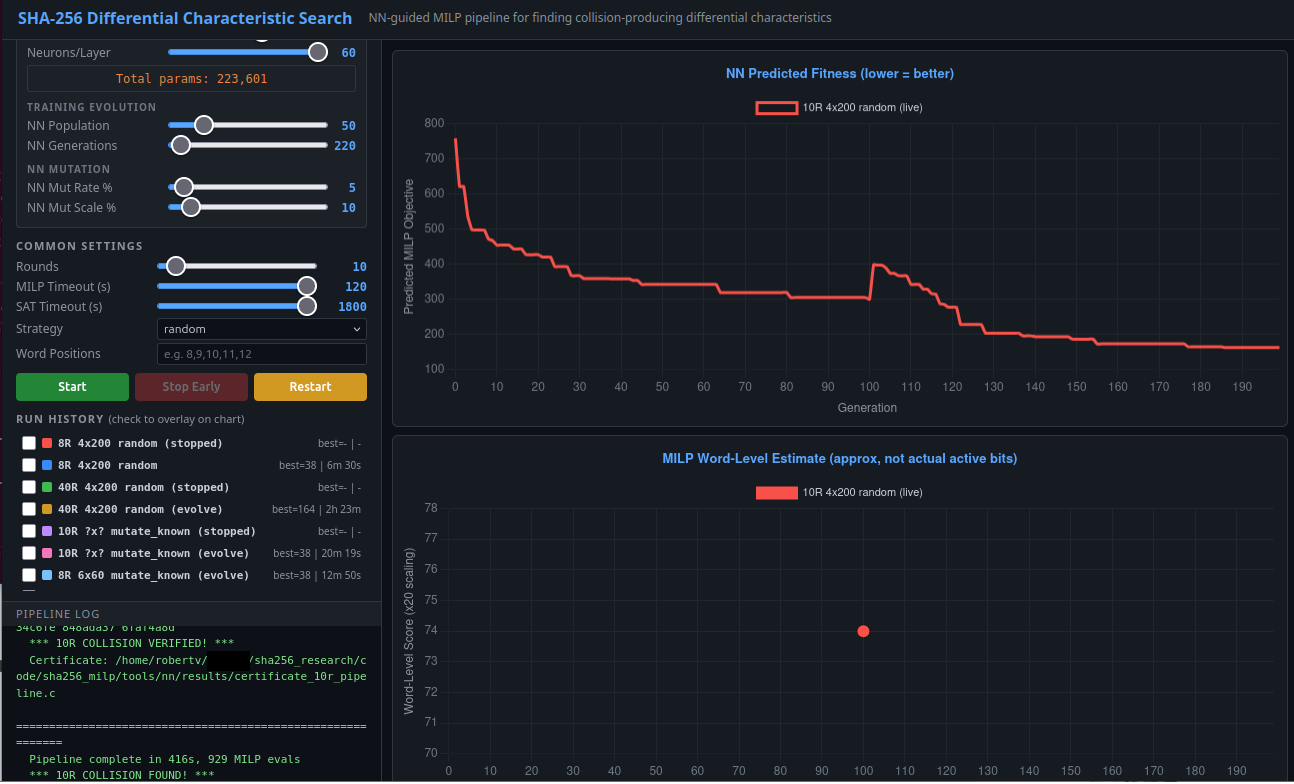
After training it fully, we moved on to the inference stage, trying it on the round counts we didn't have data for! It turned out ... to have zero predictive ability on data it didn't see before. This is on well-structured, sensible extrapolations for what worked at lower round counts, and what could be selected based on real algabraic correlations. This mini neural network isn't part of our pipeline now.
[1] screenshot: https://taonexus.com/publicfiles/mar2026/neural-network.png