106 pointsby ofrzeta12 hours ago6 comments
  • jzer0cool3 hours ago
    Could anyone recommend a budget tooling (has most features desired, please explain) to capture on wire like an oscilloscope. Help understand what kind of sample rates needed etc. features desired, cost and any recommended brand/models to get by. Thx!
    • Aurornis3 hours ago
      The QSGMII signals in this blog are very high speed. Beyond the range of what you can measure with budget tooling. Even the probes for such lines are thousands of dollars.

      There are some budget sampling oscilloscopes on the market, but budget is still mid four figures and up. That's before probes, cabling, and other things you'd need. Sampling oscilloscopes are only useful for repeating test patterns sent by SDK tools, not for capturing normal data as it goes by

      It's possible to look at Ethernet signals with oscilloscopes in the budget range but you would need appropriate fixtures to tap the line. Even at those speeds, touching a regular oscilloscope probe on to a wire disturbs the circuit so much that it might stop communicating.

      • userbinatoran hour ago
        At the other end of the scale, looking at classic 10M Ethernet signaling is perfectly doable with a sub-$1k scope, and 100M should also be fine with anything 500MS/s or higher. Note that Cat5 is rated for a bandwidth of 100MHz.
  • Cadwhisker2 hours ago
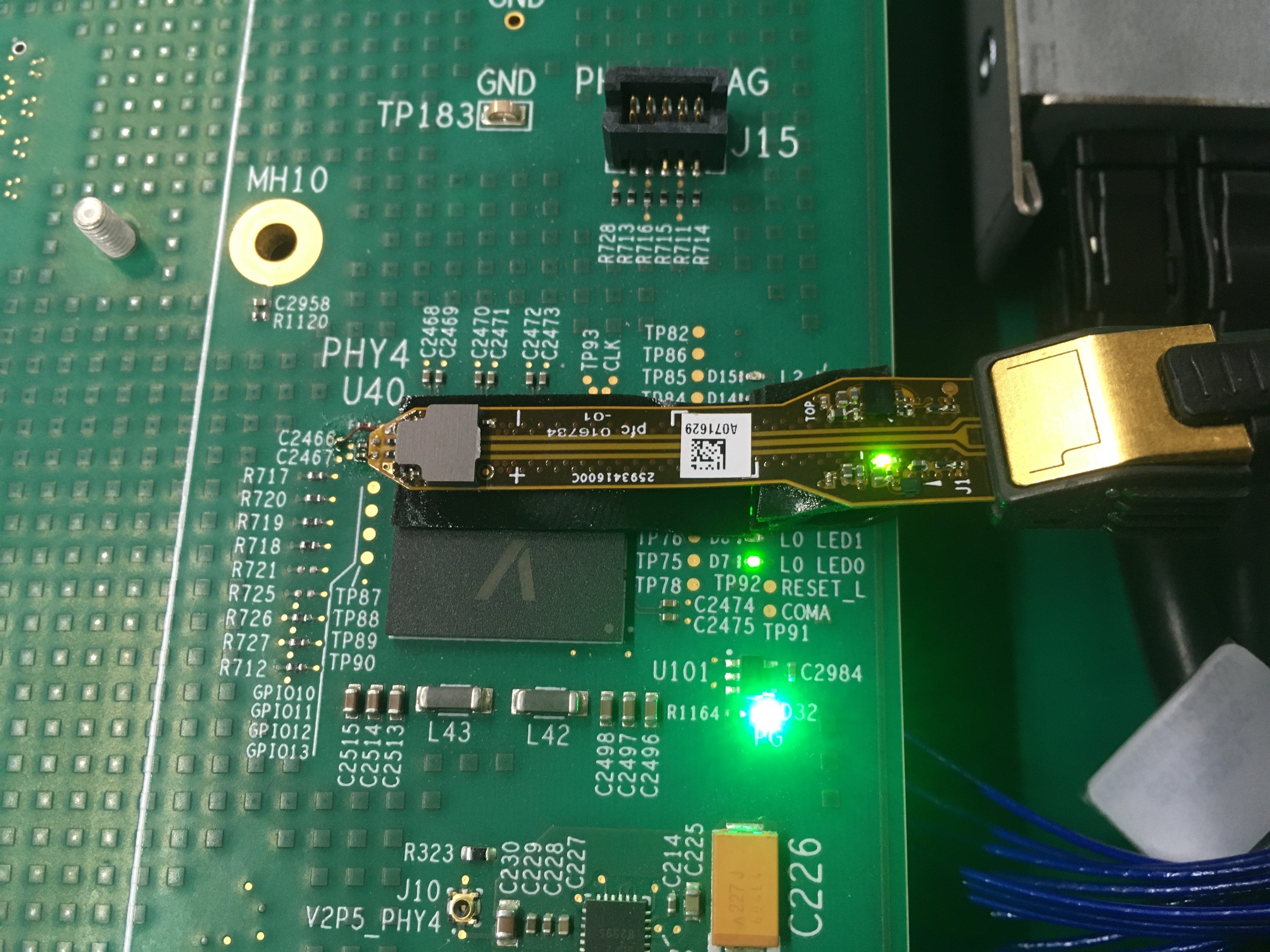
    I love the photo of the probe, and I bet it's very expensive. I wonder if the "A071626" sticker changes the impedance of the traces enough for you to notice :)

    https://www.mattkeeter.com/blog/2022-08-11-udp/probes_full.j...

  • Retr0id11 hours ago
    > I configured the oscilloscope to collect 100M samples at 1 TSPS

    Typo? I didn't think we had sample rates anywhere near that high!

    • nativeit10 hours ago
      > Random equivalent-time sampling takes advantage of the nature of a repetitive signal by using samples from several trigger events to digitally reconstruct the waveform. Since sampling occurs on both sides of the trigger point, pretrigger capability is very flexible. Because repetitive signals are being sampled, the bandwidth of an equivalent-time scope can far exceed its sample rate.

      https://www.tek.com/en/documents/application-note/real-time-...

      • nativeit10 hours ago
        Here's a more specific example: PicoScope 9400 series supports just 500Msps per channel, however it's advertising "70ps transition time and 1TS/s (1ps resolution) random equivalent-time sampling", this sort of "equivalent sampling" is presumably where that seemingly crazy spec comes from.
      • Retr0id9 hours ago
        But you can't use equivalent-time sampling for something non-repetitive like network packets.
        • Aurornis9 hours ago
          For measurements like this the SDK will usually include some utilities to send the same data over and over on a port.
    • KK7NIL11 hours ago
      A Keysight UXR can do one quarter of that, 256GS/s, but a Tektronix 6 series is limited to 25 GS/s iirc, so you're right.
      • Junk_Collector9 hours ago
        If you are an absolute nutcase, you could characterize a set of line stretchers and a multiplexer on a high end VNA then offset the inputs of the 4 channels on that UXR with them, take a capture and finally rebuild a 1TSamp/s signal out of the 4 results.

        You have to have the 240V model of the scope to run all four channels at full rate (110GHz) though.

        • cesaref8 hours ago
          The older Tektronix TDS540 series did this, but at much lower rates as was common in those days though. Internally there are differential feeds from the very beautiful hybrid ceramic input boards to 4 DACs, with some clever switching so that a single input can be sampled by all 4 DACs with a suitable offset to create 4x the sample rate when running with all 4 inputs.

          The calibration procedure on the scope fiddles with the time alignment to get the different DACs correctly offset so that the combined signal is correct.

          The hybrid ceramic input boards in their metal cases are a thing of beauty, fragile (don't ask how I know), but beautiful.

        • jacquesm8 hours ago
          Take that Nyquist ;)
      • HunterWare10 hours ago
        Looks like max 50GS/s per their site. That also looks reasonable with the screenshot they have in the article showing 1ns / div horiz. But clarity on the data would be lovely. =)
        • HunterWare10 hours ago
          Actually I take it back: For the series 6B spec page... Real-time: 50 GS/s (2 channels), 25 GS/s (4 channels), 12.5 GS/s (> 4 channels) Interpolated: 2.5 TS/s
    • mkeeter8 hours ago
      Not a typo, but you’re correct about the sample rate - with those settings, the scope was doing interpolation between samples.
      • nomel7 hours ago
        By definition, you can't interpolate a sample. A sample is a measured value.

        What you can do, if and only if you have an exactly repeating signal triggering at the same point within a cycle, is change the delay between the trigger and sample, and repeat. In other words, sample at different times within the same signal (since it's exactly repeating), to build up samples in time, of that waveform, to whatever time resolution you want.

        Of course, you're limited to any noise in the trigger, variation in the signal, etc.

        This is how you can record light moving through your garage [1]!

        [1] https://www.youtube.com/watch?v=o4TdHrMi6do

        • jacquesm7 hours ago
          Not sure if mkeeter's comment has been ninja edited but it says between samples, it doesn't say it is interpolating to generate new samples.
          • nomel6 hours ago
            I understand, but that's my point, it's not interpolated!

            The number he's referring to is in units of samples per second. It's not doing interpolation between samples, to achieve a high samples per second, because that's not possible, which is my point. Interpolation results in an imagined value, but samples are measured values.

            It would be correct to say that the values between samples are interpolated, but the subject of interpolation isn't applicable for anything mentioned in this comment chain.

            • jacquesm6 hours ago
              Ah you are referring to the 'sps' bit. Ok, but I think the extra sentence is enough clarification of what they mean, even if they're wrong about what the device is doing.

              The only time these are interpolating is when they are visualizing, there is no point (hah) in storing interpolated data, you can generate that whenever you want.
  • 10 hours ago
    undefined
  • James36185104756 hours ago
    [dead]
  • AIinfoclip146 hours ago
    [dead]