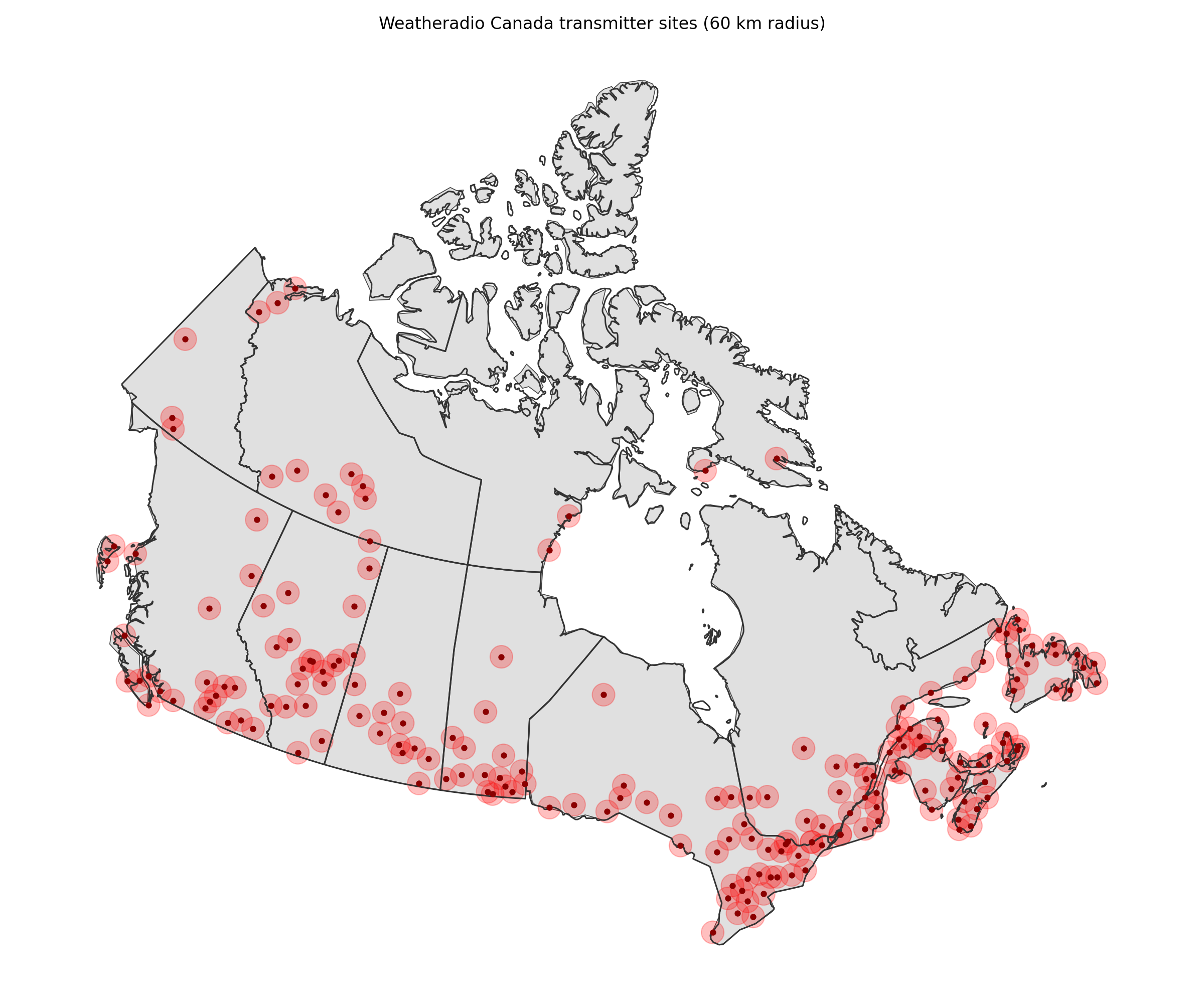
And if anybody is curious, here's the coverage for the equivalent Weather Radio service in the United States: https://www.weather.gov/nwr/maps
Guess I'll sell my weather radio on eBay in a few weeks, since there won't be any market for it locally.
Weather radio is a critical service, and even if traditional AM/FM or RF signals are deprecated, there should still be a way for anyone - no matter how remote - to get safety and meteorology information from the government. Given that its constant availability is more important than latency or bandwidth, it feels like an appropriate use for GEO satellites broadcasting down over a large area in the clear, such that any basic SDR and a cheap dish could grab the signal with minimal fuss.
Requiring line-of-sight outdoors to a satellite does fuck-all in emergency situations, especially one you're trying to shelter in place from, likely underground.
In the US, these broadcasts are localized, usually a county or multiple county area.
https://en.wikipedia.org/wiki/Minot_train_derailment
> Because it was the middle of the night, there were few people at local radio stations, all operated by Clear Channel with mostly automated programming. No formal emergency warnings were issued for several hours while Minot officials located station managers at home. North Dakota's public radio network, Prairie Public Broadcasting, was notified and did broadcast warnings to citizens.
If you wanted to make commercial radio even minimally acceptable as an emergency alert system you'd be... guess what... reinventing EAS and EAS-a-likes, except more expensive and less responsive! EAS never has to "Interrupt This Program" it can just get to the meat.
Exactly, whatever it costs to operate and maintain the emergency and weather services commercial radio would need to make enough money to pay for that, and then also make enough money on top of that to stuff their pockets with profit. The people shouldn't be on the hook for those extra expenses while private companies do everything in their power to degrade the service in order to lower their costs to increase profits even farther.
Again, I am biased, but as far as HN bias goes, that ain't bad. These are amazing places chock-full of the coolest people.
After decades of the West Coast life I now live in rest of world, and wish that rest of world could be so lucky.
The number of Canadians is relatively easy to estimate though, since the geographic distribution is similar and the majority do speak English. I'd expect a roughly 8.5:1 ratio of Americans to Canadians based solely on population.
I think the HN population is more distributed geographically then you'd initially think
If the Corporation is type S it is purely US citizen owned, but most are type C thanks to the great work by AMCHAM attracting global investment.
Notably, most science is done on UTC time... because politicians were always functionally ignorant about the collateral costs of arbitrary technology policy changes. Evey village usually has at least one idiot. =3
Purely US resident owned, not US citizen owned. Resident aliens, who are not citizens, can have ownership in an S corp.
People often do whatever they like, but whether it is locally legal is not a YOLO/LLM matter. Best of luck =3
If you live in a portion of the US that has severe weather, a NOAA weather radio with the EAS alerting function is a mandatory addition to your home. It could be the difference between life or death. See: first five minutes of Twister.
Inexpensive, AC powered with battery backup and it always works. No internet, no cell tower needed, which was likely just trashed by the storm you're trying to shelter from.
Fun fact these radios can warn you about more than weather. "Radiological Hazard Warning" and "Volcano Warning" to name a few.
Many more people died in decades past from severe weather and natural disasters precisely because of inadequate advance warning.
So naturally they would migrate people to...a replacement orders of magnitude more unreliable.
We still have CBC radio that broadcast weather reports, and whether reports are still available on the internet.
If I understand correctly, this service was for people who didn't have internet access, which with cell service, StarLink (yeah, Elon Musk, I know but it has been a game charger in remote communities) and similar services is become a very small minority of individuals.
I think we have to not maintain things that are older tech and unused and focus on things that are the future. If we didn't, we'd still have roads maintained for horse and buggies.
Commercial radio/television broadcasts are not the same thing since they do not offer continuous weather broadcasts. Getting weather information from the Internet is better in most respects, but it is not always the best medium to receive such information. I am a regular user of the Weatheradio service during the summer months, and have been through one situation where it most likely saved lives.
> I think we have to not maintain things that are older tech and unused and focus on things that are the future.
The problem is that we are ditching older tech without finding a viable replacement. I find it difficult to associate that approach with focusing on the future. I find it easier to associate it with forgetting lessons we learned the hard way.
For me, the value isn't in the weather report, but in the SAME alerts: https://en.wikipedia.org/wiki/Specific_Area_Message_Encoding
I don't typically keep my phone on me when I'm in the house, but my weather radio is loud enough to hear anywhere in the house, the alerts it notifies for can be configured (unlike phone emergency alerts in Canada which all broadcast at the unconfigurable ICBM-incoming level, so the result is that authorities have to be very careful of alert fatigue), it never runs out of battery, never needs software updates, never has its OS take away app permissions, etc.
So far in the four years I've had the radio the worst it's alerted me for has been severe hail (thankfully), but that's saved me thousands of dollars in damage to my cars. (And gave me time to cover my tomato plants.)
I don't know of any way to reliably replicate this type of alert even with reliable internet.
You'd be surprised at how bad cell service is in Canadian areas that aren't even considered "boonies". There are often times when you're driving without cell service or any other options.
I'm not bringing Starlink on a week-long kayak voyage. My cousin isn't bringing it on his hiking and hunting trip in the bush. There's no cell service out there - radio is all you get, at best. This might not be tremendously well used, but there was and continues to be utility for radio broadcasting that one can receive on a cheap low-powered device for free with no subscription in the middle of nowhere. None of your suggestions touch that.
> we'd still have roads maintained for horse and buggies.
Do you leave the city, much? Ever drive up an FSR?
For what it's worth, we're probably a few years off from ubiquitous availability of cheap, sat-based cellphone data. In fact, my iPhone has free sat-based texting right now.
Although also, I really don't enjoy that crucial safety services such as weather data are being discontinued. And I actually really don't enjoy the premise that I'll be able to be reached anywhere in the world, even the remote wilderness.
We just take it as it comes and deal with it...
I've got a NOAA weather radio near my bed. It's a Midland WR120 that I picked up several years ago for $20. I've programmed in what areas I want to pay attention to, and what alerts I'm interested in for those areas.
Accordingly, it spends the vast majority of its time just sitting there in silence. Months will go by without a single peep from it.
When a selected alert happens, it comes to life automatically (courtesy of SAME messages) and announces information about it... and then silences itself again. Current alerts are also denoted by a red or yellow LED that stays alight for the duration, for a good visual indicator, and briefly summarized information also shows on the very basic character display on the front.
And, well, that's pretty good for me. We get things like tornadoes here that can flatten a neighborhood in an instant, and I'd rather survive that unscathed than to wind up dead (or, worse: permanently maimed). Proactive, broadcast weather alerts help improve my odds of success.
And unlike my community's outdoor warning sirens that are hard to hear indoors even when I'm listening for them during scheduled tests, this is loud AF inside of my house and will wake the dead.
Other than plugging into the wall for power, it will also run for a long time (days, IIRC) on the 3 AA batteries that it uses for backup power.
Now, don't get me wrong: I've also got other means, but they're all complete shit.
I've had severe weather alerts show up on my phone before (from Google and/or Verizon), but they're amazingly inconsistent with whether they'll appear or not and seemingly impossible to control. I've set up push notifications for apps that are dedicated to the purpose, but my Samsung phone loves to put apps to sleep in ways that make reliable push notifications mostly a non-starter.
In terms of computers and Internet access: Yeah, sure -- I've got computers and Internet access. But I'm not trying to hit refresh on a weather page all night just to see if a tornado is happening nearby when the weather is iffy, or to set up a computer to alert me to a weather hazard. And when the power dips here because the weather is awful, the DOCSIS network immediately goes with it. The cell phone towers, which are slow here on their very best days, also get overloaded and become unusable for data.
Running my network on batteries and/or integrating a generator and/or getting a Starlink dish for backup sounds like a fools' errand when a trio of cheap alkaline cells and a normally-silent radio will do what I need.
So anyway, weather radio is a lot more than just a thing that a person can tune into if they elect to choose to hear the weather forecast.
And Canada's service appears offer similar functionality -- with SAME messages and the whole 9 yards: https://en.wikipedia.org/wiki/Weatheradio_Canada#History
You guys are losing something important up there.
The costs of these stations were probably like change one find in their sofa. But in the US, there is always enough funds for killing people, little for keeping people alive and safe. The same may be starting to happen in Canada too, they probably need to start increasing they defense spending due to changing winds from the south.
> From one of my internal sources at ECCC, basically they’re completely overhauling the warning system right now. We had the colour coded warnings implemented in November but the real massive change is the convective alert system which is moving to free form polygons and automatic storm tracking this spring. Basically combined with the fact they’re also changing over to semi-automatic phrasing on all warnings, the cost to upgrade the weather radio network to be capable of handling the convective alert changes would be wayyy to much to warrant it. They have already had to basically completely gut the way they issue CAP files to alert ready which has delayed the project by at least a year and put the budget over by god knows how much. Given the relative low use of WRC, and the enormous cost (we’re talking in the 10s of millions here) I can understand why. I will miss it. I have fond memories of being at my cottage listening to Severe Thunderstorm warnings while watching those beautiful summer storms move over the lake. WRC will alas become another part of our history.
The budget projects increases in both revenue and spending, and increases the deficit by ~50% percent.
What the government has asked for is widespread cuts across the board from current programs and operations (and staffing) to try to make more room for new spending in new areas. They are targeting getting to ~$13 billion CAD reduction in annual operations cost by end of decade.
By contrast, there are a lot of major spending programs - ~$10 billion CAD added to the defense budget, ~$5 billion CAD in tariff relief.
I guess the stations are just stuck right now live transmitting possibly not even a forecast, just an endless station ID announcement.