If you are interested in this, you can choose to study (1) why is the set of real numbers the same size as the powerset of the natural numbers; (2) why is any set (infinite or not) smaller in size than its powerset; (3) doing arithmetic on sizes of sets, for example what it means to have one more than the size of the natural numbers or twice the size of the natural numbers; (4) the continuum hypothesis, that there is no set bigger than the natural numbers and smaller than the real numbers.
Unfortunately there’s not much else about cardinal numbers that beginners can readily grasp; you’ll have to switch your study to ordinal numbers.
Off to a bad start. Aristotle was not making a mathematical point but a metaphysical one. Infinities do not exist and is not a number. For example, Pi is not a number but a symbol that stands for an open-ended (infinite) process to calculate a rational number and is a perfectly valid mathematical concept that, I am sure, Aristotle would agree. On any computer, despite protestations by the mathematical platonists, Pi is ultimately a rational number in all use cases involving actual measurement or calculations.
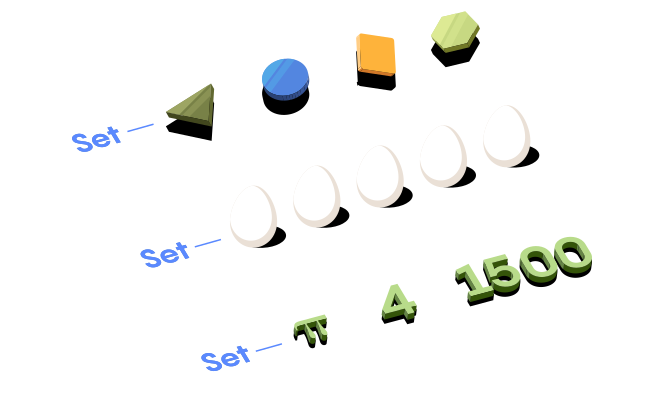
The error is illustrated in the first image in the article.
https://www.quantamagazine.org/wp-content/themes/quanta2024/...
The third set in this example is an invalid and undefined set by including Pi since Pi is indeterminent and thus cannot be an object to be counted. All of Cantor's nonsense rests on this type of error, i.e. treating a mathematical process as a number. All of these errors are implicit in Newton's calculus and Berkeley's Ghost of Departed Quantities critique still needs to be answered. Hint; there is no such thing as infinite precision and epsilon/delta needs to be defined in a consistent way, not arbitrarily as it is now.
this seems weird to me. doesn't pi (the symbol) point to one specific concept, whether or not we can determine its exact shape?