>It is always the case that there are benefits available from relinquishing core civil liberties: allowing infringements on free speech may reduce false claims and hateful ideas; allowing searches and seizures without warrants will likely help the police catch more criminals, and do so more quickly; giving up privacy may, in fact, enhance security.
> But the core premise of the West generally, and the U.S. in particular, is that those trade-offs are never worthwhile. Americans still all learn and are taught to admire the iconic (if not apocryphal) 1775 words of Patrick Henry, which came to define the core ethos of the Revolutionary War and American Founding: “Give me liberty or give me death.” It is hard to express in more definitive terms on which side of that liberty-versus-security trade-off the U.S. was intended to fall.
And if you don't get the security you were promised, it's too late to do anything about it.
The key phrase is "a little temporary safety". 250 years ago people understood that the "security" gains were small and fleeting, but the loss of liberty was massive and permanent.
1. Postal Service Act of 1792
2. Electronic Communications Privacy Act (ECPA) of 1986
Anyway, Facebook can read your DMs, Google can read your email, Ring can take photos from your camera.
We can very easily make those things a crime, but we don't seem to want to do it.
>we don't seem to want to
Congress protects only itself and its actual constituents — wealthy corporate persons.
----
Citizens United (2012) and the surveillances themselves make this monitoring self-capturing: the only way to prevent it is to convince most people to not install, but most people want the installed benefits.
Even getting your neighbors to re-position their Ring cameras (which they have every right to install) can become very difficult.
After city councils individually ban Flock-like CCTV traffic monitoring within their jurisdictions, their police can (and often do) still access neighboring jurisdictions' to monitor border crossings. You can't escape This System, even without license plates nor cell phones.
----
Term Limits now? end Citizens United. release The Files!
Why is everyone suddenly outraged Ring has access to your footage? These cloud-connected cameras...hosted on someone else's servers. It's literally how they work. "But I didn't think they would use the video in a way I didn't personally approve after giving it to them!"
So instead, people are rage-returning Ring cameras and posting their receipts and exchanging them for...Chinese cameras. Which do the same thing, except this time the servers are overseas and completely uncontrolled.
It's hard to have any empathy when the warning label was already on the box for all these products.
This is exactly the sort of thing there should be legislation for. To a somewhat weaker extent than I’d like this is what GDPR and friends covers, the law says that companies must state what data they’re gathering and what purposes they’re gathering it for. If they overreach then they can be fined into oblivion.
In practice this is not as strong as it should be, broadly companies can and do basically go “we’re collecting all your data for whatever purpose we like” and get away with it, but they do at least think carefully about doing so.
There’s no reason we can’t force providers of cloud backed devices to treat your data with respect, rather than thinking of it as residual income they’re leaving on the table if they don’t also sell it to third parties for data mining.
Accept that many folks are built differently than you and me and stuff like actual freedom you may be willing to lay your life for may be meaningless fart for others, especially when its not hurting them now. For example US folks voted current admin willingly second time and even after a full year of daily FUBARs the support is still largely there. If even pedophilia won't move some 'patriots' then reading some communication doesn't even register as a topic.
Also, anybody actually concerned about even slightest privacy would never, ever buy such products, not now not a decade earlier. Ie for my family I don't even see any added value of such devices, just stupid fragile something I have no control over, but it sees everything. Why?
If anyone with power picks and chooses who gets justice then there is no justice, those people are corrupt, and they need to be removed from power and charged.
Whatabout whatabout whatabout. Charge, try, and imprison the guilty regardless of how much money they have, which political party they are part of, or how they vote. Anything else is madness.
I wish more people would use AI to build alternatives with a clear, binding mission not to exploit the data, not to sell or be funded by investors who expect it to, etc. We have the power to build more than ever. We should use it.
I noticed your own app's website [0] hosts videos on YouTube [1] and uses Stripe as a payment processor [2], which is hosted on AWS. You also mentioned that your app is vibe coded [3]; the AI labs that facilitated your vibecoding likely built and run their models using Meta's PyTorch or Google's TensorFlow.
"Just stop using" makes for a catchy manifesto in HackerNews comments, but the reality is a lot more complicated than that.
[1] https://www.youtube.com/watch?v=AbCM99cz9W8
Just not using it is really unrealistic for the average person at this moment
Unfortunately, the status quo also means the US (and its tech giants) has real power and control over other countries' technology sector. So, no party in America will make or enforce laws that will change the status quo within the country or overseas.
Don't get me wrong. I appreachiate all the work being done to get Europe out of the claws of US tech companies, but I think having an official EU app store alternative would be a good start.
None of this is legally easy to implement or enforce, and any attempt of doing it is virtually guaranteed to create an unbelievable amount of unintended consequences as people figure out ways to game this new set of rules.
Say for example your local/state/federal agency publishes (or accepts) documents exclusively in ods/odf instead of proprietary formats, that will automatically drive adoption of software and prevent lock-in.
The only way I see a change possibility is for people to think about how to change this collectively. Pushing for open source everywhere would be one partial strategy that could work in certain areas.
Regulation and liberty mongering are very American. We do it constantly at multiple levels of government.
What kills privacy regulation is this weird strain of political nihilism that seems to strongly intersect with those who care about the issue. I've personally worked on a few bills in my time. The worst, by far, were anything to do with privacy. If you assume you're defeated by forces that be, you're never going to probe that hypothesis.
How so?
(Damn, I failed at my attempt to stop posting.)
All school and class related information is shared exclusively via WhatsApp communities.
Yeah, Tim Apple handing over a 24-karat gold plaque to the sitting president is completely normal behavior for CEOs to engage in, and not at all about just making as much money as possible. He had to do that, otherwise Apple as a company would disappear tomorrow. They're just trying to survive.
But in any case the legal battles work as nice PR for Apple (see how much we care about privacy) and also as a great scenario for the government because any battles they win are domains where they can now legally use information directly to the courts and sidestep the parallel construction. That also takes the burden off of Apple PR in giving that information up because it can be framed as the courts and government forcing them, rather than them collaborating in mass data collection.
Unfortunately, I think reality is much worse than you seem to be under the impression of. Voter suppression and military violence against your own population isn't "narcissism", it's the introduction of authoritarianism. The flagrant narcissism is a symptom of that, not the actual issue.
For something like icloud vs gmail/gdrive, they're approximately the same, but that doesn't mean "they share just as much [...] as Microsoft and Google. If they never collected data in the first place, they don't have to share with NSA. The most obvious would be for location data, which apple keeps on-device and google did not (although they did switch to on device a few years ago).
It is akin to Visa/MasterCard duopoly. It is hard to escape but even if one does it then it resulted only inconvenience. I still don't have my cards in phone - neither will google change path nor will govts force a change.
What I meant to convey, from my personal experience, is that it seemed hard to get off of platforms like X, Facebook, Instagram, Amazon Prime, Alexa, Ring, Google Photos, etc. but then I did it and didn’t miss them. These small moves by a lot of people, I believe, can still make a difference. It’s not perfect, but it’s something. Do I still use some services? Of course, I have Gmail and WhatsApp, and use a lot of Apple products. When I can, I choose intentionally what I use since there’s no perfect companies out there, but there are “better” ones (whatever that may be in one’s opinion). I chose cloudflare for hosting and Anthropic for vibe coding. Allowing people to use existing login info versus exposing them to more risk with self managed auth was a choice I made. There are tons of choices we make every day so trying to be more intentional is a good start.
Nobody is perfect, but we can try to improve each day in these choices we make.
I can understand aws, youtube, being on google index, and other things as they sometimes are the most cost efficient or vendors don't offer alternatives... but stripe-paypal is more expensive and worse than the less-bad alternatives. jeez.
It's not just hard for some though, literally their livelihood depends on it. Want to run a restaurant today? You basically must have Facebook, Instagram and Google Maps entry for enough people to discover you, probably more than half of the people we got to our restaurant who we ask, cite Google Maps as the reason they found the place, and without half our income, the restaurant wouldn't have survived.
At best, we can only control our own actions. Even then, it is only possible to minimize (rather than eliminate) the use of their products without putting up barriers between ourselves and society. Consider email: we can use an alternative provider, but chances are that we will be corresponding personally or professionally with people who use Gmail or Outlook. The same goes for phones, only the alternatives available are much more limited. Plus you have some degree of tracking by the telecom networks. (I don't consider Apple or Microsoft much better on these fronts. Ultimately they have their business interests in mind and, failing that, their existence is ultimately at the whim of the state.)
Also, most people don't actually need something like Amazon. Not to minimize the level of investment in it, but I don't see Amazon or Google as being quite the same as Bell or Standard Oil. Maybe between Google and Apple there's some kind of duopoly like that?
My impression is people don't value — either because they don't understand or minimize — things that protect privacy and anonymity. This is a standard refrain on these kinds of forums and elsewhere — "your typical person doesn't know or care about [feature X that preserves privacy, choice, and autonomy], they just want something that works and is fun". It's been belittled as unfashionable or paranoid or performative or something, when it's really something that's had short term costs that pale in comparison to the long-term costs.
I'm not saying governments don't need to be on the "right side" but I think people need to see security as involving not just encryption and so forth, but also decentralization, anonymity, demonopolization, and censorship resistance. It needs to be seen as part of the product or service benefits.
A lot of this reminds me of stuff from the 90s, when network security was ignored for awhile for customer convenience's sake. It seems really similar now, only the thing that's been ignored is like user control and privacy or something like that.
I think the thing that's surprising to me, for example, is that it takes a Super Bowl ad for people to realize that maybe there are downsides to letting a monopoly have access to video throughout the neighborhood everywhere.
Look at Kagi's success and compare it to Google. It doesn't even register.
People need to start paying for things, because if you're not paying for it, you're not in control of it.
The problem is centralization is more convenient for consumers. You can easily control your doorbell, your garage door, your security cameras with 1 app, and everything just works.
Open source and decentralized solutions need to be just as convenient and cheaper than centralized ones for consumers to choose them.
You're looking at America in 2026 and concluding we want to give the state more control over private lives?
Thomas Sowell's Conflict of Visions describes the difference well.
Getting away from American tech has become an actual national security issue.
Ideally you would still have private enterprise create alternatives, but it’s easy to imagine that email, social media will simply be built for citizens by their government.
What brought the popularity of gmail was the huge space provided which at the time felt infinite. I still remember the counter that was showing the size increasing seemingly indefinitely.
We need to move in the right direction, not get paralysis in the status quo because of high profile edge cases.
No matter what there will always be warrants and wire taps. The goal is to get away from the "free flow" of information.
In most cases there can’t be movement in this direction and to the degree there can be, it isn’t enough.
...with money. They are already paying for things by violating their own privacy and those around them. The irony is that the amount of money required for the service is much less the expected value of the surveillance for the provider. Service payment is an insurance expense, protecting against individual and systematic violation of the 4th Amendment rights. It's insurance (and cheap insurance) because this usually doesn't matter in practice. But sometimes it does, and when it does it REALLY does matter.
<tinfoil_hat>It would be smart for surveillance capital to fund some of these privacy forward providers, steer them to both charge you for a service and violate your privacy, hope for a very public controversy, and eventually discredit the fundamental approach.</tinfoil_hat>
That's one of the big hidden factors driving the ad/surveillance economy: people's purchasing power just isn't what it used to be, while at the same time they're expected to be paying regularly for more things than ever before (home broadband, mobile phone plans, etc).
- regulate the crap out of surveillance capitalism.
- enforce laws on the books
- Break up firms
Tech used to have a leg to stand on in the face of government over reach. Today, tech firms have largely adapted to the incentives that actually make themselves known every quarter.
Customer support, content moderation, compliance are avoided, and lobbying argues that if you dont let tech it easy, your economy wont innovate. Except enshittification is the term to describe how extractive mature tech markets become.
I am all for more subscription models, but this shouldn’t come at the cost of throwing our hands up and ignoring the many changes that can better align the current incentives.
So for me "stop using Facebook" sound similar to saying "burn all of your family photos and throw away your ability to talk to many of the people who are important to you."
I don't say this to necessarily mean that you are completely wrong, just to point out that opting out of these companies can be more complicated than it may initially appear.
People have become dependant on the convenience of these tools and become, for lack of a gentler word, lazy. Moreover we have this current sense of entitlement -- that all of these details of modern living should be done for us. Having our social circles organized and maintained for us, having infinite entertainment a button press away, food delivered to our door on a whim, cars to take us anywhere always minutes away.
People survived just fine before these conveniences, it just too a bit more effort. You could collect your friends contact information, keep an address book, call them up from time to time. It's not perfect, but it works and starts to break the silicon valley tech giant dependence.
Personally I find adding friction to these processes has actual value. When you slow down and have to put a bit more effort in, it helps you to evaluate what is important, and what truly matters. You prioritize, you make tradoffs. The process IS the richness in life. We all don't need to be jet setting globetrotters to whom paris might as well be New York or london or munich, while robots manage our social lives. There is no substitute for actively working to build a community where you are. You have to put the effort in, and in a single generation we have lost so much of it. But we can get back there again if we try.
Local events - check
Local groups - check
Small time music bands/artist/performances/etc - check
Buy nothing groups where I can get rid of something I don't use - check
Groups for mom with kids to get organized for some kids event - check
A library having a read together event for a kids book author - check
I'm happy I don't have to use FB, but my wife uses it all the time, she just avoids newsfeeds and all the click/rage bait parts.
Google and Amazon are harder to complete cut imo. I have replaced Google apart from using YouTube, and I do rely on Amazon for delivery and running personal projects on AWS.
That said for some I can foresee Meta being hard or harder to disconnect from because of their percieved level of personal social needs.
I left facebook and many of my friendships faded away.
Awkward bumping into people conversations would happen such as: "We missed you at my birthday party!", "I didn't know about it, else I would have been there!" "We posted it to facebook..." "I deleted my facebook account 2 years ago."
My personal philosophy was maybe they were not real friends to begin with. After all in the now 5 years since deletion, not one has reached out to ask if I'm even still alive. I've reached out to a couple people, with little to no reply. None the less, it was a hard transition.
For others', that might be an impossible task.
I guess it can be hard initially though. Also, my core group of friends is less than 10, but that’s enough for me. I don’t need to follow what 100 other people are doing in their day to day haha.
That's the easy part. What do you do about stuff like face recognition and cameras everywhere? Should you hide your face every time you go out? Should you not speak because there might be a mic around picking up your voice?
This is only going to get worse. We can't trust companies or governments to respect our privacy. We can't trust each other to keep the data recorded by our devices private.
It seems like the fight for privacy is a lost cause. What do we do?
No Go, no Flutter, no Android, no GCP nor AWS or anyone that relies on them like Vercel and Netlify, no llama, no React or framework that builds on top of it.
Keeping the list small, there are other items that depend on those companies money and engineering teams.
And the upfront cost will be quite high.
I see everyone talking about how to stop using products. I even thought about legislation that could help. But that's just it, none of that is possible. You can't even employ a "torches and pitchforks" approach. For any of this to be possible, people would have to coordinate. The means by which people communicate and coordinate are under the influence and control of the very entities that the people are trying to bring under control.
The only way to win this war is by means of economic warfare. And I don't mean "vote with your wallet". If I could spell out what I mean here, then the previous paragraph would have been invalid.
We are only in this situation because the economic war was lost. You want the world to fight Amazon and Google while they're in the middle of counting their spoils?
We still have the power to panic the billionaires, and they have the power to get what they want. If what they want is temporarily in sync with what society needs, then so much the better.
If you know you know I guess, but even then, broken clocks and all that. There was a point where he was such a cool guy to me, and I grew up a little in a good way seeing him turn into whatever he did.
It may just be Twitter's fault at the end of the day too!
https://www.theguardian.com/media/2026/feb/07/revealed-how-s...
The elitism and groupthink here is fucking wild.
>That's why I hang out here on HN with my fellow crazies who can separate ideas, thoughts and knowledge from the person.
Is unironically what you think and posted in earnest? Thats WILD.
That's exactly the point! We're both thinking very different, yet neither of us have explicitly (only implicitly) tried to insult each other. What place on the internet does that better than HN?
If we're gonna judge authors for what platforms they're using, does that mean we're all bad guys here on HN too, since a lot of current misery is because of startups and technology companies who used to receive a lot praise here?
The US has lots of issues but at least it doesn't toss you out a window when you cross Fearless Leader. Maybe you get ICE'd, but Russia's kill rate of people Putin doesn't like is 1000x Trump.
This is a calculated move to normalize such technology. Yes, it will cause controversy in the short term, and these companies knew this was a possibility—but as a result the image in people's minds won't be the gestapo rounding up grannies; it'll kids finding puppies. To call this "unwitting" is simply naive (not surprising for Greenwald).
Propaganda is, and always has been, a subset of marketing aimed at shifting public perception. It would be wild to assume it never happens.
The argument isn't against ethics. It's about self interest. Amazon bought the Super Bowl ad to sell Nest units.
"Unwitting" is correct. There are no lizard people coordinating our march towards dystopia. Just individual people who will–like me–read this article, think we should do more, and then probably do nothing.
(If you want a realistic conspiracy, Amazon may have greenlit the spot with an eye towards an audience of one or two in D.C.)
There are no lizard people coordinating our march towards dystopia. Just individual people who will–like me–read this article, think we should do more, and then probably do nothing.
It's very much possible for people to brand the surveillance state as cute; and for consent for a surveillance state to spontaneously emerge / be generated from the attempts of marketers trying to make the Ring dystopia cute.
On what planet would the ask be marketing copy versus straight access?
Then this guy [1] walks into the room and says no, be bold, who could possibly object to my life's work, and he gets his way because he's signing the cheque.
Completely off topic, and for future reference, it's "err" not "air".
Completely fine mistake, stupid homophones and all. Just thought you'd like to know.
Also, these things happen to me all the time if I use voice dictation. I don't trust it because of edge cases like this.
The people creating ads are just organizationally isolated in most cases.
Sometimes it was for no other reason than a bunch of people in house felt they needed to justify their existence, but regardless that’s how it was 90% of the time.
So it is unsurprising to me that a creative team might have been given brand guidelines and a goal, like "hey we want to sell this, we want people happy with this" (much more concretely, obviously) and that could lead to this sort of ad, and I think that's probably more plausible than the team going "we're going to psyop everyone into surveillance statehood".
They'll avoid negative perception because this is their job, the message is still arbitrary.
And yet there are countless examples that show the exact opposite.
This made it through one of the largest marketing budgets in the world…
Attorneys challenge each other as a matter of course in every case before a court. This is how the adversarial system works.
Perhaps what you meant to say is that “I don’t like the activity that is happening here,” or “I think some of this might be unconstitutional.” When someone makes a naked blanket assertion about the law, it’s usually a sign that that person doesn’t know what they’re talking about.
Why have the other amendments not enjoyed this same individual freedom absolutism? Why are we cherry picking which amendments get expanded modern powers "in the spirit of the text"? It's because of how the judges feel.
So before you dismiss someone's opinion because how it might be, let's all be honest with ourselves and realize constitutional law of this nature does not depend on precedent and is largely do to the whims of the supreme court.
I also disagree with your characterization of 2nd Amendment jurisprudence, but I'm not going into that rathole!
And yes, they are spying on everybody. They have access to things like cellphone metadata, which to a normal human being is a very clear violation of privacy.
It's also my firm belief that our legal system has been undermining these basic concepts for decades now. It benefits the federal government to make this all very vague, as if modern technology suddenly means you have no expectation of privacy anymore. They've also mixed in some of that wonderfully authoritarian "for purposes of national security".
There's actual lawyers saying these same things, if you'd like someone to properly debate with.
However:
> They have access to things like cellphone metadata, which to a normal human being is a very clear violation of privacy.
In the U.S., when you study 4th Amendment law in Criminal Procedure, you learn there is a "third party doctrine" that says that if you voluntarily provide a third party with information--even information you consider private-it's the third party's property and you can no longer object to it being sought by the Government. There's a good overview of this on Wikipedia: https://en.wikipedia.org/wiki/Third-party_doctrine
The Supreme Court declined to extend the third-party doctrine to tracking one's location via cell-phone metadata in Carpenter v. U.S., 585 U.S. 296 (2018), so it's not absolute.
> The Supreme Court declined to extend the third-party doctrine to tracking one's location via cell-phone metadata in Carpenter v. U.S., 585 U.S. 296 (2018), so it's not absolute.
In other words, principles are law -- in the US, whatever the principles of 9 judges at a given time, because they are the final arbiter of what anything written down by Congress means. "Third-party doctrine" is not law as written by Congress, it is something the Supreme Court made up out of thin air according to their principles. And these principles are not binding; a later panel of judges is free to throw out the rulings of older judges if they decide their principles differ, as famously happened to Roe v. Wade among other cases.
The government can now partner with private businesses to effectively bypass the Fourth Amendment.
If it were a violation, Courts could enjoin it. But since it's not a violation, there's nothing to enjoin.
It's almost like HN isn't a court and the OP was expressing their opinion that this should be illegal. . . Not relying on specific semantics for the current state of affairs?
HN is a forum of written communications. Clarity and accuracy are essential skills for participating effectively in such places, and are the responsibility of the author.
People commit minor offenses, and often felonies without knowing it, on a regular basis. If surveillance was consistently used to actually enforce the laws, people would a) notice the surveillance[0] and then actually object to it and b) start objecting to all the ridiculous and poorly drafted laws they didn't even know existed.
But they don't want the majority of people objecting to things. They want a system that provides a thousand pretexts to punish anyone who does something they don't like, even something they're supposed to have a right to do, by charging them with any of the laws that everybody violates all the time and having the surveillance apparatus in place so they can do it to anyone as long as it's not done to everyone. That doesn't work if the laws are enforced consistently and the majority thereby starts insisting that they be reasonable.
If the only way to protect yourself from selfish people is if their actions explicitly illegal, then the logical outcome is to make more and more things explicitly illegal.
IMHO, that's one of the core failures of modern Libertarian/Objectivist influenced thought.
Except that that isn't the only way to protect yourself from selfish people and the assumption that it is is the source of a significant proportion of the dumb laws.
There is a narrow class of things that have to be prohibited by law because there is otherwise no way to prevent selfish people from doing them, like dumping industrial waste into the rivers. What these look like is causing harm to someone you're not otherwise transacting with so that they can't prevent the harm by refusing to do business with you. And then you need functional antitrust laws to ensure competitive markets.
The majority of dumb laws are laws trying to work around the fact that we don't have functional antitrust laws, or indeed have the opposite and have laws propping up incumbents and limiting competition, and therefore have many concentrated markets where companies can screw customers and workers because they have inadequate alternatives. Trying to patch that with prohibitions never works because in a concentrated market there are an unlimited number of ways the incumbents can screw you and you can't explicitly prohibit every one of them; the only thing that works is to reintroduce real competition.
As a society plunges into dysfunction due to economic stress, the number of people harming one another increases. If the society responds using more laws, and fails to correct the source of the dysfunction, it will eventually collapse under the weight of those laws as enforcement becomes uneven and politically driven. (This is the failure mode of legalist and bureaucratic states.) Alternatively, if the society responds with a more arbitrary case-by-case system of punishment, it will collapse into mob rule or dictatorship, so lack of structured law isn’t a solution either.
The only real solution is to fix the root problems facing the society. Antitrust helps with this because it can “unstick” parasitic incumbents who are preventing the market from dynamically responding to real economic conditions.
It's not. You're asking for contract law.
You can see the counter example during the 40s-70s when the FBI targeted the mafia and local political corruption to take out the remaining organized crime strongholds .
Today organized crime doesn’t have much political influence. A sort of truce. So there’s no longer incentive for the feds to pursue street crime. Street crime yields no longer funnel into influence.
In fact, most political corruption today is coming from entitlements , which further bolsters political control.
There are some neighborhoods with more murders in a month than some whole states see in a couple years.
We know exactly where the majority of crime is in the US, you are correct, down to the neighborhood.
Now… let’s say you were to call the national guard in to safeguard those areas, how do you think that would go over by those cities governors and reaction media? I guess the answer depends on the year.
That is not Donald Trump's / Stephen Miller's objective in Minnesota, nor is it the outcome.
So, are you using your brain and demanding other systemic changes like free mental-health care and housing? or are you just being a tool and wanting more police violence?
https://www.themarshallproject.org/2025/11/19/gallup-crime-p...
There's always the question of where exactly you're referring to and what kind of crime you're referring to. But I assumed that's what the parent post was referring to.
https://jasher.substack.com/p/crime-is-likely-down-an-enormo...
If you’re not, yes it is, unfortunately same can’t be said about the U.S., where my not very large social circle have experienced robbery at gun point at a gas station, street mugging, home break-in with everything stolen, smashed car window, all within the past decade. I was more fortunate but still got my bike stolen.
https://en.wikipedia.org/wiki/Crime_in_the_United_States#/me...
There’s a ton of evidence of foreign state intervention since WW2. And there are hints at domestic intervention since the 1960s . The likely focus is domestic political intervention, since it takes time for whistleblowers and stories to see the light of day.
How do we build a resilient system that doesn’t rely on single platforms?
by making sure that compatibility is enshrined into law, so that competition occurs, rather than walled gardens.
It has to start at the top - gov't has to mandate it.
Compatibility isn't the problem. CCTV is pretty much an open standard. Folks are choosing Ring and Nest over open systems.
Compatibility in terms of the Ring/Nest ecosystem would be the separation out as separate product categories, and prohibition against anti-competitive bundling of these four aspects: hardware device, backend storage service, app that interacts with both, any background "app" functionality (image recognition, sharing with neighbors/police, etc).
If Google or Amazon released a product in each of these categories that's fine, as long as they were only built with documentation publicly available to every other company. The point is if Amazon storage + Amazon social features were still wildly popular-by-default leading to this type of commercial, people could easily switch to alternatives that respected privacy.
We need resilience that's hard to regulate or undo.
What does a non-government solution look like to you that can't be undone by the People?
If government regulation is the tool which can bring the amount of torque needed to loosen the screws on competition, then government is the tool you have to use.
Regulation is also being developed around the world to figure out how to address the challenges being thrown up. The DSA and GDPR are being studied and better policy will result.
Government has connotations in America, that end up derailing any conversation about it.
Usually at some point, it gets pointed out that Tech is booming in America, while it’s moribund in Europe, and do you really want to be Europe? This shifts the conversation to what kind of money you want to make.
More good reading that I found helpful are the books: Privacy is Power and Surveillance Capitalism.
The stored video is encrypted with key generated on your phone. You have to be physically close to the camera in order to share the key and complete the set-up. Once encrypted, the video can't be analyzed by AI or used in a broad surveillance effort.
It's entirely possible that the encryption keys have a backdoor, but I doubt it. Although there is no way to verify.
https://aws.amazon.com/blogs/media/securing-your-origin-for-...
even Amazon Web Services:
    Benefits of using HTTPS connections:
HTTPS provides end-to-end encryptionSo… exactly not the part I care about?
Cool, it’s encrypted on transit to me… now what about at rest with them? Is it encrypted and they absolutely can not view or hand that footage to police/gov? No.
Technically yes, e2e encryption means video hosted on their servers is only viewable by devices with decryption keys. So if the police/gov brought a subpoena to request the video, Ring could only offer them the encrypted video. They would have to take possession of your phone and gain access in order to decrypt and view the video.
In this case the "ends" in the e2e encryption is the camera and your phone.
With respect to Greenwald, I don't think it's remarkable at all.
I have learned, through experience, that sometimes when people want to do things they should not, or against which there is opposition, there is enormous power in simply doing it. If you ignore people enough, you can do anything.
Preventing this requires systems with accountability.
And as HN commenters frequently note, accountability for government, tech, or corporate leaders in general seems culturally missing in the US.
Despite Snowden, nothing here is remarkable. This has grown because it _can_ grow.
I think the long term solution will have to be to become as independent as possible on these sniffer-corporations and to get real people into office rather than those lobbyists who work for those corporations. This will require a complete re-design of the whole system though. I am not sure we'll see that in our lifetime.
East Germany spent millions to spy on people.
Now people spend millions so the state can spy on them.
Madness.
Now he's complaining that Nest had video footage without a subscription as if the user wouldn't know this. Nest still processes video for motion detection alerts for people without a subscription. It just deletes the video after processing unless you have a subscription to pay for the storage. Even though I am not a user myself, I'd be surprised if this isn't clear to the people who use the product. I am not at all surprised that Greenwald doesn't understand it though.
Its another copy of their MAC data storage scenario due to a "rogue engineer"
I'm confident Google etc will be compelled (if they haven't already been) to share their dossiers with the US and allies so that there is a file on each individual's psychology, weaknesses, and a how-to manual for gaslighting that person with the goal to silence them or coerce them into acting a certain way.
And by then, the Stasi would look like cute amateurs in comparison.
Those raising these concerns have been dismissed as paranoid for decades, even post-Snowden. And yet, surprising no-one, here we are.
Its like those who live in the states have a incentive to act like everything going on is ok, while those outside are increasingly having statements like yours. "How do you not see this power 13 years past Snowden"
I've not given up trying to point out how dangerous the US govs powers are in the hands of an ever less capable and more fascist government, ie posting here on HN, but the odds to convince people are low.
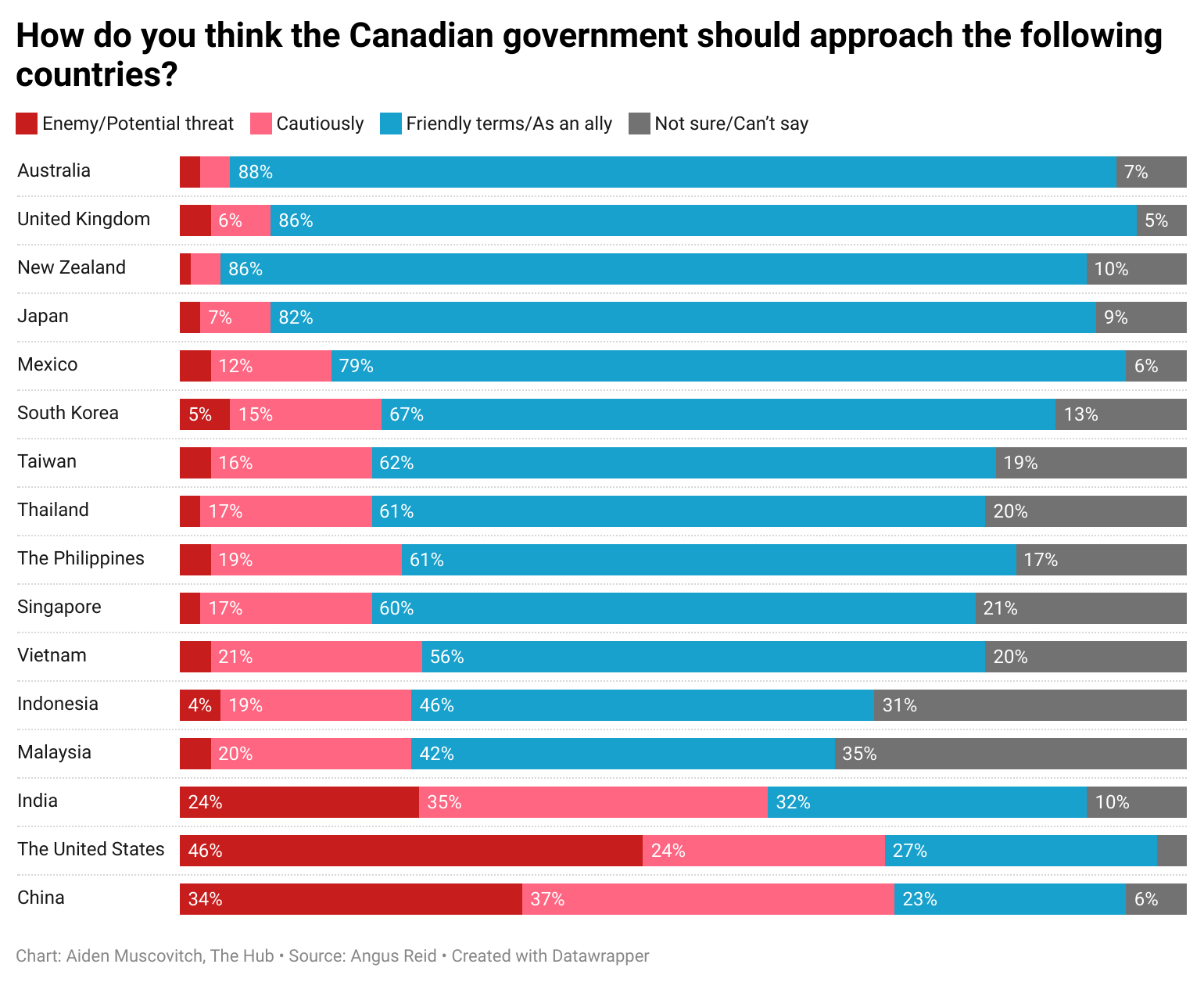
Both Canada and Europe are undertaking major projects to reduce their interdependence with America, and public sentiment on America has changed rapidly since the current administration assumed power. Europeans have always distrusted American tech, and Canadians have started trying to break away as well.
The Americans I spend time with are also unhappy with the direction things are going, but most of them still use Google Chrome and buy everything on Amazon. They seem to be less willing to accept a little bit of inconvience to take a moral stand.
https://thehub.ca/wp-content/uploads/2025/10/c9Enf-how-do-yo...
Some is just shock and overreaction I think. But it is an enormous shift.
I don't use google maps, I use Waze I don't use messenger, I use whatsapp I don't upload my pictures, contacts (sync is enabled by default)
Anyways. What are the options? It will be another free cloud hosted service.
No one cares.
Will another Progressive Era bring about more equality, or are the billionaires too entrenched?
Counterculture is disorganized and shallow, and funding is not as abundant where understanding of this problem exists.
I don't own a smart speaker. It's actually annoying because there are so few options for a music system now. I've previously owned a Sonos but honestly it's just not a polished product. Anyway, my issue with smart speakers is I don't want a cloud-connected always-on microphones in my house. Sorry but no. You simply never know when law enforcement will use such a thing via a warrant nobody can tell you about (ie FISA). It could be targeted to you, individually but there are far worse alternatives.
It could be a blanket warrant against, say, people posting negatively against ICE online. Or microphones couldd be used to identify such people based on what it hears. You just have no control.
And once again, Google handed over PII voluntarily to the government recently [1]. Companies don't need to comply with administrative subpoenas. It takes a court order signed by a judge to enforce.
All of this is just another reason why China was correct to keep US tech companies out, basically. But here's where it's going to get much worse for the US and those same companies: when the EU decides enough is enough and creates their own versins that are subject to EU jurisdiction.
[1]: https://techcrunch.com/2026/02/10/google-sent-personal-and-f...
The keys then become:
1) Implementing policies discouraging them from doing so at the societal level
and
2) Implementing force behind those policies at the personal and societal level
DHS isn't getting paid right now because Kristi "Dog Shooter" Noem managed to screw up so badly that even Congressional Republicans under Trump don't want to own her agency's behavior and carved DHS out of the normal funding bill. There's still a chance for #1 to be achieved. #2 remains to be seen at the societal level, but you can start working on that yourself for the personal level.
So while some parts of DHS aren't funded, and it does give Democrats bargaining power, it could still end up in a situation like the October 2025 shutdown where they don't get meaningful change.
TSA employees won't get paid which could impact air travel. Probably not as bad as when FAA employees weren't getting paid but if it's bad enough the pressure for Democrats to cave again will be high.
[1] https://www.cato.org/blog/one-big-beautiful-bill-made-ice-sh...
But the other holes in the bucket doesn't mean you have to help. From a real opsec point of view a single tiny hole is the same as no wall at all. But from a day to day view less is less. It does at least reduce the spam.
And there is also, say you plug hole A and you can't do anything about hole B.
Some day something may develop that changes hole B (maybe a new law, maybe it's a service that you can stop using, maybe one org stops cooperating with another, whatever).
If hole A has already been wide open for years then closing hole B may not change much. But if hole A has been closed for years when the opportunity to close hole B comes along, then maybe closing hole B actually does something.
I choose to see it as something is better than nothing and it's worth it to apply pressure and be sand in the gears.
It's got to be better for everyone that there is at least some sand in the gears than if there were no sand in the gears.
2. Because everyone knows China is a surveillance state. It’s also entirely done by the state.
3. As above, the US’ surveillance is masked under private companies. This is far different from everywhere else.
4. Whataboutism (although I generally hate this newspeak term).
It’s like the “don’t tread on me” militia crowd voting by like a 90% margin for a regime that is now enacting every single one of the things they’ve been afraid of for 50 years: masked cops, opaque detention centers, assaulting (and murdering) people for legally exercising second amendment rights, mass surveillance, social credit systems, and so on.
Or, I guess, like Lenin creating a totalitarian state to enslave the workers to liberate the workers? Or the French Revolution replacing the monarchy with the terror? Many examples in history I suppose.
If anything, he has been attacked by numerous 'strong men' (in various governments!) over several years.
He's either insanely clueless, a propagandist who is being dishonest about his goals, or an accelerationist who thinks making things worse will make them better after (magic happens here).
The magic never happens. Any political program that boils down to (1) break everything, (2) magic, (3) things are better, really goes (1) break everything, (2) either things stay broken and you end up a failed state or someone worse takes over.
Insurrections do not look like that.
.png)