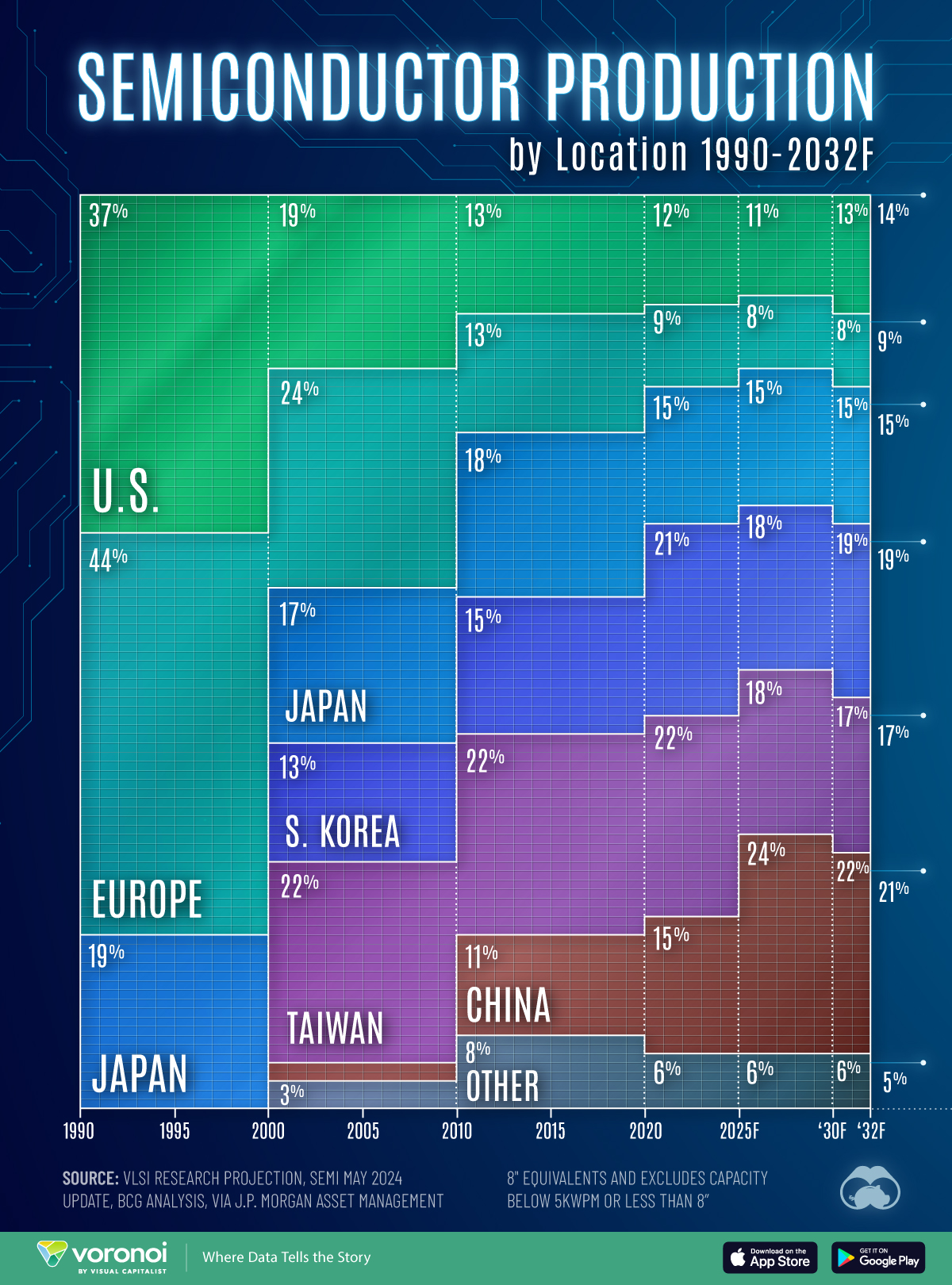
Meanwhile Europe only got 40k WSPMs of 12+ nm capacity: https://overclock3d.net/news/software/bringing_advanced_semi...
The problem is that unlike Airbus, which (highly inefficiently) can be made in multiple countries, you can't really spread out parts of a fab that way. The most you can do is fab machines + chips + chip packaging. Netherlands already has fab machines and in packaging there isn't a high margin.
That leaves chips, and you can be sure that whoever gets the fabs, the other EU countries will throw a shit fit and demand counter investments to compensate. And on top of that there is also regional animosity. So even if it makes logical sense to pop the fab down in the middle of the blue banana, it won't make political sense because France and all of South and East EU will be angry about "the rich getting richer".
And how are we gonna do that exactly? When you're relying on national subsidies you're tied to national interests and demands. France and Germany aren't gonna give billions in subsidies from their taxpayers' money to semiconductor companies so that they can create jobs in Poland and Romania instead of at home.
[0] https://www.visualcapitalist.com/wp-content/uploads/2025/01/...
We get what we deserve.
While capitalism is a good model, it needs to be kept balanced, restricted..
Shareholder primacy is ruining everything, too much influence in politics from too many external sources.
That's not at all how it works. You're talking as if you're buying a plug-and-play Xerox copy machine that you can just unbox and start printing copies of your work and make money.
Buying the latest EUV machines doesn't get you the latest nodes and economically viable yields.
Intel, Samsung also have the latest ASML machines that TSMC has and yet they haven't caught up to TSMC because there's a lot more to semi manufacturing that just the machine itself.
If Germany just buys an ASML machine it would be an expensive paperweight without the know-how that engineers at TSMC have amassed over the decades in order to get the most economically competitive yields.
Even if this fab is 3 times more expensive then other ones, the result of not having one will tank the entire economy and GDP of a nation if things go bad.
We speak here about trillions of damage while a fab costs only a few billions.
This is like a complete non brainer.
EU leaders and finance gave up on the electronics industry 20+ years ago and just kept offshoring it to the cheapest suppliers to lower costs and increase shareholder value.
The U.S and Japan indeed will have less incentive to defend the sovereignty of Taiwan, but other reasons remain to ensure the statu quo remains. Purely geopolitical, not just industrial.
This keeps ppl locked in to the TSMC universe. The Japan and US fabs produce just a fraction of what these countries need.
The past is of no value in predicting the future right now.
Also, not sure why everyone forgets about it. People should have learned from the experience of the pandemic that the cutting-edge foundry nodes are not really the crucial ones, as being the bottleneck of industrial infrastructure. A delay of the next-gen iPhone or RTX gaming card isn't that catastrophic. But a shortage of embedded MCUs, which are actually fabricated by mature nodes, could stall the entire industrial base of a country.
Japan can't even sell arms to Taiwan right now. Even starting selling arms would be a huge change, let alone a mutual defensive pact.
It's extremely hard to change the constitution of Japan. It's the only constitution that has never been revised since WWII. LDP has been pushing this agenda for decades and nothing really happened.
It’s easy to ignore or work around it though, just like it routinely happens for every other constitution in the world.
The process to amend the constitution of Japan [0]:
1. two thirds of the house
2. two thirds of the senate
3. referendum
LDP just won the house. IF all LDP house representatives agreed with Takaichi then she could pass the first stage. Only two left!
[0]: https://ja.wikipedia.org/wiki/%E6%97%A5%E6%9C%AC%E5%9B%BD%E6...
In reality no such thing happened and one YouTube video of a handful of protestors doesn’t make it so.
What she did say is that a Chinese attack on Taiwan _could_ clearly become an existential threat to Japan. Note that key word _could_
Which… of course it could!
Japan hosts multiple US military bases. If it developed into an armed conflict between the US and China then it’s exceedingly likely that Japan would be attacked. Think Chinese missiles aimed At Yokosuka, just south of Tokyo.
Not only that but Japan and China have multiple territorial disputes. It’s not hard to imagine China deciding to go all in and settle those as well.
But it will happen one way or another. Taiwan's Sovereignty is completely depending on one single country, the US. It's not like that Taiwan can just say no if the US demands more diversified chip production.
For example, discounting Ukraines unwillingness to simply accept foreign rule by the country that brought them Holodomor as purely based on American propaganda and arms sales is either delusional or Russian propaganda.
Reunification with Taiwan has been a major policy goal of the CCP since the civil war and is one of Xi’s explicit policy goals. He just reaffirmed this commitment as part of his New Year’s speech.
Historically China has lacked force projection capability. However it has had a multi-decade modernisation and military build-up which has drastically changed this situation.
Further we’ve seen significant tightening of CCP control over society and in particular the military in Xi’s term.
A straight forward analysis of these events, in line with Xi’s public statements and past Chinese actions, is that the ground work is being laid for encirclement of Taiwan followed by China taking over, by force if necessary.