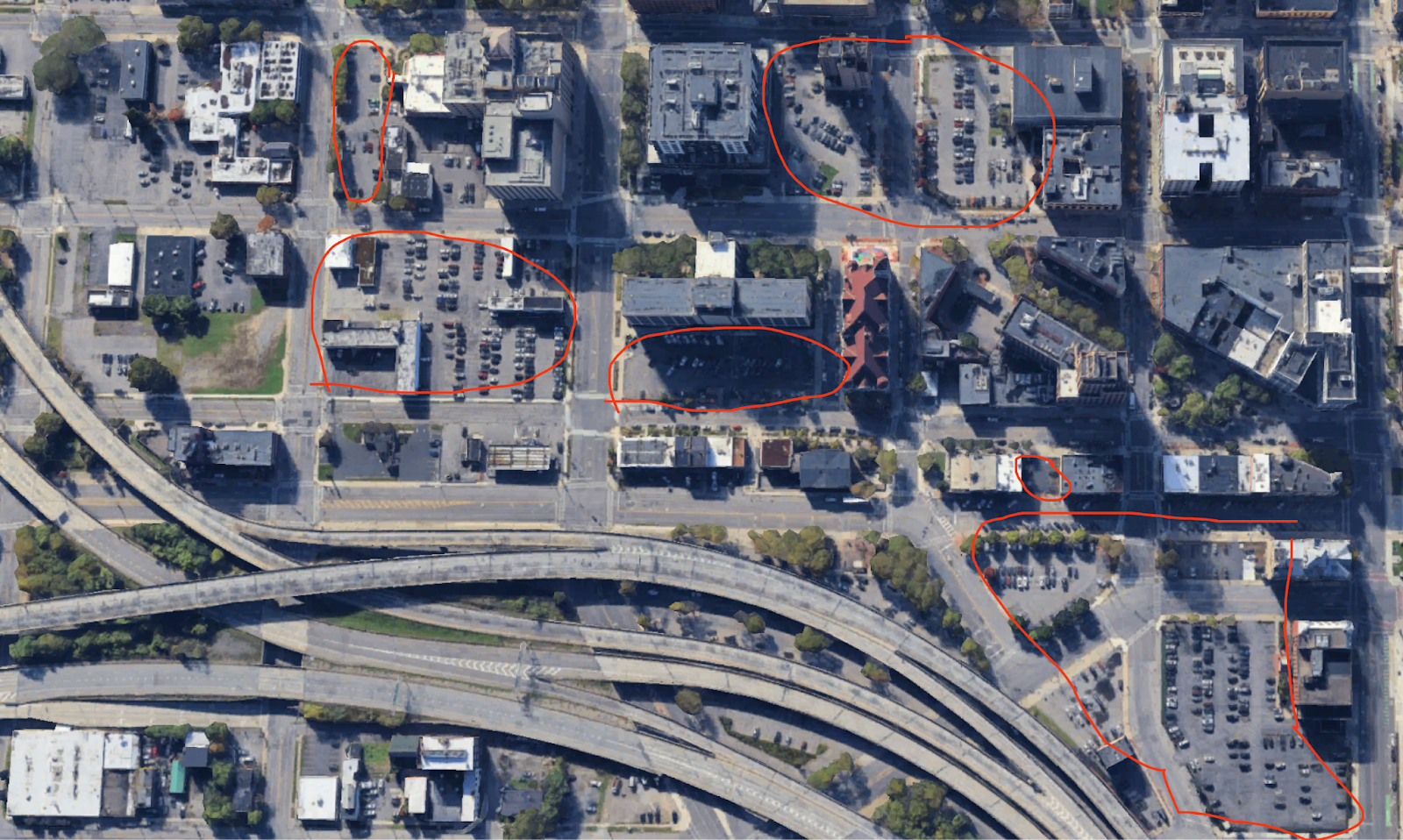
So eliminating parking minimums by themselves will create nasty side effects.
But of course the correct answer to tragedy of the commons is pricing -- price the street parking appropriately and it won't be abused so you won't need worse solutions like parking minimums.
But in addition to pricing street parking more appropriately, and some cities are doing so, shifting the load on to the common spaces is kind of what you want to see as a transit user because if it continues to be set at a minimum you just wind up building more parking lots, highways, and cars. But if “the market” decides the market can actually signal to government entities that we do indeed need and want more options.
Like you actually want to see new apartments in urban cores built without parking garages. Theoretically (and perhaps in practice) these new developments should also be cheaper and less theoretically they give sidewalks and bus routes and tram routes more users and thus more funding and support. That then alleviates pressure on existing highways and everybody wins except the obnoxious highway lobby and the revolving door that it operates with existing state departments of highways.
If you live in the US, there's a very good chance that's coming from the property and sales tax everyone pays, not any tax on your vehicle.
So Manhattan or the San Francisco Peninsula?
I suspect the refusal to kowtow to car owners and the density are interrelated. Tokyo is more dense, in (small?) part, because there is far less space consumed by inanimate appliances.
Another way of looking at it: parking minimums require developers to encroach upon a commons, that commons being land that could otherwise be used for more productive things than free parking.
The article explains this well:
> The office, filled with workers and transactions, generates far more in economic activity and value creation than its land value and, therefore, rises the highest. The apartment, where dozens of residents live, stands nearly as high. The rowhomes add steady, smaller value. But the parking lot does something different. It dips below the surface, shown as a red bar sinking into the ground.
> Why below ground? Because in economic terms, a parking lot doesn’t simply fail to add value; it actively subtracts value. Every year it sits idle, it consumes some of the most valuable land in the city.
> When valuable downtown land lies idle, it blocks the housing, jobs, and amenities that could exist there. The costs ripple outward: higher rents, longer commutes, fewer opportunities nearby. What could have been a productive part of the community instead becomes a hole in its fabric.
The LVT focus on profit above all else is why it is an unsatisfactory solution.
If the most important goal for every plot of land is to maximize its economic activity & tax revenue, that's going to be a miserable place to live.
All of the space uses that make a town nice to live in, are also underutilizing the land if the sole goal is to maximize economic activity.
Open space with native vegetation, parks, playgrounds, sports fields of all kinds like soccer fields, community pools, hiking trails.. all of that is wasted land if viewed through the lens of LVT maximization. All that space should be crammed full of high rise offices and apartments.
No, because all of that would be open to the community. The waste is only if it was locked up for use by certain people.
Pretty damn rich to say such a thing when exactly this sort of hand wringing that brought this whole crap about.
"oh no, think about how the commons will be polluted if we don't compel people to build parking space". -some karen in 1970, probably
The right thing go do is back off the regulation. Let land owners do what they please. If that's a parking space (it almost certainly won't be in the overwhelming majority of cases) so be it. And then when there's enough demand parking garages will go up.
This is exactly how it is here in Tokyo. People are free to build parking lots (or parking garages even) if they want. But they don't, except in rare cases, because it's far more profitable to build an apartment building or shop or some other building there. Though for apartments, they'll usually build a small parking lot (or garage for a big apartment building) and charge very high rent for residents who want to park their car there, which is a small minority of residents.
With regards to the argument presented in the article, it's arguable that parking lots create value by making places accessible to more people. As such, a parking lot raises the property values and economic output of neighboring properties. I didn't see anything about that covered in the article, nor did I see any actual data. This is why chambers of commerce and the like support parking mandates, because they actually have positive externalities, not negative ones.
I think it's arguable, but I think it's not the full picture. Let's look at downtown Columbus, Ohio where I live. With the parking lots that exist, there's less housing, which means that people move further away from where they work, creating traffic, creating highway construction costs, insurance, &c. I'm quite sure that creating a parking lot makes the location of my employer (well not mine literally) more valuable, but it does seem like it creates more costs. If those lots were, say, because it's a downtown location a 10-story building with 300 residents those people would be shopping downtown, going to restaurants and bars downtown, spending more time there, &c.
There are cases where a parking lot does create economic value, though I think those are more nuanced and limited. I'm not sure your point nor the one you were responding to, nor mine for that matter, are able to really calculate the economic costs of surface parking lots without taking into account factors like, well where the hell is the thing?
> As such, a parking lot raises the property values and economic output of neighboring properties.
Cherry-picking this comment. I'd add to what I wrote above, but I'd also add that I'm not sure that there is evidence to support this statement and if you take this to its quasi-logical extreme you wind up with your entire neighborhood just being one gigantic skyscraper with a Costco and doctors office inside surrounded by parking lots or something. And then the increased profit flows to Costco's shareholders which is fine, but for your local economy that's kind of bad versus having a variety of stores that can open and close. It's putting your eggs in one basket, so to speak.
I assume that Syracuse or other similar tier-2-to-3 cities would be far worse off if you replaced all the parking with apartment buildings.
I've never been to Syracuse but with the university there and number of employees you may be right, but it really depends I think on the layout. In the US once you get away from college towns or smaller towns like you're describing and get into medium-sized American cities we really lack density and transportation and we pay out the ass for the poor planning and past destruction that took place. It's changing though.
The frame of mind that brings such comparisons about is anything but funny in a world where all our votes count the same.
When ranking consumption such as large cars, flights, plastic toys, etc, space on the surface of the Earth, within an urban/suburban metro, is at the very top in terms of impact on others.
And it’s taxed the least.
A better solution might be to mandate parking minimums (to ensure the property is actually useful / not encroaching on the street) but not allowing "open air" spots to count to the minimum, meaning an open lot gets you nothing, a 2 level garage counts for half the spots, etc. Maybe tack on some credits for proximity to public transit while we're at it.
The "there is no parking at all" wonderlands can exist (even NOT counting artificial ones like Disneyland) - and the "everything is acres of parking and there's no street parking at all" also.
The question is how you get from one extreme to another - in a way that does NOT require you to redevelop the entire city Simcity style, nor puts onerous costs such that all development is stifled.
Part of it might be that if the parking lots/garages are not heavily used, or not used much, they'll "redevelop themselves" - but that likely requires making transit and other options better which is difficult, expensive, and often politically unsound.
In practice, of course, existing residents feel entitled to "their" street parking and get mad when a new building with new people contending for those spots is built but there's no logical reason to preference residents who have previously lived there. This is where politics rears its head though.
If we're talking about commercial properties and zones, people unwilling to pay that time cost just won't come to the area.
Also, you no longer have to worry about kids appearing into the street between parked cars that obscure their presence even near crosswalks (that cars park way too close to because they can't find parking elsewhere). Win-win.
Most drivers are using their car to scoot around 5-10 miles. Make them walk (yes not everyone can; they have friends and family, care workers, etc). Invest in infrastructure to backfill gaps that make walking onerous.
There was measurable improvement in air pollution during Covid lockdown. We'll hate it now but thank ourselves when we're 70 and a little less anxious about environmental collapse.
Cars are great for road trips but a massive pollution and burden on urban infrastructure.
Rip up superfluous sidewalks then (aka heat storage. Plus concrete is worse for joints) and leave the avenues/streets not designated for ingress and egress for bikes, small delivery vehicles, handicap accessibility.
Ultimately this is a geometry problem. Cars are by far the least space-efficient method of transporting people; eventually your roads just can't accommodate any more traffic. If there's enough demand to visit a given area then anything that doesn't minimize cars will just make things worse.
Not true in practice even if true in theory; in many places the average full-size bus contains fewer people than would fit in a minivan.
The problem is you need 5-10 years of reliable public transit in an area before non-transit users begin to convert (or transit users begin to move in).
The bus might have less than 5 people on it at any given moment you observe, but over its >2 hour route it transports dozens or hundreds of people between stops.
I really wish someone would be a modern city from scratch.
And parking is a time sink. There's a place in my city that has huge parking garages with lots of parking but you still have to drive through a few levels of the garage, park, and then walk back down a few flights of stairs, then walk to your destination. I just park my bike right outside of my destination with the wheel lock. Street parking is always awful in populated cities, and I never have to worry about it. I always park right at my destination, where ever it is.
In suburbia, cars are faster because the average distance per trip is a lot longer. But it's ironic that the reason why the average distance is longer is BECAUSE it was built for cars so everything gets spread out! Cars are a solution to a problem that they created.
I'd say change the requirements first, then if there's a surge in street parking demand there will be natural pressure to raise prices.
The High Cost of Free Parking is an incredible book that shows exactly how awful parking has been for society.
Not parking would be worse. Just think of the injuries from jumping from moving vehicles.
Yes, and. If you start charging for parking to try to fight against this without also improving public transportation, it just kills cities faster. I avoid going into downtown cores where I will pay $25-$40 to park for an hour or two to eat at a restaurant, which means those restaurants can only support their businesses off captive people during the work day, which means that moving to remote work widely across society devastated downtown cores in a way you would not have expected. All because I can get downtown in 15 minutes from my house in my car but it takes 3 hours and 20 minutes by bus and there is no other public transport in the 7th largest city in the US by population.
Cars are the enemy, sort of, but the biggest enemy is the complete lack of any reasonable public transport in almost every major US city, which needs to exist to fairly ratchet up on parking.
What's your solution to it then?
Then invest in public transit (trains, mainly) for whatever isn't within walking distance.
Also ban free parking
Nice to think, "the people will take trains!" but sometimes it doesn't work that way.
Which in turn affects the kind of economies that the new development can support. A car dealership? Needs parking and a large catchment area. Burrito shop? Probably not getting much destination traffic and can support itself on locals.
It need not happen, but all too often simple answers are wrong.
I've seen this sad downward spiral multiple times, it is not a good outcome.
I used to live not too far from a town with a mellow but nice downtown center. Not a huge draw but many small nice restaurants and shops and there was steady business. Sensing a profit machine, the city filled all streets with parking meters. Turns out that while it was a nice area, it wasn't so irreplaceable, so nobody goes anymore. Business collapsed. I drove by last summer and everything is closed, the parking meters sit empty.
Same is happening now to the downtown one town over. It used to very vibrant awesome downtown, although small. Bars, restaurants, music venues, fun shops. I was there every night for something or other. Loved it. Easy free parking around. Some of the parking lots have office buildings now and the city lots have become very expensive. Much less activity there now, about a third of the venues are closed and the remaining ones are saying they can't last very long with fewer people going. While in its heyday this downtown was far more active than my first example, turns out it wasn't irreplaceable either. People just don't go anymore.
Point is that this tactic works only when the downtown is so established and so dense that people are going to go anyway even if parking is hard, like Manhattan.
Or the facilitating of cars has now made it more unattractive for people to go and hangout there even if it is easier to drive to.
Sounds to me like that found a valueable use for their land and got rid of the low value things you really enjoyed...
Of course to you this is bad, and the city lost the night life, but that might or might not be worse overall. They seem to be a denser area despite it, for whatever that means.
That would be the case if the storefronts didn't just wind up remaining empty. Empty commercial real estate is rife in the US right now.
Your "No Parking" area always has competition from the suburbs in the US. If you make parking too problematic, things can invert. Then, people will save up tasks for their trip to the burbs and be completely inert locally--they will do next to nothing with local businesses, do everything inside their house (way cheaper, you know, since I bought the stuff at Costco) and the car remains parked and unmoving until their next trip to the burbs. Once that inversion happens, your "walkable business area" spirals into more and more empty storefronts and the decline becomes ridiculously difficult to arrest.
Churchill Downs for example is surrounded by residential properties. At Derby time a lot of those enterprising people would let you park in their yard for $5 or $10 (maybe more now, it's been many years). These are not large properties - typical older shotgun houses. I seem to remember them getting 10 or more cars and that's not even counting the space the house itself is taking up.
I've heard this, but I've never seen an example in practice. It seems like making things more walkable and bikeable, at the expense of cars, always increases foot-traffic, with no exception.
Basically anytime it is tried in the suburbs where nobody is walking now nothing changes. When a lot of people are already walking you can increase traffic by getting rid of cars.
Details matter, most of the places people take aware cars are already dense areas and they tell you about it. However in a few cases someone who hasn't understood the context tried to apply a lesson it doesn't apply and it fails.
When I choose where to go, I look if I'll be able to park there, and if not - I will always be able to find another place. Parking availability is number one priority, not star rating or $$$
Am I the only person on Earth who would stop going to downtown restaurants if parking became inaccessible? I don't think so, but your guess is as good as mine
We need to attack The Modern Moloch (99pi).
This experiment was kind of done in Buffalo in the 70s. They blocked off large swathes of downtown to build the above ground section of metro rail. This encouraged business to close downtown locations and move to suburban malls. That kind of retail never came back to downtown in the roughly 1 decade after completion of the metro. So you had a mass transit system that went effectively from nowhere to nowhere, and managed to kill the downtown retail corridor.
The solution, which has done in my city to genuinely smashing success is to nationalize the parking garages meaning government builds them, maintains them, and they're free forever. Dot them around a dense mixed use area and quite literally watch the money pour in. Everything is within grandpa walking distance of at least one garage, they're specced to over capacity so each one is never full, and it provides parking to the workers and apartments.
Maybe some people are fully car-pilled, but many people want to live in an area that isn't so car-dependent, it tends to make everything more spread out, noisy, polluted, and congested. It also imposes very large personal costs.
You're conflating people with cars. You want people and you're assuming that all those people must be attached to a car. There are other ways to get people to be populate an area which brings me to my second point...
> If you rip out the parking you won't get a vibrant walkable downtown
You will if you build a lot more housing in that area. If thousands more people are able to live right there then of course it'll become more vibrant. That parking garage could be home to hundreds of people. Instead it's temporary storage for cars. The problem is that suburbanites are going to fight tooth-and-nail to bring their cars. So what you get is cars.
If that's what you want, so be it. That doesn't sound like a vibrant place if everybody has to drive a car to get there, though. It's traffic by design.
This is another point people miss - 50 maybe 75 years ago the downtown area was a valuable destination because stores were smaller and what you needed could only be found at one or two places in a city; often downtown.
Cities are much bigger, but so are stores - you can go for months shopping nowhere but a SuperTarget or Walmart; and half the remainder can be delivered.
You make downtown desirable and then begin fixing the traffic problems. It takes 20+ years, but it can be done.
... do people hate park and rides? Where I'm from (suburbs outside a US city) it's completely standard to park outside the city (in a garage or big lot at a train station) and take the train in. I find it quite comfortable personally.
It sounds like yours is specifically for buses, but I think it's that people generally don't like buses, they're slow and uncomfortable. The park and ride is fine when you can walk from it to a subway/train.
I do think parking garages are a pretty good solution, though obviously expensive (but cheaper than building out trains, like you said)
Imagining sitting in a cosy, warm pod, driving in a tunnel autonomously, point to point, and you have my vote.
Every complain about public transit being unsafe is twice as true about cars
In mass-transit facilities all the people look at their screens, using headphones, waiting to be coughed on, scared to be not talked to, anxiety all around. Nope, not for me. Never looking into a dirty public toilet again, while the society yells: "but its free!".
Progress, folx, not regress. Come out of your bubbles, ignore the voices, that tell ya, hundreds of human bodies efficiently transported in an iron can is progress! Live! Expand! Use everything!
> Imagining sitting in a cosy, warm pod, driving in a tunnel autonomously, point to point, and you have my vote.
They already have this. It's called a metro.
Very telling how these arguments are always the most ableist shit you've ever heard and yet people seem to think they're Very Progressive for making them.
Before using "ableist" as a cudgel, consider whether you know the first thing about the people you think you're defending.
It is generally more productive to assume charity in the people you are talking to, that of course no one is going to ignore that some people need cars to get around.
But, you know what, life changes. I know there’s hardcore folks out there who will cycle miles with their kids, or take them on transit, or even live with them in a 2 bedroom downtown apartment, but it is just too hard to live that way for many people. With a family, most people need more space, and they need to be able to get from their suburban home to some kind of shopping or work, in minimum time so that they can both take care of kids, maintain a career, and have a glimpse of a life for themselves.
We don’t need to have surface lots right in the middle of every downtown, but there needs to be somewhere for people to park.
It's inconvenient for people, yes. It was inconvenient to drive and park in the narrow streets of a medieval city too. This is unfortunately not easy to implement in North America, as the cities are relatively new. What we have feels very privileged.
I use our car approximately once per week. In 2024 I used my car a total of 32 times (I actually tallied it out for the whole year)
It's really just a matter of city design. Do you think there aren't families in Copenhagen who need to get to their job and shops? They manage with much lower car mileage than the average American. American suburbs are car-centric and those cars end up clogging up urban cores where people are trying to live their lives.
Many Americans/Canadians probably cannot even imagine what my life is like. They can't even picture what it means to pick up a week's worth of groceries for a family of 5 on a bike (with a kid!). It just doesn't even register that this is a possibility.
I wonder how much of that is the case - anymore. I am suburb or even exurb, but I don't go "to the urban core" unless basically forced to; these days that's specialized medical only.
And surprisingly numbers of what people call "suburbs" are decently walkable, if you're willing to compromise on where you walk to - e.g., you might not have 20 restaurants in short walking distance, perhaps only 5.
(I've literally walked young kids - including a baby! - to school when it's -40°. A big big part of the change is to slowly move people to fewer car trips - not try to get them to reduce the number of cars. That comes later once they realize they only used it 32 times!)
- pollution
- traffic deaths
- heat generation from all the infra
- inefficient use of space
- ugly aesthetic of strip malls and parking lots
It doesn't have to be this way. We can do better to build diverse housing in our cities, leverage space at the ground level for businesses, invest in our transit to make it safer and more convenient.
Instead we just go with what's easy and continue to build roads and sprawl.
TL;DW: The difference in tax revenue between a surface parking lot and a business with subterranean parking is so vast, that cities can justify using value to underwrite the loans necessary for developers to do the work. (Called "Tax Increment Financing") This model is proving extremely successful with cities that try taking it on.
It's a great group of advocates that are making impactful changes across the US and internationally.
Austrian cities have way more parking than one would expect, but it's nearly all underground and costs €
The benefits are huge, you have have dense commerical areas where you drive in, park underground, pay for some hours, then walk between the shops to do all your business.
Yes, they're mentioned in the article. You clearly only checked out the title.
If it's a traditional 1-car driveway that's about $70K worth of land, although in the end it's zero-sum because it takes away an on-street spot. Parking garages for larger developments probably cost as much or more per parking space - they use less land, but they're expensive to build.
It's insane, and they're trying to fix it, and approving special permits left and right to omit the spots.
Now, I know nobody not rich enough to play the game owns land in Cambridge, but even the something tells me the guy who had a Trump 2024 sign on his garage, the guy who owns a business that's at odds with the city, something tells me their permits require the most $1-10k engineering expenses, lawyers fees, etc, etc, to get approved.
If you want your downtowns to not have parking you need an alternative. In most cases that means you need to improve your transit in the entire city so people can get there.
Places like Los Angeles are grappling with 30+ years of investing in transit with minimal changes in modeshare, because they continued investing in automobility at the same rate.
The carrot is great, but we need the stick too.
This is the exact reasoning for cutting taxes on the rich and let the upper middle class pay the highest percentages.
Maybe the family who has owned that lot for 80 years doesnt have the money to upgrade it for the "highest and best use" by someone else's standards, but the revenue allows them to live a little better.
I've never understood why constant growth is so often a priority. The world is headed for population decline so governments better figure out how to shrink instead of growing.
Im not against city planning, but this whole piece stinks of telling people what to do.
[1] https://substack-post-media.s3.amazonaws.com/public/images/2...
Net Contribution=(Economic Output in $)−(Land Value in $)"
This calculation is shady. Land value fluctuates and already "bakes in" the predicted economic output... but multiplied across decades. Not to mention, land doesn't consume value by existing. the value never goes anywhere. Its opportunity cost, not a decrease in actual value.
Yes, there is value "missed out on", but it hasn't been destroyed. Because it never existed. And that value wouldn't have appeared out of nowhere. it would've required using up other resources that the parking lot wasn't.
In the US most places that aren't already highly urbanized are based on car culture. The culture isn't going to magically shift to transit if you take away parking, people will just complain and go elsewhere.
The article also completely abandons this angle later when it acknowledges that parking can be financially acceptable for the land owners. It also acknowledges that municipally mandated parking isn't the issue either.
How many parcels in e.g. downtown Syracuse are just vacant? That represents a much lower value than surface parking.
I definitely agree that parking in garages and integrated into buildings is much better but if you're unsatisfied with your downtown area I don't think targeting parking lots is the place to start. The real question is why don't people believe they can get more value out of it with further development? It's a little chicken-and-egg but you have to make the downtown a desirable place for those investments.
> in economic terms, a parking lot doesn’t simply fail to add value; it actively subtracts value. Every year it sits idle
Idle. Cars park on it, right?
But no, it is sincere.
https://docs.google.com/spreadsheets/d/1MY89q9pnrS-rB8t6Df4T...
Switch from a culture of car use to walking, biking and public transport (buses, trams, light rail). And if people outside the city are coming in by car - let them park outside the town center and continue with public transport from there (while public transport is developed further afield; after that they would only drive their cars as far as the nearest train station, or even bike there).
In effect, reducing parking reduces economic activity. Even if you increase public transit use, those users are overwhelmingly poor and don't contribute greatly to the economic activity where they go.
Let the market decide how much parking is needed. It'll do a much better job than you ever could.
If you're really concerned with surface parking push the government to stop making it so expensive for companies to develop self-driving technology or to offer transportation services. If it's easier and less expensive for individuals to use transportation that they don't need to park anywhere the need for surface lots vanishes and those owning the property will look for something else to do with it.
But we are using government to hurt people — we are incentivizing (or worse, requiring) land owners to harm the surrounding community by not developing their property. A land value tax would simply shift some of the cost that is already burdening the rest of the community onto the unproductive property owners.
We shouldn't use the government to hurt people, so we should stop subsidizing cars that spew poison and crush children. Right?
Not if there's a law mandating they maintain a certain amount of parking. Eliminating such laws is part of what the article is advocating for.
Other than that I agree.