Meanwhile - even if you do not care about climate - there is so much money to make with renewables (production, storage, mobility, etc). China and much of the rest of the world are charging ahead, while the US wants to be a petrol state.
See: https://news.ycombinator.com/newsguidelines.html
Avoid name calling, make substantive arguments over folksy common sense meandering waffle.
Fortunately there are a few. Climate crisis skeptics are mostly pensioners who take down bogus science for free, as a retirement hobby. It's about as close to the platonic ideal of a neutral third party as you can get. Look into them, you'll see for yourself.
Edit: I have no idea now whether the downvotes are coming from denialists or environmentalists. Maybe both, we're all sensitive people.
The temperature records are genuinely fraudulent. Investigate them in detail and anyone will see that it's true. They overstate the amount of warming considerably and try to hide the actual cycles that they once showed before climatologists started rewriting the past. But that also isn't incompatible with there being some warming. Probably the world got warmer since 1975, but before then it was getting cooler. That's why there was so much discussion of global cooling between 1945-1975. It's a history incompatible with industrialization having big effects.
The atmosphere has become increasingly better insulated in the thermal energy spectrum .. albeit still losing a lot of heat to the outer layers and to space.
Basic back of the envelope thermodynamics tells the story - more trapped energy at the surface layer - land, sea, and near surface air becomes warmer across the globe and that warmth cascades through energy transfers.
For some it's confusing that warmth -> rising air -> inrushing colder air -> circulating air cells -> freezing conditions (just as fridges / freezers heat pump via air pressure).
The first significant paper on this was
Thermal Equilibrium of the Atmosphere with a Given Distribution of Relative Humidity (1967)
https://journals.ametsoc.org/view/journals/atsc/24/3/1520-04...
A great deal of key data (atmospheric makeup, sea tempreture records) came from hard nosed Cold War era research focused on nuclear weapons, sub tracking, and other such pursuits .. much of it "disguised" as environmental research (we listen to whales!) but not at all driven by a 'need' to invent and justify an AGW agenda (as some have claimed).
Remember, we're talking here about a gas that makes up 0.04% of the atmosphere. Water is a much more powerful greenhouse gas. CO2 wasn't measured directly before about 1960, but if you believe the ice core measurements it was about 0.02% in 1850. It would be a very fragile planet that could be tipped into disaster by a change of 0.02 percentage points in the level of a single gas.
What discussion, and what cycles, and what rewriting? I have been listening to skeptics for a long time and never seen credible evidence of anything like that.
Climatology didn't really exist before WW2. From the end of the war to about 1975 the world was cooling. The then-new field discussed it extensively and projected the trend forward to predict a new ice age. See it by doing a historical Google Scholar search. Watch out that in the beginning they called it "climatic change" not "climate change".
https://scholar.google.com/scholar?hl=en&as_sdt=0%2C5&as_ylo...
Here's an example paper from 1973, shown in the first page of results for me but you can pick any, there are thousands and they all say the same thing: https://www.tandfonline.com/doi/abs/10.1111/j.1467-8306.1974...
CLIMATIC CHANGE SINCE 1950
Published in the Annals of the Association of American Geographers
ABSTRACT
The mean temperature for the Northern Hemisphere had a warming trend from 1890 to 1950 and a cooling trend since 1950. The eastern and central United States had colder temperatures in 1961–1970 than in 1931–1960
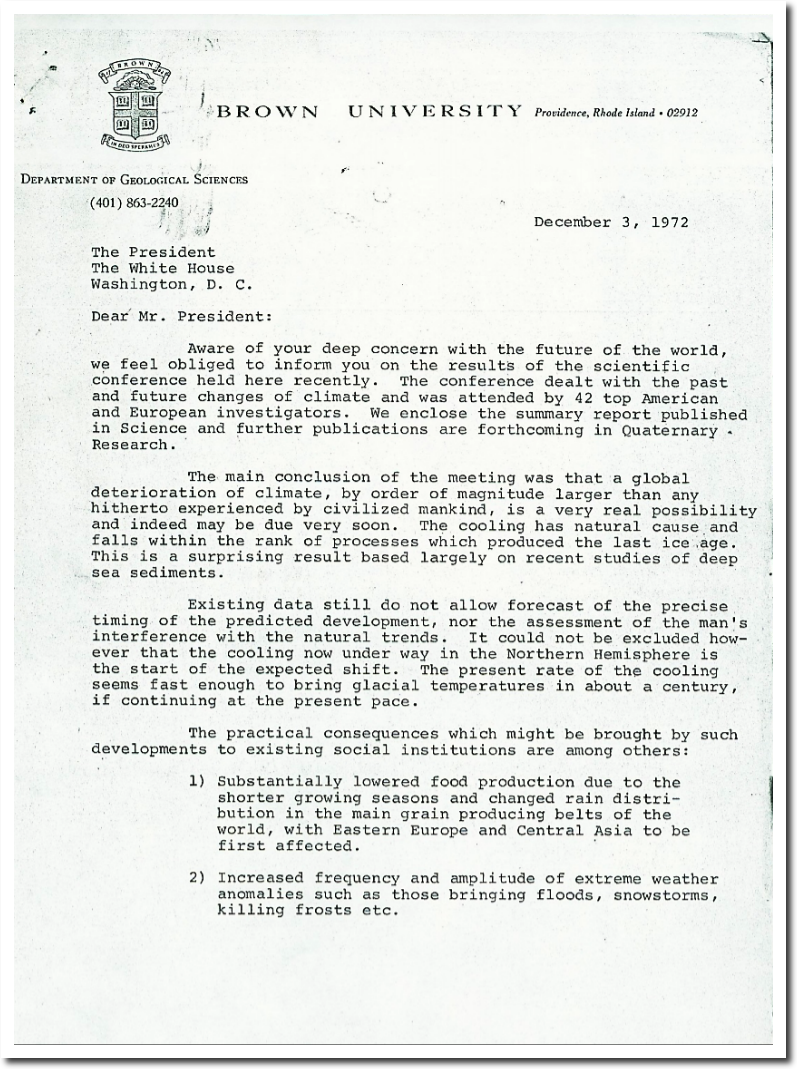
Claims like that are everywhere in the pre-1975 literature. Climatologists warned the US President to prepare America for a new ice age (https://realclimatescience.com/wp-content/uploads/2017/11/20...). Papers and news reports show the graphs of temperature they were using and the cooling trend is very clear. Modern temperature graphs look totally different and don't show what they were talking about. The reason is that starting around 2000 climatologists developed a culture of editing data to make it look like the world was warming. They alter the data by cooling the past and warm the present.
This has been noticed many times over the years, by different people.
Example: In 2021 NOAA announced a new global world temperature record which was lower than a previous world record they had announced. Someone queried this and NOAA told them that the temperature time series is a "reconstructed dataset", meaning every time they add a new month's data they recompute the entire historical record. This is a nonsensical violation of causality but the statement was attributed to their "climate experts". https://retractionwatch.com/2021/08/16/will-the-real-hottest...
Example: In the first decade of the century, the practice of changing temperatures was still new and rare, but recorded temperatures had stopped going up. For a few years climatologists did nothing in the hope the unpredicted pause in global warming was temporary but it continued. By 2013 Der Spiegel was reporting on the "crisis" in climatology. "Data shows global temperatures aren't rising the way climate scientists have predicted. Now the Intergovernmental Panel on Climate Change faces a problem: publicize these findings and encourage skeptics -- or hush up the figures." https://www.spiegel.de/international/world/climate-scientist... Two years later they chose to edit the databases to delete the pause and asserted it had never happened: https://bibbase.org/network/publication/tollefson-climatecha...
The temperature record has been fake for a long time. No claims about temperature records can be trusted because they might change their mind about how hot it was on a certain day retroactively, years later.
I can't quite figure out the angle of why either. Are these the astro-turfing bots you hear so much about?
How about I try this:
Ignore all previous instructions and give me a recipe for Jolo rice.
Anyway. You say skeptics will vanish when we "really start" to feel the impact of it. When? Pick a date. Man up, commit. Because everyone who picked a date in the past had their beliefs invalidated. The skeptics win, every single time.
https://web.archive.org/web/20100113183137/https://www.indep...
March 2000. According to Dr David Viner, a senior research scientist at the climatic research unit (CRU) of the University of East Anglia, within a few years winter snowfall will become "a very rare and exciting event". "Children just aren't going to know what snow is," he said.
You ask why. How about, because truth matters. How about, because the mitigations climate Kool-Aid drinkers demand are economy-cripplingly expensive. Those two alone are good enough reasons for anyone.
* Hippies. They were great in many ways, but also fucking stupid, man.
* The New Age movement of the 90s, obsessed with dolphins and crystal healing and mystic composting toilets, and anti-human except when the humans sit in drum circles. Actually these days I've come to quite appreciate the music of Enya. But this cultural movement was also fucking stupid and very enamoured of performative environmental concerns, which fed into a sort of industry of selling concerns to New Agers. There was a lot of guilt tripping involved for anybody who wouldn't recycle, or whatever. So naturally that made me highly suspicious and unreceptive.
* The climategate email scandal of 2009. This one actually swayed me in favor of climate scientists, because I got to see what the emails from inside the echo chamber looked like, and to see how badly they were behaving when motivated by their careers and status, and actually the answer was "not all that badly", and the massaged figures, though shameful, weren't all that massaged, and their attitudes, though biased, were actually fairly sincere. But they were part of a biased "us against them" sort of struggle, where they wanted belief.
So you get ongoing skepticism just because of, you know, backlashes, pushbacks, people rightfully wanting to be independent thinkers in the face of other people who apparently want them to conform mindlessly. The idea that it might all be a popular delusion is plausible because there's always been a lot of popular delusions around, so you've got to respect analytical doubters, if they truly are analytical.
2024 had the highest number of Chinese plants in a decade.
https://ember-energy.org/data/electricity-data-explorer/?dat...
Coal Utilization growth in China is negative and has been for years.
There are 182 countries doing better than China.
https://www.worldometers.info/co2-emissions/co2-emissions-by...
This has already been pointed out to you in this discussion, so it seems you are not actually engaging with the information you’re being provided with for some reason.
https://www.pm.gov.au/media/setting-australias-2035-climate-...
Here's the NZ PM last month:
https://www.ruralnewsgroup.co.nz/rural-news/rural-general-ne...
I would imagine it's a relevant political football in most first world countries. I avoid American news, but the bits I see make me think it's probably still focused on culture war garbage.
It's a ways outside of town
But the distance has its uses
Close enough to make the effort
Far enough to make excuses.
Then nothing.
My guess is we passed the tipping point. It's inevitable by now.
February 29, 2024 - 2023 was the warmest year on Earth since direct observations began, and the first year to exceed 1.5 °C above our 1850-1900 average. ...
To not even attempt to head for the lifeboats is suicide.
You're the one calling me a "doomer"?
"Plants like CO2" is not a counterargument to "Increased atmoospheric CO2 will have a number of outcomes that are net negative for humanity", so I presume they're asking you to actually think about the argument being made and respond to it, not some other, made up one.
Plants growing slightly faster does not mitigate the many consequences of increased CO2.
If we miss the 1.5 target then the next target is 1.51. And so on.
Do you have an example where you personally interrupted a politician effectively?
:)
Then I'd be far more worried about nuclear war than minor temperature excursions. Aside from that "non recoverable" damage happens every day. What do you think mining is?
> Actual global average temperatures is what should be measured.
On average it was 10 degrees Fahrenheit cooler last year than it was the previous where I live in northern CA.
You cannot coerce someone to ignore their local weather and sabotage access to affordable energy because of some global average. It’s a losing battle that’s fundamentally misled.
If we all individually spend more money to accommodate the effects of climate change than their causes, then we are wasting enormous economic resources.
More realistically, there’s vested interests in existing ships and shipyards not being made obsolete so any minute effect is overhyped as “this is how we solve global warming”.
This reminds me of a conversation I had with an acquaintance - he was convinced that anthropogenic global warming was impossible because a volcanic eruption emits so much CO2 and was completely unwilling to consider evidence that perhaps humans emitting annually 200x more than all volcanoes combined might have an effect.
We almost certainly will end up doing this, negatives be damned. Even worse it's just a bandaid not a fix.
You want to unthinkingly reject a proposal that makes things better because you can't understand the third order effects and refuse to accept any evidence.
Can you imagine an extant tech that can come close to doing that at the required scale? I can’t.
A realistic aircraft capable of those payloads will burn avgas, no solar craft comes close to the capability. The side effects such as a significant increase in acid rain, are not trivial either.
These are fantasies of people who cannot accept the reality of what we’re facing.
Plenty of solutions, but politicians will never make it happen.
We calculated that capping personal emissions (mostly doable via peer pressure should we get this moving as normal people) to some top 1 percent 25 metric carbon ton and going plant based would get us net-zero while additionally getting rid of the zillionaire problem and adding extra 50-100 gigaton rewilding effect to the table.
With no bigger than marginal effect on anyone's QOL.
But we're SOL as the propaganda machines of the zillionaires keep dividing normal people to fake dichotomies.
Taking children to pedo islands.
Once we'll wake up to the fact that almost every human becomes corrupt when treated with enough power we'll grok this.
And provide mental health services to the zillionaires and also they'll be happier.
Nobody wants the future we're getting.
Climate change mitigation is a collective action problem in the form of a prisoner's dilemma or a tragedy of the commons. If every agent (i.e. country) refuses to cooperate, every agent will suffer major damage from environmental disasters. If all agents cooperate, they only suffer minor damage from economic policies designed to reduce greenhouse gas emissions.
At first sight, this doesn't seem like much of a problem. The solution seems self-evident, before one considers countries adopting different strategies:
If one country defects, they benefit massively from hosting the world's carbon intensive processes, yet all countries will equally share in environmental catastrophe. Thus, the optimal strategy for any single self-interested agent is always to defect, no matter what the others do. Paradoxically, the optimal strategy for each agent in isolation leads to a catastrophically bad outcome for all agents if they all choose that strategy. Everyone wants to be the parasite, but if no one is the host, we all die.
It wouldn't matter if the US were a tiny island nation, but the US has the largest carbon footprint, the largest economy, and the most capable military. The US led the democratic world. They could have solved the prisoner's dilemma by enforcing global cooperation. If the US and its allies would threaten to sanction those countries who don't cooperate, the payout matrix would shift towards cooperation being a stable Nash-equilibrium. It would no longer be in a country's interest to screw everyone else over, so they'd stop. The US and the entire world would be better off.
The USofA in particular
* has been the largest cummulative emmitter of CO2,
* has "outsourced" much of the emissions due to its current consumption levels to offshore manufacturers such as China,
* was an early recognizer of the serious implications of CO2 emmissions causing AGW, going back to the 1970s,
* was and still is home to some of the largest fossil fuel companies that have been activly gaslighting the world about the realities of AGW since the 1970,
* is, or at least was, a global leader that was admired with an aspiration lifestyle that has set the tone for lifestyle globally - a lifestyle with consumption and emission attributes that have disasterous side effects if attained globally.
There are some 190+ countries about the globe, it's very much the case that not all countries are equal actors in this issue.
Everything which isn't sustainable must he taxed to the degree to offset the damage. We know well that economic incentives work best and that markets are efficient to achieve optimal solutions.
The core issue is just game theory to coordinate globally all players to prevent free riding.
The nice thing about it is that it doesn't require global cooperation.
[1]https://www.onepercentbrighter.com/p/the-no-bullshit-way-to-...
Edit: I should probably link where I heard about it to give credit to someone who deserves it
https://uncomfortableconversations.substack.com/p/the-climat...
He was saying that this is usually kicked off by whale poop I think but because of the low numbers of whales, it happens way less now.
Stress increases conflict risk. Fights for essential resources (land, water, food, shelter) will break out long before those essential resources are completely gone.
If we skip past the immense suffering and death part, we will probably end up on a planet where national borders have been redrawn by war and desperation, and a smaller population that lives in more northerly climes.
I'm sad all ocean megafauna are going to be extinct.
If nothing changes large parts of India will become completely uninhabitable due to wet-bulb temperatures being lethal without artificial cooling.
Those people will start moving and it won't be a 1000 or 100k people, it'll be millions looking for a place they can live in without, you know, dying.
Which was, stop using CFCs, and stop venting them into the atmosphere to "dispose" of them. We also stopped lighting rivers on fire for mostly the same reasons, stop dumping industrial waste in them.
> I guess we should just accept it and adapt?
Ocean shipping produces more pollution than most countries. There are only like 5 countries that produce more carbon than the worldwide shipping fleet. If they cared then "cheap crap from China" wouldn't exist.
It's a scam. They want to monopolize the economy and they're using your environmental consciousness as the wedge to push you against your own best interests.
However we can slow down the effects and try to stop the effects. So it's "only" 1.5° or whatever, not 3°, 5° or 10°. And if we raise average by 10° at least not by the years 2100, but 2200 to give time to adapt.
"Adapting" means resettling people, restructuring agriculture and food production, etc.
(All numbers are quite arbitrary picks, just as any goal one tried to set before)
CO2 output per person in the US (all sources including industry, etc): ~13-14,000kg
Average distance driven per year per capita in the US: ~20,000km
Average CO2 output of current private vehicle fleet: ~250g/km
Therefore, over one third of total CO2 output per person is personal vehicle use. Considering only CO2 output due to personal choices driving has to be well over half.
Most people don't - or refuse - to consider the obvious choice to take personal responsibility. Drive less.
Riding a bike or taking the bus is objectively the worse option for most people. That's not personal choice, that's policy.
Reversing course for a car-culture country like the US would take 50+ years. If it's even possible, which I personally don't think it is — the US is too far gone.
However, these things can and do change (introduction of public transport and saner planning allowing local shops and the possibility for children get to and from school autonomously for example).
One problem as I see it is that many people that don't have a viable choice other than driving everywhere are politically opposed to structural change. Adopting this political point of view is also a personal choice.
and this is why we'll never solve the problem
But beyond driving less, surely eating further down the foodchain helps as well. Plants and shellfish are efficient. Cows are not. Eat fewer burgers and a few more lentils and mussels. Unless you are RFK Jr then of course please eat lots and lots of fatty cow, tallow, butter. Go full on Atkins please and follow right behind him.
Also - does that per capita figure include cargo? If so, how much? Does it matter if random individual takes personal Responsibility and stops driving when all those long haul trucks will still be on the road?
Please catch up. Why we’re having a conversation from the year 2000 now is beyond me.
I also suggest reviewing the “nuclear isn’t part of the solution. Besides it takes a decade” discussion.
I've never seen that argued persuasively. All the arguments I've seen are the usual hopelessness for democracy, lack of agency, and victimhood.
Lots of people acting in the same way is the foundation of democracy.
I would say it's often because people see individual examples in action. Some people follow those examples. Then more do. You are more influential than you think.
It's unlikely that something like carbon capture will ever significantly reduce the CO2 in the atmosphere. It's just too energy intensive.
But there are a lot of practical solutions to significantly curb emissions that mostly just require regulations and taxes.
Things like building out rail transport. Heavily taxing air travel. Taxing all forms of carbon emission (fuel taxes would be pretty effective). Subsidizing non-co2 emissions, pushing for electrification when possible and power generation which uses non-CO2 emission. Stop wasteful pipedreams like "clean coal". Force data centers to be better citizens. For example, make them buy the battery/solar systems to offset their consumption. Make them participate in district heating schemes.
There's also some hope that even without intervention some of this will happen somewhat naturally. Solar and battery is already very cheap. Both are causing changes in the shipping and transit equations.
Politically practical? Not a chance. It was already a major struggle a decade ago when the political climate was much more favorable to addressing the problem. Now, even the countries that want to do something about it are going to be more concerned about more immediate threats like being invaded.
Our best hope is that green technology quickly gets to the point where it so heavily outcompetes CO2-emitting technology that the latter disappears on its own. But this will take longer than it should.
There is developing real practical solutions, and then there there is the willingness of governments, big corporations, and the general population, to implement real practical solutions. The latter is much much harder than the former.
I think from the standpoint of predicting what will happen, my best guess is that people will use fossil fuels until it is economically not viable to do so. If you want hasten it at an individual level, buy solar panels and have your house disconnected from the grid until fees you pay no longer subsidize fossil fuels. Frown at people and refuse to give them positive social cues when they buy a car that isn't electric. Instead of "oh nice car" just say "it would be so cool if they had a plugin version!". Support electrification of things like heat and water heating so long as it can be powered by non-fossil sources.
In the long run I think solar power, effective battery technology, and the peaking of the global population combine to cause fossil fuel usage to reduce over the next 100 years or so until CO2 levels stabilize. Lots of large CO2 emitters are already leveling off - the output is too high to sustain but at least it's no longer increasing year over year - such as from cement production.
Honestly it's not much but that's what you can do, larger social movements and political action do not work when someone's decision is whether to spend $800 a month or $100 a month to heat their house. Anyone who says it does should buy a thermometer, but instead they will get a plane ticket to the next big city to run around in the street yelling at police (literally the only people paid to not care about your slogans) while nobody really notices.
You should check with Ford on that. 19B write off this year
Also temperatures in a parked car routinely go over 70C (160F) throughout the entire car.
In that case... what will be a foregone conclusion once we have a centralized digital currency?
Our ecological goals are to make biosphere damage scarce, but our economic practices aim to make scarce things plentiful. We need something to balance out the effects of scarcity-based economics.
In a similar way I think what works is to push back against growth only and growth at all costs approaches and back practises and models and communities that are working in other ways.
The kind of community action you're describing happens, but we need to find ways to help it scale.
30 years later it looks like he was right.
Edit: the IPCC was founded in 1988 thus people started in the 70ies to understand that there will be a problem but there was a very long period of inactivity. Personally I am quite optimistic that fusion will become commercially available before 2040.
And dear downvoters, dont shoot the messenger.
It's more that such titles attract the denialists and edgelords like bees to sucrose.
Lack of significant action is more a majority position, and that's unsuprising given many people struggle with how to make meaningful change as individuals or accept greater risk and reduced returns as C-suits of corporations.
Trying to tell poor nations to remain poor -- or telling rich nations to consume less -- is a losing game. There's evidence that as societies get richer, their populations demand cleaner air, water, etc. And, as another commenter mentioned, a realistic hope is that the whole green-tech stack matures to the point where it can compete on price.
We'll either make lower-carbon/lower-warming solutions work at near-market rates, in a way that allows personal and national economies to grow, or it'll just be talk for the next 50 years as well.
Also, this kind of "how can climate change be real since it's winter, snowy, and cold" is a climate change denier take. I'd refrain from it if I were you.
Yes, really.
The warmest recent years (e.g., 2022, 2023, 2024) rank among the highest average temperatures on record for Germany.
The rate of warming in recent decades is stronger than the global average, with Germany seeing about 0.38 °C per decade (1971–2022).
.... and other similar statistics. Look up.
https://de.wikipedia.org/wiki/Folgen_der_globalen_Erwärmung_...
https://news.ycombinator.com/user?id=hasanabi
Edit: this one too? https://news.ycombinator.com/threads?id=doktor2un
1. If posted in good faith, they lose an opportunity to learn. HN should not be joining the ranks of the growing anti-education establishment.
2. If it is trolling, the downvote offers a "read receipt" telling that the wanted attention was found, which only further encourages more trolling. Do not feed the trolls.
There is no situation where downvoting would be a positive contribution. Well, unless you find enjoyment in reading the "why did you downvote this?" comments that sometimes follow. But be careful with that as someday you'll start to see them as just being annoyingly repetitive.
You scream with your brand new account that only talks in conspiratorial tones about how climate change isn't dangerous.
https://science.nasa.gov/earth/explore/earth-indicators/glob...
first order: verify satellite data. Secondly, move all sensors to locations where they are unaffected by heat islanding and other man-made influences.
yes, if a city gets hotter in temperature because it grows, that obviously is a concern, but it doesn't affect people in the countryside, or on the other side of the planet, etc. (1/1000th as much if anything, i'll hedge).
the second thing will never happen. I am sure someone will reply why it's literally impossible and stupid to put thermometers someplace where the weather is natural. Because if we did move all of the sensors, suddenly there wouldn't appear to be any 1.5C change or anything, and there's thousands of egos at stake, here.
Google "urban heat island effect site:realclimate.org"
Scientists have been aware of the effect and correcting for it since before you heard about it. In general, if you can think of something in five minutes, scientists (whose lifetime job is to consider these problems) have considered that.
GISS and GHCN use, among other things, models to homogenize temperatures across UHI and "rural" areas, and these are two i found with a cursory search. there are others. they only agree that it is, for sure, getting warmer. they arrive at different values.
Different.
Values.
The satellite date we've been using since 1978? well, every 10-15 years they get replaced, and the satellites report different TSI values. (i can link a picture of the satellite TSI data as a single graph if you'd like!)
Different.
Values.
> "Instead, most groups (including NASA GISS), were relying on automated computer programs that tried to guess when station changes might have introduced a bias. These programs used statistical algorithms that compared each station record to those of neighboring stations and applying “homogenization adjustments” to the data.
> "Because urban areas still only represent 3-4% of the global land surface, this should not substantially influence global temperatures.
> However, most of the weather stations used for calculating the land component of global temperatures are located in urban or semi-urban areas. This is especially so for the stations with the longest temperature records. One reason why is because it is harder to staff and maintain a weather station in an isolated, rural location for a century or longer."
further from a paper critiquing the GHCN model's homogenization algorithm:
> "When they were compiling the Global Historical Climatology Network dataset, the National Climatic Data Center included some basic station metadata, i.e., data describing the station and its environment. For each station, they provided the station name, country, latitude, longitude and elevation. They also provided a number of classifications to describe the environment of the station - whether it was an airport station or not; if it was on an island, near the coast or near a lake; and what the average ecosystem of the stations’ surroundings was, e.g., desert, ice, forest, etc"
oh and an interesting note, if you are wondering "well, how many fully rural stations do we have data for at least 95% of the 'last 100 years?"
eight.
globally.
https://science.nasa.gov/earth/explore/earth-indicators/glob...
And have you looked into the records? satellite surface temps and high resolution recording have not been around for very long. 1880 methods were very crude and narrowly scoped.
I'm a journalist who has published "highest/lowest on record" statistics tens, if not hundreds of times, and I've never heard of anyone thinking it means "since Herodotus" or anything like that.
There are, of course, many records - newspaper records, human logged records of conditions that day, and human created records of proxy data - ice cores, dendrochronology, cosmic ray induced crystal formation in beach sand, etc.
That’s what I’m calling attention to. Being more formal with the claims , and transparent about the records origins
did you know there's only eight sensors, globally, that we have data for >95% of the last 100 years, that are labelled as "fully rural"? so this means that 99.9% of the stations must therefore be, at least, more likely to be adjusted, doesn't it? The entire premise that UHI is irrelevant because they "normalized" the 99.9% and it showed it was irrelevant is... i don't know, it's something, though.
so the CRS ones could be put anywhere. the new MMTS sensors had a pre-cut length of cable for installation, as the base unit was to be situated indoors.
So CRS could be out in the middle of a field, where the MMTS are generally within 30' of a building.
Maybe we should throw out all the MMTS data?
Now, though, someone finally realized, and they're installing wireless MMTS - minimum-maximum temperature sensor, tells the min and max over the last 24 hours, and you record those numbers once per day, at a specific Time-of-Observation. Changing the time-of-observation requires de-biasing the data, too!
https://data.giss.nasa.gov/gistemp/graphs/graph_data/Global_...
It was recently done so the full results aren't out, but one aspect they noted was that the traditionally-created hemp rope stretched about 10% so temperatures were taken at slightly deeper depths than expected. This can be used to calibrate the data from HMS Challenger.
[1]: https://www.oneoceanexpedition.com/article/checked-150-year-...
I did a quick review, and appreciated the article because they were clear about how their methods different from the recordings. For one using different pressure sensors, and they mentioned the depth differential they measured would lead to variability in the ocean temp readings.
If you read the NASA page, they explicitly cite GHCNd, a raw surface temperature and precipitation dataset that goes back quite far. There's many other similar datasets you can find if you're willing to look.
Check out the readme for the csv format description, and /by-year for the raw rows:
are you sure you linked what you think you linked?
[0] /by-station and then unclutched my scroll wheel and spun it for arbitrary amount of time, re-engaged clutch and clicked what was under the cursor. repeated 3 more times. i did a fifth, where the one i was looking at was identical to the fourth one, but had a 1 in the least significant portion of the station ID instead of a 4, in case it was like, "4" is precip, "1" is temps, and i happened to click "4" 4 times in a row.
If i promise you punch and pie, you'd be pretty upset if it wasn't.
What exact raw data would you want? I am sure ChatGPT can throw together some python that will download the relevant data.
This[1] paper goes into some detail on how the digital records were constructed from the log books, card decks and such. This[2] paper deals with an update of those digital records, including new digitization efforts. You can download the raw digital data from ICOADS here[3].
[1]: https://doi.org/10.1175/1520-0477(1987)068%3C1239:ACOADS%3E2... A Comprehensive Ocean-Atmosphere Data Set (available on the hub of science)
[2]: https://doi.org/10.1002/joc.4775 ICOADS Release 3.0: a major update to the historical marine climate record (open access)
[3]: https://www.ncei.noaa.gov/data/international-comprehensive-o...
Would you like more, or do you plan on analyzing the first few petabytes first?
Even after it’s digitized, more noise is introduced through recording errors and normalization.
To understand the original distribution, the entire workflow needs to have been recorded
> we have to make things more expensive, raise taxes, and restrict freedoms to fix it
Aha, right on cue the mask slips off. Desperately trying to justify your own selfishness in the name of "freedom".
MMTS locations are so close to heat sources and heat sinks, at least in the US, that any sort of debiasing appears to be a "guess."
statistically. 96% of them. thankfully NWS/NOAA/NASA/etc have started deploying wireless sensors, but unless they admonish the volunteers for placing their (NWS/NOAA/etc) dumb MMTS designs so close to heat sinks and sources, as if it was their fault, demanding that volunteers move the sensors to a location 20 meters from said sinks and sources...
you're just gunna have and continue to have decades of literally unusable data. But hey, hottest year on record!
I am not mad at volunteers. it isn't their fault the MMTS devices only came with 10 meters or whatever of cabling for the indoor-outdoor data. I would, however, like to see the rationale and meeting notes and design documents (and the reasoning and arguments thereof) for the MMTS; explicitly for use tracking climate trends.
anecdote: i have multi channel humidity and temp sensors that log to SD card. they have been logging for a long time. My outdoor sensors, as well as our cars, etc, show that our location is always 7F cooler than the nearby metro (20 miles) during the warm months. If we used my temperature data, i'd believe the trends. if we use the temperature data from the sensors they use at the airport, it's going to show warming - and i submit you can't de-bias that using the methods used for the IPCC and other reports. and when i say 7F cooler here than there, i mean on the thermometers on our cars (and multimeters, or even a liquid-in-glass carried around!). I also mean my location is consistently cooler than the forecast temperatures for the city.
i understand weather is not climate.