Distributing free potatoes will likely cause waste somewhere else, as e.g. people will buy less potatoes in supermarkets. The waste just becomes less visible as supermarkets dispose of food every day.
Another current exhibit is the prohibition of using salt for removing snow and ice from the pavements because it's "bad for plants and the ground water". While that is true to some degree, the Berlin policy conveniently ignores all second-order effects: Sidewalks are more slippery, more people get hurt. I see people slipping on snow-compacted ice almost every day. How many trees have to be saved to make it worthwhile for more people breaking their bones?
You can apply for an exemption though, e.g. if you plan to use salt on a driveway to a hospital. Processing fees for such an exemption are up to 1.4k€ [1].
The rent cap is another one. But let's go there another day..
[1] https://www.berlin.de/umwelt/themen/natur-pflanzen-artenschu...
Rigorously considering second-order (and greater) effects is a massive undertaking, though. Like: how do you even know how many more people will slip and get hurt without salting sidewalks and how much the damage the salt does to "plants and ground water," without many careful and expensive research projects? And then there's the challenge of weighing such completely disparate things: how many injuries are healthier plants worth?
Basically is seems easier said than done.
But there’s no shred of enforcement and instead of calling for enforcement, politicians now call for relaxing the rules on salting.
Works elsewhere, why not in Germany, where taxes should actually be even better able to cover it? [yes I know people in Germany, even specifically in Berlin and no this is not a Berlin specific thing]
Like where I live, the city also says not to use salt whenever you can and use alternatives and they themselves do not salt the roads in our town either, except for the major in and out ones. This is Canada btw. so we do get a load of snow and ice. They use grit and in spring the city sends through a grit cleaning crew (for reuse next winter). Except for the parts that make it onto lawns from snow plows pushing it onto your property. There it's your job i.e. some people put down mats in fall or they use brushes to get it out of the lawn and back onto the street where it can be picked up. Just yesterday, it was above freezing and the city snow plows went and used the warmer weather to scrape lots of ice off the road!
Here in New York the problem is opposite. Every home and business owner is responsible for quickly clearing any walkways/sidewalks/driveways they own and are in front of their homes or businesses. New York is very litigious. As a consequence, unless someone is unable, way off the beaten path or doesn't care about getting sued for huge money, most everyone, especially businesses, made sure that their sidewalks and pathways are completely clear of snow and ice to avoid a ruinous lawsuit. On the flip side, properties owned by the county, city, town or other public entities are far more likely to be unmaintained and covered in snow and ice. In general I'm against living in an overly litigious society, but when it comes to snow and ice clearance it certainly has an impact here. This is all in spite of extremely high tax rates (property, income, sales and otherwise).
Thing is, the current system works well for all people except the ones that want to walk on the icy pavement. Politicians aren’t responsible. House owners shed the responsibility to a contractor. Many contractors regard this essentially as largely free money and just weigh the cost of a potential lawsuit against the accumulated income. It’s extremely good at diluting the responsibility so that no affected individual can effectively do anything about it. Why change a system that works so well for all of the people except the ones affected by the outcome?
Funny you mention cost. This year our town actually did not contract out the snow clearing of the roadways to a contractor like they've done for decades past, because it became too expensive (or rather the percentage increase I believe was the trigger). So instead the city is now doing the snow clearing themselves! I would call this very good stewardship of our property tax payments, which is what pays for that. Just now instead of going to greedy contractors (let's face it, most of that money isn't going to the people actually doing the snow clearing) and instead it will go towards paying the salaries of actual city employees (not sure how many temporary) and I guess equipment cost.
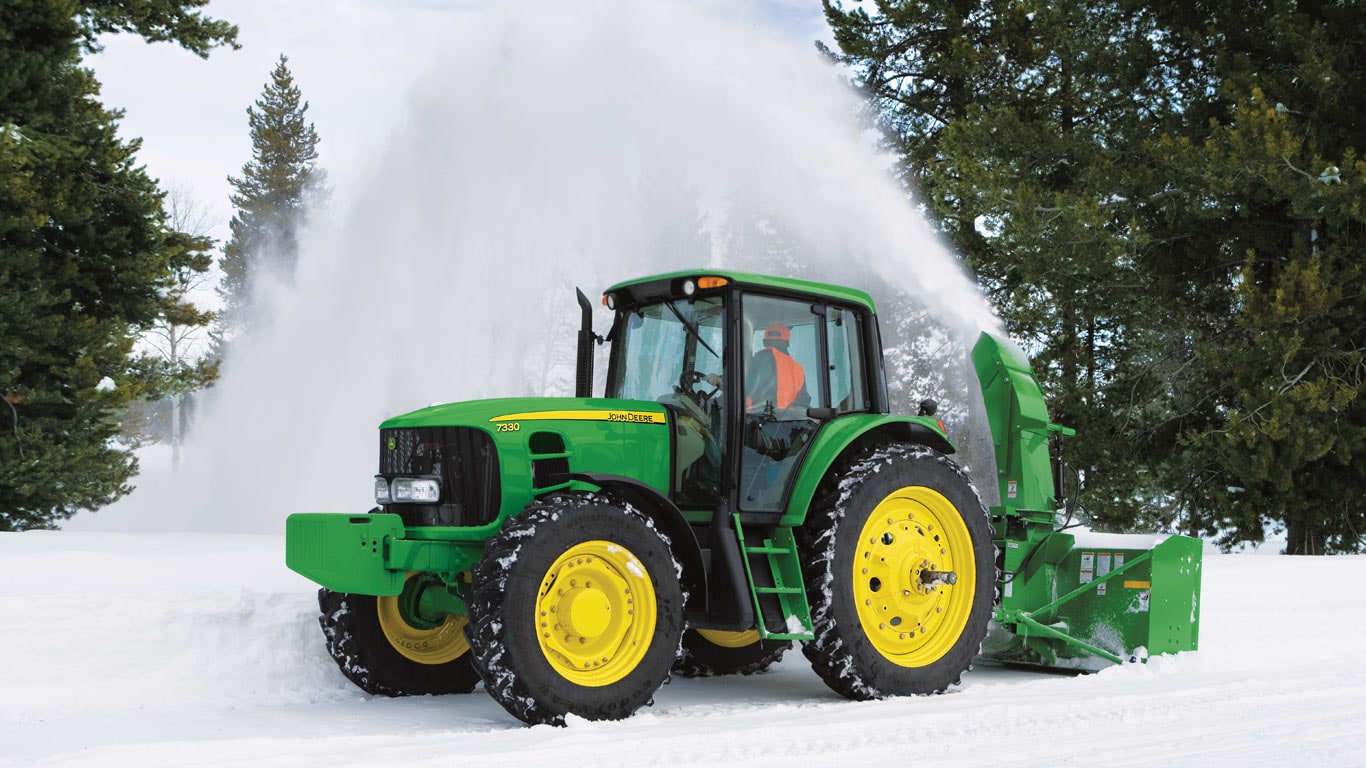
Most people here also get a local contractor or in our case it's usually one of the farms around the area, that offer snow clearing of your driveway. Both the actual driveway, which around here can be quite large, and for clearing the large amounts of snow and ice left across your driveway by the city plows clearing the roads. Essentially tractors with snow blower attachments on the back PTO. Like this: https://www.deere.ca/assets/images/region-4/products/attachm...
We are wary of salt, having damaged a stretch of sidewalk in a rowhouse development by heavily salting it one winter. Others, and the city of Washington, will put down salt at the least probability of snow.
Our tax rate is insane. This is a responsibility/liability that should rest with the governments, but they'd never get it done.
My hot take is that the govt ought to facillitate the process, e.g. by providing salt/grit/shovels/salt spreaders, so that people at least have a realistic chance of getting it done.
Donating potatoes that were about to go to waste might cause waste elsewhere, but what you propose is that we never give food away unless we can be absolutely sure it won’t cause waste in another sub-system. That’s a tall order. These potatoes were going to be waste anyway.
Given this example is about 1T batches of potatoes, it could be used by a business that depends on cheap potatoes like a food kitchen, or a business that can absorb the input surge and convert it into a product that can be stored longer term like frozen foods.
I seriously doubt they did not know that. The whole point of salt is to prevent people from falling. Of course they knew more people will fall.
Also how do you choose between negative second order effects? Salting roads creates negative effects for groundwater and plants which are really hard to mitigate. On the other hand the second order effect of people slipping could at least be dealt with on an individual level by putting spikes on your shoes.
First off you have to identify them. Until you frame the costs and benefits of salting, it isn't clear that the real question is how can we improve pedestrian and vehicular traction without poisoning our plants and water supply. (I'd argue it's frequent ploughing, gravelling and dynamic signs for signalling when chains/snowies/AWD are required.)
That has a specific answer, like "twenty". But calculating it would be a hopeless task.
EDIT: Seems that some roads are allowed to be salted! It's a pretty main thoroughfare, so likely the case. https://www.bsr.de/bsr-winterdienst-gut-geruestet-fuer-die-k...
Wyoming here. We don't generally salt our roads. Instead, a combination of ploughs (to clear it) and gravel (to increase traction) are used.
More broadly: if you're "astonished with some people not having a grasp," consider that astonishment signals encountering something new.
With properly graded streets and sidewalks, liquid water runs off. When the bulk of snow is cleared, the small bits that remain melt, flow off, and/or evaporate during melting days. I can't comment on the specific climate of Berlin, but it certainly doesn't seem poised to be an arctic encampment.
The **** is a death cult. They are very very happy to see you become an invalid if it avoids the death of a sapling. I know that this sounds hyperbolic to the point of being derisive, but it's the observable truth.
In this case, it seems that Berliner Morgenpost and Ecosia are doing shipping and distribution for free, for PR reasons or maybe as some kind of charitable volunteering project. It's nice of them to volunteer their time, but it seems strange to talk about “a story about the absurdities of our food system”. Are they saying that it is absurd that a newspaper doesn't permanently turn into a money-losing grocery distributor?
https://www.morgenpost.de/berlin/article410886475/gruene-woc...
Negative prices occur from time to time in the electricity market because some types of power plants are slow to ramp up and down. So if demand falls too rapidly, spot electricity prices can negative.
Stuff that didn't sell was called "Flush Out" and had to be disposed of.
You couldn't legally just dump the contents without paying money so I made an app that let employees get cases for shipping costs. It was popular, even though we were usually talking about weird flavours that no one liked (stuff akin to Apple Ginger ale)
They eventually got rid of it, but I was already out of the company so I didn't know the reason.
I know this is beside the point, but Apple Ginger Ale sounds legitimately awesome. I’ve never seen that flavor before, but now I really want to try it haha.
In retrospect I miss the teas from Japan more than any of the weird flavours we had. Thankfully one can make them oneself but there is something special about going to a corner store and having relatively healthy options instead of a hundred flavours of sugar water.
It was near the beginning of the pandemic, due to the demand shock of everything shutting down.
There were probably practical ways to profit off the low prices (assuming the risk of them not recovering), but I never did figure out something that would work for a retail investor.
(which is a pretty big ask, of course, and maybe free labor to pick it up up and move it into the truck...(
But there also has to be a cost (or other liability) to keeping it, or you could just wait for demand to arise. (There generally is some kind of inventory/warehousing cost. But just saying.)
https://worldpopulationreview.com/country-rankings/potato-co...
> A farm in Saxony has been left with 4,000 tons of potatoes in what Berliner Morgenpost is calling “a story about the absurdities of our food system”.
I dunno; it doesn’t seem too absurd, better to have too many than too few potatoes.
That would be if we were talking about water (and at 4ºC if we want to be "exact"), but potatoes have a different density and cannot fill the space entirely due to their irregular shapes. Are you saying that those two things cancel themselves out and the result is that 1 cubic meter of potatoes is "exactly" 1 tone?
> Wie werden die Kartoffeln geliefert? Die Kartoffeln werden per LKW direkt an Ihre angegebene Adresse geliefert. Die Lieferung erfolgt in einem Big Bag, in das ca. 1000 Kilogramm Kartoffeln passen.
Standard Big bags are roughly 1x1x1m
It is exactly four million kilograms. (Germany uses the SI metric ton)
https://langleyadvancetimes.com/2025/08/09/record-breaking-u...
At 2000 kcal/day average caloric expenditure, you could feed 1.6 million people for a day. Or 3.2 if it was only half the diet. That's a lot of food indeed!
The problem is most of the volume/weight is water; that's not very convenient. In comparison, an equivalent volume of cereals would feed 7 million people and are much easier to store long term, they are very efficient !
According to google a 200g potato give off about half a volt (0.5v) and 0.2mah
    4000 tonnes = 4,000,000 kg = 4,000,000,000 g

    num potatoes = 4,000,000,000 / 200 = 20,000,000 potatoes

    volts = 20,000,000 x 0.5v = 10,000,000 volts (10megavolts)
I am not an electrical engineer, what could we do with this?
You'll also need to buy the metal electrodes.
But other potatoes likely will be.
It's not like people are suddenly going to want more potatoes.
I did some math out of curiosity to better visualize this amount in my head. If we assume that a typical serving of potatoes in a meal where potatoes are an important part is 200g, then with 4 million kg of potatoes you can make 20 million of such meals (1/4 of Germany's population).
And nowadays, Belgians eat way more of them per capita than they do!
It seems that they acknowledge that they are doing thus because there is a supply glut so potatoes will go to waste in any case...
Ultimately this give away is a waste of efforts, too. Sometimes there is just nothing to be done...
Be kind. Don't be snarky. Converse curiously; don't cross-examine. Edit out swipes.
Please respond to the strongest plausible interpretation of what someone says, not a weaker one that's easier to criticize. Assume good faith.
What I pretty much suspected. But that in USA 20% of children don’t get enough? That is a big TIL for my ignorance. A sister comment states some child eat only at school. Boy I thought (in 2 figure percentage) was only 3rd world.
>"at the household level, food security is defined as access to food that is adequate in terms of quality, quantity, safety and cultural acceptability for all household members." (Gillespie, and Mason, 1991).[0]
These potatoes being given away might not meet all the criteria for food security either. Eg they might not have all the things that are considered a nutritious meal (but I'm unsure).
Second, the website might say "1 in 7 people face daily challenges", but it's probably based on this stat:
>An estimated 86.3 percent of U.S. households were food secure throughout the entire year in 2024, with access at all times to enough food for an active, healthy life for all household members. The remaining households (13.7 percent) were food insecure at least some time during the year.
Ie for the vast majority of these people it's not a daily thing, but something that happens sometimes (but even sometimes is too much imo).
And from the report summary:
>Children are usually shielded from the conditions that characterize very low food security. However, in 2024, children, along with adults, experienced instances of very low food security in 0.9 percent of households with children, statistically similar to the 1.0 percent in both 2023 and 2022. These 318,000 households with very low food security among children reported that, at times in 2024, children were hungry, skipped a meal, or did not eat for a whole day because there was not enough money for food.
I'm not saying food insecurity isn't a thing, but these headlines often paint a different picture than what's really happening.
That said, perhaps the reason why food insecurity is relatively low is because these advocacies say what they say. Food security is a bit like server up-time - it's relatively easy to get 99% uptime, but getting to 99.999% uptime is very hard. With food security the numbers are lower though - relatively easy to get 80-90% food security in a developed country but the last 10% are very hard (or at least that's what it seems to me).
---
[0] https://www.fao.org/4/x0172e/x0172e01.htm
[1] https://www.ers.usda.gov/publications/pub-details?pubid=1136...
EDIT: I live in Portugal.
Given the direction of public school funding, and the sentiment of MAGA shitheels, I expect the problem to worsen.
The farmer got their money (it was purchased in advance). The company purchasing it didn't pick it up tho, because demand is not there, and they'd likely lose more money on transport and distribution. Which is where the two companies doing this campaign come in - they pay for distribution costs, so the farmer doesn't throw them away.
Occam's razor says that it's actually one of our noble and enlightened European journalists who made that sloppy remark without realising it.
(1): Kinda a bit like local farmer markets, but also very different.
the problem isn't the giving away stuff for free part
but the scale of it
I mean giving free stuff to people in need is always grate, irrelevant of scale.
Giving it to people which can easily afford it on small scale is just fine too.
Giving it to people which can easily afford it on gigantic scale and it's only slightly hurting the bottom line of some huge cooperation, then who cares.
But giving away a product people might have bought from smaller local businesses in very larger amounts (more then what such small 1-2 person businesses sell in multiple month), that is where your "charitable" action might cost people their job and you might do far more harm then good.
now Germans are picky about their potato and the chance that 4k Tons of free potato are the kind of potato you find in "local traditional markets" is pretty slim. So this might all just be very hypothetical.
From the original pages FAQ:
> Wie viele Kartoffeln bekomme ich?
> Jede Abnahmestelle erhält ca. 1 Tonne (1.000 kg) Kartoffeln.