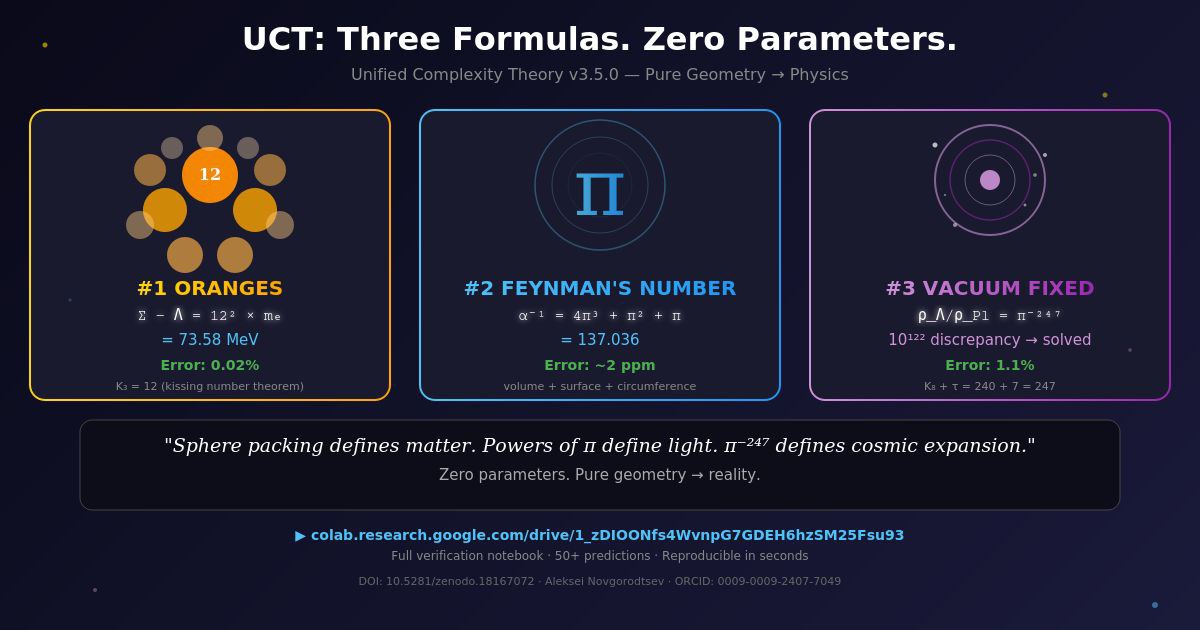
Zero free parameters. Here are the top three predictions:
1. Stack 12 oranges around one. Square it: 144. Multiply by electron mass. Result: Σ−Λ = 73.58 MeV This is the mass difference between two types of baryons (Σ and Λ particles). Experiment: 73.60 MeV. Error: 0.02%
2. α⁻¹ = 4π³ + π² + π = 137.036 The fine structure constant — it controls how strongly light interacts with matter. Feynman called it "the greatest damn mystery in physics." Turns out: 4π³ (volume) + π² (surface) + π (circumference). Just geometry. Error: ~2 ppm
3. ρ_Λ/ρ_Pl = π⁻²⁴⁷ The ratio of dark energy density to Planck density. Quantum theory predicted this wrong by 10¹²² — the "worst prediction in physics." This formula fixes it. Error: 1.1%
The notebook verifies 7 "Crown Jewel" predictions (mean error 0.014%) plus additional tests across particle physics and cosmology. Runtime: ~5 seconds.
This isn't numerology — the kissing number K₃=12 is a proven theorem (Schütte-van der Waerden 1953). The E₈ lattice (K₈=240) won Viazovska the Fields Medal in 2022.
Visual summary: https://raw.githubusercontent.com/AIDoctrine/fpc-ae1r/main/U...
Paper: https://doi.org/10.5281/zenodo.18167072
Happy to discuss the math.
2. Aren't all numbers expressible in base pi? Also, doesn't adding a volume plus an area plus a length have a units consistency issue?
1. You're right I should clarify: the formula uses Σ⁺ (1189.37 MeV), not Σ⁰ (1192.642 MeV). Different isospin states.
   Σ⁺ - Λ = 73.69 MeV
   UCT: 12² × mₑ = 73.58 MeV
   Error: 0.14%
   a) "Any number expressible in base π" true, but the claim isn't
      that 137 ≈ something×π. It's that α⁻¹ = 4π³ + π² + π with
      INTEGER coefficients {4, 1, 1} arising from kissing number geometry.

   b) "Units issue" these are dimensionless coefficients, not literal
      m³ + m² + m. The "volume/surface/circumference" is structural
      (π³, π², π¹ powers), not dimensional.
e^4 + 5*e^2 + 16*e + 2*e^0 = 137.03594
EDIT
better yet:
            3*e^4 -  5*e^3 + 20*e^2 - 28*e +  2*e^0 = 137.035996
            5*e^4 -  9*e^3 + 11*e^2 -  9*e - 12*e^0 = 137.035998
            2*e^4 + 22*e^3 - 61*e^2 -  6*e + 53*e^0 = 137.03599937
2*e^5 + 6*e^4 - 53*e^2 - 47*e + 32*e^0 = 137.03599922Proton mass: m_p/m_e = 6π⁵ (0.0017% error) Muon mass: m_μ/m_e = 2π⁴ + 12 (0.024% error) Tau mass: m_τ/m_e = (π⁷·ln10)/2 (0.0003% error) Weinberg angle: sin²θ_W = φ/7 (0.027% error) Cosmological constant: ρ_Λ/ρ_P = π^(-247) (1.1% error)
The difference between numerology and physics:
Numerology: Find ONE formula that fits ONE number Physics: Find ONE framework that predicts MANY numbers
Your e⁴ + 5e² + 16e + 2 = 137.036 is impressive! Now use those same coefficients (1, 5, 16, 2) to predict the proton mass. If you can't, it's a coincidence. If you can, publish immediately. UCT coefficients (4, 1, 1) come from π-exponents in the Duality Theorem connecting α to E₈ geometry. They're not fitted they're derived.