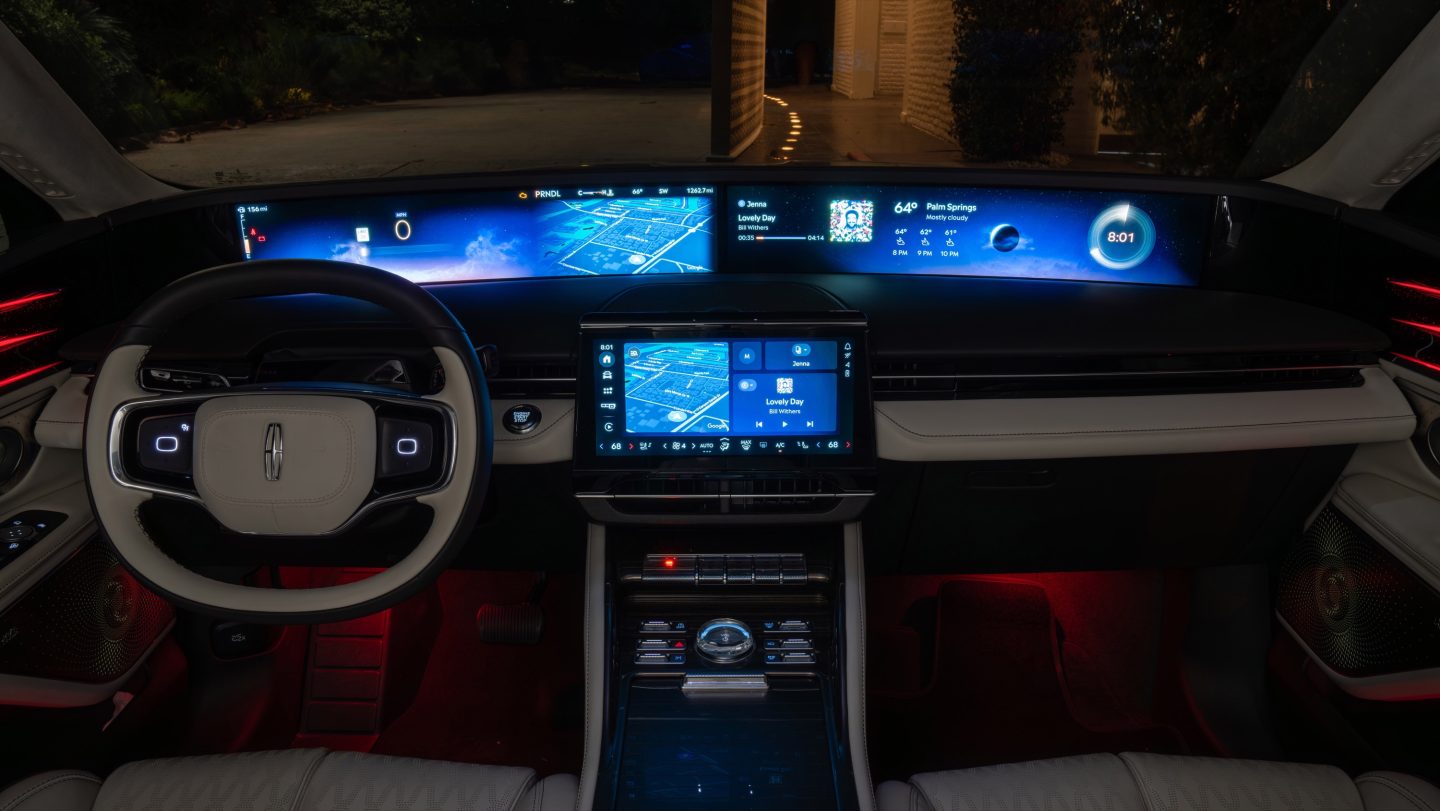
I own an ID.4, the "car" part of the car is fine, but the controls inside are by far the most unpleasant I've ever used. 60% of the time I want to turn the fog lights on, it registers as "Defrost Max" that is right next to it. The worst offender by far though are the windows controls. Instead of four buttons like most sane cars, you have 2 buttons as well as a capacitive "Rear" toggle. That toggle is both incredibly easy to activate by accident and impossible to use with glove.
I can't fathom how someone designed these things and though, yep, this is a good experience. At least the car has wireless CarPlay so I can ignore the terrible VW software.
Ever tried to open a window on an ID.7? There are 4 windows, 2 buttons and a touch sensor that toggles between front and rear windows.
Step 1: Try to open to driver's window. You touch the sensor and open the rear window.
Step 2: Try to close the rear window now. Of course you touch the sensor again. The buttons now controls the front windows which are not open.
I'm getting used to greet my neighbors through the rear window and close it later when I stopped the car and can look at the controls.
The interface of the id4 was known to you prior to purchase and the Chevy bolt existed…
We needed a third electric car and instead of buying a second audi etron we bought a second Chevy bolt for 1/4 the price solely based on the interface and controls.
My 2 cents: it's the typical "lab" test. It overall looks cool if you think about it, on paper. In reality, they should test with children inside (potentially screaming, because that's what they do!), while pedestrians/bikes are outside near the street so you need to pay particular attention, the traffic light is turning red, and at the same time you need to open the windows to let that f** wasp out, that somehow was inside the car. I wanna see how cool that is. If there are UX standards for accessibility, why aren't there patterns about such things? Oh, right, maybe there are, and someone wants to "innovate" :)
This is the kind of distractions that really can lead to accidents, because you need to actually "watch" whether something got activated or not.
EDIT: my comment was for the other comment that mentioned the buttons for the windows :) somehow I clicked on the wrong "reply". It still applies, though!
In 2026 this is roughly equivalent to saying "at least the car has wheels."
The Rivian is really testing my resolve to never buy another vehicle without CarPlay. If I don't buy one, that will probably the #1 reason.
Whereas with GM, I'd rather poke my eyes out than use their software (similar to Toyota's or BMW's).
You want to turn on the lamp? Try some waving gestures...
Also, I don't know whether this is a feature, a bug, or just a lack of skill on my side but I couldn't get the lamp to turn on with the engine turned off. VERY impractical.
The windows' "rear" button thing is especially infuriating. That and the climate controls being behind a mandatory privacy click-through warning every damn time you turn the car on. Gah.
I have heard rumours that they were penny-pinching to get the price under various countries' cut-offs to be eligible for EV grants.
But yeah the interior controls are terrible for an otherwise pretty nice car.
It's fine - it's just a car and it is fine as a car, just some irritating bits.
But nope, turns out that Tesla's UX is actually top of the line and everybody else, even the best chinese models, are fumbling about, trying to catch Tesla's quality and failing.
ID.7 was absolutely the worst. As you say, the cars are good as cars, and indeed climbing into the car felt good. That shattered utterly in 10 seconds -- we talked loud with the family how neat the car felt, and turns out that the car was listening to us and started blabbing "sorry, I didn't get that" in loud volume over our conversation. Trying to find out how to permanently turned that feature off revealed how dismal the UX of the media system is. Perhaps a testament to the Android system it's built on.
It might be fastest I've ever experienced a mildly positive feeling dropping to absolute zero point.
VW needs to fire 80% of the interface designers they have, starting from the top and perhaps hiring somebody from Tesla to help them restart from scratch. They had the moment of a lifetime 2 years ago and they totally blew it.
I recently used a kia Rio 2019 and everything is nicely placed, zero ambiguity and, except the touchscreen, everything cam be used with gloves
That's a horrible mistake from their part, but has nothing to do with UX.
>Curious how did you consider a car forcing a giant tablet interactions ... opening a "top of the line" ux, compared, say, to Kia EV6.
By having good taste, I guess?
I'm not saying that it's a good experience, but I don't think it's a tragedy either.
"New Euro NCAP tests due in 2026 will encourage manufacturers to use separate, physical controls for basic functions in an intuitive manner, limiting eyes-off-road time and therefore promoting safer driving."
Actually, no, no official EU organization nor any council mandates that. It's Euro NCAP, an independent organization, who decided they'll include tactile control in their car safety evaluation. It is literally explained in that article.
It will still make a difference, but this is not something EU did.
A lot of times safety innovations are first introduced on NCAP ratings, then the ETSC carefully evaluates adoption and will then advocate for those requirements to become legally binding regulations.
A technical standard will then typically be designed at the UNECE, Then the European Commission will propose it to be discussed and voted both by the EU Parliament and the European Council.
It is not like the NCAP is just the EU version of the US "Consumer Reports". While not a part of the EU, it is a non-profit thoroughly embedded into the development of automotive safety standards in the EU.
This is the advantage over a touchscreen - you can't learn those by feel.
Yeah, there's, like, I don't know, 25 buttons if you count the stalks? That's a lot I guess, but I wouldn't want to turn down my music or skip the track by looking over at a touch screen and guessing.
Staying continuously visually connected with all environment simplifies driving and definitely improves safety. Also thanx to that heads up display I didn't get a single speeding fine while by default driving at the very limit of allowed speed, including our radar-infested towns and highways.
2010-level of tech of bmw f11 is enough for me, the only real improvement would be full unsupervised self driving which isn't coming anytime soon.
I rent A LOT of cars for work and it’s clear that some makes know what the fuck they are doing(Volvo, Toyota) while others don’t.
Gotta be kidding me.
Surely voice commands can replace buttons and touch interfaces in 2026!
I don't like music while driving, so I know by feel how to mute or turn media/radio off in every car my family has.
My wife can't drive without music, so, she knows all the other media controls I don't care about by muscle memory.
Buttons on the wheel is the same. You simply learn their place and feel.
To add insult to injury, despite the fact that the speed up and speed down buttons are actual physical buttons, they are so aggressively denounced that there’s a loop: press button, wait, press, read screen to see if you’re making progress, press, etc.
Anyway, the point is that, while physical buttons in predictable locations can make it possible to operate something without looking, it still needs a good design and implementation.
IIHS doesn’t have any mandate power over manufacturers (they are not a regulatory body) but they do align with insurance company interests, whose goals are to pay out less for damages from vehicle incidents, and therefore IIHS logically would theoretically be focused on actuarial data-driven analysis. If you have specific examples of where this has not been the case, I’d love to learn more.
Automatic Emergency Braking (AEB) with Pedestrian Detection: IIHS rates vehicles on forward collision avoidance, including pedestrian scenarios, but systems often underperform in real-world conditions like nighttime or with larger vehicles (e.g., trucks or motorcycles). Studies show virtually no crash reduction at night, and features can create false alerts, weather-related failures, or a false sense of security, potentially dulling driver awareness without clear evidence of broad effectiveness at higher speeds.
Roof Strength Test: Vehicles must withstand a force equivalent to a certain multiple of their weight (e.g., 4x for a "good" rating) to simulate rollover protection. Critics, including automotive industry analyses, argue there's no statistically reliable evidence that increasing roof strength beyond basic levels (e.g., from 2.5 to 3.5 strength-to-weight ratio) reduces injury risk, with claims relying on unsupported extrapolations from low-strength data and anomalous results.
Updated Side Impact Test (Introduced 2021): This tougher test uses a heavier, faster-moving barrier (4,200 lbs at 37 mph) to mimic modern SUV strikes. It's criticized for disadvantaging smaller vehicles unfairly, incorporating misleading variables (e.g., tire grip affecting results), and prioritizing structural deformation over occupant outcomes, potentially leading to "poor" ratings despite good dummy readings. Detractors view it as more marketing-driven than reflective of common real-world crashes, with little evidence that the changes proportionally save lives beyond the original test.
To give a very concrete and potentially hazardous example: I have an induction range which has no physical controls but has a touch interface which requires various combinations of tapping, holding and sliding fingers. To say nothing of the fact that this is useless for people who have significant visual impairments, how am I supposed to turn it off if there's an electrical fire because a pot boils over or something? Is the expectation that I reach into boiling water that potentially has current running through it and hope to tap my fingers in the right place? Am I supposed to try to yank the power? Or is the expectation that I just walk outside and call the fire department?
Though also I would wonder if bad market research was a problem. I bet if, 10 years ago, you showed someone a traditional VW interface, or a touchscreen thing, they'd go "oh, cool, touchscreens". They might feel differently if they actually _used_ the thing, but if you skip that bit of the research... It's fairly common that companies make changes based on what customers _say_ they want, because customers are not necessarily good at realising what they _actually_ want until they experience it.
1 may be one the same button as cruese control
2, 5 may be on shifter knob panel
3 and 4 are the only new buttons on steering wheel
2 I've usually found in the buttons near the shifter
3 I'm not sure what you're referring to? If it's the little screen generally between the speed and battery/rpm display those controls are usually on the steering wheel in my experience.
4 Steering wheel, in every car I've seen it in and that's often standard across the models
5 This one I've only had one experience with and that's my wife's Kia Niro EV and those are on what would be shifter paddles in a car with a gear box.
The number of buttons on steering wheels between my decade old gas Golf and my wife's few year old Niro EV are shockingly similar though presented and arranged differently. Both have 4 buttons and two directional pairs (audio control for skipping on one, volume on the other, cruise control speed on another and one dimension of the hud paging on the last) though the Niro has the pairs as rocker switches that can click for one extra button I suppose.
I think of an initiative GM had, I think circa 2000, to standardize branding across all their vehicles and notably use the same buttons from the bottom of the line compacts up to flagships like the HUMMER, Cadillac, and the GMC Suburban. Sensitized by media coverage whenever I looked at these buttons sitting in a GM car or looking through the windows I felt that it diluted the higher end brands.
Automotive hardware is extremely difficult to get right. Buttons are a solved problem. Touchscreens are getting there. Everything else is a gamble in an area where failures have huge risks. OEMs don't like those. We'll probably continue seeing haptic feedback on things like wheels and shifters, but haptic touchscreens seem to be on the way out these days.
Also Everyone: I will never buy a car without CarPlay / Android Auto
https://en.wikipedia.org/wiki/CarPlay (March 10, 2014)
https://en.wikipedia.org/wiki/Android_Auto (March 19, 2015)
If the music from my phone could controlled by big thunky buttons, that would be great. I get upset with CarPlay and its touch interface all the time.
There is also the issue that I simply don’t trust the car companies with my data. They have proven they can’t be trusted with it, and CarPlay is a way to get a lot of that data isolated (I hope).
I’m fine with a display for some things, a backup camera demands it, but I want to control it all with tactile controls, not touch.
I would say that 2005 was peak car, except 2000 is slightly better because they had not yet gone nuts with serialized components.
(another reason is that direct inject fuel injection hadn't taken over yet, it's a disaster)
I love and prefer buttons. (I also demand Android Auto, though my car didn't have it initially - it was later added through a major software update.)
We all love screens but in a car, I think that buttons are better for the interface for climate, wipers, signaling, drive modes, cruise control, headlights, 4WD selection, volume, radio stations... while Android Auto and Apple CarPlay are excellent for navigation and other entertainment.
Then they get it home and find the app is crapware full of ads and nags, or the touch screen is impossible to use unless your fingers are as dry as the sahara or such.
That has to be a big part of it... especially if the customers' reference point is modern touchscreen cell phones (high quality displays, fast, etc).
But, the touch screen in my Honda is NOTHING like my iPhone. It's slow. It's not a good display. The software package is lackluster. It has a "apps" page, but there's no app store for crying out loud!!!
At least the screen is only for radio stuff and a few car monitoring things. The HVAC is still manual buttons.
It isn't hard to see, tbh. Think about the controls in a Tesla from a few years ago. They had physical controls for drive selection, turn signals, cruise control/TACC, cruise control distances, volume, next and previous track, seat controls, and manual overrides for the automatic wipers. The things that were used a little less were on the touch screen, with automation attempting to mitigate the downsides of this. This largely consisted of climate, manual overrides for the automatic headlights, and things like suspension settings.
So, what has VW made better here? Well, they have physical controls for turn signals, drive selection, volume, next and previous track, etc. They appear to use the touch screen for much of the climate control and entertainment settings, including appearing to retain the much maligned touch settings for seat heaters.
I'm not convinced that this is better. By contrast, my Nissan has driving settings like lane centering and seat heater controls on physical buttons... right next to my left knee where they are nearly inaccessible while driving.
TBH, the whole debate around this needs to be recentered around actual ergonomics and less around touch vs physical.
The climate controls should be physical buttons. Touchscreen climate controls tend to be giant messes requiring multiple interactions and often (hi, Tesla!) have controls in unpredictable locations. And fine-tuning the climate while driving is not exactly unusual.
Of course, physical buttons can be awful too. I’ve been in a Mercedes SUV where the A/C state is controlled by some bizarre split physical buttons and 100% of front passengers surveyed are entirely unable to confidently figure out what they do even after reading the test and contemplating for a while.
So, if I'm using physical buttons, how do I set the temperature to 24° (75° for US-folks) without looking away from the road?
Or set the radio to 106.9MHz? Or the cruise control to 88km/h (55mph)?
In all cases, I still need to look at an indicator.
You don’t. Instead you observe it’s a bit too warm and press the down button once or twice. Source: I used to do this regularly when I owned a car with excellent buttons.
> Or set the radio to 106.9MHz?
By pressing preset 6 by feel. Or by glancing for 1/4 second to find preset 6 (which is a clearly labeled button that never moves) and pressing it.
> Or the cruise control to 88km/h (55mph)?
By driving 55mph and pressing the stalk in the appropriate direction?
This stuff was all worked out very nicely in the late 1980s by UX experts who put very serious effort into making cars with an excellent user experience.
You can buy buttons if you have disability that makes it difficult to use touchscreens.
Tesla fans sung the praises of other stupid ideas like the Highland's indicator buttons and the Plaid's 'yoke', both of which were silently shelved after buyer dissatisfaction.
> Why defend an obvious regression?
Because it's not a regression. Whenever I use my older cars with manual controls I see no benefit. Most of the time I still have to look at it - it has a dial or little screen to know what exact temperature you are setting.
I can beat that.
2011 Prius. USB-A port is inside the center console at the bottom of the back vertical interior panel.
You have to lift the center console lid, move all of the crap you've stored inside the console away from the lower rear of the compartment to reach the port, then by feel (unless you want to turn your head 100 degrees to the right and look down while driving) attempt to slot the USB cable into the receptacle.
I hate sitting around with a cold butt waiting on the infotainment system to boot...
The number of times I've got gone back to check something and it was ruined sitting 200deg lower than it should have been is more than I can count.
There are some very real benefits to touch interfaces in cooking (primarily ease of cleaning a solid flat surface, and manufacturers don’t need to worry about moisture ingress), but it’s pretty hard to make one that actually consistently works in a way that won’t accidentally burn your house down when your cat walks across the cooktop in the middle of the night. I’m personally going to stick to knobs and buttons in the meantime.
Regardless of how the controls work, you can make a cooktop that, functionally, will not set your cat on fire: use an induction stove. Unless your cat ends up in a pan or your cat is ferromagnetic, the stove won’t heat it :)
Oh, and a switch for the light.
* Tesla infotainment is fast, responsive, good software
* Other OEMs struggle to compete in this space
* Other OEMs have software updates that require dealer visits
So the OEMs tried to emulate having a big screen UI and shoving more functionality into software, so they can update it.
Not to say Tesla gets all the credit, or that OEMs didn't start leaning on screens more and more before then. As screens got cheaper, customers demanded bigger screens, and OEMs felt like getting rid of buttons and shoving the functionality in the screen UI was the best way to appease their customers.
A big and higher definition screen provides a ton more context from the navigation's map with wider sidebars that can contain more information, while also providing more contrast and better legibility.
Usual Android auto screen sizes and resolutions feel to me like the difference between looking at a 32" monitor and an early 4.5" LED mobile screen. Too small for context, low definition, and not enough space to display additional useful information (so you don't have to touch the display every 5 seconds).
As someone with a 2003 Golf (with a tape deck) I find the screen on my iPhone sufficient to get me to where I want to go. ¯\_(ツ)_/¯
/s
Safety is in fact the big selling point of the device. The surface doesn't get above food temperature. If you boil a pot over, move the pot and just wipe it up with a rag, just like you would spilled tea or whatever.
That's not to say there aren't human interface issues with relying on capacitive sensors[1], but safety surely isn't one of them.
[1] Actually "boiling over" is in fact the shortcoming: what happens is that your sauce spills over the controls and causes the sensors to glitch, which the device detects as a failure and shuts down before you can wipe it. Then you have to reset all the temperatures.
Why are they frustrating? Because every time I have to clean the stove top (which is after most uses) wiping the controls results in activating them. Sometimes things boil over or spit out hot fat while cooking and you need to clean it up right away (or it will get cooked on like welded steel) and you end up switching the simmer on the back element to high and drop the oven temperature by 100 degrees. A zillion beeps and cute jingle tones don't help, they just contribute to sensory overload.
It's a great cooktop but I would prefer physical controls that are not on the cook surface.
Cool is generally bad in UX design.
Maybe it can be implemented in a single hand gesture. But the point is pot or pan can be control interface itself.
Also the breaker itself is like $130+, plus slightly higher chance to nuisance trip, so fat chance any builder is putting that in voluntarily.
The folks who just want a drop-in replacement are probably not getting induction - they're the ones who complain about the necessary electrical upgrades being too expensive.
There were two converging factors: number one is that there was a time where it was considered a sign of sophistication / progress. Definitely a case of form over function, but remember this was the era when everything Tesla did was cool and everyone was chasing them.
The second factor is cost. Physical buttons are expensive to design, certify and manufacture (most people don't have a notion of how high the durability bar is for everything that goes into a car interior). Once you have to have a touchscreen anyway you can (theoretically) remove almost all physical controls.
I believe Toyota did this frequently in their Prius models, where things were different from mainline Toyota just because, like the center-mounted speedometer and the joystick shifter.
Consider the key fob to my car. It has two buttons on it with icons - lock and unlock. You'd think that's what it does. Not so. It has all kinds of behaviors based on how you press the buttons! Thinks like setting of a siren (which won't turn off until you put the key in the ignition), opening all the doors or only one of them, opening the windows, putting the car in "sentry" mode (whatever that is), etc.
I also got to wondering why the battery in it never died, like it would do in other key fobs. It turns out it recharges when inserted into the ignition lock! (I actually kinda liked that feature!)
We both know that cannot be true.
Phone.
You can still buy niche phones with a physical keyboard right now.
The idea that, because we aren't willing to pay $700 for a garbage tier "smartphone" with spotty support and basement level specs is somehow evidence that we don't actually want keyboards on our phones is bad faith.
Before smartphones I was buying feature phones with full keyboards too, including things like the Samsung Alias 2.
Meanwhile, folding phones, despite being a niche, are getting real attention by manufacturers, because it's a "new" gimmick and can drive sales.
I'm not sure whether this is also true for your induction range. Certainly on generic table lamps and such, the touch-activated buttons are the hobby slop we'd buy from amazon.
Anyway, I've never really heard anyone offer performance, likeability, or usability as a reason for touchscreens in cars. Glad to see the industry get rid of them, at the decadeslong speed you'd expect from a dinosaur industry with a regulatory forcefield.
But that’s the issue. Grey suits in boardrooms with no passion for driving making decisions based on cost and homogenizing manufacturing amongst the car lines.
For example someone at VWAG thought it was a good idea to replace the 911 key with a button, and dials with a screen. Why? Cost and stupid tech fantasies fueled by EV manufacturers and Apples next-gen CarPlay nonsense.
I can't speak for other manufacturers, but having lived with a Tesla I can say these are some justifications, beyond cost:
- Standardization. With some exceptions where hardware is different, once you've driven one Tesla you can drive any Tesla. I love physical buttons too, but I don't love finding the drive mode buttons in a different place every time I rent a car, or trying to figure out how this one does the windshield wipers, or headlights, or radio tuning, or parking brake, or whatever.
- Simplification. Along with the mandate to reduce physical controls, Tesla also pushed toward making everything automatic. I never have to think about my headlights (and they dim in a circle around any detected vehicle in front of me), and I don't have to think much about drive modes either. It does a good job of automatically picking the correct direction when you tap the brake, and has a good mechanism for auto-switching between forward and reverse as you manipulate the brake and wheel.
- OTA updates. When something isn't working out for people they can make adjustments. They can also add new features (AI assistant, more automation) without mounting new buttons.
There are some silly choices, like the glove box (which is tiny and not very useful anyway) requiring a voice command or the touchscreen. And some people don't like the touchscreen vents (I do, surprise surprise). But most of it makes good sense.
Schadenfreude maybe after watching people interact with their UI. I regularly drive in an ID4 and it's hilarious how terrible the whole experience is from a user UX point of view.
You can live a LONG time without a working ... radio tuning knob, if the other 99.9% of the controls work. Or if the right passenger door lock button fails, really who cares. But when the central control of the entire car fails, its scrap.
Very profitable for the manufacturer.
to me it feels like a cost cutting measure needed for Tesla to survive. Elon and his reality distortion field made it look like a touch screen (and no controls) are superior - and all the car companies started mimicking it out of fear to miss out on something
How many other execs would have the courage to do that vs letting the current thing (microdrive player) settle and holding the new thing (flash memory player) in reserve to launch only in response to a competitor gaining traction?
It's a good thing when consumers put pressure on corporate management. That's free market economics working efficiently.
I felt inspired to channel a little Douglas Adams - the whole removing buttons thing is so anti-consumer, it'd be such a PR win for some company to champion the return of physical buttons that it seems like a no-brainer for us consumers, but management types have been charging ahead with eliminating buttons for almost a decade now. Less wiring, more opportunities to nickel and dime, etc.
>>> That's free market economics working efficiently
The enshittification paradox - what the customers want is not what they get, because the UX and UI designers and the MBAs in charge know better than those silly customers. They have degrees! From Harvard and Stanford and Yale!
For your sentiments to be true several important parts of the pipeline and market need to be dysfunctional already.
Most parts of the market are dysfunctional and have been for a long time.
Actually I take that back, we don't really have markets anymore, we just have oligopolies.
https://www.caranddriver.com/photos/g64477839/2026-subaru-ou...
I don't want a screen at all, but reversing cameras are now mandatory so that one is probably not going away.
I like the "return to real buttons" trend but it's less about buttons and more about the appropriate physical controls for the operation being performed. The control itself should both indicate current status and provide for changing it. For example, things that are "on" or "off" should have a switch with distinct "on" and "off" positions, not a single pushbutton that toggles. Temperature or volume or blower speed should be dials or sliders that move between two physical end points. If you have to repeatedly push or hold an "up" or "down" button and look at a display to set the temperature that's suboptimal. Moving a slider or dial where the physical position corresponds to the actual setting is so much better.
My Mercedes is absolutely terrible at this. Having owned it for a couple of years now I still have no intuition about what most of the steering wheel buttons do. On the other hand, they get cruise control right: It's a simple stalk on the steering column. Up for faster. Down for slower. Easy to find and operate without even a glance off of the road.
If there were a few carefully chosen single-purpose buttons on the steering wheel I could maybe get on board. But if there are too many or they are multifunction then it's cognitive overload.
I don't mind this feature is somewhere deep in the menus of the driver settings area. However, if you're tripping over settings like this either the car is poorly designed or your routinely delving into settings areas you really shouldn't be in while driving.
It's awesome. I've never had a better cruise control button setup than in my Subarus. They're usually slightly different by model/year but we're consistently good and easy to use without looking.
I have never accidentally while driving found any settings menu getting in the way there. Yes there buttons there that do that. But only in the same way as my 25 year ago cars did: basic settings you set once and never again and that are in those menus probably for historic reasons as they were there pre-screen being standard in the car and they just left them.
I don't use my phone at all while driving so all of the phone buttons could go away in my car. I hate audio assistants, so that button could go away too. The dash control switch could be on the dash.. etc etc. I'm not a UI person and I'm sure some committee fought over every square inch of that space, but just personal preference.
But make climate control 3 knobs: Fan speed + off, temperature and output ports. Put the AC button inside the temperature knob, and the 'recirculate' button inside the output ports knob.
With the radio have a push on/off volume knob that starts up at the SAME volume as always (i.e. relative, not absolute) and NOT the previous volume. The volume knob should have some resistance to it. Opposite that have a tune knob for precise tuning, and pressing that gets you into setup and navigates you through it. This should have the same resistance, but the outside has some indents so you know it's not the volume knob. Have 6 preset buttons and 3 'banks' with a single 'next bank' button. pressing and holding a preset will save it with a beep for confirmation. On the steering wheel: up/dn for radio should be seek, not next/previous preset. There are 6 nice big buttons for presets but when traveling seek up/dn is the main way we change music.
On the door have the rear view mirror controls, and above that have a knob for dashboard light brightness.
2008 Honda Fit was close to a perfect car. https://www.carsdirect.com/honda/fit/2008/pictures/interior
And touchscreens are another visual distraction. I think they're a contributor to the increasing vehicle accident and mortality rates. Ideally, nothing should take your mind/eyes off the road. A HUD for navigation and dashboard guages/alerts is about all anyone 'needs' in terms of display, but in the end it's about what individuals want, human lives be damned.
Except they are decreasing...
> HUD
Except HUD is kinda worse than center console: https://www.sciencedirect.com/science/article/abs/pii/S13698...
(I say kinda because you still get a bit of peripheral vision from HUD. Traditional dash behind steering wheel is undoubtedly worse - this has been proven decades ago).
This data says otherwise. I'm certain pedestrian mortality has been increasing, and by the looks of this graph it looks like 'other road user' deaths are trending up too. If you have data to support your claim, keen to see it.
https://injuryfacts.nsc.org/motor-vehicle/road-users/pedestr...
> Except HUD is kinda worse than center console
The glance time might be affected by a lack of contrast? Or perhaps the novelty of using a HUD? It's possibly right, but I'd want to see more study on the 'why' it's worse and whether that's a technical thing.
This also needs to be divided per miles driven as those are constantly increasing.
Finally, my guess pedestrians are disproportionately more at fault here - mostly impairment (meth, fentanyl), but also smartphones and headphones in particular. Drivers are mostly distracted by phones mostly, not by adjusting climate controls for 2-3 seconds.
Europe can be explained by pedestrianisation of cities, congestion taxes, separated bike lanes that encourage bike use, vehicle safety standards that—at least until recent loopholes have emerged—have been keeping dangerous vehicles off the road. Even still, if you look at that graph you'll notice a little uptick in the last 5 years, curiously around the time that screens became more prevalent, but also...
> my guess pedestrians are disproportionately more at fault here - mostly impairment (meth, fentanyl),
A-pillar sizes and bonnet heights have all been increasing, reducing visibility of pedestrians. Sounds like a larger factor to me. People have been getting high and drunk behind the wheel for decades, but maybe it's more prevalent now?
> not by adjusting climate controls for 2-3 seconds.
That's really all it takes if a kid decides to chase after a ball on a side street. You might have seen them before they ran from one side past behind an occluding object and emerged on the other, with not enough time for automated systems to respond (if they respond). A lot can change in 2-3 seconds, and I'd be surprised to hear an experienced driver say otherwise.
I think I've said as much as I can.
Thats how long it takes to glance at rearview mirror, your partner, your kids in the back or you know... button based climate controls.
> Europe can be explained by pedestrianisation of cities,
It can be. But also can be explained by lack of zombies in the streets.
Going back to https://en.wikipedia.org/wiki/Motor_vehicle_fatality_rate_in... - fatalities per 100k population has been decreasing for a while, even since smartphones and trucks went mainstream.
Truck issue feels like imported here in NZ. We don't even have f150 here, most popular car is hilux and raptor which are about same height as my people mover.
Who the hell still tunes a radio in 2026.
I know first world countries come first, but you asked.
Next, they need to make the buttons more physically distinguishable, instead of panels of identical buttons
The dashboards of older pre-1990s cars had a wide variety of buttons, switches, and knobs, all with different locations and feels. Of course today's designers would see this as an unclean mess driven more by manufacturing considerations than "design" considerations, but it was a much lower driver workload to operate those "messy" controls. The different position, size, shape, and feel of each control allowed easy operation by just feel, without taking eyes off the road.
In contrast, the all-the-same rows of buttons on modern cars are still hard to operate after familiarization; which one is the front vs rear defrost?
Moving many buttons to the steering wheel overcomes many of these limitations, but again, rows of identical buttons do not help. Consider a Formula One steering wheel with 20+ controls. They are 100% custom and can be made any way they want. They make the OPPOSITE of identical controls — they are all different and brightly colored.
The point of driver cockpit design is NOT some clean asthetic.
The point is to use every available mnemonic device so a driver under heavy workload can recognize the controls instantly and reliably.
[0] https://www.wired.com/2014/05/formula-1-steering-wheels/
[1] https://www.formula1.com/en/latest/article/f1-explains-how-f...
[2] https://medium.com/formula-one-forever/the-nerve-center-of-a...
When I vehicle shop, my budget isn't endless, but it's fairly uninhibited because I keep cars for an average of 10+ years and I like driving and want it to be an experience I enjoy. That said, companies just aren't making cars I like much anymore. I /loathe/, utterly /detest/ crossovers, and that's the vast majority of new vehicles being brought to market. Even vehicle lines that I previously liked, such as the BMW 3 series, have become enshittified in weird ways that dilute the core concept of that particular vehicle line. I'd love an E92 M3 w/ DCT but made in 2025/2026, but that's not made anymore and I think the current G80 M3 is a much worse car in every way that matters to me, even though the S58 is in some ways a better engine.
It's really disappointing and frustrating trying to find a decent vehicle these days.
Ironically people are constantly surprised every time this comes up that I cross-shopped a Mazda 3 vs an Audi RS3, but if you put aside some of the cost difference (which isn't as large as you think, it's 50% more, not 2x the price), Mazda is trying to up its game and move into the Japanese Luxury space to compete with Lexus, Acura, and Infinity rather than the other Japanese brands. Some issues aside, I think the execution on the interior of the Mazda 3 Premium is pretty great, especially at its price point ($40k base).
Surprising to see companies still learning this a decade later.
In reality, for Europe at least, their hand was forced by Euro NCAP via their safety tests. They announced it a couple of years ago but it starts now. No car that has just a touchscreen, instead of physical controls, will be awarded a 5-star rating. I don't really know to what extent people take note of the NCAP ratings these days, but they certainly used to be a very big deal to car buyers (for example, in the late 90s, the rating given to the Rover 100 effectively killed it overnight).
The NCAP ratings make physical controls essential for the most basic functions (e.g. indicators) and strongly encouraged for others (e.g. climate control).
So obviously the same goes for other manufacturers shouting about doing the same thing - don't swallow their hype about how much they love your feedback.
In what cars are indicators not a physical control?
Question aside, I definitely agree with the shift back to physical buttons. My new car has a touch screen for climate control and I loved it, for about a week. And now I hate it because it just adds confusion and distraction when driving
I hope Apple Carplay and Google Android auto can also take over other car control such as volume and climate control. Later someone can build uniform hardware buttons and knobs that I can place on my steering wheel and it can use the phone to control those features.
General cautionary tale: just coz a company is successful, doesn't mean it's doing _everything_ right. Plenty of folks who love their Teslas would prefer a few more buttons (and door handles on the inside, etc) if given the choice. Could say similar things about some choices Apple made.
1. What Tesla did right was put a big screen in the center of the car, and then actually think about the UX, and how to improve the software to avoid having to fiddle every other minute with controls on the screen (e.g. climate control is usually amazing, I rarely touch the temperature). What other companies did was just put the screen and slap on sub-par software without much regard for UX, so of course it sucks, even if you have the big screen.
2. Yes, I'd have loved a couple extra buttons, perhaps programmable. My main gripe for instance is/was the air re-circulation (used to live in a country with lots of tunnels), but I'm sure others would have liked some other button. I'd have been very happy to have 3-4 software-programmable buttons for the most used functions.
I would disagree with that. You do not need a big flashing distract-o-tron in the middle of the dashboard.
Cars should have exactly zero screens.
Except my car's screen is not distracting: I set it up for my destination, I give it a glance when needed for navigation, and I basically don't touch it until I'm done driving, because (second part of the previous comment) the UX is so well done that I don't have to. Worst case, voice control works well enough for e.g. changing playlists and songs or changing destination mid-trip.
> Cars should have exactly zero screens.
People have been attaching tomtoms and mobiles to the windscreen for the past 30 years anyway to solve exactly the same problem (navigation), and they were always inferior solutions to a well done integrated screen: detaching on a bump, leaving forever-smudges, having to update all maps offline, removable meaning easier to steal, limited functionality, ..... So I disagree. I'd rather have governing bodies evolve to take screen UX into account at regulation: most cars with screens couldn't have been sold.
Turn all that off. Don't drive distracted.
Backup / 360 view cameras and navigation? I'd argue those are a lot safer than no camera looking backwards and fiddling with maps / phones.
Tesla has the most subdued interior of every brand on the market.
The screen is not useful.
If they want to sell cars at that price they need to not feel like a base-spec Skoda.
The features are better than mid tier luxury . Fit and finish is adequate, still better than a Rav 4.
You sound like you're my age (given your preferences, and experience with cars). The car market is very different.
We rented a $35k 2025 Prius and it felt like a 2005 Corolla.
Believe me , Tesla's are a great value.
My mum's 14-year-old Fiat felt more solid.
* compress and de-risk production timelines because changes can be made in software instead of requiring retooling/replacing parts.
* reduce cost; the cost of a display is basically required by legislation requiring back-up cameras. Add in a few settings or map view and it has to be a touch screen. Consolidating everything else into a part you are already mandated to included reduces cost.
* meet customer reqirements; Except at the very bottom end of the market, customers expect cars to have space to display a map and be able to use music streaming services. Carplay/android auto also is a requirement for some users.
Thankfully no one back then had the absurd idea to force them into every single car model, and eliminate choice for the next ten years.
And still no temperature dial. They achieved near perfection 20 years ago:
https://external-content.duckduckgo.com/iu/?u=https%3A%2F%2F...
It’s unclear what the temperature numbers actually mean if this isn’t an automatic climate control system (or is in manual mode).
The part that rotates also appears to be symmetric, which means one may need to find the white marking to decipher where the dial is pointing. That can be even more difficult in a dark environment than trying to read a display.
The numbers are centigrade, which for the local market is mostly very obvious and widely understood. 22 is roughly room temperature, so it's good that's at 12 o'clock. This model doesn't have auto climate control.
> which means one may need to find the white marking to decipher where the dial is pointing
You hand can feel the angle the dial is pointing. It was a non-issue for me. the white is illuminated softly at night, and one very quick glance can confirm the position anyway.
Anyway, I'm contrasting to this modern VW abomination: https://www.discoverauto.com.au/wp-content/uploads/2025/02/2... . Try to feel where the slider is set to on that interface... :D Or quickly enable the rear/front demister options...
I'm aware of centigrade, I've lived in places that use centigrade. :) My issue is that absolute temperature markings don't seem appropriate for a manual climate control system that isn't matching a temperature. Here, the traditional blue/red-style markers or similar are probably more informative.
> You hand can feel the angle the dial is pointing. It was a non-issue for me. the white is illuminated softly at night, and one very quick glance can confirm the position anyway.
Fair, if it's clear with some tactile difference and is visible at night that seems quite alright!
E.g. Tesla, even in Europe, is pretty blatantly ignoring privacy laws and is used to surveil the population: https://www.spiegel.de/panorama/justiz/tesla-waechtermodus-f... (paywall)
I would be very surprised if it didn't have some kind of "heavily-restricted debugging interface, only available to select VW engineers, which provides a limited set of fully anonymous vehicle diagnostic metrics" - which in practice is of course used to sell trivially deanonymizable data to anyone with a few bucks to spare.
https://reynardsec.com/en/volkswagens-bad-streak-we-know-whe...
"The data, which includes detailed location information and even vehicle owner details, was left exposed and unprotected on the internet for an extended period of time."
Wir wissen wo dein Auto steht Volksdaten von Volkswagen
https://media.ccc.de/v/38c3-wir-wissen-wo-dein-auto-steht-vo...
The US regulators wouldn't have cared about higher emission levels as all cars in the US have them anyway, but the cars were still introduced with the EU specs. First because otherwise they would need to remeasure all the car emissions and second, because even as the real emissions would still be low by US standards that would have questions why the same car has different emissions in EU and US. That plan however didn't work out, as the US doesn't do tests in a controlled environment, but while actually driving. Thus, the scandal started becoming public. That is the official part.
The following comes from an "industrial expert", that held a guest lecture at our university: This whole thing was actually done with knowledge (and silent agreement) of the EU regulators, as they aren't dumb and know what is physically possible. However they were still forced to act once this became public in the US, as the politicians and the general voter don't like regulators doing there own thing against the law. Also this was done by a VW supplier, which is basically the only shop in town, so of course this wasn't specific to VW.
So in my opinion, blaming VW, while legally correct, is actually kind of dumb. At last a bit anecdotal evidence: We also did the update for our car. Of course we tried to delay it, but eventually the car would have lost it's street legality, so we needed to do it. And afterwards the car is louder, has visible emissions and smells (more). (No, this isn't even a car from VW or any other company of the same business group.) Thanks. Sometimes the best option would have been to just keep quite and stick to gentlemen agreements.
Sure, but it is not like they just got away with that (ironically other manufacturers who did essentially the same thing, did mostly get away with it).
>I would be very surprised if it didn't have some kind of "heavily-restricted debugging interface, only available to select VW engineers, which provides a limited set of fully anonymous vehicle diagnostic metrics" - which in practice is of course used to sell trivially deanonymizable data to anyone with a few bucks to spare.
The GDPR allows you to receive a copy of all data a manufacturer has about you, "trivially deanonymizable" is by any reasonable interpretation of the GDPR personal data. Of course you can believe that VW and other manufacturers are secretly ignoring laws (again) and of course evidence for that would be hard to come by, but it it did come out it would be a massive scandal, with a massive criminal investigation.
In general, do you want to have minimal laws protecting your privacy and manufacturers blatantly not caring about existing laws and individuals having no recourse or do you want strict laws protecting your privacy with manufacturers facing heavy sanctions, when they ignore those laws? The choice seems pretty clear.
In 2024 when they got hacked it turned out they were gathering (and "lost") a great deal of user data that they weren't supposed to.
https://cybersecuritynews.com/volkswagen-data-breach/
I don't think that VW were punished for that breach; the GDPR has no teeth.
I drive a VW but I won't buy another.
Removing network connectivity from basically any new car is trivial, often as simple as pulling an easily accessible fuse.
I'm guessing that you haven't actually done this on "basically any new car".
If you had tried, you would know that there is no fuse dedicated to "network connectivity". It is typically tied in with other, often essential functions like the engine control computer --- specifically in order to thwart a simple disconnect.
What I have seen done is to tear into the right roof pillar and cut the wires going to the antenna on the roof. But this is usually not without consequences as well such as a perpetual error code display and/or the radio, navigation or entertainment functions stop working.
I've never seen an antenna that was difficult to disconnect, on the super simple end you have something like the W222 where you can literally just pop out the antenna cover on the roof and just remove the antenna module inside.
>But this is usually not without consequences as well such as a perpetual error code display or the radio, navigation or entertainment functions stop working.
Well sure, I do have cars without GPS because I was lazy. Carplay still works fine, so can't really bother to do anything about it.
Even if you can't pull the modem or the sim card (less common now) directly, you can certainly always find and disable the antenna connection.
Any decent shop will be able to do this for a reasonable price.
That largely depends on the specific vehicle. I’m surprised that there wer no negative effects in pulling the telematics fuse on a W223, less surprised on a W222.
Depends on the car. On modern Fords, it’s the TCU fuse.
> What I have seen done is to tear into the right roof pillar and cut the wires going to the antenna on the roof
Nonsense. Only a fool would do this, rather than simply disconnecting the antennas from the back of the module.
Manufacturers almost universally use FAKRA connectors for quick and error-free assembly on the production line.
Depends on the car. It some cases, this is not simple. Accessing the connections means disassembling the dash.
Both times, the touchscreen-only controls were such a pain in the butt that we vowed we would never purchase such a car. It was a timesaver, because in that period our family has gotten two new (to us) cars, and our experiences with the rental Volkswagons allowed us to exclude an entire manufacturer from consideration.
If they haven't re-broken their interiors by the next time we look for a new car, I guess we'll have to consider them again.
The Equinox EV is one of the better EVs to offer AWD out there right now, matching the range of a Model 3 at a decently better price and obviously massively better UI. Slower charging is the only real downside.
And a used pre-2020s Bolt is a really excellent value, because they are insanely cheap (under $15k) and due to the whole catching-on-fire thing they all had their batteries replaced in the last few years, which means you get a much newer battery than the mileage/age of the car would suggest. The Bolt is replacing a much older Leaf, so bumping the range up to ~200 miles from ~70 is a huge upgrade for us.
The bar should be whether the operator can keep their eyes on the road while operating the controls. And when getting into a new vehicle, how easy can they find common controls like mirrors, climate, parking brake, cruise without consulting the manual.
I rented a Highlander which did have nice physical controls, but many features were buried in cryptic menus. The auto steer feature, which dragged and pulled steering in corners, and aggressively applied braking , was buried under 3 levels of menus labeled "RTSS", "SCS", "Advanced".
Capable drivers don't need cornering and braking assist. It's $2k+ worth of useless components , for a worse driver experience.
https://cdn.arstechnica.net/wp-content/uploads/2024/03/2024-...
https://www.naval-technology.com/news/us-navy-to-replace-tou...
Reminds me a lot of the skeuomorphism from classic iOS and WebOS, but cleaned up with elements of modern “flat” designs.
Mine still cold boots/watchdogs every time you start the car in what I suspect a Patriot-style fix of numerous issues. It still has confirmation dialogs over confirmation dialogs (e.g. when selecting CarPlay you get to confirm your choice three times). Voice input is still unusable: the only thing it reliably recognizes is when I tell it to fuck off (and it scolds me for that). Door locks/keyless became more unreliable, which I frankly doubted was even possible. Everything is lagging, especially after cold boot: getting to entering nav destination after you sit in the car takes an eternity.
It's a shame too. I drive a 2016 VW GTI and it's an absolute joy. The last era of VW worth any consideration. Small touchscreen that shows current playing track, or carplay/map, but still with physical controls for volume and AC. I was glad to see Doug DeMuro shred them for the electronics in the newer model.
I'll be driving my 2016 car and 2008 truck into the grave, at which point I'll replace them with something of the same era or older. There are some enticing ways to die in a fiery car crash, but eating a median while trying to finger stab a mid ass ipad knockoff for control of the defroster is not among them.
A nice balance of buttons and screen is just fine ... (imo).
Whether this specific example is great or not remains to be seen - but I appreciate the direction.
I couldn't be more thrilled to see them taking this direction.
I’ll be in the market for a new car soon and I am only considering ones with touch buttons for HVAC. It’s not worth getting into an accident trying to change the temperature.
I was given a rental once from a dealership who was doing warranty work on my truck. It was one of those weird months in the midwest, where the temperature could be 80 or 30 depending on the day, and this day just happened to be 30. I realized shortly after I got onto the road that it wasn't getting any warmer, because A/C was on. There were no buttons to turn it down or off, only a touchscreen, so I just did the 15 minute drive home of shame in 30 degree weather with the AC blasting. That was all it took to make me swear off -ever- buying a car without physical buttons.
But because of my need for buttons I need to go and buy a car that actually was designed in 2019, in order to avoid the giant iPad slapped to the dashboard.
As an aside, a lot of "talking" lifts in Glasgow appear to have a Polish accent.
I feel like there's just too many of them, seemingly with duplicated functionalities (multiple up/down buttons for different functions). This is just a guess, but I think there was a meeting where each business unit responsible for a particular function submitted what controls they need, and they just fitted them all, which is kinda bonkers.
Due to the sheer amount of stuff, you can't operate this without looking down, which defeats the purpose.
Also, despite having this many of them, I think some of them are still contextual, requiring you to look at a screen or press another button to make them do the thing you want.
While I applaud the effort, the implementation I feel is lacking.
I say they because I hope I am gone by then.
https://www.caranddriver.com/photos/g63743843/2023-ineos-gre...
* https://etsc.eu/volkswagen-to-reintroduce-physical-buttons-i...
Related to Euro NCAP mandating physical controls for certain functions, "including indicators, hazard lights, sounding the horn, operating windscreen wipers and activating the eCall SOS function"?
* https://etsc.eu/cars-will-need-buttons-not-just-touchscreens...
Modern cars are absolute shit, the UI on my 30 year old Camry feels amazing by comparison to any car that I’ve driven that has come out since 2010.
The Tesla-fication of the dashboard has been such a shit automotive direction over the last decade and I'm relieved other manufacturers (not just VW) have woken up from the Musk fever-dream.
A good balance of screen and physical buttons is just fine, thanks.
Maybe don't have so much distracting shit in the car.
I entered a 150k € Mercedes two weeks ago and the display looked very similar to a toy display I got for my godchild.
What happened to them is that they're still #2 globally and make 5.5x as many cars as Tesla.
It's absolutely not too little too late for them.