The ultimatum game is the simplest example; N dollars of prize to split, N/2 is fair, accept with probability M / (N /2) where M is what's offered to you; the opponents maximum expected value comes from offering N/2; trying to offer less (or more) results in expected value to them < N/2.
Trust can be built out of clearly describing how you'll respond in your own best interests in ways that achieve fairness, e.g. assuming the other parties will understand the concept of fairness and also act to maximize their expected value given their knowledge of how you will act.
If you want to solve logically harder problems like one-shot prisoners dilemma, there are preliminary theories for how that can be done by proving things about the other participants directly. It won't work for humans, but maybe artificial agents. https://arxiv.org/pdf/1401.5577
Not only does this algorithm exist, but we're using it to communicate right now!
[1] https://www.geeksforgeeks.org/computer-networks/aimd-algorit...
Signaling theory (in evolutionary biology) might also be vaguely related.
But the game theory of nature also leaves room for other sort of players to somehow win over fair play. I thought this was a bug but over time realised it is a feature, critical to making players as a whole stronger. Without it there would be no point for anyone to be creative.
If you can solve the issue and make a playbook so that everyone do tic for tac, it won't take long for a bad actor to exploit it, then more, then you are back to where we are now.
You could try building a social credit system to scale things up, but that tends to upset people...
Humanity has accomplished a lot with the notion of number, quantity, and numerical model, but in nearly all these cases our success relies on the heavy use of assumptions and more importantly constraints—most models are actually quite poor when it comes to a Laplacean dream of fully representing everything one might care about in practice.
Unfortunately I think our successes tends to lead individuals to overestimate the value and applicability of abstract models. Human beings are not automatons and human behavior is so variable and vast that I highly doubt any mathematical model could ever really account for it in sufficient detail. Worse, there's a definite quantum problem. The moment you report on predicted behaviors according to your model, human beings can respond to those reports, changing their own behaviors and totally ruining your model by blowing the constraints out of the water.
I actually believe that many of humanity's contemporary social issues actually stem from overreliance on mathematical models with respect to understanding human behavior and making decisions about economics and governance. The more we can directly acquire insight into individuals rather than believe in their "revealed preferences" the better off we'll be if we really want a system in which people's direct wants are represented (rather than telling them "you say you want X but when I give you only Y as choice you choose Y so you must want Y"—it's totally idiotic).
A random note in case Non-Zero-Sum James is looking: It's frustrating that reading footnotes[0] requires scrolling back and finding your previous place. A link from the footnote back to the original place in the text or something that reveals a footnote in-place (e.g. on hover) is fairly universal and very helpful!
[0] e.g. https://nonzerosum.games/emergencespirals.html#notes
"... if you take anything away from this, it is to recognise that if meritocracy is based on achievement only, then we must be sure not to confuse it with effortocracy when it comes to its moral weight."
Related reading: The Tyranny of Merit, by Michael Sandel (I was hoping the article would reference this, and it does.)
Systems that try to get too “objective” fail to recognize this as most KPIs are on direct outcomes that are easy to measure, though often less important.
No joke I once worked at a company with multi-category numeric ratings that then rolled up to a total rating score that had 2 decimal places of precision.
To that boss’ credit, the text feedback was actually useful, but the numeric scores were comical.
Another issue is that often effort is the only lever one has in providing value as what tasks you are assigned constrains potential value output.Hypothetically, If my boss assigns me a stupid project destined to failure and tells me to shut up when I push back I'm really not going to get much value regardless of how much effort I put in... unless I was wrong in my assesment which is admittedly possible. Good management I suppose would then use effort as a proxy to try to find projects with potential to match one's effort.
Of course that would be ridiculous. You're trivializing the author's point. I'm not sure you've actually read the article in full. The author admits the difficulty in measuring it and that we may have to rely on "non-scientific" measurements.
Many of the tech robber barons and VCs (who call themselves "angels") carry the air of "my winnings are entirely of my own making". They rarely acknowledge the role of good fortune (in various aspects) in any meaningful way.
They inhale their success too deeply, as Michael Sandel memorably puts it.
But that's the whole reason why we reward outcomes in the first place. If it was possible to reward only "well-directed" effort regardless of outcomes, we'd be doing that already!
If we took the moral value away from meritocracy-as-indicated-by-wealth as it is, not giving it the bait-and-switch moral weight of a "well-directed efforts" Effortocracy, it would be less of an uphill political battle to level the playing field for those with great potential to contribute to society but who are currently locked out by poverty or other accidents of birth.
The reason there are so many books on grit is because it's a very compelling lie that anyone can succeed if they just try hard enough without giving up. It's useful for the person who hasn't succeeded because it gives them hope. It's useful for the person who has succeeded because it implies that they earned/deserve what they have because they were better than others or tried harder than others did. These are lies, but they are comforting to a lot of people and so they sell a lot of books. Books that say things like "Be born to wealthy parents, preferably in a rich nation or your odds of success are highly unlikely, then also get really lucky" just aren't going to sell as well.
Based on what? Biographical accounts by successful founders?
Nassim Taleb's Fooled By Randomness [1] covers the topic of mis-attribution of some causal factor X (i.e. grit) to some phenomena (i.e. business success) that can be effectively explained solely by randomness. In the specific case of successfully starting a business, causal factors are often mis-attributed post-facto through a lens that blatantly ignores survivorship bias [2].
> "To truly measure and reward by an effortocratic measure we need both a top-down and bottom-up approach
- At the top, reward people who have overcome more to get to the same point
- At the bottom, level the playing field so that potential, wherever it is, can be realised"
The way I think of it is using a vector analogy. They're arguing that a meritocracy only reward the end point, and that instead we should value both the magnitude of the vector in addition to its end point. You're interpreting effortocracy (not unfairly IMO) as only rewarding the magnitude of the vector, which is indeed absurd.
In my opinion however, they themselves are straw-manning what they point to as "moral meritocracy". As I understand it, their main gripe is that achievements are not only rewarded, but also ascribed higher moral weight, which is plain false. People vastly prefer rag-to-riches story to born-rich ones. So much so that you have many rich people straight up lying about their origin stories to make it sound more rag-to-riches than it is.
Edit: removed last bit that was harsher than intended.
Each post can't describe my entire take on society absolutely, but taken with other posts on the site, I'd like to think it's fairly cohesive. I think subsidising industries for the sake of providing employment is pointless and unsustainable approach, it undermines both a genuine source of meaning for people and it undermines the market (making goods more expensive).
The same is true of moral character, which as the post points out is a better predictor of future behaviour than an absolute measure of prior contribution.
But the main takeaway is not how we assess people in the world as it is, but how do we set up the world in a way where everyone's efforts lead to their optimal potential merit, which is incentivised by rewarding effort at each step. Part of effort is also thinking about the effectiveness of your efforts, but also many efforts might be seen as pointless and futile until they are not, scientists who contributed to the Covid vaccine had been doing seemingly pointless work for decades until it finally became relevant to MRNA vaccines.
And on the other hand, it is entirely possible to put fairly low effort into profitable ventures that are detrimental to society—porn, alcohol, sugary foods and get rewarded for it. An effortocracy would seek to tweak the incentives differently.
1) Mixing up merit (ability to provide achievement) with effort.
2) Assuming it has anything to do with moral weight. While it primarily targets just decision making and distribution of deserts (rewards).
Why distribution of deserts should be meritocratic? Because that ensure that collaboration is positive-sum for everybody involved. Considering this, fair reward for participation in some group effort has to satisfy a condition that reward is at least as large as a missed opportunity (of collaborating in some other group, individually, or not collaborating at all).
Effort can't be fairly measured so in practice the attempts toward "effortocracy" always seem to replace objective systems with a mess of human biases.
Look at college admissions: instead of SAT scores colleges want to look at skin color and how sympathetic your essays sound. That doesn't measure how much a person has overcome in life, it measures a person by how they fit in to the admissions office's prejudices.
The merit based approach, giving academic opportunity to people with a history of academic success, isn't as fair as we want, but it is useful. Broken, gameable, biased measures of effort are neither fair nor useful.
The fact of resource extraction from society and externalities like pollution not being counted by capitalist because they “can’t count them “and just bundle them as externalities demonstrably destroy any concept of non-zero sum game
There are limited resources on the planet and that’s the sum.
If you want to take it even further the extraction pace is even more important than the total gross amount of resources because of inefficient allocation and distribution processes
So no the universe itself is zero some we’re not creating more Mattar and especially in the context of humans on earth the functional and numerical reality is zero sum
The article explicitly addresses this:
The fact that Capitalism is non-zero-sum doesn't mean it is necessarily positive-sum. An economy that gets out of balance can produce very negative results (which are still non-zero). Cons of capitalism: — Can not be relied on to provide adequate social services, including healthcare and education. — Can be expected to run at a cost to externalities like the environment. — Can produce products that are detrimental to well-being.
In the passage you linked to, the author argues that property is impossible, which seems like a rather different argument than the one you are making.
If you read Prudhon thoroughly you’ll understand that his critique is that the entire concept of capitalism is based on the concept of property (undisputed) and the concept of property is an entirely made up mythical thing (disputed)
Some raw thoughts of mine if I may (feel free to add seasoning):
You mention that capitalism is definitionally zero-sum, and you seem to be facing quite a bit of resistance. I've had similar thoughts (perhaps still premature) that capitalism is zero-sum, but only (?) under a strong definition of "zero". I've not fleshed out my thoughts completely, but I suspect there are intangible/abstract dimensions along which we maintain some kind of equilibrium, regardless of what we do. "Do" here is quite abstract, but as a first approximation in the realm of economics, it might refer to any act of investment, compensation, or labour. (I may be abusing some technical terms in economics here—not my home turf.) A separate question could then emerge as to how significant these intangible/abstract dimensions are.
Actually, I'm not even sure that this is specific to the context of capitalism. However, whether something is a zero-sum game would seem relevant to systems obsessed with objective quantification, and where that quantification is heavily involved in steering moral views (or decision making), and I view capitalism as one of them.
capitalism however makes transactionalism the explicit structure such that it cannot coexist with any other type of ownership regime by function
That is to say, if you look at anarcho socialist philosophy it can theoretically coexist with other philosophies inside the same state and action space
Historically however, we have not found a stable equilibrium for the lived reality of our experience such that we could map it cleanly onto some discreet and identified philosophical framework
So neither anarcho-socialism nor capitalism is a sustainable equilibrium point due to the constraints of a human biological substrate
Claiming that “it could” or “can” or “is the best we can do” are all beside the point, because they ignore the intractable fundamental fact of separating human systems from all other systems
Every possible game is zero sum because the universe isn’t creating more matter or energy, it’s just moving around. How we move it around is the problem to solve and anyone using weak justifications with bankrupt epistemological foundations is just wasting everyone’s time.
Like this is the entire history of capitalism and it’s not even close
the fact that other organizations (USSR, China) do the same thing (horde property and then use consolidated resources to enforce economic heirarchy) but don’t call it capitalism doesn’t make it any less true
They can say “communism” all day but if the functional properties of the system of the Russian Federation or CCP are that Property control is limited to a small group of elites who then use those resources to create a command economy that is purely capitalist philosophy.
That's pretty much backwards. The industrial revolution was the first time in human history where people could get rich on a very large scale via some way other than pillage and conquest. If you think "capitalism" started in the late 18th century and is essentially coterminous with industry (which is quite nonsensical since you had forms of capital as far back as ancient farming societies, but that's the way many scholars choose to use the term) that's exactly what let us choose something that was not plunder and conquest.
There’s no period of time where that has not been true for some portion is society, but we reached a point to which there are no places where that is not true.
Of course, one can dispute specific claims, with facts and argumentation.
https://en.wikipedia.org/wiki/Baumol_effect
If I pay somebody to dig a ditch and I pay somebody else to fill it in was something of value created? Unequivocally no.
Whether or not that allowed somebody to survive and feed their family is entirely orthogonal to the question of the zero-sum nature of the universe
Nothing is free
energy comes from somewhere and you have to eat food which takes from the environment, that somebody else can’t eat or some other process can’t utilize, so by a function of your existence you cost energy to maintain that would’ve otherwise gone to some other mechanical process
No free lunch theorem describes this mathematically and you can go all day reading about that
Just because pointless things are possible doesn't mean not pointless things are not possible.
Nothing is free, but the service isn't free either. It's not free because people find it valuable, so valuable they're willing to pay for it. More than the cost of food needed to compensate energy spent. Way more in most cases. Is the sum still zero?
I’m describing conservation laws in physical state space.
Preference gains don’t violate thermodynamics, but they also don’t escape zero-sum reality once you include energy, ecology, and time.
You’re doing what I’m complaining about separating Economics from ecology - there’s a very firm reason why climate changes the most important topic of our decade is because we have to merge our lived experience with the work experience and kill this embedded dualism that somehow human environments are different than the rest of the universe.
It’s like you’re trying to do control theory without energy constraints.
If you want to have a constructive conversation about pricing environmental externalities then by all means, but you need to drop this "I'm smarter than you" attitude if you want better reactions to your comments, especially if you're just going to aggressively post lukewarm takes and then insult people.
Money may be constant-sum but that doesn't mean what you can purchase with that money is constant, new markets emerge, others become more efficient. Many positive-sum systems are possible within a universe that is on-the-whole zero-sum.
This is literally the position of the field of ecology and the field of cybernetics
I live day-to-day inside of that world because that is the real world
the fact that few others live live day-to-day inside the field of ecology and Cybernetics is precisely the problem I’m pointing out
the fact that you want to deny this means that you’re ignoring the intersectionality between climate change, social and structural dynamics, industrial production, financial production, Infrastructure and all this other stuff as though they are separate they are not separate
Is pure projection to say that it’s reductive for me to demand an accounting for all possible externalities in order to have a coherent system
I’m telling you to do 10 to 100 times more work in evaluating any of these actions structurally then is currently happening and you’re trying to induce that I’m collapsing the problem into some kind of single state variable and I’m saying no you need thousands of more variables to be tracking in your head at all time and on ledgers at all time then we currently do because all of these externalities have been dumped into the ocean and nto the atmosphere effectively
When the global food supply collapses and there’s blight and drought and famine because we overextended resource extraction without identifying the long-term effects of that literally no other argument is going to hold sway
That's not an honest representation of what I wrote.
Thanks for signalling you aren't ready to discuss in good faith, bye.
Thats on me
Any statement about any economy is meaningless if you're ignoring services. Especially when discussing the totality of an economic system, such as the question whether capitalism is zero-sum. I am happy to hear actual arguments how the value of services always, necessarily, by definition comes at the cost of some environment somewhere. I'm not happy to hear arguments that dismiss existence of services entirely.
I was sure you were a troll yourself after that hole digging line. My bad.
I have a degree in econometrics
that has nothing to do with reality
economists are totally completely capitulated to capitalism as a religion
there is no other possible thing that institutional economics talks about
so if your entire point is that you wanna stay within the frame of institutional economics then like I said there’s nothing else to be said here
If you really wanna go fully into this then you can read my paper that pulls all of it together:
My objection to the thermodynamic argument is that it means that no value can ever possibly be gained from any action whatsoever, both at micro and macro scale. Life is pointless, nothing matters, etcetera etcetera. While undisputably true, it doesn't make for an interesting discussion.
Capitalist model, even if fundamentally wrong, at least makes it possible to talk about value and its changes. And even if it doesn't describe real world, it still describes some kind of world. Taken purely as a mathematical construct, the world of the capitalist economic model can be analyzed in terms of game theory. And at least when I do the analysis, it comes as non-zero-sum. Not only because of services, but also because of processed goods - even if thermodynamic balance is the same, some arrangement of atoms have more value than others, usually because of their utility (copper lumps vs. copper wires, for example).
Taking away parts of the model in order to show that it's zero sum isn't very convincing - what if it's only zero sum because you took away parts that make it non-zero-sum? A much more convincing argument would be to add to the model - accept what the economists say as is, but expand on how externalities are being ignored and that if you account for them, the sum does indeed end up zero.
Note that I'm not claiming capitalism is good. I'm only claiming that in game theory terms, it is not an example of a zero sum game. The only way it could possibly be true is if there was some inherent law that any . It's much easier for me to believe the world will be destroyed in 30 years due to capitalism than that the world being eventually destroyed is a mathematical consequence of zero-sumness of capitalism.
> Services are an extremely clear example of positive sum - no resources disappeared from the world, as much money was gained as was spent, but on top of it somebody got something of value.
I think it's very hard to fall back on services being positive-sum on a gross basis (i.e., 0 inputs, positive outputs) to justify that it is positive-sum on a net basis.
What kinds of services actually consume no resources? I could agree that, in isolation and on a marginal basis, a particular exchange of services for money might deplete a negligible amount of (physical) resources, but when you consider the operation of the entire industry (supposing a mature industry, i.e., that there is an industry to speak of), can it really be said that the entire industry consumes no resources? A prototypical counterexample is any service that relies on physical equipment: I would view that physical equipment always incurs wear and tear, and this is potentially substantial for sufficiently large industries. The wider umbrella here are all the other various externalities of the service.
(A good rebuttal to the physical equipment counterexample is actually where we've mastered the materials science well enough that, miraculously, the wear and tear outlasts the lifetime of anyone involved and hence where the equipment feels impervious to wear and tear... I resort to time horizons, which is another aspect of "scale". Something like GDP [growth] tries to normalise for time scales, but sadly I see this as falling prey to the same shortcomings as any kind of prediction activity.)
Personally, I consider it reductionist to try and measure every transaction with a currency value and then aggregate for a GDP. (The next key phrase in this train of thought is "Goodhart's law", which happily also gets addressed in the OP site [0].) However, I do also appreciate that this is a really fundamental paradigm in modern implementations of capitalism to attempt to uproot.
One way through which I can appreciate that capitalism is non-zero-sum is: across multiple different dimensions/axes/facets of measurement (currency value may be one of them), transactions incentivised by capitalism are not "zero" on all of them simultaneously. Under capitalism, it is that the transaction is positive by currency value which incentivises its own execution.
But there are lots of service industries where an undue focus on the currency value pushes us towards undesirable outcomes (necessarily on some axis besides currency value or GDP). For instance, some services are just innately incompatible with commercialisation. (Arts and culture comes to mind as one. Basic research is another.) When you attempt to offer/conduct these services under capitalism, you invariably need to moderate/regulate/limit the offering due to capital constraints. As in everything, moderation is sensible, so the next question is: are there enough people with enough influence thinking about whether we've gone too far? In a system where garnering influence is highly positively associated with accumulating capital, the answer seems self-fulfilling...
[0]: https://nonzerosum.games/goodhartslaw.html
---
EDIT: I just realised that the "G" in "GDP" is "gross", for being gross of depreciation ("wear and tear"). This is a pretty big revelation for me, since it probably sheds some light on why I think GDP gets undue focus. Nevertheless, I think the principle of what I said above still stands.
I focused on zero-resources-needed services because they're the easiest example. They don't make much of the overall economy, but they do exist - tutoring, standup comedy, basic massage to name a few. Because no resources are used, you don't have to quantify the value to prove the sum is positive, you just need to prove the service isn't completely pointless. A proof for services that do use resources is also possible, but far more complicated and requires quantification of value, which is always a very contentious topic in and of itself. Like, you already contended it before I even invoked this concept, that's how contentious it is.
Externalities exist, sure. And are often omitted in pro-capitalism arguments, sure. But to argue that externalities make capitalism zero-sum is to argue externalities always exactly match whatever value was gained by capitalist transactions. Which is even harder to prove than the already dubious argument that externalities are larger than the value of capitalism.
I only brought up GDP to highlight that services are a big part of modern economy, so any model of economy that assigns no value to services is a wrong model, because it will not match the actual flow of money within a real world economy. I strongly believe models ought to be useful.
• Do you see it as a single number (e.g., representable by a single floating-point value)? If not, how alike to a number is it? To what degrees does it lend itself to ordering (higher/lower/equal) and aggregation?
• Do you think the concept of "the sum" has a consensus interpretation (consensus across people, say)? For a particular game, do you think its sum has a consensus determination?
I'm less settled on precisely those aspects, and I think they tend to mask aspects that are worth clarifying/examining. Please do not see this as my claim that my stance is absolutely the only valid one. However, without a unified stance on these aspects, it feels hard to contribute further to the discussion.
My contention is that "a game" cannot be condensed down to a single number. (More specifically, I think that it should only be done so in a way that is unequivocally universal and objective. If this doesn't exist, any discussion should begin on more general premises, rather than the premise that a game can be condensed down to a single number.) From the perspective of evaluating whether capitalism installs incentives that result in a better world, I view it as overly simplistic to think about "a sum" and then consider whether that sum is zero/nonzero/positive/negative.
Of course, these are models, and I judge the merits of a model based on its ability to be useful. But here I really consider that such a simplistic model is a hindrance. I don't mean hindrance in the sense that it necessarily results in poor decisions being made (partially because the model seems to come with an intrinsic notion of "poor"). It's a hindrance in that it seems too ubiquitously adopted, to the extent that discussions on the alternative are hard to initiate/sustain/come by.
As a result, I think there is a lot more elaboration needed before landing on this dichotomy:
> But to argue that externalities make capitalism zero-sum is to argue externalities always exactly match whatever value was gained by capitalist transactions. Which is even harder to prove than the already dubious argument that externalities are larger than the value of capitalism.
Namely, I don't readily see that there is a dichotomy in the form of either (1) "externalities always exactly match whatever value was gained by capitalist transactions" or (2) "externalities are larger than the value of capitalism". The dichotomy doesn't easily stand to me because it seems attached to an oversimplified way to compare outcomes/merits of a game ("exactly match whatever value", "larger than the value of").
We CAN needlessly increase entropy without that benefiting anyone. It's easy.
The sum doesn't have to be zero.
And, of course, once you agree that the sum can go negative. Then we can work on trying to avoid that. Game theory doesn't actually care all that much about any finite offset. Whether the maximum we can reach is 0 or ten quadrillion, it's all the same to the theory.
Your assertion that "energy comes from somewhere" seems to be borrowing a concept from thermodynamics and apply it, at the scale of the entire universe, to an opinion about the properties of economic/political system.
Our planet, as a system, is unequivocally energy-positive. We are inundated with energy from the sun. Does that mean capitalism is positive-sum on Earth?
However we eat plants and we eat the things that eat plants. So do you consider plants and animals part of your environment or not?
Is the basic requirements for having an economy being a set of humans in a society that has language and culture and exchange?
There’s no free lunch
Human activity takes from the non-human environment.
Under an abstracted society which you could call capitalism if you like these resource extractions are done with no view to externalities and we know this because even in a basic undergraduate economics degree you will be told companies do not price externalities and there are no pricing mechanisms for externalities outside of Reactionary measures historically
Again I’ll reference here the entire history of ecology and cybernetics has tried to make this abundantly clear that these are all connected and the fact that you seem befuddled about these connections tells me everything I need to know about this conversation
I understand they're trying to go for a whimsical and fun feeling, but imo as implemented it is far from "really well made".
Perhaps you'd like https://en.wikipedia.org/wiki/Blockout .
Yours sincerely, a TGM-fan
It is obviously impossible to engage with every single idea proposed at once, but I think the main thrust of the argument is encapsulated in
>"Personally, I feel like the world might be a happier, more cooperative place if situations were by default framed as Stag Hunts."
Which is just so bizarrely and obviously false. Especially when just sentences before the issue of climate change came up, which certainly is not a positive sum game and we would be lucky if it was a zero sum game, but given all evidence it is very obviously a negative sum game, where governments get to talk about who has to bear the most pain. (And it isn't clear that cooperation even is the best opportunity for survival)
The optimism strikes me as so blindingly naive that it makes it hard to take anything said seriously. Maybe this is just a generational divide, many of the older people I know, in their 40s or older, seem much more optimistic about the state of the world. And the attempt to justify affirmative action is just so bizarre. If historic grievances are legitimate arguments for preferential treatment, then you will never get me to accept that this is anything but a brutal race to the bottom, which is about who can make the other suffer most. No, the world is not a positive sum game and I will never live under the delusion that it is.
1. How easy it is to start fresh and shed your past reputation if you get caught doing something bad.
2. How forgiving people are and how tolerant they are to deception, abuse and immorality. I hate to say it but a lot of people are attracted to abusers. They keep going back to the same kinds of people who will abuse them over and over. These same people who tolerate abuse often seem to show disrespect and look down on good, honest people. I cannot overstate how powerful this effect is; and it seems to be getting worse over time! And these people keep coming up with narratives to gaslight themselves about their abusers "they're not so bad"... People will especially do this when their abuser has power over them (Stockholm Syndrome).
Once you factor these two things, cheating is the clear winning strategy. By a mile... It's objectively a superior strategy. If we just follow game theory; it will take us somewhere really dark. Game theory isn't what's keeping the world civilized. Society literally all rests on people's irrational emotions and moral principles.
The desire to do the right thing is completely irrational and is a net loss to the individual. If we continue with the current system and current assumptions, all moral individuals will be wiped out because they are at a HUGE disadvantage. To solve our social problems, we need to be more moral; we need to learn to judge ourselves and other people through the lens of morality and be very firm about it.
However, here in Japan, we have a different operating system called "Shinise" (companies lasting over 1,000 years). They play an "Infinite Game". Their reputation is tied to a "Noren" (shop curtain) or a family name that has been built over centuries. You cannot simply discard it and respawn.
There is a movie hitting theaters here in Tokyo right now called "KOKUHO" (National Treasure). It depicts Kabuki actors who inherit a "Name" (Myoseki) with 400 years of history. Watching it, I realized: In their world, cheating doesn't just mean losing a job. It means "killing the Name" for all ancestors and future generations. The penalty is infinite.
When the "Reset Button" is removed from the game, "Honesty" and "Sanpo-yoshi" (Three-way satisfaction) naturally become the mathematically dominant strategies. Cheating only works when you plan to exit.
Japan will either lose its traditional culture including this long term aversion to "cheating", or they will lose their nation. It's existential and their refusal to embrace globalism will destroy them.
Zero sum game, and yes they (ZSGs) do actually exist nearly everywhere in real life and are the norm. I can't physically be in the same place as another person. Time spent on one action is time not spent on everything else. Every bit of food I eat is food denied from every other person.
However, living right in the middle of it, I have started to see it differently. Japan is running a global experiment: *"How to sustain a civilization without growth."*
As you said, if the world is finite (Zero Sum), then "Scale or Die" will eventually stop working physically for everyone. Every country will hit the same wall. We are just hitting it first. We are the *test subjects* to see if humans can mature into a "Steady State" or if we just collapse. I am here to document the result.
It is consumerism that is a culture killer and a fertility destroyer, and Japan is very consumerist. Consumerism reshapes a culture in its own image. Careerism and delayed pregnancy? Motivated by desire for money to consume. Limiting children? Motivated by the desire to restrict expenses on children so they can be diverted toward consumption. The habits consumerism instills makes the long game unattractive, because it takes away from your consumption now. Nothing is greater than consumption. Consumption is "status". Consumption is our god, but a nihilistic one that leads us toward death: personal, physical, familial, social, spiritual, and cultural.
If I were a satanic figure bent on destroying the human species, I would reach for consumerism without batting an eye. I would watch with satisfaction, relish, and verve as the human race liquidates and defiles itself.
That is why I am obsessed with "Shinise". They are the "Resistance" inside the belly of this beast. They prioritize Continuity (Future) over Growth (Present Consumption).
In a world that is eating its own children for status, these companies are the Ark. They are the proof that we can choose to Sustain, rather than Devour.
Which is ironic, given Japan's abysmal fertility. That is the ultimate name killer. Lineages that have survived from the beginning, gone.
1. *The "Inheritance" Route (Muko-yoshi / M&A):* As I mentioned, you can inherit an existing engine. In Japan, "Shinise" with no successor often legally adopt talented outsiders as CEOs (Muko-yoshi). Or, you can buy the company. My job is often matching these "Old Trust" with "Young Energy".
2. *The "Newcomer" Route (Startup Support):* If you want to build from zero, the system actually protects you. Depending on the municipality, there are massive subsidies for startups. For example, "0% interest" and "0 guarantee fees" for the first 5 years.
    Culturally, we have a soft spot for the "Shinzan-mono" (Newcomer) who works hard. If you humbly present yourself as a beginner, the community and local government often step in to support you.
Japan is strict with "Rude Outsiders," but surprisingly warm (Humanity) to "Sincere Beginners."True, but this is a necessary feature of a society or workplace to discourage cheating and abuse.
If a person could easily shed their reputation and start over on an equal footing with everyone else, cheating would be a zero-cost option. Cheat until you get caught, then start over and repeat.
This is why trust and reputation are built over time and are so valuable. It’s frustrating for newcomers or those who have lost reputation somehow, but it’s a necessary feature to discourage fraud and cheating.
Poor countries tend to stay poor not due to fundamental resource constraints but due to self-reinforcing loops of desperate crab-bucket like behavior, where everyone is cheating one another out of necessity (or culture). Broad collaboration and institution building is always the only way out of the hole, although the hole can be very deep and collaboration can be very costly until you get out.
You are right though, that for an individual living in a good collaborative system, often cheating is very effective, it's just that the system can only handle a certain amount of that behavior before it collapses.
As is discussed in the first scene of Plato's The Republic (surprisingly entertaining to modern tastes), the best play tends to be "to be unjust while seeming just". If people are going to be assholes, it is actually much better if they are discrete about it and keep a pretense of civilization. When people start acting conspicuously like assholes, out of a weird sense of honesty, that's when it propagates and the whole thing collapses, like a bank-run. It's an ancient story that we are still living.
Yep this is a huge problem now. I think wealth inequality is also making this worse because people often turn a blind eye to the bad behaviors of people who have power over them. This is an extremely powerful effect; it's everywhere. For example, Christians turning a blind eye to certain negative character traits of God as he appears in the old testament. Employees turning a blind eye to the immoral actions of their boss and coming up with justifications to keep them on a pedestal...
The social structure is not determined by morality; it's the other way round; morality is determined by the social structure.
It reminds me of an old French fable in which a lamb tries to reason with a wolf why he should let him live... The wolf listens to the lamb's logic but then he eats it anyway and the story ends with a sentence like "The reason of the strongest is always the best one."
It is quite a cynical point of view of course. It's a hard balance, when it gets bad sometimes it's better to air the dirty laundry and go through the pain of purging those cheaters.
But the worse thing is to have people be loud and proud cheaters, which is happening more and more. That's a deadly virus to a civilized society, everyone starts thinking they are dumb for not cheating, and we quickly go back to the dark ages.
It's a bit like calling out the bank for being a fraud because they don't have all the money in a vault, and rushing to get your cash out. If people start taking the red pill and shouting that society is just a game of pretend, which it kind of is, then our very real prosperity can vanish overnight.
This sentence assumes a certain degree of shared prosperity. I think this is increasingly an illusion. IMO, Social media tends to create filter bubbles which create illusions of shared prosperity. Most of the social bubbles I participate in, the view is much more like 'monopolized prosperity' than 'shared prosperity'.
I've been in a unique position to have mingled with billionaires/millionaires and also normal people and the contrast is significant. In some circles; it's like even the company cook, janitor, receptionist and wall-painter is getting rich... In others, it's like there are some really talented people who keep failing over and over and can't make any money at all from their work; like they're suppressed by algorithms.
I think most people wouldn't mind seeing the whole system collapse as they don't feel they have any stake in it; their experience is that of being oppressed while simultaneously being gaslit about being privileged! It's actually deeply disturbing. I don't think most people on the other side have any idea how bad it is because their reality looks really wonderful.
My view is that the oppression which used to be carried out at a distance in Africa is now being carried out to large groups of people within the same country; and filter bubbles are used to create artificial distance.
My experience of the system is that it works by oppressing people whilst keeping them out of view so that those who benefit from that system can enjoy both physical as well as psychological comfort. The physical comfort is real but the psychological comfort is built on the illusion of meritocracy; which can be maintained by creating distance from the oppressed. It's why the media keeps spreading narratives about homeless people being 'crazy' and 'on drugs' IMO. Labeling people as crazy is a great way to ensure that nobody talks to them to actually learn about their experience. It's the ultimate way to dehumanize someone. Because their experiences would shock most people and create deep discomfort; it would sow distrust in the system.
I think it's exactly the other way around? Wealth inequality (in the US, as an example) has actually not drastically changed in the past few decades, but I do agree the perception of unfairness has increased a lot.
My hunch is that everyone is now being fed wealth porn on social media and comparing themselves to influencers or actual billionaires who actually do live or pretend to live a .01%er lifestyle.
Life's never been fair; but feeling shortchanged for living a solid middle class lifestyle because Bezos has a big yacht seems new.
Ultimately it all feels depressingly materialistic to me. Go work on something actually meaningful!
If I were to extend your analogy, the problem in modern world has become aggresive. E.g. you have committed a crime or fraud. Everyone else has proved decisively and beyond doubt that you have committed fraud such that it has become common knowledge. yet the justice system isn't acting. In a sense, you are taunting and teasing me, "what you gonna do about it?" This is inviting violence. The guy killing insurance company CEO has exactly this line of thinking.
This doesn't seem true and I'd be interested in any stats that back this up. It reminds me of a very interesting result (that most never internalize) which is that the number one way to avoid corruption is to pay public servants handsomely such that the job rivals the private sphere. Most developing countries can't do that, and that's why most of them have issues with corruption.
Rich countries also have crab-bucket like behavior. You don't have to look twice at the current US administration to see lots of corruption and cheating and fraud, for example.
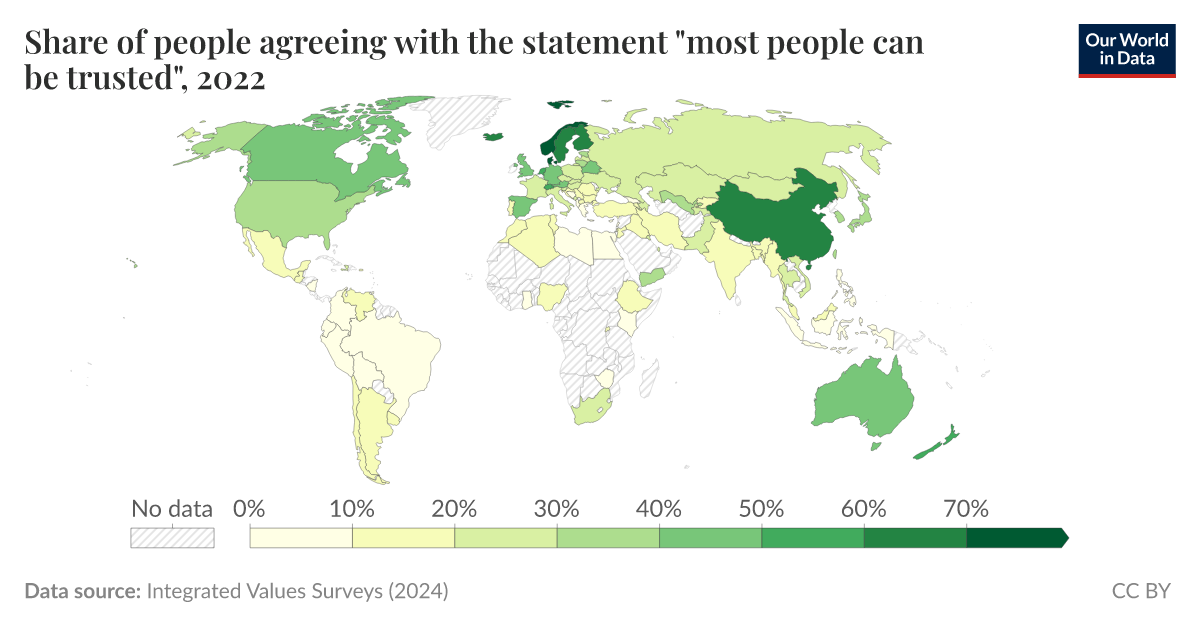
Pretty clear trend: low-trust societies have low gdp and high-trust societies have high gdp, regardless of resource distribution. Africa/South America are resource rich, japan/iceland are resource poor.
I can easily conjure a scenario where high per-capita GDP makes trusting easier (either because there’s enough to go around and/or because there are reliable police/judicial sanctions for violating trust) than in a hardscrabble low per-capita GDP society with lower (insufficient?) lawfulness.
Yemen and the US are equal shades on that trust polling map. That alone should show you it's not really a factor.
India has a higher GDP and GDP per capita than it's neighbor Pakistan, but Pakistan has quite a higher trust score on your map than India.
There are many more examples, just these jumped out at me.
I don't meant that everybody should be nice, and that poor countries are somehow culturally nasty, absolutely not. Real collaboration cannot be just founded on morals and good faith, it's not sustainable, it's more about incentives engineering.
In terms of references, the main one that comes to mind is the economics Nobel price from 2024: "for studies of how institutions are formed and affect prosperity".
if this is true, then the public servant would earn only till he becomes rich equivalent to private sphere job. but nope, they go all the way in.
"Therefore Socrates said that it wasn’t enough to use the intellect in all things, but it was important to know for which cause one was exerting it. We would now say: One must serve the “good cause.” But to serve the good cause is—to be moral. Thus, Socrates is the founder of ethics.
"Socrates opened this war, and its peaceful end does not occur until the dying day of the old world."
Plato/Socrates are the original ghost story tellers. I spit on their grave. Republic is easily one of the worst books written in human history in terms of its impact. Right up there with Das Kapital.
Sometimes highly shrewd rich countries infiltrate the power structure of poor countries through N-pronged strategy to keep them stuck in a rut so that they don't become future threat, also extract their resources in the meantime.
And the last century showed that this also works at a large scale, we all got a lot richer as a global community by letting poor countries develop and doing business with them, instead of exploiting them to death.
Like the story of Thomas Sankara's assassination by his trusted childhood friend Blaise Compaoré is quite disturbing. It seems like Compaoré was leader for a very long time and is still in politics... I cannot think of a more morally deprived individual. If game theory was as claimed; nobody should want to work with such deeply disloyal and psychopathic individual. It's just like I say; people have a strong tolerance, even attraction to abusers. If you look at the real story, you notice this pattern over and over... but we are so badly gaslit about such things (aka 'PR') that we don't notice.
If your comment was true that fact wouldn't exist.
We may consider the world we live in today competitive, but at the end of the day, humanity is a globe spanning machine that exists due to cooperative behavior at all scales.
Comments such as yours are really missing the forest for the trees.
I suspect that it's really the fact that cooperation is so powerful and pervasive that makes it normal to the point where any deviation from it feels outrageous.
So you focus on the outrageous due to availability bias (seeing the trees rather than the forest).
Evolution does not work maximizing individual success.
Yes it does. In fact, unless you want to get nit-picky about intra-gene, inter-allele selection, that is _exactly_ what it does.
I think I understand the GP pretty well. Cheating, or defection in the language of evolutionary theory, is subject to frequency based selection, meaning it is strongly selected against if its frequency is too high in the population. It's not a stable strategy.
It can be a winning strategy for a few individuals in a cooperative environment, yes, but it breaks down at a point because the system collapses if too many do it.
And yet, cooperative systems are common and stable, which is my point.
Chance to pass genes forward. This is only equivalent to individual fitness for very solitary species and humans aren't.
As an extreme example, take soldier termites - their chance to pass their genes is zero, but the chance for the colony to survive grows. Also gay people exist (they also - usually - don't reproduce, but help others instead).
Humans naturally care about their family and tribe because this increases the chance of their bloodline to survive.
In evolutionary theory this is made clear by using the term "inclusive fitness" - worker ants actually pass their genes on to future generations more effectively by taking the detour, if you will, through the queen.
If you want to be nitpicky and argue we should consider the individual gene the unit of selection, as Dawkins famously argued, I'm not going to disagree, you can see it that way too.
That specific distinction very rarely leads to different predictions though.
I'm not trying to be a shit, but your post comes across as either very gatekeeping or just snotty for no good reason. Do you have arguments to support what you're saying other than a hand-waving dismissal of the site?
Read any serious philosophical work and the first thing it does it tells you what it’s assumptions are about the world and basis for reality.
At no point does this website do that at all it just assumes a lot of background and then jumps into this concept that there exist these “win-win games” with a bare grounding in game theory, and that all we need to do is pull the concepts out of existing structures without acknowledging any of the foundational structures or any of the epistemological Foundations of the claims.
My primary problem with it is that it sneaks in a bunch of factually incorrect and problematic concepts like the idea of capitalism as win-win which has been thoroughly debunked by Proudhon in “What is Property” and expanded on by Graeber in his book Debt
I don't think "Proudhon debunked this" is going to change anyone's mind. I don't find his arguments particularly compelling, even taking the historical context into account. I see him as trying to take a moral position and then trying to shoehorn it into an economic theory. The spirit of the underlying moral position is much more interesting than his pseudo-intellectual attempt at rigour.
Why? because the plurality of people in the late 19th century when all these things were being written was still primarily smallish groups with limited capacity to generate impactful externalities. Read: Engels formation of the family, property etc..
While there was global capitalism, it had not entirely consumed the entire globe at that point
Ad of today there are no parts of the globe that are free from the reach of some property owner attempting to extract a resource from property that they do not control. There are no indigenous peoples that are free from the effects and impact of global climate change as a function of global capitalism
That’s just as fact
> Critics of affirmative action often commit the fallacy of letting a failure in one area doom the entire enterprise. This ignores the interdependent nature of affirmative action. [1]
Affirmative action sets up a zero-sum game where fixed resources like university admissions and employment offers are redistributed to people with the "correct" demographics. The conflict is not a disagreement over effectiveness. It's a misalignment between meritocracy and equity.
AA is being used as an example of the failure mode where:
"The failure of a single component does not mean the program is fatally flawed; rather, it highlights the need for a comprehensive, coordinated approach"
Indeed, I'm sure the author would agree that part of the comprehensive solution is to increase the amount of university admission slots.
The implicit argument is that AA's largest challenge is a coordination problem. It's not. It's a clash in values and a fight over zero-sum rewards.
I am with the author on this one. Creating better educational outcomes (for all students) is a coordination problem.
The point is that the author picks some arbitrary critique and calls them fallacious, when the core of the disagreement is elsewhere.
This is is such a weird non-argument dressed as some gotcha. "Some critics of x are committing y fallacy" is probably universally correct statement. It is so devoid of any meaning that this particular type of discourse has not only a name, but a mascot too.
This is evident in later paragraphs:
> Often it won't be obvious what issues need to be addressed in a coordination problem, which means despite our best attempts to find points of weaknesses while researching and designing a plan, the nature of a coordination problem is that missing one element can lead to failure. If we eliminate individual failed solutions as options it becomes impossible to find the successful coordinated solution.
A statement is made here that a failing individual solution can still be a part of a working coordinated solution, which is not inherently wrong in itself. However, another point raised in this paragraph is that it is supposedly impossible to evaluate suitability of an approach without finding a successful coordinated solution. This marks every failing policy as potentially part of a working coordinated solution and therefore a claim that a policy is part of such a solution inherently unfalsifiable.
> Coordination problems are a particular type of non-zero-sum game, and they are all around us. Until they are solved, they are very much a negative-sum game. The key to solving coordination problems, including affirmative action, is understanding all variables, designing a system-wide approach, and not letting a failure in one area doom the enterprise.
Here affirmative action is defined to be a coordination problem precisely over failure of existing, supposedly uncoordinated, approaches.
If the author could propose an affirmative action program that didn’t have that “single component” at the core of how it operates then I’d be more interested in the argument, but as-is it just feels like an attempt to forcefully ignore valid criticisms.
Either way, seems like a very narrow distinction you are drawing when he is making the meatier claim that affirmative action is fundamentally flawed.
Admittedly, the article does a bad job framing that as the real goal while AA is a specific component. It makes it sound like AA in admissions is the goal itself.
There is a lot more work to do to prove that "investing in education for historically disadvantaged groups" doesn't improve society at large.
A large part of the value of elite education is its scarcity, and adding more slots dilutes that value.
That's a stupid thing to value. Nothing worthwhile is gained by limiting education to a select few. The value of an elite education should be the actual education. Plenty of very wealthy idiots get a golden ticket to an "elite education" and are still uneducated idiots afterwards. If a large part of the value is nothing more than giving others the perception of having a lot of money or connections we should probably come up with other ways to signal that.
No doubt in a world of 8 billion people, there exists someone, somewhere, who has for some reason voiced the belief described - i.e. that if institutions really heavily based their selection of applicants on skin color rather than merit, that would be good, but that because in reality institutions have only been convinced to somewhat compromise on merit-based selection in favour of skin-color-based selection, it's bad, and should thus be abandoned completely in favour of total meritocracy. But that belief would really be rather odd, and I have never seen it expressed even once in my entire life.
Nor am I convinced, despite its oddness, that it is properly considered to contain a fallacy! After all, sometimes it really is the case, for various reasons, that some endeavour is only worth doing if total success can be achieved, and not worth the downsides if you can only succeed partially. No doubt if someone really held the allegedly fallacious view described, they would believe affirmative action is exactly such an endeavour and be able to explain why!
How many people actually hold such beliefs is a debate between you and the author.
Everything looks like zero-sum if viewed as a static, local model.
(See Caplan's Case Against Education.)
I wish I could find the source, but the vast majority of universities don't have a fixed admissions quota. They are criteria based (if you meet the criteria, you get in). In principle, AA admissions did not prevent others from getting a seat.
Of course, it's possible the general admissions criteria is raised slightly to compensate, but again - for most universities, AA admissions wasn't a significant number, and however much the bar raised, it was likely minuscule.
I'll be blunt. Everyone I've personally known who didn't get admissions in a particular university and blamed AA for it was trying to get into a top school, and likely didn't earn his spot.
> We sometimes run into problems where a number of factors have to be addressed simultaneously in order for them to be effective at all. One weak link can ruin it for the rest. These are called Coordination Problems.
Coordination problems are about multiple actors choosing interdependent outcomes, rather than a problem that needs everything to be done right. This sounds more like a "Weakest Link" problem than a coordination problem.
Not that it invalidates the rest of the post, but it did make me dig in more into the person's background and showed that they're more of a journalist than a game theory expert.
Due to this, people considered affirmative actions to correct for this skew. That would actually make it a meritocratic motivated AA.
And then you have the idea of missed potential. Those who weren't given the opportunity to develop, it limits the pool of exceptional candidates. It's similar to when black athletes weren't allowed in sports. We thought we had a meritocratic process, but we were artificially limiting those with potential. The challenge is bigger here, so you need a bootstrapping process, because you're faced with a chicken and egg situation. You wouldn't know if it works or not unless you give it at least one if not two generations to take effect. I admit that this is the more controversial one, as it means temporarily favoring disadvantaged groups to bootstrap things. I just wanted to point out that there's a meritocratic angle to it as well.
Equity doesn't mean give those that suck a boost. It means give those that weren't given the environment to develop their full potential a chance at it, they may end up being even better than the alternative.
> You had examples of CVs with woman names removed getting more callbacks
That is not meritocracy.
A meritocratic process by definition is not prejudiced or biased. There were studies that claimed to show processes to not actually be meritocratic. In my experience, these findings either haven't reproduced or don't appropriately account for confounders; and if they held up they would be pointing at things that are already illegal (and irrational).
> It's similar to when black athletes weren't allowed in sports. We thought we had a meritocratic process
What? How do you come to the conclusion that "we" thought any such thing? The term (https://en.wikipedia.org/wiki/Meritocracy) was coined in the 50s for socialist criticism invoking satire. The discourse had nothing to do with race and was about disputing how merit is measured, not about supposed prejudices (except perhaps class privilege). Nor did coaches, managers etc. imagine any inferiority on the part of black athletes in regards to physical prowess. Segregation was to keep the peace; see e.g. https://en.wikipedia.org/wiki/Baseball_color_line :
> Before the 1860s Civil War, black players participated in the highest levels of baseball.[2] During the war, baseball rose to prominence as a way to bring soldiers from various regions of the country together. In the aftermath of the war, baseball became a tool for national reconciliation; due to the racial issues involved in the war, baseball's unifying potential was mainly pursued among white Americans.[3]
Anyway,
> You wouldn't know if it works or not unless you give it at least one if not two generations to take effect.
This time lapse isn't required for a moral judgment, however.
> Equity doesn't mean give those that suck a boost. It means give those that weren't given the environment to develop their full potential a chance at it, they may end up being even better than the alternative.
An employer, or a college admissions officer, cannot provide what was missing from someone's "environment" during the formative years, and should not be expected to try; nor ought they shoulder the risk of anyone's "full potential" being absent. Everyone might as well hire randomly from the general population at that point.
AA advocacy exposed cracks in systems that claimed to be merit based and pushed reforms like anonymization and structured evaluation, which made selection more merit based, not less.
Merit is noisy and ties are unavoidable. When candidates are effectively equal, a tie breaker is required. The old default was incumbency and other status quo dynamics that favored the existing cohort. Random selection among equals would be defensible. Favoring candidates from groups historically denied opportunity is another possible tie breaker. You can disagree with that choice, but it is coherent to see it as pro merit rather than anti merit.
And that's just my point, some proponents of AA were arguing for better merit based systems, not all, but a lot did.
Pulls a lot of weight there.
> AA advocacy exposed cracks in systems
No; it proposed a supposed justice for those former social boundaries.
> and pushed reforms like anonymization and structured evaluation
No, these are clearly not anything to do with AA programs as actually observed today. It's extremely disingenuous to attribute the "colourblindness" of the 90s to "AA" and then use that to justify the explicitly race-conscious policies of today.
> You can disagree with that choice, but it is coherent to see it as pro merit rather than anti merit.
No, it is not. It completely ignores what the word "merit" means.
A lot of proponents of affirmative action will agree with this. They'll explicitly acknowledge that people admitted under AA will be underqualified, due to factors mentioned in the article:
[Minorities] may lack foundational skills (taken for granted in more affluent households and schools) and therefore might require breaks from study, which can lead to dropping out. They might have developed unhelpful habits or attitudes formed in teen years, or a sense of identity tied up with being part of a historically maligned group, affecting confidence and performance. [Affirmative action] does nothing to address these factors.
It would be a sad day indeed, were America to become a quota-ridden society, with each identifiable minority assigned proportional representation in every desirable walk of life. But that is not the rationale for programs of preferential treatment; the acid test of their justification will be their efficacy in eliminating the need for any racial or ethnic preferences at all. […] It has been 25 years since Justice Powell first approved the use of race to further an interest in student body diversity in the context of public higher education [California v. Bakke (1978)]. Since that time, the number of minority applicants with high grades and test scores has indeed increased. We expect that 25 years from now, the use of racial preferences will no longer be necessary to further the interest approved today.
Yup. Though there is a third option: completely ignore the meritocracy vs. equity zero-sum game and simply argue that demographic-based weighting of applicants is an ineffective way to rectify those historical injustices. It is treating a symptom, not the underlying disease.
Is there any effective way to rectify them or the underlying disease that you'd recommend?
It turns out that the government forcing racial integration actually works! Being a "quota ridden society" would be good for America.
By American constructions of race, almost everyone in Singapore is of the same race.
Even going by genetically objective ethnicity, almost three quarters of people in Singapore are Han Chinese. It's not remotely comparable to the American situation.
https://en.wikipedia.org/wiki/Race_in_Singapore
> and they have by many metrics, the best standard of living in the entire world.
As self-reported by people from cultures that happen to share common values. They rate higher on HDI than the US, sure; but so does the UAE, and Slovenia is almost as high. They're unusually wealthy per capita, but so is Ireland (capitalist shell games). And there are a lot of things the average American probably wouldn't like about that society, e.g. the strict rules against littering and the threat of https://en.wikipedia.org/wiki/Caning_in_Singapore .
That's the argument for it, not my belief. The argument for AA is that the so-called meritocracy had/has its own unequal distributions.
If that was the case it would be based on family wealth/income.
AA just pushes against THAT, for better or worse.
The most neutral way I can put it: Every school turns away a LOT of equally qualified applicants, at some point decisions must be made. Next issue, schools don't exist purely for the benefit of the students, but the world at large. This is why you want a -- dare I say it -- diverse population. To maximize the good your students can do.
Now, one may not love race as a proxy for this, but it's at least arguably a workable solution.
> with slots going to the rich and privileged) [...] AA just pushes against THAT
It doesn't give away the slots reserved for the rich.
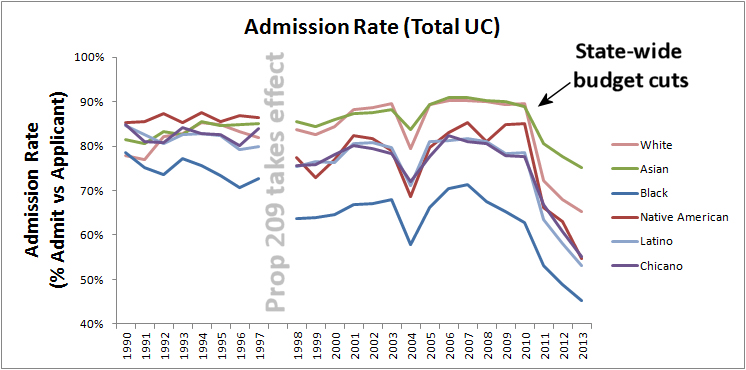
And it's not a tiebreaker between equally qualified candidates. At Harvard, Africans who performed in the 4th decile were admitted more often than Asians in the 10th decile. [1]
[1]. See page 11 (by document numbering). https://www.supremecourt.gov/DocketPDF/20/20-1199/169941/202...
In a purely meritocratic sense, all other beings equal a university that provides a diverse faculty and student body will better educate its students than a university that doesn't, all other things remaining equal.
If the team uses relational databases but someone shows up to an interview with a strongly held belief that NoSQL is the way to go, they’re likely to be rejected because their ideas don’t match the team’s. Same if the team strongly believes in some version of agile but a person they interview doesn’t like agile. Diversity programs in practice never even attempt to push diversity of ideas, they ignore all of that and focus on things like gender and ethnic background.
This feels like a dangerous opinion to voice, but the workplace affirmative action programs I’ve seen in practice have been very poor in their implementation. At my last workplace that instituted diversity targets, HR would just start rejecting hires if they thought it would skew the diversity numbers in the wrong way. So you’d hit a wall where the only candidates you were allowed to hire couldn’t be, for example, men or of Asian descent or some other demographic trait they thought was over-represented. None of this improved diversity of ideas, it became a game to find a person whose ideas matched the team who also happened to have the right gender or skin color to keep our diversity statistics going in the direction HR demanded.
That sounds hopelessly naive.
In a zero-sum game, you just min-max and that's it. No hard feelings.
Non-zero-sum games is where you pre-emptively nuke your neighbour.
See also https://www.lesswrong.com/posts/tJQsxD34maYw2g5E4/thomas-c-s...