53 pointsby ourmandave11 hours ago8 comments
  • wongarsu11 hours ago
    "ridiculous precision" being 1km resolution. Considering how one of the author's said "The U.S. taxpayers have a right to this data" I really wish they had put up a web viewer

    Here's the paper: https://www.nature.com/articles/s41597-025-06391-w

    And the data as a bunch of zipped geotiffs: https://zenodo.org/records/15446748

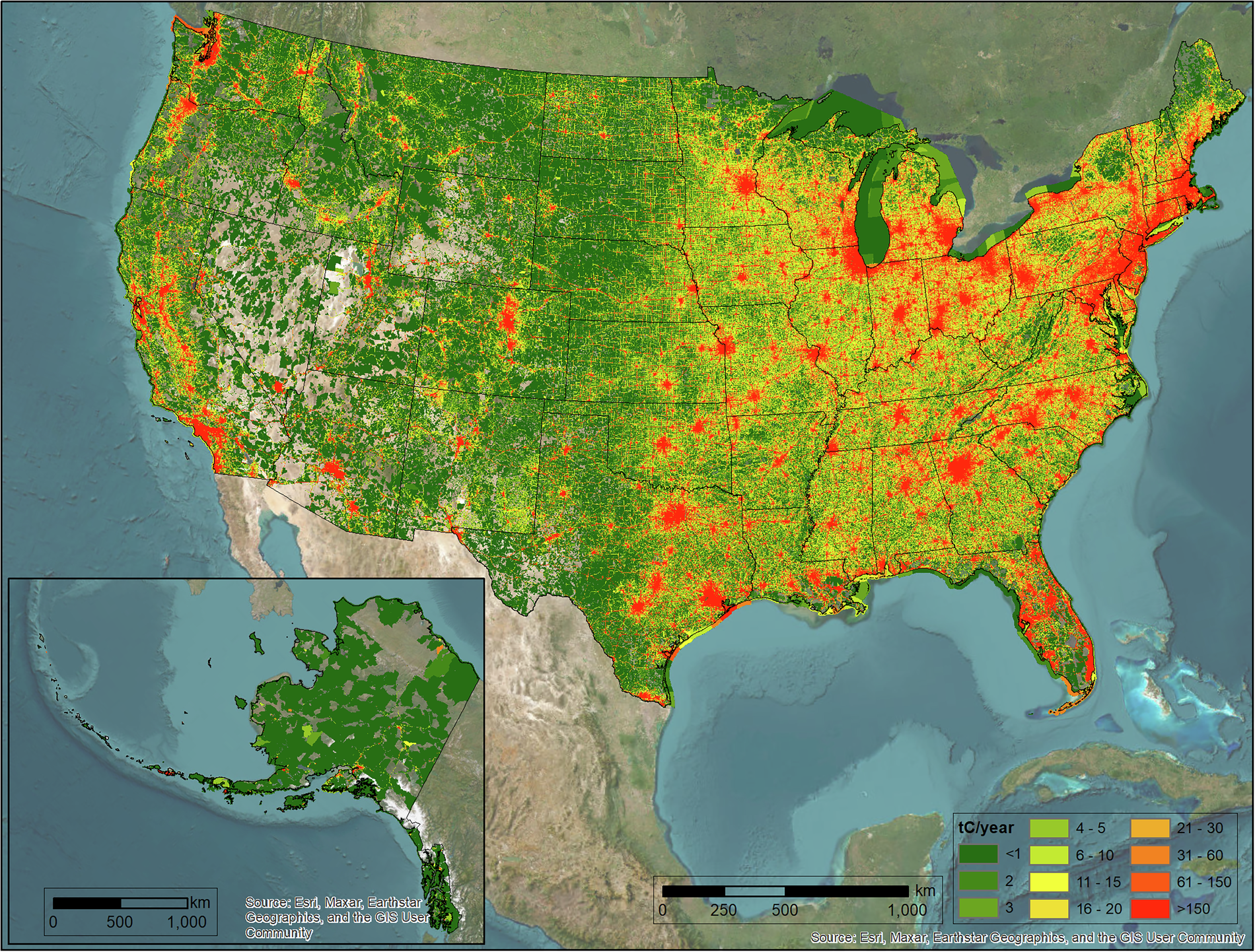
    A reasonable-ish resolution version of the headline image (total CO2 emissions 2010-2022): https://media.springernature.com/full/springer-static/image/...

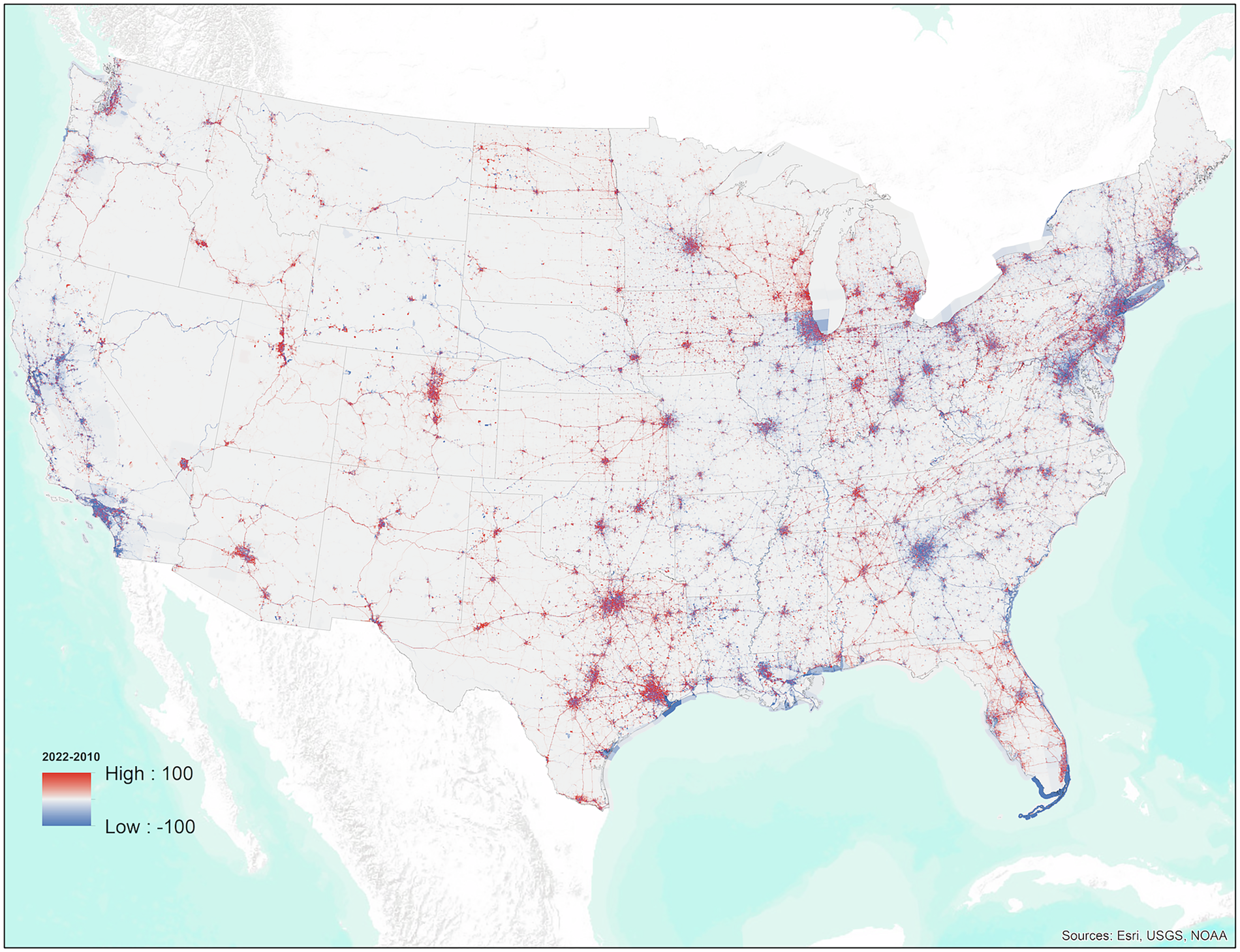
    And my favorite: Difference in CO2 emissions between 2010 and 2022: https://media.springernature.com/full/springer-static/image/...

    • vegetablepotpie10 hours ago
      Is that the full dataset?

      “The output constitutes many terabytes of data and requires a high-performance computing system to run,” co-author Pawlok Dass, a SICCS research associate, said in the release.”

      The largest zip file I see on the zenodo link is 404 MB in size, I’d be surprised if it unzips into anything more than a few gigabytes.

      • wongarsu9 hours ago
        I'd be happy for someone to find more data. I just followed the links: the article links to the release [1] which contains the same quotes. That release links to the paper, published yesterday [2]. The paper contains a section "Data availability" which links to the dataset [3], and it also explains in detail what is inside, unambiguously referring to that dataset. The gizmodo article also directly links [2], so there isn't much room for ambiguity there.

        I think the clue is in the sentence "this map is actually a high-level visualization of the data Vulcan provides". The source data is terabytes of data, they boiled it down to a couple of maps with 1 square kilometer resolution. Maybe the next data releases will contain more.

        I don't have a clue how we go from this dataset to "down to every city block, road segment and individual factory or power plant". I guess some refineries can be measured in square kilometers, and it's a pretty good resolution for looking at highways, but other than that it seems like an exaggeration.

        1: https://news.nau.edu/gurney-co2/

        2: https://www.nature.com/articles/s41597-025-06391-w

        3: https://zenodo.org/records/15446748

    • cheschire10 hours ago
      The article claims precision to a city block or individual factory?
  • korkoros10 hours ago
    At 1km resolution, this is largely just a map of US urbanized areas. The spatial variation isn't that interesting. The temporal variation and the absolute values per spatial unit are the greater value of this project.
    • JimmyBuckets9 hours ago
      That is unfair. The largest co2 producers are also large in size. I think 1km resolution is more than sufficient to identify the source of the majority of emissions - e.g. factories, power plants, buildings, etc. Even if the resolution is not fine-grained enough for definitive identification it reduces the scope to manageable size for more detailed investigations.
  • wood_spirit9 hours ago
    A better link would be the press release with the map? https://news.nau.edu/gurney-co2/
  • epaga9 hours ago
    Look at that, it correlates to Martha Stewart Living subscribers. https://xkcd.com/1138/
  • Lerc9 hours ago
    I'm interested in how accurate "America’s Dirtiest Carbon Polluters" is when they are measuring "CO2 emissions from fossil fuel combustion". I assume the majority of carbon pollution comes from fossil fuel combustion, but that is just an assumption. It would be nice to have that explicitly shown.

    A quick search suggests %90 percent of human caused CO2 emission is from fossil fuel consumption (things like calcium carbonate produce half of cement emissions). All cause emissions of CO2 dwarfs human emissions, but as part of a cycle that consumes CO2 as well.

    • Lerc9 hours ago
      I am curious as to what part of this comment is accruing downvotes, it seems entirely uncontroversial. Are readers interpreting it as taking a stance on something? If so, in which direction?
      • 8 hours ago
        undefined
  • jmclnx8 hours ago
    So high population areas emit more carbon, who knew :)
  • 6 hours ago
    undefined
  • jgalt21210 hours ago
    CO2 is not inherently "dirty", so I'd argue that if the headline is advocacy minded, it's probably working against itself.
    • Rygian10 hours ago
      CO₂ is inherently dirty, except where it happens naturally. See for example: https://iere.org/carbon-dioxide-an-air-pollutant/
    • black66 hours ago
      CO2 is plant food. It's amazing how the spin has affected so many generations. Much much worse than that for the environment are particulates from incomplete combustion, NOx from poor combustion, et cetera.
    • gspr9 hours ago
      > CO2 is not inherently "dirty", so I'd argue that if the headline is advocacy minded, it's probably working against itself.

      This derailing tactic is working against us all. You're trying to nitpick how a term is used, without acknowledging that the term is imprecise as is. It's not relevant whether we call carbondioxide "dirty" or not; man-made emissions of it are a huge problem.

      • oceanplexian9 hours ago
        I think the parent has a valid point. What's the big deal with simply stating the facts?

        When I think about dirty industry I don't think of CO2, I think of Sulfur Dioxide, Nitrogen Oxide, etc. For example a Natural Gas plant that emits CO2 is not even remotely "dirty" the way that a Coal plant is. When you trivialize the issue you're training people to stop caring about pollution that actually causes acute and immediate health consequences to the people around it.

    • idiotsecant9 hours ago
      I'm not sure the problem is how 'dirty' a source is, whatever you think that means. What's important is how much that source increases the net carbon content in our atmosphere. Unless you're burning wood (which is a vanishingly small proportion of all carbon release) you're releasing carbon that was bound on geological timescales, which is massively changing that balance.