The coolest thing about solar is that the devices to capture the fusion energy in the skies are manufactured, unlike other options being built. I'm not anti-nuclear but I don't like its extremely long building phase.
I sometimes fantasize about closed loop fully automatic solar PV panels factories that we can build on some remote area, just bring in the raw material and let it auto-expand using the energy it captures. As it grows geometrically at some point we can decide that we no longer want it to grow and start taking out the finished PV panels and installing them everywhere.
Storage for the night probably wouldn't be that much of a problem, not everything needs to work 24/7 and for these things that need to work 24/7 we can use the already installed nuclear capacity and as the energy during the day becomes practically unlimited we can just stor it however we like even if its quite inefficient. With unlimited energy space wouldn't be a problem, we can dig holes and transfer materials into anything we need with the practically free daytime energy.
https://ember-energy.org/latest-insights/solar-electricity-e...
It's saying solar + batteries is enough to supply 97% of power cheaper than any other way in sunny locales.
It's possible to get 99.99% of your power with solar + batteries, you'd just need a lot of batteries. The news is that batteries have got so cheap that you're better installing enough batteries to hit 97% and leave your natgas peakers idle 97% of the time. That number used to be a lot lower, and that 97% number will be higher every year.
The other cool thing about that report is that it gives a number of 90% for non-ideal places. Sure solar is cheap in sunny locales, but that solar is cheap in places that aren't sunny is far more exciting to me.
A small amount of other power generation whose output isn't correlated with the sun overhead should do a lot to make the last few percent (which come up when there's many cloudy days in a row) cheaper.
Solar's just knocking it out of the park at this point. Building out anything else new (as in you haven't already started) doesn't really make sense.
That said, using it in aircraft (and a number of boots/submersibles) economically is an unsolved problem, but many other places can use it.
E.g. if a {1 kWh, 1000 cycles} battery costs USD 50 to make, and it's made using electricity that costs USD 0.1/kWh, (USD 50)/(USD 0.1/kWh) = 500 kWh. If it needed more energy than that, they would be getting sold at a loss. As a bonus point, this upper bound naturally includes the entire supply chain including the personal purchases of the people working in the factories that make the batteries, all the way up to any waste from e.g. unnecessary private jet flights made by unwise billionaire owners of the battery companies.
This example battery then allows you to time-shift 1000 kWh of electricity from day to night before it needs replacement or refurbishment.
But note the difference between "energy" and "electricity". This kind of calculation is made more complicated by the actual energies used being quite diverse in cost and type, e.g. Pacific-crossing cargo ships are mostly fossil fuelled, the stuff the mining company uses could be any mix of electric or fossil, the aluminium is extracted from ore electrically but any steel probably isn't, etc.
The ecological cost is also strongly dependent on how far the world has gone in greening itself before that battery was made. The first Li-Ion batteries were made in an industrial base that was mostly fossil powered, new ones in China are made in an industrial base that gets 35% of its electricity from renewables.
No, you got this exactly the wrong way.
In fact, it was Russia who initially funded European (German) "green" movement, their main purpose was opposing nuclear (by far the greenest elective source of energy, as evidenced by France's carbon footprint), so that Europe (Germany) would get hooked on Russian gas.
The plan worked brilliantly!
But beside this, Germany was leading in the anti-nuclear movement, and finally shut down there last nuclear power plant two years ago. Currently, in Germany, renewable energy sources [1] are around 75% in the summer and and 55% in the winter month. Renewable are growing fast [2].
[1] https://www.energy-charts.info/charts/renewable_share/chart....
[2] https://www.energy-charts.info/charts/remod_installed_power_...
[1] https://www.energy-charts.info/charts/import_export/chart.ht...
Also the initial green movement was not against nuclear power per se but rather a peace movement against nuclear weapons, the concept just expanded over time to cover also civilian nuclear power, notably after Tchernobyl.
In contrast Russia is indeed known to finance both the far left (which has a lot of 'Ostalgia') and far right (whereby nationalism works against Western unity and strength) movements.
Tbf, perhaps that is still an instrinsic problem with nuclear, that it isn't easily ammenable to economies of scale the way solar pannels or fossil fuels are.
Historical evidence therefore rather suggests nuclear isn't economical at any scale once active subsidies are out. Current nuclear power plants under construction in the US or Europe, or recently completed there add more than evidence for high cost and major overruns to the pile.
Of course, one can go all conspiracy and claim that's only because of the deep anti-atom lobby, and because the cheap SMRs have always been torpedoed, or because Thorium molten salt reactors have been secretly killed by the military-industrial complex or whatever.
Occam's razor makes me think though, could it just be that nuclear was, is, and likely, at least for quite a while still, will be just so friggin' expensive that pretty much any "alternative" is more economical?
(back-of-envelope calcs say that if ~1.5GW electric from a new nuclear power plant cost ~20..40G$ to build .. between ~13..28$/W ... solar is <1$/W, there's a lot of spare change for batteries in that. Ok, that's pub talk. Still, if I have influence where my money goes, I'd only grudgingly accept nuclear for base load, subsidised as needed. Economics say, build what's cheap capex to build and then gives zero-opex energy when "running". There's no economic alternative to the "alternatives")
And if economics were the only hurdle for SMRs, the arctic would be full of them. Flying in diesel or jet fuel to run generators is expensive as hell.
As far as the anti-atom lobby, they're like right there, out in the open, proud of what they do and vocal about it. It's no conspiracy.
Economics is a reason for the lack of nuclear after the 80s, but it's far from the only one.
So what? Capitalism doesn't work from any point of view.
(because the German anti-nuclear-energy movement and the rise of the Green party all got kickstarted by the Chernobyl disaster)
Large grids, overbuilding renewables, diversity of renewables, short and medium term storage, and load shedding/dynamic pricing are all good starts but IMO won’t be enough— we should scale up nuclear too.
Where we're replacing fossil fuel heat with a heat pump we don't get that efficiency improvement from motors - burning fuel was 100% efficient per se, but the heat pump is > 100% efficient in those terms because it's not making heat just moving it.
Nuclear is much less popular than almost any generation technology, so you're fighting a significant political battle to make that happen.
Reaching current nighttime use with storage and wind and existing hydro looks infeasible, and we need a minimum of twice as much.
Power to gas (and back to power or to mix with natural gas for existing uses) is probably a part of this, but nuclear improves this (allowing there to be less of it and allowing the electrolysis cells to be used for a greater fraction of the day.
Its usage is technically accounted for in fossil fuel extraction numbers, but generally ignored when people are accounting for total electrical generation and the usage of fuels as heat sources.
Canada needs between double and triple the electricity generation of today. Canada may not be the best example but there is a lot of uncertainty, especially around climate. it is not unreasonable to expect that places like Europe and India will increasingly add air conditioning, pushing the required grid capacity to double today's.
What are the caveats of your 30% figure?
https://natural-resources.canada.ca/energy-sources/powering-...
I suspect you are quoting an EV-only number.
Alternatively, you might be looking at how much electricity demand is expected to increase if we maintain our current trajectory and don’t aggressively decarbonize.
Even at the high end efficiency, this is enough that you can burn the gas centrally in a generator, lose 40-60% of it as heat as is standard with fossil electricity generation, lose a few percent more electricity in transmission and still come out ahead overall.
And of course, that's a lower bound as you'd ideally be generating electricity from other sources like solar and wind and battery and keeping the gas generators for when needed, making use of the giant scale gas storage most countries already have.
The scale is such that if we imagine a future with fully electrified cars, the batteries in those cars are more than enough to load-balance the current uses of the grid, and still are enough for the current uses of the grid when those batteries have been removed from the vehicles due to capacity wear making them no longer useful in a vehicle.
The best time for more nuclear power was the 90s, the second best was 10 years ago; unless you have a cunning plan you've already shown to an investor about how to roll out reactors much much faster, I wouldn't hold your breath on them.
This assumes you can do just the condensation during the day— E.g. you are amortizing the electrolyzers capital cost over just times when there is surplus power instead of something closer to 24/7.
With a 5x higher LCOE and lead times of 15-20 years instead of 1-2 for solar/wind deployments, allocating money to scale up nuclear as well will just make the transition happen slower and at higher cost.
Cost is currently $35/kWh, dropping 20% per year.
Total installed system costs— not batteries alone— are estimated at $300B/TWh. So that is on the order of $30T at current prices (some estimates reach to $100T). And of course, these investments don’t last forever— we can’t be kicking 3pc of GDP to storage.
I expect this to improve, but having some clean, always-on generation greatly reduces the amount of storage and overprovisioned production of other types needed.
Similarly, 100 TWh sounds like a huge number, and it is, but it's like the equivalent capacity of one base Model 3 per 6 people globally. It's a lot in absolute terms, for sure, but it's by no means a crazy unachievable quantity of battery for a family of 6 to use.
That is assuming we can hit that scale in the next couple decades and that nothing happens to push up costs with increased scale. More likely is a moderate cost increase, but who knows? Putting all our eggs in the battery storage basket is not great.
Just a few percent more stable base generation in the mix would greatly reduce the amount of storage needed and open more options (e.g making power to gas more reasonable)
It may be cheaper overall; it may not be. But even if you think this is modestly costlier, reducing risk and volatility of outcomes is something that one often chooses to pay for.
Idk, it seems like even pretty pessimistic arguments with frozen costs and early retirements suggest this is cheaper than the numbers you gave.
> That is assuming we can hit that scale in the next couple decades and that nothing happens to push up costs with increased scale.
This strikes me as odd to posit about a technology that has had a steady 23% cost reduction per doubling over the last 6 decimal orders of magnitude.
Replacing it all on a 20 year cadence seems like a reasonable assumption.
Arguments assuming a positive return to scale 4 orders of magnitude out may be true— or may be unduly optimistic. I don’t like to have too much faith extending the lines too far off the right of the graph. When that is required, I want whatever margin and ways to reduce risk as possible: which is why I would like more nuclear in the mix. A grid with 12pc nuclear and the rest renewable (so about 3-4pc of nameplate power nuclear) would require much less over provisioning and storage.
Replacing the whole system every 20 years still seems really wild to me, especially in worlds where price doesn't fall past the cost of maintenance, because the only wear part is the battery, and batteries are modular. We could, sure, I just showed the cost is a fraction of today's energy spend, it just seems really weird not to do something smarter instead.
It may be pessimistic. At the same time, you amortize things based on history.
Things like substations are amortized over 30-40 years. Battery banks don't have the history; a 20 year timeframe seems like a reasonable amortization time. Indeed, if technology improves and costs reduce like people are advocating for here, it'll be thrown away and replaced. If it wears out in ways that don't justify refurbishment, same. And refurbishment/recycling/etc are not well understood processes at scale, yet, nor are future usage patterns well enough understood to know if we will have those resources at the right places.
Again, we could get lucky: batteries could last longer than expected; we could use technologies that are close enough cousins and have a really good time at refurbishment; we could not hit any kind of scaling limitations with battery storage; etc. I agree battery storage is great. And I agree it could be sufficient alone (well, combined with other storage options) if we hit the top third of possible scenarios.
I just am concerned about the other scenarios. I can't rule them out. And if we're going to have insurance against them, it's time to buy it now.
I'd much rather face a future where people say that we wasted a few tens of billions on nuclear power plants than to face a future where people shake their head that we wasted the opportunity to save the climate by foregoing nuclear.
Isn't that the whole debate? What are we arguing about at this point?
I'm sorry, I don't think that cost is readily affordable!
> You agree that there's a reasonable chance the price could go down
I think the most likely outcome is that the price goes down. But I also think it's possible that the price goes up (decreasing returns to scale) as you try to build more.
> agree that parts other than the battery chemistry do indeed last much longer.
We often depreciate substations at 40 years despite parts inside lasting longer, and we have a whole lot of experience to value that. We don't have a lot of experience with long term lifecycle of batteries. E.g. recycling and decommissioning of batteries at scale is still a big unknown.
Yes we can, indefinitely, and doing so saves money relative to fossil fuels (which are currently about $8T/year[0]) and nuclear (which is on the expensive side of electricity compared to fossil fuels anyway).
You're not considering cost.
>Unfortunately, a lot of these loads are closer to 24/7
The exact opposite is true. Heating, cooling and car charging are just 3 examples of current loads that burn fossil fuels which are already being demand shifted on an electric grid.
>The IEA net zero scenario assumes 100TWh of storage
Did you assume it was all going to be achieved with batteries? This is a common fallacy perpetuated by nuclear industry propaganda.
350GWh are being built in australia right now with zero batteries, and studies show there is plenty of geography suitable to build plenty more of that around the world.
Power2gas+solar+wind is still cheaper than nuclear power even though it's quite expensive.
>but having some clean, always-on generation greatly reduces the amount of storage and overprovisioned production of other types needed
and there is zero point if the cost is stupidly high (which it is) and we have the imagination to look beyond just batteries as a means of storing power.
Nuclear industry propaganda is alas not capable of such.
The costing mistake people always make is assuming p2g infrastructure can be operated at high duty cycle with an all renewable grid. If you need to amortize the infrastructure over a few hours per day it looks much less favorable. Of course, with a little more stable base generation in the mix, this assumption is less shaky. It doesn’t need to be a ridiculous amount.
More base generation simultaneously makes p2g more reasonable and reduces the total need for it (and total need to overprovision everything else)
And even if one disagrees that a small amount of additional nuclear reduces total system cost, it absolutely reduces systemic risk vs putting all of our eggs in the battery basket.
Pumped hydro is great for Australia, but the capability to increase hydro in most areas is much more limited. We are going to have to mostly do it with batteries and intermediate term storage with p2g.
Adding that as a base input cost too all storage technology just makes the entire enterprise unfeasible.
You also have to answer why this P2G infrastructure should buy your extremely expensive nuclear electricity when renewables and storage delivers way cheaper electricity.
Having a few percent of nameplate power being nuclear means much less total nameplate power, and allows loads like p2g for longer term storage to run more of the day (and means you need to tap the p2g less often, so you can have a -lot- less electrolyzer infrastructure— better utilization and less need).
Diversity of approaches lower risks and may lower costs.
Lets calculate running Vogtle at a 10-15% capacity factor like a traditional fossil gas peaker.
The electricity now costs $1-1.5/kWh. That is Texas grid meltdown prices. That is what you are yearning for.
The problem is anytime you try to force the nuclear costs on the consumers they will instead buy solar and storage and decouple themselves from the grid. There is no way you can try to "average" things out when distributed power production is involved.
The market is fundamentally a marginal cost one, no matter how you try to handwave with averages and what not.
I'm proposing we run it at a close-to-100% capacity factor, and overprovision solar by less. Make the grid 10-15% nuclear and the rest renewable (which means 3-5% of nameplate power is nuclear).
Use surplus daytime power to charge storage and power2gas. Use surplus nighttime power for power2gas for longer term reserve. Run electrolyzers and power to gas infrastructure during more of the day and make -their- capital costs less ridiculous by having off-hours electricity for them.
Build a lot less storage and a lot less overcapacity as a result.
> The market is fundamentally a marginal cost one, no matter how you try to handwave with averages and what not.
A marginal cost market looking just at KWh isn't stable: in that market, no one pays for grid stability, 99th percentile events, etc. If you're going to pay for things like stability, production at night, guaranteed power for industrial loads, etc: the picture is more nuanced.
I already told you. This does not work when the consumers can generate their own electricity through distributed renewables and storage. With distributed electricity generation the market fundamentally becomes marginal cost.
Please do tell me, how will you nuclear plant achieve a "near 100% capacity" factor in a grid where rooftop solar alone can meet 107% of grid demand. All utility scale renewables are forced off the grid. Let alone expensive thermal plants.
https://reneweconomy.com.au/rooftop-solar-meets-107-5-pct-of...
Said grid was supplied by 100% renewables (excluding a tiny sliver of fossil gas from the ancillary market for grid services) most of the past week. Averaging 82% renewables. In mid winter.
https://explore.openelectricity.org.au/energy/sa1/?range=7d&...
This is what you are up against. Tell me why this grid should build a nuclear plant.
Why should these electrolyzers buy your $190/MWh nuclear electricity when they can buy renewables producing zero marginal cost electricity? You still end up only making money on 10-15% of the time leading to the same calculation, you just don't get paid most of the day instead and are considering if you should shut down your nuclear plant to prevent fuel burn and wear and tear compared to what a thermal cycle costs.
> A marginal cost market looking just at KWh isn't stable: in that market, no one pays for grid stability, 99th percentile events, etc. If you're going to pay for things like stability, production at night, guaranteed power for industrial loads, etc: the picture is more nuanced.
Which is why we have ancillary services? Your problem is that you don't know that nuclear power generally doesn't participate in the ancillary markets. It produces too much when no one wants it and too little when it would be needed.
Nuclear power is fundamentally unfit for our modern grids.
I want a market where we pay for things like stability or generation at certain times of day. And I want it regulated, so that we buy enough of these things. This, incidentally, is how well-functioning electric markets have operated for a long time.
> This does not work when the consumers can generate their own electricity through distributed renewables and storage.
Some consumers can, some can't. A lot of consumers and industrial users will be dependent upon a grid. It's reasonable for that common infrastructure to be regulated as a common good, and for it to be stewarded in a way that minimizes systematic risk.
If it just goes as "baseload" then nuclear power does not solve anything. The yearly "baseload" in California is 15 GW while peak load is 50 GW. Even with 15 GW of nuclear "baseload" forcing out all renewables when it happens said renewables and firming will still need to manage 35 GW on their own when peak load happens.
Do tell me what problem a "baseload" of nuclear power would solve in the Californian grid.
Take a look at France. They generally export quite large amounts of electricity. But whenever a cold spell hits that export flow is reversed to imports and they have to start up local fossil gas and coal based production.
What they have done is that they have outsourced the management of their grid to their neighbors and rely on 35 GW of fossil based electricity production both inside France and their neighbors grids. Because their nuclear power produces too much when no one wants the electricity and too little when it is actually needed.
Their neighbors are able to both absorb the cold spell which very likely hits them as well, their own grid as the French exports stops and they start exporting to France.
So you will force $190/MWh on all industrial consumers? This will end up killing said industry. What will you do when all commercial real estate start covering their roofs and parking lots with solar to not have to deal with your abhorrent new built nuclear costs?
You also completely dodged the South Australian grid. Again:
Please do tell me, how will you nuclear plant achieve a "near 100% capacity" factor in a grid where rooftop solar alone can meet 107% of grid demand. All utility scale renewables are forced off the grid. Let alone expensive thermal plants.
This grid achieved 82% renewables in the midst of winter.
Tell me why this grid should build a nuclear plant!
> So you will force $190/MWh on all industrial consumers? This will end up killing said industry.
It is possible to have 10% of production be nuclear without having every kilowatt of energy sell for what nuclear production costs. And having stable base generation lowers some other costs (less storage required; less renewable overprovisioning required) and reduces some risks (that not enough storage can be built).
It comes down to:
* How much energy do you need to store for normal daily variation? If nuclear provides 10% of the energy overall, it's about 15% of the base load. On a typical day, you this means need to store 15% less to make it through the night.
* How much energy do you need to store for longer term variations, like hot weeks without much sunshine or cold weeks without much wind (via technologies like power to gas, etc). This means providing for normal demand during 99th percentile events and for critical demand for 99.99th percentile events. Batteries can't help much with this, so it's to some extent a duplicated set of infrastructure (power to gas, gas turbines operated at very low duty cycle, etc).
* How can you operate longer term storage infrastructure, like p2g and pumped hydro for more of the day, so that its capital costs amortize better? Shifting the renewable production curve upwards improves duty cycles.
New-build LCOE for both nuclear and storage often falls in the same ballpark — around $100–200/MWh — but they mean very different things. Storage LCOE doesn't include the cost of the energy being stored, so total delivered cost depends on the generation mix and timing. Without firm generation like nuclear, you need to overbuild renewables even more to cover gaps, which adds cost. On the flip side, nuclear has a fixed output profile, so you’re paying its full LCOE even when cheaper solar is abundant and curtailment is high.
Even if nuclear does prove more expensive per MWh than wind or solar + storage, having it supply 10% of total annual energy won’t significantly raise average rates. A higher LCOE on a small slice of the mix has limited impact on the weighted average, especially as it will reduce other system costs by cutting the need for overbuilding or long-duration storage.
I don't think you grasp the difference in costs here. Lazard (which uses US prices including tariffs etc.) find wind or solar + storage to be $50/MWh.
Now you want to add 10% of $190/MWh to the cost base. So instead of $50/MWh we end up with $65/MWh. And now we don't even include the backup needed if the nuclear plant is offline. You know, like when half the French fleet was offline.
By adding 10% nuclear you just forced the consumers to hike their energy bills by 30% and we assumed that nuclear power is 85% reliable, which does not compute when even taking a single reactor off line in a normal sized grid removes more than 15% of the output.
https://www.nytimes.com/2022/11/15/business/nuclear-power-fr...
And all this assumes your communistic utopian grid where everyone pays into a single pot which then distributes the cost. Instead of the marginal pricing electricity grids we have in essentially the entire western world.
> And having stable base generation lowers some other costs (less storage required; less renewable overprovisioning required) and reduces some risks (that not enough storage can be built).
What you are saying is that you will lower costs in the $50 - 150/MWh range by forcing costs in the $190/MWh range.
That literally does not compute.
Those are US costs. Do you dare calculating the cost for the $52/MWh batteries with a 20 year lifespan that gets built in China? Or ~$70/MWh outside of China?
https://reneweconomy.com.au/watershed-moment-big-battery-sto...
> It is possible to have 10% of production be nuclear without having every kilowatt of energy sell for what nuclear production costs. And having stable base generation lowers some other costs (less storage required; less renewable overprovisioning required) and reduces some risks (that not enough storage can be built).
Why should I charge my batteries with extremely expensive nuclear electricity when I am swimming in zero marginal cost renewable electricity?
Again, this does not compute. You are trying to force nuclear power to be the solution with ever more insane takes.
> * How much energy do you need to store for normal daily variation? If nuclear provides 10% of the energy overall, it's about 15% of the base load. On a typical day, you this means need to store 15% less to make it through the night.
And you still haven't answered why I would need your nuclear plant at night when wind power delivers, or storage.
> * How much energy do you need to store for longer term variations, like hot weeks without much sunshine or cold weeks without much wind (via technologies like power to gas, etc). This means providing for normal demand during 99th percentile events and for critical demand for 99.99th percentile events. Batteries can't help much with this, so it's to some extent a duplicated set of infrastructure (power to gas, gas turbines operated at very low duty cycle, etc).
So now you are again back to your peaking nuclear plant. But a nuclear base load literally does not solve those events. You completely skipped the California example: 15 GW baseload, 50 GW peak load.
There are countless studies on this. Nuclear power does not make the grid cheaper because it as well needs storage and peaking to manage a real grid load.
Here's a study that doesn't even use batteries:
https://www.sciencedirect.com/science/article/pii/S030626192...
Maybe this quote from the abstract can help jog you along?
> The study finds that investments in flexibility in the electricity supply are needed in both systems due to the constant production pattern of nuclear and the variability of renewable energy sources.
The lowering of costs by adding baseload is tiny compared to what is needed to fulfill a real grid load.
> New-build LCOE for both nuclear and storage often falls in the same ballpark — around $100–200/MWh — but they mean very different things.
You seem to have fallen for misinformation? Or are spreading wildly out of date information because you can't accept reality? For US costs renewables and storage are down to for wind $44 - 123 per MWh and $50 - 131 for solar. For this case Lazard uses $122 - 313/MWh storage.
We have recently seen auctions conclude in China on $51.59/MWh batteries and outside of China ~$70/MWh. That leads to a naive cycle cost of 0.8 cents/kWh assuming a 20 year lifespan and 80% DoD. Add on financing it, O&M
> Storage LCOE doesn't include the cost of the energy being stored, so total delivered cost depends on the generation mix and timing.
Maybe you are getting it? Why should I store $190/MWh nuclear electricity in my battery? Why would that make sense?`
> On the flip side, nuclear has a fixed output profile
I think this is your issue. You think the grid has a constant demand profile over the days and seasons? It truly doesn't.
Maybe you should read about the history of our grids? Do you know why pumped hydro was invented? To manage the extremely high CAPEX and fixed output profile of nuclear power. They were unwilling to lower the output during low demand seasons and times of the day and instead built storage to manage it.
> Even if nuclear does prove more expensive per MWh than wind or solar + storage, having it supply 10% of total annual energy won’t significantly raise average rates. A higher LCOE on a small slice of the mix has limited impact on the weighted average, especially as it will reduce other system costs by cutting the need for overbuilding or long-duration storage.
We just found a 30% increase assuming extremely expensive US battery costs. But that is fine, everyone will love their bills massively increasing!
You also of course completely ignore the timespans it takes to build nuclear power. About 20 years from political noise to finished plant.
Please, do tell me what relevancy a new built nuclear plant will have in 2045?
Yes-- that's how it works if we assume none of the benefits I'm talking about and assume that storage is free. (Of course, storage has an estimated incremental LCOE similar to the entire cost of nuclear, and a small amount of stable generation can mean much less storage).
> For this case Lazard uses $122 - 313/MWh storage.
There you go; for a small share of nuclear, you can just get the power later in the day for $100-250/MWh, versus paying $122-313/MWh. (And this is the intraday benefit, not counting the interday benefits).
The downside is that you need to amortize the capital cost for the nuclear even when you have a surplus of electricity. So you wouldn't want too much of it.
So it's really more like you pay nuclear's cost * 1.5 for the 2/3rds of the day when you would be tapping storage, and you get additional free power when renewables are producing. $100-250 times 1.5 is similar to 122-313 plus the cost of original renewable generation, but there are the mentioned ancillary benefits, too.
We need to roughly double grid size, and unfortunately a whole lot of the increment wants to be closer to 24/7 loads than current demand (industrial, heating, charging of vehicle batteries, etc-- and if we do any power2gas, that counts in a big way).
I think you've not heard the argument, so I'm bailing out.
Which does not pencil out in the studies made on the topic. Which you keep ignoring. Because nuclear power itself needs loads of flexibility to meet a grid load over the course of days and seasons.
> There you go; for a small share of nuclear, you can just get the power later in the day for $100-250/MWh, versus paying $122-313/MWh. (And this is the intraday benefit, not counting the interday benefits).
Ahh sorry. I love how you pounced on a figure you would know to be erroneous if you had knowledge on the topic. But you desperately want to paint renewables as impossible.
The $122-313 figure is of course per kWh when installed. Leading to cycle costs in the cents. Not tens of cents like "$122 - 313/MWh storage" would have you believe.
Which in China today is down to $52/kWh. I see you didn't dare calculating the cycle cost for those batteries. I suppose because you that would invalidate your nuclear cultism.
> 24/7 loads than current demand (industrial, heating, charging of vehicle batteries, etc).
You truly don't comprehend how the grid works? Charging EVs is a 24/7 load when you need to paint nuclear power as the solution?
The people with EVs and hourly contracts are literally the ones watching the electricity prices like the weather and timing their charging to perfect.
It is by definition the perfect load to match a renewable grid.
And you still ignore the timescales involved. I suppose you don't have an answer.
Again: Do tell me what relevancy a new built nuclear plant will have when it comes online in 2045?
Will we just keep polluting for decades while waiting on this nuclear plant? Is that what you propose?
Given that we amortize other bits of electrical infrastructure over 30-40 years, amortizing a new bit over 20 years when A) it has a wear component inside, and B) we don't have 40 years of experience with it seems fair.
> Will we just keep polluting for decades while waiting on this nuclear plant? Is that what you propose?
Right now our intercept involves us polluting for decades beyond that nuclear power showing up. I propose doing more of everything low-carbon, including more nuclear.
> I love how you pounced on a figure
I said $100-200 13 hours ago. You said a different, similar number, so I used your number.
> The people with EVs and hourly contracts are literally the ones watching the electricity prices like the weather and timing their charging to perfect.
Most charging happens overnight. Lots of transport loads will be forced to charge overnight, too. Yes, they have some flexibility to dispatch load, but not enough to substantially hold up a truck for cheaper electricity or shift the time in the day when it is driving.
My big issue talking to you: you're engaging in a lot of hyperbole, don't really seem to be responding to my arguments, and you're continually being abrasive:
> I suppose you don't have an answer.
> when you need to paint
> Ahh sorry. I love how you
> But you desperately want
> if you had knowledge on the topic.
I don't think I'm talking to you like that (if I am, please point it out so that I can stop). If your objective is to just chase me away by making discussion unpleasant, you're having some success.
What we are seeing today is many renewable projects built 20 years ago nearing the of their expected economic life as per their financing are seeing life extensions. They keep producing a valuable product and their loans are paid off making it pure profit.
Renewables don't stop working after 20 years. Just like old nuclear plants don't stop working after 20 years.
Nuclear powers problem is that it takes 20 years to get built. Then it needs to pay off its loans, and recent plants have hade insanely expensive 40 year PPAs attached to them.
Meaning for a project started today we will be paying for the boondoggle until 2085.
Why do you want to make us poorer by wasting money?
> Right now our intercept involves us polluting for decades beyond that nuclear power showing up. I propose doing more of everything low-carbon, including more nuclear.
Why waste money on the option costing 5-10x as much per kWh decarbonized if you truly care about decarbonization?
> Most charging happens overnight. Lots of transport loads will be forced to charge overnight, too. Yes, they have some flexibility to dispatch load, but not enough to substantially hold up a truck for cheaper electricity or shift the time in the day when it is driving.
Until you know, charging wherever you can stop essentially becomes standard? Or just let your home battery charge the car from your daytime rooftop solar?
With battery costs coming down to $50-100/kWh adding a sizeable battery to a house is a trivial cost. We are starting to enter an economic reality where the work done by professional installers is more expensive than the battery itself.
BEV transport and public transport is generally modeled as an inflexible load. But all in all their demand is quite small compared to the rest of society.
In California storage has already brought down fossil gas usage by 43%. But you say we should instead have kept the fossil gas, invested in nuclear power and waited until the 2040s.
It literally does not make sense to waste money on a dead-end technology like nuclear power.
Because if we're making an argument purely based on the cost of a cycle on a battery, that's not reasonable. New batteries do not appear in the system for the cost of buying them. Old batteries do not disappear, perfectly recycled for free.
> Renewables don't stop working after 20 years.
I wasn't talking about renewables. Maybe we can extend renewable amortization times as we gain experience.
Amortization is an imperfect tool, but a crucial one to know what stuff really costs. Amortizing batteries over 20 years seems reasonable (many people advocate for 10).
> Nuclear powers problem is that it takes 20 years to get built.
Yes, and if we'd listened to me 25 years ago when I was making this same argument, we'd have more zero-carbon electricity on the grid today. ;) "It'll show up too late" is an argument that's false until it's true.
> Why do you want to make us poorer by wasting money?
OK, and now we have reached another of the kind of comments that I find problematic, so I've stopped reading here.
So lets include the costs for decommissioning nuclear plants, dealing with the waste and that the public is on the hook for essentially the entire accident insurance?
> Yes, and if we'd listened to me 25 years ago when I was making this same argument, we'd have more zero-carbon electricity on the grid today. ;)
You seem to not be caught up with what happened 25 years ago? Or are projecting because you can't accept reality?
There was a massive push to build nuclear power alongside a tiny one to build renewables.
The Energy Policy Act of 2005 was a massive handout to the nuclear industry. That is the act that spawned Vogtle, Virgil C. Summer and another 15 now cancelled reactors.
https://en.wikipedia.org/wiki/Energy_Policy_Act_of_2005
You can read about all the individually cancelled reactors here:
https://en.wikipedia.org/wiki/List_of_canceled_nuclear_react...
In the meantime Vogtle required handout after handout to get pushed over the finish line and we all know how Virgil C. Summer went. The ratepayers saddled with hiked bills for decades to pay for the boondoggle.
You seem to be living in some completely made up reality were we didn't subsidize the absolute shit out of nuclear power? Because that is what we did.
Everyone is against nuclear power and if only everyone hade listen to you had given even more subsidies 20 years ago it would have gotten built! We need trillions in subsidies!
> OK, and now we have reached another of the kind of comments that I find problematic, so I've stopped reading here.
Love the dodge. If you don't read it doesn't exist. Due to the well known costs of nuclear power what you propose will make us poorer for generations.
What you say is that it is fine to add multiples to our electricity costs because you can't let go of a dead-end technology.
Pure insanity.
Yes. All nuclear power plants pay into trust funds for decommissioning and waste disposal, and that's included in the LCOE.
And re: history: yes, deciding to build nuclear power and then chickening out is even worse than not building nuclear power. I agree.
> Pure insanity.
Are you really upset and that's why you're lashing out? Or is this just your normal way to treat another human you're discussing something with?
Because I would be happy to discuss more with you if you can restrain yourself from doing this. But otherwise, these just lead me to nope out quickly.
The $190/MWh figure for Vogtle does not include decommissioning, waste disposal or the 99% subsidized accident insurance.
I love how you call it "chickening out" when what happened was that despite the absolutely massive handouts they couldn't work out a business case. But just keep throwing trillions at an industry experiencing negative learning by doing and hope for another outcome.
I love how you resorted to inventing new costs for storage when even you realized you couldn't dodge reality anymore.
Thank you for confirming that storage is undeniable here and that new built nuclear power is a completely unreasonable proposition in 2025.
If your next comment includes something like this again, I will not respond. You can "win" the last word by including insulting language like this.
https://www.lazard.com/media/uounhon4/lazards-lcoeplus-june-...
"Reflects the average of the high and low LCOE marginal cost of operating fully depreciated gas peaking, gas combined cycle, coal and nuclear facilities, inclusive of decommissioning costs for nuclear facilities. Analysis assumes that the salvage value for a decommissioned gas or coal asset is equivalent to its decommissioning and site restoration costs. Inputs are derived from a benchmark of operating gas, coal and nuclear assets across the U.S. Capacity factors, fuel, variable and fixed operating expenses are based on upper- and lower-quartile estimates derived from Lazard’s research"
Reactors in the US are required to prefund decommissioning and to pay into a government-run waste disposal program. They also pay for the first $450M of accident insurance and pay into a secondary $12B liability pool.
No US accident has ever tapped the secondary liability pool.
These are all ordinary operating costs.
> I love how you resorted to inventing new costs for storage when even you realized you couldn't dodge reality anymore.
Again loaded language. No, I'm saying using the amortized as-built capital costs-- like Lazard does-- to figure LCOE is reasonable. There's reasons it's pessimistic (we may have some useful life left in batteries; we may be able to keep using components and infrastructure even if we replace batteries). There's reasons it's optimistic (e.g. battery recycling and disposal costs; possible obsolescence or changes in patterns of need; etc). In the end, until we have experience we have to use something in the ballpark, and as-built costs amortized over design life is reasonable.
> (4) Unless otherwise indicated, the analysis herein does not reflect decommissioning costs, ongoing maintenance-related capital expenditures or the potential economic impacts of federal loan guarantees or other subsidies.
Even when including the entire fleet the pool is nothing compared to the $200B cleanup bill for Fukushima, last updated in 2016, with recent estimates going up to trillions.
Lets just phase out the Price-Anderson act and force the nuclear companies to buy insurance for a Fukushima scale accident from commercial insurers?
But the nuclear industry is just handout after handout and it still costs a horrifying $190/MWh to build and doesn't deliver until the mid 2040s.
> No US accident has ever tapped the secondary liability pool.
No Japanese accident ever tapped the "secondary liability pool" until Fukushima. No Soviet accident ever tapped the "secondary liability pool" until Chernobyl.
Sounds like you just want to bury your head in the sand and pretend that nuclear accidents can't happen.
Just slice every industry into a tiny enough sliver and pretend it is not affected. Just like people complaining that we can't do anything about our emissions "because China".
Still no final storage in sight. 0.1 cents per kWh sounds like it is wildly underfunded.
In Sweden, which has started to build its final waste storage, the cost is 1 cent per kWh for the existing fleet to have all its waste stored.
1 cent per kWh is massive when your competition in renewables comes in at 3-5 cents per kWh for their total all in costs.
I also love how you completely skipped over the accident insurance. Why don't you want to privatize the nuclear accident insurance? Because you know that the entire industry would shut down over night or run without insurance?
I understand your comment now. I thought the quote was intended to support what you were saying previously, not to illustrate the previous version of the report that you relied upon.
> 0.1 cents per kWh sounds like it is wildly underfunded.
We need a big final waste storage facility for the US no matter what, and the commercial waste doesn't make it too much bigger. A cent per kilowatt-hour is plausible for the marginal cost of storing more waste.
> I also love...
I'm choosing to talk about one thing at a time.
I notice that you're trying to talk a little more respectfully and I appreciate it-- but phrasing like this still grates a little bit. You don't need to address me (and indeed, I don't need to address you other than asking you to be nice)-- just address the facts.
> I also love how you completely skipped over the accident insurance. Why don't you want to privatize the nuclear accident insurance? Because you know that the entire industry would shut down over night or run without insurance?
The federal government is the insurer of last resort in basically any industry that can create outsized losses (water projects/hydroelectric, aviation, hazmat, etc.) And bounds that risk in a couple of ways: first requiring insurance and risk pools in those industries, and second by regulating those industries to reduce the chance of an accident. I think we could have a safer industry with a lower LCOE with some regulatory requirements lowered and with insurance requirements raised, but this is the operating point that our society has chosen.
We want to phase out oil both for the carbon emissions, and because how nasty it is to deal with in terms of spills. You do know that the oil industry is one of few other industries that also has liability caps due to the potential damage?
Why are you so hellbent on wasting risk and money on a dead-end technology that does not provide anything valuable to a modern grid?
You still haven't answered:
Why should South Australia build a nuclear plant?
They have a grid swinging between a weekly average of 65-85% renewables in the midst of winter with almost every day hitting at least a portion of 100% renewable electricity in the mix.
That is where all grids globally are headed, and will be long before a single new built nuclear reactor project started today would come online in the 2040s.
If you can't answer that question for South Australia then you agree that nuclear power is entirely unfit to be built today.
A critic will read that and think "most people won't do that." Except it's really easy. You just tell the car "make sure you're charged by 7AM", and the car will do the right thing.
I hope you got something out of your excellent comments since you're talking to somebody who isn't listening, and the story is long past off the front page.
If we end up with a surplus of nighttime electricity, sure.
But if my car needs to be charged sometime from 8PM to 6AM, it's going to be some mix of nuclear, storage, and wind that goes in, and one cannot reasonably build enough wind to cover more than doubled nighttime use.
> I hope you got something out of your excellent comments since you're talking to somebody who isn't listening,
I'm listening, and I don't understand why my counter-commenter has to call names and call people out like that -- or why you do.
If your car truly needs to be charged too 100% before 6AM because you are going on a road trip then you of course are willing to pay a tiny bit extra for the more expensive electricity at that time?
For all the other ones. If don't know how many nines after 99%. I they start their day with 60% or 80% or 100% does not matter in the slightest for their daily commute.
That is the entire point. Pay extra only when you need it to get reliability. With wasting money on new built nuclear power we would be making an entire generation poorer because you assume everyone wants to go on daytrips every single day.
I guess you mean stuff like this https://gravitricity.com/ - I believe there's a few old coals mines in Scotland that have (/in progress) been retrofitted as gravity batteries to store renewables which is pretty cool (https://www.bbc.co.uk/news/articles/c5yd18q248jo)
Due to that, much of the solar generation can't but be highly local.
I’d love to know how well loaded the lines are and a cost analysis of batteries at every sensible junction. Things like charging batteries close to solar and discharging them at night and having residential batteries to cope with peak demand.
You do t have to handle dubkelflauten because there is still gas capacity and gas can cover the 1% of times that it is necessary.
We also have an entire fleet of them, which lives are easily extended as long as we add for example capacity markets to ensure their survival as renewables push down their capacity factors.
https://www.dw.com/en/former-chancellor-schr%C3%B6der-sworn-...
Solar & wind need to be backed by dispatchable power. Nuclear & Coal are not a good fit as they need to run at the same output always. Batteries are good for predictable outages (night time) but not for long periods of cloudy days with no wind. Gas (which in europe comes from Russia) is the only real option.
All in all, it's several things that need to be reinforced. The distribution network needs to be smarter. The energy generation facilities need to be tested through their entire voltage range, so they can be counted upon. And there has to be more voltage inertia available in the network.
And with UPSes that beep when they kick on, it's become very apparent that this happens basically daily during the summer, when power demand for air conditioning is high.
That doesn't sound right to me. In the UK the legal requirement is to be within 1% so between 49.5 to 50.5 Hz.
In operation they aim for tighter than that at +/- 0.2 Hz, so 49.8 to 50.2 Hz, or 0.4%.
I can believe that other countries might have tighter limits but not that much!
(And a DC grid would be much more difficult to manage: the nice thing about frequency is that it has to be pretty much the same over the whole grid, so it's a useful signal for the balance between supply and demand, while voltage is really quite sensitive to local effects)
Price the ancillary services and you will be swimming in them.
Having some extra power generation capacity means you're not freezing to death in a cold snap or frying all the elderly in a heat wave.
We have plenty of oil and gas (normal and fracking). We have just convinced ourselves its better to leave it in the ground and pay foreign countries instead. ¯\_(ツ)_/¯
The energy crisis in Europe is a self-inflicted wound.
Europe is deindustrializing. Especially Germany, the EU economic engine, has been hit hard. So yes, the word crisis is used correctly here.
> For instance, BASF, a global chemical giant, recently announced plans to downsize its operations in the country with the reason being unbearably high energy prices in Germany. Now, the company is shifting its focus toward expanding its production efforts in China and the U.S. to access more stable energy costs. Germany’s prime power- the Automotive industry, is also struggling due to immense pressure caused by rising energy costs. A recent study revealed that energy costs for Germany’s automotive sector increased by 20% in 2022 and a similar trend followed in 2023. https://ceinterim.com/deindustrialization-in-germany/
Ok, I'll bite, name 3 collapsing industries - on the verge of extinction due to rising energy prices - that could be fixed by building highly-polluting power generators ASAP?
Steel.
Anything chemical. We already lost half our production. :o
You should read some financial newspapers. Things are really bad.
Wow…
> The European Union’s chemical sector is facing a series of headwinds that the European Chemical Industry Council, Cefic, says are pushing the industry to ‘breaking point.’
A joint study by Cefic and Advancy: The Competitiveness of the European Chemical Industry, paints a bleak picture, with the report saying that between 2023 and 2024 announcements were made indicating that 11 million tonnes of production capacity would be closed across 21 major European production sites
> The coolest thing about solar is that the devices to capture the fusion energy in the skies are manufactured, unlike other options being built. I'm not anti-nuclear but I don't like its extremely long building phase.
What do you do during a windless cloudy day or (any) night? No solar, no wind, no nothing. Small clouds, large power fluctuations, and you get grid failures.
Yes, sure, nuclear takes 10 years to build, and 10 years ago, people like you were complaining about the same things, and same for 20 and 30 years ago. If we didn't listen to the "it'll take 10 years..." 10, 20, 30 years ago, we'd have a lot more nuclear power now, that also works at night.
And we do have and build much more high voltage transmission lines.
And otherwise there is no technical limit to build lots of rare earth free batteries. Once they are common in allmost every household and once electric cars can be used for that, too, I don't see any technical problem.
It takes time and investment of course. And pragmatism till we are there. I don't like coal plants, but I am not in favor of just shutting them down now.
For the US PJM (US east coast and midwest) and CAISO (California, Oregon, Washington, Nevada) grid areas, total wind power fluctuates over a 4:1 range on a daily basis. Both grids post dashboards where you can see this. Averaging out wind over a large area does not help all that much.
This largely means we have to build a bit more of each, and store some.
The chances of an entire continent being devoid of wind and solar for an extended period becomes vanishingly small pretty fast.
This needs a better cite.
Someone claiming, there was a day with no wind and no sun in whole north america in the last 30 years?
I wouldn't believe that. But concrete data to have, is of course better than assuming ..
It just doesn't "average out" across even a sizable country.
[1] https://www.caiso.com/todays-outlook/supply
[2] https://dataviewer.pjm.com/dataviewer/pages/public/wind.jsf
It goes dramatically up and down on a daily pattern, too.
...or we can just build nuclear powerplants, no need for millions of batteries, power at night too, and all it takes is removing a few "greens" from their position of power.
Heck, there are companies cleaning up coal plants to use the connection for solar or wind, and that's a lot more expensive than cleaning up an old solar plant.
There are bioremedition techniques used to treat contaminated sites, just as there are similar techniques for toxic metals contamination.
https://en.wikipedia.org/wiki/Bioremediation_of_radioactive_...
https://www.sciencedirect.com/science/article/pii/S266676572...
The point being, there are biological processes that address toxic waste.
Further, there are waste issues with pretty much all human uses of energy and resources, including "green" technologies. It's impossible to have green tech w/out rare earths, and impossible to have rare earth end products w/out creating radioactive waste.
* https://www.nytimes.com/2025/07/05/business/china-rare-earth...
* https://hamiltonlocke.com.au/unlocking-clean-energy-the-cruc...
The sane approach is to address external costs from the get go, not assert that there are none.
Where do you get this idea from? (If it's NYT, paywall, can't read it).
Solar power does not leave us with radioactive waste.
Considering radiation and heavy metals as the same problem because they're both bad for you and involve remediation processes when things go wrong is like treating a lack of seatbelts in cars the same as sugar induced diabetes.
Closest I can think of for why someone might think "rare earths" are "radioactive" is lithium deposits come in salt flats, salt flats contain potassium, some potassium is radioactive. But that's already diffused everywhere on the planet making *all life* radioactive well before we arrived in the pre-neolithic.
a few decades in mineral and energy exploration, processing, etc. Several million line kilometres of environmental radiometric surveying, covering both exploration and industrial settling ponds across many countries. Had a 42 litre crystal pack and spectrometer airborne in Northern India over the 1998 Pokhran-II test series.
> (If it's NYT, paywall, can't read it).
Try archive.md et al.
See second link:
Unlocking Clean Energy: The Crucial Role of Rare Earth Minerals: What’s all the Fuss About?
Without an abundance of rare earth minerals, renewable energy technologies would not exist in their current form or would be highly inefficient when compared with traditional generation methods such as oil, coal and gas.
Any reason your "thinks" might be better than actual exposure to mineral processing IRL ?
China, Malaysia, other rare earth processing locations have concentrations of radioactive waste as a result of refining concentrates to end product (see NYT article).
I'm one of today's lucky 10,000, this is a new and exciting definition of "radioactive waste" that I was previously unaware of.
All previous uses of the phrase "radioactive waste" I have encountered, have been "things produced in a nuclear reactor or by a nuclear weapon detonation", and not simply "found in ores that also have thorium and uranium". (While this is broader than my potassium example, I think it's of the same category).
I'll note that alternative meaning for future use. I'm sure you're not the only one on here who would use it in this sense, and wouldn't want to mix up these two very different risks.
Of course, the consequence of this definition is that there is, in this sense, "radioactive waste" from coal mining. What with the trace levels of, IIRC, both uranium and thorium in coal.
Even when it's cloudy there's still light, it's not as if it's pitch black when there's clouds, what do you think is illuminating everything still?
But efficiency in solar panels needs to increase, which is happening.
There's no strong deterrent there. These plants don't blow up like nukes, or even Chernobyl. Nuclear disasters require very precise conditions to sustain the chain reaction. Blowing up a reactor with conventional weapons will spread the fuel around, which is a nasty pollution, but localized enough that it's the victim's problem not the aggressor’s problem.
Why do you even mention transformers and cables as an implied alternative to nuclear power plants? Power plants absolutely require power distribution infrastructure, which is vulnerable to attacks.
From the perspective of resiliency against military attacks, solar + batteries seem the best - you can have them distributed without any central point of failure, you can move them, and the deployments can be as large or small as you want.
(BTW, this isn't argument against nuclear energy in general. It's safe, and we should build more of it, and build as much solar as we can, too).
I recall hearing in school that 9-11 masterminds had considered planes against nuclear power plants but abandoned it after doing the math and realizing that it would do little damage. Not sure how true that is admittedly.
Reinforced concrete is great if they're just shelling you. Sure, all the outdoor infrastructure will be toast but your reactor probably won't get damaged. It'll take a bit to get back on the grid but you don't need to rebuild the plant.
Bunker busters, on the other hand, eat reinforced concrete for breakfast. A pinpoint strike into each reactor hall and you're down for good.
The former is cheaper, less risky for the attacker, and hurts you bad enough for most military purposes, so the latter isn't really worth worrying about unless you're Iran or North Korea.
this argument relies on the false-but-widely-held idea that "natural resources" are commercial wealth and if you don't hold them you are poor. Look at Japan, has very limited natural resources and not hippies but has built a world-class economy on knowledge work. Look at resource rich 3rd world countries, why are they poor?
If Europe needs oil, they can buy it, it's completely fungible and sold at auction in huge volumes every day. The reason for the switch to wind and solar is the global warming argument, not the "we don't have our own oil" fallacy.
“Look at Japan”. Ok, let’s look. They attacked the US in 1941 because of the US oil embargo. Their current situation is predicated on the US continuing to be the world’s policeman, ensuring that shipments get from point A to B. There will come a time when that assumption will not hold.
Things change.
That didn't end well when the oil and gas supplier decided to invade Europe. They even run clips showing how Europe will freeze in the winter and be poor if keep supporting the invaded ally.
Check this out: https://www.youtube.com/watch?v=HvdBzZVVovc
If EU wasn't heavily invested in green tech and efficiency, the Russians film might have had become a reality.
Just use the fusion in the skies.
I think we cannot buy oil and gas only from sane countries or we would already.
How can you regain sovereignty? Installing solar and heat pumps is part of this process.
I hate this argument. Why should one care about global warming in order to switch to solar? It just makes sense economically. Even if you think that the world is flat, solar energy is still cheaper than anything else.
You say "OK, Joe thinks the Earth is flat but he should still use Solar" and Joe doesn't follow. Joe's number one news source is "Jenny Truth Sayer" on TikTok and Jenny just told him that the solar panels attract Venusian Space Clowns, and he has to smash them with a hammer or else his genitals will explode
There are greedy assholes for whom it doesn't matter why the line is going up. But it turns out they don't like wind or solar because they're too democratic. Those assholes are - like most capitalist asshole, used to a system where you own stuff (a mine, a well, a pipeline, a ship) and you get infinite money, but newer systems aren't about owning stuff. You can't own the sunlight, or the wind, well then it's no good is it? The big oil companies stepped back from "We're part of the transition" and doubled down on fossil fuels, because that means more money for them, and if we all die well, too bad.
Marginal pricing seems to be a large part of the problem when the general public do not see the benefit of this green revolution that's been going a long time.
In the UK part of the payment is for social/environmental factors. It's about time the state awarded people that have already done that instead of paying marginal prices.
The joke is that the LCOE of solar is "Infinity / kWh" at night if the battery is empty, "-Infinity / kWh" at noon if the reservoir is full, and "NaN / kWh" when there is not enough câbles.
That being said, the answer to "which carbon -light electricity source should we build ?" is "YES".
I, too, long for the days where we have batteries massive enough to not even care any more.
This is no longer true.
Storage has become a lot cheaper very rapidly. The LCOE of solar with storage covering the night is now competitive.
Solar+storage : from 50$/MWh to... 131$/MWh !
Go make a decision with something like that.
The trend is clear, for sure, and it will make sense to extrapolate... Up to a point, as usual. (baring one of the "breakthroughs" that make it to the HN top page on e in a while and never materialize... Sigh)
“For the first time, solar was the largest source of electricity in the EU last month, supplying a record 22 percent of the bloc’s power.”
Great result, but not “biggest source of power” yet.
For example, you can run a boiler to do electricity and/or district heating. Very common in Sweden for example.
EU is ahead of China and US.
EU June Solar power generated 22.1% of EU electricity (45.4 TWh)
China April solar power generated 12.4% of electricity (96 TWh)
US March solar power generated 9.2% of electricity
https://ember-energy.org/latest-updates/wind-and-solar-gener...
https://ember-energy.org/latest-updates/fossil-fuels-fall-be...
e.g. The UK grid fluctuates between 25% and 75% renewable. That only works because there is significant gas capacity on hand plus France nuclear and Norway hydro can cover about 15% with interconnects.
Only way to get this even more renewable is with plenty storage (or nuclear if you're of that persuasion)
It ”just” needs to be a magnitude or maybe two more economical.
Context: Nordics, generally electric residential heating via heat pumps, week-long periods of very little sun + wind, typically when it’s the coldest.
In the meanwhile we are rebuilding nuclear.
You mean like OL3 or the political noise with hundreds of billions in subsidies needed to get the projects started?
The plan is essentially locking in energy poverty for generations due to the costs.
Are you not worried about pissing away one of the largest advantages Scandinavia has in cheap electricity? And instead of investing in the future we’re going all in on a dead end industry.
But it's a good step along the way to a headline like the above.
In the winter though... In February there were 7 days where the average we produced was about 2 kWh/day, so I need about 5 times more roof areas and £50k. And that's without a heat pump.
Fortunately we have wind... But even so it's hard to see how we can get away from gas completely without either a lot of nuclear or some crazy changes to the market.
Dams provide most parts of the globe a lot of seasonal storage. It takes the same water if they average 10% over the year or 5% over 9 months and 25% over 3. Similarly, locations for wind farms often vary in the season they provide the most power. So the economic maximum around high solar productivity ends up compensating for it’s lower winter output.
Is this true? I think it's the opposite, that dams and pumped hydrostorage of energy works in a few areas where the geography supports it, but (for example) in the plains of the USA it's not really possible.
Why haven't we built a huge solar farm around the Hoover Dam to pump water back up to Lake Mead insted of letting it flow downstream.
Given how oversubscribed the river water already is, how the river flow rate is steadily diminishing due to increasing temperatures, and the politics involved, even a small or temporary additional reduction in downstream flow would encounter huge opposition.
The northeast and northwest has an abundance of water. Managing total water usage is a large problem for the southwest but there’s many opportunities to do things like evaporation reduction.
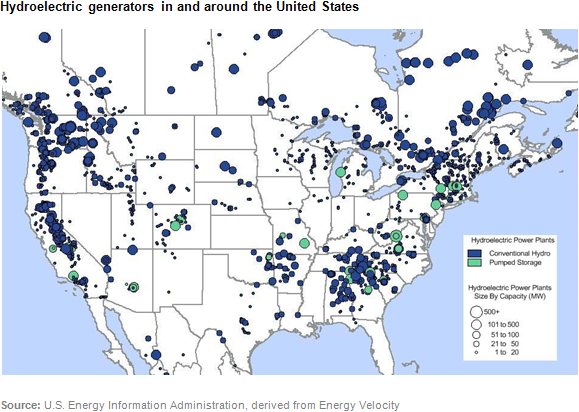
Looking at the US most of it is family close to large scale hydropower, except Florida, but it’s a little under 7% of annual power nationwide. https://www.eia.gov/todayinenergy/images/2011.06.10/hydro_pa...
[1] https://www.energy-charts.info/charts/remod_installed_power_...
[2] https://www.energy-charts.info/charts/renewable_share/chart....
Still, diversity of energy production is a good thing. There's no one silver bullet. Solar + Wind + Nuclear + Fossil + Hydro all have their pros and cons.
In particular, during hot and dry months, Solar will shine while Hydro will be a trickle of power (no pun intended), also affecting Nuclear and Fossil power plants near rivers.
Europe just sucks in oil, gas, uranium and some coal from the rest of the world to give back what exactly?
So it is no surprise that renewable energy is showing up as significant these days, particularly when so much manufacturing industry is closed down and exported overseas.
The thing is that China and elsewhere in East Asia are burning those hydrocarbons now, so it is just globalization of the emissions.
Regarding nuclear, the French have been kicked out of West Africa so no cheap uranium for them, paid for with the special Franc they can only print in Paris to obtain as much uranium as they need from Africa.
The solar panels come from China so it is not as if Europe is leading the way in terms of tech.
All Europe government bodies also want the bicycle these days, with dreams of livable neighbourhoods and cycling holidays for all.
I doubt they care for solar panels or the bicycle, however, after the Ukraine crisis in 2022 it must be clear to some in Europe that there are no energy sources in Europe apart from a spot of Norwegian gas. When paying 4x for fracked LNG from Uncle Sam it must be an eye opener to them.
You're overstating this a bit; there is a lot of coal in Europe (natural gas only got ahead of coal in Germany over the last years).
> Europe just sucks in oil, gas, uranium and some coal from the rest of the world to give back what exactly?
Finished products (like cars), some services, bit of tourism? What exactly is the problem here?
Uranium mining in Europe would be perfectly viable, but no one wants to, because modern practices basically ruin groundwater quality for a long time (in-situ leeching). This applies to a bunch of other things, too; hard to justify mining cadmium in the Alps when you can just buy the finished product for cheaper while keeping your local environment intact.
> The solar panels come from China so it is not as if Europe is leading the way in terms of tech.
They used to produce lots of those in Germany-- it's just become way cheaper to buy them from China, especially after local subsidies ran out. You could make an argument that the germans shoulda tried to keep the industry somewhat alive for strategic reasons, though.
It's called "money". Numbers on a screen that you can exchange for goods and services. The people with the oil are typically quite happy to give Europeans that oil in exchange for some European money - and the Europeans don't have to give anything back at all. The exchange has been made.
But if in the future we don't have to buy as much fossil fuel as we do today, it'll probably have sizable effects on our economies.
That's called manufacturing, the best skills in the world. Yeah it's tough work and pay is not brilliant, but when shit happens that's the thing that is going to save EU.